SEO & Internet Marketing You have two customers… y our  users  and  search engines. By  Anne La Francis Marketing Manager, Online Strategy Kaplan AEC Education January 27, 2009
SEO Workshop Agenda Introductions Internet Marketing Introduction to SEO On-Page SEO Off-Page SEO Permission-Based Email Marketing Introduction to SEM Helpful SEO Resources Questions & Answers
Internet Marketing What is Internet Marketing? Internet marketing is also known as  e-marketing  or  online marketing . It is the marketing of products or services over the Internet.  Types of Internet Marketing? Search engine optimization ( SEO ) On-Page SEO Off-Page SEO Search engine marketing ( SEM ) Pay Per Click (PPC) E-mail marketing Affiliate marketing Display advertising/Interactive advertising Social Media Marketing ( SMO ), i.e. blog marketing and viral marketing.
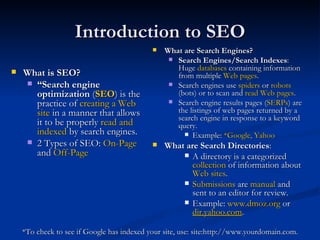
Introduction to SEO What is SEO? “ Search engine optimization  ( SEO ) is the practice of  creating a Web site  in a manner that allows it to be properly  read and indexed  by search engines. 2 Types of SEO:  On-Page  and  Off-Page What are Search Engines? Search Engines/Search Indexes : Huge  databases  containing information from multiple  Web pages . Search engines use  spiders  or  robots  (bots) or to scan and  read Web pages .  Search engine results pages ( SERPs ) are the listings of web pages returned by a search engine in response to a keyword query. Example:  *Google, Yahoo What are Search Directories :  A directory is a categorized  collection  of information about  Web sites .  Submissions  are  manual  and sent to an editor for review.  Example:  www.dmoz.org  or  dir.yahoo.com . *To check to see if Google has indexed your site, use: site:http://www.yourdomain.com.
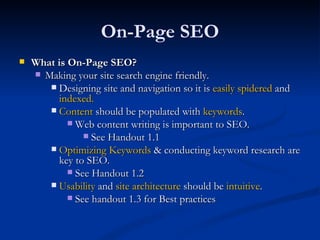
On-Page SEO What is On-Page SEO?  Making your site search engine friendly. Designing site and navigation so it is  easily spidered  and  indexed. Content  should be populated with  keywords . Web content writing is important to SEO. See Handout 1.1 Optimizing Keywords  & conducting keyword research are key to SEO. See Handout 1.2 Usability  and  site architecture  should be  intuitive .  See handout 1.3 for Best practices
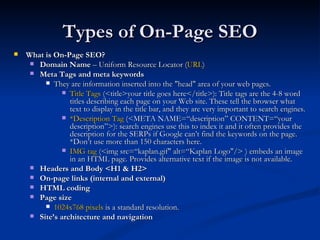
Types of On-Page SEO What is On-Page SEO?  Domain Name  – Uniform Resource Locator ( URL ) Meta Tags and meta keywords They are information inserted into the &quot;head&quot; area of your web pages. Title Tags  (<title>your title goes here</title>): Title tags are the 4-8 word titles describing each page on your Web site. These tell the browser what text to display in the title bar, and they are very important to search engines. *Description Tag  (<META NAME=“description” CONTENT=“your description”>): search engines use this to index it and it often provides the description for the SERPs if Google can’t find the keywords on the page. *Don’t use more than 150 characters here. IMG tag  (<img src=“kaplan.gif&quot; alt=“Kaplan Logo&quot;/> ) embeds an image in an HTML page. Provides alternative text if the image is not available.  Headers and Body <H1 & H2> On-page links (internal and external) HTML coding Page size 1024x768 pixels  is a standard resolution.  Site’s architecture and navigation
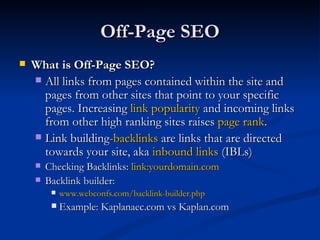
Off-Page SEO What is Off-Page SEO?  All links from pages contained within the site and pages from other sites that point to your specific pages. Increasing  link popularity  and incoming links from other high ranking sites raises  page rank . Link building- backlinks  are links that are directed towards your site, aka  inbound links  (IBLs) Checking Backlinks:  link:yourdomain.com  Backlink builder:  www.webconfs.com/backlink-builder.php Example: Kaplanaec.com vs Kaplan.com
Types of Off-Page SEO Blogs Social media optimization ( SMO ) i.e. facebook, linkedin, digg Viral  Marketing Article marketing ( online article  syndication) Forum marketing (writing on  forums ) Classifieds  Advertisements: www.craigslist.com has a page rank of 7 Topical  directories Press Releases RSS Feeds : XML data feeds are predominately designed for large web sites or e-commerce sites with hundreds of different products that are mostly database driven (dynamically generated). Through normal spidering these pages might never be found and indexed. That’s why XML data feeds were created – as a means of getting deep content found by the search engines.  Permission-Based  Email Marketing
Permission-Based Email Marketing?  What is Permission-based email marketing? This is an  opt-in online marketing  technique used to build value of a company’s brand, increase sales, and strengthen relationships with clients/subscribers. Recipients opt-in to receive information/news See Handout 1.4. Single opt-in  is when a visitor subscribes to a newsletter via a form on the web site. They have  opted-in once .  Double opt-in  is when a visitor  subscribes  to a newsletter via a web site and then is  sent a confirmation  email. Best practice What is the CAN-Spam Act of 2003? Legislation  to protect  unwanted spam emails  from arriving in people’s personal email or work email inboxes.  See Handout 1.5.
Types of Permission-Based Email Marketing Gathering contacts from  tradeshows Online  newsletter  sign-ups Web  promotional  sign-ups Invoices Point of Sale purchases Credit card  purchases Articles Press Releases Customer calls
Introduction to SEM What is Search Engine Marketing (SEM)? The broader scope of marketing across various search engine content, including both the  organic  and  paid results  (often referred to as sponsored or featured listings) in their results displays.  Just think organic “ natural search results ” vs. “ bid  for  placement ” (or pay per click advertising (PPC)).
Types of SEM Pay Per Click Programs (PPC), Pay Per Ranking, Pay Per Placement or Pay Per Position Enables your site to list at top of search engine results pages by  bidding for keywords .  Example: Google Adwords & Yahoo’s Search Marketing (formerly Overture). Paid Inclusions Pay to get your site noticed or  indexed quicker Example: Yahoo SearchSubmit Basic/Paid Inclusion/Ask Jeeves Affiliate Marketing Ad program  or content placement program that where a business  rewards affiliates  for bringing clicks, conversions, or traffic to their site.  Traditional Online Ads Web promotional strategies
Helpful SEO Resources Submitting your URL to Google: http://www.google.com/webmasters/1.html#A1   Keyword tools: http://freekeywords.wordtracker.com/   https://adwords.google.com/select/KeywordToolExternal?defaultView=3   http://www.google.com/sktool/#   Search Engine Optimizers : http://www.google.com/webmasters/seo.html   Touchgraph  (explore connections between Web sites): http://www.touchgraph.com/TGGoogleBrowser.html   Search Engine News: http://www.searchenginenews.com/   Checking Links: http://www.iXquick.com/  SEO Copywriting http://www.excessvoice.com/archive.htm Webmaster Guidelines:   http://www.google.com/webmasters/guidelines.html
Questions & Answers If anyone has any questions, please feel free to email me at  [email_address] .  To learn more about  SEO  or  Internet Marketing , try doing a search using some of the techniques we learned today to get the most out of your query.

Seo & Internet Marketing

  • 1.
    SEO & InternetMarketing You have two customers… y our users and search engines. By Anne La Francis Marketing Manager, Online Strategy Kaplan AEC Education January 27, 2009
  • 2.
    SEO Workshop AgendaIntroductions Internet Marketing Introduction to SEO On-Page SEO Off-Page SEO Permission-Based Email Marketing Introduction to SEM Helpful SEO Resources Questions & Answers
  • 3.
    Internet Marketing Whatis Internet Marketing? Internet marketing is also known as e-marketing or online marketing . It is the marketing of products or services over the Internet. Types of Internet Marketing? Search engine optimization ( SEO ) On-Page SEO Off-Page SEO Search engine marketing ( SEM ) Pay Per Click (PPC) E-mail marketing Affiliate marketing Display advertising/Interactive advertising Social Media Marketing ( SMO ), i.e. blog marketing and viral marketing.
  • 4.
    Introduction to SEOWhat is SEO? “ Search engine optimization ( SEO ) is the practice of creating a Web site in a manner that allows it to be properly read and indexed by search engines. 2 Types of SEO: On-Page and Off-Page What are Search Engines? Search Engines/Search Indexes : Huge databases containing information from multiple Web pages . Search engines use spiders or robots (bots) or to scan and read Web pages . Search engine results pages ( SERPs ) are the listings of web pages returned by a search engine in response to a keyword query. Example: *Google, Yahoo What are Search Directories : A directory is a categorized collection of information about Web sites . Submissions are manual and sent to an editor for review. Example: www.dmoz.org or dir.yahoo.com . *To check to see if Google has indexed your site, use: site:http://www.yourdomain.com.
  • 5.
    On-Page SEO Whatis On-Page SEO? Making your site search engine friendly. Designing site and navigation so it is easily spidered and indexed. Content should be populated with keywords . Web content writing is important to SEO. See Handout 1.1 Optimizing Keywords & conducting keyword research are key to SEO. See Handout 1.2 Usability and site architecture should be intuitive . See handout 1.3 for Best practices
  • 6.
    Types of On-PageSEO What is On-Page SEO? Domain Name – Uniform Resource Locator ( URL ) Meta Tags and meta keywords They are information inserted into the &quot;head&quot; area of your web pages. Title Tags (<title>your title goes here</title>): Title tags are the 4-8 word titles describing each page on your Web site. These tell the browser what text to display in the title bar, and they are very important to search engines. *Description Tag (<META NAME=“description” CONTENT=“your description”>): search engines use this to index it and it often provides the description for the SERPs if Google can’t find the keywords on the page. *Don’t use more than 150 characters here. IMG tag (<img src=“kaplan.gif&quot; alt=“Kaplan Logo&quot;/> ) embeds an image in an HTML page. Provides alternative text if the image is not available. Headers and Body <H1 & H2> On-page links (internal and external) HTML coding Page size 1024x768 pixels is a standard resolution. Site’s architecture and navigation
  • 7.
    Off-Page SEO Whatis Off-Page SEO? All links from pages contained within the site and pages from other sites that point to your specific pages. Increasing link popularity and incoming links from other high ranking sites raises page rank . Link building- backlinks are links that are directed towards your site, aka inbound links (IBLs) Checking Backlinks: link:yourdomain.com Backlink builder: www.webconfs.com/backlink-builder.php Example: Kaplanaec.com vs Kaplan.com
  • 8.
    Types of Off-PageSEO Blogs Social media optimization ( SMO ) i.e. facebook, linkedin, digg Viral Marketing Article marketing ( online article syndication) Forum marketing (writing on forums ) Classifieds Advertisements: www.craigslist.com has a page rank of 7 Topical directories Press Releases RSS Feeds : XML data feeds are predominately designed for large web sites or e-commerce sites with hundreds of different products that are mostly database driven (dynamically generated). Through normal spidering these pages might never be found and indexed. That’s why XML data feeds were created – as a means of getting deep content found by the search engines. Permission-Based Email Marketing
  • 9.
    Permission-Based Email Marketing? What is Permission-based email marketing? This is an opt-in online marketing technique used to build value of a company’s brand, increase sales, and strengthen relationships with clients/subscribers. Recipients opt-in to receive information/news See Handout 1.4. Single opt-in is when a visitor subscribes to a newsletter via a form on the web site. They have opted-in once . Double opt-in is when a visitor subscribes to a newsletter via a web site and then is sent a confirmation email. Best practice What is the CAN-Spam Act of 2003? Legislation to protect unwanted spam emails from arriving in people’s personal email or work email inboxes. See Handout 1.5.
  • 10.
    Types of Permission-BasedEmail Marketing Gathering contacts from tradeshows Online newsletter sign-ups Web promotional sign-ups Invoices Point of Sale purchases Credit card purchases Articles Press Releases Customer calls
  • 11.
    Introduction to SEMWhat is Search Engine Marketing (SEM)? The broader scope of marketing across various search engine content, including both the organic and paid results (often referred to as sponsored or featured listings) in their results displays. Just think organic “ natural search results ” vs. “ bid for placement ” (or pay per click advertising (PPC)).
  • 12.
    Types of SEMPay Per Click Programs (PPC), Pay Per Ranking, Pay Per Placement or Pay Per Position Enables your site to list at top of search engine results pages by bidding for keywords . Example: Google Adwords & Yahoo’s Search Marketing (formerly Overture). Paid Inclusions Pay to get your site noticed or indexed quicker Example: Yahoo SearchSubmit Basic/Paid Inclusion/Ask Jeeves Affiliate Marketing Ad program or content placement program that where a business rewards affiliates for bringing clicks, conversions, or traffic to their site. Traditional Online Ads Web promotional strategies
  • 13.
    Helpful SEO ResourcesSubmitting your URL to Google: http://www.google.com/webmasters/1.html#A1 Keyword tools: http://freekeywords.wordtracker.com/ https://adwords.google.com/select/KeywordToolExternal?defaultView=3 http://www.google.com/sktool/# Search Engine Optimizers : http://www.google.com/webmasters/seo.html Touchgraph (explore connections between Web sites): http://www.touchgraph.com/TGGoogleBrowser.html Search Engine News: http://www.searchenginenews.com/ Checking Links: http://www.iXquick.com/ SEO Copywriting http://www.excessvoice.com/archive.htm Webmaster Guidelines: http://www.google.com/webmasters/guidelines.html
  • 14.
    Questions & AnswersIf anyone has any questions, please feel free to email me at [email_address] . To learn more about SEO or Internet Marketing , try doing a search using some of the techniques we learned today to get the most out of your query.