KENDRIYA VIDYALAYA NO.2
PROJECT WORK ENGLISH
SENTENCE
Welcome to sentences Before looking at sentences, let’s take a look at what the symbols mean. Click Here  to begin
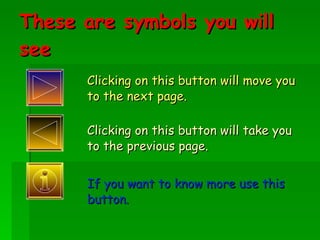
These are symbols you will see Clicking on this button will move you to the next page. Clicking on this button will take you to the previous page. If you want to know more use this button.
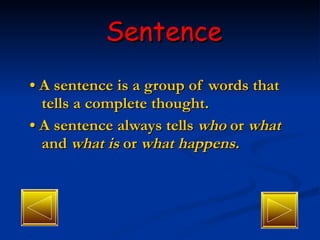
Sentence •  A sentence is a group of words that tells a complete thought. •  A sentence always tells  who  or  what  and  what is  or  what happens.
These are all sentences Jeff is always late for work. Sound the fire alarm! Why do you drive so fast? We will need more heating on site. Can I have some petty cash please? I would agree with that.
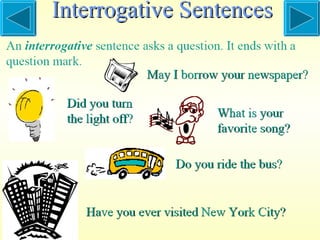
Types of sentences. •  A  declarative  sentence makes a statement. It ends with a period. •  An  interrogative  sentence asks a question. It ends with a question mark.
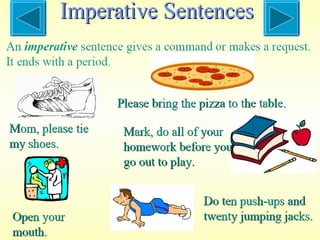
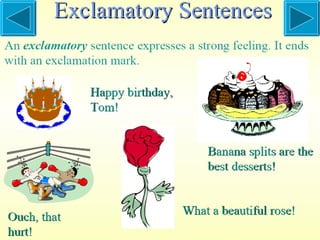
•  An  imperative  sentence gives a command or makes a request. It ends with a period. •  An  exclamatory  sentence expresses a strong feeling. It ends with an exclamation mark.


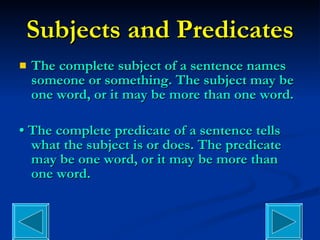
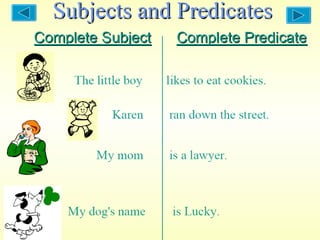
Subjects and Predicates The complete subject of a sentence names someone or something. The subject may be one word, or it may be more than one word. •  The complete predicate of a sentence tells what the subject is or does. The predicate may be one word, or it may be more than one word.
 
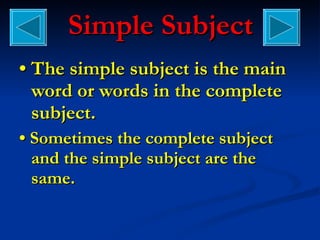
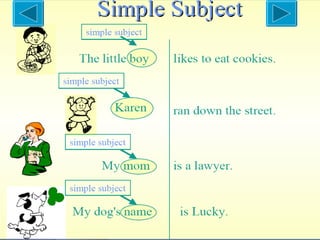
Simple Subject •  The simple subject is the main word or words in the complete subject. •  Sometimes the complete subject and the simple subject are the same.
 
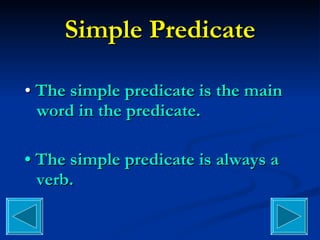
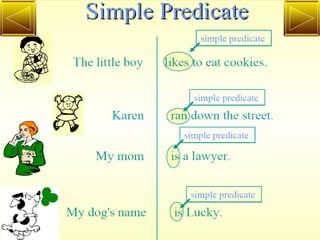
Simple Predicate •  The simple predicate is the main word in the predicate. •  The simple predicate is always a verb.
 
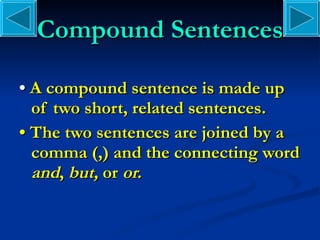
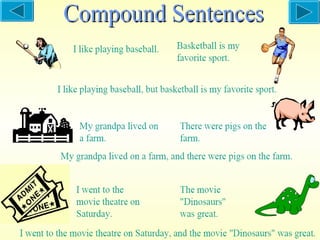
Compound Sentences •  A compound sentence is made up of two short, related sentences. •  The two sentences are joined by a comma (,) and the connecting word  and ,  but,  or  or.
 
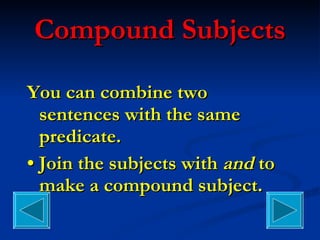
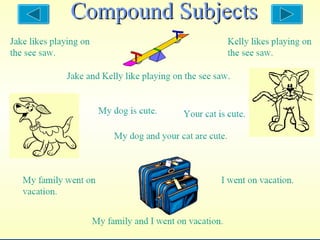
Compound Subjects You can combine two sentences with the same predicate. •  Join the subjects with  and  to make a compound subject.
 
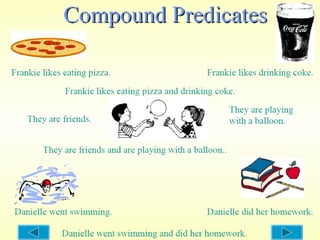
Compound Predicates •  You can combine two sentences with the same subject. •  Join the predicate with  and  to make  a compound predicate.
 
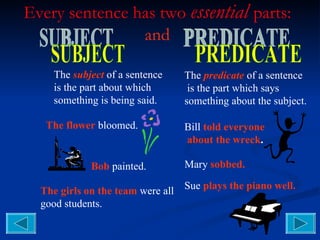
Every sentence has two  essential   parts:  and  The  subject   of a sentence is the part about which something is being said. The flower  bloomed. Bob  painted. The girls on the team  were all good students. The   predicate  of a sentence is the part which says  something about the subject. Bill  told everyone about the wreck . Mary  sobbed. Sue  plays the piano well. SUBJECT PREDICATE
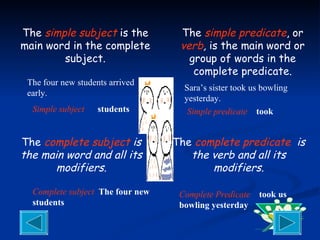
The  simple subject   is the main word in the complete subject. The  simple predicate , or  verb ,  is the main word or group of words in the complete predicate. The  complete subject  is the main word and all its modifiers. The  complete predicate  is the verb and all its modifiers. The four new students arrived early. Complete subject   The four new students Simple subject   students Sara’s sister took us bowling yesterday. Simple predicate   took Complete Predicate   took us bowling yesterday
Examples Statement- Your picture you drew is very pretty. Question- Where do you live? Exclamation- Hurray, the ice cream truck is coming! Command- Clean your room up now!
A sentence can be a statement The phone is off the hook. That will cost five pounds. A sentence always begins with a capital letter click below to see them all
A sentence can be a question Is that stack safe? Will you be driving?
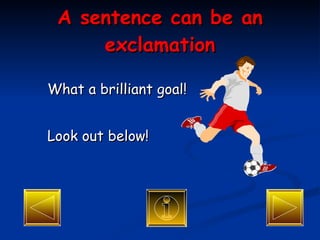
A sentence can be an exclamation What a brilliant goal! Look out below!
A sentence could be a wish I wish I could have a pay rise. I wish this bolt was easier to undo.
Or a command You must stop that at once. Make sure you use that torch safely.
A request Please be careful when you throw this away.
A sentence must begin with a  capital letter and end with a full stop . Exclamation marks and question marks have a full stop underneath them.   ?! Remember
A sentence must have both a subject and a verb
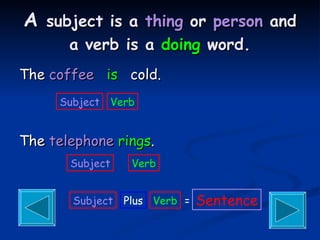
A  subject is a  thing  or  person  and a verb is a  doing  word. The  coffee   is  cold. The  telephone  rings . Subject Verb Subject Verb Verb Subject Plus = Sentence
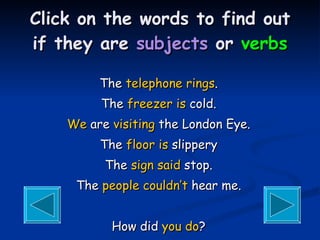
Click on the words to find out if they are  subjects  or  verbs The  telephone   rings . The  freezer   is  cold. We  are  visiting  the London Eye. The  floor   is  slippery The  sign   said  stop. The  people   couldn’t  hear me. How did  you   do ?
PRESENTED BY:-
RAHUL RAI VIII-C
THANK  YOU
THE  END Click  here  to go back to the beginning
This sign tells you that information is available It can also be seen in places such as bus and train stations.
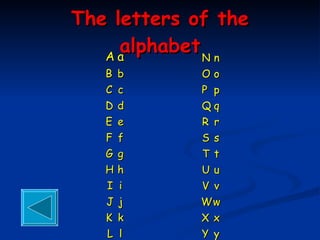
The letters of the alphabet A a B b C  c D d E e F f G g H h I i J j K k L l M m N n O o P p Q q R r S s T t U u V v W w X x Y y Z z
A question must always end with a question mark ? And could begin with why what where how who or when
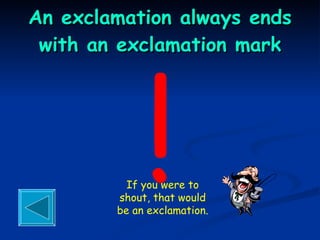
An exclamation always ends with an exclamation mark ! If you were to shout, that would be an exclamation.
A subject is A person A thing Whatever it is you want to talk about.
A verb is a doing word  a being word or a having word The hose sprays everyone. The weather is cold. The boots have steel toe caps.
You have clicked forward Now you can return to the last page Or move forward to the next page
You have clicked the back button Now you can return to the last page Or move forward to the next page
Subject
Verb

Sentences2

  • 1.
  • 2.
  • 3.
  • 4.
    Welcome to sentencesBefore looking at sentences, let’s take a look at what the symbols mean. Click Here to begin
  • 5.
    These are symbolsyou will see Clicking on this button will move you to the next page. Clicking on this button will take you to the previous page. If you want to know more use this button.
  • 6.
    Sentence • A sentence is a group of words that tells a complete thought. • A sentence always tells who or what and what is or what happens.
  • 7.
    These are allsentences Jeff is always late for work. Sound the fire alarm! Why do you drive so fast? We will need more heating on site. Can I have some petty cash please? I would agree with that.
  • 8.
    Types of sentences.• A declarative sentence makes a statement. It ends with a period. • An interrogative sentence asks a question. It ends with a question mark.
  • 9.
    • An imperative sentence gives a command or makes a request. It ends with a period. • An exclamatory sentence expresses a strong feeling. It ends with an exclamation mark.
  • 10.
  • 11.
  • 12.
  • 13.
  • 14.
    Subjects and PredicatesThe complete subject of a sentence names someone or something. The subject may be one word, or it may be more than one word. • The complete predicate of a sentence tells what the subject is or does. The predicate may be one word, or it may be more than one word.
  • 15.
  • 16.
    Simple Subject • The simple subject is the main word or words in the complete subject. • Sometimes the complete subject and the simple subject are the same.
  • 17.
  • 18.
    Simple Predicate • The simple predicate is the main word in the predicate. • The simple predicate is always a verb.
  • 19.
  • 20.
    Compound Sentences • A compound sentence is made up of two short, related sentences. • The two sentences are joined by a comma (,) and the connecting word and , but, or or.
  • 21.
  • 22.
    Compound Subjects Youcan combine two sentences with the same predicate. • Join the subjects with and to make a compound subject.
  • 23.
  • 24.
    Compound Predicates • You can combine two sentences with the same subject. • Join the predicate with and to make a compound predicate.
  • 25.
  • 26.
    Every sentence hastwo essential parts: and The subject of a sentence is the part about which something is being said. The flower bloomed. Bob painted. The girls on the team were all good students. The predicate of a sentence is the part which says something about the subject. Bill told everyone about the wreck . Mary sobbed. Sue plays the piano well. SUBJECT PREDICATE
  • 27.
    The simplesubject is the main word in the complete subject. The simple predicate , or verb , is the main word or group of words in the complete predicate. The complete subject is the main word and all its modifiers. The complete predicate is the verb and all its modifiers. The four new students arrived early. Complete subject The four new students Simple subject students Sara’s sister took us bowling yesterday. Simple predicate took Complete Predicate took us bowling yesterday
  • 28.
    Examples Statement- Yourpicture you drew is very pretty. Question- Where do you live? Exclamation- Hurray, the ice cream truck is coming! Command- Clean your room up now!
  • 29.
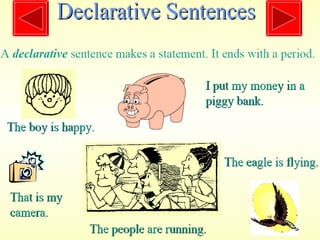
    A sentence canbe a statement The phone is off the hook. That will cost five pounds. A sentence always begins with a capital letter click below to see them all
  • 30.
    A sentence canbe a question Is that stack safe? Will you be driving?
  • 31.
    A sentence canbe an exclamation What a brilliant goal! Look out below!
  • 32.
    A sentence couldbe a wish I wish I could have a pay rise. I wish this bolt was easier to undo.
  • 33.
    Or a commandYou must stop that at once. Make sure you use that torch safely.
  • 34.
    A request Pleasebe careful when you throw this away.
  • 35.
    A sentence mustbegin with a capital letter and end with a full stop . Exclamation marks and question marks have a full stop underneath them. ?! Remember
  • 36.
    A sentence musthave both a subject and a verb
  • 37.
    A subjectis a thing or person and a verb is a doing word. The coffee is cold. The telephone rings . Subject Verb Subject Verb Verb Subject Plus = Sentence
  • 38.
    Click on thewords to find out if they are subjects or verbs The telephone rings . The freezer is cold. We are visiting the London Eye. The floor is slippery The sign said stop. The people couldn’t hear me. How did you do ?
  • 39.
  • 40.
  • 41.
  • 42.
    THE ENDClick here to go back to the beginning
  • 43.
    This sign tellsyou that information is available It can also be seen in places such as bus and train stations.
  • 44.
    The letters ofthe alphabet A a B b C c D d E e F f G g H h I i J j K k L l M m N n O o P p Q q R r S s T t U u V v W w X x Y y Z z
  • 45.
    A question mustalways end with a question mark ? And could begin with why what where how who or when
  • 46.
    An exclamation alwaysends with an exclamation mark ! If you were to shout, that would be an exclamation.
  • 47.
    A subject isA person A thing Whatever it is you want to talk about.
  • 48.
    A verb isa doing word a being word or a having word The hose sprays everyone. The weather is cold. The boots have steel toe caps.
  • 49.
    You have clickedforward Now you can return to the last page Or move forward to the next page
  • 50.
    You have clickedthe back button Now you can return to the last page Or move forward to the next page
  • 51.
  • 52.