The Parts of a Sentence
The subject of a sentence is the
person, place, thing, or idea about
which something is said.
Lava flows.
The lava from a live volcano flows hot
and smooth.
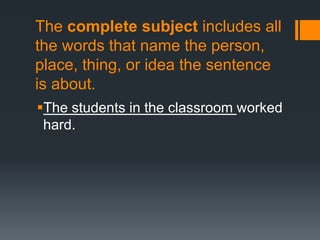
The complete subject includes all
the words that name the person,
place, thing, or idea the sentence
is about.
The students in the classroom worked
hard.
The complete predicate includes
all the words that tell what the
subject did or what happened to
the subject.
The lava from a live volcano flows hot
and smooth.
The simple subject is exactly
whom or what the sentence about.
The lava from a live volcano flows hot
and smooth.
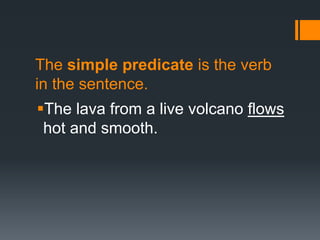
The simple predicate is the verb
in the sentence.
The lava from a live volcano flows
hot and smooth.
What are each of the following?
The flowers in Ms. Rivera’s garden perished in the
frost.
The flowers in Ms. Rivera’s garden perished in the
frost.
This broken camera will not take any pictures.
Which bus can take me to the stadium?
Compound Sentence Parts
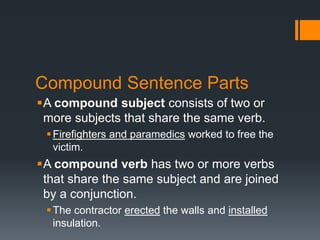
A compound subject consists of two or
more subjects that share the same verb.
Firefighters and paramedics worked to free the
victim.
A compound verb has two or more verbs
that share the same subject and are joined
by a conjunction.
The contractor erected the walls and installed
insulation.
P. 570 on CHALKBOARD 
A declarative sentence states a
fact, wish, intent, or feeling and
ends with a period.
Most declarative sentences are in subject-verb
order. However, the sentence order may be
inverted to signal special emphasis or effect.
One extra second was added to 1987 to adjust
for the slow rotation of the earth.
Just one mile from the cottage was a sandy
beach with a lifeguard on duty.
An interrogative sentence asks a
question and ends with a question
mark.
The subject of an interrogative sentence
may appear before the verb, after the verb,
or between parts of a verb phrase.
Which pianist will perform at the White
House?
Why is the economic forecast so uncertain?
Will postage rates go up again this month?
An imperative sentence gives a
command, request, or direction.
It usually ends with a period, but if the command is
strong, the sentence may end with an exclamation
point.
Usually the subject of an imperative sentence is
not expressed but it is understood to be the
pronoun you.
(You) Leave a deposit for the videotape rental.
(You) Be home by eleven!
Don’t (you) play in the park.
An exclamatory sentence
expresses strong feeling or
excitement.
Ends with an exclamation point --- unless it begins
with an interjection, in which case it may end with
an exclamation point or period.
 Hey! This boat is leaking!
 Oh no! I can’t find my keys.
Any declarative, interrogative, or imperative
sentence can be considered exclamatory when it
expresses strong feeling.
 Will you stop making that noise!
p. 572 out loud 
HW: Worksheet & continue working on
paper due next Tuesday

Subjects & predicates

  • 1.
    The Parts ofa Sentence
  • 2.
    The subject ofa sentence is the person, place, thing, or idea about which something is said. Lava flows. The lava from a live volcano flows hot and smooth.
  • 3.
    The complete subjectincludes all the words that name the person, place, thing, or idea the sentence is about. The students in the classroom worked hard.
  • 4.
    The complete predicateincludes all the words that tell what the subject did or what happened to the subject. The lava from a live volcano flows hot and smooth.
  • 5.
    The simple subjectis exactly whom or what the sentence about. The lava from a live volcano flows hot and smooth.
  • 6.
    The simple predicateis the verb in the sentence. The lava from a live volcano flows hot and smooth.
  • 7.
    What are eachof the following? The flowers in Ms. Rivera’s garden perished in the frost. The flowers in Ms. Rivera’s garden perished in the frost. This broken camera will not take any pictures. Which bus can take me to the stadium?
  • 8.
    Compound Sentence Parts Acompound subject consists of two or more subjects that share the same verb. Firefighters and paramedics worked to free the victim. A compound verb has two or more verbs that share the same subject and are joined by a conjunction. The contractor erected the walls and installed insulation.
  • 9.
    P. 570 onCHALKBOARD 
  • 10.
    A declarative sentencestates a fact, wish, intent, or feeling and ends with a period. Most declarative sentences are in subject-verb order. However, the sentence order may be inverted to signal special emphasis or effect. One extra second was added to 1987 to adjust for the slow rotation of the earth. Just one mile from the cottage was a sandy beach with a lifeguard on duty.
  • 11.
    An interrogative sentenceasks a question and ends with a question mark. The subject of an interrogative sentence may appear before the verb, after the verb, or between parts of a verb phrase. Which pianist will perform at the White House? Why is the economic forecast so uncertain? Will postage rates go up again this month?
  • 12.
    An imperative sentencegives a command, request, or direction. It usually ends with a period, but if the command is strong, the sentence may end with an exclamation point. Usually the subject of an imperative sentence is not expressed but it is understood to be the pronoun you. (You) Leave a deposit for the videotape rental. (You) Be home by eleven! Don’t (you) play in the park.
  • 13.
    An exclamatory sentence expressesstrong feeling or excitement. Ends with an exclamation point --- unless it begins with an interjection, in which case it may end with an exclamation point or period.  Hey! This boat is leaking!  Oh no! I can’t find my keys. Any declarative, interrogative, or imperative sentence can be considered exclamatory when it expresses strong feeling.  Will you stop making that noise!
  • 14.
    p. 572 outloud  HW: Worksheet & continue working on paper due next Tuesday