Hacking | Information Security Analysis
Hacking
Security Analysis
-- Build security with creativity
Danang Heriyadi (danang@hatsecure.com)
Hacking | Information Security Analysis
Hello World
Hacking | Information Security Analysis
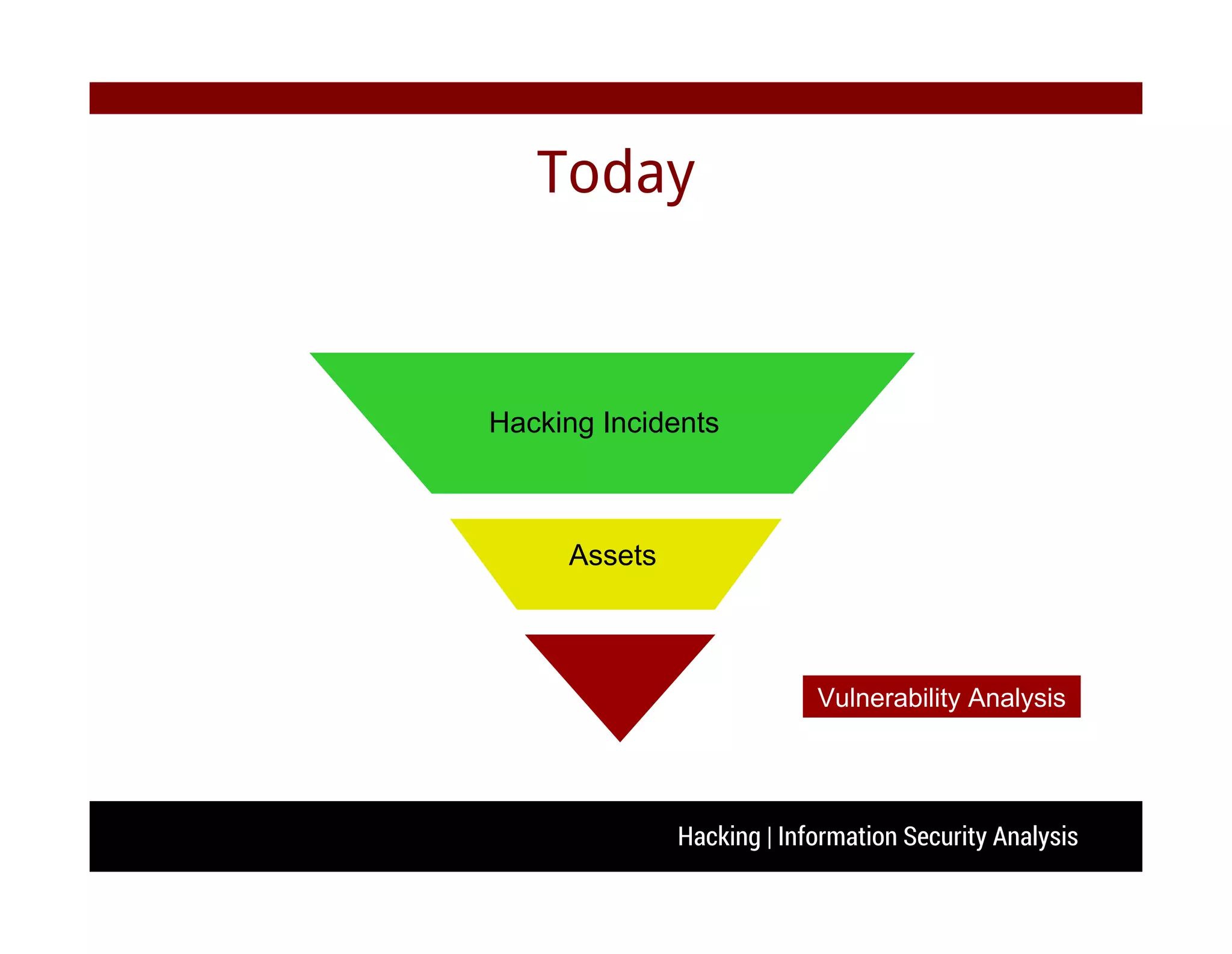
Today
Hacking Incidents
Assets
Vulnerability Analysis
Hacking | Information Security Analysis
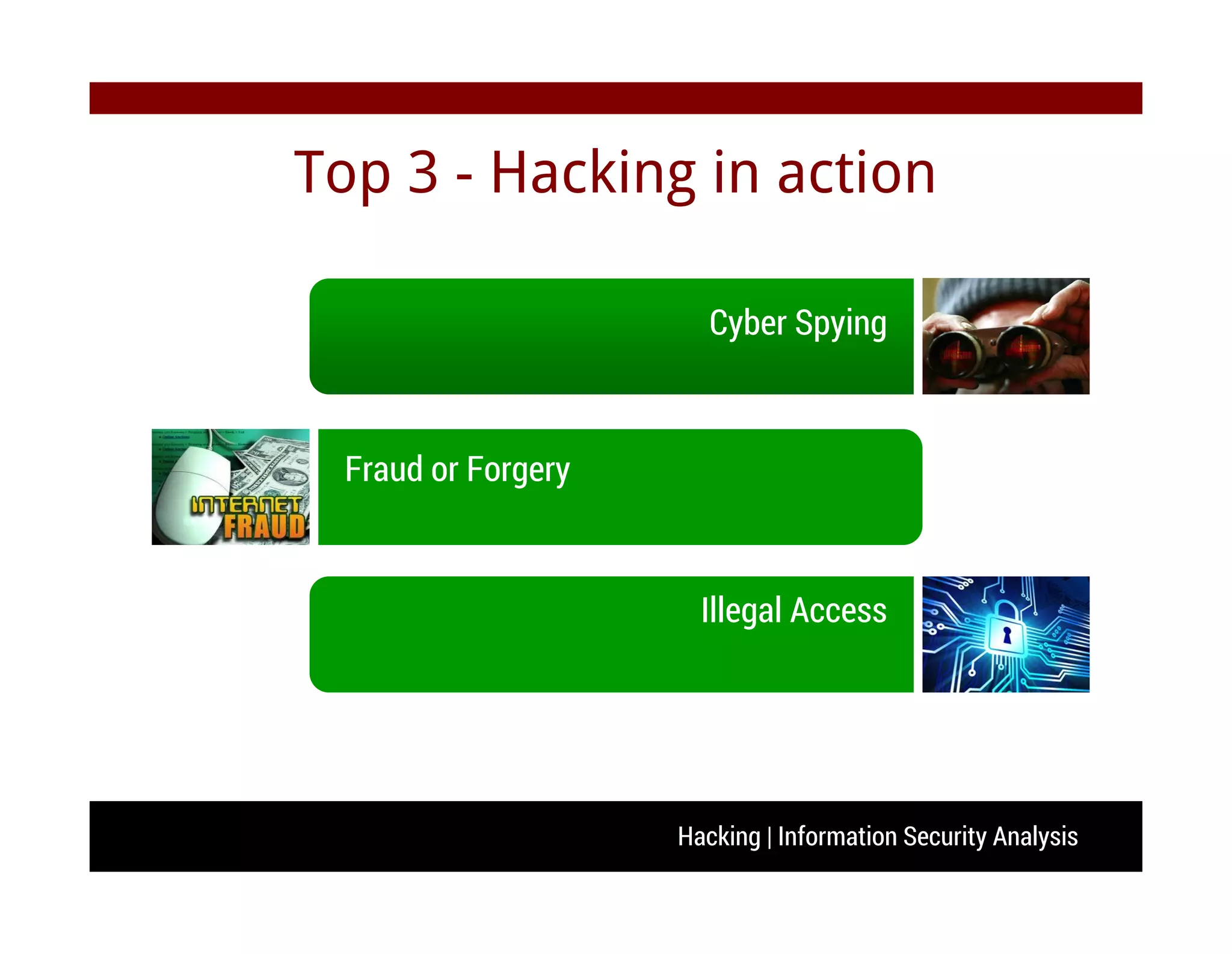
Top 3 - Hacking in action
Cyber Spying
Fraud or Forgery
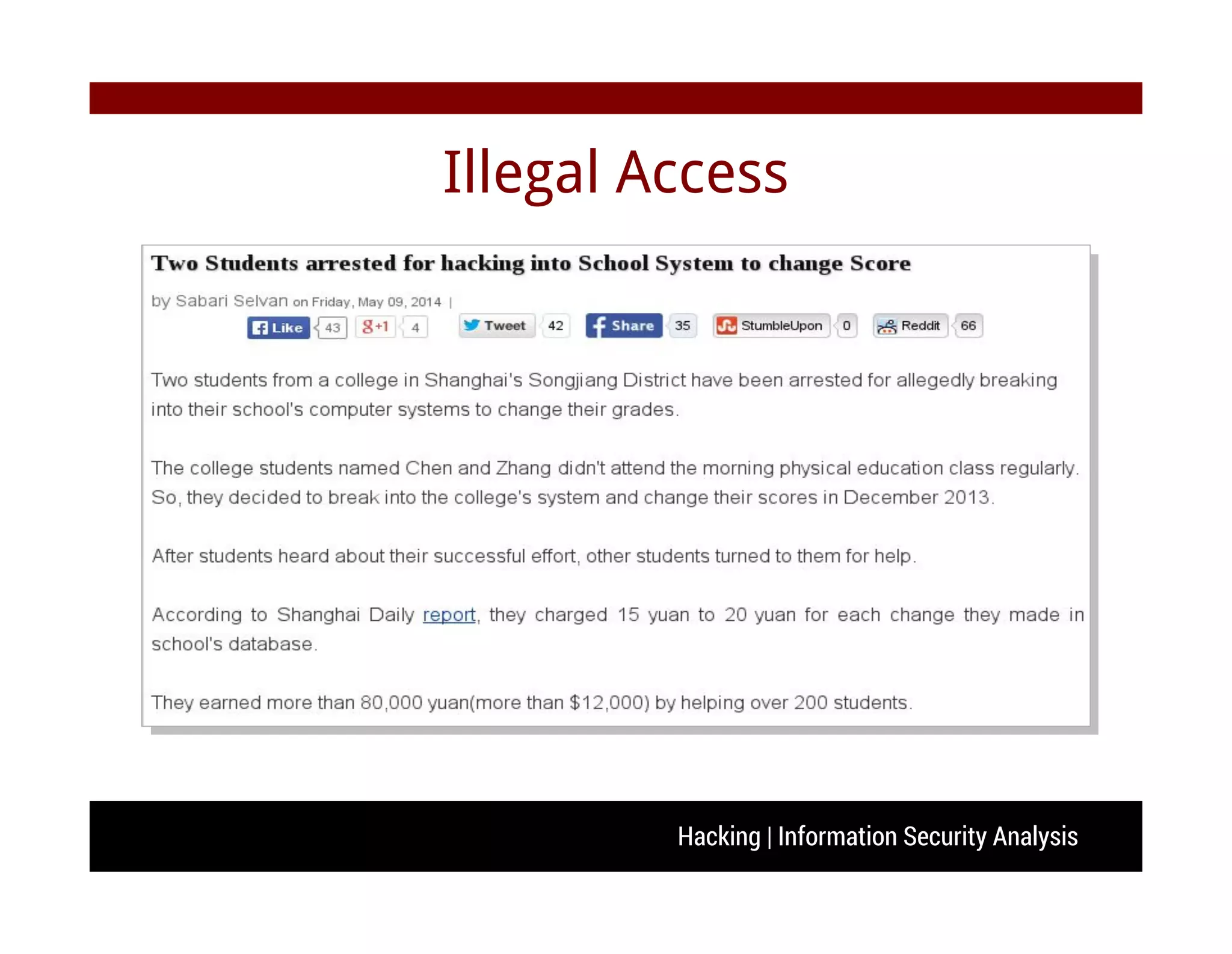
Illegal Access
Hacking | Information Security Analysis
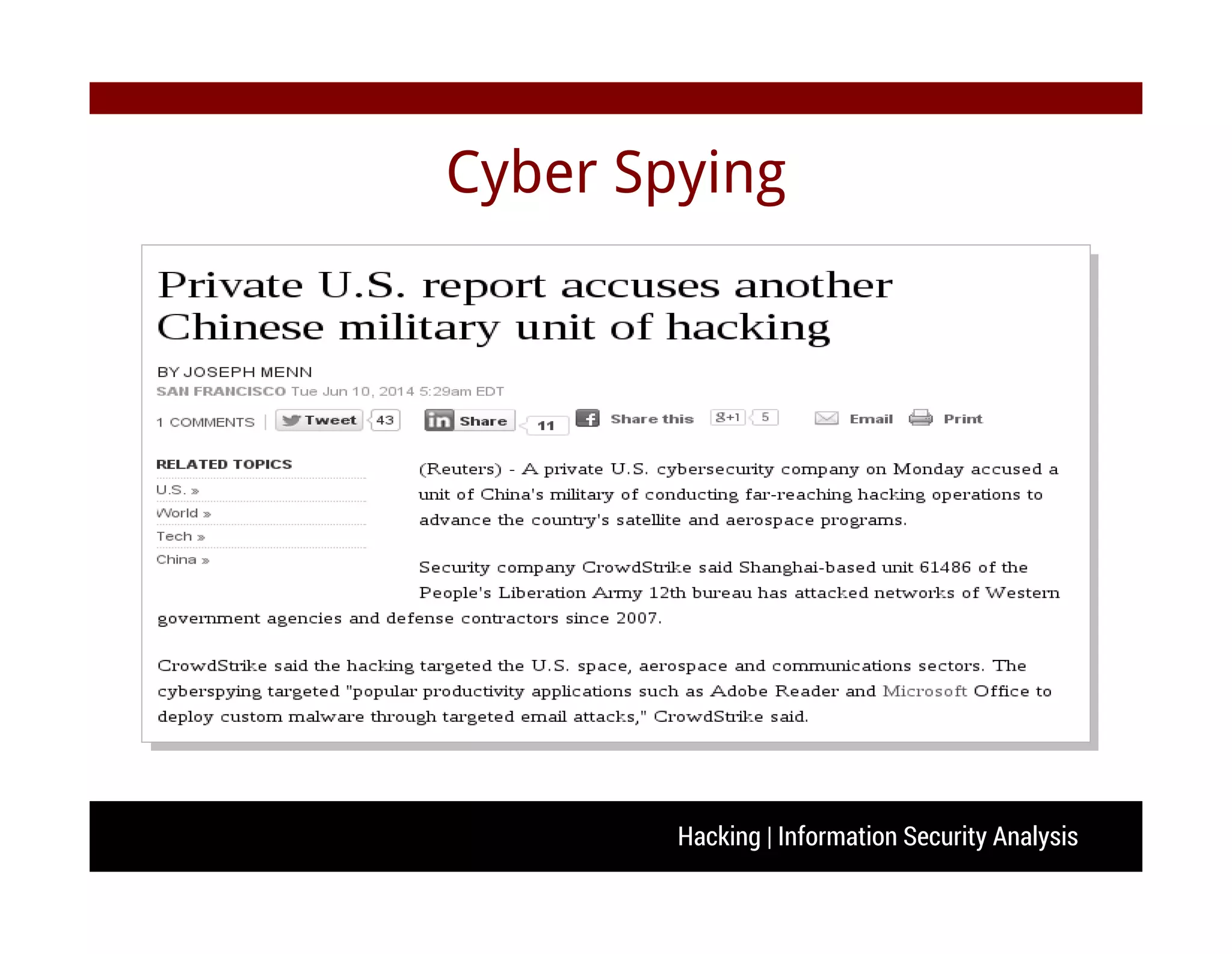
Cyber Spying
Hacking | Information Security Analysis
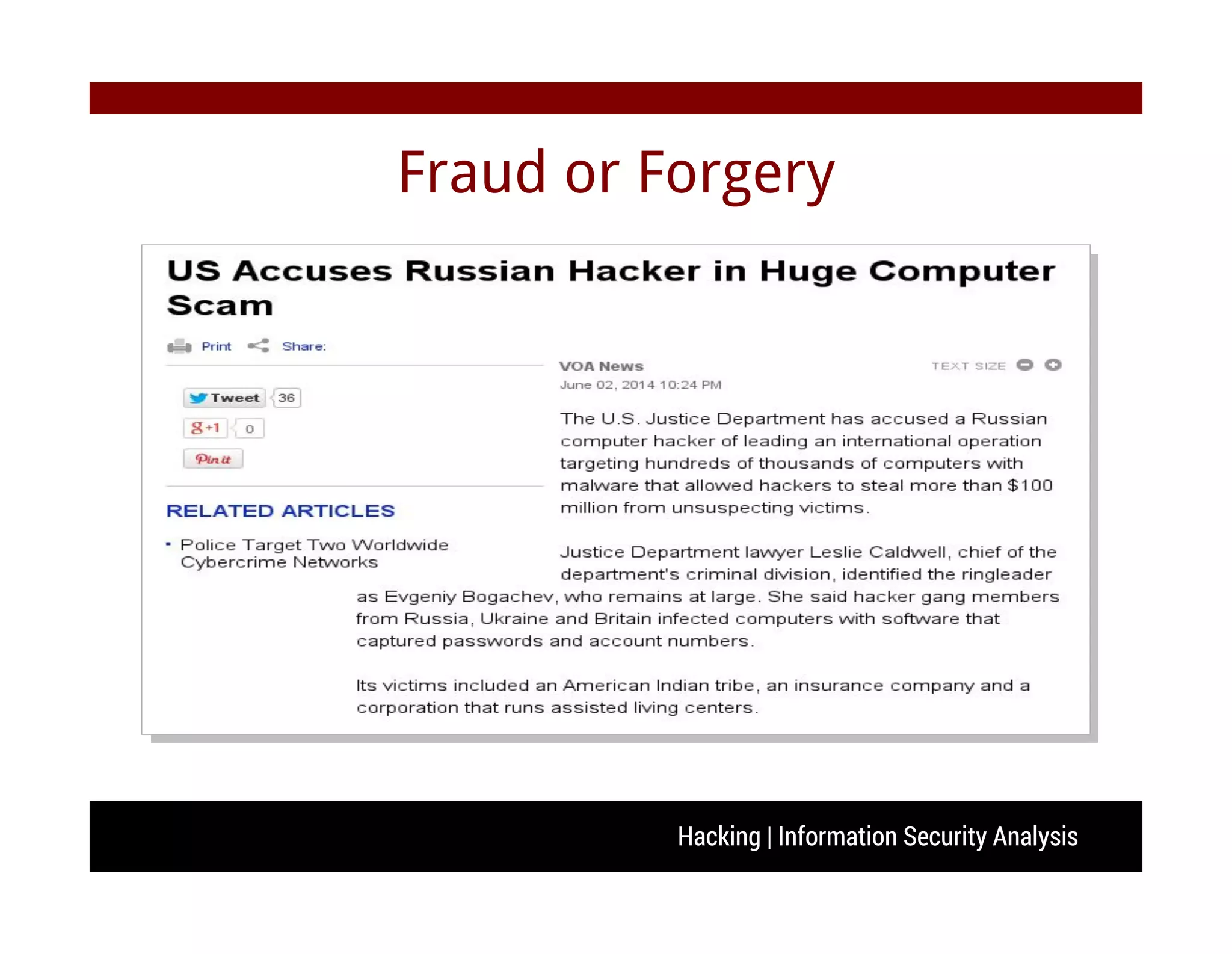
Fraud or Forgery
Hacking | Information Security Analysis
Illegal Access
Hacking | Information Security Analysis
How they can do that?
• Sensitive information disclosure
– Search Engine (google, bing, yahoo)
– Magazine
– etc
• Social engineering attacks
– The knowledge and attitude members of an organization possess
regarding the protection of the information assets.
• Vulnerability on your system
– Attacker exploit the vulnerability to gaining access.
Hacking | Information Security Analysis
Google Hacking
Hacking | Information Security Analysis
What are you trying to protect?
• Senstive personal data
• Your network infrastructure
• Your assets
Hacking | Information Security Analysis
Common Vulnerabilities
• Web
– XSS
– Database Injection
– OS command Injection
– Local File Disclosure
– File Inclusion
– Path Disclosure
– CSRF
– Dir. Traversal
• Low level Vulnerability
– Stack Overflow
– Heap Overflow
– Integer Overflow
– Memory Corruption
– Etc
Hacking | Information Security Analysis
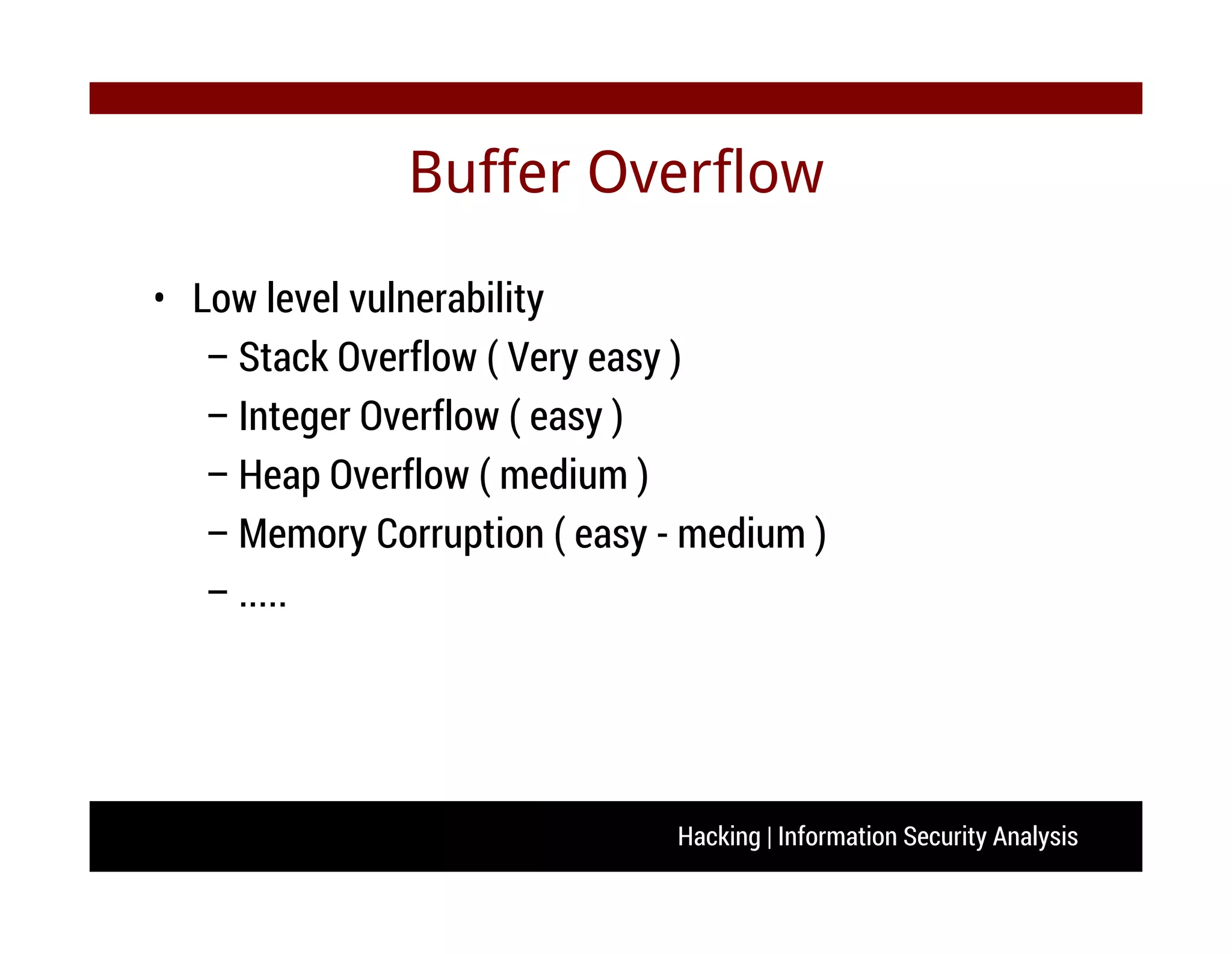
Buffer Overflow
• Low level vulnerability
– Stack Overflow ( Very easy )
– Integer Overflow ( easy )
– Heap Overflow ( medium )
– Memory Corruption ( easy - medium )
– .....
Hacking | Information Security Analysis
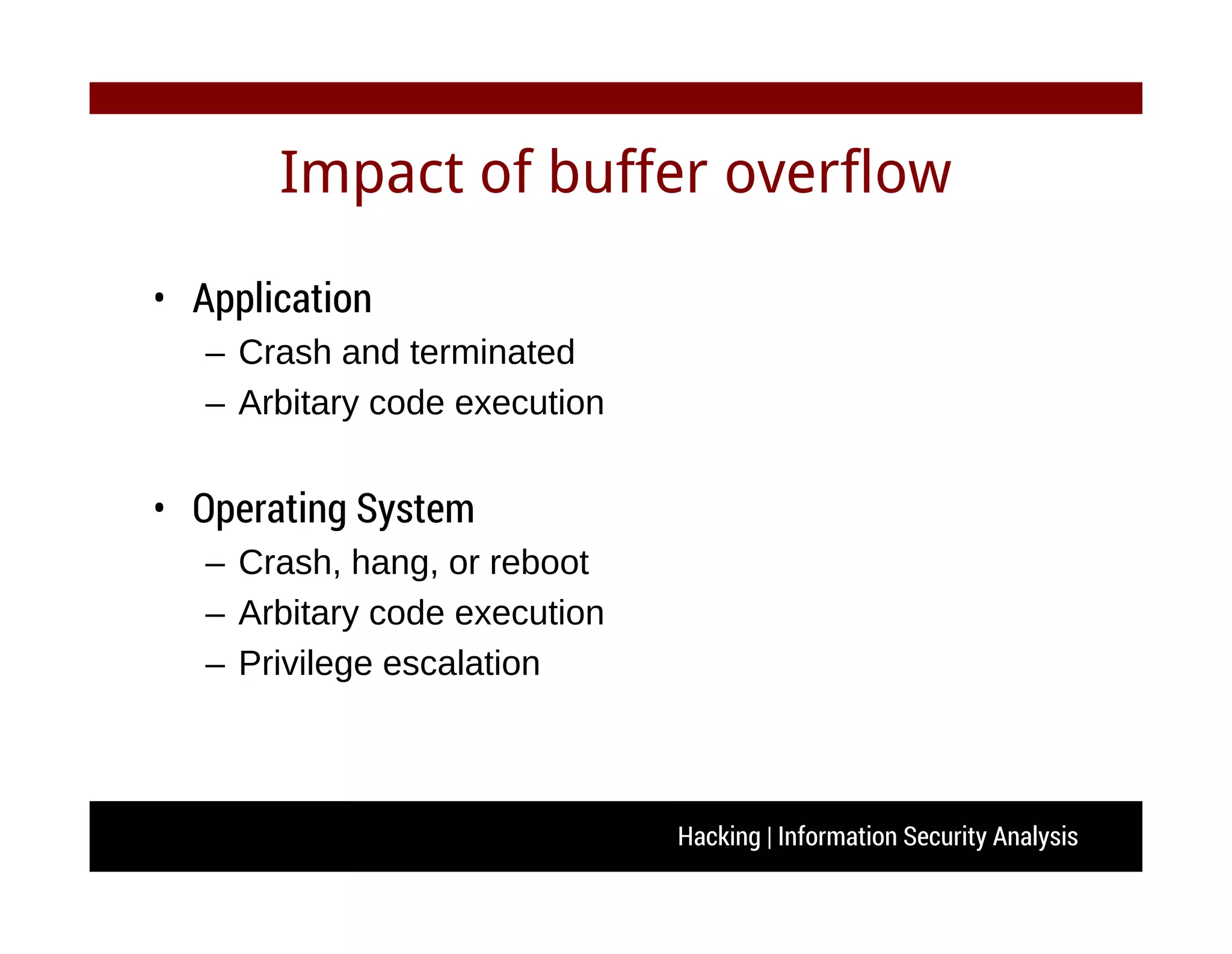
Impact of buffer overflow
• Application
– Crash and terminated
– Arbitary code execution
• Operating System
– Crash, hang, or reboot
– Arbitary code execution
– Privilege escalation
Hacking | Information Security Analysis
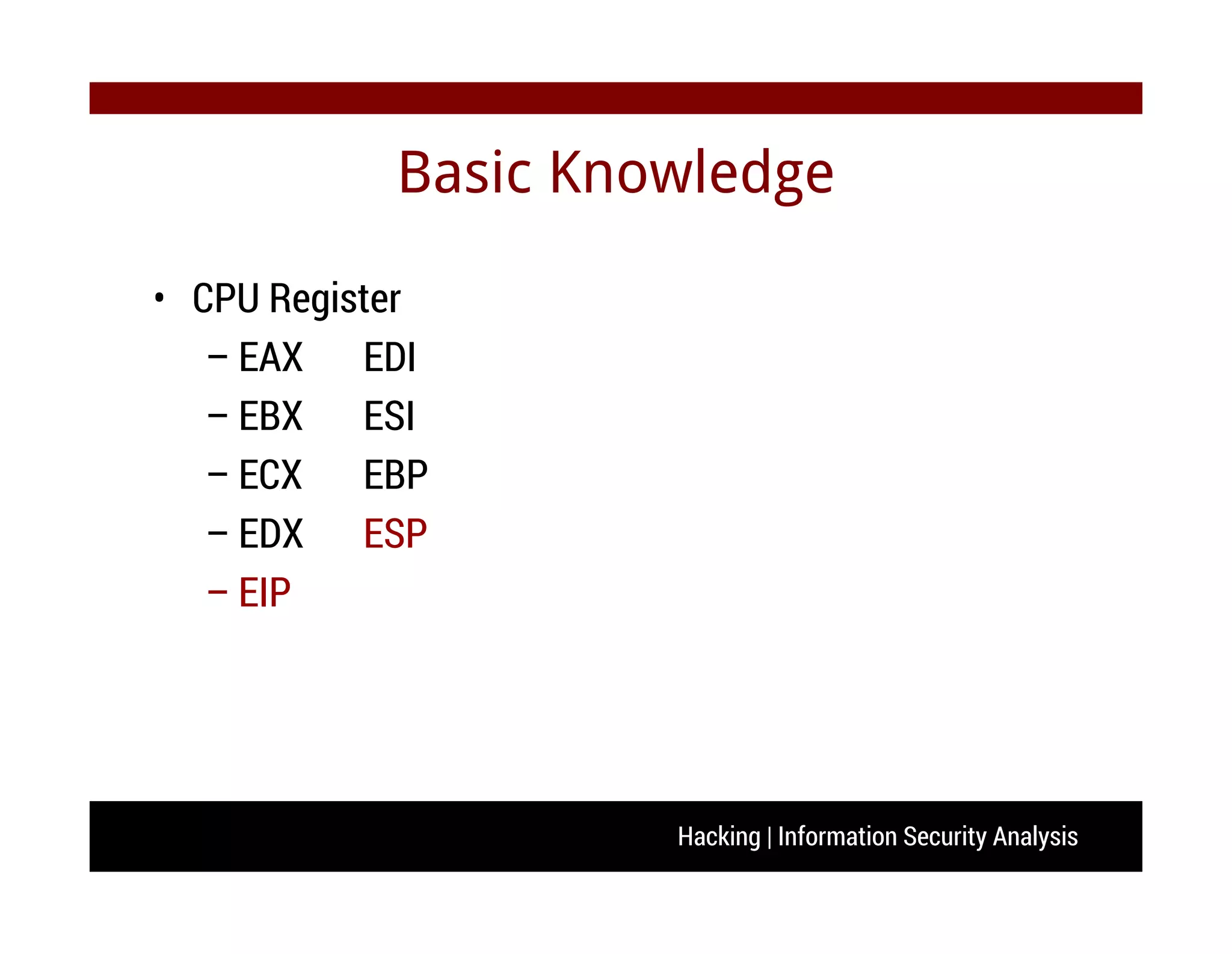
Basic Knowledge
• CPU Register
– EAX EDI
– EBX ESI
– ECX EBP
– EDX ESP
– EIP
Hacking | Information Security Analysis
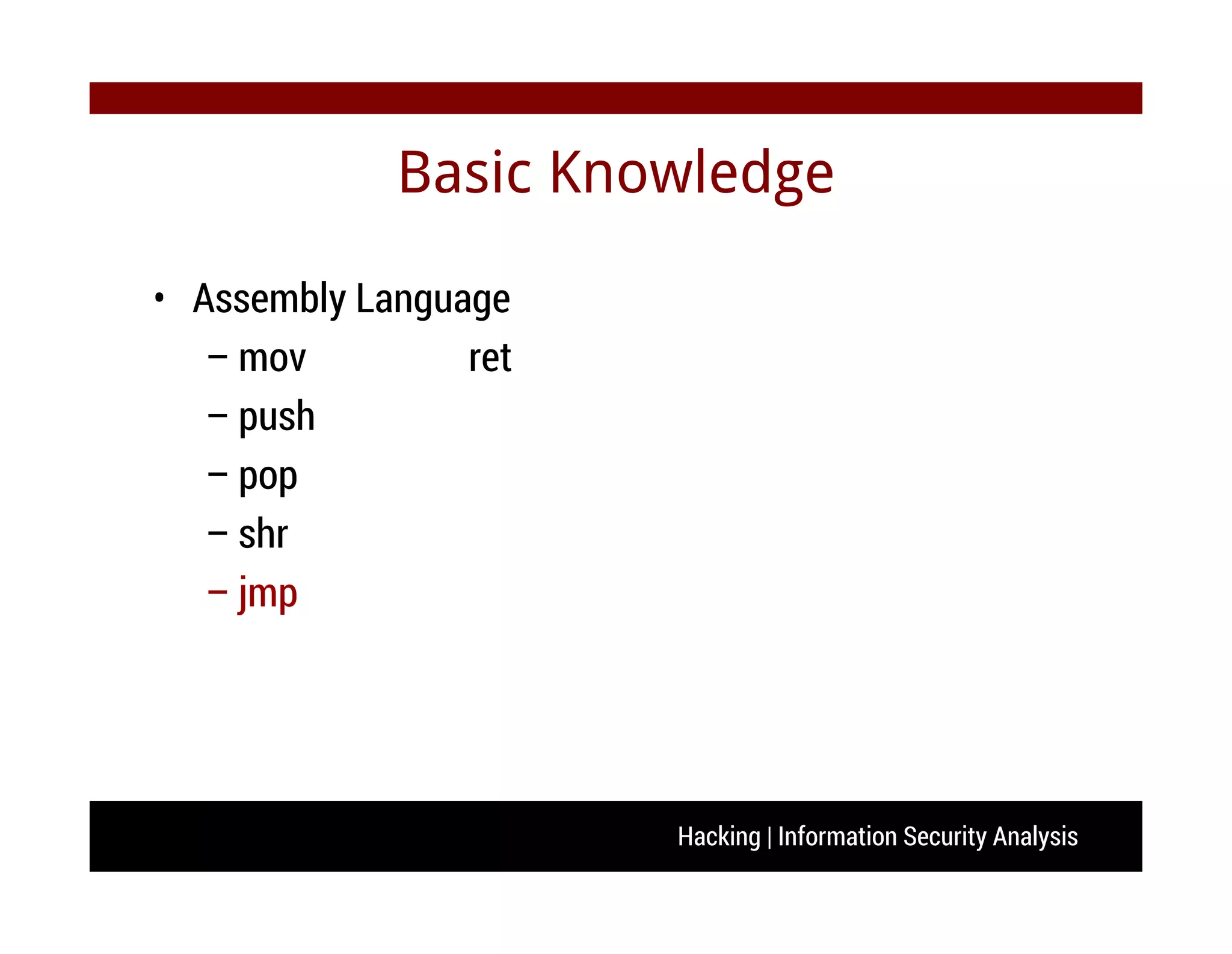
Basic Knowledge
• Assembly Language
– mov ret
– push
– pop
– shr
– jmp
Hacking | Information Security Analysis
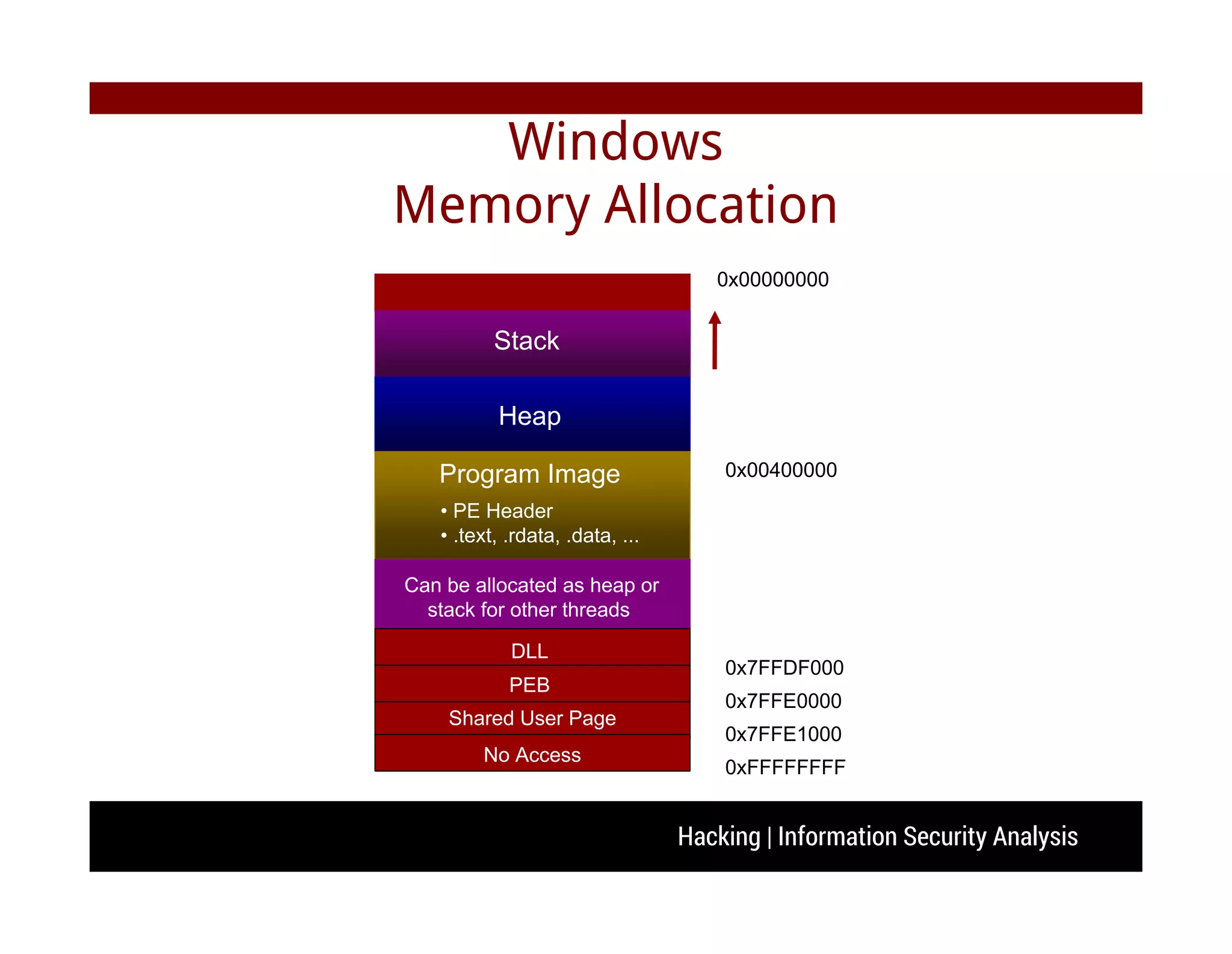
Windows
Memory Allocation
0x00000000
0xFFFFFFFF
Stack
Heap
Program Image
• PE Header
• .text, .rdata, .data, ...
Can be allocated as heap or
stack for other threads
DLL
PEB
Shared User Page
No Access
0x00400000
0x7FFE1000
0x7FFE0000
0x7FFDF000
Hacking | Information Security Analysis
C++ from beginner
#include <stdio.h>
void vulnerable(char *Buffer){
char stack_data[128];
strcpy (stack_data, Buffer);
printf( " Isi variabel stack_data : %s ", stack_data);
}
int main(int argc, char **argv){
vulnerable(argv[1]);
return 0;
}
Hacking | Information Security Analysis
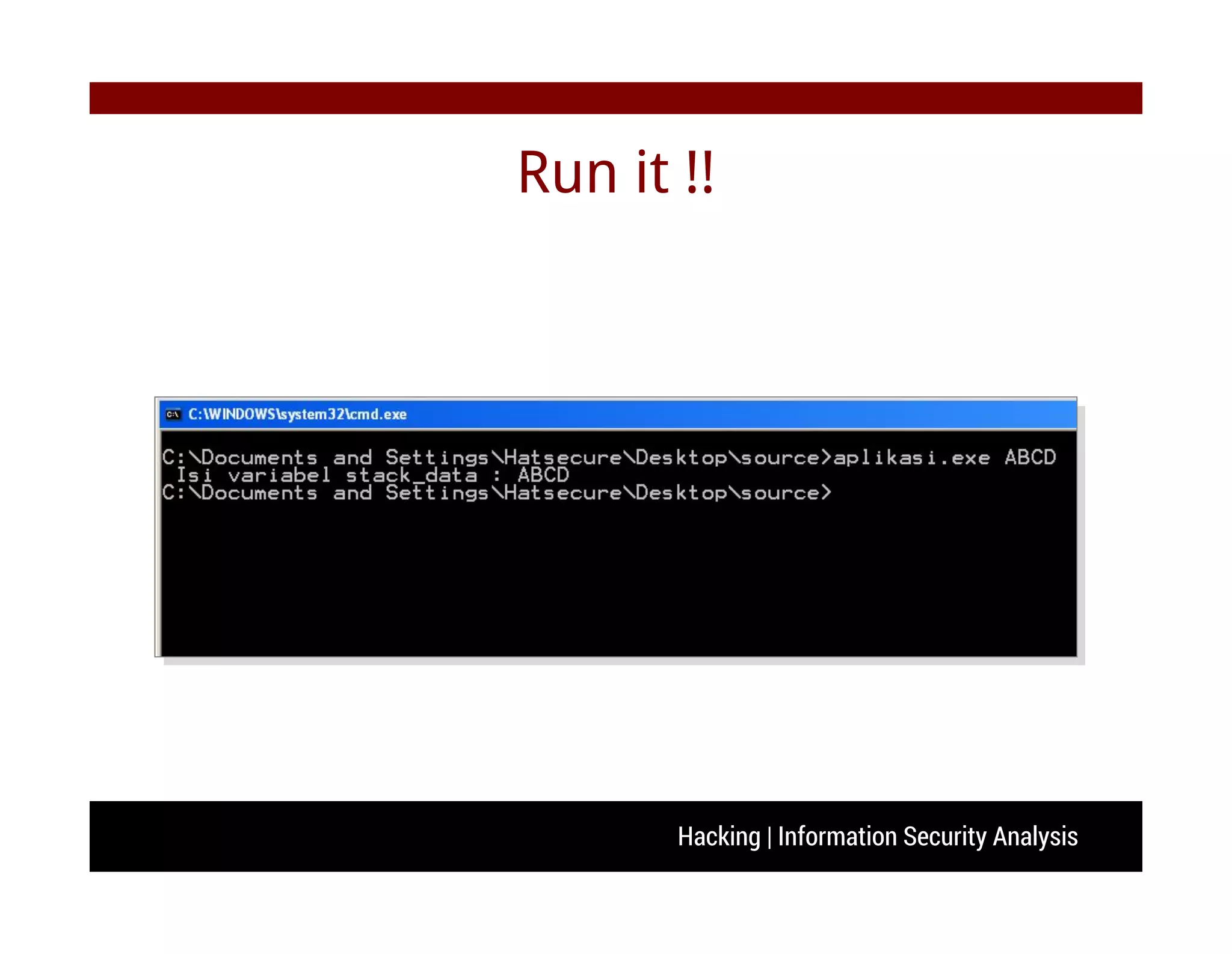
Run it !!
Hacking | Information Security Analysis
Stack Allocation
#include <stdio.h>
#include <string.h>
void vulnerable(char *Buffer){
char stack_data[128];
strcpy (stack_data, Buffer);
printf( " Isi variabel stack_data : %s ", stack_data);
}
int main(int argc, char **argv){
vulnerable(argv[1]);
return 0;
}
CPU Register (Example)
• EIP = 0x01234567 => address of main()
0x00000000
Top of Stack
Hacking | Information Security Analysis
Stack Allocation
#include <stdio.h>
#include <string.h>
void vulnerable(char *Buffer){
char stack_data[128];
strcpy (stack_data, Buffer);
printf( " Isi variabel stack_data : %s ", stack_data);
}
int main(int argc, char **argv){
vulnerable(argv[1]);
return 0;
}
0x00000000
Top of Stack
CPU Register (Example)
• EIP = 0x01234571 => address of vulnerable()
Hacking | Information Security Analysis
Stack Allocation
#include <stdio.h>
#include <string.h>
void vulnerable(char *Buffer){
char stack_data[128];
strcpy (stack_data, Buffer);
printf( " Isi variabel stack_data : %s ", stack_data);
}
int main(int argc, char **argv){
vulnerable(argv[1]);
return 0;
}
0x00000000
Top of Stack
CPU Register (Example)
• EIP = 0x01234585 => stack_data[128]
Hacking | Information Security Analysis
Stack Allocation
#include <stdio.h>
#include <string.h>
void vulnerable(char *Buffer){
char stack_data[128];
strcpy (stack_data, Buffer);
printf( " Isi variabel stack_data : %s ", stack_data);
}
int main(int argc, char **argv){
vulnerable(argv[1]);
return 0;
}
0x00000000
Top of Stack
CPU Register (Example)
• EIP = 0x01234544 => address of strcpy()
<Space for stack_data>
ESP
<ptr to argv[1]>
Saved EBP 0x00112233
Saved EIP 0x00112237
Hacking | Information Security Analysis
Stack Allocation
#include <stdio.h>
#include <string.h>
void vulnerable(char *Buffer){
char stack_data[128];
strcpy (stack_data, Buffer);
printf( " Isi variabel stack_data : %s ", stack_data);
}
int main(int argc, char **argv){
vulnerable(argv[1]);
return 0;
}
0x00000000
Top of Stack
ABCD
ESP
<ptr to argv[1]>
Saved EBP 0x00112233
Saved EIP 0x00112237
CPU Register (Example)
• EIP = 0x01234548 => address of printf()
Hacking | Information Security Analysis
Stack Allocation
#include <stdio.h>
#include <string.h>
void vulnerable(char *Buffer){
char stack_data[128];
strcpy (stack_data, Buffer);
printf( " Isi variabel stack_data : %s ", stack_data);
}
int main(int argc, char **argv){
vulnerable(argv[1]);
return 0;
}
0x00000000
Top of Stack
ESP
<ptr to argv[1]>
Saved EBP 0x00112233
Saved EIP 0x00112237
CPU Register (Example)
• EIP = 0x01234552 => restore saved EIP -> EIP
Hacking | Information Security Analysis
Stack Allocation
#include <stdio.h>
#include <string.h>
void vulnerable(char *Buffer){
char stack_data[128];
strcpy (stack_data, Buffer);
printf( " Isi variabel stack_data : %s ", stack_data);
}
int main(int argc, char **argv){
vulnerable(argv[1]);
return 0;
}
0x00000000
Top of Stack
ESP
<ptr to argv[1]>
CPU Register (Example)
• EIP = 0x01234599 => exit(0)
Hacking | Information Security Analysis
Stack Allocation
#include <stdio.h>
#include <string.h>
void vulnerable(char *Buffer){
char stack_data[128];
strcpy (stack_data, Buffer);
printf( " Isi variabel stack_data : %s ", stack_data);
}
int main(int argc, char **argv){
vulnerable(argv[1]);
return 0;
}
0x00000000
Top of Stack
Hacking | Information Security Analysis
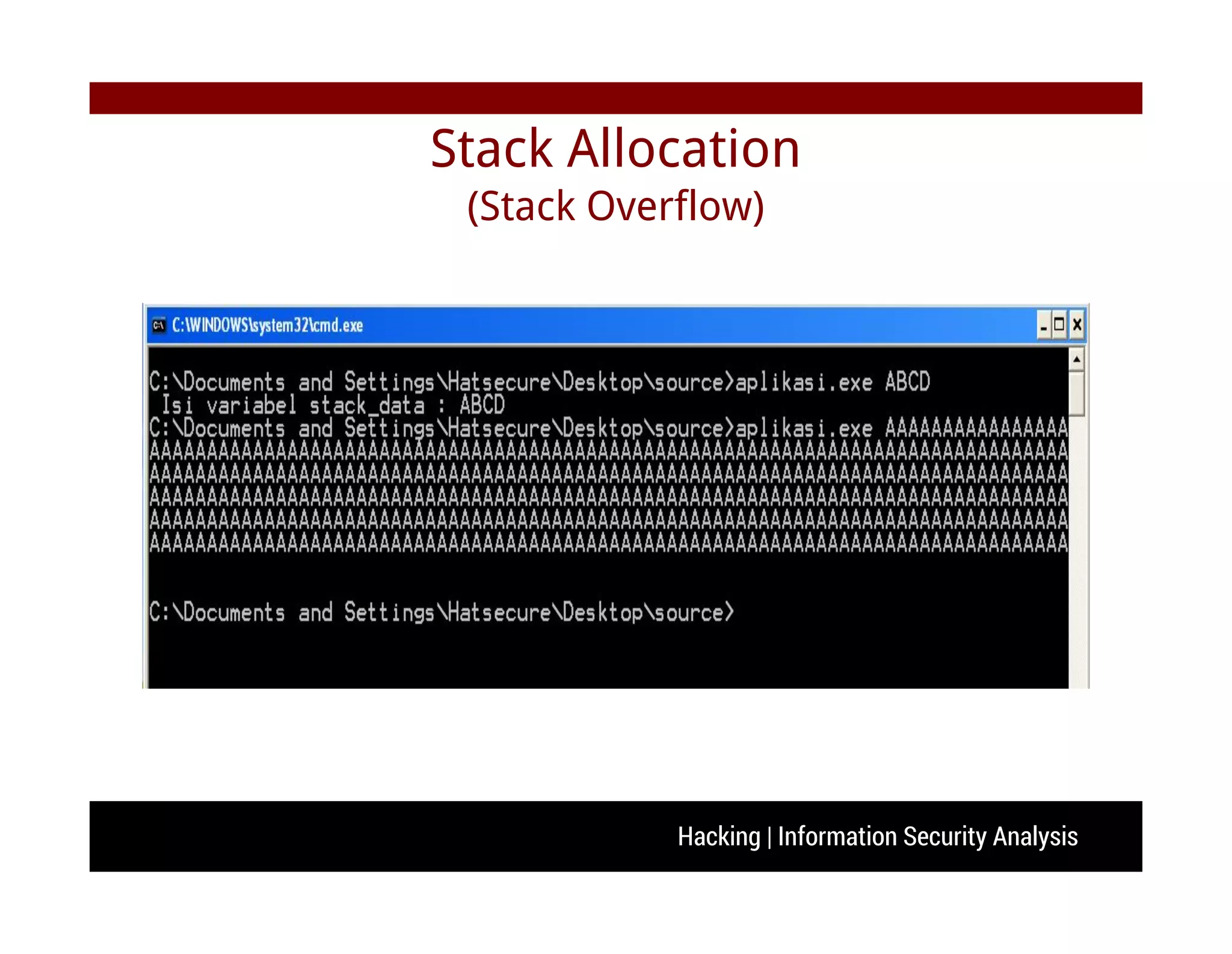
Stack Allocation
(Stack Overflow)
Hacking | Information Security Analysis
Stack Allocation
(Stack Overflow)
#include <stdio.h>
#include <string.h>
void vulnerable(char *Buffer){
char stack_data[128];
strcpy (stack_data, Buffer);
printf( " Isi variabel stack_data : %s ", stack_data);
}
int main(int argc, char **argv){
vulnerable(argv[1]);
return 0;
}
0x00000000
Top of Stack
CPU Register (Example)
• EIP = 0x012345 => address of strcpy()
<Space for stack_data>
ESP
<ptr to argv[1]>
Saved EBP 0x00112233
Saved EIP 0x00112237
Hacking | Information Security Analysis
Stack Allocation
(Stack Overflow)
#include <stdio.h>
#include <string.h>
void vulnerable(char *Buffer){
char stack_data[128];
strcpy (stack_data, Buffer);
printf( " Isi variabel stack_data : %s ", stack_data);
}
int main(int argc, char **argv){
vulnerable(argv[1]);
return 0;
}
0x00000000
Top of Stack
414141414141414141414141
414141414141414141414141
414141414141414141414141
Saved EBP 0x41414141
Saved EIP 0x41414141
ESP
414141414141414141414141
414141414141414141414141
414141414141414141414141
414141414141414141414141
414141414141414141414141
0x00112233
0x00112237
CPU Register (Example)
• EIP = 0x01234548 => address of printf()
Hacking | Information Security Analysis
Stack Allocation
#include <stdio.h>
#include <string.h>
void vulnerable(char *Buffer){
char stack_data[128];
strcpy (stack_data, Buffer);
printf( " Isi variabel stack_data : %s ", stack_data);
}
int main(int argc, char **argv){
vulnerable(argv[1]);
return 0;
}
0x00000000
Top of Stack
ESP
414141414141414141414141
414141414141414141414141
414141414141414141414141
414141414141414141414141
414141414141414141414141
0x00112233
0x00112237
Saved EBP 0x41414141
Saved EIP 0x41414141
CPU Register (Example)
• EIP = 0x41414141 => restore saved EIP -> EIP
Hacking | Information Security Analysis
Stack Allocation
#include <stdio.h>
#include <string.h>
void vulnerable(char *Buffer){
char stack_data[128];
strcpy (stack_data, Buffer);
printf( " Isi variabel stack_data : %s ", stack_data);
}
int main(int argc, char **argv){
vulnerable(argv[1]);
return 0;
}
0x00000000
Top of Stack
ESP
414141414141414141414141
414141414141414141414141
414141414141414141414141
414141414141414141414141
414141414141414141414141
0x00112233
0x00112237
CPU Register (Example)
• EIP = 0x41414141
Access Volation when executing 0x41414141
Hacking | Information Security Analysis
Stack Exploitation
Hacking | Information Security Analysis
Stack Exploitation
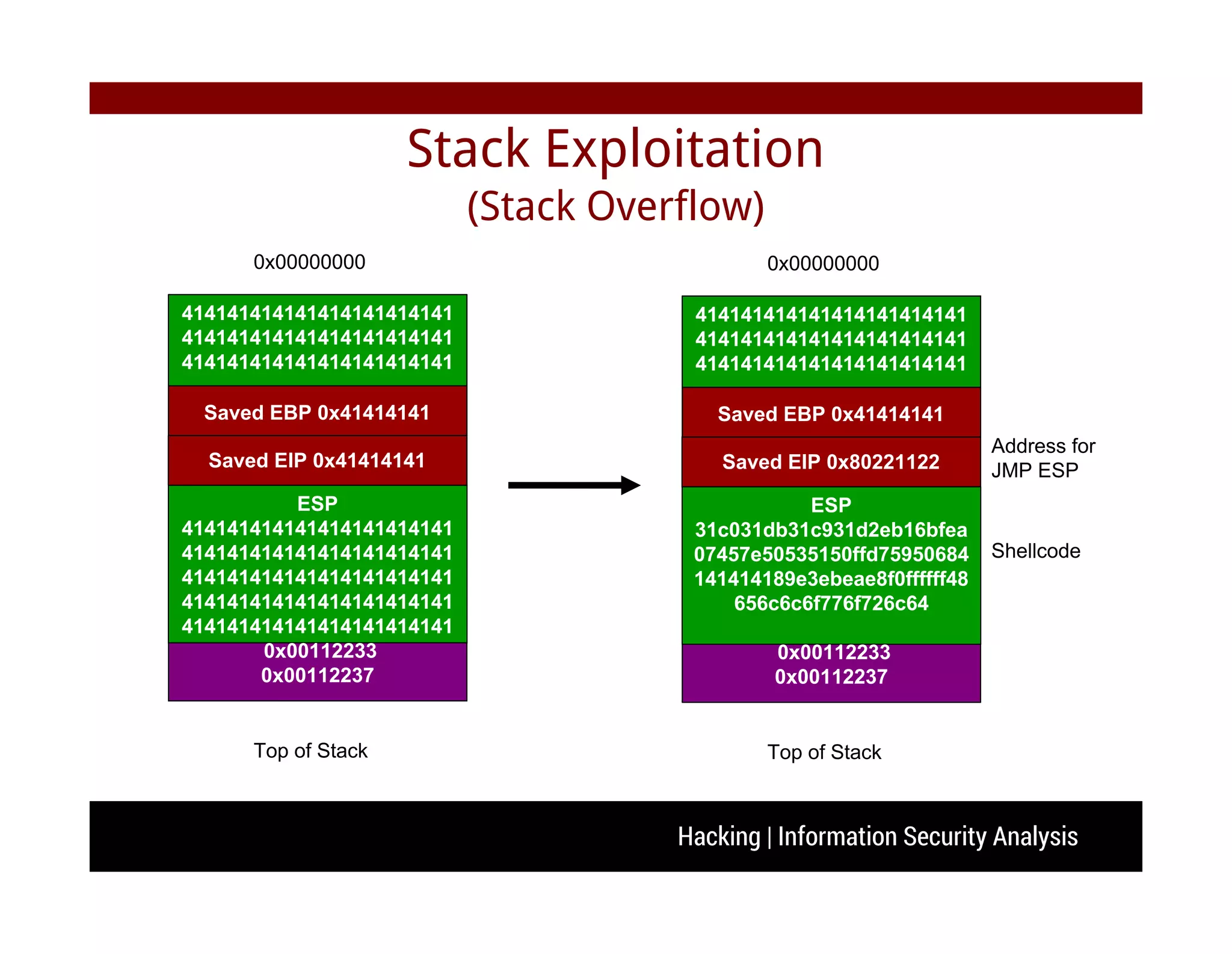
(Stack Overflow)
0x00000000
Top of Stack
414141414141414141414141
414141414141414141414141
414141414141414141414141
Saved EBP 0x41414141
Saved EIP 0x41414141
ESP
414141414141414141414141
414141414141414141414141
414141414141414141414141
414141414141414141414141
414141414141414141414141
0x00112233
0x00112237
0x00000000
Top of Stack
414141414141414141414141
414141414141414141414141
414141414141414141414141
Saved EBP 0x41414141
Saved EIP 0x80221122
ESP
31c031db31c931d2eb16bfea
07457e50535150ffd75950684
141414189e3ebeae8f0ffffff48
656c6c6f776f726c64
0x00112233
0x00112237
Shellcode
Address for
JMP ESP
Hacking | Information Security Analysis
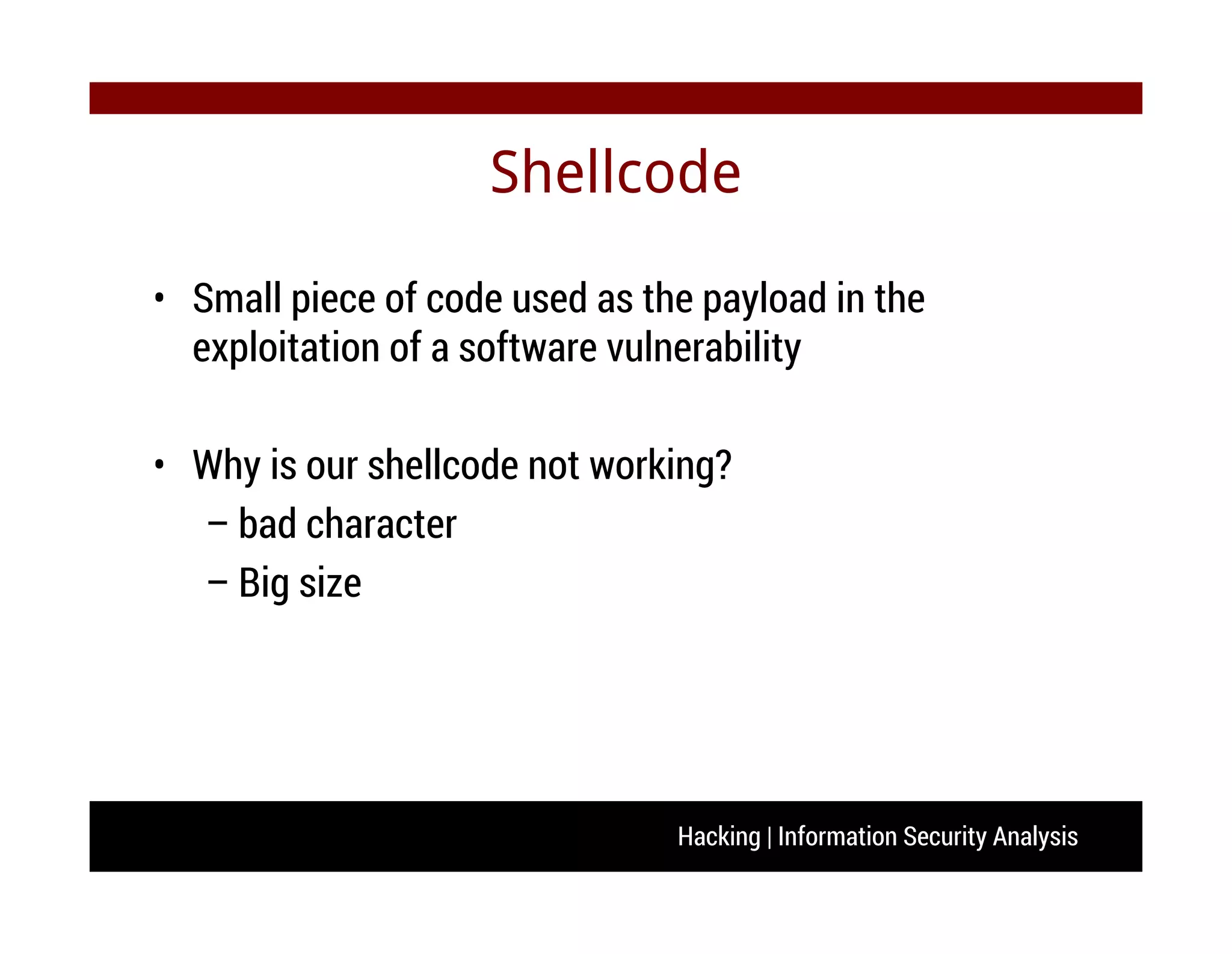
Shellcode
• Small piece of code used as the payload in the
exploitation of a software vulnerability
• Why is our shellcode not working?
– bad character
– Big size
Hacking | Information Security Analysis
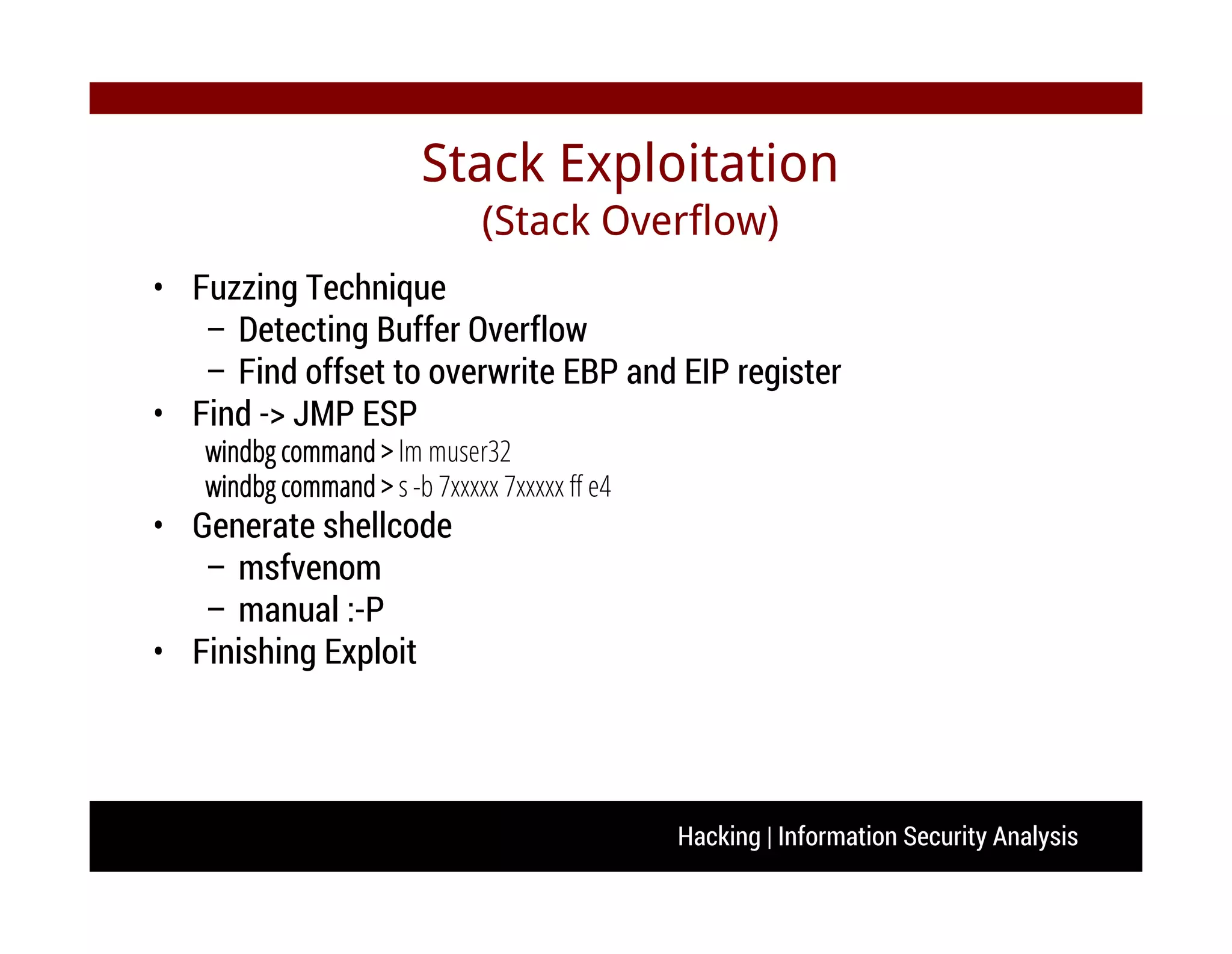
• Fuzzing Technique
– Detecting Buffer Overflow
– Find offset to overwrite EBP and EIP register
• Find -> JMP ESP
windbg command > lm muser32
windbg command > s -b 7xxxxx 7xxxxx ff e4
• Generate shellcode
– msfvenom
– manual :-P
• Finishing Exploit
Stack Exploitation
(Stack Overflow)
Hacking | Information Security Analysis
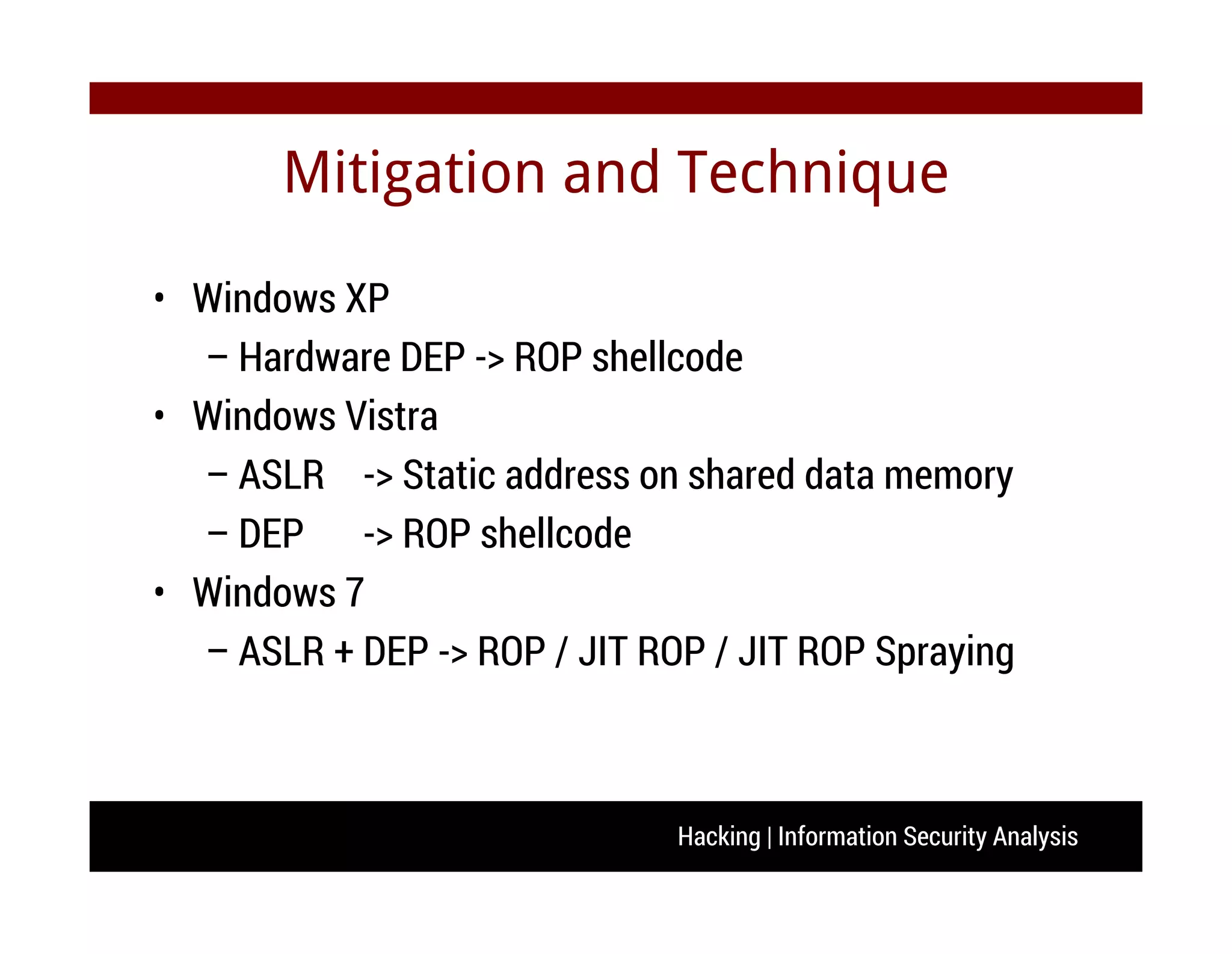
Mitigation and Technique
• Windows XP
– Hardware DEP -> ROP shellcode
• Windows Vistra
– ASLR -> Static address on shared data memory
– DEP -> ROP shellcode
• Windows 7
– ASLR + DEP -> ROP / JIT ROP / JIT ROP Spraying
Hacking | Information Security Analysis
Mitigation and Technique
• Windows 8
– ASLR + DEP (new) -> ROP / JIT ROP

Seminar Hacking & Security Analysis

  • 1.
    Hacking | InformationSecurity Analysis Hacking Security Analysis -- Build security with creativity Danang Heriyadi (danang@hatsecure.com)
  • 2.
    Hacking | InformationSecurity Analysis Hello World
  • 3.
    Hacking | InformationSecurity Analysis Today Hacking Incidents Assets Vulnerability Analysis
  • 4.
    Hacking | InformationSecurity Analysis Top 3 - Hacking in action Cyber Spying Fraud or Forgery Illegal Access
  • 5.
    Hacking | InformationSecurity Analysis Cyber Spying
  • 6.
    Hacking | InformationSecurity Analysis Fraud or Forgery
  • 7.
    Hacking | InformationSecurity Analysis Illegal Access
  • 8.
    Hacking | InformationSecurity Analysis How they can do that? • Sensitive information disclosure – Search Engine (google, bing, yahoo) – Magazine – etc • Social engineering attacks – The knowledge and attitude members of an organization possess regarding the protection of the information assets. • Vulnerability on your system – Attacker exploit the vulnerability to gaining access.
  • 9.
    Hacking | InformationSecurity Analysis Google Hacking
  • 10.
    Hacking | InformationSecurity Analysis What are you trying to protect? • Senstive personal data • Your network infrastructure • Your assets
  • 11.
    Hacking | InformationSecurity Analysis Common Vulnerabilities • Web – XSS – Database Injection – OS command Injection – Local File Disclosure – File Inclusion – Path Disclosure – CSRF – Dir. Traversal • Low level Vulnerability – Stack Overflow – Heap Overflow – Integer Overflow – Memory Corruption – Etc
  • 12.
    Hacking | InformationSecurity Analysis Buffer Overflow • Low level vulnerability – Stack Overflow ( Very easy ) – Integer Overflow ( easy ) – Heap Overflow ( medium ) – Memory Corruption ( easy - medium ) – .....
  • 13.
    Hacking | InformationSecurity Analysis Impact of buffer overflow • Application – Crash and terminated – Arbitary code execution • Operating System – Crash, hang, or reboot – Arbitary code execution – Privilege escalation
  • 14.
    Hacking | InformationSecurity Analysis Basic Knowledge • CPU Register – EAX EDI – EBX ESI – ECX EBP – EDX ESP – EIP
  • 15.
    Hacking | InformationSecurity Analysis Basic Knowledge • Assembly Language – mov ret – push – pop – shr – jmp
  • 16.
    Hacking | InformationSecurity Analysis Windows Memory Allocation 0x00000000 0xFFFFFFFF Stack Heap Program Image • PE Header • .text, .rdata, .data, ... Can be allocated as heap or stack for other threads DLL PEB Shared User Page No Access 0x00400000 0x7FFE1000 0x7FFE0000 0x7FFDF000
  • 17.
    Hacking | InformationSecurity Analysis C++ from beginner #include <stdio.h> void vulnerable(char *Buffer){ char stack_data[128]; strcpy (stack_data, Buffer); printf( " Isi variabel stack_data : %s ", stack_data); } int main(int argc, char **argv){ vulnerable(argv[1]); return 0; }
  • 18.
    Hacking | InformationSecurity Analysis Run it !!
  • 19.
    Hacking | InformationSecurity Analysis Stack Allocation #include <stdio.h> #include <string.h> void vulnerable(char *Buffer){ char stack_data[128]; strcpy (stack_data, Buffer); printf( " Isi variabel stack_data : %s ", stack_data); } int main(int argc, char **argv){ vulnerable(argv[1]); return 0; } CPU Register (Example) • EIP = 0x01234567 => address of main() 0x00000000 Top of Stack
  • 20.
    Hacking | InformationSecurity Analysis Stack Allocation #include <stdio.h> #include <string.h> void vulnerable(char *Buffer){ char stack_data[128]; strcpy (stack_data, Buffer); printf( " Isi variabel stack_data : %s ", stack_data); } int main(int argc, char **argv){ vulnerable(argv[1]); return 0; } 0x00000000 Top of Stack CPU Register (Example) • EIP = 0x01234571 => address of vulnerable()
  • 21.
    Hacking | InformationSecurity Analysis Stack Allocation #include <stdio.h> #include <string.h> void vulnerable(char *Buffer){ char stack_data[128]; strcpy (stack_data, Buffer); printf( " Isi variabel stack_data : %s ", stack_data); } int main(int argc, char **argv){ vulnerable(argv[1]); return 0; } 0x00000000 Top of Stack CPU Register (Example) • EIP = 0x01234585 => stack_data[128]
  • 22.
    Hacking | InformationSecurity Analysis Stack Allocation #include <stdio.h> #include <string.h> void vulnerable(char *Buffer){ char stack_data[128]; strcpy (stack_data, Buffer); printf( " Isi variabel stack_data : %s ", stack_data); } int main(int argc, char **argv){ vulnerable(argv[1]); return 0; } 0x00000000 Top of Stack CPU Register (Example) • EIP = 0x01234544 => address of strcpy() <Space for stack_data> ESP <ptr to argv[1]> Saved EBP 0x00112233 Saved EIP 0x00112237
  • 23.
    Hacking | InformationSecurity Analysis Stack Allocation #include <stdio.h> #include <string.h> void vulnerable(char *Buffer){ char stack_data[128]; strcpy (stack_data, Buffer); printf( " Isi variabel stack_data : %s ", stack_data); } int main(int argc, char **argv){ vulnerable(argv[1]); return 0; } 0x00000000 Top of Stack ABCD ESP <ptr to argv[1]> Saved EBP 0x00112233 Saved EIP 0x00112237 CPU Register (Example) • EIP = 0x01234548 => address of printf()
  • 24.
    Hacking | InformationSecurity Analysis Stack Allocation #include <stdio.h> #include <string.h> void vulnerable(char *Buffer){ char stack_data[128]; strcpy (stack_data, Buffer); printf( " Isi variabel stack_data : %s ", stack_data); } int main(int argc, char **argv){ vulnerable(argv[1]); return 0; } 0x00000000 Top of Stack ESP <ptr to argv[1]> Saved EBP 0x00112233 Saved EIP 0x00112237 CPU Register (Example) • EIP = 0x01234552 => restore saved EIP -> EIP
  • 25.
    Hacking | InformationSecurity Analysis Stack Allocation #include <stdio.h> #include <string.h> void vulnerable(char *Buffer){ char stack_data[128]; strcpy (stack_data, Buffer); printf( " Isi variabel stack_data : %s ", stack_data); } int main(int argc, char **argv){ vulnerable(argv[1]); return 0; } 0x00000000 Top of Stack ESP <ptr to argv[1]> CPU Register (Example) • EIP = 0x01234599 => exit(0)
  • 26.
    Hacking | InformationSecurity Analysis Stack Allocation #include <stdio.h> #include <string.h> void vulnerable(char *Buffer){ char stack_data[128]; strcpy (stack_data, Buffer); printf( " Isi variabel stack_data : %s ", stack_data); } int main(int argc, char **argv){ vulnerable(argv[1]); return 0; } 0x00000000 Top of Stack
  • 27.
    Hacking | InformationSecurity Analysis Stack Allocation (Stack Overflow)
  • 28.
    Hacking | InformationSecurity Analysis Stack Allocation (Stack Overflow) #include <stdio.h> #include <string.h> void vulnerable(char *Buffer){ char stack_data[128]; strcpy (stack_data, Buffer); printf( " Isi variabel stack_data : %s ", stack_data); } int main(int argc, char **argv){ vulnerable(argv[1]); return 0; } 0x00000000 Top of Stack CPU Register (Example) • EIP = 0x012345 => address of strcpy() <Space for stack_data> ESP <ptr to argv[1]> Saved EBP 0x00112233 Saved EIP 0x00112237
  • 29.
    Hacking | InformationSecurity Analysis Stack Allocation (Stack Overflow) #include <stdio.h> #include <string.h> void vulnerable(char *Buffer){ char stack_data[128]; strcpy (stack_data, Buffer); printf( " Isi variabel stack_data : %s ", stack_data); } int main(int argc, char **argv){ vulnerable(argv[1]); return 0; } 0x00000000 Top of Stack 414141414141414141414141 414141414141414141414141 414141414141414141414141 Saved EBP 0x41414141 Saved EIP 0x41414141 ESP 414141414141414141414141 414141414141414141414141 414141414141414141414141 414141414141414141414141 414141414141414141414141 0x00112233 0x00112237 CPU Register (Example) • EIP = 0x01234548 => address of printf()
  • 30.
    Hacking | InformationSecurity Analysis Stack Allocation #include <stdio.h> #include <string.h> void vulnerable(char *Buffer){ char stack_data[128]; strcpy (stack_data, Buffer); printf( " Isi variabel stack_data : %s ", stack_data); } int main(int argc, char **argv){ vulnerable(argv[1]); return 0; } 0x00000000 Top of Stack ESP 414141414141414141414141 414141414141414141414141 414141414141414141414141 414141414141414141414141 414141414141414141414141 0x00112233 0x00112237 Saved EBP 0x41414141 Saved EIP 0x41414141 CPU Register (Example) • EIP = 0x41414141 => restore saved EIP -> EIP
  • 31.
    Hacking | InformationSecurity Analysis Stack Allocation #include <stdio.h> #include <string.h> void vulnerable(char *Buffer){ char stack_data[128]; strcpy (stack_data, Buffer); printf( " Isi variabel stack_data : %s ", stack_data); } int main(int argc, char **argv){ vulnerable(argv[1]); return 0; } 0x00000000 Top of Stack ESP 414141414141414141414141 414141414141414141414141 414141414141414141414141 414141414141414141414141 414141414141414141414141 0x00112233 0x00112237 CPU Register (Example) • EIP = 0x41414141 Access Volation when executing 0x41414141
  • 32.
    Hacking | InformationSecurity Analysis Stack Exploitation
  • 33.
    Hacking | InformationSecurity Analysis Stack Exploitation (Stack Overflow) 0x00000000 Top of Stack 414141414141414141414141 414141414141414141414141 414141414141414141414141 Saved EBP 0x41414141 Saved EIP 0x41414141 ESP 414141414141414141414141 414141414141414141414141 414141414141414141414141 414141414141414141414141 414141414141414141414141 0x00112233 0x00112237 0x00000000 Top of Stack 414141414141414141414141 414141414141414141414141 414141414141414141414141 Saved EBP 0x41414141 Saved EIP 0x80221122 ESP 31c031db31c931d2eb16bfea 07457e50535150ffd75950684 141414189e3ebeae8f0ffffff48 656c6c6f776f726c64 0x00112233 0x00112237 Shellcode Address for JMP ESP
  • 34.
    Hacking | InformationSecurity Analysis Shellcode • Small piece of code used as the payload in the exploitation of a software vulnerability • Why is our shellcode not working? – bad character – Big size
  • 35.
    Hacking | InformationSecurity Analysis • Fuzzing Technique – Detecting Buffer Overflow – Find offset to overwrite EBP and EIP register • Find -> JMP ESP windbg command > lm muser32 windbg command > s -b 7xxxxx 7xxxxx ff e4 • Generate shellcode – msfvenom – manual :-P • Finishing Exploit Stack Exploitation (Stack Overflow)
  • 36.
    Hacking | InformationSecurity Analysis Mitigation and Technique • Windows XP – Hardware DEP -> ROP shellcode • Windows Vistra – ASLR -> Static address on shared data memory – DEP -> ROP shellcode • Windows 7 – ASLR + DEP -> ROP / JIT ROP / JIT ROP Spraying
  • 37.
    Hacking | InformationSecurity Analysis Mitigation and Technique • Windows 8 – ASLR + DEP (new) -> ROP / JIT ROP