WHAT IS A NETWORK ?
• A collection of computing devices that
are connected in various ways in order to
communicate and share resources
• Any combination of voice, video and/or
data can be transmitted.
REQUIREMENT OF
NETWORKING
• RESOURCE SHARING
• HIGH RELABILITY
• SCALABILITY
TYPES OF NETWORKS
• LAN (LOCAL AREA NETWORK)
• MAN (METROPOLITAN AREA
NETWORK)
• WAN (WIDE AREA NETWORK)
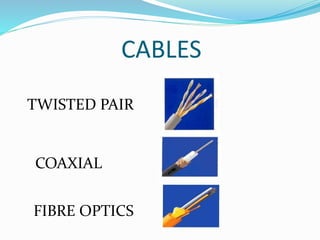
CABLES
TWISTED PAIR
COAXIAL
FIBRE OPTICS
NETWORKING DEVICES
NETWORK INTERFACE CARD (NIC)
HUB
SWITCH
ROUTER
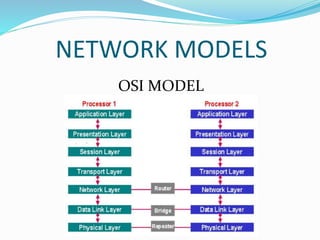
NETWORK MODELS
OSI MODEL
IP ADDRESSING
Every machine on the internet has a
unique identifying number, called an IP
address.
IP address can be 32 bit IPv4 or 128 bit
IPv6
IP address can be split into two sections
-> Network address
-> Host address
CLASSES OF IP
CLASS A: For very large network
CLASS B: For medium sized network
CLASS C: For small to mid-size buisness
CLASS D: Used for multicast
CLASS E: For experimental purpose
SUBNETTING
• Process of subdividing networks into
smaller subnets.
• Class A, B, C are used for subnetting
FIREWALL
A firewall is device of some kind that
protect our network.
A firewall examines all traffic routed
between the networks to see if it meets
certain criteria.
It can be a hardware device or a software
program running on a secure host.
TYPES OF FIREWALL
PACKET FILTERING
PROXY
STATEFUL INSPECTION
WIRELESS LAN
Wireless LAN is a network that provide
the facility of networking without the
need for physical connection.
Uses radio waves as a medium for
transmitting data between computers.
TOPOLOGIES FOR WLAN
INFRASTRUCTURE NETWORK
AD – HOC NETWORK

Seminar