COMPUTER
NETWORKING
TABLE OF
CONTENT
S
1
• INTRODUCTION
2
• HISTORY
3
• APPLICATIONS
4
• TYPES OF
NETWORKING
5
• NETWORK
TOPOLOGY
6
• CONCLUSION
INTRODUCTION
INTRODUCTION
INTRODUCTION
“A computer network is a
group of computers that use a
set of common
communication protocols over
digital interconnections for
the purpose of sharing
resources located on or
provided by
the network nodes”
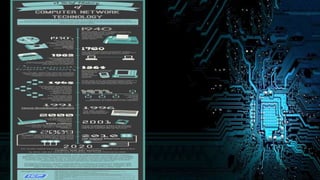
HISTORY OF COMPUTER
NETWORK
RESOURCE SHARING
E-COMMERCE
COMMUNICATION MEDIUM
SERVER-CLIENT MODEL
APPLICATIONS:
TYPES OF NETWORKING
• A local area network (LAN) is a collection of devices connected
together in one physical location, such as a building, office, or
home.
DEFINITION :
• A LAN can be small or large, ranging from a home network with
one user to an enterprise network with thousands of users and
devices in an office or school.
SIZE :
• Regardless of size, a LAN's single defining characteristic is that it
connects devices that are in a single, limited area.
CHARACTERISTIC :
• WIFI, Ethernet
EXAMPLE :
LAN:
•A metropolitan area network (MAN) is a network that
interconnects users with computer resources in a
geographic area or region larger than that covered by even
a large local area network (LAN) but smaller than the area
covered by a wide area network (WAN).
DEFINITION :
•Examples of metropolitan area networks of various sizes
can be found in the metropolitan areas of London, England;
Lodz, Poland; and Geneva, Switzerland. Large universities
also sometimes use the term to describe their networks. A
recent trend is the installation of wireless MANs.
EXAMPLE :
MAN :
•Wide Area Network is a computer
network that connect computers
over a long distance
DEFINITION:
•It is the group of several MANs and
LANs. Its range is beyond 100km.
SIZE:
WAN:
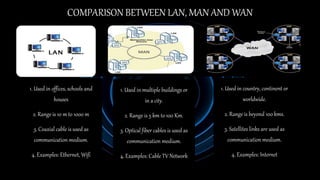
1. Used in offices, schools and
houses
2. Range is 10 m to 1000 m
3. Coaxial cable is used as
communication medium.
4. Examples: Ethernet, Wifi
1. Used in multiple buildings or
in a city.
2. Range is 5 km to 100 Km.
3. Optical fiber cables is used as
communication medium.
4. Examples: Cable TV Network
1. Used in country, continent or
worldwide.
2. Range is beyond 100 kms.
3. Satellites links are used as
communication medium.
4. Examples: Internet
COMPARISON BETWEEN LAN, MAN AND WAN
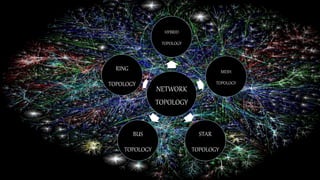
NETWORK
TOPOLOGY
HYBRID
TOPOLOGY
MESH
TOPOLOGY
STAR
TOPOLOGY
BUS
TOPOLOGY
RING
TOPOLOGY
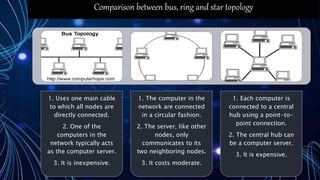
BUS TOPOLOGY:
RING TOPOLOGY:
STAR TOPOLGY:
1. Uses one main cable
to which all nodes are
directly connected.
2. One of the
computers in the
network typically acts
as the computer server.
3. It is inexpensive.
1. The computer in the
network are connected
in a circular fashion.
2. The server, like other
nodes, only
communicates to its
two neighboring nodes.
3. It costs moderate.
1. Each computer is
connected to a central
hub using a point-to-
point connection.
2. The central hub can
be a computer server.
3. It is expensive.
Comparison between bus, ring and star topology
CONCLUSION:
 COMPUTER NETWORKS ARE BASICALLY USED IN SHARING THE INFORMATION OR DATA.
IT IS ALSO USED TO CONNECT COMPUTERS
COMPUTER NETWORK WORK ON THE BASIS OF TOPOLOGIES AND TECHNICAL COMMUNICATION
BARRIERS.
IT INCLUDES NEW DEVELOPMENTS ACCORDING TO TODAY’S ERA.
INTERNET IS THE MOST COMMON EXAMPLE OF COMPUTER NETWORKS.

Computer Network

  • 1.
  • 2.
    TABLE OF CONTENT S 1 • INTRODUCTION 2 •HISTORY 3 • APPLICATIONS 4 • TYPES OF NETWORKING 5 • NETWORK TOPOLOGY 6 • CONCLUSION
  • 3.
  • 4.
    INTRODUCTION “A computer networkis a group of computers that use a set of common communication protocols over digital interconnections for the purpose of sharing resources located on or provided by the network nodes”
  • 5.
  • 7.
  • 8.
  • 9.
    • A localarea network (LAN) is a collection of devices connected together in one physical location, such as a building, office, or home. DEFINITION : • A LAN can be small or large, ranging from a home network with one user to an enterprise network with thousands of users and devices in an office or school. SIZE : • Regardless of size, a LAN's single defining characteristic is that it connects devices that are in a single, limited area. CHARACTERISTIC : • WIFI, Ethernet EXAMPLE : LAN:
  • 10.
    •A metropolitan areanetwork (MAN) is a network that interconnects users with computer resources in a geographic area or region larger than that covered by even a large local area network (LAN) but smaller than the area covered by a wide area network (WAN). DEFINITION : •Examples of metropolitan area networks of various sizes can be found in the metropolitan areas of London, England; Lodz, Poland; and Geneva, Switzerland. Large universities also sometimes use the term to describe their networks. A recent trend is the installation of wireless MANs. EXAMPLE : MAN :
  • 11.
    •Wide Area Networkis a computer network that connect computers over a long distance DEFINITION: •It is the group of several MANs and LANs. Its range is beyond 100km. SIZE: WAN:
  • 12.
    1. Used inoffices, schools and houses 2. Range is 10 m to 1000 m 3. Coaxial cable is used as communication medium. 4. Examples: Ethernet, Wifi 1. Used in multiple buildings or in a city. 2. Range is 5 km to 100 Km. 3. Optical fiber cables is used as communication medium. 4. Examples: Cable TV Network 1. Used in country, continent or worldwide. 2. Range is beyond 100 kms. 3. Satellites links are used as communication medium. 4. Examples: Internet COMPARISON BETWEEN LAN, MAN AND WAN
  • 13.
  • 14.
  • 15.
  • 16.
  • 17.
    1. Uses onemain cable to which all nodes are directly connected. 2. One of the computers in the network typically acts as the computer server. 3. It is inexpensive. 1. The computer in the network are connected in a circular fashion. 2. The server, like other nodes, only communicates to its two neighboring nodes. 3. It costs moderate. 1. Each computer is connected to a central hub using a point-to- point connection. 2. The central hub can be a computer server. 3. It is expensive. Comparison between bus, ring and star topology
  • 18.
    CONCLUSION:  COMPUTER NETWORKSARE BASICALLY USED IN SHARING THE INFORMATION OR DATA. IT IS ALSO USED TO CONNECT COMPUTERS COMPUTER NETWORK WORK ON THE BASIS OF TOPOLOGIES AND TECHNICAL COMMUNICATION BARRIERS. IT INCLUDES NEW DEVELOPMENTS ACCORDING TO TODAY’S ERA. INTERNET IS THE MOST COMMON EXAMPLE OF COMPUTER NETWORKS.