Semantic Web Applications Horatiu Mocian, 04.05.2011
Use of Semantic Web Semantic knowledge bases Freebase, DBpedia Semantic tagging tools OpenCalais, Zemanta Semantic search TrueKnowledge, Google Squared Data integration
Semantic knowledge bases Databases where information is stored in a semantic web format (RDF), and is organised in ontologies Most famous Freebase ( www.freebase.com ) Dbpedia ( www.dbpedia.org )
Semantic tagging tools Tools that automatically identify, disambiguate and mark (tag) named entities from a text Commercial: OpenCalais, Zemanta, ... Academic: GATE, Stanford NER, ...
Web search engines Traditional search engines Google, Bing, Yahoo! Structured search engines WolframAlpha, TripAdvisor Semantic search engines TrueKnowledge, Twine (extinct), Powerset (extinct), Google Square
Semantic search engines 2 distinctive features Analyze indexed documents semantically Analyze the query text semantically -> answer to natural text questions Not yet mainstream Powerset, Twine, were bought Google, Bing use semantic features
Natural Language Processing Building block of the semantic web Subfields Machine Translation Automatic Summarization Named Entity Recognition Speech Recognition POS Tagging
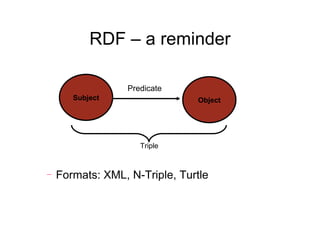
RDF – a reminder Formats: XML, N-Triple, Turtle Subject Predicate Value Object Triple
List of applications Freebase Dbpedia data.nytimes.com OpenCalais, Zemanta TrueKnowledge, Google Square Bing Microformats + Google, Bing
Freebase www.freebase.com One of the largest semantic knowledge bases (2 nd  ?) Created by the community (large input of data from Wikipedia) Over 22,000,000 topics (361M triples) Its parent, Metaweb Technologies, acquired by Google for $700 million in 2010
DBpedia http://dbpedia.org/About Largest semantic knowledge base “ A structured Wikipedia” Open community project 3.5 million things (672M triples)
NY Times Linked Open Data http://data.nytimes.com NY Times is one of the largest media companies, news organizations Started publishing semantic data in 2009 Currently, it has 10,000 topics Another 30,000 topics will be published A large effort by a large media company
OpenCalais http://viewer.opencalais.com Best NLP processing tool (for business articles in English) Developed by ClearForest, Acquired by Reuters (now Thomson Reuters) for $25 million in 2007 Used internally to tag Thomson Reuters texts
Zemanta http://www.zemanta.com/ Finds entities in texts, and enriches them with links, images Useful for blogging Example of bottom-up approach API provides information in RDF format
TrueKnowledge www.trueknowledge.com Pure semantic search (one of the fewest) Company based in Cambridge, UK 19,000,000 things (531M facts)
Google Squared http://www.google.com/squared/ Google's natural search engine Developed by Google NY office Launched in 2009
Bing www.bing.com Microsoft's search engine Handles Yahoo! Searches Steadily catching up to Google Has semantic abilities after acquiring Powerset in 2008 Examples: recipes, travel, events
RDF Microformats HTML tags that can be interpreted semantically More lightweight than proper RDF, easier to integrate in web pages Most common: hCard, hCalendar, hReview, hResume, hRecipe Recognized by both Google, and Bing Example: game reviews on IGN.com
Interested in more? TripIt (tripit.com) Evri (evri.com) Inform (inform.com) Daylife (daylife.com) Google “semantic web applications”
Thank you Questions?

SemanticWebApp

  • 1.
    Semantic Web ApplicationsHoratiu Mocian, 04.05.2011
  • 2.
    Use of SemanticWeb Semantic knowledge bases Freebase, DBpedia Semantic tagging tools OpenCalais, Zemanta Semantic search TrueKnowledge, Google Squared Data integration
  • 3.
    Semantic knowledge basesDatabases where information is stored in a semantic web format (RDF), and is organised in ontologies Most famous Freebase ( www.freebase.com ) Dbpedia ( www.dbpedia.org )
  • 4.
    Semantic tagging toolsTools that automatically identify, disambiguate and mark (tag) named entities from a text Commercial: OpenCalais, Zemanta, ... Academic: GATE, Stanford NER, ...
  • 5.
    Web search enginesTraditional search engines Google, Bing, Yahoo! Structured search engines WolframAlpha, TripAdvisor Semantic search engines TrueKnowledge, Twine (extinct), Powerset (extinct), Google Square
  • 6.
    Semantic search engines2 distinctive features Analyze indexed documents semantically Analyze the query text semantically -> answer to natural text questions Not yet mainstream Powerset, Twine, were bought Google, Bing use semantic features
  • 7.
    Natural Language ProcessingBuilding block of the semantic web Subfields Machine Translation Automatic Summarization Named Entity Recognition Speech Recognition POS Tagging
  • 8.
    RDF – areminder Formats: XML, N-Triple, Turtle Subject Predicate Value Object Triple
  • 9.
    List of applicationsFreebase Dbpedia data.nytimes.com OpenCalais, Zemanta TrueKnowledge, Google Square Bing Microformats + Google, Bing
  • 10.
    Freebase www.freebase.com Oneof the largest semantic knowledge bases (2 nd ?) Created by the community (large input of data from Wikipedia) Over 22,000,000 topics (361M triples) Its parent, Metaweb Technologies, acquired by Google for $700 million in 2010
  • 11.
    DBpedia http://dbpedia.org/About Largestsemantic knowledge base “ A structured Wikipedia” Open community project 3.5 million things (672M triples)
  • 12.
    NY Times LinkedOpen Data http://data.nytimes.com NY Times is one of the largest media companies, news organizations Started publishing semantic data in 2009 Currently, it has 10,000 topics Another 30,000 topics will be published A large effort by a large media company
  • 13.
    OpenCalais http://viewer.opencalais.com BestNLP processing tool (for business articles in English) Developed by ClearForest, Acquired by Reuters (now Thomson Reuters) for $25 million in 2007 Used internally to tag Thomson Reuters texts
  • 14.
    Zemanta http://www.zemanta.com/ Findsentities in texts, and enriches them with links, images Useful for blogging Example of bottom-up approach API provides information in RDF format
  • 15.
    TrueKnowledge www.trueknowledge.com Puresemantic search (one of the fewest) Company based in Cambridge, UK 19,000,000 things (531M facts)
  • 16.
    Google Squared http://www.google.com/squared/Google's natural search engine Developed by Google NY office Launched in 2009
  • 17.
    Bing www.bing.com Microsoft'ssearch engine Handles Yahoo! Searches Steadily catching up to Google Has semantic abilities after acquiring Powerset in 2008 Examples: recipes, travel, events
  • 18.
    RDF Microformats HTMLtags that can be interpreted semantically More lightweight than proper RDF, easier to integrate in web pages Most common: hCard, hCalendar, hReview, hResume, hRecipe Recognized by both Google, and Bing Example: game reviews on IGN.com
  • 19.
    Interested in more?TripIt (tripit.com) Evri (evri.com) Inform (inform.com) Daylife (daylife.com) Google “semantic web applications”
  • 20.