COPYRIGHT © GICT TRAINING & CERTIFICATION. ALL RIGHTS RESERVED.
Certified Big Data Science Analyst
(CBDSA)
Course Outline
www.globalicttraining.com
COPYRIGHT © GICT TRAINING & CERTIFICATION. ALL RIGHTS RESERVED.
Certified Big Data Science Analyst Program
DURATION
 5 Days
COURSE OBJECTIVES
The statistic shows a revenue forecast for the global big data industry from 2011 to 2026. For
2017, the source projects the global big data market size to grow to just under 34 billion U.S.
dollars in revenue(https://www.statista.com/statistics/254266/global-big-data-market-
forecast/)
The creation and consumption of data continues to grow by leaps and bounds and with it the
investment in big data analytics hardware, software, and services and in data scientists and
their continuing education. The availability of very large data sets is one of the reasons Deep
Learning, a sub-set of artificial intelligence (AI), has recently emerged as the hottest tech
trend, with Google, Facebook, Baidu, Amazon, IBM, Intel, and Microsoft, all with very deep
pockets, investing in acquiring talent and releasing open AI hardware and software.
The increasing interest and investment in AI, in turn, will lead to the emergence of new tools
for collecting and analysing data and new enterprise roles and responsibilities. Here are a few
predictions—based on analysis by the International Institute for Analytics (IIA), IDC, and
New Vantage Partners—regarding the market for big data analytics.
The big data analytics market will soon surpass $200 billion
IDC says that worldwide revenues for big data and business analytics will grow from $130.1
billion in 2016 to more than $203 billion in 2020, at a compound annual growth rate (CAGR)
of 11.7%. In addition to being the industry with the largest investment in big data and
business analytics solutions (nearly $17 billion in 2016), banking will see the fastest spending
growth.
There’s gold in the mountains of data
By the end of 2017, revenue growth from information-based products will double the rest of
the product/service portfolio for one third of Fortune 500 companies, says IDC. Raw data and
various value-added content will be bought and sold either via marketplaces or in bilateral
transactions and enterprises will begin to develop methods for valuing their data (see Chief
Data Officer below). “Data monetization” will become a major source of revenues, as the
world will create 180 zettabytes of data (or 180 trillion gigabytes) in 2025, up from less than
10 zettabytes in 2015, according to IDC.
COPYRIGHT © GICT TRAINING & CERTIFICATION. ALL RIGHTS RESERVED.
This course aims at introducing the concept of Business Analytics and its importance in today’s market.
Participants will understand different Data Mining techniques and tool (Rapid Miner). We aim to
educate our participants about the Big Data Solution(Hadoop) and the components working on top of
Hadoop (MapReduce, HBase, Hive, Sqoop). By the end of this course, participants will get a clear view
of how the Big Data storage and processing works to accomplish today’s growing need to work on all
variety and volume of data.
As part of the course, participant will be given a case study and it would cover all the aspects of the
Business Analytics and Big Data covered in the course. Participants will be required to give a solution
to the problem using all components taught in the course.
TARGETED AUDIENCE
 Data Analyst - Statistics and Mining
 Big Data Analyst
 Operations Research Analyst
 Senior Data Analyst- Statistics and Mining
 Data Scientist
PRE-REQUISITES
Participants should preferably have experience in software development with Java/Unix/Linux
environment and good understanding on data/business analytics.
PROGRAM STRUCTURE
Certified Big Data Science Analyst program is a 5-day intensive training program with the following
assessment components.
Component 1. Written Examination
Component 2. Project Work Component (PWC)
These components are individual based. Participants will need to obtain 70% in both the components
in order to qualify for this certification. If the participant fails one of the components, they will not
pass the course and have to re-take that particular failed component. If they fail both components,
they will have to re-take the assessment.
COPYRIGHT © GICT TRAINING & CERTIFICATION. ALL RIGHTS RESERVED.
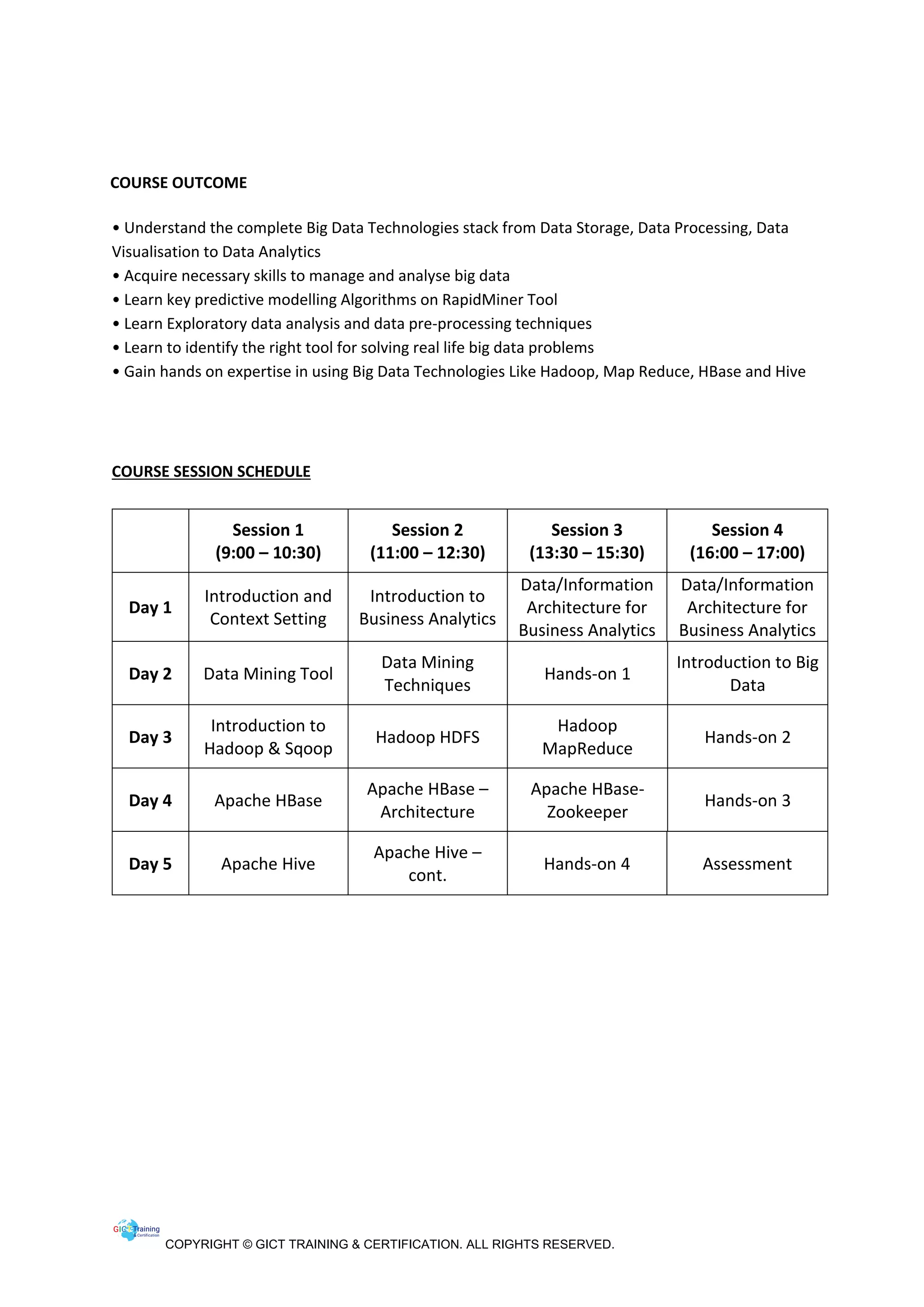
COURSE SESSION SCHEDULE
Session 1
(9:00 – 10:30)
Session 2
(11:00 – 12:30)
Session 3
(13:30 – 15:30)
Session 4
(16:00 – 17:00)
Day 1
Introduction and
Context Setting
Introduction to
Business Analytics
Data/Information
Architecture for
Business Analytics
Data/Information
Architecture for
Business Analytics
Day 2 Data Mining Tool
Data Mining
Techniques
Hands-on 1
Introduction to Big
Data
Day 3
Introduction to
Hadoop & Sqoop
Hadoop HDFS
Hadoop
MapReduce
Hands-on 2
Day 4 Apache HBase
Apache HBase –
Architecture
Apache HBase-
Zookeeper
Hands-on 3
Day 5 Apache Hive
Apache Hive –
cont.
Hands-on 4 Assessment
COURSE OUTCOME
• Understand the complete Big Data Technologies stack from Data Storage, Data Processing, Data
Visualisation to Data Analytics
• Acquire necessary skills to manage and analyse big data
• Learn key predictive modelling Algorithms on RapidMiner Tool
• Learn Exploratory data analysis and data pre-processing techniques
• Learn to identify the right tool for solving real life big data problems
• Gain hands on expertise in using Big Data Technologies Like Hadoop, Map Reduce, HBase and Hive
COPYRIGHT © GICT TRAINING & CERTIFICATION. ALL RIGHTS RESERVED.
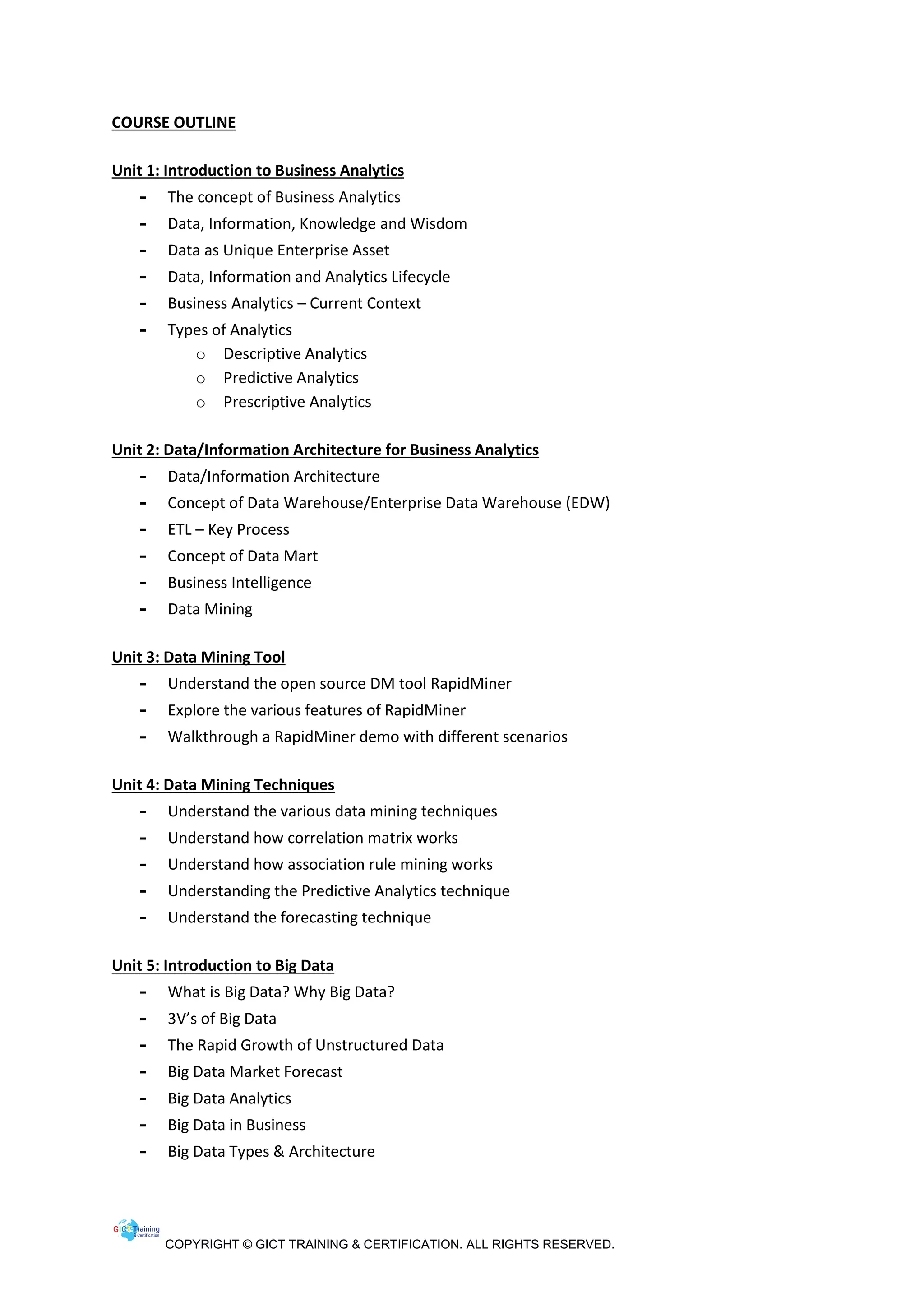
COURSE OUTLINE
Unit 1: Introduction to Business Analytics
- The concept of Business Analytics
- Data, Information, Knowledge and Wisdom
- Data as Unique Enterprise Asset
- Data, Information and Analytics Lifecycle
- Business Analytics – Current Context
- Types of Analytics
o Descriptive Analytics
o Predictive Analytics
o Prescriptive Analytics
Unit 2: Data/Information Architecture for Business Analytics
- Data/Information Architecture
- Concept of Data Warehouse/Enterprise Data Warehouse (EDW)
- ETL – Key Process
- Concept of Data Mart
- Business Intelligence
- Data Mining
Unit 3: Data Mining Tool
- Understand the open source DM tool RapidMiner
- Explore the various features of RapidMiner
- Walkthrough a RapidMiner demo with different scenarios
Unit 4: Data Mining Techniques
- Understand the various data mining techniques
- Understand how correlation matrix works
- Understand how association rule mining works
- Understanding the Predictive Analytics technique
- Understand the forecasting technique
Unit 5: Introduction to Big Data
- What is Big Data? Why Big Data?
- 3V’s of Big Data
- The Rapid Growth of Unstructured Data
- Big Data Market Forecast
- Big Data Analytics
- Big Data in Business
- Big Data Types & Architecture
COPYRIGHT © GICT TRAINING & CERTIFICATION. ALL RIGHTS RESERVED.
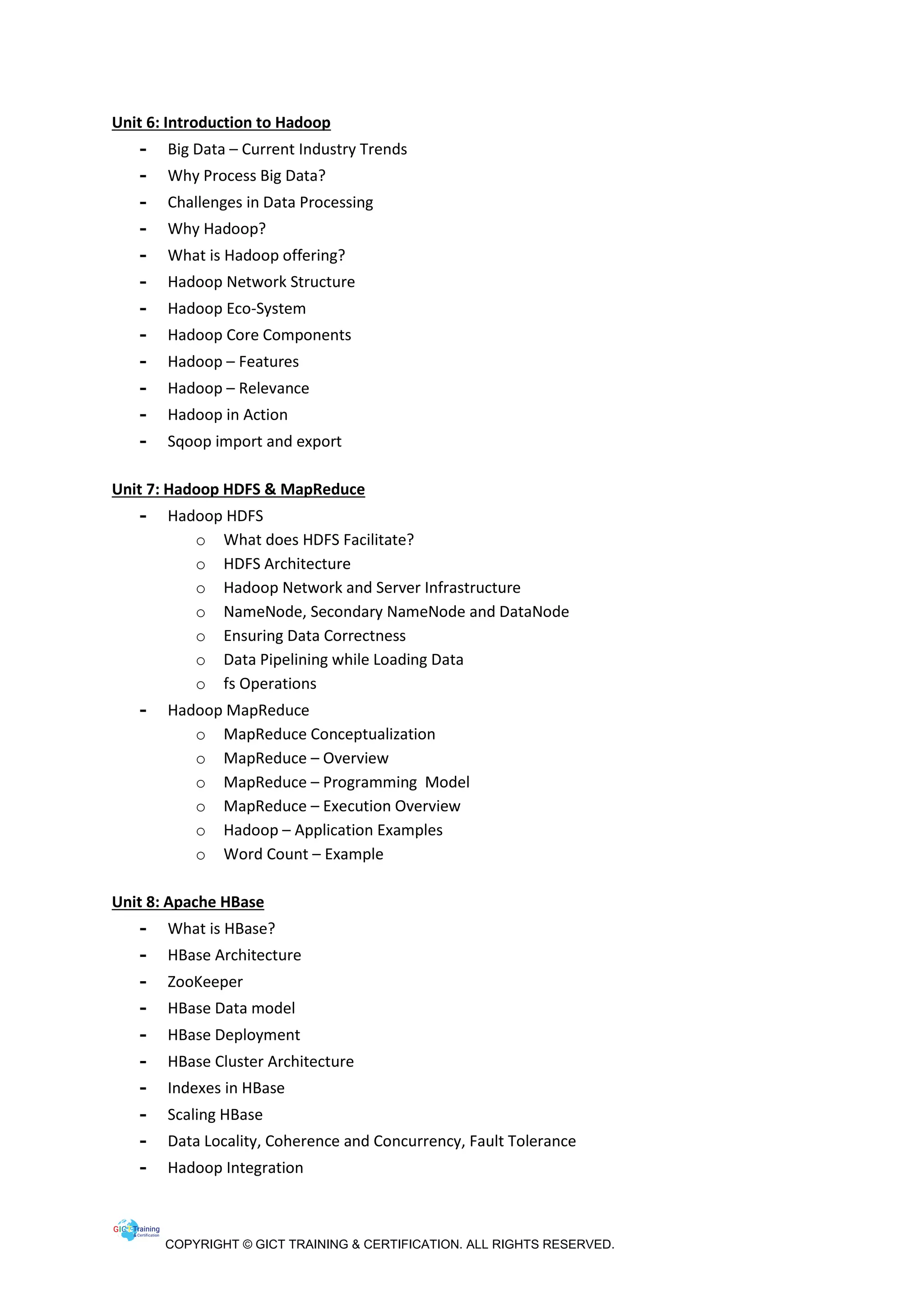
Unit 6: Introduction to Hadoop
- Big Data – Current Industry Trends
- Why Process Big Data?
- Challenges in Data Processing
- Why Hadoop?
- What is Hadoop offering?
- Hadoop Network Structure
- Hadoop Eco-System
- Hadoop Core Components
- Hadoop – Features
- Hadoop – Relevance
- Hadoop in Action
- Sqoop import and export
Unit 7: Hadoop HDFS & MapReduce
- Hadoop HDFS
o What does HDFS Facilitate?
o HDFS Architecture
o Hadoop Network and Server Infrastructure
o NameNode, Secondary NameNode and DataNode
o Ensuring Data Correctness
o Data Pipelining while Loading Data
o fs Operations
- Hadoop MapReduce
o MapReduce Conceptualization
o MapReduce – Overview
o MapReduce – Programming Model
o MapReduce – Execution Overview
o Hadoop – Application Examples
o Word Count – Example
Unit 8: Apache HBase
- What is HBase?
- HBase Architecture
- ZooKeeper
- HBase Data model
- HBase Deployment
- HBase Cluster Architecture
- Indexes in HBase
- Scaling HBase
- Data Locality, Coherence and Concurrency, Fault Tolerance
- Hadoop Integration
COPYRIGHT © GICT TRAINING & CERTIFICATION. ALL RIGHTS RESERVED.
- High-Level Architecture
- Replication of Data Across Data Centres
- HBase Applications
- Advantages and Disadvantages
Unit 9: Apache Hive
– What is Hive?
– Why Hive?
– Where to use Hive?
– Hive Architecture
– Hive: Benefits
– Hive: Tradeoffs
– Hive: Real world Examples
WRITTEN ASSESSMENT
As part of the written examination, each participant will be assessed individually on the last day of the
training for their understanding of the subject matter and ability to evaluate, choose and apply them
in specific context and also the ability to identify and manage risks. The assessment focuses on higher
levels of learning in Bloom’s taxonomy: Application, Analysis, Synthesis and Evaluation.
This written examination will primarily consist of 40 multiple choice questions spanning various
aspects as covered in the program. It is an individual, competency-based assessment.
EXAM PREPARATION
The objective of the certification examination is to evaluate the knowledge + skills acquired by the
participants during the course on Big Data. The weightage in key topics of the course as follows:
 Introduction to Business Analytics [10%]
 Data/Information Architecture for Business Analytics [15]
 Data Mining Tool [5]
 Data Mining Techniques [10]
 Introduction to Big Data [10%]
 Introduction to Hadoop [15]
 Hadoop HDFS & MapReduce [15%]
 Apache HBase [10%]
 Apache Hive [10%]
…………………

Certified Big Data Science Analyst (CBDSA)

  • 1.
    COPYRIGHT © GICTTRAINING & CERTIFICATION. ALL RIGHTS RESERVED. Certified Big Data Science Analyst (CBDSA) Course Outline www.globalicttraining.com
  • 2.
    COPYRIGHT © GICTTRAINING & CERTIFICATION. ALL RIGHTS RESERVED. Certified Big Data Science Analyst Program DURATION  5 Days COURSE OBJECTIVES The statistic shows a revenue forecast for the global big data industry from 2011 to 2026. For 2017, the source projects the global big data market size to grow to just under 34 billion U.S. dollars in revenue(https://www.statista.com/statistics/254266/global-big-data-market- forecast/) The creation and consumption of data continues to grow by leaps and bounds and with it the investment in big data analytics hardware, software, and services and in data scientists and their continuing education. The availability of very large data sets is one of the reasons Deep Learning, a sub-set of artificial intelligence (AI), has recently emerged as the hottest tech trend, with Google, Facebook, Baidu, Amazon, IBM, Intel, and Microsoft, all with very deep pockets, investing in acquiring talent and releasing open AI hardware and software. The increasing interest and investment in AI, in turn, will lead to the emergence of new tools for collecting and analysing data and new enterprise roles and responsibilities. Here are a few predictions—based on analysis by the International Institute for Analytics (IIA), IDC, and New Vantage Partners—regarding the market for big data analytics. The big data analytics market will soon surpass $200 billion IDC says that worldwide revenues for big data and business analytics will grow from $130.1 billion in 2016 to more than $203 billion in 2020, at a compound annual growth rate (CAGR) of 11.7%. In addition to being the industry with the largest investment in big data and business analytics solutions (nearly $17 billion in 2016), banking will see the fastest spending growth. There’s gold in the mountains of data By the end of 2017, revenue growth from information-based products will double the rest of the product/service portfolio for one third of Fortune 500 companies, says IDC. Raw data and various value-added content will be bought and sold either via marketplaces or in bilateral transactions and enterprises will begin to develop methods for valuing their data (see Chief Data Officer below). “Data monetization” will become a major source of revenues, as the world will create 180 zettabytes of data (or 180 trillion gigabytes) in 2025, up from less than 10 zettabytes in 2015, according to IDC.
  • 3.
    COPYRIGHT © GICTTRAINING & CERTIFICATION. ALL RIGHTS RESERVED. This course aims at introducing the concept of Business Analytics and its importance in today’s market. Participants will understand different Data Mining techniques and tool (Rapid Miner). We aim to educate our participants about the Big Data Solution(Hadoop) and the components working on top of Hadoop (MapReduce, HBase, Hive, Sqoop). By the end of this course, participants will get a clear view of how the Big Data storage and processing works to accomplish today’s growing need to work on all variety and volume of data. As part of the course, participant will be given a case study and it would cover all the aspects of the Business Analytics and Big Data covered in the course. Participants will be required to give a solution to the problem using all components taught in the course. TARGETED AUDIENCE  Data Analyst - Statistics and Mining  Big Data Analyst  Operations Research Analyst  Senior Data Analyst- Statistics and Mining  Data Scientist PRE-REQUISITES Participants should preferably have experience in software development with Java/Unix/Linux environment and good understanding on data/business analytics. PROGRAM STRUCTURE Certified Big Data Science Analyst program is a 5-day intensive training program with the following assessment components. Component 1. Written Examination Component 2. Project Work Component (PWC) These components are individual based. Participants will need to obtain 70% in both the components in order to qualify for this certification. If the participant fails one of the components, they will not pass the course and have to re-take that particular failed component. If they fail both components, they will have to re-take the assessment.
  • 4.
    COPYRIGHT © GICTTRAINING & CERTIFICATION. ALL RIGHTS RESERVED. COURSE SESSION SCHEDULE Session 1 (9:00 – 10:30) Session 2 (11:00 – 12:30) Session 3 (13:30 – 15:30) Session 4 (16:00 – 17:00) Day 1 Introduction and Context Setting Introduction to Business Analytics Data/Information Architecture for Business Analytics Data/Information Architecture for Business Analytics Day 2 Data Mining Tool Data Mining Techniques Hands-on 1 Introduction to Big Data Day 3 Introduction to Hadoop & Sqoop Hadoop HDFS Hadoop MapReduce Hands-on 2 Day 4 Apache HBase Apache HBase – Architecture Apache HBase- Zookeeper Hands-on 3 Day 5 Apache Hive Apache Hive – cont. Hands-on 4 Assessment COURSE OUTCOME • Understand the complete Big Data Technologies stack from Data Storage, Data Processing, Data Visualisation to Data Analytics • Acquire necessary skills to manage and analyse big data • Learn key predictive modelling Algorithms on RapidMiner Tool • Learn Exploratory data analysis and data pre-processing techniques • Learn to identify the right tool for solving real life big data problems • Gain hands on expertise in using Big Data Technologies Like Hadoop, Map Reduce, HBase and Hive
  • 5.
    COPYRIGHT © GICTTRAINING & CERTIFICATION. ALL RIGHTS RESERVED. COURSE OUTLINE Unit 1: Introduction to Business Analytics - The concept of Business Analytics - Data, Information, Knowledge and Wisdom - Data as Unique Enterprise Asset - Data, Information and Analytics Lifecycle - Business Analytics – Current Context - Types of Analytics o Descriptive Analytics o Predictive Analytics o Prescriptive Analytics Unit 2: Data/Information Architecture for Business Analytics - Data/Information Architecture - Concept of Data Warehouse/Enterprise Data Warehouse (EDW) - ETL – Key Process - Concept of Data Mart - Business Intelligence - Data Mining Unit 3: Data Mining Tool - Understand the open source DM tool RapidMiner - Explore the various features of RapidMiner - Walkthrough a RapidMiner demo with different scenarios Unit 4: Data Mining Techniques - Understand the various data mining techniques - Understand how correlation matrix works - Understand how association rule mining works - Understanding the Predictive Analytics technique - Understand the forecasting technique Unit 5: Introduction to Big Data - What is Big Data? Why Big Data? - 3V’s of Big Data - The Rapid Growth of Unstructured Data - Big Data Market Forecast - Big Data Analytics - Big Data in Business - Big Data Types & Architecture
  • 6.
    COPYRIGHT © GICTTRAINING & CERTIFICATION. ALL RIGHTS RESERVED. Unit 6: Introduction to Hadoop - Big Data – Current Industry Trends - Why Process Big Data? - Challenges in Data Processing - Why Hadoop? - What is Hadoop offering? - Hadoop Network Structure - Hadoop Eco-System - Hadoop Core Components - Hadoop – Features - Hadoop – Relevance - Hadoop in Action - Sqoop import and export Unit 7: Hadoop HDFS & MapReduce - Hadoop HDFS o What does HDFS Facilitate? o HDFS Architecture o Hadoop Network and Server Infrastructure o NameNode, Secondary NameNode and DataNode o Ensuring Data Correctness o Data Pipelining while Loading Data o fs Operations - Hadoop MapReduce o MapReduce Conceptualization o MapReduce – Overview o MapReduce – Programming Model o MapReduce – Execution Overview o Hadoop – Application Examples o Word Count – Example Unit 8: Apache HBase - What is HBase? - HBase Architecture - ZooKeeper - HBase Data model - HBase Deployment - HBase Cluster Architecture - Indexes in HBase - Scaling HBase - Data Locality, Coherence and Concurrency, Fault Tolerance - Hadoop Integration
  • 7.
    COPYRIGHT © GICTTRAINING & CERTIFICATION. ALL RIGHTS RESERVED. - High-Level Architecture - Replication of Data Across Data Centres - HBase Applications - Advantages and Disadvantages Unit 9: Apache Hive – What is Hive? – Why Hive? – Where to use Hive? – Hive Architecture – Hive: Benefits – Hive: Tradeoffs – Hive: Real world Examples WRITTEN ASSESSMENT As part of the written examination, each participant will be assessed individually on the last day of the training for their understanding of the subject matter and ability to evaluate, choose and apply them in specific context and also the ability to identify and manage risks. The assessment focuses on higher levels of learning in Bloom’s taxonomy: Application, Analysis, Synthesis and Evaluation. This written examination will primarily consist of 40 multiple choice questions spanning various aspects as covered in the program. It is an individual, competency-based assessment. EXAM PREPARATION The objective of the certification examination is to evaluate the knowledge + skills acquired by the participants during the course on Big Data. The weightage in key topics of the course as follows:  Introduction to Business Analytics [10%]  Data/Information Architecture for Business Analytics [15]  Data Mining Tool [5]  Data Mining Techniques [10]  Introduction to Big Data [10%]  Introduction to Hadoop [15]  Hadoop HDFS & MapReduce [15%]  Apache HBase [10%]  Apache Hive [10%] …………………