T A M A R A J O R Q U I E R A
7
Describa y grafique brevemente el estudio:
“Cell differentiation: Hepatocytes from non-hepatic adult
stem cells” Malcolm R. Alison, Richard Poulsom,
Rosemary Jeffery, Amar P. Dhillon, Alberto Quaglia, Joe
Jacob, Marco Novelli, Grant Prentice, Jill Williamson
and Nicholas A. Wright Nature 406, 257 (20 July
2000) doi:10.1038/35018642
T A M A R A J O R Q U I E R A
ABSTRACT
Stem cells are undifferentiated long-lived cells that are capable of many rounds of
division. Here we show that adult human liver cells can be derived from stem
cells originating in the bone marrow or circulating outside the liver, raising the
possibility that blood-system stem cells could be used clinically to generate
hepatocytes for replacing damaged tissue.
T A M A R A J O R Q U I E R A
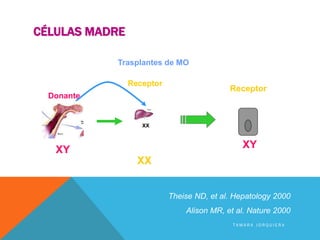
Evidencia en
seres humanos
Hepatocito
Receptor
XY
XX
Donante
XY
Receptor
XX
Theise ND, et al. Hepatology 2000
Alison MR, et al. Nature 2000
Trasplantes de MO
CÉLULAS MADRE
T A M A R A J O R Q U I E R A
8
Describa y grafique brevemente el estudio:
“Chimerism of the transplanted heart”. De
Quaini F, Urbanek K, Beltrami AP, Finato N,
Beltrami CA, Nadal-Ginard B, Kajstura J, Leri A,
Anversa P. N Engl J Med 2002 Jan 3;346(1):5-
15.
T A M A R A J O R Q U I E R A
Background
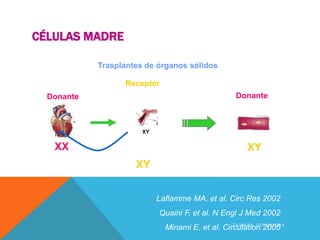
Cases in which a male patient receives a heart from a female donor provide an unusual
opportunity to test whether primitive cells translocate from the recipient to the graft
and whether cells with the phenotypic characteristics of those of the recipient
ultimately reside in the donor heart. The Y chromosome can be used to detect
migrated undifferentiated cells expressing stem-cell antigens and to discriminate
between primitive cells derived from the recipient and those derived from the donor.
Full Text of Background ...
Methods
We examined samples from the atria of the recipient and the atria and ventricles of the
graft by fluorescence in situ hybridization to determine whether Y chromosomes were
present in eight hearts from female donors implanted into male patients. Primitive
cells bearing Y chromosomes that expressed c-kit, MDR1, and Sca-1 were also
investigated.
Full Text of Methods ...
T A M A R A J O R Q U I E R A
Results
Myocytes, coronary arterioles, and capillaries that had a Y chromosome made up 7 to 10 percent
of those in the donor hearts and were highly proliferative. As compared with the ventricles of
control hearts, the ventricles of the transplanted hearts had markedly increased numbers of
cells that were positive for c-kit, MDR1, or Sca-1. The number of primitive cells was higher in
the atria of the hosts and the atria of the donor hearts than in the ventricles of the donor
hearts, and 12 to 16 percent of these cells contained a Y chromosome. Undifferentiated cells
were negative for markers of bone marrow origin. Progenitor cells expressing MEF2, GATA-4,
and nestin (which identify the cells as myocytes) and Flk1 (which identifies the cells as
endothelial cells) were identified.
Full Text of Results ...
Conclusions
Our results show a high level of cardiac chimerism caused by the migration of primitive cells from
the recipient to the grafted heart. Putative stem cells and progenitor cells were identified in
control myocardium and in increased numbers in transplanted hearts.
T A M A R A J O R Q U I E R A
CÉLULAS MADRE
Evidencia en
seres humanos
Trasplantes de órganos sólidos
XY
Donante
Laflamme MA, et al. Circ Res 2002
Quaini F, et al. N Engl J Med 2002
Minami E, et al. Circulation 2005
XX
XY
Donante
Receptor
XY
Cardiomiocito
T A M A R A J O R Q U I E R A
9
Describa y grafique brevemente el estudio:
“Allogeneic mesenchymal stem cells restore
cardiac function in chronic ischemic
cardiomyopathy via trilineage differentiating
capacity” PNAS 2009 106 (33) 14022-
14027; doi:10.1073/pnas.0903201106, vol.
106 no. 33, p. 14022–27
T A M A R A J O R Q U I E R A
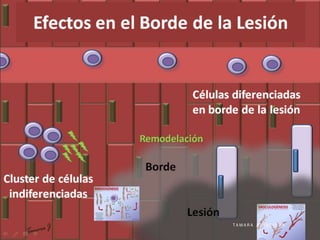
ABSTRACT
The mechanism(s) underlying cardiac reparative effects of bone marrow-derived mesenchymal stem cells (MSC)
remain highly controversial. Here we tested the hypothesis that MSCs regenerate chronically infarcted
myocardium through mechanisms comprising long-term engraftment and trilineage differentiation. Twelve
weeks after myocardial infarction, female swine received catheter-based transendocardial injections of
either placebo (n = 4) or male allogeneic MSCs (200 million; n = 6). Animals underwent serial cardiac
magnetic resonance imaging, and in vivo cell fate was determined by co-localization of Y-chromosome (Ypos)
cells with markers of cardiac, vascular muscle, and endothelial lineages. MSCs engrafted in infarct and
border zones and differentiated into cardiomyocytes as ascertained by co-localization with GATA-4, Nkx2.5,
and α-sarcomeric actin. In addition, Ypos MSCs exhibited vascular smooth muscle and endothelial cell
differentiation, contributing to large and small vessel formation. Infarct size was reduced from 19.3 ± 1.7%
to 13.9 ± 2.0% (P < 0.001), and ejection fraction (EF) increased from 35.0 ± 1.7% to 41.3 ± 2.7% (P < 0.05)
in MSC but not placebo pigs over 12 weeks. This was accompanied by increases in regional contractility and
myocardial blood flow (MBF), particularly in the infarct border zone. Importantly, MSC engraftment correlated
with functional recovery in contractility (R = 0.85, P < 0.05) and MBF (R = 0.76, P < 0.01). Together these
findings demonstrate long-term MSC survival, engraftment, and trilineage differentiation following
transplantation into chronically scarred myocardium. MSCs are an adult stem cell with the capacity for
cardiomyogenesis and vasculogenesis which contribute, at least in part, to their ability to repair chronically
scarred myocardium.
T A M A R A J O R Q U I E R A

Semana 15 2010

  • 1.
    T A MA R A J O R Q U I E R A
  • 2.
    7 Describa y grafiquebrevemente el estudio: “Cell differentiation: Hepatocytes from non-hepatic adult stem cells” Malcolm R. Alison, Richard Poulsom, Rosemary Jeffery, Amar P. Dhillon, Alberto Quaglia, Joe Jacob, Marco Novelli, Grant Prentice, Jill Williamson and Nicholas A. Wright Nature 406, 257 (20 July 2000) doi:10.1038/35018642 T A M A R A J O R Q U I E R A
  • 3.
    ABSTRACT Stem cells areundifferentiated long-lived cells that are capable of many rounds of division. Here we show that adult human liver cells can be derived from stem cells originating in the bone marrow or circulating outside the liver, raising the possibility that blood-system stem cells could be used clinically to generate hepatocytes for replacing damaged tissue. T A M A R A J O R Q U I E R A
  • 4.
    Evidencia en seres humanos Hepatocito Receptor XY XX Donante XY Receptor XX TheiseND, et al. Hepatology 2000 Alison MR, et al. Nature 2000 Trasplantes de MO CÉLULAS MADRE T A M A R A J O R Q U I E R A
  • 5.
    8 Describa y grafiquebrevemente el estudio: “Chimerism of the transplanted heart”. De Quaini F, Urbanek K, Beltrami AP, Finato N, Beltrami CA, Nadal-Ginard B, Kajstura J, Leri A, Anversa P. N Engl J Med 2002 Jan 3;346(1):5- 15. T A M A R A J O R Q U I E R A
  • 6.
    Background Cases in whicha male patient receives a heart from a female donor provide an unusual opportunity to test whether primitive cells translocate from the recipient to the graft and whether cells with the phenotypic characteristics of those of the recipient ultimately reside in the donor heart. The Y chromosome can be used to detect migrated undifferentiated cells expressing stem-cell antigens and to discriminate between primitive cells derived from the recipient and those derived from the donor. Full Text of Background ... Methods We examined samples from the atria of the recipient and the atria and ventricles of the graft by fluorescence in situ hybridization to determine whether Y chromosomes were present in eight hearts from female donors implanted into male patients. Primitive cells bearing Y chromosomes that expressed c-kit, MDR1, and Sca-1 were also investigated. Full Text of Methods ... T A M A R A J O R Q U I E R A
  • 7.
    Results Myocytes, coronary arterioles,and capillaries that had a Y chromosome made up 7 to 10 percent of those in the donor hearts and were highly proliferative. As compared with the ventricles of control hearts, the ventricles of the transplanted hearts had markedly increased numbers of cells that were positive for c-kit, MDR1, or Sca-1. The number of primitive cells was higher in the atria of the hosts and the atria of the donor hearts than in the ventricles of the donor hearts, and 12 to 16 percent of these cells contained a Y chromosome. Undifferentiated cells were negative for markers of bone marrow origin. Progenitor cells expressing MEF2, GATA-4, and nestin (which identify the cells as myocytes) and Flk1 (which identifies the cells as endothelial cells) were identified. Full Text of Results ... Conclusions Our results show a high level of cardiac chimerism caused by the migration of primitive cells from the recipient to the grafted heart. Putative stem cells and progenitor cells were identified in control myocardium and in increased numbers in transplanted hearts. T A M A R A J O R Q U I E R A
  • 8.
    CÉLULAS MADRE Evidencia en sereshumanos Trasplantes de órganos sólidos XY Donante Laflamme MA, et al. Circ Res 2002 Quaini F, et al. N Engl J Med 2002 Minami E, et al. Circulation 2005 XX XY Donante Receptor XY Cardiomiocito T A M A R A J O R Q U I E R A
  • 9.
    9 Describa y grafiquebrevemente el estudio: “Allogeneic mesenchymal stem cells restore cardiac function in chronic ischemic cardiomyopathy via trilineage differentiating capacity” PNAS 2009 106 (33) 14022- 14027; doi:10.1073/pnas.0903201106, vol. 106 no. 33, p. 14022–27 T A M A R A J O R Q U I E R A
  • 10.
    ABSTRACT The mechanism(s) underlyingcardiac reparative effects of bone marrow-derived mesenchymal stem cells (MSC) remain highly controversial. Here we tested the hypothesis that MSCs regenerate chronically infarcted myocardium through mechanisms comprising long-term engraftment and trilineage differentiation. Twelve weeks after myocardial infarction, female swine received catheter-based transendocardial injections of either placebo (n = 4) or male allogeneic MSCs (200 million; n = 6). Animals underwent serial cardiac magnetic resonance imaging, and in vivo cell fate was determined by co-localization of Y-chromosome (Ypos) cells with markers of cardiac, vascular muscle, and endothelial lineages. MSCs engrafted in infarct and border zones and differentiated into cardiomyocytes as ascertained by co-localization with GATA-4, Nkx2.5, and α-sarcomeric actin. In addition, Ypos MSCs exhibited vascular smooth muscle and endothelial cell differentiation, contributing to large and small vessel formation. Infarct size was reduced from 19.3 ± 1.7% to 13.9 ± 2.0% (P < 0.001), and ejection fraction (EF) increased from 35.0 ± 1.7% to 41.3 ± 2.7% (P < 0.05) in MSC but not placebo pigs over 12 weeks. This was accompanied by increases in regional contractility and myocardial blood flow (MBF), particularly in the infarct border zone. Importantly, MSC engraftment correlated with functional recovery in contractility (R = 0.85, P < 0.05) and MBF (R = 0.76, P < 0.01). Together these findings demonstrate long-term MSC survival, engraftment, and trilineage differentiation following transplantation into chronically scarred myocardium. MSCs are an adult stem cell with the capacity for cardiomyogenesis and vasculogenesis which contribute, at least in part, to their ability to repair chronically scarred myocardium. T A M A R A J O R Q U I E R A
  • 11.
    T A MA R A J O R Q U I E R A