Self-contained sequence representation (SCSR): Bridging the gap between bioinformatics and cheminformatics K. T. Taylor, W. L. Chen, B. D. Christie, Joseph L. Durant, D. L. Grier, B. A. Leland, J. G. Nourse Recent Progress in Chemical Structure Representation ACS Boston 2010: CINF Division of Chemical Information August 23, 2010
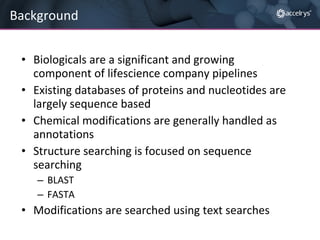
Biologicals are a significant and growing component of lifescience company pipelines Existing databases of proteins and nucleotides are largely sequence based Chemical modifications are generally handled as annotations Structure searching is focused on sequence searching BLAST FASTA Modifications are searched using text searches Background
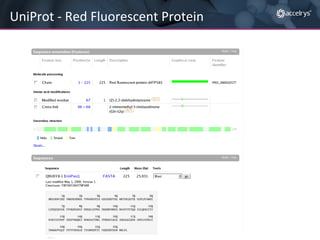
UniProt - Red Fluorescent Protein
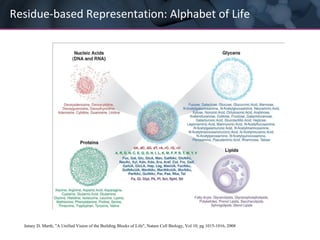
Residue-based Representation: Alphabet of Life Jamey D. Marth, "A Unified Vision of the Building Blocks of Life", Nature Cell Biology, Vol 10, pg 1015-1016, 2008
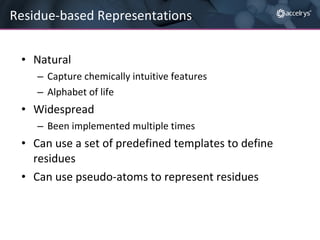
Natural Capture chemically intuitive features Alphabet of life Widespread Been implemented multiple times Can use a set of predefined templates to define residues Can use pseudo-atoms to represent residues Residue-based Representations
Provides significant size reduction ~8x for proteins ~20x for nucleotides ~10x for saccharides Converts a large biomolecule into a "small molecule" More efficient storage More efficient searching Advantages of Pseudo-Atoms
What is the residue definition? Does the cysteine pseudoatom include the sulfur? What is the connectivity? Do I read a cyclic peptide clockwise or counter-clockwise? Where is the phosphate bound? Problems with Pseudo-Atoms
Biologics are growing rapidly Average 22% of pipeline, 45%-100% in some companies Current definitions are not safely transferable between laboratories Increased reliance on partners, strategic alliances and CROs Data integrity is an issue Companies seeking one solution for traditional drugs and biologics Changing R&D landscape
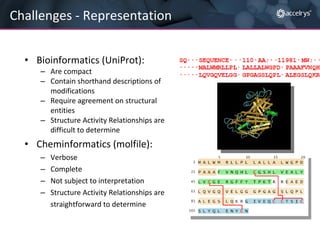
Challenges - Representation Bioinformatics (UniProt): Are compact Contain shorthand descriptions of modifications Require agreement on structural entities Structure Activity Relationships are difficult to determine Cheminformatics (molfile): Verbose Complete Not subject to interpretation Structure Activity Relationships are straightforward to determine
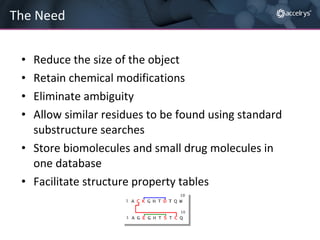
Reduce the size of the object Retain chemical modifications Eliminate ambiguity Allow similar residues to be found using standard substructure searches Store biomolecules and small drug molecules in one database Facilitate structure property tables The Need
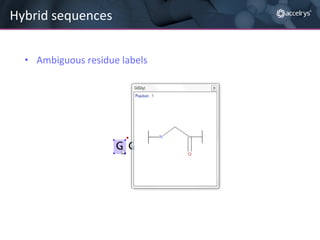
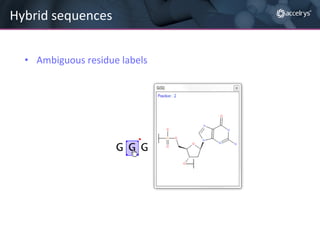
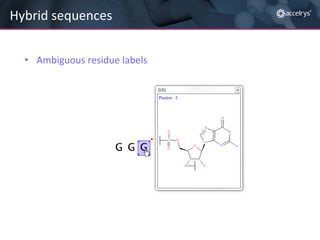
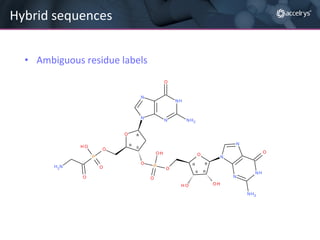
Hybrid sequences Ambiguous residue labels
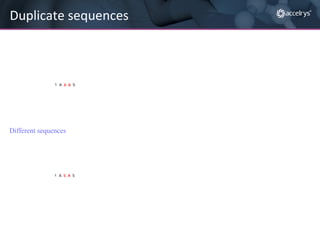
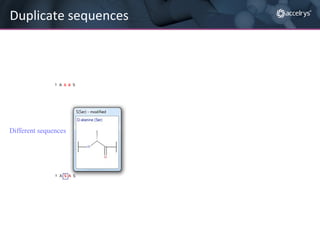
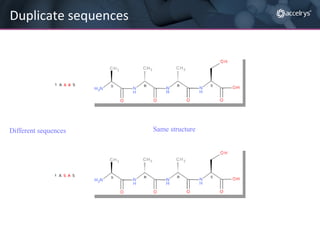
Duplicate sequences Different sequences
Duplicate sequences Same structure Different sequences
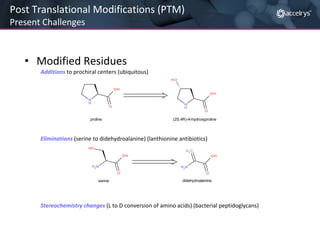
Post Translational Modifications (PTM) Present Challenges Modified Residues Additions  to prochiral centers (ubiquitous) Eliminations  (serine to didehydroalanine) (lanthionine antibiotics) Stereochemistry   changes  (L to D conversion of amino acids) (bacterial peptidoglycans)
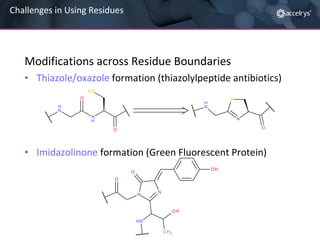
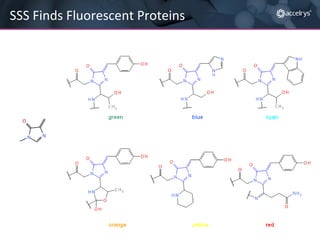
Challenges in Using Residues Modifications across Residue Boundaries  Thiazole/oxazole  formation (thiazolylpeptide antibiotics) Imidazolinone  formation (Green Fluorescent Protein)
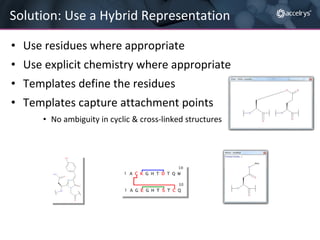
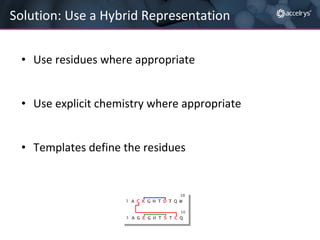
Solution: Use a Hybrid Representation Use residues where appropriate Use explicit chemistry where appropriate Templates define the residues Templates capture attachment points No ambiguity in cyclic & cross-linked structures
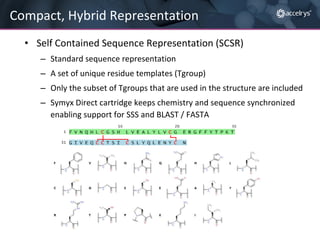
Self Contained Sequence Representation (SCSR) Standard sequence representation  A set of unique residue templates (Tgroup) Only the subset of Tgroups that are used in the structure are included Symyx Direct cartridge keeps chemistry and sequence synchronized enabling support for SSS and BLAST / FASTA Compact, Hybrid Representation
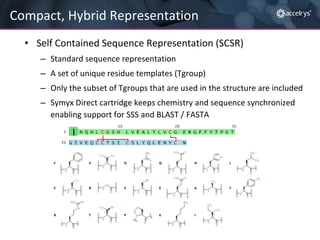
Self Contained Sequence Representation (SCSR) Standard sequence representation  A set of unique residue templates (Tgroup) Only the subset of Tgroups that are used in the structure are included Symyx Direct cartridge keeps chemistry and sequence synchronized enabling support for SSS and BLAST / FASTA Compact, Hybrid Representation F
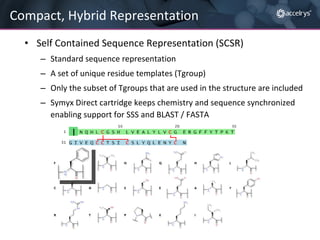
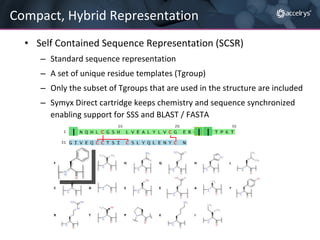
Self Contained Sequence Representation (SCSR) Standard sequence representation  A set of unique residue templates (Tgroup) Only the subset of Tgroups that are used in the structure are included Symyx Direct cartridge keeps chemistry and sequence synchronized enabling support for SSS and BLAST / FASTA Compact, Hybrid Representation F F F
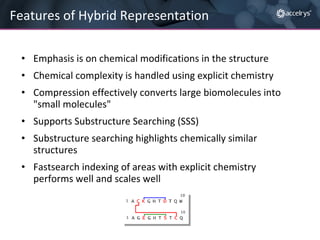
Features of Hybrid Representation Emphasis is on chemical modifications in the structure Chemical complexity is handled using explicit chemistry Compression effectively converts large biomolecules into "small molecules" Supports Substructure Searching (SSS) Substructure searching highlights chemically similar structures Fastsearch indexing of areas with explicit chemistry performs well and scales well
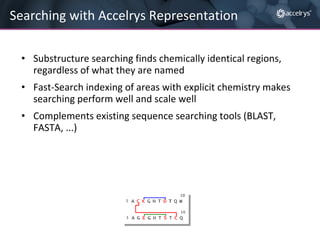
Searching with Accelrys Representation Substructure searching finds chemically identical regions, regardless of what they are named Fast-Search indexing of areas with explicit chemistry makes searching perform well and scale well Complements existing sequence searching tools (BLAST, FASTA, ...) ‏
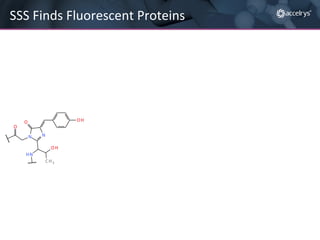
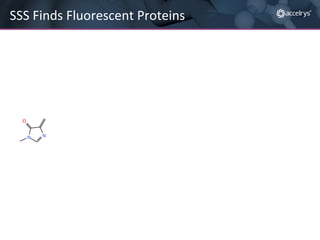
SSS Finds Fluorescent Proteins
Use residues where appropriate Use explicit chemistry where appropriate Templates define the residues Solution: Use a Hybrid Representation
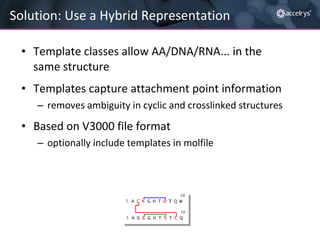
Template classes allow AA/DNA/RNA... in the same structure Templates capture attachment point information removes ambiguity in cyclic and crosslinked structures Based on V3000 file format optionally include templates in molfile Solution: Use a Hybrid Representation
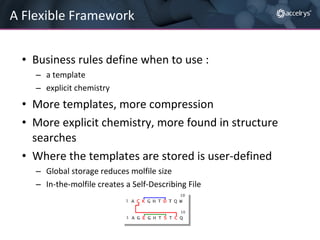
Business rules define when to use : a template explicit chemistry More templates, more compression More explicit chemistry, more found in structure searches Where the templates are stored is user-defined Global storage reduces molfile size In-the-molfile creates a Self-Describing File A Flexible Framework
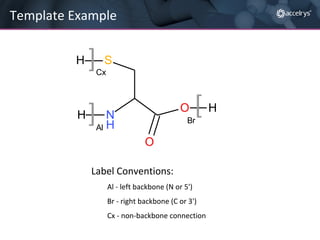
Template Example Label Conventions: Al - left backbone (N or 5') ‏ Br - right backbone (C or 3') ‏ Cx - non-backbone connection
Original residue identity Detailed connectivity Residue numbering Description of modifications  Sequence annotations What is registered?
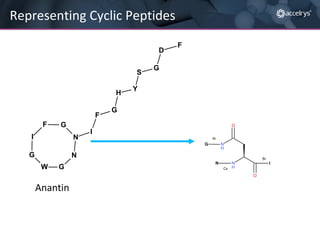
Representing Cyclic Peptides Anantin
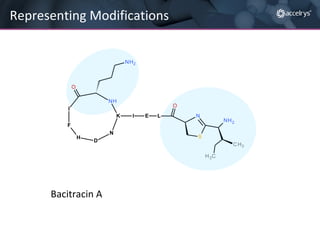
Representing Modifications Bacitracin A
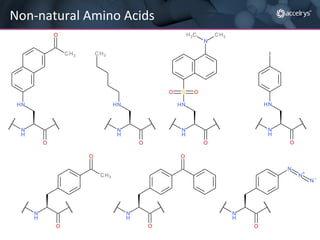
Non-natural Amino Acids
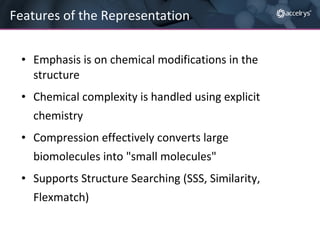
Emphasis is on chemical modifications in the structure Chemical complexity is handled using explicit chemistry Compression effectively converts large biomolecules into "small molecules" Supports Structure Searching (SSS, Similarity, Flexmatch) ‏ Features of the Representation
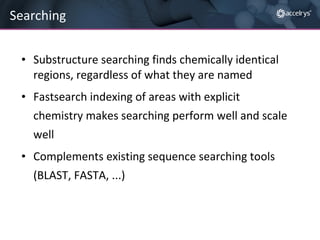
Substructure searching finds chemically identical regions, regardless of what they are named Fastsearch indexing of areas with explicit chemistry makes searching perform well and scale well Complements existing sequence searching tools (BLAST, FASTA, ...) ‏ Searching
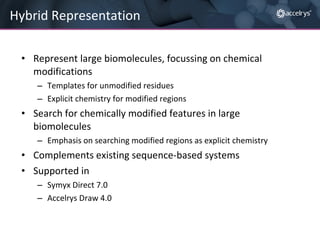
Represent large biomolecules, focussing on chemical modifications Templates for unmodified residues Explicit chemistry for modified regions Search for chemically modified features in large biomolecules Emphasis on searching modified regions as explicit chemistry Complements existing sequence-based systems Supported in Symyx Direct 7.0 Accelrys Draw 4.0 Hybrid Representation
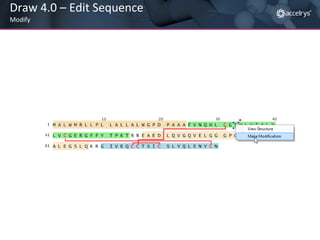
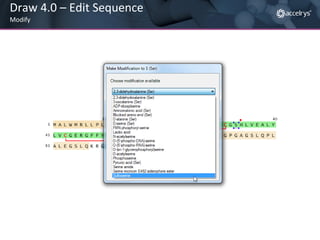
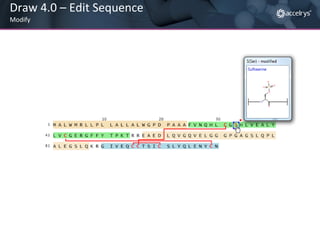
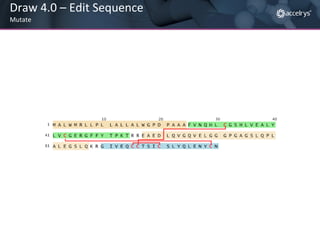
The following slides were not part of the formal presentation They reflect what was done in the live demonstration of Accelrys Draw 4.0 Supplementary material
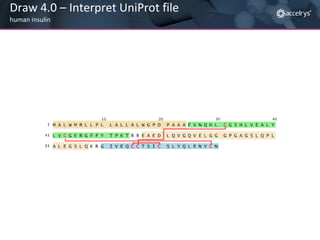
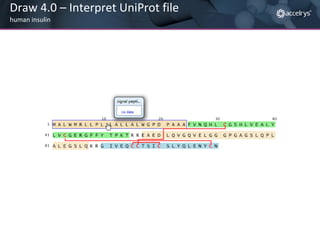
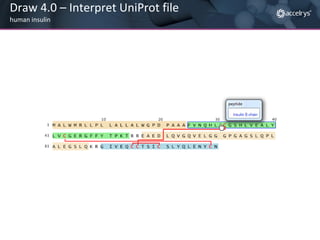
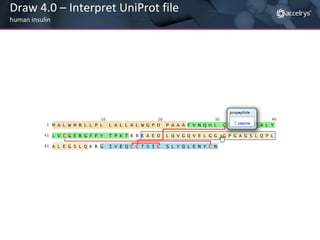
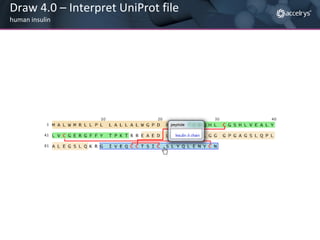
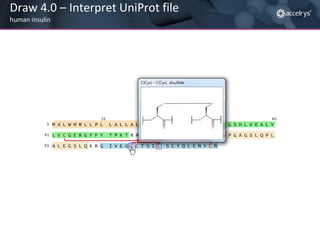
Draw 4.0 – Interpret UniProt file human insulin
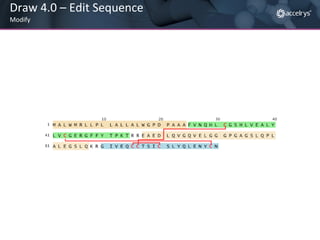
Draw 4.0 – Edit Sequence Modify
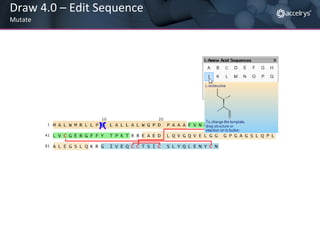
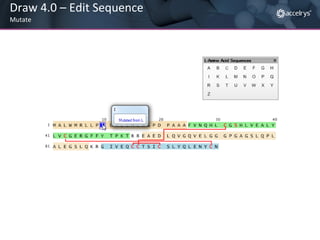
Draw 4.0 – Edit Sequence Mutate