Material of Screw Driver
Ruman Hasan
13MEB143
A4MA/38
Screwdriver
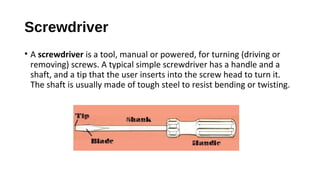
• A screwdriver is a tool, manual or powered, for turning (driving or
removing) screws. A typical simple screwdriver has a handle and a
shaft, and a tip that the user inserts into the screw head to turn it.
The shaft is usually made of tough steel to resist bending or twisting.
Raw Materials
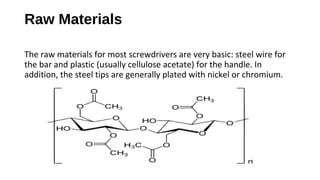
The raw materials for most screwdrivers are very basic: steel wire for
the bar and plastic (usually cellulose acetate) for the handle. In
addition, the steel tips are generally plated with nickel or chromium.
The Manufacturing Process
 Making the Steel bar
Handle
Making the tip
Making the steel bar
• Process 1:
First, coils of green wire (wire that has not yet been drawn to final size)
are delivered to a factory in large coils, some as heavy as 3,000
pounds (1,362 kilograms). The wire is usually about. 375 inch (.95
centimeter) in diameter. The wire is then machine-drawn to the
diameter necessary for the production run; one adjustable drawing
machine can produce any required diameter. In drawing, wire is fed
through a die with a reducing aperture until it assumes the proper
size.
• Process 2:
After the wire is drawn, it is annealed (heat treated) to obtain the
correct tensile strength in the metal. This process involves baking the
wire at a temperature of about 1,350 degrees Fahrenheit (732
degrees Celsius) for 12 hours
• Process 3:
Next, the wire is straightened by a string forge and then transferred to a cold
forming press, which cuts the wire to the appropriate length and forms the
tip of the screwdriver and the "wings" that will fit into the handle. These
wings can be seen through a clear or semi-clear plastic handle. The newly
formed "bar" (the actual screwdriver without Ats handle) is then heat
treated in an in-line furnace at approximately 1,555 degrees Fahrenheit
(846 degrees Celsius). This is a continuous flow process, and as the bars
come through the furnace they fall into an oil quench for cooling. The bars
are then placed in a draw back oven (450 to 500 degrees Fahrenheit or 232
to 259 degrees Celsius) and baked to a specified hardness
• Process 4:
After the cold forming press (step #3 above) cuts the wire, the
screwdriver is sent to a "swage and grind" operation, where dies form
blades for the tip from the heated wire. The tool is then ground and
the wings are formed
• Process 5:
If a professional model is being produced, the bar goes to a tipping
operation (an automatic tipping machine that creates the bullet
point), and then to a profilator machine (a machine that cuts a
"profile"). This latter machine cuts the four grooves or slots on the
sides above the point. The wire is then winged, and heat-treated in
the same way as the flat-tip screwdriver bars. Consumer model
Phillips screwdrivers are nickel plated, while the professional model is
polished and nickel/chrome plated.
Handles
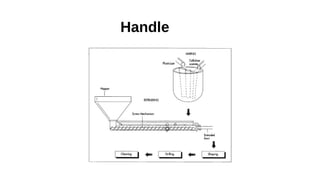
• The handles of a screwdriver are usually made of cellulose acetate; it
is delivered to the factory in powder form (cellulose acetate rosin)
and then mixed with a liquid plasticizer in a giant blender that holds
approximately 1,000 pounds (454 kilograms) of the mixed material. If
a colored handle is desired, pigments are added into the blender. The
resulting paste, which has the consistency of thick cake batter, then
goes to an extruder (a machine that forces a material out through an
opening, the way a meat grinder forces out strings of meat), which
extrudes a solid piece of cellulose acetate. The cellulose acetate is
then cut into small pellets.
Handle

Selection of Material for Screw Driver

  • 1.
    Material of ScrewDriver Ruman Hasan 13MEB143 A4MA/38
  • 2.
    Screwdriver • A screwdriveris a tool, manual or powered, for turning (driving or removing) screws. A typical simple screwdriver has a handle and a shaft, and a tip that the user inserts into the screw head to turn it. The shaft is usually made of tough steel to resist bending or twisting.
  • 3.
    Raw Materials The rawmaterials for most screwdrivers are very basic: steel wire for the bar and plastic (usually cellulose acetate) for the handle. In addition, the steel tips are generally plated with nickel or chromium.
  • 4.
    The Manufacturing Process Making the Steel bar Handle Making the tip
  • 5.
    Making the steelbar • Process 1: First, coils of green wire (wire that has not yet been drawn to final size) are delivered to a factory in large coils, some as heavy as 3,000 pounds (1,362 kilograms). The wire is usually about. 375 inch (.95 centimeter) in diameter. The wire is then machine-drawn to the diameter necessary for the production run; one adjustable drawing machine can produce any required diameter. In drawing, wire is fed through a die with a reducing aperture until it assumes the proper size.
  • 6.
    • Process 2: Afterthe wire is drawn, it is annealed (heat treated) to obtain the correct tensile strength in the metal. This process involves baking the wire at a temperature of about 1,350 degrees Fahrenheit (732 degrees Celsius) for 12 hours
  • 7.
    • Process 3: Next,the wire is straightened by a string forge and then transferred to a cold forming press, which cuts the wire to the appropriate length and forms the tip of the screwdriver and the "wings" that will fit into the handle. These wings can be seen through a clear or semi-clear plastic handle. The newly formed "bar" (the actual screwdriver without Ats handle) is then heat treated in an in-line furnace at approximately 1,555 degrees Fahrenheit (846 degrees Celsius). This is a continuous flow process, and as the bars come through the furnace they fall into an oil quench for cooling. The bars are then placed in a draw back oven (450 to 500 degrees Fahrenheit or 232 to 259 degrees Celsius) and baked to a specified hardness
  • 8.
    • Process 4: Afterthe cold forming press (step #3 above) cuts the wire, the screwdriver is sent to a "swage and grind" operation, where dies form blades for the tip from the heated wire. The tool is then ground and the wings are formed
  • 9.
    • Process 5: Ifa professional model is being produced, the bar goes to a tipping operation (an automatic tipping machine that creates the bullet point), and then to a profilator machine (a machine that cuts a "profile"). This latter machine cuts the four grooves or slots on the sides above the point. The wire is then winged, and heat-treated in the same way as the flat-tip screwdriver bars. Consumer model Phillips screwdrivers are nickel plated, while the professional model is polished and nickel/chrome plated.
  • 10.
    Handles • The handlesof a screwdriver are usually made of cellulose acetate; it is delivered to the factory in powder form (cellulose acetate rosin) and then mixed with a liquid plasticizer in a giant blender that holds approximately 1,000 pounds (454 kilograms) of the mixed material. If a colored handle is desired, pigments are added into the blender. The resulting paste, which has the consistency of thick cake batter, then goes to an extruder (a machine that forces a material out through an opening, the way a meat grinder forces out strings of meat), which extrudes a solid piece of cellulose acetate. The cellulose acetate is then cut into small pellets.
  • 11.