Social Emotional Learning (SEL)
in your home:
Community Circles and Conflict Cycle
What is SEL?
Social-emotional skills are the strategies one has for
managing strong emotions, navigating relationships, working
effectively with others, solving difficult problems, and making
responsible decisions.
Social-emotional skills pave the way for positive life
experiences. When these skills are taught and supported,
youth are more likely to succeed academically and have a
positive attitude toward self and school.
How can you help?
Social and emotional learning (SEL) starts at
home. Parents and families are critical partners in
helping their children develop social and emotional
know-how. They can model the kinds of skills,
attitudes, and behaviors we want all students to
master. And they can be important advocates for
SEL at school. (CASEL)
Why the need ?
Helps strengthen relationships at home
Connection
between
school and
home
 Builds a partnership
between home and
school
 Increases communication
 Provides consistent
language between
school and home
 Provides positive
behavioral strategies
Irving is now incorporating into
all aspects of the District:
● Panorama surveys
● Community circles
● Conflict cycles
● Restorative practices
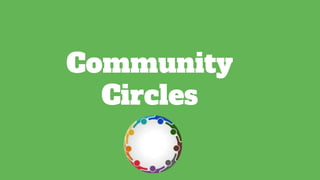
Community
Circles
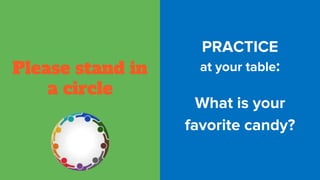
Please stand in
a circle
PRACTICE
at your table:
What is your
favorite candy?
What made
this work?
Norms:
1. Only the person with
the talking object can
speak
2. You can participate or
pass
3. You cannot respond to
what others say
Community
Circle
WHOLE GROUP:
What do you like to
do as a family?
Background behind Community Circles in schools
Research-based strategy to build relationships between people
A Community Circle is a safe discussion space in which students and the teacher
sit in a circle so that all members' faces are visible to one another. Community
circles build relationships within the classroom.
Background behind Community Circles in the home
Research-based strategy to build relationships between people
A Community Circle is a safe discussion space in which children and guardians sit
in a circle so that all members' faces are visible to one another. Community circles
build relationships within the home.
Think, Mix,
Share out
● When would be a good
time to use a
community circle in
your home?
● Brainstorm some
examples you can use
at home
Community Circles will build
trust and show you care. They
help with difficult conversations.
Conflict Cycle
Why use a
conflict cycle?
● Students seldom learn successful
behaviors for handling stress on
their own.
● Adults can help children break
the conflict cycle by teaching
children to regulate their
behavior in ways that bring more
satisfying results.
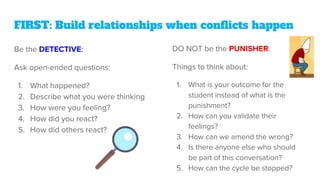
FIRST: Build relationships when conflicts happen
Be the DETECTIVE:
Ask open-ended questions:
1. What happened?
2. Describe what you were thinking
3. How were you feeling?
4. How did you react?
5. How did others react?
DO NOT be the PUNISHER:
Things to think about:
1. What is your outcome for the
student instead of what is the
punishment?
2. How can you validate their
feelings?
3. How can we amend the wrong?
4. Is there anyone else who should
be part of this conversation?
5. How can the cycle be stopped?
Make sure you
are listening
to the answers
Ask clarifying questions
Active listening through:
 Display appropriate body language
 Be calm
 Get down to their level
 Be private with the conversation
MODEL:
the fine line
between
detective and
punisher
Discussion Questions:
1. What did you notice overall?
2. How did the punisher’s words,
actions, and tone of voice
impact the child’s answers?
3. How did the detective’s words,
actions, and tone of voice
impact the child’s answers?
4. Reflect on your own
conversations when you were a
child. Do you have experiences
with the detective, the punisher,
or both?
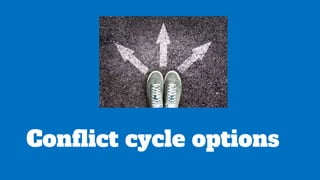
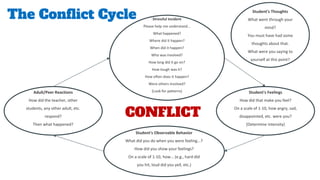
Conflict cycle options
The Conflict Cycle Stressful Incident
Please help me understand...
What happened?
Where did it happen?
When did it happen?
Who was involved?
How long did it go on?
How tough was it?
How often does it happen?
Were others involved?
(Look for patterns) Student's Feelings
How did that make you feel?
On a scale of 1-10, how angry, sad,
disappointed, etc. were you?
(Determine intensity)
Student's Observable Behavior
What did you do when you were feeling...?
How did you show your feelings?
On a scale of 1-10, how... (e.g., hard did
you hit, loud did you yell, etc.)
Student's Thoughts
What went through your
mind?
You must have had some
thoughts about that.
What were you saying to
yourself at this point?
CONFLICT
Adult/Peer Reactions
How did the teacher, other
students, any other adult, etc.
respond?
Then what happened?
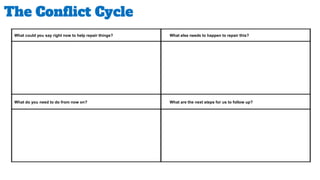
What could you say right now to help repair things? What else needs to happen to repair this?
What do you need to do from now on? What are the next steps for us to follow up?
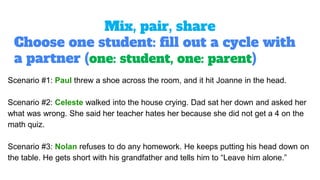
Scenario #1: Paul threw a shoe across the room, and it hit Joanne in the head.
Scenario #2: Celeste walked into the house crying. Dad sat her down and asked her
what was wrong. She said her teacher hates her because she did not get a 4 on the
math quiz.
Scenario #3: Nolan refuses to do any homework. He keeps putting his head down on
the table. He gets short with his grandfather and tells him to “Leave him alone.”
Mix, pair, share
Choose one student: fill out a cycle with
a partner (one: student, one: parent)
your
conflict cycle
Community Circle
What is one thing you learned
today you will use in your home?
Questions?

SEL in Your Home

  • 1.
    Social Emotional Learning(SEL) in your home: Community Circles and Conflict Cycle
  • 2.
    What is SEL? Social-emotionalskills are the strategies one has for managing strong emotions, navigating relationships, working effectively with others, solving difficult problems, and making responsible decisions. Social-emotional skills pave the way for positive life experiences. When these skills are taught and supported, youth are more likely to succeed academically and have a positive attitude toward self and school.
  • 3.
    How can youhelp? Social and emotional learning (SEL) starts at home. Parents and families are critical partners in helping their children develop social and emotional know-how. They can model the kinds of skills, attitudes, and behaviors we want all students to master. And they can be important advocates for SEL at school. (CASEL)
  • 4.
    Why the need? Helps strengthen relationships at home
  • 5.
    Connection between school and home  Buildsa partnership between home and school  Increases communication  Provides consistent language between school and home  Provides positive behavioral strategies
  • 6.
    Irving is nowincorporating into all aspects of the District: ● Panorama surveys ● Community circles ● Conflict cycles ● Restorative practices
  • 7.
  • 8.
    Please stand in acircle PRACTICE at your table: What is your favorite candy?
  • 9.
    What made this work? Norms: 1.Only the person with the talking object can speak 2. You can participate or pass 3. You cannot respond to what others say
  • 10.
    Community Circle WHOLE GROUP: What doyou like to do as a family?
  • 11.
    Background behind CommunityCircles in schools Research-based strategy to build relationships between people A Community Circle is a safe discussion space in which students and the teacher sit in a circle so that all members' faces are visible to one another. Community circles build relationships within the classroom.
  • 12.
    Background behind CommunityCircles in the home Research-based strategy to build relationships between people A Community Circle is a safe discussion space in which children and guardians sit in a circle so that all members' faces are visible to one another. Community circles build relationships within the home.
  • 13.
    Think, Mix, Share out ●When would be a good time to use a community circle in your home? ● Brainstorm some examples you can use at home
  • 14.
    Community Circles willbuild trust and show you care. They help with difficult conversations.
  • 15.
  • 16.
    Why use a conflictcycle? ● Students seldom learn successful behaviors for handling stress on their own. ● Adults can help children break the conflict cycle by teaching children to regulate their behavior in ways that bring more satisfying results.
  • 17.
    FIRST: Build relationshipswhen conflicts happen Be the DETECTIVE: Ask open-ended questions: 1. What happened? 2. Describe what you were thinking 3. How were you feeling? 4. How did you react? 5. How did others react? DO NOT be the PUNISHER: Things to think about: 1. What is your outcome for the student instead of what is the punishment? 2. How can you validate their feelings? 3. How can we amend the wrong? 4. Is there anyone else who should be part of this conversation? 5. How can the cycle be stopped?
  • 18.
    Make sure you arelistening to the answers Ask clarifying questions Active listening through:  Display appropriate body language  Be calm  Get down to their level  Be private with the conversation
  • 19.
    MODEL: the fine line between detectiveand punisher Discussion Questions: 1. What did you notice overall? 2. How did the punisher’s words, actions, and tone of voice impact the child’s answers? 3. How did the detective’s words, actions, and tone of voice impact the child’s answers? 4. Reflect on your own conversations when you were a child. Do you have experiences with the detective, the punisher, or both?
  • 20.
  • 21.
    The Conflict CycleStressful Incident Please help me understand... What happened? Where did it happen? When did it happen? Who was involved? How long did it go on? How tough was it? How often does it happen? Were others involved? (Look for patterns) Student's Feelings How did that make you feel? On a scale of 1-10, how angry, sad, disappointed, etc. were you? (Determine intensity) Student's Observable Behavior What did you do when you were feeling...? How did you show your feelings? On a scale of 1-10, how... (e.g., hard did you hit, loud did you yell, etc.) Student's Thoughts What went through your mind? You must have had some thoughts about that. What were you saying to yourself at this point? CONFLICT Adult/Peer Reactions How did the teacher, other students, any other adult, etc. respond? Then what happened?
  • 22.
    What could yousay right now to help repair things? What else needs to happen to repair this? What do you need to do from now on? What are the next steps for us to follow up?
  • 24.
    Scenario #1: Paulthrew a shoe across the room, and it hit Joanne in the head. Scenario #2: Celeste walked into the house crying. Dad sat her down and asked her what was wrong. She said her teacher hates her because she did not get a 4 on the math quiz. Scenario #3: Nolan refuses to do any homework. He keeps putting his head down on the table. He gets short with his grandfather and tells him to “Leave him alone.” Mix, pair, share Choose one student: fill out a cycle with a partner (one: student, one: parent)
  • 25.
  • 26.
    Community Circle What isone thing you learned today you will use in your home?
  • 27.

Editor's Notes

  • #2 Should not be used in a crisis situation. Strategies How to build relationships when things are calm. Take time to have conversations
  • #3 Be sure to read word for word and check for understanding- (Five big points - Competencies) Research is based on this framework. Setting groundwork and foundational skills for success as adults in practing SEL.
  • #4 Partnership is a shared goal.
  • #5 Building relationships and making them stronger Student - student Student - staff Siblings - Parents / Guardians and kids
  • #6 Administration and related service staff will be trained on community circles and the conflict cycle Positive approach- change the behavior through positive approaches Same language in home and school (similar approaches)
  • #7 Panorama - SEL surveys (TBD) (Framework) Building and nurturing relationships Community circles- Can be done at both secondary and elementary levels. Conflict Cycles – (Leader TBD) Restorative practices- Application - (Leader TBD)
  • #9 Doing at their table - First one in small groups (like a free for all)
  • #10 What made this work? Make a list of 8
  • #11 With the whole group give think time
  • #12 Getting to know each other- connections and getting to know each other better. More relatable. You are like me. Example Schedule: Elementary- Once per teacher Middle and High School - Once a week per teacher
  • #14 Find someone and share when this could be done. Adults and children should answer … For example, what made you smile today? Or What made you curious today?
  • #18 If you have strong relationships they are more willing to trust you. Detective / Punisher Open ended questions: Not yes or no questions / leading the witness thoughts, feelings, behavior, others actions How your choices impact you and others?
  • #19 Communication: Listening is part of communication Make sure it is private - not in front of others including siblings and other students
  • #20 Role play – Get volunteers from audience Discuss the Punisher mindset Discuss the Detective mindset
  • #22 Share at the end of the mix, pair, share
  • #25 Share at the end of the mix, pair, share