Community of Learners Plan
Creating a Collaborative Classroom Community
4/6/2013
Lesley University
Simon Moody
Community of Learners Plan
1
Introduction
The Community of Learners Plan is equal parts pedagogical manifesto, pacing guide, and reference work.
It explains my educational philosophy which is informed by my own education (at all levels), readings and
research, life experiences, and personal beliefs. It details my understanding of how students learn best,
i.e. how they retain the most information in a meaningful way while feeling safe and in control of their
own agency. It explains how to create those conditions and a detailed list of how to implement activities
and projects to develop said conditions over the course of the academic year.
This plan includes research, data, forms, ideas, and written materials created and compiled by Stephanie
Cosantino, Siobhan Franco, Regina Jardon, Ryan Keane, Gina Mazzini, Joshua Olson, Anne Sando, and
Jessica Sams.
The Philosophy
How do students learn?
As Vygostsky theorized, knowledge is not transferred from one person to another like a tangible
object. Knowledge is not something that can be simply given to someone else, like gasoline at a pump.
Knowledge must rather be acquired through exploration and reflection; this is known as constructivism,
an epistemology rapidly becoming accepted as the most effective way for educators to help their
students. Constructivists believe that students do not learn in isolation but rather develop their
understandings through the synthesis of previous experience and present exploration and interaction
with other people and ideas (Abdal-Haaq, 1998). A constructivist teacher therefore does not lecture,
since this “banking” model gives no context or deeper understanding of content; content is meaningless
without context. A constructivist teacher instead provides opportunities for students to explore and
grapple with questions and problems within familiar, real-world situations so that students can see how
the academic content applies to their lives. In other words, students “Own” the material, i.e. they can
apply it to a variety of contexts including those outside their content area (King, 1993).
Community of Learners Plan
2
Students learn constructively not only through the way a teacher presents information, but
through social interaction with their peers as well. While it is helpful for the teacher to pose problems
for students to solve based on their own experiences and naïve1
understandings, students also learn by
exchanging these ideas with their peers. Such interactions allow students to challenge their
preconceptions and provide deeper insight into the myriad perspectives that surround them. Without
these exchanges there is only so far a student can develop her understanding. This places the focus of
the classroom on the students themselves and the work that they do together with the aid of the
teacher, rather than focusing on the teacher as an unapproachable master of knowledge (King, 1993).
Simply put, students learn by doing; these explorations, guided by a knowledgeable teacher who
supports student learning and asks probing questions, ensure students not only learn the content but
retain it and can apply it to future contexts for the rest of their lives.
What will I teach?
The Common Core Standards dictate the importance of reading, writing, speaking, and listening
skills for students in English Language Arts (ELA). I will be teaching these skills through a variety of media
and sources, from novels to poems, plays to speeches, essays to speeches; students will not only be
reading these materials, but creating such products as well. They will explore these core skills in the
context of real-world situations to understand their connection to their local and global communities,
and to understand the answer to the ubiquitous question, “When am I going to use this?” In exploring
ELA through a variety of lenses, students will uncover the universality of stories, the power of language,
and develop their own voices so they can express themselves and their ideas in a compelling and
coherent way.
More importantly, I will be teaching students how to collaborate with their peers in order to
create powerful products. This document is designed to provide the architecture needed to help
1
“Naïve,” in this case, means “undeveloped” rather than anything pejorative.
Community of Learners Plan
3
students come together, set aside their biases and challenge their preconceptions, work and support
each other as a team, and make connections between the work they have done and the contributions of
others. The purpose of my pedagogy and this document’s title are eponymous: these activities, plans,
policies, and guidelines are designed to create a community of learners, with emphasis on community.
What conditions must be met for this model to succeed?
Students must explore the material themselves if they are to understand it outside the context
of a test or a specific context. It is extremely difficult to teach content and process skills without context
in all content areas, but it is especially challenging in English Language Arts. Far too often, we teach a
text rather than a concept through the lens of a text; this is an essential distinction. When students read
a play like Antigone, they may only understand some of it, and may resort to others’ opinions on the
piece without developing their own if it is taught without context. However, when Antigone is used as
part of an exploration of when it is acceptable to rebel against authority – an issue close to many
adolescents’ hearts – they will understand more and become more engaged. It is not efficient for a
teacher to lecture students on a topic and explain why the teacher thinks it is important, because the
student is memorizing by rote and not through experience. When a student explores a concept and
really struggles with it, through writing, discussion, and reflection, she will Own that concept and will be
able to apply it to a variety of different contexts both within and outside the classroom. This is an
unbelievably powerful ability which gives these students a leg up on those who have not explored
similarly. It then falls to these students to help others explore and realize their own potential. Through
inquiry education, I hope to help guide students towards unlocking their own potential, and in turn
guide their peers and community members to unlocking theirs as well.
Community of Learners Plan
4
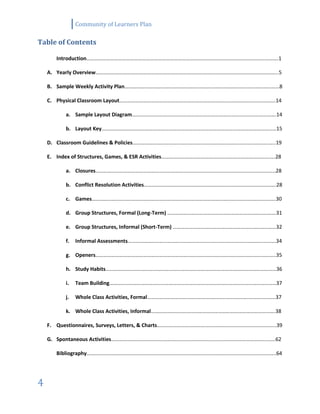
Table of Contents
Introduction……………………………………………………………………………………………………………………………….1
A. Yearly Overview………………………………………………………………………………………………………………………...5
B. Sample Weekly Activity Plan………………………………………………………………………………………………………8
C. Physical Classroom Layout……………………………………………………………………………………………………….14
a. Sample Layout Diagram……………………………………………………………………………………………….14
b. Layout Key……………………………………………………………………………………………………………………15
D. Classroom Guidelines & Policies………………………………………………………………………………………….…..19
E. Index of Structures, Games, & ESR Activities……………………………………………………………………….….28
a. Closures……………………………………………………………………………………………………………………….28
b. Conflict Resolution Activities……………………………………………………………………………………….28
c. Games………………………………………………………………………………………………………………………….30
d. Group Structures, Formal (Long-Term) ……………………………………………………………………….31
e. Group Structures, Informal (Short-Term) ……………………………………………………………………32
f. Informal Assessments………………………………………………………………………………………………….34
g. Openers……………………………………………………………..………………………………………………………..35
h. Study Habits…………………………………………………………………………………………………………………36
i. Team Building………………………………………………………………………………………………………………37
j. Whole Class Activities, Formal…………………………………………………………………………………….37
k. Whole Class Activities, Informal………………………………………………………………………………….38
F. Questionnaires, Surveys, Letters, & Charts……………………………………………………………………………...39
G. Spontaneous Activities…………………………………………………………………………………………………………….62
Bibliography……………………………………………………………………………………………………………………………..64
Community of Learners Plan
5
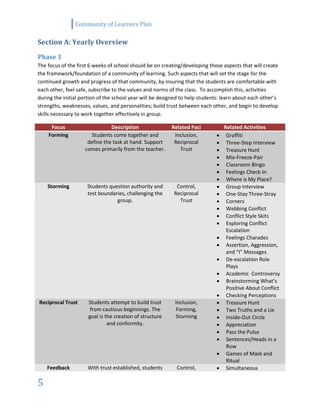
Section A: Yearly Overview
Phase 1
The focus of the first 6 weeks of school should be on creating/developing those aspects that will create
the framework/foundation of a community of learning. Such aspects that will set the stage for the
continued growth and progress of that community, by insuring that the students are comfortable with
each other, feel safe, subscribe to the values and norms of the class. To accomplish this, activities
during the initial portion of the school year will be designed to help students: learn about each other’s
strengths, weaknesses, values, and personalities; build trust between each other, and begin to develop
skills necessary to work together effectively in group.
Focus Description Related Foci Related Activities
Forming Students come together and
define the task at hand. Support
comes primarily from the teacher.
Inclusion,
Reciprocal
Trust
 Graffiti
 Three-Step Interview
 Treasure Hunt
 Mix-Freeze-Pair
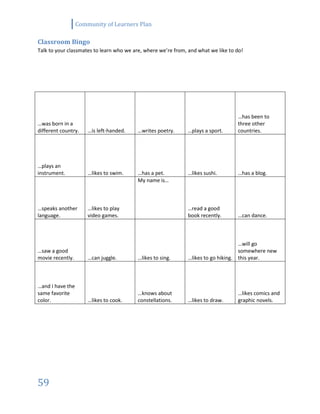
 Classroom Bingo
 Feelings Check-In
 Where is My Place?
Storming Students question authority and
test boundaries, challenging the
group.
Control,
Reciprocal
Trust
 Group Interview
 One-Stay Three-Stray
 Corners
 Webbing Conflict
 Conflict Style Skits
 Exploring Conflict
Escalation
 Feelings Charades
 Assertion, Aggression,
and “I” Messages
 De-escalation Role
Plays
 Academic Controversy
 Brainstorming What’s
Positive About Conflict
 Checking Perceptions
Reciprocal Trust Students attempt to build trust
from cautious beginnings. The
goal is the creation of structure
and conformity.
Inclusion,
Forming,
Storming
 Treasure Hunt
 Two Truths and a Lie
 Inside-Out Circle
 Appreciation
 Pass the Pulse
 Sentences/Heads in a
Row
 Games of Mask and
Ritual
Feedback With trust established, students Control,  Simultaneous
Community of Learners Plan
6
(Communication) are able to create ways of
communicating with each other,
including the exchange of ideas
and staying on task within the
classroom and in groups.
Norming,
Performing
Roundtable
 Fishbowl
 Group Interview
 Mantle of the Expert
 Exquisite Corpse
 Feelings Echo
 Freeze and Justify
Inclusion The student is focused on being
accepted by (and accepting) peers
and the teacher. Focus is primarily
on fitting in rather than academic
learning. Feeling accepted allows
students to focus on academic
learning.
Forming,
Reciprocal
Trust
 Corners
 I Like My Neighbors
Who
 Popcorn Share
 Orchestra
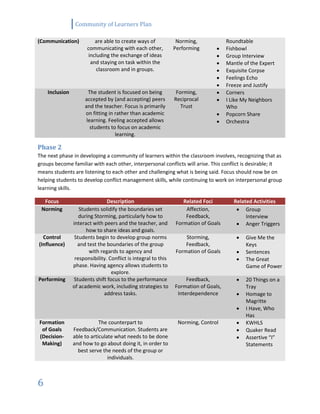
Phase 2
The next phase in developing a community of learners within the classroom involves, recognizing that as
groups become familiar with each other, interpersonal conflicts will arise. This conflict is desirable; it
means students are listening to each other and challenging what is being said. Focus should now be on
helping students to develop conflict management skills, while continuing to work on interpersonal group
learning skills.
Focus Description Related Foci Related Activities
Norming Students solidify the boundaries set
during Storming, particularly how to
interact with peers and the teacher, and
how to share ideas and goals.
Affection,
Feedback,
Formation of Goals
 Group
Interview
 Anger Triggers
Control
(Influence)
Students begin to develop group norms
and test the boundaries of the group
with regards to agency and
responsibility. Conflict is integral to this
phase. Having agency allows students to
explore.
Storming,
Feedback,
Formation of Goals
 Give Me the
Keys
 Sentences
 The Great
Game of Power
Performing Students shift focus to the performance
of academic work, including strategies to
address tasks.
Feedback,
Formation of Goals,
Interdependence
 20 Things on a
Tray
 Homage to
Magritte
 I Have, Who
Has
Formation
of Goals
(Decision-
Making)
The counterpart to
Feedback/Communication. Students are
able to articulate what needs to be done
and how to go about doing it, in order to
best serve the needs of the group or
individuals.
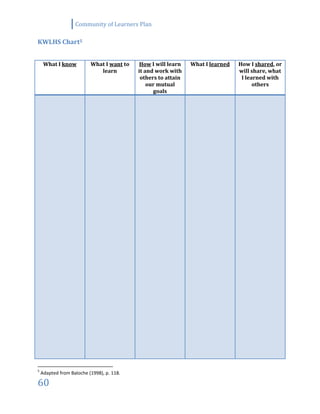
Norming, Control  KWHLS
 Quaker Read
 Assertive “I”
Statements
Community of Learners Plan
7
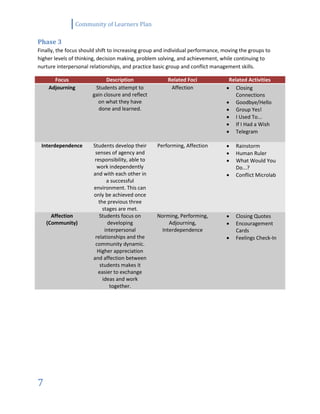
Phase 3
Finally, the focus should shift to increasing group and individual performance, moving the groups to
higher levels of thinking, decision making, problem solving, and achievement, while continuing to
nurture interpersonal relationships, and practice basic group and conflict management skills.
Focus Description Related Foci Related Activities
Adjourning Students attempt to
gain closure and reflect
on what they have
done and learned.
Affection  Closing
Connections
 Goodbye/Hello
 Group Yes!
 I Used To...
 If I Had a Wish
 Telegram
Interdependence Students develop their
senses of agency and
responsibility, able to
work independently
and with each other in
a successful
environment. This can
only be achieved once
the previous three
stages are met.
Performing, Affection  Rainstorm
 Human Ruler
 What Would You
Do...?
 Conflict Microlab
Affection
(Community)
Students focus on
developing
interpersonal
relationships and the
community dynamic.
Higher appreciation
and affection between
students makes it
easier to exchange
ideas and work
together.
Norming, Performing,
Adjourning,
Interdependence
 Closing Quotes
 Encouragement
Cards
 Feelings Check-In
Community of Learners Plan
8
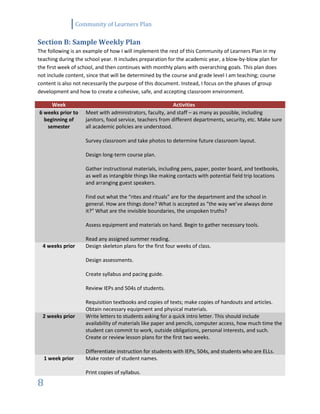
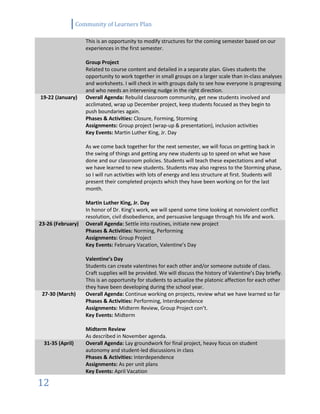
Section B: Sample Weekly Plan
The following is an example of how I will implement the rest of this Community of Learners Plan in my
teaching during the school year. It includes preparation for the academic year, a blow-by-blow plan for
the first week of school, and then continues with monthly plans with overarching goals. This plan does
not include content, since that will be determined by the course and grade level I am teaching; course
content is also not necessarily the purpose of this document. Instead, I focus on the phases of group
development and how to create a cohesive, safe, and accepting classroom environment.
Week Activities
6 weeks prior to
beginning of
semester
Meet with administrators, faculty, and staff – as many as possible, including
janitors, food service, teachers from different departments, security, etc. Make sure
all academic policies are understood.
Survey classroom and take photos to determine future classroom layout.
Design long-term course plan.
Gather instructional materials, including pens, paper, poster board, and textbooks,
as well as intangible things like making contacts with potential field trip locations
and arranging guest speakers.
Find out what the “rites and rituals” are for the department and the school in
general. How are things done? What is accepted as “the way we’ve always done
it?” What are the invisible boundaries, the unspoken truths?
Assess equipment and materials on hand. Begin to gather necessary tools.
Read any assigned summer reading.
4 weeks prior Design skeleton plans for the first four weeks of class.
Design assessments.
Create syllabus and pacing guide.
Review IEPs and 504s of students.
Requisition textbooks and copies of texts; make copies of handouts and articles.
Obtain necessary equipment and physical materials.
2 weeks prior Write letters to students asking for a quick intro letter. This should include
availability of materials like paper and pencils, computer access, how much time the
student can commit to work, outside obligations, personal interests, and such.
Create or review lesson plans for the first two weeks.
Differentiate instruction for students with IEPs, 504s, and students who are ELLs.
1 week prior Make roster of student names.
Print copies of syllabus.
Community of Learners Plan
9
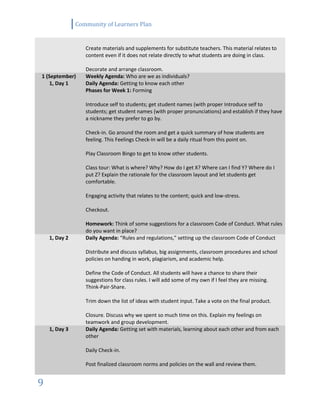
Create materials and supplements for substitute teachers. This material relates to
content even if it does not relate directly to what students are doing in class.
Decorate and arrange classroom.
1 (September)
1, Day 1
Weekly Agenda: Who are we as individuals?
Daily Agenda: Getting to know each other
Phases for Week 1: Forming
Introduce self to students; get student names (with proper Introduce self to
students; get student names (with proper pronunciations) and establish if they have
a nickname they prefer to go by.
Check-in. Go around the room and get a quick summary of how students are
feeling. This Feelings Check-In will be a daily ritual from this point on.
Play Classroom Bingo to get to know other students.
Class tour: What is where? Why? How do I get X? Where can I find Y? Where do I
put Z? Explain the rationale for the classroom layout and let students get
comfortable.
Engaging activity that relates to the content; quick and low-stress.
Checkout.
Homework: Think of some suggestions for a classroom Code of Conduct. What rules
do you want in place?
1, Day 2 Daily Agenda: “Rules and regulations,” setting up the classroom Code of Conduct
Distribute and discuss syllabus, big assignments, classroom procedures and school
policies on handing in work, plagiarism, and academic help.
Define the Code of Conduct. All students will have a chance to share their
suggestions for class rules. I will add some of my own if I feel they are missing.
Think-Pair-Share.
Trim down the list of ideas with student input. Take a vote on the final product.
Closure. Discuss why we spent so much time on this. Explain my feelings on
teamwork and group development.
1, Day 3 Daily Agenda: Getting set with materials, learning about each other and from each
other
Daily Check-in.
Post finalized classroom norms and policies on the wall and review them.
Community of Learners Plan
10
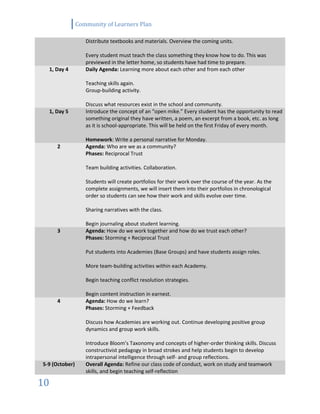
Distribute textbooks and materials. Overview the coming units.
Every student must teach the class something they know how to do. This was
previewed in the letter home, so students have had time to prepare.
1, Day 4 Daily Agenda: Learning more about each other and from each other
Teaching skills again.
Group-building activity.
Discuss what resources exist in the school and community.
1, Day 5 Introduce the concept of an “open mike.” Every student has the opportunity to read
something original they have written, a poem, an excerpt from a book, etc. as long
as it is school-appropriate. This will be held on the first Friday of every month.
Homework: Write a personal narrative for Monday.
2 Agenda: Who are we as a community?
Phases: Reciprocal Trust
Team building activities. Collaboration.
Students will create portfolios for their work over the course of the year. As the
complete assignments, we will insert them into their portfolios in chronological
order so students can see how their work and skills evolve over time.
Sharing narratives with the class.
Begin journaling about student learning.
3 Agenda: How do we work together and how do we trust each other?
Phases: Storming + Reciprocal Trust
Put students into Academies (Base Groups) and have students assign roles.
More team-building activities within each Academy.
Begin teaching conflict resolution strategies.
Begin content instruction in earnest.
4 Agenda: How do we learn?
Phases: Storming + Feedback
Discuss how Academies are working out. Continue developing positive group
dynamics and group work skills.
Introduce Bloom’s Taxonomy and concepts of higher-order thinking skills. Discuss
constructivist pedagogy in broad strokes and help students begin to develop
intrapersonal intelligence through self- and group reflections.
5-9 (October) Overall Agenda: Refine our class code of conduct, work on study and teamwork
skills, and begin teaching self-reflection
Community of Learners Plan
11
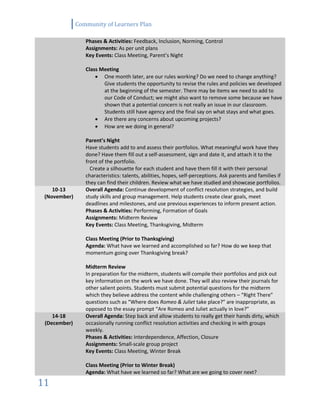
Phases & Activities: Feedback, Inclusion, Norming, Control
Assignments: As per unit plans
Key Events: Class Meeting, Parent’s Night
Class Meeting
 One month later, are our rules working? Do we need to change anything?
Give students the opportunity to revise the rules and policies we developed
at the beginning of the semester. There may be items we need to add to
our Code of Conduct; we might also want to remove some because we have
shown that a potential concern is not really an issue in our classroom.
Students still have agency and the final say on what stays and what goes.
 Are there any concerns about upcoming projects?
 How are we doing in general?
Parent’s Night
Have students add to and assess their portfolios. What meaningful work have they
done? Have them fill out a self-assessment, sign and date it, and attach it to the
front of the portfolio.
Create a silhouette for each student and have them fill it with their personal
characteristics: talents, abilities, hopes, self-perceptions. Ask parents and families if
they can find their children. Review what we have studied and showcase portfolios.
10-13
(November)
Overall Agenda: Continue development of conflict resolution strategies, and build
study skills and group management. Help students create clear goals, meet
deadlines and milestones, and use previous experiences to inform present action.
Phases & Activities: Performing, Formation of Goals
Assignments: Midterm Review
Key Events: Class Meeting, Thanksgiving, Midterm
Class Meeting (Prior to Thanksgiving)
Agenda: What have we learned and accomplished so far? How do we keep that
momentum going over Thanksgiving break?
Midterm Review
In preparation for the midterm, students will compile their portfolios and pick out
key information on the work we have done. They will also review their journals for
other salient points. Students must submit potential questions for the midterm
which they believe address the content while challenging others – “Right There”
questions such as “Where does Romeo & Juliet take place?” are inappropriate, as
opposed to the essay prompt “Are Romeo and Juliet actually in love?”
14-18
(December)
Overall Agenda: Step back and allow students to really get their hands dirty, which
occasionally running conflict resolution activities and checking in with groups
weekly.
Phases & Activities: Interdependence, Affection, Closure
Assignments: Small-scale group project
Key Events: Class Meeting, Winter Break
Class Meeting (Prior to Winter Break)
Agenda: What have we learned so far? What are we going to cover next?
Community of Learners Plan
12
This is an opportunity to modify structures for the coming semester based on our
experiences in the first semester.
Group Project
Related to course content and detailed in a separate plan. Gives students the
opportunity to work together in small groups on a larger scale than in-class analyses
and worksheets. I will check in with groups daily to see how everyone is progressing
and who needs an intervening nudge in the right direction.
19-22 (January) Overall Agenda: Rebuild classroom community, get new students involved and
acclimated, wrap up December project, keep students focused as they begin to
push boundaries again.
Phases & Activities: Closure, Forming, Storming
Assignments: Group project (wrap-up & presentation), inclusion activities
Key Events: Martin Luther King, Jr. Day
As we come back together for the next semester, we will focus on getting back in
the swing of things and getting any new students up to speed on what we have
done and our classroom policies. Students will teach these expectations and what
we have learned to new students. Students may also regress to the Storming phase,
so I will run activities with lots of energy and less structure at first. Students will
present their completed projects which they have been working on for the last
month.
Martin Luther King, Jr. Day
In honor of Dr. King’s work, we will spend some time looking at nonviolent conflict
resolution, civil disobedience, and persuasive language through his life and work.
23-26 (February) Overall Agenda: Settle into routines, initiate new project
Phases & Activities: Norming, Performing
Assignments: Group Project
Key Events: February Vacation, Valentine’s Day
Valentine’s Day
Students can create valentines for each other and/or someone outside of class.
Craft supplies will be provided. We will discuss the history of Valentine’s Day briefly.
This is an opportunity for students to actualize the platonic affection for each other
they have been developing during the school year.
27-30 (March) Overall Agenda: Continue working on projects, review what we have learned so far
Phases & Activities: Performing, Interdependence
Assignments: Midterm Review, Group Project con’t.
Key Events: Midterm
Midterm Review
As described in November agenda.
31-35 (April) Overall Agenda: Lay groundwork for final project, heavy focus on student
autonomy and student-led discussions in class
Phases & Activities: Interdependence
Assignments: As per unit plans
Key Events: April Vacation
Community of Learners Plan
13
This is a cooling-off period where students are still reading and completing small
assignments, but are given respite from group work so they can come back at full
strength for the final project next month. In the meantime, students will continue
using their independence and agency to lead discussions on the readings in class. At
this point in the year, I am much more on the sidelines than ever before.
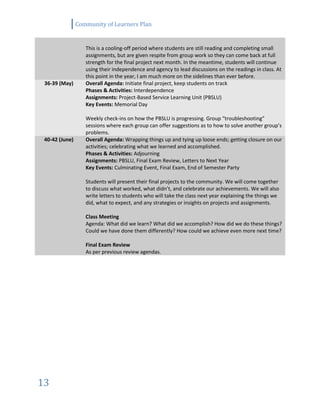
36-39 (May) Overall Agenda: Initiate final project, keep students on track
Phases & Activities: Interdependence
Assignments: Project-Based Service Learning Unit (PBSLU)
Key Events: Memorial Day
Weekly check-ins on how the PBSLU is progressing. Group “troubleshooting”
sessions where each group can offer suggestions as to how to solve another group’s
problems.
40-42 (June) Overall Agenda: Wrapping things up and tying up loose ends; getting closure on our
activities; celebrating what we learned and accomplished.
Phases & Activities: Adjourning
Assignments: PBSLU, Final Exam Review, Letters to Next Year
Key Events: Culminating Event, Final Exam, End of Semester Party
Students will present their final projects to the community. We will come together
to discuss what worked, what didn’t, and celebrate our achievements. We will also
write letters to students who will take the class next year explaining the things we
did, what to expect, and any strategies or insights on projects and assignments.
Class Meeting
Agenda: What did we learn? What did we accomplish? How did we do these things?
Could we have done them differently? How could we achieve even more next time?
Final Exam Review
As per previous review agendas.
Community of Learners Plan
14
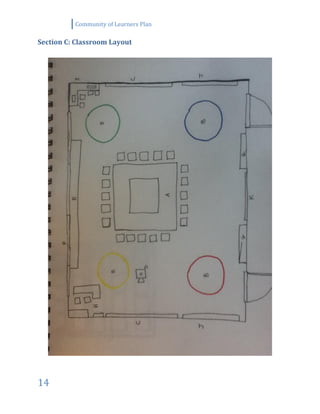
Section C: Classroom Layout
Community of Learners Plan
15
Layout Key
A. “Roundtable” desks and chairs
B. Base Group locations
C. Whiteboards
D. Projector
E. Cupboards and bookshelves
F. Windows
G. Student mailboxes
H. Teacher’s corner
I. Tech Center
J. Corkboards
K. Announcements
Rationale
The purpose of this classroom is to provide fluidity and functionality, as well as the creation of a safe
and open space, while still maintaining a sense of structure. To these ends, the classroom is physically
arranged so that students are continuously engaged with each other in discussions at the group and
whole-class scales, while allowing them the freedom to move between spaces easily. Materials are
accessible and minimal shifting of the classroom environment is required. All of these elements are
arranged to optimize learning while building community.
Roundtable
This arrangement allows all students to see each other at all times, as well as whiteboards. As the
teacher, I sit among the students in this setup, reinforcing the sense of classroom community and that
learning is conducted in this class through conference and discussion. I can move to the board easily to
write down ideas or assign a scribe to help students develop confidence and writing skills.
Base Groups (“Academies”)
The use of base groups helps create stability and community within the classroom. These zones
represent where students will move their chairs when working in groups. Although students lack in desk
space, sitting in a circle with no obstructions makes it easier to see each other and stay focused on the
conversation.
These groups serve as mini-homerooms, in which each member is responsible for the academic
and personal well-being of each other. Each student has a responsibility, from gathering materials for
Community of Learners Plan
16
absent students to working with other groups for resources and ideas. In doing so, students will be
learning how to take responsibility, divide up complex tasks and complete them, and generally build
skills necessary for success in future academics and their lives in the long run.
Whiteboards
Having two whiteboards gives much more space for writing out discussion points, student thinking, and
organizing information. It allows me to sort things as necessary in a fluid way. The one permanent
element of these boards is the Parking Lot, a section on the right board which is marked off.
The Parking Lot is where I keep student questions which have been raised but may be better
addressed later in the day, unit, or semester. This is a section of the board with the “parking” symbol (a
P in a circle) drawn at the top. When a student asks a question or raises a topic which is not addressed in
the lesson plan for the day, or will be addressed later in the class, I will put the question in the Parking
Lot in the student’s own words and attribute it to them. We will return to every question in the Parking
Lot as long as time and the lesson permit since they drive our learning just as much as the lesson plan
(and may create new lessons in turn).
Projector
This projector is ceiling-mounted and pointed at the left whiteboard which has a pull-down screen
above it. This allows me to bring in multimedia such as film clips and PowerPoint presentations.
Cupboards and Bookshelves
These shelves stand at waist-height so as to not obstruct the windows. These shelves are broken into
categories: Course Texts (for assigned reading), Student Materials (markers, pencils, paper, items for in-
class projects), and a selection of books, magazines, and articles students can choose to read if they
have completed a quiz or have nothing else to do at the moment.
This section also includes the Class Library, a space where students can donate a book, article,
magazine, or poem. It is clearly labeled with the student’s information and other students may check it
out to read on their own in class; they may also take it outside of class but they are responsible for any
damages or lost items.
Windows
These windows reach from the shelves to the ceiling and span most of the north wall. They bring in
plenty of natural light and provide a window to the outside world. This is to reinforce the idea that
students are part of the bigger picture, the global community.
Community of Learners Plan
17
Student Mailboxes
Next to the classroom entrance is a series of cubbies which are referred to as students’ mailboxes. There
is a set for each block of students, organized by color (red for A Block, blue for B Block, green for C block,
etc.)
Each day, students will check their mailboxes as they enter the classroom for announcements,
handouts, and work I have graded or need to pass back for any reason. They will also put their “outgoing
mail” in these boxes once they have been emptied, i.e. permission slips, homework, etc. At the end of
class I will remind students to put work in their mailboxes before they leave, then go through each
mailbox with a checklist and mark who has or has not handed in assignments or paperwork for the day;
if a student is handing in an assignment late, I will mark it off with a record of the date.
I believe this system allows students to get to work faster since it cuts down on time spent
handing out papers. It also reduces the stress inherent in handing in homework which can be
confrontational and embarrassing for some students.
Teacher’s Corner
Ideally I will spend as little time as possible here. This space contains a desk and computer, and two
chairs. The second chair is for students who need to have a conference with me for any reason, and is
placed alongside mine rather than opposite the desk to create intimacy and reduce tension.
This space also contains an A/V cabinet on the wall for controlling the projector, as well as a
small closet for storing larger classroom materials (large sheets of paper, etc.).
Tech Center
This space has two computers with word processing software and internet access. These are for
research during class, as well as writing projects. They can also be used by students who require
accommodations.
Corkboards
These large corkboards are for hanging student work and other student-created artifacts. They will also
display “source material” for the content we are working on, including photos, articles, and other items
to help students develop background knowledge. For example, if we were reading Athol Fugard’s
Master Harold… and the Boys, I would display examples of what a tea room looked like, pictures of Port
Elizabeth from 1950, photos of ballroom dancing, as well as articles and quotations about South Africa
and the apartheid era.
Community of Learners Plan
18
Announcements
As students file into the classroom to collect their mail, they are also greeted with the announcements
board, a space for me to put up reminders about upcoming projects, field trips, and school events. It is
also a space for students to put up their own announcements and flyers, provided they are respectful of
the rest of the classroom community and do not violate any codes of conduct the school itself may have
in place. This gives students a space to tell their peers about activities they are involved in or excited
about, such as school plays, sports events, fundraisers, and student concerts.
Entrances
This is an ideal feature and may not be possible due to the constraints of the building I am teaching in.
Two entrances allow for ease of flow of traffic through the hallways and can be less disruptive for late
students to enter the classroom. It helps students coming from any direction of the school.
Features Not Shown
Posters
Where space allows, I will hang posters and printouts of inspiring messages that reflect my pedagogy:
that every student has the right and ability to succeed, as well as reminders of respect for others. I will
also include images and quotations from a variety of content-related figures such as authors, poets, and
social activists. This array will be as multicultural as possible; this multiculturalism includes variety of
ethnicity, nationality, gender, and sexual orientation. There are also stickers indicating that this is an
LGBTQ Safe Space on both doors leading into the classroom.
Grading Pens
The pens I use for grading are purple felt-tips. Red is too aggressive and carries negative connotations.
By using an unconventional color, I disarm students’ expectations about feedback and help them
become more receptive to reading my comments, whether encouraging or suggestions of how to
modify or edit their work so it can become stronger.
Suggestion Box
Attached to the wall adjacent to one of the classroom entrances is a colorful box with a thin slit at the
top. This is for submitting anonymous (or signed) questions, comments, and concerns students may
have that they do not feel comfortable bringing to me in person. These may include a problem with
another student, a personal concern, a suggestion about how I can improve student learning or a
request for an extension on an assignment, or a request to cover a particular topic in an upcoming class.
Community of Learners Plan
19
Section D: Classroom Guidelines and Policies
Element Policy Whose
All Policies and
Guidelines
Ongoing development of these. Deal with issues when they come up.
Get the class involved in (i.e. if a student is using inappropriate
language ask others how it makes them feel, what it does to our
community, and what we should do about it.)
Teachers &
Students
Homework
Homework in my class is used to build background knowledge and
assess students’ skill levels before beginning a unit; as a formative
assessment as to how students are learning the material; and as a
summative assessment to determine overall student learning.
Assignments include fill-in worksheets, written artifacts (letters,
speeches, and proposals), essays and research papers, collaborative
and personal projects, and take-home tests and quizzes.
Homework is usually due by our next class. Assignments which require
more thought and effort may be due in one to three weeks, such as
essays and research papers. Larger projects may take the majority of
the semester but small “checkpoint” assignments will be due during the
process as formative assessments.
Teacher
Homework
Collection
Homework will be collected every day via the mailbox system described
in Section C.
Late homework will be accepted but will receive a reduced grade.
While punitive, this is to encourage students to take responsibility for
their time management. Extensions will still be given to students who
request them as per their IEPs and 504s. Extensions due to medical,
familial, or personal issues will be considered on a case-by-case basis.
Teacher &
Student
Class
Participation
Participation is integral to my classroom because it helps me assess
student learning while learning more about my students, as well as
encouraging students to feel comfortable sharing their ideas with their
peers.
Exemplar: listens actively to others when they are speaking; provides
insightful, on-task, comments; returns to ideas previously raised by
other students; speaks to the whole class, not just the teacher; always
follows the class policy for who can speak next; synthesizes course
content, discussion, and outside learning; praises and visibly
appreciates other students.
Unsatisfactory: never speaks in class discussions or small groups;
disrupts others or class activities; only speaks to the teacher; makes off-
task commentary; insults or puts down other students.
Teacher &
Students
Gum Students may decide what the gum policy for the class is, barring any Teacher &
Community of Learners Plan
20
school-wide rulings on the issue. I believe that many students who have
some form of ADD/ADHD need to keep moving or repeat a motion,
such as tapping a foot. My personal inclination is to allow students to
chew gum provided they share with others; they must also spit their
gum out when giving presentations, so as to encourage enunciation
and respect.
Students
Asking for Help
“See Three Before Me.” If students have a question during an activity,
they must ask three of their peers before coming to me. This
encourages collaboration and inquiry skills; it also helps me determine
whether or not directions are clear or if there is a teachable moment in
the works. If a student has a question about the activity which three of
their peers are unsure of, it follows that I should halt the activity to talk
with the whole class about the issue. If the question cannot be
answered easily or immediately, it can go into the Parking Lot, which
may increase student self-esteem in knowing they are asking the
“tough” or “big” questions.
This also has a disciplinary effect; it encourages students to think about
their question and whether or not it really needs to come to me.
Teacher &
Students
Food
Students can pitch in $1.00 for a communal Snack Center, but either all
students must contribute or none. Once the money is pooled, I will
purchase a small supply of snack foods which are fairly healthy and do
not conflict with any student allergies. Once the supply is empty, I will
ask students if they want to renew them.
Eating loudly, leaving trash out, or spreading out an eating space that
prevents others from working or intrudes on others’ space are
unacceptable behaviors.
Teacher &
Students
Drinks
Water and water bottles are permitted. Sodas, coffee, and other similar
beverages are not allowed; I cannot force students to not consume
energy drinks, for example, but I can keep them out of my class.
Teacher
Call to Action
When we need to transition between activities, I will announce, “Let’s
come back together in…” and count down from ten. After I reach “one,”
I will announce, “Welcome back,” share some of my observations from
what I saw happening during the activity, and then begin a reflection
with the students.
During group work, I will help students get ready to transition by
quietly approaching each group and letting them know there is X time
left (5 minutes, 1 minute) and to get ready to share their thoughts with
the class.
If something needs to be clarified during an activity or group work, I will
announce to the class, “Folks, listen up,” and make a brief statement or
Teacher &
Students
Community of Learners Plan
21
explanation. I will then ask if anyone is still confused or has another
related question.
Leaving Class
At the end of class, I will:
 Remind students of upcoming assignments and deadlines
 Clarify the homework
 Have a one word Check Out
 Tell students “Be well.”
I will then wait by the door as students gather their things (they may
not pack up before we finish our rituals), and give each student a light
fist-bump as they leave. I will make the effort to make a quick but
meaningful comment to certain students as they leave, such as praise
for working through a difficult assignment or participation from a
normally shy student.
Teacher &
Students
OR School
Seating
Arrangement
Students are allowed to sit wherever they like in the roundtable at the
center of the room. Because students are sitting in close proximity with
each other, and I am sitting with them, it is less likely students will talk
with their neighbors or get off-task. Chairs can be moved to the Base
Group locations around the room and students can arrange those
however they like.
Teacher &
Students
Team Partners
Initially, students will be paired up randomly or assigned to a group by
me. This mixing gets students to know each other and gives me a sense
of who works well with whom. As the year progresses, I may select
groups based on shared interests, complimentary skill sets, or
supportive needs. I will continue to mix people up for quick activities to
keep students from sticking to the same people they are comfortable
with in the interest of building community and exchanging new ideas.
Students will also have a chance to determine their own group partners
for certain projects, since autonomy and self-regulation are also
essential skills I want to develop in my classroom.
Students are required to fill out a self-assessment and group
assessment after completing group work. This reflection is integral to
building intrapersonal skills necessary for the rest of students’ lives and
will help them work better together in the future.
Teacher &
Students
Unfinished
Work
If a student is unable to complete an assignment, they may hand in
what they have to receive a partial grade and make a contract with me
to complete it by a certain time. Once the assignment is completed, the
student and I will discuss what each of us believes is a fair adjustment
to the grade based on effort and quality of work. If the contract
deadline passes, I will check in again with the student to find out what
the situation is and what they think a reasonable solution is.
If a student refuses to meet with me, I will treat the assignment as late
work and reduce the grade as per my policy on late work. If the student
Teacher &
Students
Community of Learners Plan
22
breaks the contract, I will reduce the grade as well.
Students may request extensions on assignments as long as they
provide me with a reason. This does not necessarily guarantee an
extension, but special consideration will be given to medical issues;
family events; certain outside commitments such as jobs, familial care,
performances and sports events; and students with disabilities.
Unfinished
Projects
Because projects are a key part of my pedagogy, they should be
completed on time so that all students are on the same page. If a
student or group believes they need an extension on an assignment,
they may request one as described above. They must create a contract
for work to be completed by a specific deadline.
If a project is unfinished by its due date and students have not met with
me to discuss the issue, I will meet with the student or group after class
to discuss what the situation is and how to proceed. In most cases, the
student(s) will be allowed to complete the work within a week or two
for a reduced grade.
Teacher &
Students
Projects
Finished Early
In the event that classwork or a test is finished early, students may
choose from the following options, depending on the context:
 Read quietly from a book for school, or from a personal
selection.
 Work on an assignment for our class, or another course.
 Work on an extra credit project such as a crossword or short
essay, chosen from a selection available to all students.
 Discuss a group project with group members, either quietly in a
corner or in the hall outside the classroom.
In any case, the student should not distract other classmates from
finishing their work.
If a project or assignment is completed before its due date, students
may hand it in and will receive the role of Mentor. These students will
act as consultants to other groups on the project. I believe this is more
powerful than allowing students free time since it reinforces the theme
that the classroom is truly a community of learners. It applauds the
work of the students who completed their work early while providing
them the responsibility to help every other student achieve as much as
they have.
Teacher
Late Projects
If an assignment is not handed in at all, without an explanation, it is
considered late work. Late work will be accepted within a week of its
assigned due date, though it will receive a minor penalty to its overall
grade depending on how late it is completed; if a student explains
circumstances which caused the delay, the penalty may be reduced.
After one week of being late, a whole letter grade will be removed from
the assignment each week it is not turned in, up to a maximum of 3
Teacher
Community of Learners Plan
23
weeks – this assumes the student would have received an A on each
assignment.
Late projects (as opposed to assignments) are treated similarly to
unfinished projects – students must meet with me to discuss a plan of
action and create a contract to complete the project by a certain time.
There may be circumstances where a serious penalty will be imposed
on the project because having completed projects is integral to an
event involving members of the community outside the classroom. For
example, if a project which would be featured in a school-wide event is
late, the student(s) involved might receive such a penalty.
Late Arrivals
Students who are late are expected to enter class in an orderly and
undisruptive manner and then check in with their Academy (base
group) to find out what they missed. It is the responsibility of the other
Academy members to provide them with the information and handouts
they need.
Barring the rules of the school, students are allowed one unexcused
absence from class per semester. All subsequent absences will reduce
the student’s attendance grade. This is because we are a community
and to function we must have all members present to have a diversity
of ideas and experiences. In addition, each Academy diminishes in
strength when it is missing a member.
Students who are late more than once, or consistently late, must meet
with me to discuss their situation. This is diagnostic, not punitive – I
believe it is important for me to know whether or not a student is late
because they slept in, missed their bus, got into a fight, were finishing
homework, or any other reason, because it helps me establish what is
going on in that student’s life. This information will help me understand
their situation and provide whatever support I can.
Teacher &
Students
Starting Class
I will greet each student at the door, address them by name, and try to
make a quick comment or give a compliment to each student: “Cool t-
shirt, Alex”; “I know you like science fiction, Yuko, so I think you’ll like
what we’re going to talk about today”; “You did a fantastic job in the
play last night, Sophie; I didn’t know you were such a great singer.”
Students should enter the classroom, gather any assignments and
handouts from their mailboxes, drop any completed work into their
mailboxes, then take a seat at the roundtable and begin work on a Do
Now activity which may rely on a handout from their mailbox or may be
described on one of the whiteboards. This activity will get students
warmed up and preview what we will be doing in class that day.
As we wrap up the time allotted for the Do Now, I will begin my Call to
Action, then begin with a Check In, a very brief explanation of how
Teacher &
Students
Community of Learners Plan
24
everyone is feeling or what they are thinking about. Next, I will make
announcements including birthdays, upcoming deadlines and pertinent
events (both in and outside of school), and shoutouts to students who
may have recently performed in a play or played in a sporting event I
attended. I will then go over our agenda for the day, discuss the Do
Now, and finally move into an activity or larger discussion about a given
topic.
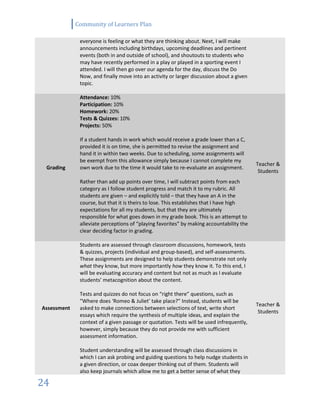
Grading
Attendance: 10%
Participation: 10%
Homework: 20%
Tests & Quizzes: 10%
Projects: 50%
If a student hands in work which would receive a grade lower than a C,
provided it is on time, she is permitted to revise the assignment and
hand it in within two weeks. Due to scheduling, some assignments will
be exempt from this allowance simply because I cannot complete my
own work due to the time it would take to re-evaluate an assignment.
Rather than add up points over time, I will subtract points from each
category as I follow student progress and match it to my rubric. All
students are given – and explicitly told – that they have an A in the
course, but that it is theirs to lose. This establishes that I have high
expectations for all my students, but that they are ultimately
responsible for what goes down in my grade book. This is an attempt to
alleviate perceptions of “playing favorites” by making accountability the
clear deciding factor in grading.
Teacher &
Students
Assessment
Students are assessed through classroom discussions, homework, tests
& quizzes, projects (individual and group-based), and self-assessments.
These assignments are designed to help students demonstrate not only
what they know, but more importantly how they know it. To this end, I
will be evaluating accuracy and content but not as much as I evaluate
students’ metacognition about the content.
Tests and quizzes do not focus on “right there” questions, such as
“Where does ‘Romeo & Juliet’ take place?” Instead, students will be
asked to make connections between selections of text, write short
essays which require the synthesis of multiple ideas, and explain the
context of a given passage or quotation. Tests will be used infrequently,
however, simply because they do not provide me with sufficient
assessment information.
Student understanding will be assessed through class discussions in
which I can ask probing and guiding questions to help nudge students in
a given direction, or coax deeper thinking out of them. Students will
also keep journals which allow me to get a better sense of what they
Teacher &
Students
Community of Learners Plan
25
are thinking about; this is especially useful for students who may not
feel comfortable contributing in class, or are more comfortable writing
for any reason.
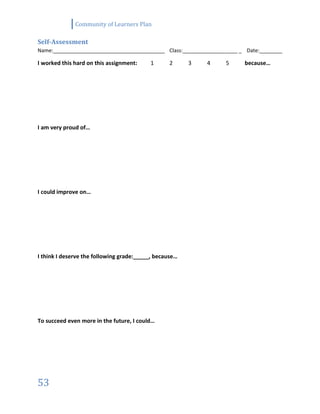
Finally, students will be assessing themselves during the course of the
year. After completing a project, students must complete a self-
reflection in which they analyze how well they worked with others, how
much they worked on the project, what they learned from each other,
and what grade they think they deserve based on all previous evidence.
This intrapersonal knowledge is vital to develop as a lifelong skill for
determining cause and effect, such as study strategies and habits which
did or did not work.
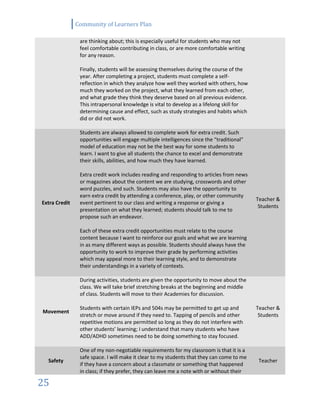
Extra Credit
Students are always allowed to complete work for extra credit. Such
opportunities will engage multiple intelligences since the “traditional”
model of education may not be the best way for some students to
learn. I want to give all students the chance to excel and demonstrate
their skills, abilities, and how much they have learned.
Extra credit work includes reading and responding to articles from news
or magazines about the content we are studying, crosswords and other
word puzzles, and such. Students may also have the opportunity to
earn extra credit by attending a conference, play, or other community
event pertinent to our class and writing a response or giving a
presentation on what they learned; students should talk to me to
propose such an endeavor.
Each of these extra credit opportunities must relate to the course
content because I want to reinforce our goals and what we are learning
in as many different ways as possible. Students should always have the
opportunity to work to improve their grade by performing activities
which may appeal more to their learning style, and to demonstrate
their understandings in a variety of contexts.
Teacher &
Students
Movement
During activities, students are given the opportunity to move about the
class. We will take brief stretching breaks at the beginning and middle
of class. Students will move to their Academies for discussion.
Students with certain IEPs and 504s may be permitted to get up and
stretch or move around if they need to. Tapping of pencils and other
repetitive motions are permitted so long as they do not interfere with
other students’ learning; I understand that many students who have
ADD/ADHD sometimes need to be doing something to stay focused.
Teacher &
Students
Safety
One of my non-negotiable requirements for my classroom is that it is a
safe space. I will make it clear to my students that they can come to me
if they have a concern about a classmate or something that happened
in class; if they prefer, they can leave me a note with or without their
Teacher
Community of Learners Plan
26
name in a small box. If an issue becomes serious or big enough, we may
hold a Class Meeting to discuss it and how we can remedy the situation.
My classroom is also an LGBTQ Safe Space. If the school has a Gay-
Straight Alliance chapter, I am happy to host meetings in my classroom
during free blocks or after school. Hate speech towards anyone
regarding their sex, gender, sexual orientation, as well as ethnicity,
religion, ability, appearance, or socioeconomic status is not permitted.
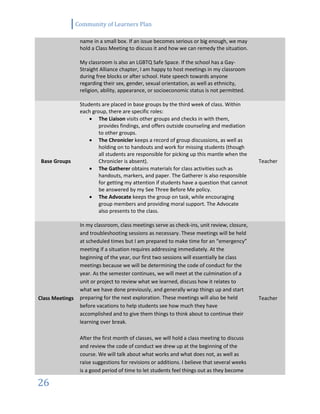
Base Groups
Students are placed in base groups by the third week of class. Within
each group, there are specific roles:
 The Liaison visits other groups and checks in with them,
provides findings, and offers outside counseling and mediation
to other groups.
 The Chronicler keeps a record of group discussions, as well as
holding on to handouts and work for missing students (though
all students are responsible for picking up this mantle when the
Chronicler is absent).
 The Gatherer obtains materials for class activities such as
handouts, markers, and paper. The Gatherer is also responsible
for getting my attention if students have a question that cannot
be answered by my See Three Before Me policy.
 The Advocate keeps the group on task, while encouraging
group members and providing moral support. The Advocate
also presents to the class.
Teacher
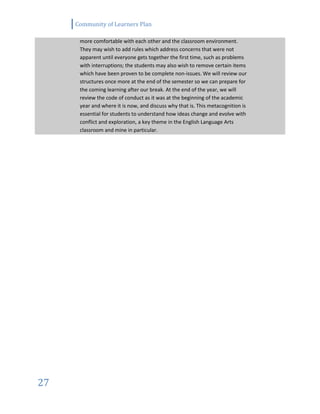
Class Meetings
In my classroom, class meetings serve as check-ins, unit review, closure,
and troubleshooting sessions as necessary. These meetings will be held
at scheduled times but I am prepared to make time for an “emergency”
meeting if a situation requires addressing immediately. At the
beginning of the year, our first two sessions will essentially be class
meetings because we will be determining the code of conduct for the
year. As the semester continues, we will meet at the culmination of a
unit or project to review what we learned, discuss how it relates to
what we have done previously, and generally wrap things up and start
preparing for the next exploration. These meetings will also be held
before vacations to help students see how much they have
accomplished and to give them things to think about to continue their
learning over break.
After the first month of classes, we will hold a class meeting to discuss
and review the code of conduct we drew up at the beginning of the
course. We will talk about what works and what does not, as well as
raise suggestions for revisions or additions. I believe that several weeks
is a good period of time to let students feel things out as they become
Teacher
Community of Learners Plan
27
more comfortable with each other and the classroom environment.
They may wish to add rules which address concerns that were not
apparent until everyone gets together the first time, such as problems
with interruptions; the students may also wish to remove certain items
which have been proven to be complete non-issues. We will review our
structures once more at the end of the semester so we can prepare for
the coming learning after our break. At the end of the year, we will
review the code of conduct as it was at the beginning of the academic
year and where it is now, and discuss why that is. This metacognition is
essential for students to understand how ideas change and evolve with
conflict and exploration, a key theme in the English Language Arts
classroom and mine in particular.
Community of Learners Plan
28
Section E: Index of Games/Structures/ESR Activities
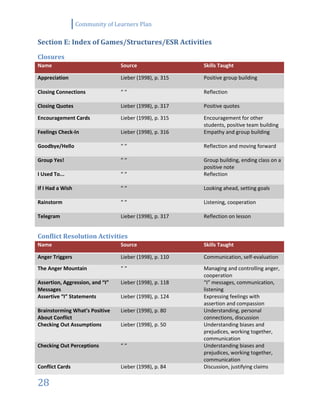
Closures
Name Source Skills Taught
Appreciation Lieber (1998), p. 315 Positive group building
Closing Connections “ “ Reflection
Closing Quotes Lieber (1998), p. 317 Positive quotes
Encouragement Cards Lieber (1998), p. 315 Encouragement for other
students, positive team building
Feelings Check-In Lieber (1998), p. 316 Empathy and group building
Goodbye/Hello “ “ Reflection and moving forward
Group Yes! “ “ Group building, ending class on a
positive note
I Used To... “ “ Reflection
If I Had a Wish “ “ Looking ahead, setting goals
Rainstorm “ “ Listening, cooperation
Telegram Lieber (1998), p. 317 Reflection on lesson
Conflict Resolution Activities
Name Source Skills Taught
Anger Triggers Lieber (1998), p. 110 Communication, self-evaluation
The Anger Mountain “ “ Managing and controlling anger,
cooperation
Assertion, Aggression, and “I”
Messages
Lieber (1998), p. 118 “I” messages, communication,
listening
Assertive “I” Statements Lieber (1998), p. 124 Expressing feelings with
assertion and compassion
Brainstorming What’s Positive
About Conflict
Lieber (1998), p. 80 Understanding, personal
connections, discussion
Checking Out Assumptions Lieber (1998), p. 50 Understanding biases and
prejudices, working together,
communication
Checking Out Perceptions “ “ Understanding biases and
prejudices, working together,
communication
Conflict Cards Lieber (1998), p. 84 Discussion, justifying claims
Community of Learners Plan
29
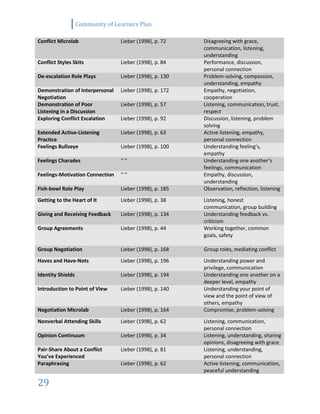
Conflict Microlab Lieber (1998), p. 72 Disagreeing with grace,
communication, listening,
understanding
Conflict Styles Skits Lieber (1998), p. 84 Performance, discussion,
personal connection
De-escalation Role Plays Lieber (1998), p. 130 Problem-solving, compassion,
understanding, empathy
Demonstration of Interpersonal
Negotiation
Lieber (1998), p. 172 Empathy, negotiation,
cooperation
Demonstration of Poor
Listening in a Discussion
Lieber (1998), p. 57 Listening, communication, trust,
respect
Exploring Conflict Escalation Lieber (1998), p. 92 Discussion, listening, problem
solving
Extended Active-Listening
Practice
Lieber (1998), p. 63 Active listening, empathy,
personal connection
Feelings Bullseye Lieber (1998), p. 100 Understanding feeling’s,
empathy
Feelings Charades “ “ Understanding one another’s
feelings, communication
Feelings-Motivation Connection “ “ Empathy, discussion,
understanding
Fish-bowl Role Play Lieber (1998), p. 185 Observation, reflection, listening
Getting to the Heart of It Lieber (1998), p. 38 Listening, honest
communication, group building
Giving and Receiving Feedback Lieber (1998), p. 134 Understanding feedback vs.
criticism
Group Agreements Lieber (1998), p. 44 Working together, common
goals, safety
Group Negotiation Lieber (1998), p. 168 Group roles, mediating conflict
Haves and Have-Nots Lieber (1998), p. 196 Understanding power and
privilege, communication
Identity Shields Lieber (1998), p. 194 Understanding one another on a
deeper level, empathy
Introduction to Point of View Lieber (1998), p. 140 Understanding your point of
view and the point of view of
others, empathy
Negotiation Microlab Lieber (1998), p. 164 Compromise, problem-solving
Nonverbal Attending Skills Lieber (1998), p. 62 Listening, communication,
personal connection
Opinion Continuum Lieber (1998), p. 34 Listening, understanding, sharing
opinions, disagreeing with grace
Pair-Share About a Conflict
You’ve Experienced
Lieber (1998), p. 81 Listening, understanding,
personal connection
Paraphrasing Lieber (1998), p. 62 Active listening, communication,
peaceful understanding
Community of Learners Plan
30
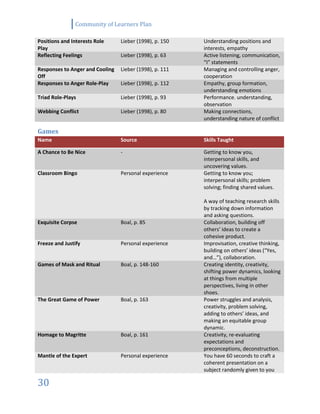
Positions and Interests Role
Play
Lieber (1998), p. 150 Understanding positions and
interests, empathy
Reflecting Feelings Lieber (1998), p. 63 Active listening, communication,
“I” statements
Responses to Anger and Cooling
Off
Lieber (1998), p. 111 Managing and controlling anger,
cooperation
Responses to Anger Role-Play Lieber (1998), p. 112 Empathy, group formation,
understanding emotions
Triad Role-Plays Lieber (1998), p. 93 Performance. understanding,
observation
Webbing Conflict Lieber (1998), p. 80 Making connections,
understanding nature of conflict
Games
Name Source Skills Taught
A Chance to Be Nice - Getting to know you,
interpersonal skills, and
uncovering values.
Classroom Bingo Personal experience Getting to know you;
interpersonal skills; problem
solving; finding shared values.
A way of teaching research skills
by tracking down information
and asking questions.
Exquisite Corpse Boal, p. 85 Collaboration, building off
others’ ideas to create a
cohesive product.
Freeze and Justify Personal experience Improvisation, creative thinking,
building on others’ ideas (“Yes,
and…”), collaboration.
Games of Mask and Ritual Boal, p. 148-160 Creating identity, creativity,
shifting power dynamics, looking
at things from multiple
perspectives, living in other
shoes.
The Great Game of Power Boal, p. 163 Power struggles and analysis,
creativity, problem solving,
adding to others’ ideas, and
making an equitable group
dynamic.
Homage to Magritte Boal, p. 161 Creativity, re-evaluating
expectations and
preconceptions, deconstruction.
Mantle of the Expert Personal experience You have 60 seconds to craft a
coherent presentation on a
subject randomly given to you
Community of Learners Plan
31
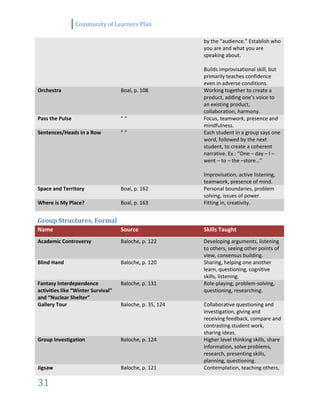
by the “audience.” Establish who
you are and what you are
speaking about.
Builds improvisational skill, but
primarily teaches confidence
even in adverse conditions.
Orchestra Boal, p. 108 Working together to create a
product, adding one’s voice to
an existing product,
collaboration, harmony.
Pass the Pulse “ “ Focus, teamwork, presence and
mindfulness.
Sentences/Heads in a Row “ “ Each student in a group says one
word, followed by the next
student, to create a coherent
narrative. Ex.: “One – day – I –
went – to – the –store…”
Improvisation, active listening,
teamwork, presence of mind.
Space and Territory Boal, p. 162 Personal boundaries, problem
solving, issues of power.
Where is My Place? Boal, p. 163 Fitting in, creativity.
Group Structures, Formal
Name Source Skills Taught
Academic Controversy Baloche, p. 122 Developing arguments, listening
to others, seeing other points of
view, consensus building.
Blind Hand Baloche, p. 120 Sharing, helping one another
learn, questioning, cognitive
skills, listening.
Fantasy Interdependence
activities like “Winter Survival”
and “Nuclear Shelter”
Baloche, p. 131 Role-playing, problem-solving,
questioning, researching.
Gallery Tour Baloche, p. 35, 124 Collaborative questioning and
investigation, giving and
receiving feedback, compare and
contrasting student work,
sharing ideas.
Group Investigation Baloche, p. 124 Higher level thinking skills, share
information, solve problems,
research, presenting skills,
planning, questioning.
Jigsaw Baloche, p. 121 Contemplation, teaching others,
Community of Learners Plan
32
sharing information,
questioning, synthesis of
information.
KWHLS Baloche, p. 118 Shared goals, personal goal
setting, differentiated learning.
One-Stay, Three Stray Baloche, p. 123 Questioning, sharing ideas,
feedback, higher level thinking
skills, movement.
Simultaneous Roundtable Baloche, p. 130 Checking work, problem-solving,
working together to solve a
problem, sharing materials.
Student Teams-Achievement
Divisions (STAD)
“ “ Competition, individual
responsibility for learning,
sharing of ideas.
Group Structures, Informal (Short-Term)
Name Source Skills Taught
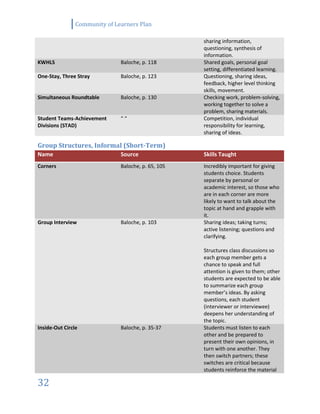
Corners Baloche, p. 65, 105 Incredibly important for giving
students choice. Students
separate by personal or
academic interest, so those who
are in each corner are more
likely to want to talk about the
topic at hand and grapple with
it.
Group Interview Baloche, p. 103 Sharing ideas; taking turns;
active listening; questions and
clarifying.
Structures class discussions so
each group member gets a
chance to speak and full
attention is given to them; other
students are expected to be able
to summarize each group
member’s ideas. By asking
questions, each student
(interviewer or interviewee)
deepens her understanding of
the topic.
Inside-Out Circle Baloche, p. 35-37 Students must listen to each
other and be prepared to
present their own opinions, in
turn with one another. They
then switch partners; these
switches are critical because
students reinforce the material
Community of Learners Plan
33
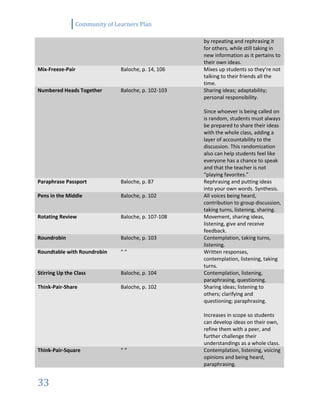
by repeating and rephrasing it
for others, while still taking in
new information as it pertains to
their own ideas.
Mix-Freeze-Pair Baloche, p. 14, 106 Mixes up students so they’re not
talking to their friends all the
time.
Numbered Heads Together Baloche, p. 102-103 Sharing ideas; adaptability;
personal responsibility.
Since whoever is being called on
is random, students must always
be prepared to share their ideas
with the whole class, adding a
layer of accountability to the
discussion. This randomization
also can help students feel like
everyone has a chance to speak
and that the teacher is not
“playing favorites.”
Paraphrase Passport Baloche, p. 87 Rephrasing and putting ideas
into your own words. Synthesis.
Pens in the Middle Baloche, p. 102 All voices being heard,
contribution to group discussion,
taking turns, listening, sharing.
Rotating Review Baloche, p. 107-108 Movement, sharing ideas,
listening, give and receive
feedback.
Roundrobin Baloche, p. 103 Contemplation, taking turns,
listening.
Roundtable with Roundrobin “ “ Written responses,
contemplation, listening, taking
turns.
Stirring Up the Class Baloche, p. 104 Contemplation, listening,
paraphrasing, questioning.
Think-Pair-Share Baloche, p. 102 Sharing ideas; listening to
others; clarifying and
questioning; paraphrasing.
Increases in scope so students
can develop ideas on their own,
refine them with a peer, and
further challenge their
understandings as a whole class.
Think-Pair-Square “ “ Contemplation, listening, voicing
opinions and being heard,
paraphrasing.
Community of Learners Plan
34
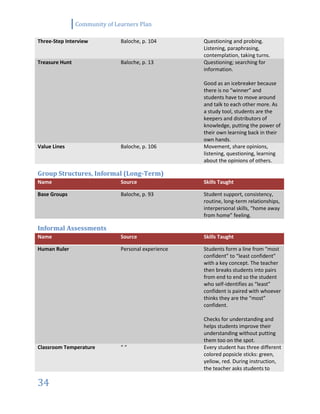
Three-Step Interview Baloche, p. 104 Questioning and probing.
Listening, paraphrasing,
contemplation, taking turns.
Treasure Hunt Baloche, p. 13 Questioning; searching for
information.
Good as an icebreaker because
there is no “winner” and
students have to move around
and talk to each other more. As
a study tool, students are the
keepers and distributors of
knowledge, putting the power of
their own learning back in their
own hands.
Value Lines Baloche, p. 106 Movement, share opinions,
listening, questioning, learning
about the opinions of others.
Group Structures, Informal (Long-Term)
Name Source Skills Taught
Base Groups Baloche, p. 93 Student support, consistency,
routine, long-term relationships,
interpersonal skills, “home away
from home” feeling.
Informal Assessments
Name Source Skills Taught
Human Ruler Personal experience Students form a line from “most
confident” to “least confident”
with a key concept. The teacher
then breaks students into pairs
from end to end so the student
who self-identifies as “least”
confident is paired with whoever
thinks they are the “most”
confident.
Checks for understanding and
helps students improve their
understanding without putting
them too on the spot.
Classroom Temperature “ “ Every student has three different
colored popsicle sticks: green,
yellow, red. During instruction,
the teacher asks students to
Community of Learners Plan
35
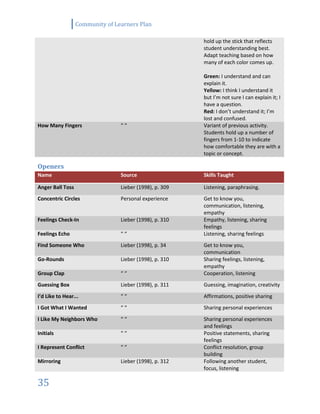
hold up the stick that reflects
student understanding best.
Adapt teaching based on how
many of each color comes up.
Green: I understand and can
explain it.
Yellow: I think I understand it
but I’m not sure I can explain it; I
have a question.
Red: I don’t understand it; I’m
lost and confused.
How Many Fingers “ “ Variant of previous activity.
Students hold up a number of
fingers from 1-10 to indicate
how comfortable they are with a
topic or concept.
Openers
Name Source Skills Taught
Anger Ball Toss Lieber (1998), p. 309 Listening, paraphrasing.
Concentric Circles Personal experience Get to know you,
communication, listening,
empathy
Feelings Check-In Lieber (1998), p. 310 Empathy, listening, sharing
feelings
Feelings Echo “ “ Listening, sharing feelings
Find Someone Who Lieber (1998), p. 34 Get to know you,
communication
Go-Rounds Lieber (1998), p. 310 Sharing feelings, listening,
empathy
Group Clap “ “ Cooperation, listening
Guessing Box Lieber (1998), p. 311 Guessing, imagination, creativity
I’d Like to Hear... “ “ Affirmations, positive sharing
I Got What I Wanted “ “ Sharing personal experiences
I Like My Neighbors Who “ “ Sharing personal experiences
and feelings
Initials “ “ Positive statements, sharing
feelings
I Represent Conflict “ “ Conflict resolution, group
building
Mirroring Lieber (1998), p. 312 Following another student,
focus, listening
Community of Learners Plan
36
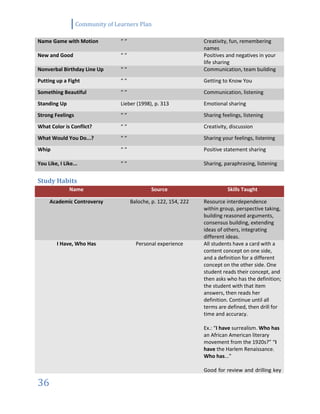
Name Game with Motion “ “ Creativity, fun, remembering
names
New and Good “ “ Positives and negatives in your
life sharing
Nonverbal Birthday Line Up “ “ Communication, team building
Putting up a Fight “ “ Getting to Know You
Something Beautiful “ “ Communication, listening
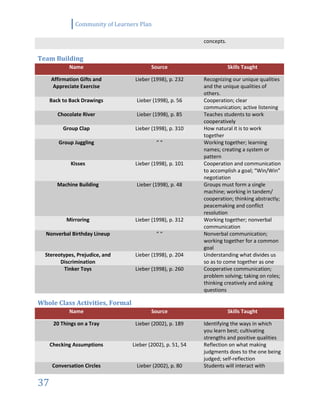
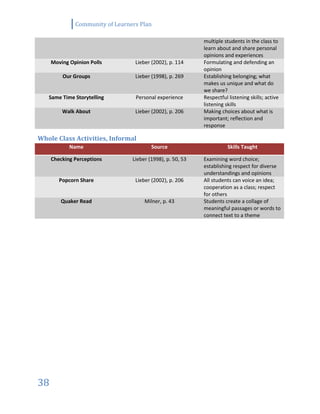
Standing Up Lieber (1998), p. 313 Emotional sharing
Strong Feelings “ “ Sharing feelings, listening
What Color is Conflict? “ “ Creativity, discussion
What Would You Do...? “ “ Sharing your feelings, listening
Whip “ “ Positive statement sharing
You Like, I Like... “ “ Sharing, paraphrasing, listening
Study Habits
Name Source Skills Taught
Academic Controversy Baloche, p. 122, 154, 222 Resource interdependence
within group, perspective taking,
building reasoned arguments,
consensus building, extending
ideas of others, integrating
different ideas.
I Have, Who Has Personal experience All students have a card with a
content concept on one side,
and a definition for a different
concept on the other side. One
student reads their concept, and
then asks who has the definition;
the student with that item
answers, then reads her
definition. Continue until all
terms are defined, then drill for
time and accuracy.
Ex.: “I have surrealism. Who has
an African American literary
movement from the 1920s?” “I
have the Harlem Renaissance.
Who has...”
Good for review and drilling key
Community of Learners Plan
37
concepts.
Team Building
Name Source Skills Taught
Affirmation Gifts and
Appreciate Exercise
Lieber (1998), p. 232 Recognizing our unique qualities
and the unique qualities of
others.
Back to Back Drawings Lieber (1998), p. 56 Cooperation; clear
communication; active listening
Chocolate River Lieber (1998), p. 85 Teaches students to work
cooperatively
Group Clap Lieber (1998), p. 310 How natural it is to work
together
Group Juggling “ “ Working together; learning
names; creating a system or
pattern
Kisses Lieber (1998), p. 101 Cooperation and communication
to accomplish a goal; “Win/Win”
negotiation
Machine Building Lieber (1998), p. 48 Groups must form a single
machine; working in tandem/
cooperation; thinking abstractly;
peacemaking and conflict
resolution
Mirroring Lieber (1998), p. 312 Working together; nonverbal
communication
Nonverbal Birthday Lineup “ “ Nonverbal communication;
working together for a common
goal
Stereotypes, Prejudice, and
Discrimination
Lieber (1998), p. 204 Understanding what divides us
so as to come together as one
Tinker Toys Lieber (1998), p. 260 Cooperative communication;
problem solving; taking on roles;
thinking creatively and asking
questions
Whole Class Activities, Formal
Name Source Skills Taught
20 Things on a Tray Lieber (2002), p. 189 Identifying the ways in which
you learn best; cultivating
strengths and positive qualities
Checking Assumptions Lieber (2002), p. 51, 54 Reflection on what making
judgments does to the one being
judged; self-reflection
Conversation Circles Lieber (2002), p. 80 Students will interact with
Community of Learners Plan
38
multiple students in the class to
learn about and share personal
opinions and experiences
Moving Opinion Polls Lieber (2002), p. 114 Formulating and defending an
opinion
Our Groups Lieber (1998), p. 269 Establishing belonging; what
makes us unique and what do
we share?
Same Time Storytelling Personal experience Respectful listening skills; active
listening skills
Walk About Lieber (2002), p. 206 Making choices about what is
important; reflection and
response
Whole Class Activities, Informal
Name Source Skills Taught
Checking Perceptions Lieber (1998), p. 50, 53 Examining word choice;
establishing respect for diverse
understandings and opinions
Popcorn Share Lieber (2002), p. 206 All students can voice an idea;
cooperation as a class; respect
for others
Quaker Read Milner, p. 43 Students create a collage of
meaningful passages or words to
connect text to a theme
Community of Learners Plan
39
Section F: Questionnaires, Letters, Surveys, and Charts
Sample Introductory Letter to Student Homes
Dear Parents, Families, and Caregivers,
My name is Simon Moody and I am very excited to be your child’s English teacher for the coming
year! I earned my Master’s degree from Lesley University; I am also a graduate of Marlboro College,
from which I received my Bachelor of Arts degree in Theatre & Performance Studies. I have taught
improvisational theatre in New England previously, and I have had numerous opportunities to work with
high school students during my Master’s program. I am writing to explain my teaching style to you since
it may be different from what you are used to.
I am a teacher who believes in acting as a guide rather than a lecturer, and that while I can teach
students a great deal, they can learn even more from their peers and the world around them. I want my
students to take a more active role in their education, and to do that I want to present them with real-
world problems so they can answer that classic question, “When are we ever going to use this?”
To achieve this goal, my classes will be less focused on reading textbooks and taking tests; we
will still read a great deal, from poetry to plays, novels to newspaper articles. However, students will
also be collaborating with their classmates on projects relating to English Language Arts. Theatre
teaches us powerful lessons about collaboration, listening, and supporting each other in different ways.
By working together, in small groups and as a class, your student will strengthen her abilities to express
her ideas and learn from those of others, and develop a community of learners and explorers she can be
proud to be a part of. Some of these projects will be assigned by me, but your student will also have the
opportunity to choose topics that specifically interest her. I am genuinely interested in learning what
your child is passionate about and will help them find the resources they need to show me their mastery
of the subject matter in the way that best suits them.
In addition to working with each other, we will be working with members of our community to
solve local problems. We have become a much more globally-aware society and it is my hope that this
focus on contemporary issues, in our own neighborhoods and around the world, will help your children
develop the understandings and skills necessary to succeed in this global economy, as well as make
powerful connections to local organizations and figures.
Community of Learners Plan
40
I hope this explains my educational philosophy and what your child can expect from the coming
months. If you have any further questions, feel free to contact me however is most convenient for you. I
look forward to meeting and learning from your child!
Sincerely,
Simon Moody
Dept. of English Language Arts, Lesley High School
Sample Introductory Letter to Administrators
Dear Principal ___________,
I am very excited to join the faculty of Lesley High School and am looking forward to meeting
you and the rest of the faculty in person. As part of my preparations before the school year begins, I
thought it would be prudent to explain my educational philosophy and how I plan to teach my students.
While it may seem unorthodox – or at least nontraditional – at first, there is compelling evidence that
shows what I propose can only help students grow more.
During my time pursuing teaching certification through Lesley University, I have examined a
variety of educational theories and styles and come to the conclusion that my personal pedagogies are
strongly constructivist in nature. I believe that all students have the capability to master content equally,
as long as they are supported academically, encouraged to express their opinions, and given ample
opportunities to explore their passions within a safe and engaging academic environment. I also believe
that students develop their understandings from interactions with their peers as well as the teacher,
supported by readings, hands-on activities, and experiential learning with members of the local
community. My future students are at a point in their lives when they need to spread their wings more,
so to speak, and I believe in giving them that freedom while still maintaining a degree of order and
discipline in the classroom.
What I propose is to give students the opportunity to develop their own code of conduct within
our classes, though I reserve the right to veto any suggestions that are clearly disruptive to a positive
environment. This code covers everything from how I will call on students (speaking order, raised hands,
round robin) to issues of mutual respect (listening to others, no negative comments about
race/gender/sexuality/ability). It is my firm belief that giving students this kind of input will preemptively
address problems with disruptions and discipline because the students are more invested. To be honest,
Community of Learners Plan
41
I believe setting all classroom rules myself creates a negative power dynamic; students are more inclined
to follow the code of conduct when they have a hand in its creation. This initial project will take time but
I assert that such an empowering collaboration will pay great dividends for the rest of the school year.
I would also like to address concerns about meeting the needs of standardized testing in this age
of No Child Left Behind and Common Core Standards. As a constructivist, I advocate the frequent use of
project-based and service learning to teach content mastery; as I have already mentioned, students
learn much more when they explore an issue themselves with guidance from the teacher, rather than
through lecture alone. To this end, I have developed several projects which are firmly rooted in the
Standards which give students the opportunity to grapple with real-world problems and see how the
material relates to their own lives. Through the completion of such projects, students will retain far
more information and be able to apply it across the disciplines; I see no problem with this. I also plan to
involve members of the community in student learning, such as involving local news anchors in a unit on
journalism, or historical society members sharing their knowledge about Colonial America. Getting
students involved in their communities and giving back to them is an integral part of being a global
citizen, something that I know is part of the mission statement of many schools. From a distance it may
seem that these projects are superfluous but I believe them necessary not only for students’ personal
development but content mastery as well.
I hope this gives you some deeper insight into my pedagogy. I believe a student-centered
learning environment will not only help students master content and achieve academic success, but will
also help keep students on task. When my students feel safe to express their ideas, keep each other
accountable for the rules they created, and make connections between the classroom and the real
world, they will want to be present in the classroom, physically and mentally. I know you will be pleased
with my results.
Sincerely,
Simon Moody
Dept. of English Language Arts, Lesley High School
Community of Learners Plan
42
Student Survey Given on First Day of Class
Dear __________,
I am writing to welcome you to my class, [Course Name]! I look forward to learning more about
you and collaborating with you over the course of the year. Please answer the following questions as
fully as possible so I can help create a classroom environment that feels comfortable, and write lessons
which work with your individual learning style and needs. Thank you in advance for helping create a
collaborative, successful classroom environment!
Cheers,
Mr. Moody
Please complete this survey and place it in your mailbox by the end of class on Friday. If you need more
space for any section, feel free to type or write out your responses on separate paper and attach them.
My Contact Information:
Your Full Name: _______________________________________________________________________
Classroom appropriate name that you prefer being called: _____________________________________
Email Address: ________________________________________________________________________
Your birthday: _____________________________________________________ _________(mm/dd/yy)
My Academic Experience Outside of School:
Do you have a peer, parent, or guardian available to assist you with your homework at night and on the
weekends?
If yes, in what ways do they help you?
If no, what do you do when you are having trouble with your homework or an assignment?
Do you have a quiet place at home where you can focus on homework and study?
If no, what can you do to try and create a quiet and focused space? (Example: Can you stay after school
or work at the public library?)
Community of Learners Plan
43
Do you have access to the following (circle Yes or No for each)?
Computer – Yes No Thesaurus – Yes No
Internet – Yes No Digital Camera – Yes No
Dictionary – Yes No Public Library – Yes No
What additional materials do you need at home to complete homework assignments, do research
papers, and study for tests and quizzes?
What does your family like to do on school nights?
What does your family like to do on the weekends?
Does your family speak another language at home? If so, which one or which ones?
Are you fluent in this language or these languages?
My Academic Experience in School:
What are your academic goals this year? (Example: What do you want to have improved on or
succeeded in doing by the end of this year?)
In what ways can I help you achieve these academic goals? Please be specific.
Community of Learners Plan
44
What social goals do you have for yourself this year? Please be appropriate with your response.
In what ways can I help you achieve these social goals? Please be specific.
My Learning Style:
Check ALL of the following that apply to you:
____ I enjoy reading, writing, or speaking out loud in class and in groups.
____ I enjoy math, science, logic problems, or numbers.
____ I enjoy making or looking at art, pictures, paintings, or movies/video games.
____ I enjoy moving, dancing, sports, crafts, sculpture, or performance art.
____ I enjoy hearing music, playing an instrument, or writing songs.
____ I enjoy being social, interacting with others, or working in groups.
____ I enjoy alone time, daydreaming, personal space, or working independently.
____ I enjoy being outside, learning about nature, or being with animals.
Overall, what teaching methods or devices are best for helping you learn?
Academically, where have you struggled in the past?
Why do you think this is so?
Community of Learners Plan
45
Academically, where have you done well in the past?
Why do you think this is so?
My Interests, Hobbies, and Activities:
Outside of school, what do you enjoy doing?
What is your favorite academic subject or subjects and why?
What is your least favorite academic subject or subjects and why?
Is there anything else that you think I should know about you that will help me meet your needs this
year? Be as detailed as possible.
Community of Learners Plan
46
Parents/Family Survey Sent Home on First Day of Class
Dear Parents and Guardians,
Below you will find a series of questions regarding your child’s activities and behaviors inside
and outside of the classroom. Please answer the following questions with as much detail as possible so
that I can use your responses to tailor my lessons to meet your child’s needs.
Thank you so much and if you have any questions, please do not hesitate to call my work phone
at _____________ or email me at _________________. I sincerely appreciate your active participation
in your child’s success this year in English class!
Sincerely,
Simon Moody
Please answer the following questions as completely as possible. If you require more space for your
responses, feel free to type or write them out on separate paper and attach them. Please give your
completed responses to your child to hand in by our class on Friday.
Parent or Guardian Contact Information:
Parent or Guardian Name: _______________________________________________________________
Relationship to student: ______________________________________________________________
Type/Place of Employment: ___________________________________________________________
Best phone number for me to reach you: ________________________________________________
Alternative phone number for me to reach you: __________________________________________
Best time for me to call you (Example: morning, afternoon, evening):
__________________________________________________________________________________
Second Parent or Guardian Name (if applicable): _____________________________________________
Relationship to student: ______________________________________________________________
Type/Place of Employment: ___________________________________________________________
Best phone number for me to reach you: ________________________________________________
Alternative phone number for me to reach you: __________________________________________
Best time for me to call you (Example: morning, afternoon, evening):
__________________________________________________________________________________
Community of Learners Plan
47
Parent or Guardian Questions:
Are you interested in accompanying the class on field trips or other out of class excursions?
Will you or another parent/guardian be available to assist your child with his/her homework at night and
on weekends?
If so, are there any materials or tools that I could provide you with that would help you better assist
your child with homework and out of class assignments? (Example: extra copy of class novel, detailed
copy of syllabus, weekly update of assignments and expectations, writing tools worksheets, vocabulary
flashcards, etc.)
What does your family like to do on school nights?
What does your family like to do on the weekends?
Does your family speak another language at home? If so, which one or which ones?
Is your child also fluent in this language or these languages?
Student General Questions:
Your child’s full name: __________________________________________________________________
Name your child prefers being called: ______________________________________________________
Your child’s birthday: _________________________________________________________ (mm/dd/yy)
Community of Learners Plan
48
Does your child have a quiet place at home where she/he can focus on homework and study?
Does your child have access to the following (circle Yes or No for each)?
Computer – Yes No Thesaurus – Yes No
Internet – Yes No Digital Camera – Yes No
Dictionary – Yes No Public Library – Yes No
What additional materials does your child need at home to complete homework assignments, do
research papers, and study for tests and quizzes?
Student Expectations Questions:
What academic goals do you have for your child this year?
In what ways can I help your child meet these academic goals? Please be specific.
What social goals do you have for your child this year?
In what ways can I help your child meet these social goals? Please be specific.
Community of Learners Plan
49
Student Learning Style Questions:
Check ALL of the following that apply to your child:
____ Enjoys reading, writing, or speaking out loud in class and in groups.
____ Enjoys math, science, logic problems, or numbers.
____ Enjoys making or looking at art, pictures, paintings, or videos.
____ Enjoys moving, dancing, sports, crafts, sculpture, or performance art.
____ Enjoys hearing music, playing an instrument, or writing songs.
____ Enjoys being social, interacting with others, or working in groups.
____ Enjoys alone time, daydreaming, personal space, or working independently.
____ Enjoys being outside, learning about nature, or being with animals.
Overall, what teaching methods or devices are the best for helping your child learn?
Academically, where has your child struggled in the past?
Academically, where has your child thrived in the past?
Student Interests, Hobbies, and Activities Questions:
Outside of school, what does your child enjoy doing?
Community of Learners Plan
50
What would you say your child’s favorite academic subject is? Why?
Is there anything else that you think I should know about your child?
Community of Learners Plan
51
Letter Home Prior to Project-Based Service Learning Unit
Dear parents, families, and caregivers,
We are writing to let you know about an exciting learning project we are about to undertake in
our English Language Arts class. For the next three to five weeks, we will be exploring the question,
“What does it mean to have a voice, and to be heard?”
We believe that everyone has a voice – a way of expressing themselves – and that it is important
to develop it and use it to support causes and interests we are passionate about. We also believe that
using our skills and resources to give back to the community is an important obligation. Unfortunately,
many students are not given these opportunities for a variety of reasons. The purpose of this project is
to help your students find – or refine – their voices, make connections to the community, and use all of
our voices to help local organizations get the support they need.
We will be working with members of [Community Organization] on this project. Your student
will interview professionals who work with [Community Organization] to find out what kind of help they
need. They will draft a proposal for a personal, creative product which will help strengthen that
organization, and then work by themselves or with their peers to create that product based on their
skills and interests.
At the culmination of this project, students will unveil their creations and present to the
community what they did, how it affects the success of [Community Organization], and how their work
helped them develop their own voices. We will host these presentations at [location], on [date] at
[time]. We hope you will be able to attend.
This project will require much more collaboration and communication than projects your or
your child may be used to. We would greatly appreciate the contribution of any contacts within
[Community Organization] or the community at large you may have, as well as any craft supplies,
publishing software, recording equipment, or any other similar resources you can provide for students.
Even a donation of your time to help chaperone students on site visits will help out.
If you have any questions about this project, feel free to contact us. You can call us at Lesley
High School at 617-555-1234. We are available Monday through Friday between 3 and 4 PM. You can
also email us at [email addresses].
Sincerely,
Simon Moody
Dept. of English Language Arts
Lesley High School
Community of Learners Plan
52
Inclusionary Classroom Guidelines2
These policies inform and influence my pedagogy and serve as the basis for the creation of our
classroom Code of Conduct. I will ensure each of these is included in some form in our collaborative list
of guidelines and rules, and will include them in my own teaching regardless.
Engage in Active Listening
Listen without an agenda, listening with full attention to the very essence of the person speaking.
Engage in active and deep listening, which includes noticing your own reactions, assumptions, rehearsed
responses and strategies.
Suspend Assumptions
Suspend assumptions as a listener and have the willingness to articulate assumptions you may have. Try
not to be judgmental of yourself and others. Observe rather than evaluate each other’s words and
actions.
Bring a Spirit of Curiosity and Inquiry
Stay tuned to the process. Ask for what you need and ask questions for clarification and understanding.
Have a sense of humor and remember we are all learning and that everyone has different work to do.
Take Responsibility
Take responsibility for your own learning. Be prepared for class and bring your best self to all you do
here. Take risks and challenge yourself. Speak your own experience, know your limits, and remember
you are the expert of yourself and your feelings.
Participate Fully (with option to pass)
Notice when you choose to speak and when you choose to listen. Keep in mind that we are all in this
together, that we need to share talking space and also respect a call for silence.
Respect
Be supportive to each other. Disagree and challenge respectfully. Use “yes and” instead of “no but”.
“Ouch” is a useful response if something that is said feels hurtful. Refrain from “zapping” group
members.
Maintain Confidentiality
Respect confidentiality of all participants. Be selective of what and how you reveal to others. Witness
yourself as you decide.
Be Aware of Connections
Notice when and where you are personally connected and disconnected. Don’t assume connection
exists with others. Try not to “piggy back” or “one up” on others’ stories in an attempt to create
connections, for example refrain from saying, “I know. The same thing happened to me…”
2
Adapted from course materials created by Dr. Vivian Carlo, Lesley University.
Community of Learners Plan
53
Self-Assessment
Name:_______________________________________ Class:___________________ _ Date:________
I worked this hard on this assignment: 1 2 3 4 5 because…
I am very proud of…
I could improve on…
I think I deserve the following grade:_____, because…
To succeed even more in the future, I could…
Community of Learners Plan
54
Daily Group Work Assessment3
Name:________________________________________________________________________
Group Members:________________________________________________________________
Fill in the bubbles next to the three items that best describe you in your group work today.
Circle one of these items as your goal to work on next time.
o I stayed with my group.
o I made sure my voice did not get too loud.
o I reminded others to stay on task in an agreeable way.
o I helped manage the materials and made sure they were returned “in good shape.”
o I participated.
o I asked others to participate.
o I helped my group make a plan.
o I helped my group stick with the plan.
o I helped summarize our work.
3
Adapted from Baloche (1998), p. 182.
Community of Learners Plan
55
Group Assessment
In the space below, honestly evaluate the work of other students in your group by answering yes or no
and by using a scale from 1 to 3 – 1 being below average, 2 being average, and 3 being above average.
Circle your choices clearly. Remember to include yourself as a group member!
Evaluator’s Name: ___________________________________________________ Date: _____________
Group Member 1: ___________________________
1. Did this group member complete his/her assigned tasks for the group? Yes No
2. How would you rate the quality of this person’s work? 1 2 3
3. How would you rate the timeliness of the completion of the work? 1 2 3
4. How would you rate the accuracy of the work? 1 2 3
5. Overall, how would you rank this group member’s performance in the group? 1 2 3
6. Would you want to work with this person again? Yes No
Explain why in the space below.
Group Member 2: ___________________________
1. Did this group member complete his/her assigned tasks for the group? Yes No
2. How would you rate the quality of this person’s work? 1 2 3
3. How would you rate the timeliness of the completion of the work? 1 2 3
4. How would you rate the accuracy of the work? 1 2 3
5. Overall, how would you rank this group member’s performance in the group? 1 2 3
6. Would you want to work with this person again? Yes No
Explain why in the space below.
Community of Learners Plan
56
Group Member 3: ___________________________
1. Did this group member complete his/her assigned tasks for the group? Yes No
2. How would you rate the quality of this person’s work? 1 2 3
3. How would you rate the timeliness of the completion of the work? 1 2 3
4. How would you rate the accuracy of the work? 1 2 3
5. Overall, how would you rank this group member’s performance in the group? 1 2 3
6. Would you want to work with this person again? Yes No
Explain why in the space below.
Overall Group Experience: ___________________________
1. Did your group complete all your assignments? Yes No
2. How would you rate the quality of your group’s work? 1 2 3
3. How would you rate the timeliness of your group’s completion of the work? 1 2 3
4. How would you rate the accuracy of your group’s? 1 2 3
5. Overall, how would you rank this group work experience? 1 2 3
6. How helpful did you find it to work in this group? 1 2 3
7. Would you want to work in this group again? Yes No
Explain why.
Community of Learners Plan
57
Problem-Solving Worksheets4
Student’s name:
Student’s statement of problem:
Teacher’s statement of problem:
Student’s ideas for solutions to the problem:
1.
2.
3.
Which solution will we try? Why?
Action plan:
Follow-up date:
4
Adapted from Baloche (1998), p. 162-163.
Community of Learners Plan
58
Problem-Solving Worksheets, con’t.
Student’s name:
Teacher’s statement of problem:
Student’s understanding of, and reaction, to, teacher’s statement of problem:
Student’s ideas for solutions to the problem:
1.
2.
3.
Teacher’s ideas for solutions to the problem:
1.
2.
3.
Steps teacher will take to solve problem:
Steps student will take to solve problem:
Positive consequences for student if steps are followed:
Negative consequences for student if steps are not followed:
Follow-up date:
Community of Learners Plan
59
Classroom Bingo
Talk to your classmates to learn who we are, where we’re from, and what we like to do!
…was born in a
different country. …is left-handed. …writes poetry. …plays a sport.
…has been to
three other
countries.
…plays an
instrument. …likes to swim. …has a pet. …likes sushi. …has a blog.
…speaks another
language.
…likes to play
video games.
My name is…
…read a good
book recently. …can dance.
…saw a good
movie recently. …can juggle. …likes to sing. …likes to go hiking.
…will go
somewhere new
this year.
…and I have the
same favorite
color. …likes to cook.
…knows about
constellations. …likes to draw.
…likes comics and
graphic novels.
Community of Learners Plan
60
KWLHS Chart5
What I know What I want to
learn
How I will learn
it and work with
others to attain
our mutual
goals
What I learned How I shared, or
will share, what
I learned with
others
5
Adapted from Baloche (1998), p. 118.
Community of Learners Plan
61
Gathering Data on Our Class Values
Every classroom is different. I would like to know what you think about what life in this classroom is like.
Please mark an X in the box which you feel best matches each statement about our classroom.
Almost
Never
Seldom Sometimes Frequently Almost
Always
In this class, students usually get to
work with other students.
In this class, other students like to help
me learn.
In this class, I do most of the work
myself.
In this class, I like to share my ideas
with others.
In this class, I learn important things
from others.
In this class, I have good friends.
In this class, students share ideas and
materials with each other.
In this class, all students know each
other well.
In this class, I get to talk with other
students.
In this class students like being
together
6
6
Instrument adapted from Baloche (1998), p. 32.
Community of Learners Plan
62
Section G: Spontaneous Activities
This section includes outlines of activities and policies for dealing with potential conflicts, which de-
escalate the situation and transform it into a teachable moment rather than a purely punitive one.
Promoting Active Listening
If students seem to be having trouble listening to each other, I will begin implementing a “ticket to
leave” policy – something students must complete or do before they can leave class – focused on active
listening. Students must write down something they learned, or a new idea, from another student on an
index card and hand it in at the end of class. I will assess how students are listening to each other and
proceed from there using additional activities to promote active listening, including Paraphrase Passport
and Sentences.
In addition, we will play some quick improve games and exercises, then have a discussion about what
we saw, what worked and what didn’t, and why. The key focus in these exercises is the guiding principle
of “Saying Yes, and…,” i.e. accepting what another person has given you or presented, and then building
off of it in a constructive manner. If a student walks into a scene and says “It sure is cold,” and their
scene partner responds, “No it isn’t,” the initiator will feel disrespected and shut down. However, if the
second student responds, “Yeah, I think it’ll snow soon; do you want my coat?”, they acknowledge the
concept introduced by the first student (cold weather) and add to the situation (impending snow and an
offer of the coat). The same principle applies to a discussion: imagine a student presenting their
interpretation of a scene from The Great Gatsby, only to have another student say “That’s stupid,” or
“That’s not what it means.” Instead, I will help students respond more constructively: “I see your point,
and I’d like to add my interpretation too.”
Bullying
Bullying is a destructive behavior which has no place in my classroom. However, I acknowledge that the
intention of the bully may not be wholly malicious; in many instances, there is a cause for such behavior
which should be addressed as well. If a student comes to me in confidence about a conflict with another
student, I will take each student aside individually and ask them what their stories are. I will then
mediate a discussion between the two students after class.
If an altercation occurs during class, I will separate both parties and take each student aside for a private
conference. A Liaison from another Academy may step in for in-class mediation in a private corner of the
room or in the hall. We may also run some conflict resolution activities during class and through the
week.
Put-Downs
Insults and put-downs have no place in a constructive classroom. When a student makes such a
comment, I will ask “What do you mean?” Simply calling a student out in this way is relatively
unthreatening and the student may realize they don’t know the gravity of what they are saying. If a
student insists on repeating the insult, I will ask “How do you know that’s true?” In doing so, students
will learn that they cannot get “off the hook” and that they are accountable for everything they say.
Community of Learners Plan
63
I will run activities like Letting Go of Labels to supplement this line of questioning. Students must come
around to the understanding that their words can hurt others more than they intend or realize, rather
than me telling them from on high.
Racial Slurs
There is a zero-tolerance policy for these comments. I will initiate with my policy on put-downs, and
immediately state that such comments are unacceptable in my classroom and in the world at large. We
will run activities like Letting Go of Labels. We will have a whole-class discussion on the issue as well.
We may also do a mask exercise where students put on a blank mask with a single slur written on it,
such as “Bitch” or “Retard.” Students must drift around the room without saying anything, only able to
see the singular label on each other’s faces. We will process this activity with a discussion on how
reductive labels are and how none of us are immune to them. This activity may take several days to
process fully but it is a very powerful tool.
General Doldrums
Sometimes we get bored or we are tired and need to do something completely different. In this case,
improvisational theatre games are great for building energy or refining energy into focus.
If students are lacking energy, we will do a Shakedown where we stand up and wiggle out each limb
eight times, then four times each, then two, then one. This is how I always open my Improv sessions and
it always gets people warmed up and ready to go. We can also play Zip Zap Zop, where students must
form a circle and pass an invisible energy to their left, right, or straight across. This high-energy game
also encourages focus, because if a student Zips when she should have Zapped, she is out.
If students are lacking focus, we will Pass the Pulse, an activity described in Section E. Students form a
circle, close their eyes, hold hands, and must squeeze the hand of the person next to them clockwise in
succession. As we continue this activity, we increase the speed. Eventually, everyone is able to
anticipate when the pulse will pass to them and can react immediately when they receive the pulse. This
activity promotes presence of mind and active listening and is a great way to mold raw energy into
dedicated focus and attention to the following tasks.
Community of Learners Plan
64
Bibliography
Abdel-Haaq, I. (1998). Constructivism in teacher education: Considerations for those who would link
practice to theory. ERIC Digest. Retrieved from ERIC database.
Baloche, L. A. (1998). The cooperative classroom: Empowering learning. Upper Saddle River, NJ:
Prentice-Hall, Inc.
Boal, A. (2002). Games for actors and non-actors (2nd
ed.) (Jackson, A. trans.). New York: Routledge.
Carlo, V. (2011). EEDUC 6162: Equity and achievement (course materials). Cambridge, MA: Lesley
University.
Crawford, G. B. (2004). Managing the adolescent classroom: Lessons from outstanding teachers.
Thousand Oaks, CA: Corwin Press.
King, A. (1993). From sage on the stage to guide on the side. College Teaching, 41(1), p. 30-35. Retrieved
from ERIC database.
Lieber, C. M. (1998). Partners in learning: From conflict to collaboration in secondary classrooms.
Cambridge, MA: Educators for Social Responsibility.
Lieber, C. M. (2002). Conflict resolution in the high school: skills for classrooms, skills for life. Cambridge,
MA: Educators for Social Responsibility.
Markham, T. (2003). Project based learning: A guide to standards-focused project based learning for
middle and high school teachers (2nd
ed.). Novato, CA: Buck Institute for Education.
Milner, J. O., & Milner, L. F. M. (2008). Bridging English (4th
ed.). Upper Saddle River, NJ: Prentice-Hall,
Inc.
Rutherford, P. (2009). Why didn’t I learn this in college? Teaching & learning in the 21st
century (2nd
ed.).
Alexandria, VA: Just ASK Publications.

Moody.EEDUC6205.COLP_Final

  • 1.
    Community of LearnersPlan Creating a Collaborative Classroom Community 4/6/2013 Lesley University Simon Moody
  • 2.
    Community of LearnersPlan 1 Introduction The Community of Learners Plan is equal parts pedagogical manifesto, pacing guide, and reference work. It explains my educational philosophy which is informed by my own education (at all levels), readings and research, life experiences, and personal beliefs. It details my understanding of how students learn best, i.e. how they retain the most information in a meaningful way while feeling safe and in control of their own agency. It explains how to create those conditions and a detailed list of how to implement activities and projects to develop said conditions over the course of the academic year. This plan includes research, data, forms, ideas, and written materials created and compiled by Stephanie Cosantino, Siobhan Franco, Regina Jardon, Ryan Keane, Gina Mazzini, Joshua Olson, Anne Sando, and Jessica Sams. The Philosophy How do students learn? As Vygostsky theorized, knowledge is not transferred from one person to another like a tangible object. Knowledge is not something that can be simply given to someone else, like gasoline at a pump. Knowledge must rather be acquired through exploration and reflection; this is known as constructivism, an epistemology rapidly becoming accepted as the most effective way for educators to help their students. Constructivists believe that students do not learn in isolation but rather develop their understandings through the synthesis of previous experience and present exploration and interaction with other people and ideas (Abdal-Haaq, 1998). A constructivist teacher therefore does not lecture, since this “banking” model gives no context or deeper understanding of content; content is meaningless without context. A constructivist teacher instead provides opportunities for students to explore and grapple with questions and problems within familiar, real-world situations so that students can see how the academic content applies to their lives. In other words, students “Own” the material, i.e. they can apply it to a variety of contexts including those outside their content area (King, 1993).
  • 3.
    Community of LearnersPlan 2 Students learn constructively not only through the way a teacher presents information, but through social interaction with their peers as well. While it is helpful for the teacher to pose problems for students to solve based on their own experiences and naïve1 understandings, students also learn by exchanging these ideas with their peers. Such interactions allow students to challenge their preconceptions and provide deeper insight into the myriad perspectives that surround them. Without these exchanges there is only so far a student can develop her understanding. This places the focus of the classroom on the students themselves and the work that they do together with the aid of the teacher, rather than focusing on the teacher as an unapproachable master of knowledge (King, 1993). Simply put, students learn by doing; these explorations, guided by a knowledgeable teacher who supports student learning and asks probing questions, ensure students not only learn the content but retain it and can apply it to future contexts for the rest of their lives. What will I teach? The Common Core Standards dictate the importance of reading, writing, speaking, and listening skills for students in English Language Arts (ELA). I will be teaching these skills through a variety of media and sources, from novels to poems, plays to speeches, essays to speeches; students will not only be reading these materials, but creating such products as well. They will explore these core skills in the context of real-world situations to understand their connection to their local and global communities, and to understand the answer to the ubiquitous question, “When am I going to use this?” In exploring ELA through a variety of lenses, students will uncover the universality of stories, the power of language, and develop their own voices so they can express themselves and their ideas in a compelling and coherent way. More importantly, I will be teaching students how to collaborate with their peers in order to create powerful products. This document is designed to provide the architecture needed to help 1 “Naïve,” in this case, means “undeveloped” rather than anything pejorative.
  • 4.
    Community of LearnersPlan 3 students come together, set aside their biases and challenge their preconceptions, work and support each other as a team, and make connections between the work they have done and the contributions of others. The purpose of my pedagogy and this document’s title are eponymous: these activities, plans, policies, and guidelines are designed to create a community of learners, with emphasis on community. What conditions must be met for this model to succeed? Students must explore the material themselves if they are to understand it outside the context of a test or a specific context. It is extremely difficult to teach content and process skills without context in all content areas, but it is especially challenging in English Language Arts. Far too often, we teach a text rather than a concept through the lens of a text; this is an essential distinction. When students read a play like Antigone, they may only understand some of it, and may resort to others’ opinions on the piece without developing their own if it is taught without context. However, when Antigone is used as part of an exploration of when it is acceptable to rebel against authority – an issue close to many adolescents’ hearts – they will understand more and become more engaged. It is not efficient for a teacher to lecture students on a topic and explain why the teacher thinks it is important, because the student is memorizing by rote and not through experience. When a student explores a concept and really struggles with it, through writing, discussion, and reflection, she will Own that concept and will be able to apply it to a variety of different contexts both within and outside the classroom. This is an unbelievably powerful ability which gives these students a leg up on those who have not explored similarly. It then falls to these students to help others explore and realize their own potential. Through inquiry education, I hope to help guide students towards unlocking their own potential, and in turn guide their peers and community members to unlocking theirs as well.
  • 5.
    Community of LearnersPlan 4 Table of Contents Introduction……………………………………………………………………………………………………………………………….1 A. Yearly Overview………………………………………………………………………………………………………………………...5 B. Sample Weekly Activity Plan………………………………………………………………………………………………………8 C. Physical Classroom Layout……………………………………………………………………………………………………….14 a. Sample Layout Diagram……………………………………………………………………………………………….14 b. Layout Key……………………………………………………………………………………………………………………15 D. Classroom Guidelines & Policies………………………………………………………………………………………….…..19 E. Index of Structures, Games, & ESR Activities……………………………………………………………………….….28 a. Closures……………………………………………………………………………………………………………………….28 b. Conflict Resolution Activities……………………………………………………………………………………….28 c. Games………………………………………………………………………………………………………………………….30 d. Group Structures, Formal (Long-Term) ……………………………………………………………………….31 e. Group Structures, Informal (Short-Term) ……………………………………………………………………32 f. Informal Assessments………………………………………………………………………………………………….34 g. Openers……………………………………………………………..………………………………………………………..35 h. Study Habits…………………………………………………………………………………………………………………36 i. Team Building………………………………………………………………………………………………………………37 j. Whole Class Activities, Formal…………………………………………………………………………………….37 k. Whole Class Activities, Informal………………………………………………………………………………….38 F. Questionnaires, Surveys, Letters, & Charts……………………………………………………………………………...39 G. Spontaneous Activities…………………………………………………………………………………………………………….62 Bibliography……………………………………………………………………………………………………………………………..64
  • 6.
    Community of LearnersPlan 5 Section A: Yearly Overview Phase 1 The focus of the first 6 weeks of school should be on creating/developing those aspects that will create the framework/foundation of a community of learning. Such aspects that will set the stage for the continued growth and progress of that community, by insuring that the students are comfortable with each other, feel safe, subscribe to the values and norms of the class. To accomplish this, activities during the initial portion of the school year will be designed to help students: learn about each other’s strengths, weaknesses, values, and personalities; build trust between each other, and begin to develop skills necessary to work together effectively in group. Focus Description Related Foci Related Activities Forming Students come together and define the task at hand. Support comes primarily from the teacher. Inclusion, Reciprocal Trust  Graffiti  Three-Step Interview  Treasure Hunt  Mix-Freeze-Pair  Classroom Bingo  Feelings Check-In  Where is My Place? Storming Students question authority and test boundaries, challenging the group. Control, Reciprocal Trust  Group Interview  One-Stay Three-Stray  Corners  Webbing Conflict  Conflict Style Skits  Exploring Conflict Escalation  Feelings Charades  Assertion, Aggression, and “I” Messages  De-escalation Role Plays  Academic Controversy  Brainstorming What’s Positive About Conflict  Checking Perceptions Reciprocal Trust Students attempt to build trust from cautious beginnings. The goal is the creation of structure and conformity. Inclusion, Forming, Storming  Treasure Hunt  Two Truths and a Lie  Inside-Out Circle  Appreciation  Pass the Pulse  Sentences/Heads in a Row  Games of Mask and Ritual Feedback With trust established, students Control,  Simultaneous
  • 7.
    Community of LearnersPlan 6 (Communication) are able to create ways of communicating with each other, including the exchange of ideas and staying on task within the classroom and in groups. Norming, Performing Roundtable  Fishbowl  Group Interview  Mantle of the Expert  Exquisite Corpse  Feelings Echo  Freeze and Justify Inclusion The student is focused on being accepted by (and accepting) peers and the teacher. Focus is primarily on fitting in rather than academic learning. Feeling accepted allows students to focus on academic learning. Forming, Reciprocal Trust  Corners  I Like My Neighbors Who  Popcorn Share  Orchestra Phase 2 The next phase in developing a community of learners within the classroom involves, recognizing that as groups become familiar with each other, interpersonal conflicts will arise. This conflict is desirable; it means students are listening to each other and challenging what is being said. Focus should now be on helping students to develop conflict management skills, while continuing to work on interpersonal group learning skills. Focus Description Related Foci Related Activities Norming Students solidify the boundaries set during Storming, particularly how to interact with peers and the teacher, and how to share ideas and goals. Affection, Feedback, Formation of Goals  Group Interview  Anger Triggers Control (Influence) Students begin to develop group norms and test the boundaries of the group with regards to agency and responsibility. Conflict is integral to this phase. Having agency allows students to explore. Storming, Feedback, Formation of Goals  Give Me the Keys  Sentences  The Great Game of Power Performing Students shift focus to the performance of academic work, including strategies to address tasks. Feedback, Formation of Goals, Interdependence  20 Things on a Tray  Homage to Magritte  I Have, Who Has Formation of Goals (Decision- Making) The counterpart to Feedback/Communication. Students are able to articulate what needs to be done and how to go about doing it, in order to best serve the needs of the group or individuals. Norming, Control  KWHLS  Quaker Read  Assertive “I” Statements
  • 8.
    Community of LearnersPlan 7 Phase 3 Finally, the focus should shift to increasing group and individual performance, moving the groups to higher levels of thinking, decision making, problem solving, and achievement, while continuing to nurture interpersonal relationships, and practice basic group and conflict management skills. Focus Description Related Foci Related Activities Adjourning Students attempt to gain closure and reflect on what they have done and learned. Affection  Closing Connections  Goodbye/Hello  Group Yes!  I Used To...  If I Had a Wish  Telegram Interdependence Students develop their senses of agency and responsibility, able to work independently and with each other in a successful environment. This can only be achieved once the previous three stages are met. Performing, Affection  Rainstorm  Human Ruler  What Would You Do...?  Conflict Microlab Affection (Community) Students focus on developing interpersonal relationships and the community dynamic. Higher appreciation and affection between students makes it easier to exchange ideas and work together. Norming, Performing, Adjourning, Interdependence  Closing Quotes  Encouragement Cards  Feelings Check-In
  • 9.
    Community of LearnersPlan 8 Section B: Sample Weekly Plan The following is an example of how I will implement the rest of this Community of Learners Plan in my teaching during the school year. It includes preparation for the academic year, a blow-by-blow plan for the first week of school, and then continues with monthly plans with overarching goals. This plan does not include content, since that will be determined by the course and grade level I am teaching; course content is also not necessarily the purpose of this document. Instead, I focus on the phases of group development and how to create a cohesive, safe, and accepting classroom environment. Week Activities 6 weeks prior to beginning of semester Meet with administrators, faculty, and staff – as many as possible, including janitors, food service, teachers from different departments, security, etc. Make sure all academic policies are understood. Survey classroom and take photos to determine future classroom layout. Design long-term course plan. Gather instructional materials, including pens, paper, poster board, and textbooks, as well as intangible things like making contacts with potential field trip locations and arranging guest speakers. Find out what the “rites and rituals” are for the department and the school in general. How are things done? What is accepted as “the way we’ve always done it?” What are the invisible boundaries, the unspoken truths? Assess equipment and materials on hand. Begin to gather necessary tools. Read any assigned summer reading. 4 weeks prior Design skeleton plans for the first four weeks of class. Design assessments. Create syllabus and pacing guide. Review IEPs and 504s of students. Requisition textbooks and copies of texts; make copies of handouts and articles. Obtain necessary equipment and physical materials. 2 weeks prior Write letters to students asking for a quick intro letter. This should include availability of materials like paper and pencils, computer access, how much time the student can commit to work, outside obligations, personal interests, and such. Create or review lesson plans for the first two weeks. Differentiate instruction for students with IEPs, 504s, and students who are ELLs. 1 week prior Make roster of student names. Print copies of syllabus.
  • 10.
    Community of LearnersPlan 9 Create materials and supplements for substitute teachers. This material relates to content even if it does not relate directly to what students are doing in class. Decorate and arrange classroom. 1 (September) 1, Day 1 Weekly Agenda: Who are we as individuals? Daily Agenda: Getting to know each other Phases for Week 1: Forming Introduce self to students; get student names (with proper Introduce self to students; get student names (with proper pronunciations) and establish if they have a nickname they prefer to go by. Check-in. Go around the room and get a quick summary of how students are feeling. This Feelings Check-In will be a daily ritual from this point on. Play Classroom Bingo to get to know other students. Class tour: What is where? Why? How do I get X? Where can I find Y? Where do I put Z? Explain the rationale for the classroom layout and let students get comfortable. Engaging activity that relates to the content; quick and low-stress. Checkout. Homework: Think of some suggestions for a classroom Code of Conduct. What rules do you want in place? 1, Day 2 Daily Agenda: “Rules and regulations,” setting up the classroom Code of Conduct Distribute and discuss syllabus, big assignments, classroom procedures and school policies on handing in work, plagiarism, and academic help. Define the Code of Conduct. All students will have a chance to share their suggestions for class rules. I will add some of my own if I feel they are missing. Think-Pair-Share. Trim down the list of ideas with student input. Take a vote on the final product. Closure. Discuss why we spent so much time on this. Explain my feelings on teamwork and group development. 1, Day 3 Daily Agenda: Getting set with materials, learning about each other and from each other Daily Check-in. Post finalized classroom norms and policies on the wall and review them.
  • 11.
    Community of LearnersPlan 10 Distribute textbooks and materials. Overview the coming units. Every student must teach the class something they know how to do. This was previewed in the letter home, so students have had time to prepare. 1, Day 4 Daily Agenda: Learning more about each other and from each other Teaching skills again. Group-building activity. Discuss what resources exist in the school and community. 1, Day 5 Introduce the concept of an “open mike.” Every student has the opportunity to read something original they have written, a poem, an excerpt from a book, etc. as long as it is school-appropriate. This will be held on the first Friday of every month. Homework: Write a personal narrative for Monday. 2 Agenda: Who are we as a community? Phases: Reciprocal Trust Team building activities. Collaboration. Students will create portfolios for their work over the course of the year. As the complete assignments, we will insert them into their portfolios in chronological order so students can see how their work and skills evolve over time. Sharing narratives with the class. Begin journaling about student learning. 3 Agenda: How do we work together and how do we trust each other? Phases: Storming + Reciprocal Trust Put students into Academies (Base Groups) and have students assign roles. More team-building activities within each Academy. Begin teaching conflict resolution strategies. Begin content instruction in earnest. 4 Agenda: How do we learn? Phases: Storming + Feedback Discuss how Academies are working out. Continue developing positive group dynamics and group work skills. Introduce Bloom’s Taxonomy and concepts of higher-order thinking skills. Discuss constructivist pedagogy in broad strokes and help students begin to develop intrapersonal intelligence through self- and group reflections. 5-9 (October) Overall Agenda: Refine our class code of conduct, work on study and teamwork skills, and begin teaching self-reflection
  • 12.
    Community of LearnersPlan 11 Phases & Activities: Feedback, Inclusion, Norming, Control Assignments: As per unit plans Key Events: Class Meeting, Parent’s Night Class Meeting  One month later, are our rules working? Do we need to change anything? Give students the opportunity to revise the rules and policies we developed at the beginning of the semester. There may be items we need to add to our Code of Conduct; we might also want to remove some because we have shown that a potential concern is not really an issue in our classroom. Students still have agency and the final say on what stays and what goes.  Are there any concerns about upcoming projects?  How are we doing in general? Parent’s Night Have students add to and assess their portfolios. What meaningful work have they done? Have them fill out a self-assessment, sign and date it, and attach it to the front of the portfolio. Create a silhouette for each student and have them fill it with their personal characteristics: talents, abilities, hopes, self-perceptions. Ask parents and families if they can find their children. Review what we have studied and showcase portfolios. 10-13 (November) Overall Agenda: Continue development of conflict resolution strategies, and build study skills and group management. Help students create clear goals, meet deadlines and milestones, and use previous experiences to inform present action. Phases & Activities: Performing, Formation of Goals Assignments: Midterm Review Key Events: Class Meeting, Thanksgiving, Midterm Class Meeting (Prior to Thanksgiving) Agenda: What have we learned and accomplished so far? How do we keep that momentum going over Thanksgiving break? Midterm Review In preparation for the midterm, students will compile their portfolios and pick out key information on the work we have done. They will also review their journals for other salient points. Students must submit potential questions for the midterm which they believe address the content while challenging others – “Right There” questions such as “Where does Romeo & Juliet take place?” are inappropriate, as opposed to the essay prompt “Are Romeo and Juliet actually in love?” 14-18 (December) Overall Agenda: Step back and allow students to really get their hands dirty, which occasionally running conflict resolution activities and checking in with groups weekly. Phases & Activities: Interdependence, Affection, Closure Assignments: Small-scale group project Key Events: Class Meeting, Winter Break Class Meeting (Prior to Winter Break) Agenda: What have we learned so far? What are we going to cover next?
  • 13.
    Community of LearnersPlan 12 This is an opportunity to modify structures for the coming semester based on our experiences in the first semester. Group Project Related to course content and detailed in a separate plan. Gives students the opportunity to work together in small groups on a larger scale than in-class analyses and worksheets. I will check in with groups daily to see how everyone is progressing and who needs an intervening nudge in the right direction. 19-22 (January) Overall Agenda: Rebuild classroom community, get new students involved and acclimated, wrap up December project, keep students focused as they begin to push boundaries again. Phases & Activities: Closure, Forming, Storming Assignments: Group project (wrap-up & presentation), inclusion activities Key Events: Martin Luther King, Jr. Day As we come back together for the next semester, we will focus on getting back in the swing of things and getting any new students up to speed on what we have done and our classroom policies. Students will teach these expectations and what we have learned to new students. Students may also regress to the Storming phase, so I will run activities with lots of energy and less structure at first. Students will present their completed projects which they have been working on for the last month. Martin Luther King, Jr. Day In honor of Dr. King’s work, we will spend some time looking at nonviolent conflict resolution, civil disobedience, and persuasive language through his life and work. 23-26 (February) Overall Agenda: Settle into routines, initiate new project Phases & Activities: Norming, Performing Assignments: Group Project Key Events: February Vacation, Valentine’s Day Valentine’s Day Students can create valentines for each other and/or someone outside of class. Craft supplies will be provided. We will discuss the history of Valentine’s Day briefly. This is an opportunity for students to actualize the platonic affection for each other they have been developing during the school year. 27-30 (March) Overall Agenda: Continue working on projects, review what we have learned so far Phases & Activities: Performing, Interdependence Assignments: Midterm Review, Group Project con’t. Key Events: Midterm Midterm Review As described in November agenda. 31-35 (April) Overall Agenda: Lay groundwork for final project, heavy focus on student autonomy and student-led discussions in class Phases & Activities: Interdependence Assignments: As per unit plans Key Events: April Vacation
  • 14.
    Community of LearnersPlan 13 This is a cooling-off period where students are still reading and completing small assignments, but are given respite from group work so they can come back at full strength for the final project next month. In the meantime, students will continue using their independence and agency to lead discussions on the readings in class. At this point in the year, I am much more on the sidelines than ever before. 36-39 (May) Overall Agenda: Initiate final project, keep students on track Phases & Activities: Interdependence Assignments: Project-Based Service Learning Unit (PBSLU) Key Events: Memorial Day Weekly check-ins on how the PBSLU is progressing. Group “troubleshooting” sessions where each group can offer suggestions as to how to solve another group’s problems. 40-42 (June) Overall Agenda: Wrapping things up and tying up loose ends; getting closure on our activities; celebrating what we learned and accomplished. Phases & Activities: Adjourning Assignments: PBSLU, Final Exam Review, Letters to Next Year Key Events: Culminating Event, Final Exam, End of Semester Party Students will present their final projects to the community. We will come together to discuss what worked, what didn’t, and celebrate our achievements. We will also write letters to students who will take the class next year explaining the things we did, what to expect, and any strategies or insights on projects and assignments. Class Meeting Agenda: What did we learn? What did we accomplish? How did we do these things? Could we have done them differently? How could we achieve even more next time? Final Exam Review As per previous review agendas.
  • 15.
    Community of LearnersPlan 14 Section C: Classroom Layout
  • 16.
    Community of LearnersPlan 15 Layout Key A. “Roundtable” desks and chairs B. Base Group locations C. Whiteboards D. Projector E. Cupboards and bookshelves F. Windows G. Student mailboxes H. Teacher’s corner I. Tech Center J. Corkboards K. Announcements Rationale The purpose of this classroom is to provide fluidity and functionality, as well as the creation of a safe and open space, while still maintaining a sense of structure. To these ends, the classroom is physically arranged so that students are continuously engaged with each other in discussions at the group and whole-class scales, while allowing them the freedom to move between spaces easily. Materials are accessible and minimal shifting of the classroom environment is required. All of these elements are arranged to optimize learning while building community. Roundtable This arrangement allows all students to see each other at all times, as well as whiteboards. As the teacher, I sit among the students in this setup, reinforcing the sense of classroom community and that learning is conducted in this class through conference and discussion. I can move to the board easily to write down ideas or assign a scribe to help students develop confidence and writing skills. Base Groups (“Academies”) The use of base groups helps create stability and community within the classroom. These zones represent where students will move their chairs when working in groups. Although students lack in desk space, sitting in a circle with no obstructions makes it easier to see each other and stay focused on the conversation. These groups serve as mini-homerooms, in which each member is responsible for the academic and personal well-being of each other. Each student has a responsibility, from gathering materials for
  • 17.
    Community of LearnersPlan 16 absent students to working with other groups for resources and ideas. In doing so, students will be learning how to take responsibility, divide up complex tasks and complete them, and generally build skills necessary for success in future academics and their lives in the long run. Whiteboards Having two whiteboards gives much more space for writing out discussion points, student thinking, and organizing information. It allows me to sort things as necessary in a fluid way. The one permanent element of these boards is the Parking Lot, a section on the right board which is marked off. The Parking Lot is where I keep student questions which have been raised but may be better addressed later in the day, unit, or semester. This is a section of the board with the “parking” symbol (a P in a circle) drawn at the top. When a student asks a question or raises a topic which is not addressed in the lesson plan for the day, or will be addressed later in the class, I will put the question in the Parking Lot in the student’s own words and attribute it to them. We will return to every question in the Parking Lot as long as time and the lesson permit since they drive our learning just as much as the lesson plan (and may create new lessons in turn). Projector This projector is ceiling-mounted and pointed at the left whiteboard which has a pull-down screen above it. This allows me to bring in multimedia such as film clips and PowerPoint presentations. Cupboards and Bookshelves These shelves stand at waist-height so as to not obstruct the windows. These shelves are broken into categories: Course Texts (for assigned reading), Student Materials (markers, pencils, paper, items for in- class projects), and a selection of books, magazines, and articles students can choose to read if they have completed a quiz or have nothing else to do at the moment. This section also includes the Class Library, a space where students can donate a book, article, magazine, or poem. It is clearly labeled with the student’s information and other students may check it out to read on their own in class; they may also take it outside of class but they are responsible for any damages or lost items. Windows These windows reach from the shelves to the ceiling and span most of the north wall. They bring in plenty of natural light and provide a window to the outside world. This is to reinforce the idea that students are part of the bigger picture, the global community.
  • 18.
    Community of LearnersPlan 17 Student Mailboxes Next to the classroom entrance is a series of cubbies which are referred to as students’ mailboxes. There is a set for each block of students, organized by color (red for A Block, blue for B Block, green for C block, etc.) Each day, students will check their mailboxes as they enter the classroom for announcements, handouts, and work I have graded or need to pass back for any reason. They will also put their “outgoing mail” in these boxes once they have been emptied, i.e. permission slips, homework, etc. At the end of class I will remind students to put work in their mailboxes before they leave, then go through each mailbox with a checklist and mark who has or has not handed in assignments or paperwork for the day; if a student is handing in an assignment late, I will mark it off with a record of the date. I believe this system allows students to get to work faster since it cuts down on time spent handing out papers. It also reduces the stress inherent in handing in homework which can be confrontational and embarrassing for some students. Teacher’s Corner Ideally I will spend as little time as possible here. This space contains a desk and computer, and two chairs. The second chair is for students who need to have a conference with me for any reason, and is placed alongside mine rather than opposite the desk to create intimacy and reduce tension. This space also contains an A/V cabinet on the wall for controlling the projector, as well as a small closet for storing larger classroom materials (large sheets of paper, etc.). Tech Center This space has two computers with word processing software and internet access. These are for research during class, as well as writing projects. They can also be used by students who require accommodations. Corkboards These large corkboards are for hanging student work and other student-created artifacts. They will also display “source material” for the content we are working on, including photos, articles, and other items to help students develop background knowledge. For example, if we were reading Athol Fugard’s Master Harold… and the Boys, I would display examples of what a tea room looked like, pictures of Port Elizabeth from 1950, photos of ballroom dancing, as well as articles and quotations about South Africa and the apartheid era.
  • 19.
    Community of LearnersPlan 18 Announcements As students file into the classroom to collect their mail, they are also greeted with the announcements board, a space for me to put up reminders about upcoming projects, field trips, and school events. It is also a space for students to put up their own announcements and flyers, provided they are respectful of the rest of the classroom community and do not violate any codes of conduct the school itself may have in place. This gives students a space to tell their peers about activities they are involved in or excited about, such as school plays, sports events, fundraisers, and student concerts. Entrances This is an ideal feature and may not be possible due to the constraints of the building I am teaching in. Two entrances allow for ease of flow of traffic through the hallways and can be less disruptive for late students to enter the classroom. It helps students coming from any direction of the school. Features Not Shown Posters Where space allows, I will hang posters and printouts of inspiring messages that reflect my pedagogy: that every student has the right and ability to succeed, as well as reminders of respect for others. I will also include images and quotations from a variety of content-related figures such as authors, poets, and social activists. This array will be as multicultural as possible; this multiculturalism includes variety of ethnicity, nationality, gender, and sexual orientation. There are also stickers indicating that this is an LGBTQ Safe Space on both doors leading into the classroom. Grading Pens The pens I use for grading are purple felt-tips. Red is too aggressive and carries negative connotations. By using an unconventional color, I disarm students’ expectations about feedback and help them become more receptive to reading my comments, whether encouraging or suggestions of how to modify or edit their work so it can become stronger. Suggestion Box Attached to the wall adjacent to one of the classroom entrances is a colorful box with a thin slit at the top. This is for submitting anonymous (or signed) questions, comments, and concerns students may have that they do not feel comfortable bringing to me in person. These may include a problem with another student, a personal concern, a suggestion about how I can improve student learning or a request for an extension on an assignment, or a request to cover a particular topic in an upcoming class.
  • 20.
    Community of LearnersPlan 19 Section D: Classroom Guidelines and Policies Element Policy Whose All Policies and Guidelines Ongoing development of these. Deal with issues when they come up. Get the class involved in (i.e. if a student is using inappropriate language ask others how it makes them feel, what it does to our community, and what we should do about it.) Teachers & Students Homework Homework in my class is used to build background knowledge and assess students’ skill levels before beginning a unit; as a formative assessment as to how students are learning the material; and as a summative assessment to determine overall student learning. Assignments include fill-in worksheets, written artifacts (letters, speeches, and proposals), essays and research papers, collaborative and personal projects, and take-home tests and quizzes. Homework is usually due by our next class. Assignments which require more thought and effort may be due in one to three weeks, such as essays and research papers. Larger projects may take the majority of the semester but small “checkpoint” assignments will be due during the process as formative assessments. Teacher Homework Collection Homework will be collected every day via the mailbox system described in Section C. Late homework will be accepted but will receive a reduced grade. While punitive, this is to encourage students to take responsibility for their time management. Extensions will still be given to students who request them as per their IEPs and 504s. Extensions due to medical, familial, or personal issues will be considered on a case-by-case basis. Teacher & Student Class Participation Participation is integral to my classroom because it helps me assess student learning while learning more about my students, as well as encouraging students to feel comfortable sharing their ideas with their peers. Exemplar: listens actively to others when they are speaking; provides insightful, on-task, comments; returns to ideas previously raised by other students; speaks to the whole class, not just the teacher; always follows the class policy for who can speak next; synthesizes course content, discussion, and outside learning; praises and visibly appreciates other students. Unsatisfactory: never speaks in class discussions or small groups; disrupts others or class activities; only speaks to the teacher; makes off- task commentary; insults or puts down other students. Teacher & Students Gum Students may decide what the gum policy for the class is, barring any Teacher &
  • 21.
    Community of LearnersPlan 20 school-wide rulings on the issue. I believe that many students who have some form of ADD/ADHD need to keep moving or repeat a motion, such as tapping a foot. My personal inclination is to allow students to chew gum provided they share with others; they must also spit their gum out when giving presentations, so as to encourage enunciation and respect. Students Asking for Help “See Three Before Me.” If students have a question during an activity, they must ask three of their peers before coming to me. This encourages collaboration and inquiry skills; it also helps me determine whether or not directions are clear or if there is a teachable moment in the works. If a student has a question about the activity which three of their peers are unsure of, it follows that I should halt the activity to talk with the whole class about the issue. If the question cannot be answered easily or immediately, it can go into the Parking Lot, which may increase student self-esteem in knowing they are asking the “tough” or “big” questions. This also has a disciplinary effect; it encourages students to think about their question and whether or not it really needs to come to me. Teacher & Students Food Students can pitch in $1.00 for a communal Snack Center, but either all students must contribute or none. Once the money is pooled, I will purchase a small supply of snack foods which are fairly healthy and do not conflict with any student allergies. Once the supply is empty, I will ask students if they want to renew them. Eating loudly, leaving trash out, or spreading out an eating space that prevents others from working or intrudes on others’ space are unacceptable behaviors. Teacher & Students Drinks Water and water bottles are permitted. Sodas, coffee, and other similar beverages are not allowed; I cannot force students to not consume energy drinks, for example, but I can keep them out of my class. Teacher Call to Action When we need to transition between activities, I will announce, “Let’s come back together in…” and count down from ten. After I reach “one,” I will announce, “Welcome back,” share some of my observations from what I saw happening during the activity, and then begin a reflection with the students. During group work, I will help students get ready to transition by quietly approaching each group and letting them know there is X time left (5 minutes, 1 minute) and to get ready to share their thoughts with the class. If something needs to be clarified during an activity or group work, I will announce to the class, “Folks, listen up,” and make a brief statement or Teacher & Students
  • 22.
    Community of LearnersPlan 21 explanation. I will then ask if anyone is still confused or has another related question. Leaving Class At the end of class, I will:  Remind students of upcoming assignments and deadlines  Clarify the homework  Have a one word Check Out  Tell students “Be well.” I will then wait by the door as students gather their things (they may not pack up before we finish our rituals), and give each student a light fist-bump as they leave. I will make the effort to make a quick but meaningful comment to certain students as they leave, such as praise for working through a difficult assignment or participation from a normally shy student. Teacher & Students OR School Seating Arrangement Students are allowed to sit wherever they like in the roundtable at the center of the room. Because students are sitting in close proximity with each other, and I am sitting with them, it is less likely students will talk with their neighbors or get off-task. Chairs can be moved to the Base Group locations around the room and students can arrange those however they like. Teacher & Students Team Partners Initially, students will be paired up randomly or assigned to a group by me. This mixing gets students to know each other and gives me a sense of who works well with whom. As the year progresses, I may select groups based on shared interests, complimentary skill sets, or supportive needs. I will continue to mix people up for quick activities to keep students from sticking to the same people they are comfortable with in the interest of building community and exchanging new ideas. Students will also have a chance to determine their own group partners for certain projects, since autonomy and self-regulation are also essential skills I want to develop in my classroom. Students are required to fill out a self-assessment and group assessment after completing group work. This reflection is integral to building intrapersonal skills necessary for the rest of students’ lives and will help them work better together in the future. Teacher & Students Unfinished Work If a student is unable to complete an assignment, they may hand in what they have to receive a partial grade and make a contract with me to complete it by a certain time. Once the assignment is completed, the student and I will discuss what each of us believes is a fair adjustment to the grade based on effort and quality of work. If the contract deadline passes, I will check in again with the student to find out what the situation is and what they think a reasonable solution is. If a student refuses to meet with me, I will treat the assignment as late work and reduce the grade as per my policy on late work. If the student Teacher & Students
  • 23.
    Community of LearnersPlan 22 breaks the contract, I will reduce the grade as well. Students may request extensions on assignments as long as they provide me with a reason. This does not necessarily guarantee an extension, but special consideration will be given to medical issues; family events; certain outside commitments such as jobs, familial care, performances and sports events; and students with disabilities. Unfinished Projects Because projects are a key part of my pedagogy, they should be completed on time so that all students are on the same page. If a student or group believes they need an extension on an assignment, they may request one as described above. They must create a contract for work to be completed by a specific deadline. If a project is unfinished by its due date and students have not met with me to discuss the issue, I will meet with the student or group after class to discuss what the situation is and how to proceed. In most cases, the student(s) will be allowed to complete the work within a week or two for a reduced grade. Teacher & Students Projects Finished Early In the event that classwork or a test is finished early, students may choose from the following options, depending on the context:  Read quietly from a book for school, or from a personal selection.  Work on an assignment for our class, or another course.  Work on an extra credit project such as a crossword or short essay, chosen from a selection available to all students.  Discuss a group project with group members, either quietly in a corner or in the hall outside the classroom. In any case, the student should not distract other classmates from finishing their work. If a project or assignment is completed before its due date, students may hand it in and will receive the role of Mentor. These students will act as consultants to other groups on the project. I believe this is more powerful than allowing students free time since it reinforces the theme that the classroom is truly a community of learners. It applauds the work of the students who completed their work early while providing them the responsibility to help every other student achieve as much as they have. Teacher Late Projects If an assignment is not handed in at all, without an explanation, it is considered late work. Late work will be accepted within a week of its assigned due date, though it will receive a minor penalty to its overall grade depending on how late it is completed; if a student explains circumstances which caused the delay, the penalty may be reduced. After one week of being late, a whole letter grade will be removed from the assignment each week it is not turned in, up to a maximum of 3 Teacher
  • 24.
    Community of LearnersPlan 23 weeks – this assumes the student would have received an A on each assignment. Late projects (as opposed to assignments) are treated similarly to unfinished projects – students must meet with me to discuss a plan of action and create a contract to complete the project by a certain time. There may be circumstances where a serious penalty will be imposed on the project because having completed projects is integral to an event involving members of the community outside the classroom. For example, if a project which would be featured in a school-wide event is late, the student(s) involved might receive such a penalty. Late Arrivals Students who are late are expected to enter class in an orderly and undisruptive manner and then check in with their Academy (base group) to find out what they missed. It is the responsibility of the other Academy members to provide them with the information and handouts they need. Barring the rules of the school, students are allowed one unexcused absence from class per semester. All subsequent absences will reduce the student’s attendance grade. This is because we are a community and to function we must have all members present to have a diversity of ideas and experiences. In addition, each Academy diminishes in strength when it is missing a member. Students who are late more than once, or consistently late, must meet with me to discuss their situation. This is diagnostic, not punitive – I believe it is important for me to know whether or not a student is late because they slept in, missed their bus, got into a fight, were finishing homework, or any other reason, because it helps me establish what is going on in that student’s life. This information will help me understand their situation and provide whatever support I can. Teacher & Students Starting Class I will greet each student at the door, address them by name, and try to make a quick comment or give a compliment to each student: “Cool t- shirt, Alex”; “I know you like science fiction, Yuko, so I think you’ll like what we’re going to talk about today”; “You did a fantastic job in the play last night, Sophie; I didn’t know you were such a great singer.” Students should enter the classroom, gather any assignments and handouts from their mailboxes, drop any completed work into their mailboxes, then take a seat at the roundtable and begin work on a Do Now activity which may rely on a handout from their mailbox or may be described on one of the whiteboards. This activity will get students warmed up and preview what we will be doing in class that day. As we wrap up the time allotted for the Do Now, I will begin my Call to Action, then begin with a Check In, a very brief explanation of how Teacher & Students
  • 25.
    Community of LearnersPlan 24 everyone is feeling or what they are thinking about. Next, I will make announcements including birthdays, upcoming deadlines and pertinent events (both in and outside of school), and shoutouts to students who may have recently performed in a play or played in a sporting event I attended. I will then go over our agenda for the day, discuss the Do Now, and finally move into an activity or larger discussion about a given topic. Grading Attendance: 10% Participation: 10% Homework: 20% Tests & Quizzes: 10% Projects: 50% If a student hands in work which would receive a grade lower than a C, provided it is on time, she is permitted to revise the assignment and hand it in within two weeks. Due to scheduling, some assignments will be exempt from this allowance simply because I cannot complete my own work due to the time it would take to re-evaluate an assignment. Rather than add up points over time, I will subtract points from each category as I follow student progress and match it to my rubric. All students are given – and explicitly told – that they have an A in the course, but that it is theirs to lose. This establishes that I have high expectations for all my students, but that they are ultimately responsible for what goes down in my grade book. This is an attempt to alleviate perceptions of “playing favorites” by making accountability the clear deciding factor in grading. Teacher & Students Assessment Students are assessed through classroom discussions, homework, tests & quizzes, projects (individual and group-based), and self-assessments. These assignments are designed to help students demonstrate not only what they know, but more importantly how they know it. To this end, I will be evaluating accuracy and content but not as much as I evaluate students’ metacognition about the content. Tests and quizzes do not focus on “right there” questions, such as “Where does ‘Romeo & Juliet’ take place?” Instead, students will be asked to make connections between selections of text, write short essays which require the synthesis of multiple ideas, and explain the context of a given passage or quotation. Tests will be used infrequently, however, simply because they do not provide me with sufficient assessment information. Student understanding will be assessed through class discussions in which I can ask probing and guiding questions to help nudge students in a given direction, or coax deeper thinking out of them. Students will also keep journals which allow me to get a better sense of what they Teacher & Students
  • 26.
    Community of LearnersPlan 25 are thinking about; this is especially useful for students who may not feel comfortable contributing in class, or are more comfortable writing for any reason. Finally, students will be assessing themselves during the course of the year. After completing a project, students must complete a self- reflection in which they analyze how well they worked with others, how much they worked on the project, what they learned from each other, and what grade they think they deserve based on all previous evidence. This intrapersonal knowledge is vital to develop as a lifelong skill for determining cause and effect, such as study strategies and habits which did or did not work. Extra Credit Students are always allowed to complete work for extra credit. Such opportunities will engage multiple intelligences since the “traditional” model of education may not be the best way for some students to learn. I want to give all students the chance to excel and demonstrate their skills, abilities, and how much they have learned. Extra credit work includes reading and responding to articles from news or magazines about the content we are studying, crosswords and other word puzzles, and such. Students may also have the opportunity to earn extra credit by attending a conference, play, or other community event pertinent to our class and writing a response or giving a presentation on what they learned; students should talk to me to propose such an endeavor. Each of these extra credit opportunities must relate to the course content because I want to reinforce our goals and what we are learning in as many different ways as possible. Students should always have the opportunity to work to improve their grade by performing activities which may appeal more to their learning style, and to demonstrate their understandings in a variety of contexts. Teacher & Students Movement During activities, students are given the opportunity to move about the class. We will take brief stretching breaks at the beginning and middle of class. Students will move to their Academies for discussion. Students with certain IEPs and 504s may be permitted to get up and stretch or move around if they need to. Tapping of pencils and other repetitive motions are permitted so long as they do not interfere with other students’ learning; I understand that many students who have ADD/ADHD sometimes need to be doing something to stay focused. Teacher & Students Safety One of my non-negotiable requirements for my classroom is that it is a safe space. I will make it clear to my students that they can come to me if they have a concern about a classmate or something that happened in class; if they prefer, they can leave me a note with or without their Teacher
  • 27.
    Community of LearnersPlan 26 name in a small box. If an issue becomes serious or big enough, we may hold a Class Meeting to discuss it and how we can remedy the situation. My classroom is also an LGBTQ Safe Space. If the school has a Gay- Straight Alliance chapter, I am happy to host meetings in my classroom during free blocks or after school. Hate speech towards anyone regarding their sex, gender, sexual orientation, as well as ethnicity, religion, ability, appearance, or socioeconomic status is not permitted. Base Groups Students are placed in base groups by the third week of class. Within each group, there are specific roles:  The Liaison visits other groups and checks in with them, provides findings, and offers outside counseling and mediation to other groups.  The Chronicler keeps a record of group discussions, as well as holding on to handouts and work for missing students (though all students are responsible for picking up this mantle when the Chronicler is absent).  The Gatherer obtains materials for class activities such as handouts, markers, and paper. The Gatherer is also responsible for getting my attention if students have a question that cannot be answered by my See Three Before Me policy.  The Advocate keeps the group on task, while encouraging group members and providing moral support. The Advocate also presents to the class. Teacher Class Meetings In my classroom, class meetings serve as check-ins, unit review, closure, and troubleshooting sessions as necessary. These meetings will be held at scheduled times but I am prepared to make time for an “emergency” meeting if a situation requires addressing immediately. At the beginning of the year, our first two sessions will essentially be class meetings because we will be determining the code of conduct for the year. As the semester continues, we will meet at the culmination of a unit or project to review what we learned, discuss how it relates to what we have done previously, and generally wrap things up and start preparing for the next exploration. These meetings will also be held before vacations to help students see how much they have accomplished and to give them things to think about to continue their learning over break. After the first month of classes, we will hold a class meeting to discuss and review the code of conduct we drew up at the beginning of the course. We will talk about what works and what does not, as well as raise suggestions for revisions or additions. I believe that several weeks is a good period of time to let students feel things out as they become Teacher
  • 28.
    Community of LearnersPlan 27 more comfortable with each other and the classroom environment. They may wish to add rules which address concerns that were not apparent until everyone gets together the first time, such as problems with interruptions; the students may also wish to remove certain items which have been proven to be complete non-issues. We will review our structures once more at the end of the semester so we can prepare for the coming learning after our break. At the end of the year, we will review the code of conduct as it was at the beginning of the academic year and where it is now, and discuss why that is. This metacognition is essential for students to understand how ideas change and evolve with conflict and exploration, a key theme in the English Language Arts classroom and mine in particular.
  • 29.
    Community of LearnersPlan 28 Section E: Index of Games/Structures/ESR Activities Closures Name Source Skills Taught Appreciation Lieber (1998), p. 315 Positive group building Closing Connections “ “ Reflection Closing Quotes Lieber (1998), p. 317 Positive quotes Encouragement Cards Lieber (1998), p. 315 Encouragement for other students, positive team building Feelings Check-In Lieber (1998), p. 316 Empathy and group building Goodbye/Hello “ “ Reflection and moving forward Group Yes! “ “ Group building, ending class on a positive note I Used To... “ “ Reflection If I Had a Wish “ “ Looking ahead, setting goals Rainstorm “ “ Listening, cooperation Telegram Lieber (1998), p. 317 Reflection on lesson Conflict Resolution Activities Name Source Skills Taught Anger Triggers Lieber (1998), p. 110 Communication, self-evaluation The Anger Mountain “ “ Managing and controlling anger, cooperation Assertion, Aggression, and “I” Messages Lieber (1998), p. 118 “I” messages, communication, listening Assertive “I” Statements Lieber (1998), p. 124 Expressing feelings with assertion and compassion Brainstorming What’s Positive About Conflict Lieber (1998), p. 80 Understanding, personal connections, discussion Checking Out Assumptions Lieber (1998), p. 50 Understanding biases and prejudices, working together, communication Checking Out Perceptions “ “ Understanding biases and prejudices, working together, communication Conflict Cards Lieber (1998), p. 84 Discussion, justifying claims
  • 30.
    Community of LearnersPlan 29 Conflict Microlab Lieber (1998), p. 72 Disagreeing with grace, communication, listening, understanding Conflict Styles Skits Lieber (1998), p. 84 Performance, discussion, personal connection De-escalation Role Plays Lieber (1998), p. 130 Problem-solving, compassion, understanding, empathy Demonstration of Interpersonal Negotiation Lieber (1998), p. 172 Empathy, negotiation, cooperation Demonstration of Poor Listening in a Discussion Lieber (1998), p. 57 Listening, communication, trust, respect Exploring Conflict Escalation Lieber (1998), p. 92 Discussion, listening, problem solving Extended Active-Listening Practice Lieber (1998), p. 63 Active listening, empathy, personal connection Feelings Bullseye Lieber (1998), p. 100 Understanding feeling’s, empathy Feelings Charades “ “ Understanding one another’s feelings, communication Feelings-Motivation Connection “ “ Empathy, discussion, understanding Fish-bowl Role Play Lieber (1998), p. 185 Observation, reflection, listening Getting to the Heart of It Lieber (1998), p. 38 Listening, honest communication, group building Giving and Receiving Feedback Lieber (1998), p. 134 Understanding feedback vs. criticism Group Agreements Lieber (1998), p. 44 Working together, common goals, safety Group Negotiation Lieber (1998), p. 168 Group roles, mediating conflict Haves and Have-Nots Lieber (1998), p. 196 Understanding power and privilege, communication Identity Shields Lieber (1998), p. 194 Understanding one another on a deeper level, empathy Introduction to Point of View Lieber (1998), p. 140 Understanding your point of view and the point of view of others, empathy Negotiation Microlab Lieber (1998), p. 164 Compromise, problem-solving Nonverbal Attending Skills Lieber (1998), p. 62 Listening, communication, personal connection Opinion Continuum Lieber (1998), p. 34 Listening, understanding, sharing opinions, disagreeing with grace Pair-Share About a Conflict You’ve Experienced Lieber (1998), p. 81 Listening, understanding, personal connection Paraphrasing Lieber (1998), p. 62 Active listening, communication, peaceful understanding
  • 31.
    Community of LearnersPlan 30 Positions and Interests Role Play Lieber (1998), p. 150 Understanding positions and interests, empathy Reflecting Feelings Lieber (1998), p. 63 Active listening, communication, “I” statements Responses to Anger and Cooling Off Lieber (1998), p. 111 Managing and controlling anger, cooperation Responses to Anger Role-Play Lieber (1998), p. 112 Empathy, group formation, understanding emotions Triad Role-Plays Lieber (1998), p. 93 Performance. understanding, observation Webbing Conflict Lieber (1998), p. 80 Making connections, understanding nature of conflict Games Name Source Skills Taught A Chance to Be Nice - Getting to know you, interpersonal skills, and uncovering values. Classroom Bingo Personal experience Getting to know you; interpersonal skills; problem solving; finding shared values. A way of teaching research skills by tracking down information and asking questions. Exquisite Corpse Boal, p. 85 Collaboration, building off others’ ideas to create a cohesive product. Freeze and Justify Personal experience Improvisation, creative thinking, building on others’ ideas (“Yes, and…”), collaboration. Games of Mask and Ritual Boal, p. 148-160 Creating identity, creativity, shifting power dynamics, looking at things from multiple perspectives, living in other shoes. The Great Game of Power Boal, p. 163 Power struggles and analysis, creativity, problem solving, adding to others’ ideas, and making an equitable group dynamic. Homage to Magritte Boal, p. 161 Creativity, re-evaluating expectations and preconceptions, deconstruction. Mantle of the Expert Personal experience You have 60 seconds to craft a coherent presentation on a subject randomly given to you
  • 32.
    Community of LearnersPlan 31 by the “audience.” Establish who you are and what you are speaking about. Builds improvisational skill, but primarily teaches confidence even in adverse conditions. Orchestra Boal, p. 108 Working together to create a product, adding one’s voice to an existing product, collaboration, harmony. Pass the Pulse “ “ Focus, teamwork, presence and mindfulness. Sentences/Heads in a Row “ “ Each student in a group says one word, followed by the next student, to create a coherent narrative. Ex.: “One – day – I – went – to – the –store…” Improvisation, active listening, teamwork, presence of mind. Space and Territory Boal, p. 162 Personal boundaries, problem solving, issues of power. Where is My Place? Boal, p. 163 Fitting in, creativity. Group Structures, Formal Name Source Skills Taught Academic Controversy Baloche, p. 122 Developing arguments, listening to others, seeing other points of view, consensus building. Blind Hand Baloche, p. 120 Sharing, helping one another learn, questioning, cognitive skills, listening. Fantasy Interdependence activities like “Winter Survival” and “Nuclear Shelter” Baloche, p. 131 Role-playing, problem-solving, questioning, researching. Gallery Tour Baloche, p. 35, 124 Collaborative questioning and investigation, giving and receiving feedback, compare and contrasting student work, sharing ideas. Group Investigation Baloche, p. 124 Higher level thinking skills, share information, solve problems, research, presenting skills, planning, questioning. Jigsaw Baloche, p. 121 Contemplation, teaching others,
  • 33.
    Community of LearnersPlan 32 sharing information, questioning, synthesis of information. KWHLS Baloche, p. 118 Shared goals, personal goal setting, differentiated learning. One-Stay, Three Stray Baloche, p. 123 Questioning, sharing ideas, feedback, higher level thinking skills, movement. Simultaneous Roundtable Baloche, p. 130 Checking work, problem-solving, working together to solve a problem, sharing materials. Student Teams-Achievement Divisions (STAD) “ “ Competition, individual responsibility for learning, sharing of ideas. Group Structures, Informal (Short-Term) Name Source Skills Taught Corners Baloche, p. 65, 105 Incredibly important for giving students choice. Students separate by personal or academic interest, so those who are in each corner are more likely to want to talk about the topic at hand and grapple with it. Group Interview Baloche, p. 103 Sharing ideas; taking turns; active listening; questions and clarifying. Structures class discussions so each group member gets a chance to speak and full attention is given to them; other students are expected to be able to summarize each group member’s ideas. By asking questions, each student (interviewer or interviewee) deepens her understanding of the topic. Inside-Out Circle Baloche, p. 35-37 Students must listen to each other and be prepared to present their own opinions, in turn with one another. They then switch partners; these switches are critical because students reinforce the material
  • 34.
    Community of LearnersPlan 33 by repeating and rephrasing it for others, while still taking in new information as it pertains to their own ideas. Mix-Freeze-Pair Baloche, p. 14, 106 Mixes up students so they’re not talking to their friends all the time. Numbered Heads Together Baloche, p. 102-103 Sharing ideas; adaptability; personal responsibility. Since whoever is being called on is random, students must always be prepared to share their ideas with the whole class, adding a layer of accountability to the discussion. This randomization also can help students feel like everyone has a chance to speak and that the teacher is not “playing favorites.” Paraphrase Passport Baloche, p. 87 Rephrasing and putting ideas into your own words. Synthesis. Pens in the Middle Baloche, p. 102 All voices being heard, contribution to group discussion, taking turns, listening, sharing. Rotating Review Baloche, p. 107-108 Movement, sharing ideas, listening, give and receive feedback. Roundrobin Baloche, p. 103 Contemplation, taking turns, listening. Roundtable with Roundrobin “ “ Written responses, contemplation, listening, taking turns. Stirring Up the Class Baloche, p. 104 Contemplation, listening, paraphrasing, questioning. Think-Pair-Share Baloche, p. 102 Sharing ideas; listening to others; clarifying and questioning; paraphrasing. Increases in scope so students can develop ideas on their own, refine them with a peer, and further challenge their understandings as a whole class. Think-Pair-Square “ “ Contemplation, listening, voicing opinions and being heard, paraphrasing.
  • 35.
    Community of LearnersPlan 34 Three-Step Interview Baloche, p. 104 Questioning and probing. Listening, paraphrasing, contemplation, taking turns. Treasure Hunt Baloche, p. 13 Questioning; searching for information. Good as an icebreaker because there is no “winner” and students have to move around and talk to each other more. As a study tool, students are the keepers and distributors of knowledge, putting the power of their own learning back in their own hands. Value Lines Baloche, p. 106 Movement, share opinions, listening, questioning, learning about the opinions of others. Group Structures, Informal (Long-Term) Name Source Skills Taught Base Groups Baloche, p. 93 Student support, consistency, routine, long-term relationships, interpersonal skills, “home away from home” feeling. Informal Assessments Name Source Skills Taught Human Ruler Personal experience Students form a line from “most confident” to “least confident” with a key concept. The teacher then breaks students into pairs from end to end so the student who self-identifies as “least” confident is paired with whoever thinks they are the “most” confident. Checks for understanding and helps students improve their understanding without putting them too on the spot. Classroom Temperature “ “ Every student has three different colored popsicle sticks: green, yellow, red. During instruction, the teacher asks students to
  • 36.
    Community of LearnersPlan 35 hold up the stick that reflects student understanding best. Adapt teaching based on how many of each color comes up. Green: I understand and can explain it. Yellow: I think I understand it but I’m not sure I can explain it; I have a question. Red: I don’t understand it; I’m lost and confused. How Many Fingers “ “ Variant of previous activity. Students hold up a number of fingers from 1-10 to indicate how comfortable they are with a topic or concept. Openers Name Source Skills Taught Anger Ball Toss Lieber (1998), p. 309 Listening, paraphrasing. Concentric Circles Personal experience Get to know you, communication, listening, empathy Feelings Check-In Lieber (1998), p. 310 Empathy, listening, sharing feelings Feelings Echo “ “ Listening, sharing feelings Find Someone Who Lieber (1998), p. 34 Get to know you, communication Go-Rounds Lieber (1998), p. 310 Sharing feelings, listening, empathy Group Clap “ “ Cooperation, listening Guessing Box Lieber (1998), p. 311 Guessing, imagination, creativity I’d Like to Hear... “ “ Affirmations, positive sharing I Got What I Wanted “ “ Sharing personal experiences I Like My Neighbors Who “ “ Sharing personal experiences and feelings Initials “ “ Positive statements, sharing feelings I Represent Conflict “ “ Conflict resolution, group building Mirroring Lieber (1998), p. 312 Following another student, focus, listening
  • 37.
    Community of LearnersPlan 36 Name Game with Motion “ “ Creativity, fun, remembering names New and Good “ “ Positives and negatives in your life sharing Nonverbal Birthday Line Up “ “ Communication, team building Putting up a Fight “ “ Getting to Know You Something Beautiful “ “ Communication, listening Standing Up Lieber (1998), p. 313 Emotional sharing Strong Feelings “ “ Sharing feelings, listening What Color is Conflict? “ “ Creativity, discussion What Would You Do...? “ “ Sharing your feelings, listening Whip “ “ Positive statement sharing You Like, I Like... “ “ Sharing, paraphrasing, listening Study Habits Name Source Skills Taught Academic Controversy Baloche, p. 122, 154, 222 Resource interdependence within group, perspective taking, building reasoned arguments, consensus building, extending ideas of others, integrating different ideas. I Have, Who Has Personal experience All students have a card with a content concept on one side, and a definition for a different concept on the other side. One student reads their concept, and then asks who has the definition; the student with that item answers, then reads her definition. Continue until all terms are defined, then drill for time and accuracy. Ex.: “I have surrealism. Who has an African American literary movement from the 1920s?” “I have the Harlem Renaissance. Who has...” Good for review and drilling key
  • 38.
    Community of LearnersPlan 37 concepts. Team Building Name Source Skills Taught Affirmation Gifts and Appreciate Exercise Lieber (1998), p. 232 Recognizing our unique qualities and the unique qualities of others. Back to Back Drawings Lieber (1998), p. 56 Cooperation; clear communication; active listening Chocolate River Lieber (1998), p. 85 Teaches students to work cooperatively Group Clap Lieber (1998), p. 310 How natural it is to work together Group Juggling “ “ Working together; learning names; creating a system or pattern Kisses Lieber (1998), p. 101 Cooperation and communication to accomplish a goal; “Win/Win” negotiation Machine Building Lieber (1998), p. 48 Groups must form a single machine; working in tandem/ cooperation; thinking abstractly; peacemaking and conflict resolution Mirroring Lieber (1998), p. 312 Working together; nonverbal communication Nonverbal Birthday Lineup “ “ Nonverbal communication; working together for a common goal Stereotypes, Prejudice, and Discrimination Lieber (1998), p. 204 Understanding what divides us so as to come together as one Tinker Toys Lieber (1998), p. 260 Cooperative communication; problem solving; taking on roles; thinking creatively and asking questions Whole Class Activities, Formal Name Source Skills Taught 20 Things on a Tray Lieber (2002), p. 189 Identifying the ways in which you learn best; cultivating strengths and positive qualities Checking Assumptions Lieber (2002), p. 51, 54 Reflection on what making judgments does to the one being judged; self-reflection Conversation Circles Lieber (2002), p. 80 Students will interact with
  • 39.
    Community of LearnersPlan 38 multiple students in the class to learn about and share personal opinions and experiences Moving Opinion Polls Lieber (2002), p. 114 Formulating and defending an opinion Our Groups Lieber (1998), p. 269 Establishing belonging; what makes us unique and what do we share? Same Time Storytelling Personal experience Respectful listening skills; active listening skills Walk About Lieber (2002), p. 206 Making choices about what is important; reflection and response Whole Class Activities, Informal Name Source Skills Taught Checking Perceptions Lieber (1998), p. 50, 53 Examining word choice; establishing respect for diverse understandings and opinions Popcorn Share Lieber (2002), p. 206 All students can voice an idea; cooperation as a class; respect for others Quaker Read Milner, p. 43 Students create a collage of meaningful passages or words to connect text to a theme
  • 40.
    Community of LearnersPlan 39 Section F: Questionnaires, Letters, Surveys, and Charts Sample Introductory Letter to Student Homes Dear Parents, Families, and Caregivers, My name is Simon Moody and I am very excited to be your child’s English teacher for the coming year! I earned my Master’s degree from Lesley University; I am also a graduate of Marlboro College, from which I received my Bachelor of Arts degree in Theatre & Performance Studies. I have taught improvisational theatre in New England previously, and I have had numerous opportunities to work with high school students during my Master’s program. I am writing to explain my teaching style to you since it may be different from what you are used to. I am a teacher who believes in acting as a guide rather than a lecturer, and that while I can teach students a great deal, they can learn even more from their peers and the world around them. I want my students to take a more active role in their education, and to do that I want to present them with real- world problems so they can answer that classic question, “When are we ever going to use this?” To achieve this goal, my classes will be less focused on reading textbooks and taking tests; we will still read a great deal, from poetry to plays, novels to newspaper articles. However, students will also be collaborating with their classmates on projects relating to English Language Arts. Theatre teaches us powerful lessons about collaboration, listening, and supporting each other in different ways. By working together, in small groups and as a class, your student will strengthen her abilities to express her ideas and learn from those of others, and develop a community of learners and explorers she can be proud to be a part of. Some of these projects will be assigned by me, but your student will also have the opportunity to choose topics that specifically interest her. I am genuinely interested in learning what your child is passionate about and will help them find the resources they need to show me their mastery of the subject matter in the way that best suits them. In addition to working with each other, we will be working with members of our community to solve local problems. We have become a much more globally-aware society and it is my hope that this focus on contemporary issues, in our own neighborhoods and around the world, will help your children develop the understandings and skills necessary to succeed in this global economy, as well as make powerful connections to local organizations and figures.
  • 41.
    Community of LearnersPlan 40 I hope this explains my educational philosophy and what your child can expect from the coming months. If you have any further questions, feel free to contact me however is most convenient for you. I look forward to meeting and learning from your child! Sincerely, Simon Moody Dept. of English Language Arts, Lesley High School Sample Introductory Letter to Administrators Dear Principal ___________, I am very excited to join the faculty of Lesley High School and am looking forward to meeting you and the rest of the faculty in person. As part of my preparations before the school year begins, I thought it would be prudent to explain my educational philosophy and how I plan to teach my students. While it may seem unorthodox – or at least nontraditional – at first, there is compelling evidence that shows what I propose can only help students grow more. During my time pursuing teaching certification through Lesley University, I have examined a variety of educational theories and styles and come to the conclusion that my personal pedagogies are strongly constructivist in nature. I believe that all students have the capability to master content equally, as long as they are supported academically, encouraged to express their opinions, and given ample opportunities to explore their passions within a safe and engaging academic environment. I also believe that students develop their understandings from interactions with their peers as well as the teacher, supported by readings, hands-on activities, and experiential learning with members of the local community. My future students are at a point in their lives when they need to spread their wings more, so to speak, and I believe in giving them that freedom while still maintaining a degree of order and discipline in the classroom. What I propose is to give students the opportunity to develop their own code of conduct within our classes, though I reserve the right to veto any suggestions that are clearly disruptive to a positive environment. This code covers everything from how I will call on students (speaking order, raised hands, round robin) to issues of mutual respect (listening to others, no negative comments about race/gender/sexuality/ability). It is my firm belief that giving students this kind of input will preemptively address problems with disruptions and discipline because the students are more invested. To be honest,
  • 42.
    Community of LearnersPlan 41 I believe setting all classroom rules myself creates a negative power dynamic; students are more inclined to follow the code of conduct when they have a hand in its creation. This initial project will take time but I assert that such an empowering collaboration will pay great dividends for the rest of the school year. I would also like to address concerns about meeting the needs of standardized testing in this age of No Child Left Behind and Common Core Standards. As a constructivist, I advocate the frequent use of project-based and service learning to teach content mastery; as I have already mentioned, students learn much more when they explore an issue themselves with guidance from the teacher, rather than through lecture alone. To this end, I have developed several projects which are firmly rooted in the Standards which give students the opportunity to grapple with real-world problems and see how the material relates to their own lives. Through the completion of such projects, students will retain far more information and be able to apply it across the disciplines; I see no problem with this. I also plan to involve members of the community in student learning, such as involving local news anchors in a unit on journalism, or historical society members sharing their knowledge about Colonial America. Getting students involved in their communities and giving back to them is an integral part of being a global citizen, something that I know is part of the mission statement of many schools. From a distance it may seem that these projects are superfluous but I believe them necessary not only for students’ personal development but content mastery as well. I hope this gives you some deeper insight into my pedagogy. I believe a student-centered learning environment will not only help students master content and achieve academic success, but will also help keep students on task. When my students feel safe to express their ideas, keep each other accountable for the rules they created, and make connections between the classroom and the real world, they will want to be present in the classroom, physically and mentally. I know you will be pleased with my results. Sincerely, Simon Moody Dept. of English Language Arts, Lesley High School
  • 43.
    Community of LearnersPlan 42 Student Survey Given on First Day of Class Dear __________, I am writing to welcome you to my class, [Course Name]! I look forward to learning more about you and collaborating with you over the course of the year. Please answer the following questions as fully as possible so I can help create a classroom environment that feels comfortable, and write lessons which work with your individual learning style and needs. Thank you in advance for helping create a collaborative, successful classroom environment! Cheers, Mr. Moody Please complete this survey and place it in your mailbox by the end of class on Friday. If you need more space for any section, feel free to type or write out your responses on separate paper and attach them. My Contact Information: Your Full Name: _______________________________________________________________________ Classroom appropriate name that you prefer being called: _____________________________________ Email Address: ________________________________________________________________________ Your birthday: _____________________________________________________ _________(mm/dd/yy) My Academic Experience Outside of School: Do you have a peer, parent, or guardian available to assist you with your homework at night and on the weekends? If yes, in what ways do they help you? If no, what do you do when you are having trouble with your homework or an assignment? Do you have a quiet place at home where you can focus on homework and study? If no, what can you do to try and create a quiet and focused space? (Example: Can you stay after school or work at the public library?)
  • 44.
    Community of LearnersPlan 43 Do you have access to the following (circle Yes or No for each)? Computer – Yes No Thesaurus – Yes No Internet – Yes No Digital Camera – Yes No Dictionary – Yes No Public Library – Yes No What additional materials do you need at home to complete homework assignments, do research papers, and study for tests and quizzes? What does your family like to do on school nights? What does your family like to do on the weekends? Does your family speak another language at home? If so, which one or which ones? Are you fluent in this language or these languages? My Academic Experience in School: What are your academic goals this year? (Example: What do you want to have improved on or succeeded in doing by the end of this year?) In what ways can I help you achieve these academic goals? Please be specific.
  • 45.
    Community of LearnersPlan 44 What social goals do you have for yourself this year? Please be appropriate with your response. In what ways can I help you achieve these social goals? Please be specific. My Learning Style: Check ALL of the following that apply to you: ____ I enjoy reading, writing, or speaking out loud in class and in groups. ____ I enjoy math, science, logic problems, or numbers. ____ I enjoy making or looking at art, pictures, paintings, or movies/video games. ____ I enjoy moving, dancing, sports, crafts, sculpture, or performance art. ____ I enjoy hearing music, playing an instrument, or writing songs. ____ I enjoy being social, interacting with others, or working in groups. ____ I enjoy alone time, daydreaming, personal space, or working independently. ____ I enjoy being outside, learning about nature, or being with animals. Overall, what teaching methods or devices are best for helping you learn? Academically, where have you struggled in the past? Why do you think this is so?
  • 46.
    Community of LearnersPlan 45 Academically, where have you done well in the past? Why do you think this is so? My Interests, Hobbies, and Activities: Outside of school, what do you enjoy doing? What is your favorite academic subject or subjects and why? What is your least favorite academic subject or subjects and why? Is there anything else that you think I should know about you that will help me meet your needs this year? Be as detailed as possible.
  • 47.
    Community of LearnersPlan 46 Parents/Family Survey Sent Home on First Day of Class Dear Parents and Guardians, Below you will find a series of questions regarding your child’s activities and behaviors inside and outside of the classroom. Please answer the following questions with as much detail as possible so that I can use your responses to tailor my lessons to meet your child’s needs. Thank you so much and if you have any questions, please do not hesitate to call my work phone at _____________ or email me at _________________. I sincerely appreciate your active participation in your child’s success this year in English class! Sincerely, Simon Moody Please answer the following questions as completely as possible. If you require more space for your responses, feel free to type or write them out on separate paper and attach them. Please give your completed responses to your child to hand in by our class on Friday. Parent or Guardian Contact Information: Parent or Guardian Name: _______________________________________________________________ Relationship to student: ______________________________________________________________ Type/Place of Employment: ___________________________________________________________ Best phone number for me to reach you: ________________________________________________ Alternative phone number for me to reach you: __________________________________________ Best time for me to call you (Example: morning, afternoon, evening): __________________________________________________________________________________ Second Parent or Guardian Name (if applicable): _____________________________________________ Relationship to student: ______________________________________________________________ Type/Place of Employment: ___________________________________________________________ Best phone number for me to reach you: ________________________________________________ Alternative phone number for me to reach you: __________________________________________ Best time for me to call you (Example: morning, afternoon, evening): __________________________________________________________________________________
  • 48.
    Community of LearnersPlan 47 Parent or Guardian Questions: Are you interested in accompanying the class on field trips or other out of class excursions? Will you or another parent/guardian be available to assist your child with his/her homework at night and on weekends? If so, are there any materials or tools that I could provide you with that would help you better assist your child with homework and out of class assignments? (Example: extra copy of class novel, detailed copy of syllabus, weekly update of assignments and expectations, writing tools worksheets, vocabulary flashcards, etc.) What does your family like to do on school nights? What does your family like to do on the weekends? Does your family speak another language at home? If so, which one or which ones? Is your child also fluent in this language or these languages? Student General Questions: Your child’s full name: __________________________________________________________________ Name your child prefers being called: ______________________________________________________ Your child’s birthday: _________________________________________________________ (mm/dd/yy)
  • 49.
    Community of LearnersPlan 48 Does your child have a quiet place at home where she/he can focus on homework and study? Does your child have access to the following (circle Yes or No for each)? Computer – Yes No Thesaurus – Yes No Internet – Yes No Digital Camera – Yes No Dictionary – Yes No Public Library – Yes No What additional materials does your child need at home to complete homework assignments, do research papers, and study for tests and quizzes? Student Expectations Questions: What academic goals do you have for your child this year? In what ways can I help your child meet these academic goals? Please be specific. What social goals do you have for your child this year? In what ways can I help your child meet these social goals? Please be specific.
  • 50.
    Community of LearnersPlan 49 Student Learning Style Questions: Check ALL of the following that apply to your child: ____ Enjoys reading, writing, or speaking out loud in class and in groups. ____ Enjoys math, science, logic problems, or numbers. ____ Enjoys making or looking at art, pictures, paintings, or videos. ____ Enjoys moving, dancing, sports, crafts, sculpture, or performance art. ____ Enjoys hearing music, playing an instrument, or writing songs. ____ Enjoys being social, interacting with others, or working in groups. ____ Enjoys alone time, daydreaming, personal space, or working independently. ____ Enjoys being outside, learning about nature, or being with animals. Overall, what teaching methods or devices are the best for helping your child learn? Academically, where has your child struggled in the past? Academically, where has your child thrived in the past? Student Interests, Hobbies, and Activities Questions: Outside of school, what does your child enjoy doing?
  • 51.
    Community of LearnersPlan 50 What would you say your child’s favorite academic subject is? Why? Is there anything else that you think I should know about your child?
  • 52.
    Community of LearnersPlan 51 Letter Home Prior to Project-Based Service Learning Unit Dear parents, families, and caregivers, We are writing to let you know about an exciting learning project we are about to undertake in our English Language Arts class. For the next three to five weeks, we will be exploring the question, “What does it mean to have a voice, and to be heard?” We believe that everyone has a voice – a way of expressing themselves – and that it is important to develop it and use it to support causes and interests we are passionate about. We also believe that using our skills and resources to give back to the community is an important obligation. Unfortunately, many students are not given these opportunities for a variety of reasons. The purpose of this project is to help your students find – or refine – their voices, make connections to the community, and use all of our voices to help local organizations get the support they need. We will be working with members of [Community Organization] on this project. Your student will interview professionals who work with [Community Organization] to find out what kind of help they need. They will draft a proposal for a personal, creative product which will help strengthen that organization, and then work by themselves or with their peers to create that product based on their skills and interests. At the culmination of this project, students will unveil their creations and present to the community what they did, how it affects the success of [Community Organization], and how their work helped them develop their own voices. We will host these presentations at [location], on [date] at [time]. We hope you will be able to attend. This project will require much more collaboration and communication than projects your or your child may be used to. We would greatly appreciate the contribution of any contacts within [Community Organization] or the community at large you may have, as well as any craft supplies, publishing software, recording equipment, or any other similar resources you can provide for students. Even a donation of your time to help chaperone students on site visits will help out. If you have any questions about this project, feel free to contact us. You can call us at Lesley High School at 617-555-1234. We are available Monday through Friday between 3 and 4 PM. You can also email us at [email addresses]. Sincerely, Simon Moody Dept. of English Language Arts Lesley High School
  • 53.
    Community of LearnersPlan 52 Inclusionary Classroom Guidelines2 These policies inform and influence my pedagogy and serve as the basis for the creation of our classroom Code of Conduct. I will ensure each of these is included in some form in our collaborative list of guidelines and rules, and will include them in my own teaching regardless. Engage in Active Listening Listen without an agenda, listening with full attention to the very essence of the person speaking. Engage in active and deep listening, which includes noticing your own reactions, assumptions, rehearsed responses and strategies. Suspend Assumptions Suspend assumptions as a listener and have the willingness to articulate assumptions you may have. Try not to be judgmental of yourself and others. Observe rather than evaluate each other’s words and actions. Bring a Spirit of Curiosity and Inquiry Stay tuned to the process. Ask for what you need and ask questions for clarification and understanding. Have a sense of humor and remember we are all learning and that everyone has different work to do. Take Responsibility Take responsibility for your own learning. Be prepared for class and bring your best self to all you do here. Take risks and challenge yourself. Speak your own experience, know your limits, and remember you are the expert of yourself and your feelings. Participate Fully (with option to pass) Notice when you choose to speak and when you choose to listen. Keep in mind that we are all in this together, that we need to share talking space and also respect a call for silence. Respect Be supportive to each other. Disagree and challenge respectfully. Use “yes and” instead of “no but”. “Ouch” is a useful response if something that is said feels hurtful. Refrain from “zapping” group members. Maintain Confidentiality Respect confidentiality of all participants. Be selective of what and how you reveal to others. Witness yourself as you decide. Be Aware of Connections Notice when and where you are personally connected and disconnected. Don’t assume connection exists with others. Try not to “piggy back” or “one up” on others’ stories in an attempt to create connections, for example refrain from saying, “I know. The same thing happened to me…” 2 Adapted from course materials created by Dr. Vivian Carlo, Lesley University.
  • 54.
    Community of LearnersPlan 53 Self-Assessment Name:_______________________________________ Class:___________________ _ Date:________ I worked this hard on this assignment: 1 2 3 4 5 because… I am very proud of… I could improve on… I think I deserve the following grade:_____, because… To succeed even more in the future, I could…
  • 55.
    Community of LearnersPlan 54 Daily Group Work Assessment3 Name:________________________________________________________________________ Group Members:________________________________________________________________ Fill in the bubbles next to the three items that best describe you in your group work today. Circle one of these items as your goal to work on next time. o I stayed with my group. o I made sure my voice did not get too loud. o I reminded others to stay on task in an agreeable way. o I helped manage the materials and made sure they were returned “in good shape.” o I participated. o I asked others to participate. o I helped my group make a plan. o I helped my group stick with the plan. o I helped summarize our work. 3 Adapted from Baloche (1998), p. 182.
  • 56.
    Community of LearnersPlan 55 Group Assessment In the space below, honestly evaluate the work of other students in your group by answering yes or no and by using a scale from 1 to 3 – 1 being below average, 2 being average, and 3 being above average. Circle your choices clearly. Remember to include yourself as a group member! Evaluator’s Name: ___________________________________________________ Date: _____________ Group Member 1: ___________________________ 1. Did this group member complete his/her assigned tasks for the group? Yes No 2. How would you rate the quality of this person’s work? 1 2 3 3. How would you rate the timeliness of the completion of the work? 1 2 3 4. How would you rate the accuracy of the work? 1 2 3 5. Overall, how would you rank this group member’s performance in the group? 1 2 3 6. Would you want to work with this person again? Yes No Explain why in the space below. Group Member 2: ___________________________ 1. Did this group member complete his/her assigned tasks for the group? Yes No 2. How would you rate the quality of this person’s work? 1 2 3 3. How would you rate the timeliness of the completion of the work? 1 2 3 4. How would you rate the accuracy of the work? 1 2 3 5. Overall, how would you rank this group member’s performance in the group? 1 2 3 6. Would you want to work with this person again? Yes No Explain why in the space below.
  • 57.
    Community of LearnersPlan 56 Group Member 3: ___________________________ 1. Did this group member complete his/her assigned tasks for the group? Yes No 2. How would you rate the quality of this person’s work? 1 2 3 3. How would you rate the timeliness of the completion of the work? 1 2 3 4. How would you rate the accuracy of the work? 1 2 3 5. Overall, how would you rank this group member’s performance in the group? 1 2 3 6. Would you want to work with this person again? Yes No Explain why in the space below. Overall Group Experience: ___________________________ 1. Did your group complete all your assignments? Yes No 2. How would you rate the quality of your group’s work? 1 2 3 3. How would you rate the timeliness of your group’s completion of the work? 1 2 3 4. How would you rate the accuracy of your group’s? 1 2 3 5. Overall, how would you rank this group work experience? 1 2 3 6. How helpful did you find it to work in this group? 1 2 3 7. Would you want to work in this group again? Yes No Explain why.
  • 58.
    Community of LearnersPlan 57 Problem-Solving Worksheets4 Student’s name: Student’s statement of problem: Teacher’s statement of problem: Student’s ideas for solutions to the problem: 1. 2. 3. Which solution will we try? Why? Action plan: Follow-up date: 4 Adapted from Baloche (1998), p. 162-163.
  • 59.
    Community of LearnersPlan 58 Problem-Solving Worksheets, con’t. Student’s name: Teacher’s statement of problem: Student’s understanding of, and reaction, to, teacher’s statement of problem: Student’s ideas for solutions to the problem: 1. 2. 3. Teacher’s ideas for solutions to the problem: 1. 2. 3. Steps teacher will take to solve problem: Steps student will take to solve problem: Positive consequences for student if steps are followed: Negative consequences for student if steps are not followed: Follow-up date:
  • 60.
    Community of LearnersPlan 59 Classroom Bingo Talk to your classmates to learn who we are, where we’re from, and what we like to do! …was born in a different country. …is left-handed. …writes poetry. …plays a sport. …has been to three other countries. …plays an instrument. …likes to swim. …has a pet. …likes sushi. …has a blog. …speaks another language. …likes to play video games. My name is… …read a good book recently. …can dance. …saw a good movie recently. …can juggle. …likes to sing. …likes to go hiking. …will go somewhere new this year. …and I have the same favorite color. …likes to cook. …knows about constellations. …likes to draw. …likes comics and graphic novels.
  • 61.
    Community of LearnersPlan 60 KWLHS Chart5 What I know What I want to learn How I will learn it and work with others to attain our mutual goals What I learned How I shared, or will share, what I learned with others 5 Adapted from Baloche (1998), p. 118.
  • 62.
    Community of LearnersPlan 61 Gathering Data on Our Class Values Every classroom is different. I would like to know what you think about what life in this classroom is like. Please mark an X in the box which you feel best matches each statement about our classroom. Almost Never Seldom Sometimes Frequently Almost Always In this class, students usually get to work with other students. In this class, other students like to help me learn. In this class, I do most of the work myself. In this class, I like to share my ideas with others. In this class, I learn important things from others. In this class, I have good friends. In this class, students share ideas and materials with each other. In this class, all students know each other well. In this class, I get to talk with other students. In this class students like being together 6 6 Instrument adapted from Baloche (1998), p. 32.
  • 63.
    Community of LearnersPlan 62 Section G: Spontaneous Activities This section includes outlines of activities and policies for dealing with potential conflicts, which de- escalate the situation and transform it into a teachable moment rather than a purely punitive one. Promoting Active Listening If students seem to be having trouble listening to each other, I will begin implementing a “ticket to leave” policy – something students must complete or do before they can leave class – focused on active listening. Students must write down something they learned, or a new idea, from another student on an index card and hand it in at the end of class. I will assess how students are listening to each other and proceed from there using additional activities to promote active listening, including Paraphrase Passport and Sentences. In addition, we will play some quick improve games and exercises, then have a discussion about what we saw, what worked and what didn’t, and why. The key focus in these exercises is the guiding principle of “Saying Yes, and…,” i.e. accepting what another person has given you or presented, and then building off of it in a constructive manner. If a student walks into a scene and says “It sure is cold,” and their scene partner responds, “No it isn’t,” the initiator will feel disrespected and shut down. However, if the second student responds, “Yeah, I think it’ll snow soon; do you want my coat?”, they acknowledge the concept introduced by the first student (cold weather) and add to the situation (impending snow and an offer of the coat). The same principle applies to a discussion: imagine a student presenting their interpretation of a scene from The Great Gatsby, only to have another student say “That’s stupid,” or “That’s not what it means.” Instead, I will help students respond more constructively: “I see your point, and I’d like to add my interpretation too.” Bullying Bullying is a destructive behavior which has no place in my classroom. However, I acknowledge that the intention of the bully may not be wholly malicious; in many instances, there is a cause for such behavior which should be addressed as well. If a student comes to me in confidence about a conflict with another student, I will take each student aside individually and ask them what their stories are. I will then mediate a discussion between the two students after class. If an altercation occurs during class, I will separate both parties and take each student aside for a private conference. A Liaison from another Academy may step in for in-class mediation in a private corner of the room or in the hall. We may also run some conflict resolution activities during class and through the week. Put-Downs Insults and put-downs have no place in a constructive classroom. When a student makes such a comment, I will ask “What do you mean?” Simply calling a student out in this way is relatively unthreatening and the student may realize they don’t know the gravity of what they are saying. If a student insists on repeating the insult, I will ask “How do you know that’s true?” In doing so, students will learn that they cannot get “off the hook” and that they are accountable for everything they say.
  • 64.
    Community of LearnersPlan 63 I will run activities like Letting Go of Labels to supplement this line of questioning. Students must come around to the understanding that their words can hurt others more than they intend or realize, rather than me telling them from on high. Racial Slurs There is a zero-tolerance policy for these comments. I will initiate with my policy on put-downs, and immediately state that such comments are unacceptable in my classroom and in the world at large. We will run activities like Letting Go of Labels. We will have a whole-class discussion on the issue as well. We may also do a mask exercise where students put on a blank mask with a single slur written on it, such as “Bitch” or “Retard.” Students must drift around the room without saying anything, only able to see the singular label on each other’s faces. We will process this activity with a discussion on how reductive labels are and how none of us are immune to them. This activity may take several days to process fully but it is a very powerful tool. General Doldrums Sometimes we get bored or we are tired and need to do something completely different. In this case, improvisational theatre games are great for building energy or refining energy into focus. If students are lacking energy, we will do a Shakedown where we stand up and wiggle out each limb eight times, then four times each, then two, then one. This is how I always open my Improv sessions and it always gets people warmed up and ready to go. We can also play Zip Zap Zop, where students must form a circle and pass an invisible energy to their left, right, or straight across. This high-energy game also encourages focus, because if a student Zips when she should have Zapped, she is out. If students are lacking focus, we will Pass the Pulse, an activity described in Section E. Students form a circle, close their eyes, hold hands, and must squeeze the hand of the person next to them clockwise in succession. As we continue this activity, we increase the speed. Eventually, everyone is able to anticipate when the pulse will pass to them and can react immediately when they receive the pulse. This activity promotes presence of mind and active listening and is a great way to mold raw energy into dedicated focus and attention to the following tasks.
  • 65.
    Community of LearnersPlan 64 Bibliography Abdel-Haaq, I. (1998). Constructivism in teacher education: Considerations for those who would link practice to theory. ERIC Digest. Retrieved from ERIC database. Baloche, L. A. (1998). The cooperative classroom: Empowering learning. Upper Saddle River, NJ: Prentice-Hall, Inc. Boal, A. (2002). Games for actors and non-actors (2nd ed.) (Jackson, A. trans.). New York: Routledge. Carlo, V. (2011). EEDUC 6162: Equity and achievement (course materials). Cambridge, MA: Lesley University. Crawford, G. B. (2004). Managing the adolescent classroom: Lessons from outstanding teachers. Thousand Oaks, CA: Corwin Press. King, A. (1993). From sage on the stage to guide on the side. College Teaching, 41(1), p. 30-35. Retrieved from ERIC database. Lieber, C. M. (1998). Partners in learning: From conflict to collaboration in secondary classrooms. Cambridge, MA: Educators for Social Responsibility. Lieber, C. M. (2002). Conflict resolution in the high school: skills for classrooms, skills for life. Cambridge, MA: Educators for Social Responsibility. Markham, T. (2003). Project based learning: A guide to standards-focused project based learning for middle and high school teachers (2nd ed.). Novato, CA: Buck Institute for Education. Milner, J. O., & Milner, L. F. M. (2008). Bridging English (4th ed.). Upper Saddle River, NJ: Prentice-Hall, Inc. Rutherford, P. (2009). Why didn’t I learn this in college? Teaching & learning in the 21st century (2nd ed.). Alexandria, VA: Just ASK Publications.