
Subject Related: Fluid Mechanics-I
Presented By: Mujahid Hussain
Regn. No. AUIC-14FL-BECE-0797
Presented To: Dr. Salik Javaid
ISLAMABAD CAMPUS
(DEPARTMENT OF CIVIL ENGINEERING)
HISTORY & ACHIEVEMENTS OF THE
FAMOUS SCIENTIST
“BLAISE PASCAL”
TOPIC:-
(“BLAISE PASCAL”)
1623-1662
Field Specialization:
■ Mathematician
■ Scientist
■ Philosopher
■ Physicist
■ Theologian
An-Overview
■ 19 June 1623 – 19 August 1662, was a French Mathematician, Physicist,
Inventor, Writer and Christian Philosopher. He was a child prodigy who was
educated by his father, a tax collector in Rouen. Pascal's earliest work was in the
natural and applied sciences where he made important contributions to the study
of fluids, and clarified the concepts of pressure and vacuum by generalizing the
work of Evangelista Torricelli. Pascal also wrote in defense of the scientific
method.
■ In 1642, while still a teenager, he started some pioneering work on calculating
machines. After three years of effort and fifty prototypes, he built 20 finished
machines (called Pascal's calculators and later Pascalines) over the following ten
years, establishing him as one of the first two inventors of the mechanical
calculator.
■ Pascal was an important mathematician, helping create two major new areas of
research: he wrote a significant treatise on the subject of projective geometry at
the age of 16, and later corresponded with Pierre de Fermat on probability
theory, strongly influencing the development of modern economics and social
science. Following Galileo and Torricelli, in 1646, he refuted Aristotle's
followers who insisted that nature abhors a vacuum. Pascal's results caused
many disputes before being accepted.
■ In 1646, he and his sister Jacqueline identified with the religious movement
within Catholicism known by its detractors as Jansenism. His father died in
1651. Following a religious experience in late 1654, he began writing influential
works on philosophy and theology. His two most famous works date from this
period. In that year, he also wrote an important treatise on the arithmetical
triangle. Between 1658 and 1659 he wrote on the cycloid and its use in
calculating the volume of solids.
■ Pascal had poor health, especially after his 18th year, and his death came just
two months after his 39th birthday.
Early Life and Education
■ Birth & Place:
Blaise Pascal was born on June 19, 1623, in Clermont-Ferrand, France
■ Family Members:
Father:- Étienne Pascal (1588–1651), a Tax Collector
Mother:- Antoinette Begon, (died when Pascal was just 3 years old)
Elder Sister:- Gilberte
Younger Sister: Jacqueline
■ Education:
In 1631, five years after the death of his wife, Étienne Pascal moved with his
children to Paris. He had decided to educate Blaise a child prodigy—at home so he
could design an unorthodox curriculum and make sure that Blaise was able to
express his own innate curiosity. It's also believed that Blaise may have been
educated at home due to issues around his health. Ironically, Etienne omitted
mathematics from his son's early curriculum out of concern that Blaise would
become so fascinated with geometry that he wouldn’t be able to focus on classical
subjects.
The beginning of Blaise’s education was geared toward languages, especially Latin
and Greek. Even so, Etienne's plan backfired: The fact that mathematics was a
forbidden topic made the subject even more interesting to the inquisitive boy, who
at the age of 12 began exploring geometry on his own. He made up his own
terminology, not having learned official mathematical terms, and quickly managed
to work out that the sum of a triangle's angles are equal to two right angles.
Inventions & Publications:
■ In 1640, Pascal also published his first written
work, Essay on Conic Sections. The writings constituted
an important leap forward in projective geometry, which
involved transferring a 3-D object onto a 2-D field.
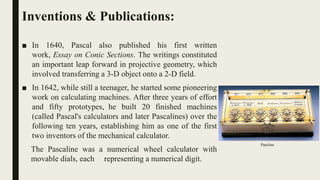
■ In 1642, while still a teenager, he started some pioneering
work on calculating machines. After three years of effort
and fifty prototypes, he built 20 finished machines
(called Pascal's calculators and later Pascalines) over the
following ten years, establishing him as one of the first
two inventors of the mechanical calculator.
The Pascaline was a numerical wheel calculator with
movable dials, each representing a numerical digit.
Pascline
Contributions to Mathematics:
■ Pascal continued to influence mathematics throughout
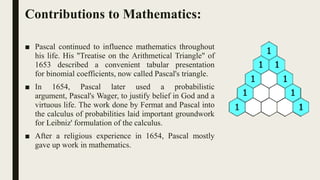
his life. His "Treatise on the Arithmetical Triangle" of
1653 described a convenient tabular presentation
for binomial coefficients, now called Pascal's triangle.
■ In 1654, Pascal later used a probabilistic
argument, Pascal's Wager, to justify belief in God and a
virtuous life. The work done by Fermat and Pascal into
the calculus of probabilities laid important groundwork
for Leibniz' formulation of the calculus.
■ After a religious experience in 1654, Pascal mostly
gave up work in mathematics.
Contributions to the Fluid Mechanics:
■ Pascal's work in the fields of the study
of hydrodynamics and hydrostatics centered on the
principles of hydraulic fluids. His inventions include
the hydraulic press (using hydraulic pressure to multiply
force) and the syringe.
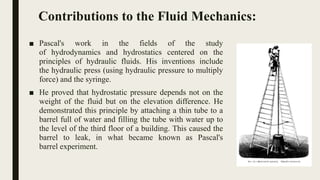
■ He proved that hydrostatic pressure depends not on the
weight of the fluid but on the elevation difference. He
demonstrated this principle by attaching a thin tube to a
barrel full of water and filling the tube with water up to
the level of the third floor of a building. This caused the
barrel to leak, in what became known as Pascal's
barrel experiment.
Pascal’s Principle:
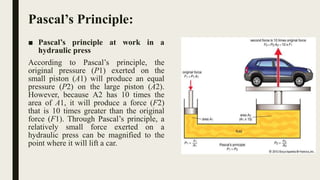
■ Pascal’s principle at work in a
hydraulic press
According to Pascal’s principle, the
original pressure (P1) exerted on the
small piston (A1) will produce an equal
pressure (P2) on the large piston (A2).
However, because A2 has 10 times the
area of A1, it will produce a force (F2)
that is 10 times greater than the original
force (F1). Through Pascal’s principle, a
relatively small force exerted on a
hydraulic press can be magnified to the
point where it will lift a car.
Legacy:
■ In honor of his scientific contributions, the name Pascal has been given to the SI
unit of pressure, to a programming language, and Pascal's law (an important
principle of hydrostatics), and as mentioned above, Pascal's triangle and Pascal's
wager still bear his name.
■ In France, prestigious annual awards, Blaise Pascal Chairs are given to outstanding
international scientists to conduct their research in the Ile de France region. One of
the Universities of Clermont-Ferrand, France, Université Blaise Pascal is named
after him. The University of Waterloo, Ontario, Canada, holds an annual math
contest named in his honor..
Death:
■ Pascal had struggled with insomnia and a digestive disorder from the time he was a
teen, and as such he was known to have suffered greatly from pain throughout his
life. Over the years, Pascal’s constant work took a further toll on his already fragile
health.
■ Pascal died of a malignant stomach tumor at his sister Gilberte's home in Paris on
August 19, 1662. By then, the tumor had metastasized in his brain. He was 39 years
old.
 Summarized Video:
Blaise Pascal Biography

Blaise Pascal Biography

  • 2.
    Subject Related: FluidMechanics-I Presented By: Mujahid Hussain Regn. No. AUIC-14FL-BECE-0797 Presented To: Dr. Salik Javaid ISLAMABAD CAMPUS (DEPARTMENT OF CIVIL ENGINEERING)
  • 3.
    HISTORY & ACHIEVEMENTSOF THE FAMOUS SCIENTIST “BLAISE PASCAL” TOPIC:-
  • 4.
  • 5.
    Field Specialization: ■ Mathematician ■Scientist ■ Philosopher ■ Physicist ■ Theologian
  • 6.
    An-Overview ■ 19 June1623 – 19 August 1662, was a French Mathematician, Physicist, Inventor, Writer and Christian Philosopher. He was a child prodigy who was educated by his father, a tax collector in Rouen. Pascal's earliest work was in the natural and applied sciences where he made important contributions to the study of fluids, and clarified the concepts of pressure and vacuum by generalizing the work of Evangelista Torricelli. Pascal also wrote in defense of the scientific method. ■ In 1642, while still a teenager, he started some pioneering work on calculating machines. After three years of effort and fifty prototypes, he built 20 finished machines (called Pascal's calculators and later Pascalines) over the following ten years, establishing him as one of the first two inventors of the mechanical calculator.
  • 7.
    ■ Pascal wasan important mathematician, helping create two major new areas of research: he wrote a significant treatise on the subject of projective geometry at the age of 16, and later corresponded with Pierre de Fermat on probability theory, strongly influencing the development of modern economics and social science. Following Galileo and Torricelli, in 1646, he refuted Aristotle's followers who insisted that nature abhors a vacuum. Pascal's results caused many disputes before being accepted. ■ In 1646, he and his sister Jacqueline identified with the religious movement within Catholicism known by its detractors as Jansenism. His father died in 1651. Following a religious experience in late 1654, he began writing influential works on philosophy and theology. His two most famous works date from this period. In that year, he also wrote an important treatise on the arithmetical triangle. Between 1658 and 1659 he wrote on the cycloid and its use in calculating the volume of solids. ■ Pascal had poor health, especially after his 18th year, and his death came just two months after his 39th birthday.
  • 8.
    Early Life andEducation ■ Birth & Place: Blaise Pascal was born on June 19, 1623, in Clermont-Ferrand, France ■ Family Members: Father:- Étienne Pascal (1588–1651), a Tax Collector Mother:- Antoinette Begon, (died when Pascal was just 3 years old) Elder Sister:- Gilberte Younger Sister: Jacqueline
  • 9.
    ■ Education: In 1631,five years after the death of his wife, Étienne Pascal moved with his children to Paris. He had decided to educate Blaise a child prodigy—at home so he could design an unorthodox curriculum and make sure that Blaise was able to express his own innate curiosity. It's also believed that Blaise may have been educated at home due to issues around his health. Ironically, Etienne omitted mathematics from his son's early curriculum out of concern that Blaise would become so fascinated with geometry that he wouldn’t be able to focus on classical subjects. The beginning of Blaise’s education was geared toward languages, especially Latin and Greek. Even so, Etienne's plan backfired: The fact that mathematics was a forbidden topic made the subject even more interesting to the inquisitive boy, who at the age of 12 began exploring geometry on his own. He made up his own terminology, not having learned official mathematical terms, and quickly managed to work out that the sum of a triangle's angles are equal to two right angles.
  • 10.
    Inventions & Publications: ■In 1640, Pascal also published his first written work, Essay on Conic Sections. The writings constituted an important leap forward in projective geometry, which involved transferring a 3-D object onto a 2-D field. ■ In 1642, while still a teenager, he started some pioneering work on calculating machines. After three years of effort and fifty prototypes, he built 20 finished machines (called Pascal's calculators and later Pascalines) over the following ten years, establishing him as one of the first two inventors of the mechanical calculator. The Pascaline was a numerical wheel calculator with movable dials, each representing a numerical digit. Pascline
  • 11.
    Contributions to Mathematics: ■Pascal continued to influence mathematics throughout his life. His "Treatise on the Arithmetical Triangle" of 1653 described a convenient tabular presentation for binomial coefficients, now called Pascal's triangle. ■ In 1654, Pascal later used a probabilistic argument, Pascal's Wager, to justify belief in God and a virtuous life. The work done by Fermat and Pascal into the calculus of probabilities laid important groundwork for Leibniz' formulation of the calculus. ■ After a religious experience in 1654, Pascal mostly gave up work in mathematics.
  • 12.
    Contributions to theFluid Mechanics: ■ Pascal's work in the fields of the study of hydrodynamics and hydrostatics centered on the principles of hydraulic fluids. His inventions include the hydraulic press (using hydraulic pressure to multiply force) and the syringe. ■ He proved that hydrostatic pressure depends not on the weight of the fluid but on the elevation difference. He demonstrated this principle by attaching a thin tube to a barrel full of water and filling the tube with water up to the level of the third floor of a building. This caused the barrel to leak, in what became known as Pascal's barrel experiment.
  • 13.
    Pascal’s Principle: ■ Pascal’sprinciple at work in a hydraulic press According to Pascal’s principle, the original pressure (P1) exerted on the small piston (A1) will produce an equal pressure (P2) on the large piston (A2). However, because A2 has 10 times the area of A1, it will produce a force (F2) that is 10 times greater than the original force (F1). Through Pascal’s principle, a relatively small force exerted on a hydraulic press can be magnified to the point where it will lift a car.
  • 14.
    Legacy: ■ In honorof his scientific contributions, the name Pascal has been given to the SI unit of pressure, to a programming language, and Pascal's law (an important principle of hydrostatics), and as mentioned above, Pascal's triangle and Pascal's wager still bear his name. ■ In France, prestigious annual awards, Blaise Pascal Chairs are given to outstanding international scientists to conduct their research in the Ile de France region. One of the Universities of Clermont-Ferrand, France, Université Blaise Pascal is named after him. The University of Waterloo, Ontario, Canada, holds an annual math contest named in his honor..
  • 15.
    Death: ■ Pascal hadstruggled with insomnia and a digestive disorder from the time he was a teen, and as such he was known to have suffered greatly from pain throughout his life. Over the years, Pascal’s constant work took a further toll on his already fragile health. ■ Pascal died of a malignant stomach tumor at his sister Gilberte's home in Paris on August 19, 1662. By then, the tumor had metastasized in his brain. He was 39 years old.
  • 16.