Seed multiplication and Seed
certification
Baldaniya Manish
Reg. No. 1010118002
Department of Agronomy
N. M. College of Agriculture
Navsari Agricultural University, Navsari
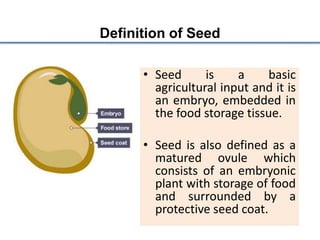
• Seed is a basic
agricultural input and it is
an embryo, embedded in
the food storage tissue.
• Seed is also defined as a
matured ovule which
consists of an embryonic
plant with storage of food
and surrounded by a
protective seed coat.
Definition of Seed
• Timely availability of good quality seeds at
reasonable price ensures good yield and profit to
the farmers.
• The seeds plays a vital role in agriculture and acts
as a carrier of the genetic potential of varieties.
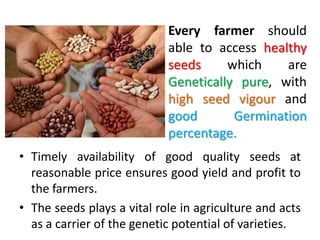
Every farmer should
able to access healthy
seeds which are
Genetically pure, with
high seed vigour and
good Germination
percentage.
Seed Multiplication
• Multiplication and distribution of high quality
seed of improved varieties is a crucial step in
the agricultural production of any country.
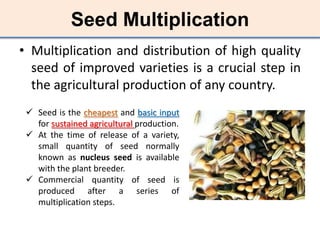
 Seed is the cheapest and basic input
for sustained agricultural production.
 At the time of release of a variety,
small quantity of seed normally
known as nucleus seed is available
with the plant breeder.
 Commercial quantity of seed is
produced after a series of
multiplication steps.
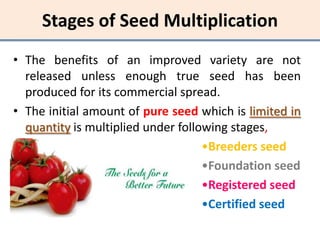
Stages of Seed Multiplication
• The benefits of an improved variety are not
released unless enough true seed has been
produced for its commercial spread.
• The initial amount of pure seed which is limited in
quantity is multiplied under following stages,
•Breeders seed
•Foundation seed
•Registered seed
•Certified seed
Breeders seed
• Breeder seed is the seed or the vegetative
propagating materials produced by the
breeder who developed the particular variety.
• Breeder seed is genetically pure.
• In case of self-pollinated species, mass
selection is regularly practiced to maintain the
genetic purity of the variety.
• Breeder seed used golden-yellow tag
Foundation seed
• Foundation seed is progeny of breeder seed.
• Foundation seed is genetically pure and is the
source of registered and/or certified seed.
• Foundation seed is produced on Government
farms, at Research stations or by competent
seed growers under strict supervision of
experts.
• Foundation seed used white color tag
Registered seed
• Registered seed is produced from foundation
seed or from registered seed.
• Genetically pure and used to produce certified
seed or registered seed.
• It is usually produced by progressive farmers
according to technical advice and supervision
provided by SCPPC (Seed Certification and
Plant Protection Centre)
• Registered seed used pink color tag
Certified seed
• Certified seed is produced from foundation,
registered or certify seed.
• This is so known because it is certified by the
SCPPC as suitable seed for raising a good crop.
• The certified seed is annually produced by
progressive farmers according to standard seed
production practices.
• To be certified the seed must meet the prescribed
requirements regarding purity and quality.
• Certified seed used blue color tag.
Requirements of Certified Seed Production
• 1) Source of Seed: Appropriate/proper class of seed need to be obtained
from approved source according to stages of seed multiplication.
a) The bags containing breeder seed or foundation seed should intact with
lead seals not tampered or removed.
b) Certification tag i.e yellow tag for breeder seed and white tag for
foundation seed should be stitched to the bag and intact. It should be
signed by seed certification officer/crop breeder.
c) While procuring the seed, period of validation or revalidation noted on
the tag be checked. If the validity or revalidation period of the tag is
expired, the seed should not be used for seed production. The source of
purchased seed should be verified by SCA before sowing.
d) The empty bags and the tags should be preserved properly till the seed is
certified. It helps in giving documentary evidence if legal dispute arises.
The tags are also required to be produced at the time of field inspections.
• Generally seeds of notified varieties are multiplied in four tier system i.e
nucleus seed, breeder seed, foundation seed and certified seed.
• 2) Registration of Seed Plot: When the seed
plot is to be offered for certification, it is
necessary to register the said plot for
certification with District Seed Certification
Officer. For this an application is to be made in
prescribed form (Form A) and is to be
submitted to District Seed Certification Officer
along with agreement bond on stamp paper of
Rs.100/- duly notarised or registered with
Taluka magistrate.
• 3) Land Requirement:
a) The land selected for seed production should be suitable for that crop. It should be
medium to deep and well drained light soils, sandy soils or waterlogged soils
should not be selected for seed production as such lands affect crop growth and
thereby reduce the seed yields.
b) The land selected for seed production should be comparatively free from soil borne
diseases, insect pests and noxious weed seeds.
c) As far as possible the land selected for seed production should not have same crop
grown in the proceeding season. However, if same crop is grown in the proceeding
season, then it should be irrigated three weeks before sowing so that seed of
preveious crop that had fallen the soil will start germination. The land should be
harrowed for removing seedlings of volunteer plants, weeds, other crop plants.
d) It is desirable to have protective irrigation source.
e) The selected land should meet isolation requirement.
• 4) Isolation Requirement:
Isolation is the separation of seed field from the fields of Other varieties or hybrids
of same crop. Same variety of hybrids which do not conforming to varietal
requirements. Other related species which are readily crossable and Fields affected
by designated diseases prevent genetic and disease contamination.
• 5) Cultivation Practices and Plants Protection:
Cultivation practice recommended for the crop are
required to be adopted timely so as to get good stand
of seed crop and thereby higher seed yields.
It consists of …….
 Good land preparation.
 Use of optimum seed rate with timely sowing.
 Application of FYM and fertilizers at recommended
doses and as per schedule of split application.
 Timely weeding and Interculturing.
 Timely control of pests and diseases.
 Timely application of irrigations.
 Watching the seed plots from birds, stray animals.
• 6) Roughing:
Roughing is the removal of individual plants which differ
significantly from the normal type of the variety.
The most important object of the seed production is to
maintain genetic purity of the variety or hybrids seed plot.
Rouging consists of removal of
 Off types Plant
 Volunteer plants
 Pollen shedders in female (A) lines,
 Plants of noxious weeds and other crops,
 Diseased plants affected by seed borne diseases growing in
the seed plot and
 Tassels from plants in the female rows of seed production of
single hybrids and double hybrids in maize.
7) Field Inspection:
• As per provisions of seed certification, the seed plots offered for
certifications are subjected to field inspection by the staff of seed
certification agency.
• The number of field inspections is usually carried without prior
intimation to the seed producer. It is the responsibility of the seed
producer to follow the instructions given by the field inspector.
• Seed producer or his responsible representative remain present on
the field during each inspection.
• During the field inspection, source of seed used with tag isolation
planting rouging are checked and counts of off types, shedders etc
are taken.
• A copy of inspection report is handed over to the producer. Seed
producer should see that all operations required to maintain
prescribed genetic and physical purity of seed plot are carried
before each inspection, otherwise carelessness on part of the seed
producer may result in rejection of seed plot from certification.
8) Harvesting, Threshing, Drying and Sealing of Raw Seed:
• Seed plot should be harvested at proper stage of maturity and only
after permission is granted by the field inspector.
• After harvesting the crop, it should be brought to threshing yard for
drying care should be taken to see that there will not be
contamination with other varieties in the produce of seed plot.
• The seed produce be threshed and winnowed for removing major
part of inert matter. i. e Stones, sand , dried twigs, leaves, husk etc.
• The cleaned seed produce should be bagged in the presence of the
field inspectors who ill seal the entire bags ad issue threshing
certificate.
• At the time of sealing, field inspector draw 3 kg sample from each
lot. In case of F/S and certified cotton seed for F.T. The seed bags
should be transported to authorized seed processing plant for
processing along with threshing certificate.
• It may be noted that the seed will not be accepted for processing at
seed processing plant unless it is brought in bags sealed by the field
inspector and issued with threshing certificate.
9) Seed Processing:
• Seed lot accepted for processing is processed at the seed
draws three samples and sends one sample to seed
testing laboratory for testing, one sample kept at his
disposal and one sample for concerned seed producer.
10) Bagging, Tagging:
• When the seed lot is passed by seed certification agency
on the basis of seed testing laboratory report (STL), than
after processed and treated seed is bagged and tagged
with appropriate tags issued by seed certification officer.
11) Release of Seed Lot:
• The certified seed lot is released to the seed producer for
sale. But foundation seed lot is released after getting FT
report.
Why need Certified seed??
• Genetic Purity - Absence of seeds of other varieties of
the same crop species as well as of other crop species.
• Physical Purity – freedom of seed from inert matter
(sand, pebbles) and defective seed (broken, diseased,
infested).
 High Germination Rate
 Free from weed seeds
 Free from Diseases
 Optimum moisture content (for efficient processing
and storage)
Seed certification
• Seed certification is a quality assurance
system whereby seed intended for marketing
is subject to official control and inspection.
Objectives of Seed Certification
There are following three primary objectives of
seed programmes:
 The systematic increase of superior varieties.
 The identification of new varieties and their
rapid increase under appropriate and
generally accepted names.
 Provision of a continuing supply of
comparable material by careful maintenance.
Seed Certification Agencies
Seeds Act, 1966 provides for the establishment of Seed Certification Agencies
in each State. Seed Certification Agency should function on the following
broad principles:
• Seed Certification agency should be an autonomous body.
• Seed Certification Agency should not involve itself in the production and
marketing of seeds.
• The Seed Certification Standards and procedures adapted by seed
certification agency should be uniform, throughout the country.
• Seed Certification Agency should have close linkage with the technical and
other related institutions.
• Its long-term objective should be to operate on no-profit no-loss basis.
• Adequate staff trained in seed certification should be maintained by the
Certification Agency.
• It should have provision for creating adequate facilities for ensuring timely
and through inspections.
• It should serve the interests of seed producers and farmers/users.
Indian seed programme includes
• Participation Central and State governments,
• Indian Council of Agricultural (ICAR),
• State Agricultural Universities (SAU) system,
• Public sector, cooperative sector and private sector
institutions.
• Seed sector in India consists of two national level corporations
i.e. National Seeds Corporation (NSC) and State Farms
Corporation of India (SFCI), 15 State Seed Corporations (SSCs)
and about 100 major seed companies.
• For quality control and certification, there are 22 State Seed
Certification Agencies (SSCAs) and 104 state Seed Testing
Laboratories (SSTLs).
• The private sector has started to play a significant role in the
production and distribution of seeds.
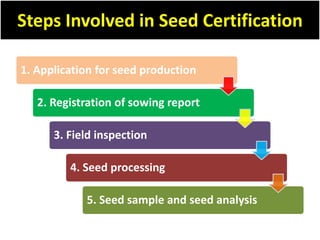
Steps Involved in Seed Certification
1. Application for seed production
2. Registration of sowing report
3. Field inspection
4. Seed processing
5. Seed sample and seed analysis
1. Application for seed production
• Any person who wants to take up certified seed
production should submit a sowing report in
triplicate to the Assistant Director of Seed
Certification to register the crop and season with
a registration fee of Rs. 25/- (Rupees twenty five
only) and prescribed certification charges.
• The fee is for a single crop variety for an area up
to 25 acres and for a single season.
• Along with this fee for seed certification the label
of the seed source should be submitted.
SAMPLE FORM OF SOWING REPORT
Name and address of the Producer :
Name and address of the grower :
Location of the seed farm :
a. Revenue village :
b. Block :
c. Taluka :
Crop / Variety / Acreage :
Class of seed to be produced :
Quantity of Seeds used (kg/acre) :
Source of seed :
a. Tag number :
b. Purchase Bill No. and date :
Date of sowing :
Signature of the grower :
Enclosures:
1. Tag for source of seed
2. Purchase bill of the grower
Signature of the producer
FOR OFFICE USE ONLY
Fee remitted :
Bill number and date :
Seed Certification No. :
Seed Certification Officer allotted :
Due dates for field Inspections :
Signature of Assistant Director of
Seed Certificatio
2. Registration of sowing report
After receiving the application of the sowing report, the Assistant
Director of Seed Certification scrutinizes and registers the seed farm
and duly assigns a Seed certification number for each sowing report.
3. Field Inspection
The objective of the field inspection is to check for the factors that
may affect the genetic purity and physical health of the seeds. Field
inspection will be conducted by the Seed Certification Officer (SCO) to
whom the specific seed farm has been allocated. The specific date of
inspection and details of the seed farm will be intimated by the Seed
Certification Officer through a copy of the sowing report sent to him.
Number of field inspections will differ from crop to crop depending
upon the growth stages of the crop. Generally field inspections would
be carried out during the following growth stages of the crop.
• Pre flowering stage
• Flowering stage
• Post flowering and Pre harvest stage
• Harvest time
4. Seed Processing
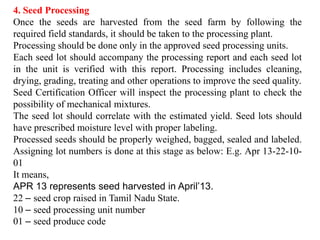
Once the seeds are harvested from the seed farm by following the
required field standards, it should be taken to the processing plant.
Processing should be done only in the approved seed processing units.
Each seed lot should accompany the processing report and each seed lot
in the unit is verified with this report. Processing includes cleaning,
drying, grading, treating and other operations to improve the seed quality.
Seed Certification Officer will inspect the processing plant to check the
possibility of mechanical mixtures.
The seed lot should correlate with the estimated yield. Seed lots should
have prescribed moisture level with proper labeling.
Processed seeds should be properly weighed, bagged, sealed and labeled.
Assigning lot numbers is done at this stage as below: E.g. Apr 13-22-10-
01
It means,
APR 13 represents seed harvested in April’13.
22 – seed crop raised in Tamil Nadu State.
10 – seed processing unit number
01 – seed produce code
SAMPLE APPLICATION FORM FOR PROCESSING REPORT
Processor Name / Address :
Producer Name / Address :
Crop / Variety :
Certification Stage :
Seed Certification No. :
Sowing date :
Seed farm situated in
Block :
Village :
Acreage of the seed farm :
Date of harvest :
Yield estimated by SCO during field inspection :
The above mentioned seed lot was inspected by me on the date………………. This seed lot is
properly
stored without any contamination of the seeds of other varieties. Kindly request you to provide
the
processing order to take the seed lots to the processing unit No. ……….. for processing.
Signature of the grower Signature of the Producer/representatives
Name : Name :
Designation : Designation:
Date: Date:
To
Assistant Director of Seed Certification
Copy to : Seed Certification Officer
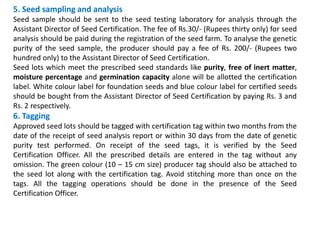
5. Seed sampling and analysis
Seed sample should be sent to the seed testing laboratory for analysis through the
Assistant Director of Seed Certification. The fee of Rs.30/- (Rupees thirty only) for seed
analysis should be paid during the registration of the seed farm. To analyse the genetic
purity of the seed sample, the producer should pay a fee of Rs. 200/- (Rupees two
hundred only) to the Assistant Director of Seed Certification.
Seed lots which meet the prescribed seed standards like purity, free of inert matter,
moisture percentage and germination capacity alone will be allotted the certification
label. White colour label for foundation seeds and blue colour label for certified seeds
should be bought from the Assistant Director of Seed Certification by paying Rs. 3 and
Rs. 2 respectively.
6. Tagging
Approved seed lots should be tagged with certification tag within two months from the
date of the receipt of seed analysis report or within 30 days from the date of genetic
purity test performed. On receipt of the seed tags, it is verified by the Seed
Certification Officer. All the prescribed details are entered in the tag without any
omission. The green colour (10 – 15 cm size) producer tag should also be attached to
the seed lot along with the certification tag. Avoid stitching more than once on the
tags. All the tagging operations should be done in the presence of the Seed
Certification Officer.
Seed multiplication

Seed multiplication

  • 1.
    Seed multiplication andSeed certification Baldaniya Manish Reg. No. 1010118002 Department of Agronomy N. M. College of Agriculture Navsari Agricultural University, Navsari
  • 2.
    • Seed isa basic agricultural input and it is an embryo, embedded in the food storage tissue. • Seed is also defined as a matured ovule which consists of an embryonic plant with storage of food and surrounded by a protective seed coat. Definition of Seed
  • 3.
    • Timely availabilityof good quality seeds at reasonable price ensures good yield and profit to the farmers. • The seeds plays a vital role in agriculture and acts as a carrier of the genetic potential of varieties. Every farmer should able to access healthy seeds which are Genetically pure, with high seed vigour and good Germination percentage.
  • 4.
    Seed Multiplication • Multiplicationand distribution of high quality seed of improved varieties is a crucial step in the agricultural production of any country.  Seed is the cheapest and basic input for sustained agricultural production.  At the time of release of a variety, small quantity of seed normally known as nucleus seed is available with the plant breeder.  Commercial quantity of seed is produced after a series of multiplication steps.
  • 5.
    Stages of SeedMultiplication • The benefits of an improved variety are not released unless enough true seed has been produced for its commercial spread. • The initial amount of pure seed which is limited in quantity is multiplied under following stages, •Breeders seed •Foundation seed •Registered seed •Certified seed
  • 6.
    Breeders seed • Breederseed is the seed or the vegetative propagating materials produced by the breeder who developed the particular variety. • Breeder seed is genetically pure. • In case of self-pollinated species, mass selection is regularly practiced to maintain the genetic purity of the variety. • Breeder seed used golden-yellow tag
  • 7.
    Foundation seed • Foundationseed is progeny of breeder seed. • Foundation seed is genetically pure and is the source of registered and/or certified seed. • Foundation seed is produced on Government farms, at Research stations or by competent seed growers under strict supervision of experts. • Foundation seed used white color tag
  • 8.
    Registered seed • Registeredseed is produced from foundation seed or from registered seed. • Genetically pure and used to produce certified seed or registered seed. • It is usually produced by progressive farmers according to technical advice and supervision provided by SCPPC (Seed Certification and Plant Protection Centre) • Registered seed used pink color tag
  • 9.
    Certified seed • Certifiedseed is produced from foundation, registered or certify seed. • This is so known because it is certified by the SCPPC as suitable seed for raising a good crop. • The certified seed is annually produced by progressive farmers according to standard seed production practices. • To be certified the seed must meet the prescribed requirements regarding purity and quality. • Certified seed used blue color tag.
  • 10.
    Requirements of CertifiedSeed Production • 1) Source of Seed: Appropriate/proper class of seed need to be obtained from approved source according to stages of seed multiplication. a) The bags containing breeder seed or foundation seed should intact with lead seals not tampered or removed. b) Certification tag i.e yellow tag for breeder seed and white tag for foundation seed should be stitched to the bag and intact. It should be signed by seed certification officer/crop breeder. c) While procuring the seed, period of validation or revalidation noted on the tag be checked. If the validity or revalidation period of the tag is expired, the seed should not be used for seed production. The source of purchased seed should be verified by SCA before sowing. d) The empty bags and the tags should be preserved properly till the seed is certified. It helps in giving documentary evidence if legal dispute arises. The tags are also required to be produced at the time of field inspections. • Generally seeds of notified varieties are multiplied in four tier system i.e nucleus seed, breeder seed, foundation seed and certified seed.
  • 11.
    • 2) Registrationof Seed Plot: When the seed plot is to be offered for certification, it is necessary to register the said plot for certification with District Seed Certification Officer. For this an application is to be made in prescribed form (Form A) and is to be submitted to District Seed Certification Officer along with agreement bond on stamp paper of Rs.100/- duly notarised or registered with Taluka magistrate.
  • 12.
    • 3) LandRequirement: a) The land selected for seed production should be suitable for that crop. It should be medium to deep and well drained light soils, sandy soils or waterlogged soils should not be selected for seed production as such lands affect crop growth and thereby reduce the seed yields. b) The land selected for seed production should be comparatively free from soil borne diseases, insect pests and noxious weed seeds. c) As far as possible the land selected for seed production should not have same crop grown in the proceeding season. However, if same crop is grown in the proceeding season, then it should be irrigated three weeks before sowing so that seed of preveious crop that had fallen the soil will start germination. The land should be harrowed for removing seedlings of volunteer plants, weeds, other crop plants. d) It is desirable to have protective irrigation source. e) The selected land should meet isolation requirement. • 4) Isolation Requirement: Isolation is the separation of seed field from the fields of Other varieties or hybrids of same crop. Same variety of hybrids which do not conforming to varietal requirements. Other related species which are readily crossable and Fields affected by designated diseases prevent genetic and disease contamination.
  • 13.
    • 5) CultivationPractices and Plants Protection: Cultivation practice recommended for the crop are required to be adopted timely so as to get good stand of seed crop and thereby higher seed yields. It consists of …….  Good land preparation.  Use of optimum seed rate with timely sowing.  Application of FYM and fertilizers at recommended doses and as per schedule of split application.  Timely weeding and Interculturing.  Timely control of pests and diseases.  Timely application of irrigations.  Watching the seed plots from birds, stray animals.
  • 14.
    • 6) Roughing: Roughingis the removal of individual plants which differ significantly from the normal type of the variety. The most important object of the seed production is to maintain genetic purity of the variety or hybrids seed plot. Rouging consists of removal of  Off types Plant  Volunteer plants  Pollen shedders in female (A) lines,  Plants of noxious weeds and other crops,  Diseased plants affected by seed borne diseases growing in the seed plot and  Tassels from plants in the female rows of seed production of single hybrids and double hybrids in maize.
  • 15.
    7) Field Inspection: •As per provisions of seed certification, the seed plots offered for certifications are subjected to field inspection by the staff of seed certification agency. • The number of field inspections is usually carried without prior intimation to the seed producer. It is the responsibility of the seed producer to follow the instructions given by the field inspector. • Seed producer or his responsible representative remain present on the field during each inspection. • During the field inspection, source of seed used with tag isolation planting rouging are checked and counts of off types, shedders etc are taken. • A copy of inspection report is handed over to the producer. Seed producer should see that all operations required to maintain prescribed genetic and physical purity of seed plot are carried before each inspection, otherwise carelessness on part of the seed producer may result in rejection of seed plot from certification.
  • 16.
    8) Harvesting, Threshing,Drying and Sealing of Raw Seed: • Seed plot should be harvested at proper stage of maturity and only after permission is granted by the field inspector. • After harvesting the crop, it should be brought to threshing yard for drying care should be taken to see that there will not be contamination with other varieties in the produce of seed plot. • The seed produce be threshed and winnowed for removing major part of inert matter. i. e Stones, sand , dried twigs, leaves, husk etc. • The cleaned seed produce should be bagged in the presence of the field inspectors who ill seal the entire bags ad issue threshing certificate. • At the time of sealing, field inspector draw 3 kg sample from each lot. In case of F/S and certified cotton seed for F.T. The seed bags should be transported to authorized seed processing plant for processing along with threshing certificate. • It may be noted that the seed will not be accepted for processing at seed processing plant unless it is brought in bags sealed by the field inspector and issued with threshing certificate.
  • 17.
    9) Seed Processing: •Seed lot accepted for processing is processed at the seed draws three samples and sends one sample to seed testing laboratory for testing, one sample kept at his disposal and one sample for concerned seed producer. 10) Bagging, Tagging: • When the seed lot is passed by seed certification agency on the basis of seed testing laboratory report (STL), than after processed and treated seed is bagged and tagged with appropriate tags issued by seed certification officer. 11) Release of Seed Lot: • The certified seed lot is released to the seed producer for sale. But foundation seed lot is released after getting FT report.
  • 18.
    Why need Certifiedseed?? • Genetic Purity - Absence of seeds of other varieties of the same crop species as well as of other crop species. • Physical Purity – freedom of seed from inert matter (sand, pebbles) and defective seed (broken, diseased, infested).  High Germination Rate  Free from weed seeds  Free from Diseases  Optimum moisture content (for efficient processing and storage)
  • 19.
    Seed certification • Seedcertification is a quality assurance system whereby seed intended for marketing is subject to official control and inspection.
  • 20.
    Objectives of SeedCertification There are following three primary objectives of seed programmes:  The systematic increase of superior varieties.  The identification of new varieties and their rapid increase under appropriate and generally accepted names.  Provision of a continuing supply of comparable material by careful maintenance.
  • 21.
    Seed Certification Agencies SeedsAct, 1966 provides for the establishment of Seed Certification Agencies in each State. Seed Certification Agency should function on the following broad principles: • Seed Certification agency should be an autonomous body. • Seed Certification Agency should not involve itself in the production and marketing of seeds. • The Seed Certification Standards and procedures adapted by seed certification agency should be uniform, throughout the country. • Seed Certification Agency should have close linkage with the technical and other related institutions. • Its long-term objective should be to operate on no-profit no-loss basis. • Adequate staff trained in seed certification should be maintained by the Certification Agency. • It should have provision for creating adequate facilities for ensuring timely and through inspections. • It should serve the interests of seed producers and farmers/users.
  • 22.
    Indian seed programmeincludes • Participation Central and State governments, • Indian Council of Agricultural (ICAR), • State Agricultural Universities (SAU) system, • Public sector, cooperative sector and private sector institutions. • Seed sector in India consists of two national level corporations i.e. National Seeds Corporation (NSC) and State Farms Corporation of India (SFCI), 15 State Seed Corporations (SSCs) and about 100 major seed companies. • For quality control and certification, there are 22 State Seed Certification Agencies (SSCAs) and 104 state Seed Testing Laboratories (SSTLs). • The private sector has started to play a significant role in the production and distribution of seeds.
  • 23.
    Steps Involved inSeed Certification 1. Application for seed production 2. Registration of sowing report 3. Field inspection 4. Seed processing 5. Seed sample and seed analysis
  • 24.
    1. Application forseed production • Any person who wants to take up certified seed production should submit a sowing report in triplicate to the Assistant Director of Seed Certification to register the crop and season with a registration fee of Rs. 25/- (Rupees twenty five only) and prescribed certification charges. • The fee is for a single crop variety for an area up to 25 acres and for a single season. • Along with this fee for seed certification the label of the seed source should be submitted.
  • 25.
    SAMPLE FORM OFSOWING REPORT Name and address of the Producer : Name and address of the grower : Location of the seed farm : a. Revenue village : b. Block : c. Taluka : Crop / Variety / Acreage : Class of seed to be produced : Quantity of Seeds used (kg/acre) : Source of seed : a. Tag number : b. Purchase Bill No. and date : Date of sowing : Signature of the grower : Enclosures: 1. Tag for source of seed 2. Purchase bill of the grower Signature of the producer FOR OFFICE USE ONLY Fee remitted : Bill number and date : Seed Certification No. : Seed Certification Officer allotted : Due dates for field Inspections : Signature of Assistant Director of Seed Certificatio
  • 26.
    2. Registration ofsowing report After receiving the application of the sowing report, the Assistant Director of Seed Certification scrutinizes and registers the seed farm and duly assigns a Seed certification number for each sowing report. 3. Field Inspection The objective of the field inspection is to check for the factors that may affect the genetic purity and physical health of the seeds. Field inspection will be conducted by the Seed Certification Officer (SCO) to whom the specific seed farm has been allocated. The specific date of inspection and details of the seed farm will be intimated by the Seed Certification Officer through a copy of the sowing report sent to him. Number of field inspections will differ from crop to crop depending upon the growth stages of the crop. Generally field inspections would be carried out during the following growth stages of the crop. • Pre flowering stage • Flowering stage • Post flowering and Pre harvest stage • Harvest time
  • 27.
    4. Seed Processing Oncethe seeds are harvested from the seed farm by following the required field standards, it should be taken to the processing plant. Processing should be done only in the approved seed processing units. Each seed lot should accompany the processing report and each seed lot in the unit is verified with this report. Processing includes cleaning, drying, grading, treating and other operations to improve the seed quality. Seed Certification Officer will inspect the processing plant to check the possibility of mechanical mixtures. The seed lot should correlate with the estimated yield. Seed lots should have prescribed moisture level with proper labeling. Processed seeds should be properly weighed, bagged, sealed and labeled. Assigning lot numbers is done at this stage as below: E.g. Apr 13-22-10- 01 It means, APR 13 represents seed harvested in April’13. 22 – seed crop raised in Tamil Nadu State. 10 – seed processing unit number 01 – seed produce code
  • 28.
    SAMPLE APPLICATION FORMFOR PROCESSING REPORT Processor Name / Address : Producer Name / Address : Crop / Variety : Certification Stage : Seed Certification No. : Sowing date : Seed farm situated in Block : Village : Acreage of the seed farm : Date of harvest : Yield estimated by SCO during field inspection : The above mentioned seed lot was inspected by me on the date………………. This seed lot is properly stored without any contamination of the seeds of other varieties. Kindly request you to provide the processing order to take the seed lots to the processing unit No. ……….. for processing. Signature of the grower Signature of the Producer/representatives Name : Name : Designation : Designation: Date: Date: To Assistant Director of Seed Certification Copy to : Seed Certification Officer
  • 29.
    5. Seed samplingand analysis Seed sample should be sent to the seed testing laboratory for analysis through the Assistant Director of Seed Certification. The fee of Rs.30/- (Rupees thirty only) for seed analysis should be paid during the registration of the seed farm. To analyse the genetic purity of the seed sample, the producer should pay a fee of Rs. 200/- (Rupees two hundred only) to the Assistant Director of Seed Certification. Seed lots which meet the prescribed seed standards like purity, free of inert matter, moisture percentage and germination capacity alone will be allotted the certification label. White colour label for foundation seeds and blue colour label for certified seeds should be bought from the Assistant Director of Seed Certification by paying Rs. 3 and Rs. 2 respectively. 6. Tagging Approved seed lots should be tagged with certification tag within two months from the date of the receipt of seed analysis report or within 30 days from the date of genetic purity test performed. On receipt of the seed tags, it is verified by the Seed Certification Officer. All the prescribed details are entered in the tag without any omission. The green colour (10 – 15 cm size) producer tag should also be attached to the seed lot along with the certification tag. Avoid stitching more than once on the tags. All the tagging operations should be done in the presence of the Seed Certification Officer.