The benefits of virtually eliminating manual data
entry and manual business process transactions
through the use of automatic data collection
(ADC) have been realised by many companies
throughout the world for several years.
Implemented correctly, it improves accuracy, speed
of fulfilment and on-going operational costs. RFID
is the latest technology for achieving more
comprehensive and flexible ADC solutions, but
perceived fears over the cost of implementation
and uncertainty over the true benefits that can be
attained are still holding the market back from
total acceptance.
RFID’s main advantage over previous ADC
technologies is in the volume and scope of
information that can be made available. However,
to actually derive any benefit from this information,
it needs to be available to core systems and
applications where it can be processed, analysed
and exploited to generate a true real-time view of
an organisation’s operational status. This requires
some form of middle tier software that sits
between the readers that gather the data and the
supply chain execution or ERP systems.
The middle tier software allows data to be
managed as a valuable corporate asset because
the data itself can appreciate over time if it is
aggregated and the proper analyses are applied.
As products move through the supply chain they
can generate real-time demand alerts and the
improvements in data accessibility and quality have
a positive impact on demand forecast accuracy.
Ultimately, companies can gain real-time visibility
into customer purchase decisions, which helps
them to more accurately and positively react to
and influence the marketplace.
Back end systems like ERPs and warehouse
management systems (WMS) are not normally
designed to run RFID in real time, which makes
the middle, integrating software level essential. It
filters the massive amounts of data generated
from the readers and allows organisations to use it
to generate real-time decisions.
Develop a clear understanding
In order to get on the right road to RFID,
companies have to develop a clear understanding
of what they are trying to achieve, what the
business improvements and benefits will be and
how fast the return on investment is going to be.
To help achieve this, Seeburger has developed
what it believes is a unique product that allows
companies to simulate RFID processes before
large-scale deployments. It can be used as a
standalone RFID operating solution for pilot
projects and small companies and also in an
implementation that is fully integrated with
internal enterprise applications and external
trading partners.
The RFID Workbench is designed to address the
full spectrum of RFID middleware needs, enabling
an organisation to implement RFID on a phased
basis without changing middleware packages or
engaging multiple providers. It has a modular
architecture for step-by-step implementation, with
the ability to scale from a standalone platform to
full enterprise application and trading partner
integration without changing systems or providers.
The software delivers platform independence, with
a 100% Java-based architecture that permits
deployment in any Java-compatible Windows,
UNIX or AS/400 environment.
The Workbench allows rapid integration with
enterprise applications and trading partners,
making it considerably less costly than other
solutions. A "best-of-breed" graphical user
interface makes it easy to visually represent the
supply chain to aid setup and tracking of products
from point to point.
The Simulation Mode enables companies to
map and test RFID infrastructure and processes –
30 RFID SOLUTIONS SUMMER 05
SOFTWARE middleware
Rakesh Harji, managing director, Seeburger
(UK) says the company's middleware
solution cost-effectively eases the path
towards RFID implementation
MAKING RFID
HAPPEN
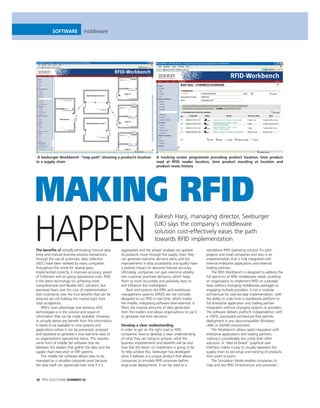
A Seeburger Workbench “map path” showing a product’s location
in a supply chain
A tracking screen programme providing product location, time product
read at RFID reader location, time product standing at location and
product route history
including simulation of events, product
flows and data flows – before an
implementation. This can be extended
using the highly configurable event
management tools that enable
granular control of routing and other
functions, including the unusual ability
to configure events and reports
differently for different distribution
centres.
By using this tool, companies can
quickly identify the best path to RFID
implementation and can also
accurately assess the potential cost
savings and return on investment.
Having used the simulation tool to
model logistic processes, test reader
placement, and fine-tune RFID
infrastructure, companies can use this
setup as a starting point for the real
implementation.
Standard mode
The Standard mode for RFID
Workbench is a standalone operating
solution for pilot projects and small
companies including tag verification,
EPC/UPC product code matching,
event management and alarm
activation, local event configuration,
graphical displays, and a variety of
other features that enable companies
to implement RFID projects quickly
and economically. The more advanced
RFID Workbench/PRO enables full
integration of RFID tag data to an
organisation’s ERP, WMS or MIS
systems; linking of databases for
filtering, comparison and analysis of
RFID information; and forwarding of
data to external partners for use in
managing the supply chain.
The strength of the software is that
it allows companies to plan and
develop a system ideally suited to their
requirements. For many companies,
the need for RFID is created by the
need to comply with industry
mandates and for this they need to
print tags, ensure they are working
and that they can be programmed
with Electronic Product Codes (EPC) or
Universal Product Codes (UPC).
The Workbench allows tags to be
stored in a catalogue, allowing
companies to verify that when they
left the facility they did in fact work,
thereby avoiding the penalties and
fees that some large organisations levy
on faulty tags. It also enables tag
consolidation by matching the data of
cases being read while packed to a
single pallet tag. This is necessary as it
can be difficult to get a 100% read of
packed cases on a full pallet due to
interference of packaging, location of
tags, or type of load (for example it is
difficult to read through liquids). It is
necessary to tag both cases and
pallets because loads will eventually be
broken down and cases need to be
read individually.
A key incremental benefit of RFID
is enabling companies to collect all
data into one area so that customer
service can verify what has been
shipped and what has been ordered.
This requires integration to existing
internal systems such as ERP, WMS or
other catalogues as well as external
trading partners to ensure all data is
collected in a central location and
eliminates spaghetti infrastructures.
Ultimately, suppliers need to
integrate RFID data into multiple back-
end systems within their own
enterprise and share that data with
partners and customers via web
portals and other electronic interfaces.
Companies can use the Workbench to
access UCCNet (ONS) to receive not
only codes of what they are sending
out, but also to receive verification of
transferred goods, thereby eliminating
manual labour costs and
counterfeiting. RFID makes it almost
impossible to ship counterfeit products
as the EPC verifies brand authenticity.
Further improvements in customer
service are generated from increased
inventory availability and reduced stock
outs, as well as streamlining shipping
notification processes and improving
responsiveness to customer needs.
In many cases, companies are
required to send an Advanced
Shipping Notice (ASN) as soon as the
goods leave their bay or get paid
faster if they send an ASN.
Workbench provides a Document
Exchange that sends an ASN
automatically when a pallet is logged
as going through the last reader to
the customer. ss
"COMPANIES HAVE TO DEVELOP A
CLEAR UNDERSTANDING OF WHAT
THEY ARE TRYING TO ACHIEVE, WHAT
THE BUSINESS IMPROVEMENTS AND
BENEFITS WILL BE AND HOW FAST
THE RETURN ON INVESTMENT"
Rakesh Harji
Solutions
RFIDVOLUME2SUMMER05

SEEBURGER_Making_RFID_Happen_RFID_Solutions

  • 1.
    The benefits ofvirtually eliminating manual data entry and manual business process transactions through the use of automatic data collection (ADC) have been realised by many companies throughout the world for several years. Implemented correctly, it improves accuracy, speed of fulfilment and on-going operational costs. RFID is the latest technology for achieving more comprehensive and flexible ADC solutions, but perceived fears over the cost of implementation and uncertainty over the true benefits that can be attained are still holding the market back from total acceptance. RFID’s main advantage over previous ADC technologies is in the volume and scope of information that can be made available. However, to actually derive any benefit from this information, it needs to be available to core systems and applications where it can be processed, analysed and exploited to generate a true real-time view of an organisation’s operational status. This requires some form of middle tier software that sits between the readers that gather the data and the supply chain execution or ERP systems. The middle tier software allows data to be managed as a valuable corporate asset because the data itself can appreciate over time if it is aggregated and the proper analyses are applied. As products move through the supply chain they can generate real-time demand alerts and the improvements in data accessibility and quality have a positive impact on demand forecast accuracy. Ultimately, companies can gain real-time visibility into customer purchase decisions, which helps them to more accurately and positively react to and influence the marketplace. Back end systems like ERPs and warehouse management systems (WMS) are not normally designed to run RFID in real time, which makes the middle, integrating software level essential. It filters the massive amounts of data generated from the readers and allows organisations to use it to generate real-time decisions. Develop a clear understanding In order to get on the right road to RFID, companies have to develop a clear understanding of what they are trying to achieve, what the business improvements and benefits will be and how fast the return on investment is going to be. To help achieve this, Seeburger has developed what it believes is a unique product that allows companies to simulate RFID processes before large-scale deployments. It can be used as a standalone RFID operating solution for pilot projects and small companies and also in an implementation that is fully integrated with internal enterprise applications and external trading partners. The RFID Workbench is designed to address the full spectrum of RFID middleware needs, enabling an organisation to implement RFID on a phased basis without changing middleware packages or engaging multiple providers. It has a modular architecture for step-by-step implementation, with the ability to scale from a standalone platform to full enterprise application and trading partner integration without changing systems or providers. The software delivers platform independence, with a 100% Java-based architecture that permits deployment in any Java-compatible Windows, UNIX or AS/400 environment. The Workbench allows rapid integration with enterprise applications and trading partners, making it considerably less costly than other solutions. A "best-of-breed" graphical user interface makes it easy to visually represent the supply chain to aid setup and tracking of products from point to point. The Simulation Mode enables companies to map and test RFID infrastructure and processes – 30 RFID SOLUTIONS SUMMER 05 SOFTWARE middleware Rakesh Harji, managing director, Seeburger (UK) says the company's middleware solution cost-effectively eases the path towards RFID implementation MAKING RFID HAPPEN A Seeburger Workbench “map path” showing a product’s location in a supply chain A tracking screen programme providing product location, time product read at RFID reader location, time product standing at location and product route history
  • 2.
    including simulation ofevents, product flows and data flows – before an implementation. This can be extended using the highly configurable event management tools that enable granular control of routing and other functions, including the unusual ability to configure events and reports differently for different distribution centres. By using this tool, companies can quickly identify the best path to RFID implementation and can also accurately assess the potential cost savings and return on investment. Having used the simulation tool to model logistic processes, test reader placement, and fine-tune RFID infrastructure, companies can use this setup as a starting point for the real implementation. Standard mode The Standard mode for RFID Workbench is a standalone operating solution for pilot projects and small companies including tag verification, EPC/UPC product code matching, event management and alarm activation, local event configuration, graphical displays, and a variety of other features that enable companies to implement RFID projects quickly and economically. The more advanced RFID Workbench/PRO enables full integration of RFID tag data to an organisation’s ERP, WMS or MIS systems; linking of databases for filtering, comparison and analysis of RFID information; and forwarding of data to external partners for use in managing the supply chain. The strength of the software is that it allows companies to plan and develop a system ideally suited to their requirements. For many companies, the need for RFID is created by the need to comply with industry mandates and for this they need to print tags, ensure they are working and that they can be programmed with Electronic Product Codes (EPC) or Universal Product Codes (UPC). The Workbench allows tags to be stored in a catalogue, allowing companies to verify that when they left the facility they did in fact work, thereby avoiding the penalties and fees that some large organisations levy on faulty tags. It also enables tag consolidation by matching the data of cases being read while packed to a single pallet tag. This is necessary as it can be difficult to get a 100% read of packed cases on a full pallet due to interference of packaging, location of tags, or type of load (for example it is difficult to read through liquids). It is necessary to tag both cases and pallets because loads will eventually be broken down and cases need to be read individually. A key incremental benefit of RFID is enabling companies to collect all data into one area so that customer service can verify what has been shipped and what has been ordered. This requires integration to existing internal systems such as ERP, WMS or other catalogues as well as external trading partners to ensure all data is collected in a central location and eliminates spaghetti infrastructures. Ultimately, suppliers need to integrate RFID data into multiple back- end systems within their own enterprise and share that data with partners and customers via web portals and other electronic interfaces. Companies can use the Workbench to access UCCNet (ONS) to receive not only codes of what they are sending out, but also to receive verification of transferred goods, thereby eliminating manual labour costs and counterfeiting. RFID makes it almost impossible to ship counterfeit products as the EPC verifies brand authenticity. Further improvements in customer service are generated from increased inventory availability and reduced stock outs, as well as streamlining shipping notification processes and improving responsiveness to customer needs. In many cases, companies are required to send an Advanced Shipping Notice (ASN) as soon as the goods leave their bay or get paid faster if they send an ASN. Workbench provides a Document Exchange that sends an ASN automatically when a pallet is logged as going through the last reader to the customer. ss "COMPANIES HAVE TO DEVELOP A CLEAR UNDERSTANDING OF WHAT THEY ARE TRYING TO ACHIEVE, WHAT THE BUSINESS IMPROVEMENTS AND BENEFITS WILL BE AND HOW FAST THE RETURN ON INVESTMENT" Rakesh Harji Solutions RFIDVOLUME2SUMMER05