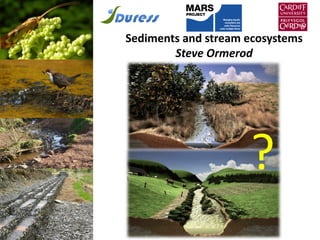
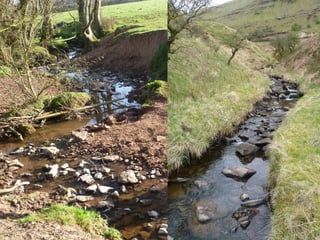
Sediments and stream ecosystems
Steve Ormerod
?
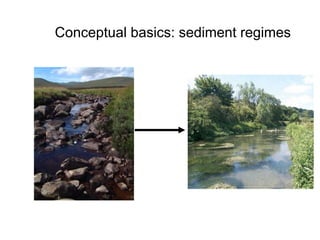
Conceptual basics: sediment regimes
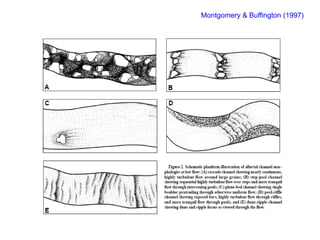
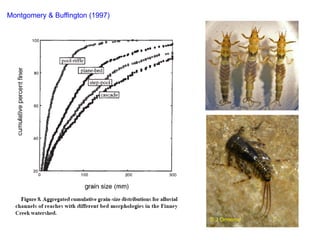
Montgomery & Buffington (1997)
S J Ormerod
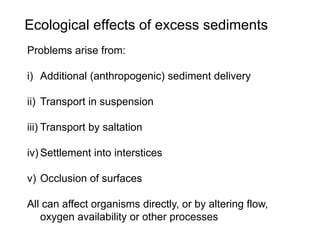
Ecological effects of excess sediments
Problems arise from:
i) Additional (anthropogenic) sediment delivery
ii) Transport in suspension
iii) Transport by saltation
iv) Settlement into interstices
v) Occlusion of surfaces
All can affect organisms directly, or by altering flow,
oxygen availability or other processes
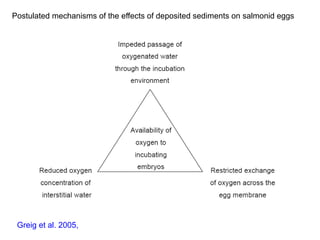
Greig et al. 2005,
Postulated mechanisms of the effects of deposited sediments on salmonid eggs
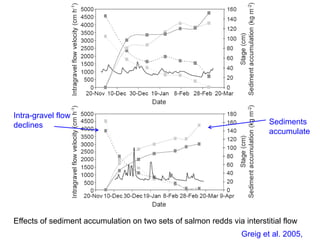
Effects of sediment accumulation on two sets of salmon redds via interstitial flow
Greig et al. 2005,
Sediments
accumulate
Intra-gravel flow
declines
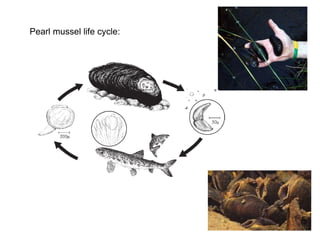
Pearl mussel life cycle:
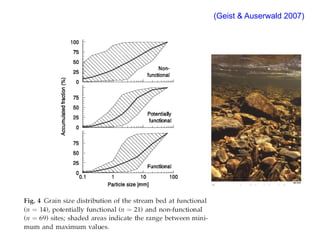
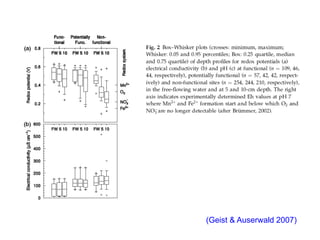
(Geist & Auserwald 2007)
Recent Welsh studies on sediments and their effects:
S. Larsen, I. P. Vaughan and S J Ormerod (2009) Scale-dependent effects of
fine sediments on temperate headwater invertebrates. Freshwater Biology, 54,
203-219
S. Larsen & S. J. Ormerod (2010) Low-level effects of inert sediments on
temperate stream invertebrates. Freshwater Biology, 55, 476-486
S. Larsen & S J Ormerod (2010) Combined effects of habitat modification on trait
composition and species nestedness in river invertebrates. Biological
Conservation, 143, 2638-2646
S. Larsen, G. Pace & S. J. Ormerod (2011) Experimental effects of sediment
deposition on the structure and function of macroinvertebrate assemblages in
temperate streams. River Research and Applications. 27, 257-267
S. Larsen and S. J. Ormerod (2014) Anthropogenic modification disrupts species
co-occurrence patterns in stream invertebrates. Global Change Biology, 20, 51-
60
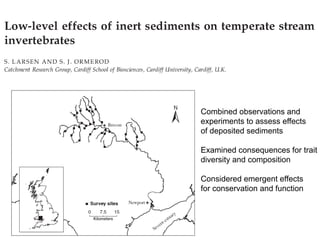
Combined observations and
experiments to assess effects
of deposited sediments
Examined consequences for trait
diversity and composition
Considered emergent effects
for conservation and function
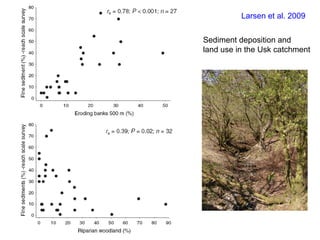
Larsen et al. 2009
Sediment deposition and
land use in the Usk catchment
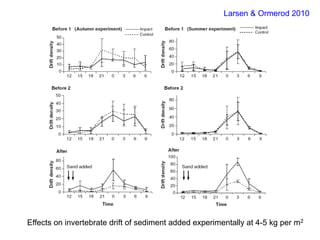
Effects on invertebrate drift of sediment added experimentally at 4-5 kg per m2
Larsen & Ormerod 2010
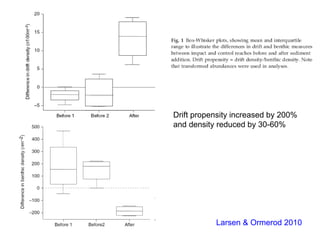
Drift propensity increased by 200%
and density reduced by 30-60%
Larsen & Ormerod 2010
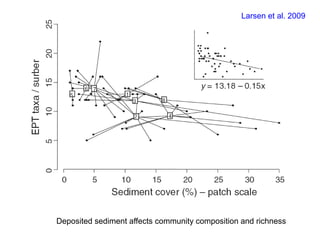
Larsen et al. 2009
Deposited sediment affects community composition and richness
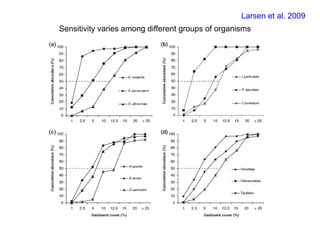
Larsen et al. 2009
Sensitivity varies among different groups of organisms
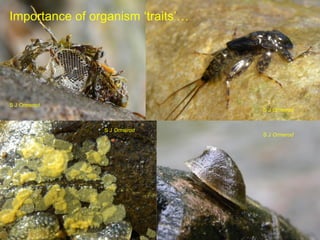
Importance of organism ‘traits’…
S J Ormerod
S J Ormerod
S J Ormerod
S J Ormerod
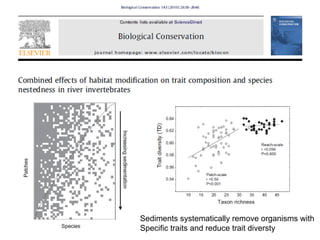
Sediments systematically remove organisms with
Specific traits and reduce trait diversty
Trait consequences:
• Effects of sedimentation detectable only after accounting
for larger-scale land-use change
• Land use-change accompanied by losses of larger, long
lived organisms
• Sedimentation increased detritivores, herbivores, deposit
feeders and burrowers but reduced filterers, predators and
attached taxa declined.
• Trait diversity reduced by both sediments and land-use
change
Important ramifications for conservation and function?
Larsen et al.
+
Diversity in upland rivers for
ecosystem service sustainability
BESS: 4.4m Euros
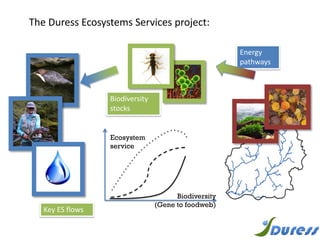
Key ES flows
The Duress Ecosystems Services project:
Energy
pathways
Ecosystem
service
Biodiversity
(Gene to foodweb)
Biodiversity
stocks
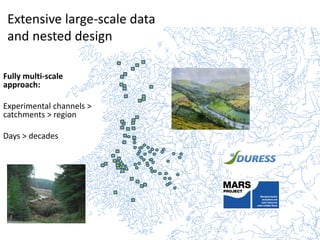
Extensive large-scale data
and nested design
Fully multi-scale
approach:
Experimental channels >
catchments > region
Days > decades
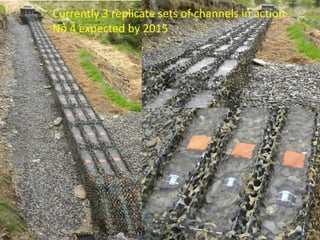
Currently 3 replicate sets of channels in action
No 4 expected by 2015
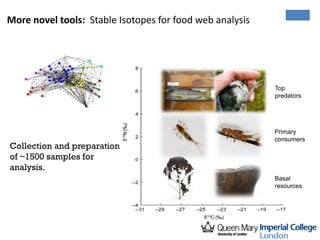
More novel tools: Stable Isotopes for food web analysis
Basal
resources
Primary
consumers
Top
predators
Collection and preparation
of ~1500 samples for
analysis.
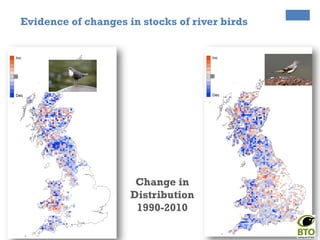
Change in
Distribution
1990-2010
Evidence of changes in stocks of river birds
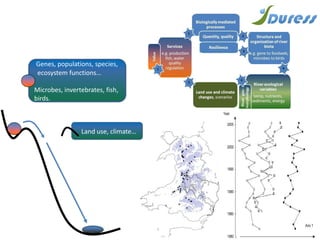
Genes, populations, species,
ecosystem functions…
Microbes, invertebrates, fish,
birds.
Land use, climate…
+
What are the important future drivers and how
will these affect stocks and flows?
Future changes:
downscaling the
Duress scenarios
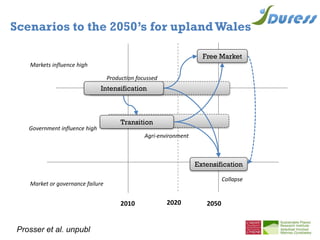
2020
Markets influence high
Government influence high
Market or governance failure
2010
Free Market
Extensification
Transition
2050
Agri-environment
Production focussed
Collapse
Intensification
Prosser et al. unpubl
Scenarios to the 2050’s for uplandWales
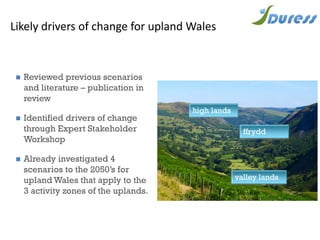
Likely drivers of change for upland Wales
 Reviewed previous scenarios
and literature – publication in
review
 Identified drivers of change
through Expert Stakeholder
Workshop
 Already investigated 4
scenarios to the 2050’s for
upland Wales that apply to the
3 activity zones of the uplands.
high lands
ffrydd
valley lands
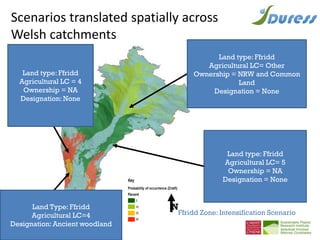
Ffridd Zone: Intensification Scenario
Land type: Ffridd
Agricultural LC= Other
Ownership = NRW and Common
Land
Designation = None
Land type: Ffridd
Agricultural LC= 5
Ownership = NA
Designation = None
Land type: Ffridd
Agricultural LC = 4
Ownership = NA
Designation: None
Land Type: Ffridd
Agricultural LC=4
Designation: Ancient woodland
N
Scenarios translated spatially across
Welsh catchments
33
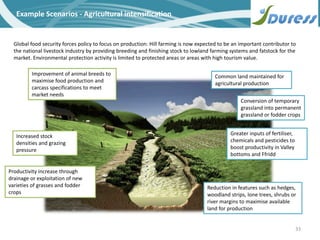
Example Scenarios - Agricultural intensification
Global food security forces policy to focus on production: Hill farming is now expected to be an important contributor to
the national livestock industry by providing breeding and finishing stock to lowland farming systems and fatstock for the
market. Environmental protection activity is limited to protected areas or areas with high tourism value.
Increased stock
densities and grazing
pressure
Conversion of temporary
grassland into permanent
grassland or fodder crops
Productivity increase through
drainage or exploitation of new
varieties of grasses and fodder
crops
Improvement of animal breeds to
maximise food production and
carcass specifications to meet
market needs
Common land maintained for
agricultural production
Greater inputs of fertiliser,
chemicals and pesticides to
boost productivity in Valley
bottoms and Ffridd
Reduction in features such as hedges,
woodland strips, lone trees, shrubs or
river margins to maximise available
land for production
34
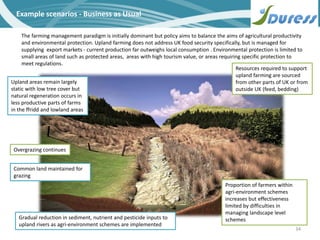
Example scenarios - Business as Usual
The farming management paradigm is initially dominant but policy aims to balance the aims of agricultural productivity
and environmental protection. Upland farming does not address UK food security specifically, but is managed for
supplying export markets - current production far outweighs local consumption . Environmental protection is limited to
small areas of land such as protected areas, areas with high tourism value, or areas requiring specific protection to
meet regulations.
Overgrazing continues
Proportion of farmers within
agri-environment schemes
increases but effectiveness
limited by difficulties in
managing landscape level
schemes
Resources required to support
upland farming are sourced
from other parts of UK or from
outside UK (feed, bedding)
Gradual reduction in sediment, nutrient and pesticide inputs to
upland rivers as agri-environment schemes are implemented
Upland areas remain largely
static with low tree cover but
natural regeneration occurs in
less productive parts of farms
in the ffridd and lowland areas
Common land maintained for
grazing
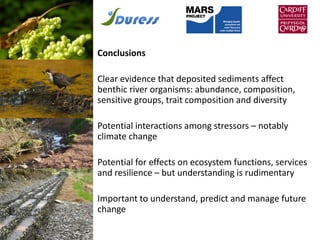
Conclusions
Clear evidence that deposited sediments affect
benthic river organisms: abundance, composition,
sensitive groups, trait composition and diversity
Potential interactions among stressors – notably
climate change
Potential for effects on ecosystem functions, services
and resilience – but understanding is rudimentary
Important to understand, predict and manage future
change

Sediments and stream ecosystems - Steve Ormerod

  • 1.
    Sediments and streamecosystems Steve Ormerod ?
  • 2.
  • 3.
  • 4.
    Montgomery & Buffington(1997) S J Ormerod
  • 5.
    Ecological effects ofexcess sediments Problems arise from: i) Additional (anthropogenic) sediment delivery ii) Transport in suspension iii) Transport by saltation iv) Settlement into interstices v) Occlusion of surfaces All can affect organisms directly, or by altering flow, oxygen availability or other processes
  • 6.
    Greig et al.2005, Postulated mechanisms of the effects of deposited sediments on salmonid eggs
  • 7.
    Effects of sedimentaccumulation on two sets of salmon redds via interstitial flow Greig et al. 2005, Sediments accumulate Intra-gravel flow declines
  • 8.
  • 9.
  • 10.
  • 11.
    Recent Welsh studieson sediments and their effects: S. Larsen, I. P. Vaughan and S J Ormerod (2009) Scale-dependent effects of fine sediments on temperate headwater invertebrates. Freshwater Biology, 54, 203-219 S. Larsen & S. J. Ormerod (2010) Low-level effects of inert sediments on temperate stream invertebrates. Freshwater Biology, 55, 476-486 S. Larsen & S J Ormerod (2010) Combined effects of habitat modification on trait composition and species nestedness in river invertebrates. Biological Conservation, 143, 2638-2646 S. Larsen, G. Pace & S. J. Ormerod (2011) Experimental effects of sediment deposition on the structure and function of macroinvertebrate assemblages in temperate streams. River Research and Applications. 27, 257-267 S. Larsen and S. J. Ormerod (2014) Anthropogenic modification disrupts species co-occurrence patterns in stream invertebrates. Global Change Biology, 20, 51- 60
  • 12.
    Combined observations and experimentsto assess effects of deposited sediments Examined consequences for trait diversity and composition Considered emergent effects for conservation and function
  • 14.
    Larsen et al.2009 Sediment deposition and land use in the Usk catchment
  • 15.
    Effects on invertebratedrift of sediment added experimentally at 4-5 kg per m2 Larsen & Ormerod 2010
  • 16.
    Drift propensity increasedby 200% and density reduced by 30-60% Larsen & Ormerod 2010
  • 17.
    Larsen et al.2009 Deposited sediment affects community composition and richness
  • 18.
    Larsen et al.2009 Sensitivity varies among different groups of organisms
  • 19.
    Importance of organism‘traits’… S J Ormerod S J Ormerod S J Ormerod S J Ormerod
  • 20.
    Sediments systematically removeorganisms with Specific traits and reduce trait diversty
  • 21.
    Trait consequences: • Effectsof sedimentation detectable only after accounting for larger-scale land-use change • Land use-change accompanied by losses of larger, long lived organisms • Sedimentation increased detritivores, herbivores, deposit feeders and burrowers but reduced filterers, predators and attached taxa declined. • Trait diversity reduced by both sediments and land-use change Important ramifications for conservation and function? Larsen et al.
  • 22.
    + Diversity in uplandrivers for ecosystem service sustainability BESS: 4.4m Euros
  • 23.
    Key ES flows TheDuress Ecosystems Services project: Energy pathways Ecosystem service Biodiversity (Gene to foodweb) Biodiversity stocks
  • 24.
    Extensive large-scale data andnested design Fully multi-scale approach: Experimental channels > catchments > region Days > decades
  • 25.
    Currently 3 replicatesets of channels in action No 4 expected by 2015
  • 26.
    More novel tools:Stable Isotopes for food web analysis Basal resources Primary consumers Top predators Collection and preparation of ~1500 samples for analysis.
  • 27.
    Change in Distribution 1990-2010 Evidence ofchanges in stocks of river birds
  • 28.
    Genes, populations, species, ecosystemfunctions… Microbes, invertebrates, fish, birds. Land use, climate…
  • 29.
    + What are theimportant future drivers and how will these affect stocks and flows? Future changes: downscaling the Duress scenarios
  • 30.
    2020 Markets influence high Governmentinfluence high Market or governance failure 2010 Free Market Extensification Transition 2050 Agri-environment Production focussed Collapse Intensification Prosser et al. unpubl Scenarios to the 2050’s for uplandWales
  • 31.
    Likely drivers ofchange for upland Wales  Reviewed previous scenarios and literature – publication in review  Identified drivers of change through Expert Stakeholder Workshop  Already investigated 4 scenarios to the 2050’s for upland Wales that apply to the 3 activity zones of the uplands. high lands ffrydd valley lands
  • 32.
    Ffridd Zone: IntensificationScenario Land type: Ffridd Agricultural LC= Other Ownership = NRW and Common Land Designation = None Land type: Ffridd Agricultural LC= 5 Ownership = NA Designation = None Land type: Ffridd Agricultural LC = 4 Ownership = NA Designation: None Land Type: Ffridd Agricultural LC=4 Designation: Ancient woodland N Scenarios translated spatially across Welsh catchments
  • 33.
    33 Example Scenarios -Agricultural intensification Global food security forces policy to focus on production: Hill farming is now expected to be an important contributor to the national livestock industry by providing breeding and finishing stock to lowland farming systems and fatstock for the market. Environmental protection activity is limited to protected areas or areas with high tourism value. Increased stock densities and grazing pressure Conversion of temporary grassland into permanent grassland or fodder crops Productivity increase through drainage or exploitation of new varieties of grasses and fodder crops Improvement of animal breeds to maximise food production and carcass specifications to meet market needs Common land maintained for agricultural production Greater inputs of fertiliser, chemicals and pesticides to boost productivity in Valley bottoms and Ffridd Reduction in features such as hedges, woodland strips, lone trees, shrubs or river margins to maximise available land for production
  • 34.
    34 Example scenarios -Business as Usual The farming management paradigm is initially dominant but policy aims to balance the aims of agricultural productivity and environmental protection. Upland farming does not address UK food security specifically, but is managed for supplying export markets - current production far outweighs local consumption . Environmental protection is limited to small areas of land such as protected areas, areas with high tourism value, or areas requiring specific protection to meet regulations. Overgrazing continues Proportion of farmers within agri-environment schemes increases but effectiveness limited by difficulties in managing landscape level schemes Resources required to support upland farming are sourced from other parts of UK or from outside UK (feed, bedding) Gradual reduction in sediment, nutrient and pesticide inputs to upland rivers as agri-environment schemes are implemented Upland areas remain largely static with low tree cover but natural regeneration occurs in less productive parts of farms in the ffridd and lowland areas Common land maintained for grazing
  • 35.
    Conclusions Clear evidence thatdeposited sediments affect benthic river organisms: abundance, composition, sensitive groups, trait composition and diversity Potential interactions among stressors – notably climate change Potential for effects on ecosystem functions, services and resilience – but understanding is rudimentary Important to understand, predict and manage future change