STDTSD
IMO Model course
What is it?
STSDSD- SECURITY TRAINING FOR SEAFARERS
WITH DESIGNATED SECURITY DUTIES.
Why are we doing it?
So that Ship and Ports are safe and
secure.
Support the Ship Security Officer in his
duties to secure the vessel.
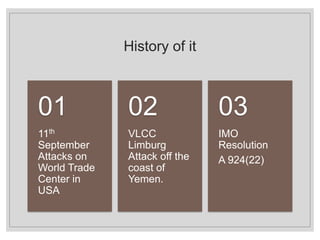
History of it
11th
September
Attacks on
World Trade
Center in
USA
01
VLCC
Limburg
Attack off the
coast of
Yemen.
02
IMO
Resolution
A 924(22)
03
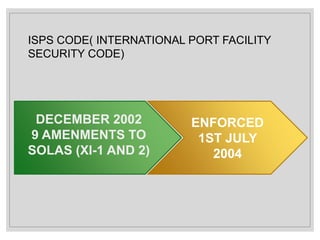
ISPS CODE( INTERNATIONAL PORT FACILITY
SECURITY CODE)
DECEMBER 2002
9 AMENMENTS TO
SOLAS (XI-1 AND 2)
ENFORCED
1ST JULY
2004
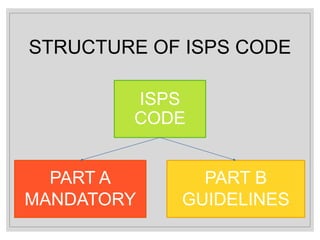
STRUCTURE OF ISPS CODE
ISPS
CODE
PART A
MANDATORY
PART B
GUIDELINES
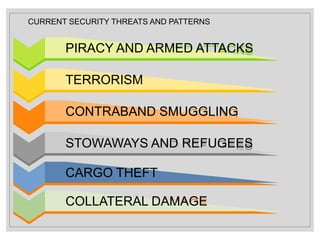
CURRENT SECURITY THREATS AND PATTERNS
PIRACY AND ARMED ATTACKS
TERRORISM
CONTRABAND SMUGGLING
STOWAWAYS AND REFUGEES
COLLATERAL DAMAGE
CARGO THEFT
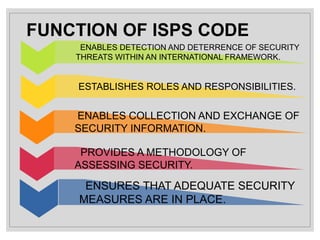
FUNCTION OF ISPS CODE
ENABLES DETECTION AND DETERRENCE OF SECURITY
THREATS WITHIN AN INTERNATIONAL FRAMEWORK.
ESTABLISHES ROLES AND RESPONSIBILITIES.
ENABLES COLLECTION AND EXCHANGE OF
SECURITY INFORMATION.
PROVIDES A METHODOLOGY OF
ASSESSING SECURITY.
ENSURES THAT ADEQUATE SECURITY
MEASURES ARE IN PLACE.
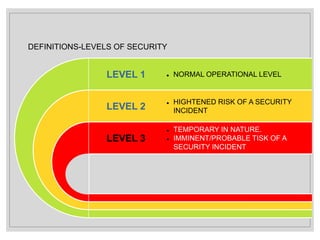
DEFINITIONS-LEVELS OF SECURITY
LEVEL 1  NORMAL OPERATIONAL LEVEL
LEVEL 2
LEVEL 3
 HIGHTENED RISK OF A SECURITY
INCIDENT
 TEMPORARY IN NATURE.
 IMMINENT/PROBABLE TISK OF A
SECURITY INCIDENT
Security Responsibilities
Contracting Governments (Flag States )
1)Shall set security level for the ship’s flying her flag.
2)Ensure each ship knows the security level it is supposed to
be at.
3)If security level changes then make sure ship’s know it.
4)Set security level for the ports and keep security levels .
5)Implement STCW among its seafarers.
a)Implement STSDSD at support and operational level
seafarers
b)Implement SSO at management level seafarers.
c)Implement PFSO training for Port facility security officers
Security Responsibilities
The Ship Owner
1)Master must have the information :
2)Who is responsible for employment of the people serving on
board.
3)Who is responsible for deciding the employment of the ship.
4)Who are the Charterers.
Security Responsibilities
The Ship
1)Before reaching a port must set Security level as
per that of the port.
2) If port wants to change security level ,ship must
respond quickly.
3)If Cannot comply with flag state or port state
requirements,then must inform competent authority
before arrival to port.
Security Responsibilities
The Port
1)Must Comply with the Security Level set by the
Government /Flag State.
2) Ensure minimum interference to the business of
the port for compliance with ISPS.
Security Responsibilities
The Company Security Officer
1)Advising level of threat likely to be encountered by the ship.
2)Ensuring Ship Security Assessments are carried out.
3)Ensuring Ship Security Plan is produced and complied with.
4)Arrange internal audits and review of security activities.
5)Arrange surveys for International Ship Security Certificate by
Recognised Security Organisation.
Security Responsibilities
The Company Security Officer
6)Deficiencies found during internal audits are closed in a
timely manner.
7)Enhance Security awaremess and vigilance.
8)Ensure effective communication between SSO and
PFSO.
9)Ensure consistency between safety and security
arrangements.
Security Responsibilities
1)The Ship Security Officer
2)Regular security inspections of the ship.
3)Supervise implementation of Ship Security Plan.
4)Co-ordinate security aspects with PFSO and crew.
5)Report to CSO regarding deficiencies,non-conformities
during internal audits.
6)Ensure security awareness onboard.
7)Ensure adequate training has been provided to security
personnel as appropriate.
8)Report all security incidents.
Security Responsibilities
1)The Port Facility Security Officer
2) Conduct intial comprehensive security survey.
3)Develop and maintain Port Facility Security Plan.
4)Update the security plan and arrangements as the port
changes/develops.
5)Enhance security awareness of the port facility
personnel.
6)Ensure adequate training has been provided to the
personnel responsible for the security of the port facility.
7)Maintain records of security incidents.
Security Responsibilities
1)The Port Facility Security Officer
7)Implement port facility security plan with CSOand SSO.
8)Coordinate with security services as appropiate.
9)Maintain,calibrate and test ,record all security
equipments.
10)Assist SSO in confirming the identity of those seeking
to board the vessel.
Security Responsibilities
1)The Seafarers with Designated Security Duties.
2)Anti-piracy duties -support level.
3)Anti-armed-robbery duties – support level.
4) Must be trained as per STCW .
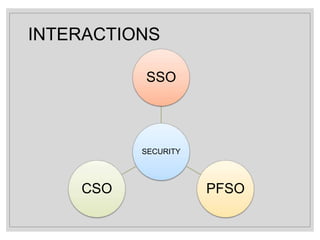
INTERACTIONS
SECURITY
SSO
PFSO
CSO
DoS – Declaration Of
Security
What is it?
1)It is a proof af agreement between a ship
and a port facility .
2)It signifies that critcal security concerns
are addressed properly.
3)Security provisions shall be maintained
during the Ship’s duration of call at the
port.
SSA – SHIP SECURITY
ASSESSMENT
What is it?
1)It must be carried out before Ship Security
Plan is produced
2)It is the responsibility of the CSO.
SSA – SHIP SECURITY
ASSESSMENT
What are the elements of it?
1)Identification of existing security measures.
2) Identification of key ship board operations in need
of protection.
3)Identification of possible threats to the above key
operations
4)Identification of weaknesses ,including human
factors in the ifrastructure , policies and procedures.
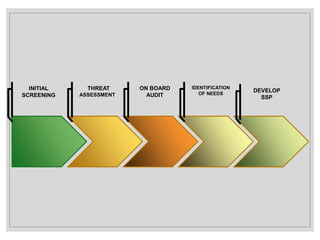
INITIAL
SCREENING
THREAT
ASSESSMENT
DEVELOP
SSP
IDENTIFICATION
OF NEEDS
ON BOARD
AUDIT
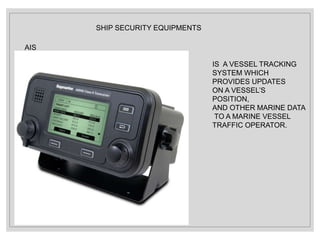
SHIP SECURITY EQUIPMENTS
AIS
IS A VESSEL TRACKING
SYSTEM WHICH
PROVIDES UPDATES
ON A VESSEL’S
POSITION,
AND OTHER MARINE DATA
TO A MARINE VESSEL
TRAFFIC OPERATOR.
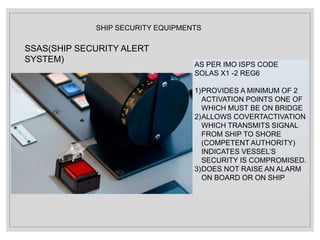
SHIP SECURITY EQUIPMENTS
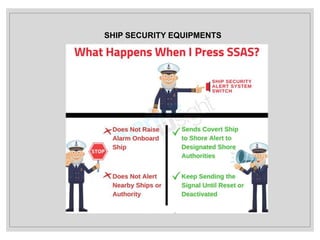
SSAS(SHIP SECURITY ALERT
SYSTEM)
AS PER IMO ISPS CODE
SOLAS X1 -2 REG6
1)PROVIDES A MINIMUM OF 2
ACTIVATION POINTS ONE OF
WHICH MUST BE ON BRIDGE
2)ALLOWS COVERTACTIVATION
WHICH TRANSMITS SIGNAL
FROM SHIP TO SHORE
(COMPETENT AUTHORITY)
INDICATES VESSEL’S
SECURITY IS COMPROMISED.
3)DOES NOT RAISE AN ALARM
ON BOARD OR ON SHIP
SHIP SECURITY EQUIPMENTS
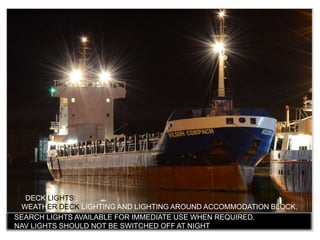
DECK LIGHTS:
WEATHER DECK LIGHTING AND LIGHTING AROUND ACCOMMODATION BLOCK.
 SEARCH LIGHTS AVAILABLE FOR IMMEDIATE USE WHEN REQUIRED.
 NAV LIGHTS SHOULD NOT BE SWITCHED OFF AT NIGHT
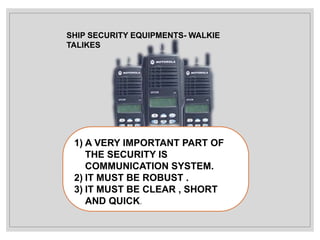
SHIP SECURITY EQUIPMENTS- WALKIE
TALIKES
1) A VERY IMPORTANT PART OF
THE SECURITY IS
COMMUNICATION SYSTEM.
2) IT MUST BE ROBUST .
3) IT MUST BE CLEAR , SHORT
AND QUICK.
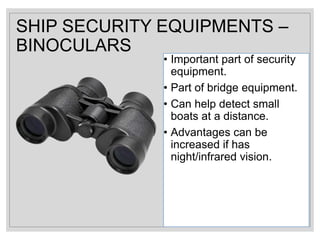
SHIP SECURITY EQUIPMENTS –
BINOCULARS
• Important part of security
equipment.
• Part of bridge equipment.
• Can help detect small
boats at a distance.
• Advantages can be
increased if has
night/infrared vision.
SHIP SECURITY EQUIPMENTS-
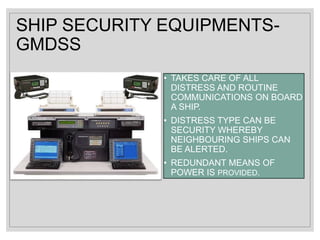
GMDSS
• TAKES CARE OF ALL
DISTRESS AND ROUTINE
COMMUNICATIONS ON BOARD
A SHIP.
• DISTRESS TYPE CAN BE
SECURITY WHEREBY
NEIGHBOURING SHIPS CAN
BE ALERTED.
• REDUNDANT MEANS OF
POWER IS PROVIDED.
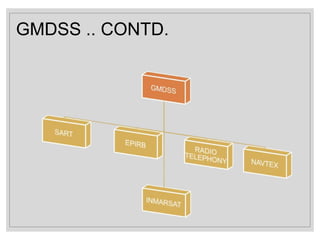
GMDSS .. CONTD.
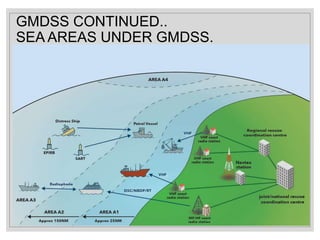
GMDSS CONTINUED..
SEA AREAS UNDER GMDSS.
SHIP SECURITY EQUIPMENTS…
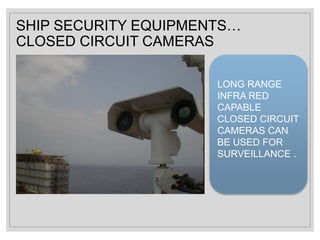
CLOSED CIRCUIT CAMERAS
LONG RANGE
INFRA RED
CAPABLE
CLOSED CIRCUIT
CAMERAS CAN
BE USED FOR
SURVEILLANCE .
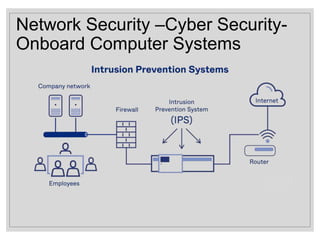
Network Security –Cyber Security-
Onboard Computer Systems
Ship Security Equipment
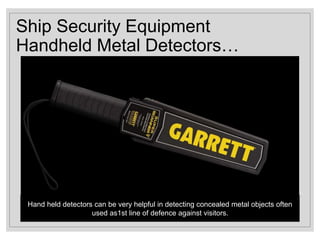
Handheld Metal Detectors…
Hand held detectors can be very helpful in detecting concealed metal objects often
used as1st line of defence against visitors.
SHIP SECURITY EQUIPMENT…
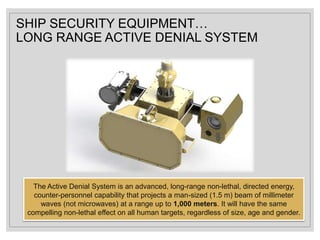
LONG RANGE ACTIVE DENIAL SYSTEM
The Active Denial System is an advanced, long-range non-lethal, directed energy,
counter-personnel capability that projects a man-sized (1.5 m) beam of millimeter
waves (not microwaves) at a range up to 1,000 meters. It will have the same
compelling non-lethal effect on all human targets, regardless of size, age and gender.
SHIP SECURITY EQUIPMENTS.
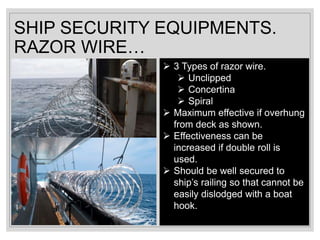
RAZOR WIRE…
 3 Types of razor wire.
 Unclipped
 Concertina
 Spiral
 Maximum effective if overhung
from deck as shown.
 Effectiveness can be
increased if double roll is
used.
 Should be well secured to
ship’s railing so that cannot be
easily dislodged with a boat
hook.
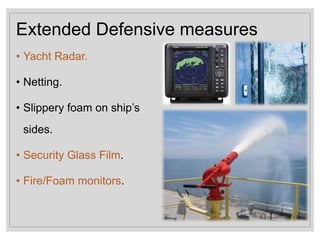
Extended Defensive measures
• Yacht Radar.
• Netting.
• Slippery foam on ship’s
sides.
• Security Glass Film.
• Fire/Foam monitors.
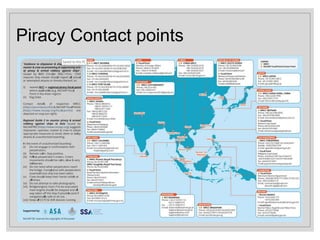
Piracy Contact points
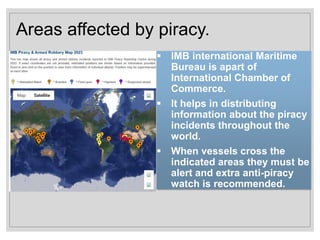
Areas affected by piracy.
 IMB international Maritime
Bureau is apart of
International Chamber of
Commerce.
 It helps in distributing
information about the piracy
incidents throughout the
world.
 When vessels cross the
indicated areas they must be
alert and extra anti-piracy
watch is recommended.
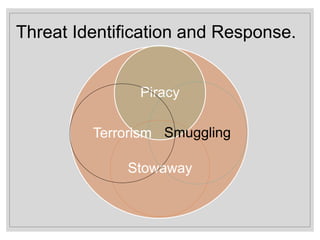
Threat Identification and Response.
Piracy
Smuggling
Stowaway
Terrorism
Recognise the Danger! ….
• IED (Improvised Explosive Devices)
• These are usually used by terrorists.
• They are highly difficult to detect as they can take several
unusual forms.
• Batteries and timer power units give away the device normally.
• Can be in the form of Incendiary devices.
• Car borne incendiary devices.
• Letter or parcel bombs.
What to do in case a parcel bomb is
detected…
 Make no attempt to open it.
 Place it on plain surface on an
open area.
 Clear and cordon off the area and
do not let any one come near .
 Notify Duty Officer.
How to detect harmful equipments
a) X ray screening
b) Low powered radar detectors.
c) Walk through detectors.
d) Trace detectors for dangerous
substances.
e) Screening containers for chemical,
biological, radioactive cargo.
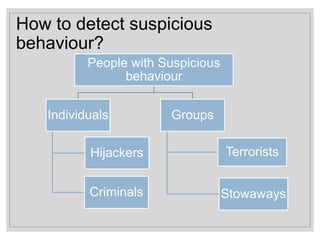
How to detect suspicious
behaviour?
People with Suspicious
behaviour
Individuals
Criminals
Hijackers
Groups
Terrorists
Stowaways
How to detect suspicious
behaviour?
• Persons seen in areas for no good reason.
• They are not dressed properly for the area they are
found in.
• Being nervous and /or sweaty when coming onboard.
• Not very proper paperwork for reasons to come
onboard.
• Persons with large sums of cash money.
• Meeting with crew members with whom they have got
no business.
• Persons taking keen interest in only a specific part of a
ship where apparently they should not.
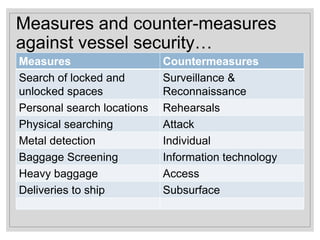
Measures and counter-measures
against vessel security…
Measures Countermeasures
Search of locked and
unlocked spaces
Surveillance &
Reconnaissance
Personal search locations Rehearsals
Physical searching Attack
Metal detection Individual
Baggage Screening Information technology
Heavy baggage Access
Deliveries to ship Subsurface
Security measures in port.
• Non Discriminatory Profiling of visitors.
• How?
• Ask questions to joining crew .
• Are you coming directly or were on leave?
• Where did you travel ? Any mementos?
• Ask questions to visitors.
• What is the purpose of your visit?
• Are you bringing tools and or equipment?
• Were you on a service call before joining us today?
• Watch the reactions..
• Are they becoming nervous?
• Do they react if you go near their baggage and or equipment?
• Are they sweating or becoming restless or aggressive?
• Are they overly happy or friendly?
• Are they trying to avoid eye contact?
Some indications of imminent
attack.
1. Interference with ship’s communication system-
damaged antenna etc.
2. Damage to locks and doors scratches found around
locks.
3. Lost or stolen keys.
4. Normally locked doors found open for no reason.
5. Dirty finger marks on clean doors or windows.
6. False alarms on security systems.
7. Possibility of collusion between threat actors and crew
cannot be ruled out.
Security at sea….
 1 or 2 small high speed crafts involved form a pirate
action group. Other accomplices can be a mother ship or
a large fishing trawler or dhow.
 Pirates normally target bridge and accommodation areas
for firing small arms and rocket propelled grenades.
 Pirates normally try to board using lightweight ladder.
 Many well trained crew have repelled the attacks by not
letting them board.
Crowd Control Techniques
• Useful in dealing with unruly passengers, mobs of workmen.
• Observation
• Communication of interest and intent.
• Channelization.
• Diversion.
• Co-Operation.
• Proclamation.
• Show of force.
• Use of barriers.
• Employment of water
• Riot control agents
Ship Security Actions
Security Level -1
• checking the identity of all persons seeking to board
the ship and confirming their reasons for doing
• in liaison with the port facility, the ship should ensure
that designated secure areas are established
• In liaison with the port Facility, the ship should ensure
that vehicles destined to be loaded onboard car
carriers; ro-ro and other passenger ships are subjected
to search
Ship Security Actions
Security Level -1
• segregating embarking from disembarking
passengers;
• identifying access points that should be secured or
attended to prevent unauthorized access;
• securing, by locking or other means, access to
unattended spaces adjoining areas to which
passenger and visitors have access and
• Providing security briefings to all ship personnel on
possible threats, the procedures for reporting
suspicious persons, objects or activities and the need
for vigilance.
Ship Security Actions
Security Level -2
• assigning additional personnel to patrol deck
areas during silent
• limiting the number of access points to the ship,
identifying those to be closed and the means of
adequately securing them;
• deterring waterside access to the ship, including,
for example, in liaison with the port facility,
provision of boat patrols
• establishing a restricted area on the shore side
of the ship, in close co-operation with the port
facility
Ship Security Actions
Security Level -2
• increasing the frequency and detail of searches of
persons, personal effects, and vehicles being
embarked or loaded onto the ship;
• escorting visitors on the ship;
• providing additional specific security briefings to all ship
personnel on any identified threats, re-emphasizing the
procedures for reporting suspicious persons, objects,
or activities and stressing the need for increased
vigilance; and
• Carrying out a full or partial search of the ship
Ship Security Actions
Security Level -3
• limiting access to a single, controlled,
access point;
• granting access only to those responding
to the security incident or threat thereof;
• directing persons on board;
• suspension of embarkation or
disembarkation;
Ship Security Actions
Security Level -3
• suspension of cargo handling
operations, deliveries, etc.;
• evacuation of the ship;
• movement of the ship; and
• preparing for a full or partial
search of the ship
Security measures in Port
• Minimize access points preferably to a single
controlled gangway or ship's side companion way.
• Keep emergency ladders clear of the water; raise
and stow pilot ladders immediately after use.
• Provide two security officers at access points if a
threat warrants the response.
• Establish perimeter security measures, such as
weather deck and ship side lighting, deck and jetty
patrols, and secure rat guards on mooring lines.
Security measures in Port
• Search all deliveries when possible; conduct
frequent, random, and overt searches if all
materials cannot be examined.
• Search all visitors and escort them while on
board.
• Keep small craft in the vicinity under constant
surveillance.
• Carefully control documents containing
information about the cargo or ship's itinerary.
• Conduct a search of the ship before sailing and
secure all doors and other access points.
Security actions at Sea
• Augment bridge watches and lookouts.
• Establish additional watches on the stern and where there are
visual and radar "blind spots."
• Equip watches with low-light binoculars and/or night-vision
goggles.
• When monitoring nearby ships, give additional attention to
small craft matching the speed of the ship or traveling parallel to
the ship.
• Ensure someone responsible for communications remains on
duty.
• Maintain radio communications with appropriate shore and
naval authorities.
Security actions at Sea
1. If a suspicious ship at sea approaches in a
threatening manner:
2. Increase speed and alter course if safe to do so.
3. Do not allow the ship to come alongside; do not
respond to messages by radio, light, or hailing.
4. Note details of the threatening ship and video or
photograph the ship if possible.
5. At night, switch off the weather deck lighting; direct
searchlights at the approaching ship.
6. Keep personnel clear of the weather deck
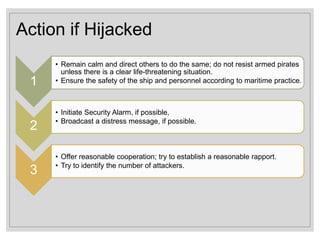
Action if Hijacked
1
• Remain calm and direct others to do the same; do not resist armed pirates
unless there is a clear life-threatening situation.
• Ensure the safety of the ship and personnel according to maritime practice.
2
• Initiate Security Alarm, if possible,
• Broadcast a distress message, if possible.
3
• Offer reasonable cooperation; try to establish a reasonable rapport.
• Try to identify the number of attackers.
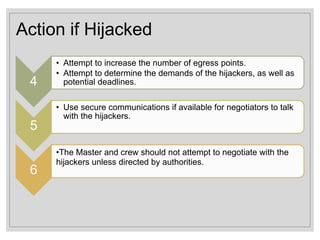
Action if Hijacked
4
• Attempt to increase the number of egress points.
• Attempt to determine the demands of the hijackers, as well as
potential deadlines.
5
• Use secure communications if available for negotiators to talk
with the hijackers.
6
•The Master and crew should not attempt to negotiate with the
hijackers unless directed by authorities.
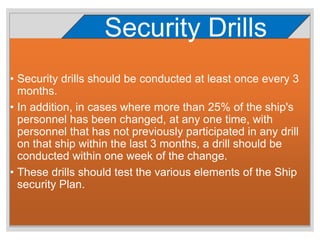
• Security drills should be conducted at least once every 3
months.
• In addition, in cases where more than 25% of the ship's
personnel has been changed, at any one time, with
personnel that has not previously participated in any drill
on that ship within the last 3 months, a drill should be
conducted within one week of the change.
• These drills should test the various elements of the Ship
security Plan.
Security Drills
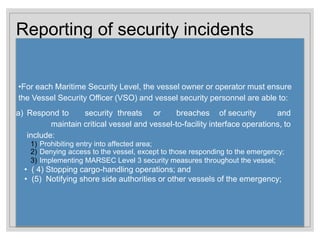
Reporting of security incidents
•For each Maritime Security Level, the vessel owner or operator must ensure
the Vessel Security Officer (VSO) and vessel security personnel are able to:
a) Respond to security threats or breaches of security and
maintain critical vessel and vessel-to-facility interface operations, to
include:
1) Prohibiting entry into affected area;
2) Denying access to the vessel, except to those responding to the emergency;
3) Implementing MARSEC Level 3 security measures throughout the vessel;
• ( 4) Stopping cargo-handling operations; and
• (5) Notifying shore side authorities or other vessels of the emergency;

SECURITY TRAINING FOR SEAFARERS WITH DESIGNATED SECURITY DUTIES IMO MODEL COURSE 3.26.pptx

  • 1.
  • 2.
    What is it? STSDSD-SECURITY TRAINING FOR SEAFARERS WITH DESIGNATED SECURITY DUTIES. Why are we doing it? So that Ship and Ports are safe and secure. Support the Ship Security Officer in his duties to secure the vessel.
  • 3.
    History of it 11th September Attackson World Trade Center in USA 01 VLCC Limburg Attack off the coast of Yemen. 02 IMO Resolution A 924(22) 03
  • 4.
    ISPS CODE( INTERNATIONALPORT FACILITY SECURITY CODE) DECEMBER 2002 9 AMENMENTS TO SOLAS (XI-1 AND 2) ENFORCED 1ST JULY 2004
  • 5.
    STRUCTURE OF ISPSCODE ISPS CODE PART A MANDATORY PART B GUIDELINES
  • 6.
    CURRENT SECURITY THREATSAND PATTERNS PIRACY AND ARMED ATTACKS TERRORISM CONTRABAND SMUGGLING STOWAWAYS AND REFUGEES COLLATERAL DAMAGE CARGO THEFT
  • 7.
    FUNCTION OF ISPSCODE ENABLES DETECTION AND DETERRENCE OF SECURITY THREATS WITHIN AN INTERNATIONAL FRAMEWORK. ESTABLISHES ROLES AND RESPONSIBILITIES. ENABLES COLLECTION AND EXCHANGE OF SECURITY INFORMATION. PROVIDES A METHODOLOGY OF ASSESSING SECURITY. ENSURES THAT ADEQUATE SECURITY MEASURES ARE IN PLACE.
  • 8.
    DEFINITIONS-LEVELS OF SECURITY LEVEL1  NORMAL OPERATIONAL LEVEL LEVEL 2 LEVEL 3  HIGHTENED RISK OF A SECURITY INCIDENT  TEMPORARY IN NATURE.  IMMINENT/PROBABLE TISK OF A SECURITY INCIDENT
  • 9.
    Security Responsibilities Contracting Governments(Flag States ) 1)Shall set security level for the ship’s flying her flag. 2)Ensure each ship knows the security level it is supposed to be at. 3)If security level changes then make sure ship’s know it. 4)Set security level for the ports and keep security levels . 5)Implement STCW among its seafarers. a)Implement STSDSD at support and operational level seafarers b)Implement SSO at management level seafarers. c)Implement PFSO training for Port facility security officers
  • 10.
    Security Responsibilities The ShipOwner 1)Master must have the information : 2)Who is responsible for employment of the people serving on board. 3)Who is responsible for deciding the employment of the ship. 4)Who are the Charterers.
  • 11.
    Security Responsibilities The Ship 1)Beforereaching a port must set Security level as per that of the port. 2) If port wants to change security level ,ship must respond quickly. 3)If Cannot comply with flag state or port state requirements,then must inform competent authority before arrival to port.
  • 12.
    Security Responsibilities The Port 1)MustComply with the Security Level set by the Government /Flag State. 2) Ensure minimum interference to the business of the port for compliance with ISPS.
  • 13.
    Security Responsibilities The CompanySecurity Officer 1)Advising level of threat likely to be encountered by the ship. 2)Ensuring Ship Security Assessments are carried out. 3)Ensuring Ship Security Plan is produced and complied with. 4)Arrange internal audits and review of security activities. 5)Arrange surveys for International Ship Security Certificate by Recognised Security Organisation.
  • 14.
    Security Responsibilities The CompanySecurity Officer 6)Deficiencies found during internal audits are closed in a timely manner. 7)Enhance Security awaremess and vigilance. 8)Ensure effective communication between SSO and PFSO. 9)Ensure consistency between safety and security arrangements.
  • 15.
    Security Responsibilities 1)The ShipSecurity Officer 2)Regular security inspections of the ship. 3)Supervise implementation of Ship Security Plan. 4)Co-ordinate security aspects with PFSO and crew. 5)Report to CSO regarding deficiencies,non-conformities during internal audits. 6)Ensure security awareness onboard. 7)Ensure adequate training has been provided to security personnel as appropriate. 8)Report all security incidents.
  • 16.
    Security Responsibilities 1)The PortFacility Security Officer 2) Conduct intial comprehensive security survey. 3)Develop and maintain Port Facility Security Plan. 4)Update the security plan and arrangements as the port changes/develops. 5)Enhance security awareness of the port facility personnel. 6)Ensure adequate training has been provided to the personnel responsible for the security of the port facility. 7)Maintain records of security incidents.
  • 17.
    Security Responsibilities 1)The PortFacility Security Officer 7)Implement port facility security plan with CSOand SSO. 8)Coordinate with security services as appropiate. 9)Maintain,calibrate and test ,record all security equipments. 10)Assist SSO in confirming the identity of those seeking to board the vessel.
  • 18.
    Security Responsibilities 1)The Seafarerswith Designated Security Duties. 2)Anti-piracy duties -support level. 3)Anti-armed-robbery duties – support level. 4) Must be trained as per STCW .
  • 19.
  • 20.
    DoS – DeclarationOf Security What is it? 1)It is a proof af agreement between a ship and a port facility . 2)It signifies that critcal security concerns are addressed properly. 3)Security provisions shall be maintained during the Ship’s duration of call at the port.
  • 21.
    SSA – SHIPSECURITY ASSESSMENT What is it? 1)It must be carried out before Ship Security Plan is produced 2)It is the responsibility of the CSO.
  • 22.
    SSA – SHIPSECURITY ASSESSMENT What are the elements of it? 1)Identification of existing security measures. 2) Identification of key ship board operations in need of protection. 3)Identification of possible threats to the above key operations 4)Identification of weaknesses ,including human factors in the ifrastructure , policies and procedures.
  • 23.
  • 24.
    SHIP SECURITY EQUIPMENTS AIS ISA VESSEL TRACKING SYSTEM WHICH PROVIDES UPDATES ON A VESSEL’S POSITION, AND OTHER MARINE DATA TO A MARINE VESSEL TRAFFIC OPERATOR.
  • 25.
    SHIP SECURITY EQUIPMENTS SSAS(SHIPSECURITY ALERT SYSTEM) AS PER IMO ISPS CODE SOLAS X1 -2 REG6 1)PROVIDES A MINIMUM OF 2 ACTIVATION POINTS ONE OF WHICH MUST BE ON BRIDGE 2)ALLOWS COVERTACTIVATION WHICH TRANSMITS SIGNAL FROM SHIP TO SHORE (COMPETENT AUTHORITY) INDICATES VESSEL’S SECURITY IS COMPROMISED. 3)DOES NOT RAISE AN ALARM ON BOARD OR ON SHIP
  • 26.
  • 27.
    DECK LIGHTS: WEATHER DECKLIGHTING AND LIGHTING AROUND ACCOMMODATION BLOCK.  SEARCH LIGHTS AVAILABLE FOR IMMEDIATE USE WHEN REQUIRED.  NAV LIGHTS SHOULD NOT BE SWITCHED OFF AT NIGHT
  • 28.
    SHIP SECURITY EQUIPMENTS-WALKIE TALIKES 1) A VERY IMPORTANT PART OF THE SECURITY IS COMMUNICATION SYSTEM. 2) IT MUST BE ROBUST . 3) IT MUST BE CLEAR , SHORT AND QUICK.
  • 29.
    SHIP SECURITY EQUIPMENTS– BINOCULARS • Important part of security equipment. • Part of bridge equipment. • Can help detect small boats at a distance. • Advantages can be increased if has night/infrared vision.
  • 30.
    SHIP SECURITY EQUIPMENTS- GMDSS •TAKES CARE OF ALL DISTRESS AND ROUTINE COMMUNICATIONS ON BOARD A SHIP. • DISTRESS TYPE CAN BE SECURITY WHEREBY NEIGHBOURING SHIPS CAN BE ALERTED. • REDUNDANT MEANS OF POWER IS PROVIDED.
  • 31.
  • 32.
  • 33.
    SHIP SECURITY EQUIPMENTS… CLOSEDCIRCUIT CAMERAS LONG RANGE INFRA RED CAPABLE CLOSED CIRCUIT CAMERAS CAN BE USED FOR SURVEILLANCE .
  • 34.
    Network Security –CyberSecurity- Onboard Computer Systems
  • 35.
    Ship Security Equipment HandheldMetal Detectors… Hand held detectors can be very helpful in detecting concealed metal objects often used as1st line of defence against visitors.
  • 36.
    SHIP SECURITY EQUIPMENT… LONGRANGE ACTIVE DENIAL SYSTEM The Active Denial System is an advanced, long-range non-lethal, directed energy, counter-personnel capability that projects a man-sized (1.5 m) beam of millimeter waves (not microwaves) at a range up to 1,000 meters. It will have the same compelling non-lethal effect on all human targets, regardless of size, age and gender.
  • 37.
    SHIP SECURITY EQUIPMENTS. RAZORWIRE…  3 Types of razor wire.  Unclipped  Concertina  Spiral  Maximum effective if overhung from deck as shown.  Effectiveness can be increased if double roll is used.  Should be well secured to ship’s railing so that cannot be easily dislodged with a boat hook.
  • 38.
    Extended Defensive measures •Yacht Radar. • Netting. • Slippery foam on ship’s sides. • Security Glass Film. • Fire/Foam monitors.
  • 39.
  • 40.
    Areas affected bypiracy.  IMB international Maritime Bureau is apart of International Chamber of Commerce.  It helps in distributing information about the piracy incidents throughout the world.  When vessels cross the indicated areas they must be alert and extra anti-piracy watch is recommended.
  • 41.
    Threat Identification andResponse. Piracy Smuggling Stowaway Terrorism
  • 42.
    Recognise the Danger!…. • IED (Improvised Explosive Devices) • These are usually used by terrorists. • They are highly difficult to detect as they can take several unusual forms. • Batteries and timer power units give away the device normally. • Can be in the form of Incendiary devices. • Car borne incendiary devices. • Letter or parcel bombs.
  • 43.
    What to doin case a parcel bomb is detected…  Make no attempt to open it.  Place it on plain surface on an open area.  Clear and cordon off the area and do not let any one come near .  Notify Duty Officer.
  • 44.
    How to detectharmful equipments a) X ray screening b) Low powered radar detectors. c) Walk through detectors. d) Trace detectors for dangerous substances. e) Screening containers for chemical, biological, radioactive cargo.
  • 45.
    How to detectsuspicious behaviour? People with Suspicious behaviour Individuals Criminals Hijackers Groups Terrorists Stowaways
  • 46.
    How to detectsuspicious behaviour? • Persons seen in areas for no good reason. • They are not dressed properly for the area they are found in. • Being nervous and /or sweaty when coming onboard. • Not very proper paperwork for reasons to come onboard. • Persons with large sums of cash money. • Meeting with crew members with whom they have got no business. • Persons taking keen interest in only a specific part of a ship where apparently they should not.
  • 47.
    Measures and counter-measures againstvessel security… Measures Countermeasures Search of locked and unlocked spaces Surveillance & Reconnaissance Personal search locations Rehearsals Physical searching Attack Metal detection Individual Baggage Screening Information technology Heavy baggage Access Deliveries to ship Subsurface
  • 48.
    Security measures inport. • Non Discriminatory Profiling of visitors. • How? • Ask questions to joining crew . • Are you coming directly or were on leave? • Where did you travel ? Any mementos? • Ask questions to visitors. • What is the purpose of your visit? • Are you bringing tools and or equipment? • Were you on a service call before joining us today? • Watch the reactions.. • Are they becoming nervous? • Do they react if you go near their baggage and or equipment? • Are they sweating or becoming restless or aggressive? • Are they overly happy or friendly? • Are they trying to avoid eye contact?
  • 49.
    Some indications ofimminent attack. 1. Interference with ship’s communication system- damaged antenna etc. 2. Damage to locks and doors scratches found around locks. 3. Lost or stolen keys. 4. Normally locked doors found open for no reason. 5. Dirty finger marks on clean doors or windows. 6. False alarms on security systems. 7. Possibility of collusion between threat actors and crew cannot be ruled out.
  • 50.
    Security at sea…. 1 or 2 small high speed crafts involved form a pirate action group. Other accomplices can be a mother ship or a large fishing trawler or dhow.  Pirates normally target bridge and accommodation areas for firing small arms and rocket propelled grenades.  Pirates normally try to board using lightweight ladder.  Many well trained crew have repelled the attacks by not letting them board.
  • 51.
    Crowd Control Techniques •Useful in dealing with unruly passengers, mobs of workmen. • Observation • Communication of interest and intent. • Channelization. • Diversion. • Co-Operation. • Proclamation. • Show of force. • Use of barriers. • Employment of water • Riot control agents
  • 52.
    Ship Security Actions SecurityLevel -1 • checking the identity of all persons seeking to board the ship and confirming their reasons for doing • in liaison with the port facility, the ship should ensure that designated secure areas are established • In liaison with the port Facility, the ship should ensure that vehicles destined to be loaded onboard car carriers; ro-ro and other passenger ships are subjected to search
  • 53.
    Ship Security Actions SecurityLevel -1 • segregating embarking from disembarking passengers; • identifying access points that should be secured or attended to prevent unauthorized access; • securing, by locking or other means, access to unattended spaces adjoining areas to which passenger and visitors have access and • Providing security briefings to all ship personnel on possible threats, the procedures for reporting suspicious persons, objects or activities and the need for vigilance.
  • 54.
    Ship Security Actions SecurityLevel -2 • assigning additional personnel to patrol deck areas during silent • limiting the number of access points to the ship, identifying those to be closed and the means of adequately securing them; • deterring waterside access to the ship, including, for example, in liaison with the port facility, provision of boat patrols • establishing a restricted area on the shore side of the ship, in close co-operation with the port facility
  • 55.
    Ship Security Actions SecurityLevel -2 • increasing the frequency and detail of searches of persons, personal effects, and vehicles being embarked or loaded onto the ship; • escorting visitors on the ship; • providing additional specific security briefings to all ship personnel on any identified threats, re-emphasizing the procedures for reporting suspicious persons, objects, or activities and stressing the need for increased vigilance; and • Carrying out a full or partial search of the ship
  • 56.
    Ship Security Actions SecurityLevel -3 • limiting access to a single, controlled, access point; • granting access only to those responding to the security incident or threat thereof; • directing persons on board; • suspension of embarkation or disembarkation;
  • 57.
    Ship Security Actions SecurityLevel -3 • suspension of cargo handling operations, deliveries, etc.; • evacuation of the ship; • movement of the ship; and • preparing for a full or partial search of the ship
  • 58.
    Security measures inPort • Minimize access points preferably to a single controlled gangway or ship's side companion way. • Keep emergency ladders clear of the water; raise and stow pilot ladders immediately after use. • Provide two security officers at access points if a threat warrants the response. • Establish perimeter security measures, such as weather deck and ship side lighting, deck and jetty patrols, and secure rat guards on mooring lines.
  • 59.
    Security measures inPort • Search all deliveries when possible; conduct frequent, random, and overt searches if all materials cannot be examined. • Search all visitors and escort them while on board. • Keep small craft in the vicinity under constant surveillance. • Carefully control documents containing information about the cargo or ship's itinerary. • Conduct a search of the ship before sailing and secure all doors and other access points.
  • 60.
    Security actions atSea • Augment bridge watches and lookouts. • Establish additional watches on the stern and where there are visual and radar "blind spots." • Equip watches with low-light binoculars and/or night-vision goggles. • When monitoring nearby ships, give additional attention to small craft matching the speed of the ship or traveling parallel to the ship. • Ensure someone responsible for communications remains on duty. • Maintain radio communications with appropriate shore and naval authorities.
  • 61.
    Security actions atSea 1. If a suspicious ship at sea approaches in a threatening manner: 2. Increase speed and alter course if safe to do so. 3. Do not allow the ship to come alongside; do not respond to messages by radio, light, or hailing. 4. Note details of the threatening ship and video or photograph the ship if possible. 5. At night, switch off the weather deck lighting; direct searchlights at the approaching ship. 6. Keep personnel clear of the weather deck
  • 62.
    Action if Hijacked 1 •Remain calm and direct others to do the same; do not resist armed pirates unless there is a clear life-threatening situation. • Ensure the safety of the ship and personnel according to maritime practice. 2 • Initiate Security Alarm, if possible, • Broadcast a distress message, if possible. 3 • Offer reasonable cooperation; try to establish a reasonable rapport. • Try to identify the number of attackers.
  • 63.
    Action if Hijacked 4 •Attempt to increase the number of egress points. • Attempt to determine the demands of the hijackers, as well as potential deadlines. 5 • Use secure communications if available for negotiators to talk with the hijackers. 6 •The Master and crew should not attempt to negotiate with the hijackers unless directed by authorities.
  • 64.
    • Security drillsshould be conducted at least once every 3 months. • In addition, in cases where more than 25% of the ship's personnel has been changed, at any one time, with personnel that has not previously participated in any drill on that ship within the last 3 months, a drill should be conducted within one week of the change. • These drills should test the various elements of the Ship security Plan. Security Drills
  • 65.
    Reporting of securityincidents •For each Maritime Security Level, the vessel owner or operator must ensure the Vessel Security Officer (VSO) and vessel security personnel are able to: a) Respond to security threats or breaches of security and maintain critical vessel and vessel-to-facility interface operations, to include: 1) Prohibiting entry into affected area; 2) Denying access to the vessel, except to those responding to the emergency; 3) Implementing MARSEC Level 3 security measures throughout the vessel; • ( 4) Stopping cargo-handling operations; and • (5) Notifying shore side authorities or other vessels of the emergency;