Security,
Compliance
& Loss
Prevention
Course
Material
Reference
Important Dates
▶ Midterm 8/25/2023
▶ Assignment 8/21/2023
▶ Final 9/5/2023
This Photo by Unknown Author is licensed under CC BY-SA-NC
Terminal Learning
Objectives
▶ The impact of cyber attacks on
the supply chain.
▶ To examine the political
environment as a factor of
risks in supply chain.
▶ To examine some of the
constantly recurring risks that
are a part of supply chain risk.
▶ Describe what the Aviation
security does to secure
process chains.
▶ Describe some of some of the
advantages in increasing
security in the supply chain.
Impact of Cyber
Attacks on the Supply
Chain
▶ Attacks on the supply chain are a
common way for cybercriminals to
interfere with a company's
manufacturing procedures using
either hardware or software. Any
step in the supply chain could be
compromised by malware. The
services of a business may also
experience interruptions or outages
as a result of this cyberattack.
Cyber attacks on the supply chain
can have far-reaching and
significant impacts on businesses,
economies, and even national
security. Supply chains are intricate
networks of interconnected entities,
including suppliers, manufacturers,
distributors, retailers, and
customers.
This Photo by Unknown Author is licensed under CC BY
Impact of Cyber
Attacks
▶ These attacks can exploit
vulnerabilities at any point in the chain,
leading to various adverse
consequences:
• Disruption of Operations: Cyber
attacks can disrupt critical operations
within the supply chain, causing delays,
production shutdowns, and delivery
interruptions. This can result in missed
deadlines, reduced product availability,
and financial losses.
• Financial Losses: Companies affected
by supply chain cyber attacks may incur
direct financial losses due to production
downtime, recovery expenses, and
damage to their reputation. Moreover,
stakeholders might lose confidence in
the company's ability to protect
sensitive data, impacting investor and
customer trust.
• Data Breaches: Attacks on supply
chains often involve the theft or
exposure of sensitive data, such as
customer information, proprietary
This Photo by Unknown Author is licensed under CC BY
Impact of Cyber
Attacks
• Reputation Damage: Companies are
judged by their ability to safeguard customer
data and ensure smooth operations. A
major breach in the supply chain can lead to
reputational damage, eroding customer trust
and loyalty. Recovering from this damage
can be a long and difficult process.
• Regulatory and Legal Consequences:
Depending on the industry and region,
companies might be subject to various
regulations regarding data protection and
privacy. A supply chain cyber attack that
results in data breaches could lead to legal
actions, fines, and other penalties for non-
compliance.
• Intellectual Property Theft: Cyber attacks
can target valuable intellectual property (IP)
and trade secrets, leading to the loss of
competitive advantage. Stolen designs,
formulas, and processes can be exploited
by competitors or sold on the black market.
• Chain Reaction: A cyber attack affecting
one entity in the supply chain can potentially
spread to other interconnected entities. This
can amplify the impact and make it more
challenging to contain and mitigate the
attack's effects.
This Photo by Unknown Author is licensed under CC BY-SA-NC
Impact of Cyber
Attacks
• National Security Concerns: In some
cases, supply chain cyber attacks can
have broader national security
implications, particularly if they target
critical infrastructure or key industries.
Attackers might exploit vulnerabilities to
gain control over essential systems,
disrupt services, or steal sensitive
defense-related information.
• Operational Complexity: As supply
chains become more complex and
globally distributed, the risk of cyber
attacks increases. Third-party vendors
and suppliers might have weaker
cybersecurity measures, making them
vulnerable entry points for attackers.
• Long-Term Effects: The aftermath of a
supply chain cyber attack can extend
beyond the initial incident. Companies
may need to invest significant
resources in strengthening their
cybersecurity measures, rebuilding
relationships with stakeholders, and
adopting new risk management
This Photo by Unknown Author is licensed under CC BY-NC-ND
Impact of Cyber
Attacks on the Supply
Chain
▶ To mitigate the impact of
cyber attacks on the supply
chain, organizations should
focus on enhancing their
cybersecurity posture,
conducting regular
assessments of their
suppliers' security practices,
implementing robust incident
response plans, and fostering
a culture of cybersecurity
awareness throughout the
supply chain network.
Collaboration, information
sharing, and continuous
monitoring are essential to
identify and address
vulnerabilities promptly.
This Photo by Unknown Author is licensed under CC BY-SA-NC
SolarWinds Supply
Chain Attack (2020)
▶ SolarWinds incident that
came to light in December
2020. In this attack,
malicious actors
compromised the software
supply chain of SolarWinds,
a leading IT management
software company. The
attackers inserted malicious
code into SolarWinds' Orion
software updates, which
were then distributed to
thousands of SolarWinds'
customers, including
government agencies,
businesses, and other
organizations.
This Photo by Unknown Author is licensed under CC BY-SA
SolarWinds Supply
Chain Attack (2020)
▶ This resulted in a
widespread and
sophisticated cyber
espionage campaign
that allowed the
attackers to gain access
to sensitive data and
networks of various
organizations. The
attackers, believed to
be associated with a
nation-state group,
exploited this access to
conduct espionage and
potentially steal
This Photo by Unknown Author is licensed under CC BY-NC
SolarWinds Supply
Chain Attack (2020)
▶ The SolarWinds supply chain
attack highlighted the
vulnerabilities in software supply
chains and the potential for
attackers to compromise multiple
organizations by targeting a
single trusted vendor. It also
underscored the need for
enhanced cybersecurity
measures, supply chain risk
management, and greater
collaboration among
organizations to detect and
respond to such attacks.
Kaseya Cyber Attack
(July 2021)
▶ In July 2021, a Russia-linked
ransomware group known as REvil
(also known as Sodinokibi) carried
out a supply chain attack against
Kaseya. The attackers exploited a
vulnerability in Kaseya's VSA
(Virtual System/Server
Administrator) software, which is
widely used by MSPs to manage
and monitor the IT systems of their
clients.
The attackers used the
compromised VSA software to
distribute malicious updates to
Kaseya's customers. These
malicious updates contained a
ransomware payload that encrypted
the data of the targeted
organizations. The attack had a
cascading effect, impacting not just
Kaseya but also the numerous
This Photo by Unknown Author is licensed under CC BY-SA-NC
Kaseya Cyber Attack
(July 2021)
▶ The Kaseya attack
highlighted the
vulnerabilities in software
supply chains and the
potential for attackers to
leverage trusted software
providers to compromise
a wide range of
organizations. It also
underscored the
importance of proactive
cybersecurity measures,
timely software patching,
and incident response
planning to mitigate the
impact of such attacks.
Kaseya Cyber Attack
(July 2021)
▶ The attack had significant
repercussions:
• Widespread Impact: The attack
affected an estimated 1,500
organizations globally, including
small and medium-sized
businesses, public sector entities,
and critical infrastructure
providers.
• Ransom Demand: The attackers
demanded a massive ransom
payment of $70 million in Bitcoin
for a universal decryption tool that
would restore the affected
organizations' data.
• Supply Chain Disruption: The
attack disrupted the operations of
the MSPs and their clients,
causing financial losses,
operational disruptions, and
This Photo by Unknown Author is licensed under CC BY-NC-ND
Kaseya Cyber Attack
(July 2021)
• Controversy: The attack
sparked controversy and
debates about paying ransoms
to cybercriminals, as well as
discussions about the role of
nation-states in cyber attacks.
• Law Enforcement and
Response: Law enforcement
agencies, cybersecurity firms,
and government entities
worked together to respond to
the attack and provide
assistance to the affected
organizations. Additionally,
Kaseya worked to release
patches to address the
vulnerabilities exploited by the
attackers.
This Photo by Unknown Author is licensed under CC BY-NC-ND
Canadian Political
Environment
▶ The Canadian political
environment can introduce
certain risks into the supply
chain, which businesses
operating in or reliant on
Canadian markets need to
consider.
Overall, businesses
operating in or reliant on
Canadian markets need to
monitor and assess the
political environment for
potential risks to their supply
chains and develop
contingency plans to mitigate
these risks effectively.
This Photo by Unknown Author is licensed under CC BY-SA
Canadian Political
Environment
▶ Some specific factors include:
• Trade Policies and Agreements: Changes in
Canadian trade policies, including tariffs, trade
agreements, and trade negotiations, can
impact import/export duties, customs
procedures, and market access. For instance,
shifts in trade relations with major trading
partners like the United States or changes in
international trade agreements such as
NAFTA (now USMCA) can affect supply chain
dynamics.
• Regulatory Changes: Alterations in Canadian
regulations related to labor, environmental
standards, product safety, or industry-specific
regulations can influence supply chain
operations. Compliance with evolving
regulations may require adjustments in
sourcing, production processes, or distribution
practices, affecting costs and timelines.
• Political Stability and Governance: Political
stability or instability in Canada can affect
investor confidence, economic growth, and
policy predictability, which in turn can impact
supply chain decisions and investments.
Stable governance is generally favorable for
business continuity and long-term planning.
This Photo by Unknown Author is licensed under CC BY-SA
Canadian Political
Environment
▶ Some specific factors include:
• Indigenous Rights and Land Disputes:
Canada has ongoing issues related to
Indigenous land rights and disputes,
particularly in resource-rich regions. Protests,
legal challenges, or disruptions related to
Indigenous land claims can affect supply
chains, especially those reliant on natural
resource extraction or transportation
infrastructure passing through Indigenous
territories.
• Labor Relations and Legislation: Changes
in labor laws, collective bargaining
agreements, or labor disputes can disrupt
operations and supply chains, particularly in
industries with strong labor unions or where
labor-intensive processes are involved.
• Environmental Policies and Sustainability
Initiatives: Canada's environmental policies,
including regulations on emissions, waste
management, and resource extraction, can
influence supply chain strategies. Compliance
with environmental standards and
sustainability initiatives may require
adjustments in sourcing practices, production
methods, or packaging materials.
This Photo by Unknown Author is licensed under CC BY-SA
Canadian Political
Environment
▶ Some specific factors include:
• Infrastructure Investment and
Development: Infrastructure
projects, such as transportation
networks, ports, or energy facilities,
can impact supply chain efficiency
and logistics. Delays or disruptions
in infrastructure development plans
can affect transportation routes,
lead times, and distribution costs.
• Geopolitical Relationships:
Canada's geopolitical relationships
with other countries and regions can
influence trade dynamics,
investment flows, and diplomatic
tensions. Changes in international
relations may impact supply chain
dependencies and sourcing
strategies.
This Photo by Unknown Author is licensed under CC BY-SA
Political Environment
as a Factor of Risks in
Supply Chain
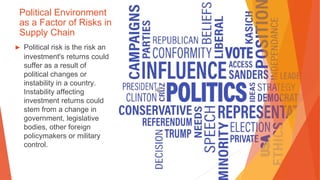
▶ Political risk is the risk an
investment's returns could
suffer as a result of
political changes or
instability in a country.
Instability affecting
investment returns could
stem from a change in
government, legislative
bodies, other foreign
policymakers or military
control.
Political Environment
as a Factor of Risks in
Supply Chain
▶ The political environment can
indeed be a significant factor that
contributes to risks in the supply
chain. Political instability,
government policies, international
relations, and geopolitical tensions
can all have far-reaching effects on
supply chain operations.
To manage and mitigate the risks
arising from the political
environment, businesses should
adopt strategies such as
diversification of suppliers and
markets, scenario planning,
developing contingency plans,
building strong relationships with
government authorities, and staying
informed about geopolitical
developments. Supply chain risk
management should take into
This Photo by Unknown Author is licensed under CC BY
Political Environment
as a Factor of Risks in
Supply Chain
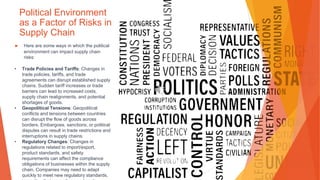
▶ Here are some ways in which the political
environment can impact supply chain
risks:
• Trade Policies and Tariffs: Changes in
trade policies, tariffs, and trade
agreements can disrupt established supply
chains. Sudden tariff increases or trade
barriers can lead to increased costs,
supply chain realignments, and potential
shortages of goods.
• Geopolitical Tensions: Geopolitical
conflicts and tensions between countries
can disrupt the flow of goods across
borders. Embargoes, sanctions, or political
disputes can result in trade restrictions and
interruptions in supply chains.
• Regulatory Changes: Changes in
regulations related to import/export,
product standards, and safety
requirements can affect the compliance
obligations of businesses within the supply
chain. Companies may need to adapt
quickly to meet new regulatory standards,
Political Environment
as a Factor of Risks in
Supply Chain
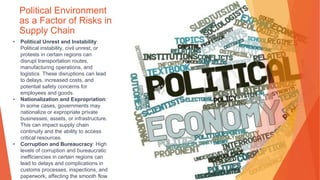
• Political Unrest and Instability:
Political instability, civil unrest, or
protests in certain regions can
disrupt transportation routes,
manufacturing operations, and
logistics. These disruptions can lead
to delays, increased costs, and
potential safety concerns for
employees and goods.
• Nationalization and Expropriation:
In some cases, governments may
nationalize or expropriate private
businesses, assets, or infrastructure.
This can impact supply chain
continuity and the ability to access
critical resources.
• Corruption and Bureaucracy: High
levels of corruption and bureaucratic
inefficiencies in certain regions can
lead to delays and complications in
customs processes, inspections, and
paperwork, affecting the smooth flow
Political Environment
as a Factor of Risks in
Supply Chain
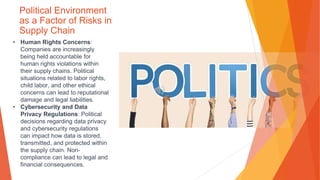
• Human Rights Concerns:
Companies are increasingly
being held accountable for
human rights violations within
their supply chains. Political
situations related to labor rights,
child labor, and other ethical
concerns can lead to reputational
damage and legal liabilities.
• Cybersecurity and Data
Privacy Regulations: Political
decisions regarding data privacy
and cybersecurity regulations
can impact how data is stored,
transmitted, and protected within
the supply chain. Non-
compliance can lead to legal and
financial consequences.
Political Environment
as a Factor of Risks in
Supply Chain
• Currency Fluctuations:
Political events, such as
elections or economic crises,
can lead to currency
fluctuations that affect the
cost of materials and
transportation across borders.
• Infrastructure Investment
and Development:
Government decisions about
infrastructure investments,
such as building new ports,
roads, or railways, can impact
supply chain efficiency and
accessibility. This Photo by Unknown Author is licensed under CC BY-SA
Trade Dispute and
Tariffs
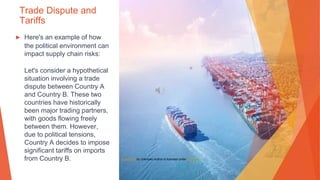
▶ Here's an example of how
the political environment can
impact supply chain risks:
Let's consider a hypothetical
situation involving a trade
dispute between Country A
and Country B. These two
countries have historically
been major trading partners,
with goods flowing freely
between them. However,
due to political tensions,
Country A decides to impose
significant tariffs on imports
from Country B. This Photo by Unknown Author is licensed under CC BY-SA
Trade Dispute and
Tariffs
▶ Impact on the Supply Chain:
• Increased Costs: The tariffs imposed
by Country A result in higher import
costs for products coming from Country
B. Companies in Country A that rely on
goods from Country B now face
increased costs, which could potentially
lead to higher prices for consumers.
• Supply Disruptions: Companies that
depend heavily on imports from
Country B may need to find alternative
suppliers to avoid the tariffs. This
sudden shift in suppliers can disrupt the
existing supply chain, requiring new
agreements, quality checks, and
adjustments to production processes.
• Inventory Management: Companies
might rush to stockpile goods before
the tariffs take effect, leading to
demand spikes and potential
shortages. Conversely, if companies
anticipate a decline in demand due to
higher prices, they might reduce their
orders, impacting the production levels
This Photo by Unknown Author is licensed under CC BY-NC-ND
Trade Dispute and
Tariffs
• Contract Renegotiations:
Existing contracts between
businesses in Country A and
Country B may need to be
renegotiated to account for the
higher costs resulting from the
tariffs. This could lead to
strained relationships and
disputes over pricing.
• Impact on Global Operations:
Companies that have global
operations involving multiple
countries may need to adjust
their supply chain strategies to
mitigate the effects of the
tariffs. They might shift
production locations, seek new
suppliers, or consider
diversifying their markets.
This Photo by Unknown Author is licensed under CC BY-SA-NC
Trade Dispute and
Tariffs
• Trade Relationships: The
trade dispute and tariffs
could have broader political
and economic implications,
potentially straining
diplomatic relations between
the two countries. This could
create uncertainty and lead
to further disruptions in the
supply chain due to
unpredictability in future
trade policies.
• Market Instability: The
uncertainty resulting from the
trade dispute and potential
retaliation from Country B
could lead to market
volatility, affecting investor
confidence, currency
This Photo by Unknown Author is licensed under CC BY-NC-ND
Trade Dispute and
Tariffs
▶ In this example, the political
decision to impose tariffs as
a result of a trade dispute
directly impacts the supply
chain of companies that
rely on goods from the
affected country. These
impacts extend beyond
financial costs to include
operational disruptions,
relationships with suppliers,
and potential market
instability. Such scenarios
highlight the importance of
supply chain risk
management strategies
that account for geopolitical
factors.
This Photo by Unknown Author is licensed under CC BY-SA
Recurring Risks of
Supply Chain
▶ Certain risks are known to be
consistently present in supply
chains due to their inherent
nature and the complex
dynamics involved. These
recurring risks can impact
supply chains across industries
and geographies.
Given the recurring nature of
these risks, effective supply
chain risk management
involves proactive planning,
diversification of suppliers,
robust contingency plans,
continuous monitoring of
potential disruptions, and
collaboration among supply
chain partners to mitigate these
This Photo by Unknown Author is licensed under CC BY-SA
Recurring Risks of
Supply Chain
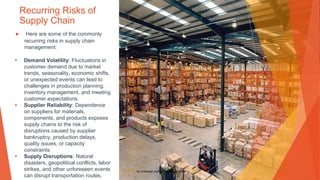
▶ Here are some of the commonly
recurring risks in supply chain
management:
• Demand Volatility: Fluctuations in
customer demand due to market
trends, seasonality, economic shifts,
or unexpected events can lead to
challenges in production planning,
inventory management, and meeting
customer expectations.
• Supplier Reliability: Dependence
on suppliers for materials,
components, and products exposes
supply chains to the risk of
disruptions caused by supplier
bankruptcy, production delays,
quality issues, or capacity
constraints.
• Supply Disruptions: Natural
disasters, geopolitical conflicts, labor
strikes, and other unforeseen events
can disrupt transportation routes,
This Photo by Unknown Author is licensed under CC BY-SA
Recurring Risks of
Supply Chain
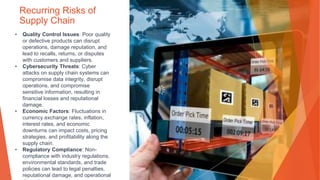
• Quality Control Issues: Poor quality
or defective products can disrupt
operations, damage reputation, and
lead to recalls, returns, or disputes
with customers and suppliers.
• Cybersecurity Threats: Cyber
attacks on supply chain systems can
compromise data integrity, disrupt
operations, and compromise
sensitive information, resulting in
financial losses and reputational
damage.
• Economic Factors: Fluctuations in
currency exchange rates, inflation,
interest rates, and economic
downturns can impact costs, pricing
strategies, and profitability along the
supply chain.
• Regulatory Compliance: Non-
compliance with industry regulations,
environmental standards, and trade
policies can lead to legal penalties,
reputational damage, and operational
Recurring Risks of
Supply Chain
• Communication Breakdowns:
Ineffective communication among
supply chain partners can lead to
misunderstandings, delays, and
misaligned expectations, impacting
the overall efficiency and
effectiveness of the chain.
• Inventory Management: Maintaining
the right balance of inventory is a
challenge. Overstocking ties up
capital, while understocking leads to
potential stockouts and lost sales.
• Political and Geopolitical Risks:
Political instability, trade disputes,
embargoes, and changes in
government policies can impact
supply chain operations, especially
those involving global suppliers and
markets.
• Transportation Issues: Disruptions
in transportation networks,
congestion, customs delays, and
rising fuel costs can affect the timely
movement of goods and increase
This Photo by Unknown Author is licensed under CC BY-SA-NC
Recurring Risks of
Supply Chain
• Talent Shortages: The lack
of skilled labor, especially in
specialized roles like logistics
and procurement, can affect
the efficiency and
performance of supply chain
operations.
• Environmental and
Sustainability Risks:
Increasing focus on
environmental sustainability
and responsible sourcing
means that supply chains
need to consider the
environmental impact of their
operations, materials, and
transportation methods.
Canadian Recurring
Risks of Supply Chain
▶ In the context of Canada, while many
of the recurring risks in the global
supply chain apply, there are some
specific factors that businesses
operating in or reliant on Canadian
supply chains should consider:
• Seasonal Weather Events: Canada
experiences various seasonal
weather events such as snowstorms,
hurricanes, and floods, which can
disrupt transportation networks, port
operations, and agricultural
production, impacting supply chain
reliability and efficiency.
• Transportation Infrastructure
Challenges: Canada's vast
geography and sometimes
underdeveloped transportation
infrastructure in certain regions can
lead to transportation bottlenecks,
delays, and increased costs,
especially during peak seasons or
Canadian Recurring
Risks of Supply Chain
• Dependency on U.S. Trade
Relations: Canada's close economic
ties with the United States mean that
changes in U.S. trade policies, tariffs,
or regulations can significantly impact
Canadian supply chains, affecting
market access, trade flows, and cross-
border logistics.
• Indigenous Land Rights and
Protests: Disputes related to
Indigenous land rights, protests, or
blockades can disrupt supply chains,
particularly in industries such as
resource extraction, forestry, or
transportation, where projects pass
through or impact Indigenous
territories.
• Regulatory Compliance:
Compliance with Canadian
regulations, including those related to
product safety, environmental
standards, and labor laws, requires
Canadian Recurring
Risks of Supply Chain
• Labour Shortages and Immigration
Policies: Labour shortages,
particularly in certain industries or
regions, can lead to recruitment
challenges, increased wage
pressures, and disruptions in
production schedules, while changes
in immigration policies can impact
workforce availability and
composition.
• Currency Fluctuations: Volatility in
the Canadian dollar exchange rate
against major currencies, particularly
the U.S. dollar, can impact
import/export costs, profit margins,
and sourcing decisions, affecting
supply chain competitiveness and
financial performance.
• Cybersecurity Risks: Like
elsewhere, Canadian businesses are
vulnerable to cybersecurity threats
such as data breaches, ransomware
Canadian Recurring
Risks of Supply Chain
• Environmental Regulations
and Climate Change:
Compliance with Canadian
environmental regulations, as
well as addressing the impacts
of climate change such as
extreme weather events, shifting
weather patterns, and
environmental risks, are critical
considerations for supply chain
sustainability and resilience.
• Geopolitical Uncertainty:
Changes in global geopolitics,
trade relations, and international
conflicts can impact Canadian
supply chains by affecting trade
routes, geopolitical risks, and
diplomatic relations, influencing
market access and trade flows.
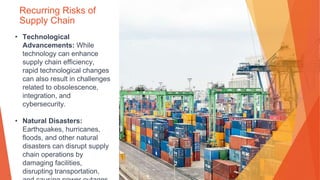
Recurring Risks of
Supply Chain
• Technological
Advancements: While
technology can enhance
supply chain efficiency,
rapid technological changes
can also result in challenges
related to obsolescence,
integration, and
cybersecurity.
• Natural Disasters:
Earthquakes, hurricanes,
floods, and other natural
disasters can disrupt supply
chain operations by
damaging facilities,
disrupting transportation,
Aviation security
▶ Aviation security plays a crucial
role in securing the supply chain
within the aviation industry to
ensure the safe transportation of
goods, equipment, and
materials required for flight
operations. Securing the
aviation supply process chain
involves a combination of
physical measures, regulatory
compliance, and collaboration
with stakeholders.
By implementing these
measures, aviation security
ensures that the supply process
chain remains secure, efficient,
and compliant with industry
standards. This helps maintain
the safety of flights, passengers,
crew, and cargo while
This Photo by Unknown Author is licensed under CC BY-SA
Aviation security
▶ Here are some key steps aviation
security takes to secure the supply
process chain:
• Regulatory Compliance: Aviation
security follows regulations and
standards set by aviation authorities and
international organizations to ensure that
all aspects of the supply chain meet
security requirements. This includes
adhering to guidelines for cargo
handling, screening, and transportation.
• Screening and Inspection: All cargo,
mail, and packages transported through
aviation are subject to screening using
advanced technologies such as X-ray
scanners, explosive detection systems,
and trace detection equipment. This
helps identify potential threats or
prohibited items within shipments.
• Known Shipper Programs: Airlines and
freight forwarders implement known
shipper programs that establish a trusted
relationship with specific shippers who
undergo rigorous security checks and
procedures. This helps prevent
unauthorized or malicious shipments
from entering the supply chain.
This Photo by Unknown Author is licensed under CC BY-SA
Aviation security
• Secure Warehousing and Storage:
Facilities used for storing aviation-
related goods are equipped with
security measures such as access
controls, surveillance systems, and
intrusion detection to prevent
unauthorized access and tampering.
• Chain of Custody: Proper
documentation and tracking of cargo
throughout the supply chain are
essential. Chain of custody processes
ensure that goods are accounted for
at each stage of their journey,
reducing the risk of tampering or
unauthorized handling.
• Cargo Integrity Checks: Security
measures are in place to ensure that
cargo is not tampered with during
transit. Seals, locks, and tamper-
evident packaging are used to
maintain the integrity of shipments.
• Screening of Personnel: Employees
involved in cargo handling and
transportation undergo background
checks and security training to prevent
insider threats and ensure proper
Aviation security
• Cybersecurity for Cargo
Systems: Cargo booking and
tracking systems are secured
against cyber threats to prevent
unauthorized access, data
breaches, and tampering with
cargo information.
• Collaboration with
Stakeholders: Airlines, airports,
cargo handlers, customs, and
law enforcement agencies
collaborate to share information
on potential threats and
suspicious activities in the supply
chain.
• Emergency Response Plans:
Preparedness plans are
developed to respond to security
incidents, such as the discovery
of suspicious cargo or dangerous
goods. These plans outline
procedures for containment,
Aviation security
• Special Handling for
Dangerous Goods:
Hazardous materials and
dangerous goods are subject
to specific regulations and
handling procedures to
prevent risks to the aviation
supply chain and ensure the
safety of both transportation
personnel and passengers.
• Risk Assessment and
Mitigation: Regular risk
assessments are conducted
to identify vulnerabilities and
potential threats within the
aviation supply process
chain. Mitigation strategies
are developed and
implemented to address
Canadian Aviation
security
▶ Here are some key steps aviation
security takes to secure the supply
process chain:
• Regulatory Compliance: Aviation
security follows regulations and
standards set by aviation authorities
and international organizations to
ensure that all aspects of the supply
chain meet security requirements.
This includes adhering to guidelines
for cargo handling, screening, and
transportation.
• Screening and Inspection: All
cargo, mail, and packages
transported through aviation are
subject to screening using
advanced technologies such as X-
ray scanners, explosive detection
systems, and trace detection
equipment. This helps identify
potential threats or prohibited items
This Photo by Unknown Author is licensed under CC BY-SA
Canadian Aviation
security
• Canadian Aviation Security Regulations
(CASRs): CASRs outline the regulatory
requirements for aviation security in
Canada. These regulations cover various
aspects of aviation security, including
passenger and baggage screening, access
control, cargo security, and security training
programs for aviation personnel.
• Airport Security: Canadian airports have
security measures in place to control access
to restricted areas, prevent unauthorized
entry onto aircraft, and detect and respond
to security threats. These measures include
the deployment of security personnel,
surveillance systems, access control
mechanisms, and security screening
checkpoints.
• Airline Security: Canadian airlines are
required to implement security measures to
protect their aircraft, passengers, and crew
from potential threats. These measures may
include pre-flight security checks, passenger
and baggage screening, training for flight
crew and cabin crew on security
procedures, and the implementation of
security protocols to address specific threats
This Photo by Unknown Author is licensed under CC BY-SA
Canadian Aviation
security
• International Standards and Cooperation:
Canada collaborates with international
organizations such as the International Civil
Aviation Organization (ICAO) and participates
in global initiatives to enhance aviation
security. Canada aligns its aviation security
measures with international standards and
works with other countries to address
common security challenges and share best
practices.
• Threat Assessment and Intelligence
Sharing: Canadian security agencies
conduct ongoing threat assessments to
identify and mitigate potential risks to aviation
security. Intelligence sharing and cooperation
between government agencies, law
enforcement, and international partners play
a crucial role in addressing security threats
and preventing terrorist attacks.
Overall, aviation security in Canada is a
multifaceted and collaborative effort involving
government agencies, airport authorities, airlines,
and other stakeholders working together to
maintain a safe and secure aviation environment.
Continuous vigilance, adherence to regulations,
and investment in security measures are
This Photo by Unknown Author is licensed under CC BY-SA
Advantages of
Enhancing Security in
the Supply Chain
▶ Increasing security in the
supply chain offers
numerous advantages that
impact various aspects of
business operations,
reputation, and overall
resilience.
Overall, increasing security
in the supply chain provides
a range of benefits that
extend beyond risk
reduction. These advantages
contribute to the overall
success, reputation, and
resilience of a business in an
increasingly complex and
This Photo by Unknown Author is licensed under CC BY-SA
Advantages of
Enhancing Security in
the Supply Chain
▶ Here are some key advantages of
enhancing security in the supply chain:
• Risk Mitigation: Strengthening security
measures helps mitigate various risks,
such as theft, counterfeiting, cyber
attacks, and disruptions caused by
natural disasters or geopolitical events.
This ensures continuity of operations and
reduces potential financial losses.
• Improved Business Resilience: A
secure supply chain is better equipped to
handle unexpected disruptions. By
identifying vulnerabilities and
implementing mitigation strategies,
businesses can recover more quickly
from disruptions and maintain customer
trust.
• Regulatory Compliance: Many
industries are subject to strict regulatory
requirements related to security, data
protection, and ethical sourcing.
Enhancing security measures ensures
compliance with regulations and helps
Advantages of
Enhancing Security in
the Supply Chain
• Brand Protection: A secure supply chain
safeguards a company's reputation by
preventing security breaches, product
recalls, and incidents that could negatively
impact public perception. Maintaining a
strong brand image is essential for
customer loyalty and trust.
• Customer Confidence: Customers value
products and services that are sourced,
produced, and delivered with security in
mind. Enhanced security measures
demonstrate a commitment to customer
safety and satisfaction.
• Reduced Insurance Costs: Companies
with well-established security measures in
their supply chain are often considered
lower-risk by insurance providers. This can
lead to reduced insurance premiums and
overall operational costs.
• Supply Chain Efficiency: Effective
security measures can lead to smoother
operations, reduced errors, and improved
visibility across the supply chain. This
translates to greater efficiency, cost
savings, and optimized resource
Advantages of
Enhancing Security in
the Supply Chain
• Prevention of Counterfeiting and
Fraud: Strong security measures
help prevent the infiltration of
counterfeit products into the supply
chain, protecting both customers and
the company's intellectual property.
• Enhanced Data Protection: As
digitalization continues to play a
significant role in supply chain
management, cybersecurity
becomes crucial. Strong security
measures safeguard sensitive data
and intellectual property from cyber
attacks and data breaches.
• Collaborative Partnerships:
Demonstrating a commitment to
security can foster stronger
relationships with supply chain
partners, vendors, and customers.
Transparency about security
practices builds trust and encourages
collaboration.
Advantages of
Enhancing Security in
the Supply Chain
• Better Risk Management: A proactive
approach to security allows companies
to identify potential risks early and
develop strategies to mitigate them
effectively. This minimizes the impact of
disruptions on operations.
• Crisis Preparedness: Businesses with
robust security measures are better
prepared to handle crises and
emergencies. This readiness reduces
panic, confusion, and potential chaos in
the event of a security breach or
disruption.
• Long-Term Sustainability: Companies
that prioritize security contribute to the
long-term sustainability of their
operations and the industry as a whole.
Ethical and secure practices are
increasingly important to
environmentally and socially conscious
consumers.
• Competitive Advantage: A strong
security stance can differentiate a
business from its competitors by
Conclusion
▶ We began by explaining the impact of cyber
attacks on the supply chain. Cyber attacks on
the supply chain can have far-reaching and
significant impacts on businesses,
economies, and even national security.
Supply chains are intricate networks of
interconnected entities, including suppliers,
manufacturers, distributors, retailers, and
customers. We examined the political
environment as a factor of risks in supply
chain. We also examined risks that are known
to be consistently present in supply chains
due to their inherent nature and the complex
dynamics involved.
We described how aviation security plays a
crucial role in securing the supply chain within
the aviation industry to ensure the safe
transportation of goods, equipment, and
materials required for flight operations. Then
concluded with advantages of enhancing
security in the supply chain. Increasing
security in the supply chain provides a range
of benefits that extend beyond risk reduction.
These advantages contribute to the overall
success, reputation, and resilience of a
business in an increasingly complex and
interconnected global marketplace.
Terminal Learning
Objectives
▶ Understand the Concept of Supply
Chain Vulnerability
▶ Analyze Price and Supply Risks in
Supply Chains
▶ Assess Resource Risks and
Country Strategies
▶ Analyze strategies employed by
resource-rich and resource-scarce
countries to mitigate resource-
related risks.
▶ Define hybrid threats in the context
of supply chain safety
management.
Enabling Learning Objectives
▶ Define Political Environment as a Factor of Risk
▶ Explain the concept of political environment as a critical factor impacting supply chain
risk.
▶ Provide examples of how political factors can disrupt supply chains.
▶ Distinguish Between Internal and External Supply Chain Risks
▶ Differentiate between internal-driven and external-driven supply chain risks.
▶ Illustrate the impact of each type of risk on supply chain operations.
▶ Apply Methodology and Data Analysis in Supply Chain Risk Assessment
▶ Describe various methodologies for assessing supply chain risk.
▶ Discuss the importance of data sources, sampling techniques, and time frames in
conducting risk assessments.
▶ Analyze Disclosed Supply Chain Risk Sources
▶ Provide examples of disclosed supply chain risk sources from real-world cases.
▶ Analyze the implications of these disclosures on supply chain management.
▶ Present Analysis and Results
▶ Present findings from your analysis of supply chain vulnerabilities and risk factors.
▶ Conclude with actionable insights and recommendations for managing and mitigating
supply chain risks.
▶ Engage in Critical Thinking and Problem Solving
▶ Encourage students to critically analyze complex supply chain scenarios.
▶ Foster problem-solving skills to develop innovative strategies for risk mitigation.
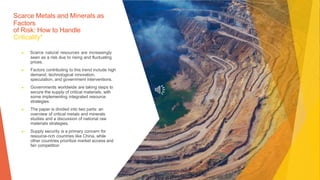
Scarce Metals and Minerals as
Factors
of Risk: How to Handle
Criticality*
▶ Scarce natural resources are increasingly
seen as a risk due to rising and fluctuating
prices.
▶ Factors contributing to this trend include high
demand, technological innovation,
speculation, and government interventions.
▶ Governments worldwide are taking steps to
secure the supply of critical materials, with
some implementing integrated resource
strategies.
▶ The paper is divided into two parts: an
overview of critical metals and minerals
studies and a discussion of national raw
materials strategies.
▶ Supply security is a primary concern for
resource-rich countries like China, while
other countries prioritize market access and
fair competition
Introduction
▶ Rare earth elements like neodymium, terbium, and cer
have gained widespread attention due to skyrocketing
prices and supply challenges.
▶ Many countries now consider rare earths as critical
resources and are seeking alternatives to address
potential supply shortages.
▶ Not only rare earths but other metals and minerals
have also experienced steep price increases recently.
▶ During the 2008/2009 financial and economic crisis,
metal and mineral prices dropped significantly but
have since risen with the global economic recovery.
▶ Metal ore reserves are not running out soon, but
prices are expected to continue rising with noticeable
fluctuations.
▶ Key drivers for this include strong and increasing
demand from China (China effect), technical
innovations boosting metal demand, and speculation
in the markets.
▶ Current factors like dollar weakness, low interest
rates, inflation concerns, and economic uncertainties
in the EU and the US make metals attractive as
investments.
▶ Growing competition, rising prices, and price volatility
raise concerns about future access to key natural
resources at sustainable prices.
▶ Uneven global distribution of many metals poses
challenges for international division of labor.
▶ Resource markets are often non-transparent, and
governments increasingly intervene, including through
export restrictions.
▶ High and fluctuating prices, market concentration, and
interventions pose significant risks to supply security.
▶ Many countries have developed national resource
strategies in response to these risks.
▶ Resources are a prominent topic on the G20 agenda
under the French presidency.
▶ The paper aims to address two sets of questions:
measuring criticality, identifying critical metals,
understanding resource market risks, and evaluating
countries' responses to these risks.
Critical Metals
and Minerals
Measuring Criticality
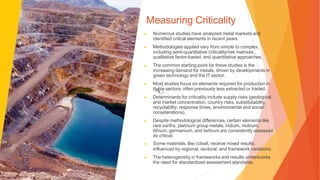
▶ Numerous studies have analyzed metal markets and
identified critical elements in recent years.
▶ Methodologies applied vary from simple to complex,
including semi-quantitative criticality/risk matrixes,
qualitative factor-based, and quantitative approaches.
▶ The common starting point for these studies is the
increasing demand for metals, driven by developments in
green technology and the IT sector.
▶ Most studies focus on elements required for production in
these sectors, often previously less extracted or traded.
▶ Determinants for criticality include supply risks (geological
and market concentration, country risks, substitutability,
recyclability, response times, environmental and social
considerations).
▶ Despite methodological differences, certain elements like
rare earths, platinum group metals, indium, niobium,
lithium, germanium, and terbium are consistently assessed
as critical.
▶ Some materials, like cobalt, receive mixed results,
influenced by regional, sectoral, and framework variations.
▶ The heterogeneity in frameworks and results underscores
the need for standardized assessment standards.
The North American
Perspective
▶ The National Academy of Science (NAS)
in the U.S. recognized the need for a
methodology to identify critical minerals.
▶ NAS introduced the criticality matrix,
consisting of two dimensions: 'importance
in use' and 'likelihood of supply
restrictions.'
▶ An element is considered critical if it's
both important in use and potentially
subject to supply restrictions.
▶ Importance in use is determined by
demand from different U.S. economic
sectors and the availability of substitutes.
▶ Likelihood of supply restrictions is
influenced by factors like geologic,
technical, environmental, political, and
economic considerations, both long-term
and short-term.
The North American
Perspective
▶ The Critical Minerals, and the U.S. Economy (NAS
2007), the National Academy of Science utilizes a
criticality matrix featuring 11 minerals or mineral
groups, including platinum group metals, rare earth
elements, indium, manganese, and niobium.
▶ The selection is not exhaustive but serves as a
demonstration of the matrix.
▶ Platinum group metals, rare earths, indium,
manganese, and niobium are identified as the most
critical elements, primarily due to high demand, a
lack of substitutes, and high supply market risks.
▶ The U.S. Department of Energy (DOE) adopts a
modified NAS methodology for assessing critical
resources, particularly in the context of clean
energy.
▶ The DOE's approach employs a two-dimensional
matrix considering 'supply risk' and 'importance to
clean energy,' with factors such as basic availability,
competing technology demand, political and
regulatory factors, and clean energy demand. The
matrix categorizes minerals as critical, near-critical,
or non-critical.
The North American
Perspective
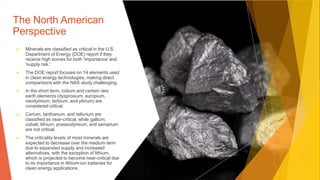
▶ Minerals are classified as critical in the U.S.
Department of Energy (DOE) report if they
receive high scores for both 'importance' and
'supply risk.'
▶ The DOE report focuses on 14 elements used
in clean energy technologies, making direct
comparisons with the NAS study challenging.
▶ In the short term, indium and certain rare
earth elements (dysprosium, europium,
neodymium, terbium, and yttrium) are
considered critical.
▶ Cerium, lanthanum, and tellurium are
classified as near-critical, while gallium,
cobalt, lithium, praseodymium, and samarium
are not critical.
▶ The criticality levels of most minerals are
expected to decrease over the medium term
due to expanded supply and increased
alternatives, with the exception of lithium,
which is projected to become near-critical due
to its importance in lithium-ion batteries for
clean energy applications.
The North American
Perspective
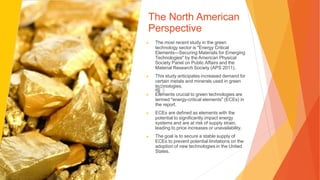
▶ The most recent study in the green
technology sector is "Energy Critical
Elements—Securing Materials for Emerging
Technologies" by the American Physical
Society Panel on Public Affairs and the
Material Research Society (APS 2011).
▶ This study anticipates increased demand for
certain metals and minerals used in green
technologies.
▶ Elements crucial to green technologies are
termed "energy-critical elements" (ECEs) in
the report.
▶ ECEs are defined as elements with the
potential to significantly impact energy
systems and are at risk of supply strain,
leading to price increases or unavailability.
▶ The goal is to secure a stable supply of
ECEs to prevent potential limitations on the
adoption of new technologies in the United
States.
The North American
Perspective
▶ The APS report uses a qualitative framework
with five indicators to assess energy-critical
elements (ECEs).
▶ These indicators include crustal abundance
and distribution of ECEs, geopolitical risks,
risk of joint production, environmental and
social concerns, and response times in
production and utilization.
▶ ECEs are typically found in only 0.1 percent
of the Earth's crust by weight, making their
concentration insufficient for primary
production at current prices.
▶ ECEs are often obtained as by-products
during the extraction and refining of primary
ores like lead, zinc, and copper.
▶ Geopolitical risks are high when there are few
producing countries, companies, or mines,
and political instability and conflict can affect
ECE supply in developing countries.
Additionally, response times in production and
technology development can significantly
impact ECE availability.
The North American
Perspective
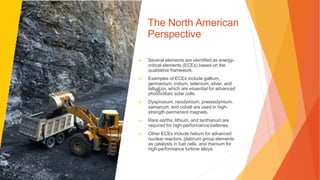
▶ Several elements are identified as energy-
critical elements (ECEs) based on the
qualitative framework.
▶ Examples of ECEs include gallium,
germanium, indium, selenium, silver, and
tellurium, which are essential for advanced
photovoltaic solar cells.
▶ Dysprosium, neodymium, praseodymium,
samarium, and cobalt are used in high-
strength permanent magnets.
▶ Rare earths, lithium, and lanthanum are
required for high-performance batteries.
▶ Other ECEs include helium for advanced
nuclear reactors, platinum group elements
as catalysts in fuel cells, and rhenium for
high-performance turbine alloys.
The German
Perspective
▶ The study "Seltene Metalle" focuses on
critical materials in the information and
communication industry.
▶ It uses three indicators for scarcity: prices,
dynamic and static range of stocks, and
concentration of production.
▶ Antimony and indium are identified as
elements with high scarcity ratings.
▶ Cobalt, gold, iridium, palladium, platinum,
rhenium, rhodium, ruthenium, zinc, and tin
are rated as medium scarce.
▶ Rare earths were not classified as scarce
metals in this study based on the applied
criteria.
The German Perspective
▶ The study by Fraunhofer Institute and Institute
for Future Studies analyzes the vulnerability of
metals and minerals in high-tech industries.
▶ Vulnerable elements are defined as those
crucial to the national economy, concentrated in
a few countries, and produced in politically
unstable regions.
▶ The study forecasts the demand for 22 metals
and minerals in certain high-tech industries in
Germany in 2030.
▶ Gallium is projected to have the highest
increase in demand, expected to be around six
times higher than in 2006.
▶ Other elements like neodymium, indium,
germanium, scandium, and platinum are also
expected to experience significant demand
growth by 2030.
The German
Perspective
▶ The report by Institut der deutschen
Wirtschaft Köln focuses on commodity
supply risks in Bavaria.
▶ It introduces the 'commodity-risk index' as a
methodology to assess short-term and long-
term risks associated with raw metals and
minerals.
▶ The index comprises seven indicators,
including static life index, country risks,
country concentration, market concentration,
economic importance, risk of strategic
employment, and substitutability.
▶ These indicators provide a comprehensive
assessment of supply risk by considering
quantitative and qualitative factors.
▶ The report's findings offer insights into the
vulnerability of Bavaria's raw material supply
and can inform strategies to mitigate these
risks.
The German Perspective
▶ The study uses seven indicators to assess supply risks for 37 metals and
minerals, resulting in a commodity-risk index.
▶ Materials are categorized into three boxes (red, yellow, and green) based
on their supply risk levels.
▶ The red box includes 14 elements at the highest risk of
supply shortage, with rare earths dominating the list.
▶ The orange box contains 14 elements with medium supply risk.
▶ The green box includes low-risk materials. This approach
allows for a precise ranking of criticality.
The European and
Global Perspective
▶ The study focuses on assessing critical
raw materials within the European Union
over a ten-year timeframe.
▶ Critical raw materials are defined as those
with a higher risk of supply shortage and a
greater economic impact compared to
most other raw materials.
▶ The assessment uses three aggregated
indicators: economic importance, supply
risks, and environmental country risk.
▶ Economic importance is determined by
analyzing the value added by raw
materials in various economic sectors.
▶ Supply risk considers factors like
production concentration, political stability,
substitutability, and recycling rates, while
environmental country risk evaluates
government environmental protection
measures.
The European and
Global Perspective
▶ The analysis uses a two-step approach to
assess materials, first placing them in a
matrix based on economic importance and
supply risk.
▶ A second step involves reassessing
materials above a certain economic
importance threshold for environmental
country risk.
▶ Materials are classified as critical if they
exceed the economic importance threshold
and have a high assessment in either supply
risk or environmental risk.
▶ The report identifies three clusters of
materials: critical metals with high production
concentration, low substitutability, and low
recycling rates; materials with high economic
importance but low supply risks; and
materials with low economic importance and
supply risk.
▶ Examples of critical metals include antimony,
indium, cobalt, rare earths, and tungsten.
The European and
Global Perspective
▶ This study takes a global perspective rather
than a national/regional focus, commissioned
by the United Nations Environment
Programme.
▶ It analyzes the availability of critical
resources and their recycling potential for
metals and metal groups important for future
sustainable technologies.
▶ The focus is on "green minor metals"
including indium, germanium, tantalum,
tellurium, cobalt, lithium, gallium, rare earths,
and platinum group metals.
▶ These metals are considered critical when
they are likely to face supply shortages and
increased costs due to growing demand for
future sustainable technologies.
▶ Future sustainable technologies encompass
electrical and electronics equipment,
photovoltaic technologies, battery
technologies, and catalysts.
The European and
Global Perspective
▶ The report considers factors like minor-
product phenomena and post-consumer
recycling challenges in its analysis of "green
minor metals" criticality.
▶ It uses three indicators to measure criticality:
demand growth, supply risk, and recycling
restrictions.
▶ Supply risks include regional mining
concentration, physical scarcity, temporary
scarcity, and structural and technical
scarcity.
▶ The report places significant emphasis on
recycling restrictions, differentiating between
pre-consumer and post-consumer recycling.
▶ Critical "green minor metals" are identified
for the short term, medium term, and long
term, with different metals becoming critical
under various scenarios of demand growth,
supply risks, and recycling restrictions.
Summary: Price
and Supply Risks
▶ The discussion of criticality leads to the
identification of two predominant risks on
resource markets: price risks and supply
risks.
▶ Price risks have been evident since the turn
of the century, with rising prices in major
commodity markets, including metals and
minerals.
▶ Strong demand from emerging economies,
especially China, has been a significant
driver of long-term price surges.
▶ Other factors contributing to rising demand
and price risks include demographic growth,
urbanization, and changing mobility patterns
driven by rising incomes.
▶ Long-term structural factors suggest that
prices will likely continue to rise in the future.
Introduction to Resource
Risks in Supply Chain
Safety Management
▶ Define resource risks
▶ Explain the importance of
addressing these risks
▶ Provide an overview of the
presentation structure
Introduction to Resource
Risks in Supply Chain
Safety Management
▶ Resource risks are the potential
for loss or damage to resources
used in the supply chain. These
resources can include people,
equipment, materials, and
information. Resource risks can be
caused by a variety of factors,
such as accidents, natural
disasters, and human error.
Defining Resource
Risks
▶ People: Employees, contractors, and
other individuals involved in the supply
chain.
▶ Equipment: Machinery, vehicles, and
other tools used in the supply chain.
▶ Materials: Raw materials, components,
and finished goods.
▶ Information: Data and documentation
used in the supply chain.
Importance of Addressing
Resource Risk
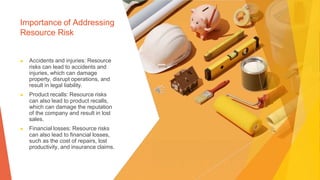
▶ Accidents and injuries: Resource
risks can lead to accidents and
injuries, which can damage
property, disrupt operations, and
result in legal liability.
▶ Product recalls: Resource risks
can also lead to product recalls,
which can damage the reputation
of the company and result in lost
sales.
▶ Financial losses: Resource risks
can also lead to financial losses,
such as the cost of repairs, lost
productivity, and insurance claims.
Importance of Addressing
Resource Risk
▶ Resource risks are a serious issue
that can have a significant impact
on the supply chain. By
understanding the different types
of resource risks and their impact,
businesses can take steps to
address these risks and protect
their assets.
High Demand, Little
Domestic Supply:
Germany
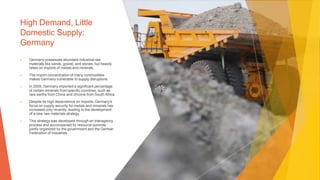
▶ Germany possesses abundant industrial raw
materials like sands, gravel, and stones, but heavily
relies on imports of metals and minerals.
▶ The import concentration of many commodities
makes Germany vulnerable to supply disruptions.
▶ In 2009, Germany imported a significant percentage
of certain minerals from specific countries, such as
rare earths from China and chrome from South Africa.
▶ Despite its high dependence on imports, Germany's
focus on supply security for metals and minerals has
increased only recently, leading to the development
of a new raw materials strategy.
▶ This strategy was developed through an interagency
process and accompanied by resource summits
jointly organized by the government and the German
Federation of Industries
High Demand, Little
Domestic Supply:
Germany
▶ The new German raw materials strategy, like previous
ones, places the responsibility for securing supply
primarily in the hands of industry, including exploration,
extraction, transport, contracts, and stockpiling.
▶ This updated strategy pays more attention to the impact
of new technologies on demand for specific metals and
minerals, the strategic orientation of commodity policies
in developing and emerging countries, and the need for
an integrated resource approach in Germany and the
EU.
▶ It is influenced by experiences during the financial and
economic crisis, increased price volatility, and concerns
about market transparency.
▶ The German government plans to assist industry by
improving market transparency, promoting competitive
and open markets, supporting foreign investment with
guarantees, and establishing bilateral resource
partnerships.
▶ To support this strategy, a new institution called the
German Agency for Raw Materials was created as an
interface and information platform for industry and
politics.
High Demand, Little
Domestic Supply:
Germany
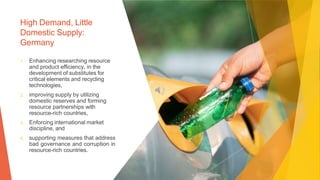
1. Enhancing researching resource
and product efficiency, in the
development of substitutes for
critical elements and recycling
technologies,
2. improving supply by utilizing
domestic reserves and forming
resource partnerships with
resource-rich countries,
3. Enforcing international market
discipline, and
4. supporting measures that address
bad governance and corruption in
resource-rich countries.
High Demand, Little
Domestic Supply:
Germany
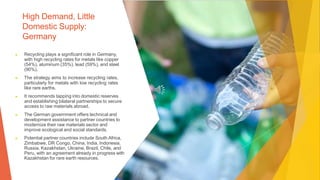
▶ Recycling plays a significant role in Germany,
with high recycling rates for metals like copper
(54%), aluminum (35%), lead (59%), and steel
(90%).
▶ The strategy aims to increase recycling rates,
particularly for metals with low recycling rates
like rare earths.
▶ It recommends tapping into domestic reserves
and establishing bilateral partnerships to secure
access to raw materials abroad.
▶ The German government offers technical and
development assistance to partner countries to
modernize their raw materials sector and
improve ecological and social standards.
▶ Potential partner countries include South Africa,
Zimbabwe, DR Congo, China, India, Indonesia,
Russia, Kazakhstan, Ukraine, Brazil, Chile, and
Peru, with an agreement already in progress with
Kazakhstan for rare earth resources.
High Demand, Little
Domestic Supply:
Germany
▶ There's a debate about establishing a
German Association of Raw Materials,
tentatively named "Deutsche Rohstoff-
NewCo."
▶ German companies withdrew from the
commodity market in the 1990s when
resources were cheaply available
internationally, leading to limited foreign
mining involvement.
▶ Investing in foreign mining could reduce
supply risks, but the diverse interests of
German companies, especially small and
medium-sized enterprises (Mittelstand),
make this strategy challenging.
▶ Deutsche Rohstoff-NewCo aims to
consolidate raw materials purchases from
German companies to increase market
influence.
▶ Corporations like ThyssenKrupp, Siemens,
BASF, and Evonik support this initiative,
although the German Federal Ministry of
Economics and Technology opposes direct
government involvement.
High Demand, Little
Domestic Supply:
Germany
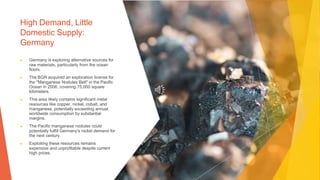
▶ Germany is exploring alternative sources for
raw materials, particularly from the ocean
floors.
▶ The BGR acquired an exploration license for
the "Manganese Nodules Belt" in the Pacific
Ocean in 2006, covering 75,000 square
kilometers.
▶ This area likely contains significant metal
resources like copper, nickel, cobalt, and
manganese, potentially exceeding annual
worldwide consumption by substantial
margins.
▶ The Pacific manganese nodules could
potentially fulfill Germany's nickel demand for
the next century.
▶ Exploiting these resources remains
expensive and unprofitable despite current
high prices.
High Demand, Little
Domestic Supply: The
European Union
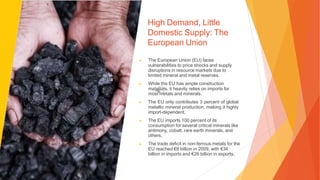
▶ The European Union (EU) faces
vulnerabilities to price shocks and supply
disruptions in resource markets due to
limited mineral and metal reserves.
▶ While the EU has ample construction
materials, it heavily relies on imports for
most metals and minerals.
▶ The EU only contributes 3 percent of global
metallic mineral production, making it highly
import-dependent.
▶ The EU imports 100 percent of its
consumption for several critical minerals like
antimony, cobalt, rare earth minerals, and
others.
▶ The trade deficit in non-ferrous metals for the
EU reached €8 billion in 2009, with €34
billion in imports and €26 billion in exports.
High Demand, Little
Domestic Supply: The
European Union
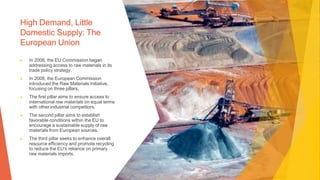
▶ In 2006, the EU Commission began
addressing access to raw materials in its
trade policy strategy.
▶ In 2008, the European Commission
introduced the Raw Materials Initiative,
focusing on three pillars.
▶ The first pillar aims to ensure access to
international raw materials on equal terms
with other industrial competitors.
▶ The second pillar aims to establish
favorable conditions within the EU to
encourage a sustainable supply of raw
materials from European sources.
▶ The third pillar seeks to enhance overall
resource efficiency and promote recycling
to reduce the EU's reliance on primary
raw materials imports.
High Demand, Little
Domestic Supply: The
European Union
▶ In 2009, the European Commission
Directorate-General for Trade published its
first Raw Materials Policy Annual Report.
▶ The report outlined three key goals, including
integrating relevant raw materials trade
disciplines in international negotiations.
▶ In response to China's export restrictions on
various materials, the EU, along with the
U.S. and Mexico, filed a complaint at the
WTO in June 2009.
▶ The dispute led to the establishment of a
dispute settlement panel in December 2009
to address China's export restrictions.
▶ These restrictions impacted the EU
significantly, affecting jobs and industries
and making China the EU's second most
important trading partner.
High Demand, Little
Domestic Supply: The
European Union
▶ The European Commission released the
Critical Raw Materials for the EU report in
2010.
▶ The EU plans to update its list of critical
raw materials every three years.
▶ On February 2, 2011, the Commission
published the EU's new resource strategy,
focusing on three pillars.
▶ The strategy emphasizes fair and
sustainable supply, fostering resource
production within the EU, and enhancing
research and development.
▶ Innovation is the central theme of the
strategy, and stockpiling of crucial
materials like rare earths is being
considered.
High Demand, Little
Domestic Supply: The
European Union
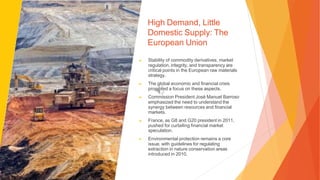
▶ Stability of commodity derivatives, market
regulation, integrity, and transparency are
critical points in the European raw materials
strategy.
▶ The global economic and financial crisis
prompted a focus on these aspects.
▶ Commission President José Manuel Barroso
emphasized the need to understand the
synergy between resources and financial
markets.
▶ France, as G8 and G20 president in 2011,
pushed for curtailing financial market
speculation.
▶ Environmental protection remains a core
issue, with guidelines for regulating
extraction in nature conservation areas
introduced in 2010.
High Demand, Little
Domestic Supply: The
European Union
▶ Resource diplomacy is a key element of
the European resource strategy.
▶ The EU plans to form strategic
partnerships with resource-rich countries,
especially in Africa.
▶ These partnerships aim to promote fair
access to raw materials and create win-
win situations.
▶ Initiatives include cooperation with the
African Union, support for governance
projects, and funding geological surveys.
▶ Transparency initiatives like the Extractive
Industries Transparency Initiative (EITI)
are also part of the strategy.
High Demand, Little
Domestic Supply:
Japan
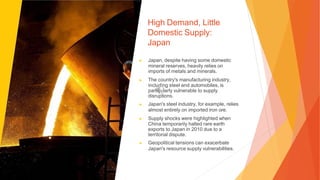
▶ Japan, despite having some domestic
mineral reserves, heavily relies on
imports of metals and minerals.
▶ The country's manufacturing industry,
including steel and automobiles, is
particularly vulnerable to supply
disruptions.
▶ Japan's steel industry, for example, relies
almost entirely on imported iron ore.
▶ Supply shocks were highlighted when
China temporarily halted rare earth
exports to Japan in 2010 due to a
territorial dispute.
▶ Geopolitical tensions can exacerbate
Japan's resource supply vulnerabilities.
High Demand, Little
Domestic Supply: Japan
▶ Japan's Ministry of Economy, Trade and Industry
(METI) introduced a strategy in 2009 to ensure a
stable supply of rare metals.
▶ This strategy identified 31 metals, including rare earth
elements, as rare and aimed to secure the industry's
supply.
▶ The strategy involves three components: a focused,
strategic approach to prioritize rare metals, four pillars
for securing them (overseas resources, recycling,
alternative materials, and stockpiling), and the
development of common infrastructure.
▶ In 2010, METI and the foreign ministry introduced a
"one-stop system" to secure industrial resources,
emphasizing support for foreign mining companies
and exploring new resource extraction opportunities.
▶ The strategy reflects Japan's efforts to address its
vulnerability to rare metal supply disruptions.
High Demand, Little
Domestic Supply:
Japan
▶ Unlike Germany and the EU, Japan's
government is actively involved in the resource
sector.
▶ The state-owned corporation JOGMEG
manages national stockpiles of seven rare
metal commodities and can release reserves if
needed for economic stability.
▶ JOGMEG has additional responsibilities such as
providing information, mineral exploration, mine
development financing, and R&D for recycling
and substitutes.
▶ Japanese companies are actively seeking
alternatives to expensive rare earths,
developing technologies like samarium-cobalt
magnets and palladium substitutes.
▶ The Japanese government provides extensive
support for these research projects to reduce
dependence on rare earth elements.
High Demand, Little
Domestic Supply: Japan
▶ The Japanese government assists domestic
companies in investing in mining projects
and companies abroad.
▶ Examples include partnerships like Sojitz's
stake in the Endako molybdenum mine in
Canada and Sumitomo's joint venture in
Kazakhstan.
▶ Support programs are facilitated through
agencies like NEXI, the Japan Bank for
International Cooperation, and JOGMEG.
▶ Japan also strengthens bilateral relationships
with resource-producing countries through
technical support, training, and infrastructure
projects.
▶ Japan is exploring cooperation with other
resource-dependent countries, including the
U.S. and the EU, to address shared
challenges related to critical elements.
High Demand, Little
Domestic Supply:
Japan
▶ Japan plans to explore about 340,000
square kilometers of its Exclusive Economic
Zone (EEZ) in the East China Sea and the
Pacific Ocean for metals.
▶ The exploration targets huge deposits of
high-tech metals and materials near
Okinawa and the Izu Peninsula.
▶ JOGMEC is developing a remote-controlled
robot to explore depths of up to 2,000
meters.
▶ It may take over 10 years for the technology
to be market-ready.
▶ Ongoing disputes with China over resource
ownership in the East China Sea and the
Senkaku/Diaoyu Islands pose potential
challenges.
Resource-Rich Countries:
The United States
▶ The U.S. has significant domestic metal and
mineral production, but it is still highly
dependent on imports for many critical
metals.
▶ Indium, gallium, and germanium are among
the metals where the U.S. relies heavily on
imports.
▶ Rare earth elements, which are vital for
various technologies, are primarily imported
from China, making the U.S. vulnerable to
supply disruptions.
▶ Low world market prices and strict
environmental regulations in the 1990s led to
reduced mining of certain metals in the U.S.
▶ The U.S. has a history of legislative efforts to
address resource security, including the
Strategic Materials Act and the Defense
Production Act.
Resource-Rich Countries:
The United States
▶ Increased demand for metals like lithium and
rare earths is expected due to President
Obama's renewable energy plans.
▶ Rare earths are crucial for both renewable
energy technologies and the defense
industry in the U.S.
▶ The Government Accountability Office (GAO)
highlighted the importance of rare earths in
various defense systems.
▶ The Department of Energy (DOE) published
the Critical Materials Strategy with three
pillars: diversified supply chains,
development of substitutes, and recycling.
▶ The strategy aims to facilitate domestic
extraction, encourage research on
substitutes, and promote efficient use and
recycling of critical minerals.
Resource-Rich
Countries: The United
States
▶ Research and development are central to
the U.S. strategy, with $15 million allocated
for rare earth research and magnet
substitutes.
▶ An additional $35 million was invested in
developing batteries that don't rely on rare
earth metals.
▶ The DOE seeks to diversify supply sources,
with a focus on increasing domestic reserve
exploitation.
▶ Efforts are underway to reduce permitting
delays and barriers to domestic mineral
projects.
▶ The U.S. aims to collaborate with other
import-dependent countries to collectively
address market distortions caused by China.
Resource-Rich Countries:
The United States
▶ U.S. Congress has considered numerous
legislative proposals addressing supply
security of metals and minerals.
▶ The Rare Earths and Critical Materials
Revitalization Act of 2010 aimed to facilitate
exploration and exploitation but wasn't voted
on before the midterm elections.
▶ In early 2011, multiple new proposals were
introduced in both the House and Senate.
▶ These proposals included acts like the RARE
Act of 2011, focusing on global rare earth
element assessment.
▶ The Critical Minerals Policy Act of 2011
aimed to revitalize the critical minerals supply
chain and ensure the U.S. can meet its
mineral needs.
Resource-Rich
Countries: The United
States
▶ The U.S. has an interest in seabed
resources, similar to its offshore oil and gas
production.
▶ Mineral exploration around Pacific islands is
ongoing, but the potential within the U.S.'s
Exclusive Economic Zone (EEZ) lacks
reliable estimates.
▶ The U.S. has not ratified UNCLOS (United
Nations Convention on the Law of the Sea).
▶ This non-ratification limits the U.S. from
claiming an expanded continental shelf or
licenses for exploration/mining in the High
Seas seabed area.
▶ Legal aspects and jurisdiction related to
seabed resource exploration are complex.
Resource-Rich Countries:
Canada
▶ Mining is a significant sector of Canada's economy,
contributing 2.7% to the GDP, employing over
300,000 people, and making up 18.5% of exports in
2009.
▶ Canada ranks highly in global mineral production,
including aluminum, cobalt, gem diamonds, refined
indium, nickel, platinum-group metals, sodium sulfate,
and zinc.
▶ The country is heavily export-oriented, with metals
and minerals being sent to nearly 200 countries, with
the U.S., EU, China, and Japan as key destinations.
▶ Canada's mineral industry benefits from rising global
demand and increasing mineral and metal prices.
▶ Canada leads in global exploration expenditure,
accounting for 16% of total spending in 2009. The
Fraser Institute assesses countries' mining policies
for attractiveness.
Resource-Rich
Countries: Canada
▶ Canada published a strategic document in
1998 emphasizing the need for a value-
added mineral and metal strategy.
▶ The government focuses on improving
market transparency and harmonizing
federal and provincial mining rules.
▶ Canada stockpiles several metals to secure
supplies, including copper, gold, lead,
molybdenum, nickel, silver, and zinc.
▶ Environmental protection and sustainability
are important aspects of Canada's mining
strategy.
▶ Canada invests in geo-mapping programs,
including the Geo-mapping for Energy and
Minerals (GEM) program, and explores
seabed resources through companies like
Nautilus Minerals.
Resource-Rich
Countries: China
▶ China is a major global producer of
various metals and minerals, including
rare earths, accounting for 95% of global
production.
▶ It's also a significant exporter of these
elements and minerals.
▶ China's minerals sector represented about
22.6% of its total trade in 2009.
▶ Despite its production capacity, China
faces shortages in some metals due to its
high domestic demand.
▶ China's strong economic growth in recent
years has been driven by infrastructure
investments and stimulus packages,
increasing its demand for metals and
raising prices.
Resource-Rich
Countries: China
▶ China lacks an official resource strategy
document, but resource-related topics are
addressed in its Five-Year Plans.
▶ The twelfth Five-Year Plan (2011-2015) focuses
on energy, climate, and heavy metal pollution
prevention.
▶ Environmental reforms in this plan could impact
the mining industry and promote environmental
friendliness in China's industries.
▶ The Ministry of Land and Resources (MLR) and
the Ministry of Industry and Information
Technology (MIIT) are involved in developing
production plans and setting production quotas
for strategic commodities.
▶ Overall, while not explicitly outlined in a central
strategy, resource issues are considered within
China's economic development plans and
ministries' activities.
Resource-Rich
Countries: China
▶ China declared rare earths a strategic
mineral in 1990, imposing restrictions on
foreign investment in this sector.
▶ The government gradually reduced rare-
earth export quotas over the years, limiting
the number of domestic and Sino-foreign
producers allowed to export.
▶ Export quotas were further reduced in 2008
and 2009, and export rebates were
eliminated in 2005 to discourage exports.
▶ China's competitive advantage in low labor
costs and environmental standards has
made it challenging for other parts of the
world to compete in rare earth production.
▶ China also dominates secondary production
and processing of rare earths, maintaining a
strong position in the industry.
Resource-Rich
Countries: China
▶ China is imposing stricter limits on emissions
associated with rare earth mineral production to
address environmental issues.
▶ The Chinese Ministry for Environmental
Protection plans to regulate emissions further.
▶ China announced a plan to promote the healthy
development of its rare earth industry, including
stricter mining policies and waste emission
standards.
▶ Measures include curbing illegal mining and
smuggling, implementing production controls,
and phasing out inefficient, polluting companies.
▶ China has authorized the creation of a "strategic
reserve" of rare earths to protect domestic
resources, allowing state-owned enterprises to
stockpile significant amounts.
Resource-Rich
Countries: China
▶ China views metals and minerals as strategic
resources, not just economic commodities.
▶ China uses its control over these resources to exert
influence, as exemplified by Deng Xiaoping's
statement, "the Middle East has oil, China has rare
earth."
▶ China's price discrimination and threats to halt
deliveries impact global raw materials prices and
create a divided market.
▶ China aims to shift production and economic returns
in its favor through trade and industry policies.
▶ Countries dependent on China's rare earth exports,
like the U.S., Japan, and South Korea, are
considering mineral stockpiling to counter the
shrinking share of Chinese minerals in world markets,
and some are pursuing legal action at the WTO for
more reliable Chinese exports.
Resource-Rich
Countries: China
▶ China encourages its enterprises to invest abroad,
particularly in countries like Australia, Brazil, Burma,
Chile, Indonesia, and Mongolia.
▶ Chinese investments in Africa, especially in the mining
industry, have significantly increased since 2000, totaling
$9.3 billion in 2009.
▶ Chinese companies are more willing to invest in
politically unstable countries, backed by state support
and less concerned about risks like non-payment.
▶ Chinese investments overseas are less scrutinized at
home, allowing them to be less strict about standards,
worker safety, and environmental protections compared
to Western competitors.
▶ China is also exploring marine resources and holds a
license from the International Seabed Authority (ISA) for
deep-sea exploration through the China Ocean Mineral
Resources R&D Association (COMRA).
Conclusion
▶ Rare earths, platinum group metals, indium, niobium,
lithium, germanium, and terbium are identified as critical
metals in various studies.
▶ Increased demand for critical metals is driven by
developments in green and information technologies,
creating a new market for formerly considered by-
products.
▶ The two predominant risks in resource markets are price
risks (fluctuations and uncertainties) and supply risks
(geological and market concentration, political conflicts,
environmental, and social concerns).
▶ Industrialized countries generally view supply security as
an industry task, while governments focus on creating
stable governing frameworks for resource markets.
▶ Resource strategies typically involve reducing
dependence on critical metals, enhancing supply through
various means, and improving market discipline through
international organizations like the WTO and G20, with
each country emphasizing different aspects based on its
unique circumstances.

Security, Compliance & Loss Prevention Part 3.pptx

  • 1.
  • 2.
  • 3.
    Important Dates ▶ Midterm8/25/2023 ▶ Assignment 8/21/2023 ▶ Final 9/5/2023 This Photo by Unknown Author is licensed under CC BY-SA-NC
  • 4.
    Terminal Learning Objectives ▶ Theimpact of cyber attacks on the supply chain. ▶ To examine the political environment as a factor of risks in supply chain. ▶ To examine some of the constantly recurring risks that are a part of supply chain risk. ▶ Describe what the Aviation security does to secure process chains. ▶ Describe some of some of the advantages in increasing security in the supply chain.
  • 5.
    Impact of Cyber Attackson the Supply Chain ▶ Attacks on the supply chain are a common way for cybercriminals to interfere with a company's manufacturing procedures using either hardware or software. Any step in the supply chain could be compromised by malware. The services of a business may also experience interruptions or outages as a result of this cyberattack. Cyber attacks on the supply chain can have far-reaching and significant impacts on businesses, economies, and even national security. Supply chains are intricate networks of interconnected entities, including suppliers, manufacturers, distributors, retailers, and customers. This Photo by Unknown Author is licensed under CC BY
  • 6.
    Impact of Cyber Attacks ▶These attacks can exploit vulnerabilities at any point in the chain, leading to various adverse consequences: • Disruption of Operations: Cyber attacks can disrupt critical operations within the supply chain, causing delays, production shutdowns, and delivery interruptions. This can result in missed deadlines, reduced product availability, and financial losses. • Financial Losses: Companies affected by supply chain cyber attacks may incur direct financial losses due to production downtime, recovery expenses, and damage to their reputation. Moreover, stakeholders might lose confidence in the company's ability to protect sensitive data, impacting investor and customer trust. • Data Breaches: Attacks on supply chains often involve the theft or exposure of sensitive data, such as customer information, proprietary This Photo by Unknown Author is licensed under CC BY
  • 7.
    Impact of Cyber Attacks •Reputation Damage: Companies are judged by their ability to safeguard customer data and ensure smooth operations. A major breach in the supply chain can lead to reputational damage, eroding customer trust and loyalty. Recovering from this damage can be a long and difficult process. • Regulatory and Legal Consequences: Depending on the industry and region, companies might be subject to various regulations regarding data protection and privacy. A supply chain cyber attack that results in data breaches could lead to legal actions, fines, and other penalties for non- compliance. • Intellectual Property Theft: Cyber attacks can target valuable intellectual property (IP) and trade secrets, leading to the loss of competitive advantage. Stolen designs, formulas, and processes can be exploited by competitors or sold on the black market. • Chain Reaction: A cyber attack affecting one entity in the supply chain can potentially spread to other interconnected entities. This can amplify the impact and make it more challenging to contain and mitigate the attack's effects. This Photo by Unknown Author is licensed under CC BY-SA-NC
  • 8.
    Impact of Cyber Attacks •National Security Concerns: In some cases, supply chain cyber attacks can have broader national security implications, particularly if they target critical infrastructure or key industries. Attackers might exploit vulnerabilities to gain control over essential systems, disrupt services, or steal sensitive defense-related information. • Operational Complexity: As supply chains become more complex and globally distributed, the risk of cyber attacks increases. Third-party vendors and suppliers might have weaker cybersecurity measures, making them vulnerable entry points for attackers. • Long-Term Effects: The aftermath of a supply chain cyber attack can extend beyond the initial incident. Companies may need to invest significant resources in strengthening their cybersecurity measures, rebuilding relationships with stakeholders, and adopting new risk management This Photo by Unknown Author is licensed under CC BY-NC-ND
  • 9.
    Impact of Cyber Attackson the Supply Chain ▶ To mitigate the impact of cyber attacks on the supply chain, organizations should focus on enhancing their cybersecurity posture, conducting regular assessments of their suppliers' security practices, implementing robust incident response plans, and fostering a culture of cybersecurity awareness throughout the supply chain network. Collaboration, information sharing, and continuous monitoring are essential to identify and address vulnerabilities promptly. This Photo by Unknown Author is licensed under CC BY-SA-NC
  • 10.
    SolarWinds Supply Chain Attack(2020) ▶ SolarWinds incident that came to light in December 2020. In this attack, malicious actors compromised the software supply chain of SolarWinds, a leading IT management software company. The attackers inserted malicious code into SolarWinds' Orion software updates, which were then distributed to thousands of SolarWinds' customers, including government agencies, businesses, and other organizations. This Photo by Unknown Author is licensed under CC BY-SA
  • 11.
    SolarWinds Supply Chain Attack(2020) ▶ This resulted in a widespread and sophisticated cyber espionage campaign that allowed the attackers to gain access to sensitive data and networks of various organizations. The attackers, believed to be associated with a nation-state group, exploited this access to conduct espionage and potentially steal This Photo by Unknown Author is licensed under CC BY-NC
  • 12.
    SolarWinds Supply Chain Attack(2020) ▶ The SolarWinds supply chain attack highlighted the vulnerabilities in software supply chains and the potential for attackers to compromise multiple organizations by targeting a single trusted vendor. It also underscored the need for enhanced cybersecurity measures, supply chain risk management, and greater collaboration among organizations to detect and respond to such attacks.
  • 13.
    Kaseya Cyber Attack (July2021) ▶ In July 2021, a Russia-linked ransomware group known as REvil (also known as Sodinokibi) carried out a supply chain attack against Kaseya. The attackers exploited a vulnerability in Kaseya's VSA (Virtual System/Server Administrator) software, which is widely used by MSPs to manage and monitor the IT systems of their clients. The attackers used the compromised VSA software to distribute malicious updates to Kaseya's customers. These malicious updates contained a ransomware payload that encrypted the data of the targeted organizations. The attack had a cascading effect, impacting not just Kaseya but also the numerous This Photo by Unknown Author is licensed under CC BY-SA-NC
  • 14.
    Kaseya Cyber Attack (July2021) ▶ The Kaseya attack highlighted the vulnerabilities in software supply chains and the potential for attackers to leverage trusted software providers to compromise a wide range of organizations. It also underscored the importance of proactive cybersecurity measures, timely software patching, and incident response planning to mitigate the impact of such attacks.
  • 15.
    Kaseya Cyber Attack (July2021) ▶ The attack had significant repercussions: • Widespread Impact: The attack affected an estimated 1,500 organizations globally, including small and medium-sized businesses, public sector entities, and critical infrastructure providers. • Ransom Demand: The attackers demanded a massive ransom payment of $70 million in Bitcoin for a universal decryption tool that would restore the affected organizations' data. • Supply Chain Disruption: The attack disrupted the operations of the MSPs and their clients, causing financial losses, operational disruptions, and This Photo by Unknown Author is licensed under CC BY-NC-ND
  • 16.
    Kaseya Cyber Attack (July2021) • Controversy: The attack sparked controversy and debates about paying ransoms to cybercriminals, as well as discussions about the role of nation-states in cyber attacks. • Law Enforcement and Response: Law enforcement agencies, cybersecurity firms, and government entities worked together to respond to the attack and provide assistance to the affected organizations. Additionally, Kaseya worked to release patches to address the vulnerabilities exploited by the attackers. This Photo by Unknown Author is licensed under CC BY-NC-ND
  • 17.
    Canadian Political Environment ▶ TheCanadian political environment can introduce certain risks into the supply chain, which businesses operating in or reliant on Canadian markets need to consider. Overall, businesses operating in or reliant on Canadian markets need to monitor and assess the political environment for potential risks to their supply chains and develop contingency plans to mitigate these risks effectively. This Photo by Unknown Author is licensed under CC BY-SA
  • 18.
    Canadian Political Environment ▶ Somespecific factors include: • Trade Policies and Agreements: Changes in Canadian trade policies, including tariffs, trade agreements, and trade negotiations, can impact import/export duties, customs procedures, and market access. For instance, shifts in trade relations with major trading partners like the United States or changes in international trade agreements such as NAFTA (now USMCA) can affect supply chain dynamics. • Regulatory Changes: Alterations in Canadian regulations related to labor, environmental standards, product safety, or industry-specific regulations can influence supply chain operations. Compliance with evolving regulations may require adjustments in sourcing, production processes, or distribution practices, affecting costs and timelines. • Political Stability and Governance: Political stability or instability in Canada can affect investor confidence, economic growth, and policy predictability, which in turn can impact supply chain decisions and investments. Stable governance is generally favorable for business continuity and long-term planning. This Photo by Unknown Author is licensed under CC BY-SA
  • 19.
    Canadian Political Environment ▶ Somespecific factors include: • Indigenous Rights and Land Disputes: Canada has ongoing issues related to Indigenous land rights and disputes, particularly in resource-rich regions. Protests, legal challenges, or disruptions related to Indigenous land claims can affect supply chains, especially those reliant on natural resource extraction or transportation infrastructure passing through Indigenous territories. • Labor Relations and Legislation: Changes in labor laws, collective bargaining agreements, or labor disputes can disrupt operations and supply chains, particularly in industries with strong labor unions or where labor-intensive processes are involved. • Environmental Policies and Sustainability Initiatives: Canada's environmental policies, including regulations on emissions, waste management, and resource extraction, can influence supply chain strategies. Compliance with environmental standards and sustainability initiatives may require adjustments in sourcing practices, production methods, or packaging materials. This Photo by Unknown Author is licensed under CC BY-SA
  • 20.
    Canadian Political Environment ▶ Somespecific factors include: • Infrastructure Investment and Development: Infrastructure projects, such as transportation networks, ports, or energy facilities, can impact supply chain efficiency and logistics. Delays or disruptions in infrastructure development plans can affect transportation routes, lead times, and distribution costs. • Geopolitical Relationships: Canada's geopolitical relationships with other countries and regions can influence trade dynamics, investment flows, and diplomatic tensions. Changes in international relations may impact supply chain dependencies and sourcing strategies. This Photo by Unknown Author is licensed under CC BY-SA
  • 21.
    Political Environment as aFactor of Risks in Supply Chain ▶ Political risk is the risk an investment's returns could suffer as a result of political changes or instability in a country. Instability affecting investment returns could stem from a change in government, legislative bodies, other foreign policymakers or military control.
  • 22.
    Political Environment as aFactor of Risks in Supply Chain ▶ The political environment can indeed be a significant factor that contributes to risks in the supply chain. Political instability, government policies, international relations, and geopolitical tensions can all have far-reaching effects on supply chain operations. To manage and mitigate the risks arising from the political environment, businesses should adopt strategies such as diversification of suppliers and markets, scenario planning, developing contingency plans, building strong relationships with government authorities, and staying informed about geopolitical developments. Supply chain risk management should take into This Photo by Unknown Author is licensed under CC BY
  • 23.
    Political Environment as aFactor of Risks in Supply Chain ▶ Here are some ways in which the political environment can impact supply chain risks: • Trade Policies and Tariffs: Changes in trade policies, tariffs, and trade agreements can disrupt established supply chains. Sudden tariff increases or trade barriers can lead to increased costs, supply chain realignments, and potential shortages of goods. • Geopolitical Tensions: Geopolitical conflicts and tensions between countries can disrupt the flow of goods across borders. Embargoes, sanctions, or political disputes can result in trade restrictions and interruptions in supply chains. • Regulatory Changes: Changes in regulations related to import/export, product standards, and safety requirements can affect the compliance obligations of businesses within the supply chain. Companies may need to adapt quickly to meet new regulatory standards,
  • 24.
    Political Environment as aFactor of Risks in Supply Chain • Political Unrest and Instability: Political instability, civil unrest, or protests in certain regions can disrupt transportation routes, manufacturing operations, and logistics. These disruptions can lead to delays, increased costs, and potential safety concerns for employees and goods. • Nationalization and Expropriation: In some cases, governments may nationalize or expropriate private businesses, assets, or infrastructure. This can impact supply chain continuity and the ability to access critical resources. • Corruption and Bureaucracy: High levels of corruption and bureaucratic inefficiencies in certain regions can lead to delays and complications in customs processes, inspections, and paperwork, affecting the smooth flow
  • 25.
    Political Environment as aFactor of Risks in Supply Chain • Human Rights Concerns: Companies are increasingly being held accountable for human rights violations within their supply chains. Political situations related to labor rights, child labor, and other ethical concerns can lead to reputational damage and legal liabilities. • Cybersecurity and Data Privacy Regulations: Political decisions regarding data privacy and cybersecurity regulations can impact how data is stored, transmitted, and protected within the supply chain. Non- compliance can lead to legal and financial consequences.
  • 26.
    Political Environment as aFactor of Risks in Supply Chain • Currency Fluctuations: Political events, such as elections or economic crises, can lead to currency fluctuations that affect the cost of materials and transportation across borders. • Infrastructure Investment and Development: Government decisions about infrastructure investments, such as building new ports, roads, or railways, can impact supply chain efficiency and accessibility. This Photo by Unknown Author is licensed under CC BY-SA
  • 27.
    Trade Dispute and Tariffs ▶Here's an example of how the political environment can impact supply chain risks: Let's consider a hypothetical situation involving a trade dispute between Country A and Country B. These two countries have historically been major trading partners, with goods flowing freely between them. However, due to political tensions, Country A decides to impose significant tariffs on imports from Country B. This Photo by Unknown Author is licensed under CC BY-SA
  • 28.
    Trade Dispute and Tariffs ▶Impact on the Supply Chain: • Increased Costs: The tariffs imposed by Country A result in higher import costs for products coming from Country B. Companies in Country A that rely on goods from Country B now face increased costs, which could potentially lead to higher prices for consumers. • Supply Disruptions: Companies that depend heavily on imports from Country B may need to find alternative suppliers to avoid the tariffs. This sudden shift in suppliers can disrupt the existing supply chain, requiring new agreements, quality checks, and adjustments to production processes. • Inventory Management: Companies might rush to stockpile goods before the tariffs take effect, leading to demand spikes and potential shortages. Conversely, if companies anticipate a decline in demand due to higher prices, they might reduce their orders, impacting the production levels This Photo by Unknown Author is licensed under CC BY-NC-ND
  • 29.
    Trade Dispute and Tariffs •Contract Renegotiations: Existing contracts between businesses in Country A and Country B may need to be renegotiated to account for the higher costs resulting from the tariffs. This could lead to strained relationships and disputes over pricing. • Impact on Global Operations: Companies that have global operations involving multiple countries may need to adjust their supply chain strategies to mitigate the effects of the tariffs. They might shift production locations, seek new suppliers, or consider diversifying their markets. This Photo by Unknown Author is licensed under CC BY-SA-NC
  • 30.
    Trade Dispute and Tariffs •Trade Relationships: The trade dispute and tariffs could have broader political and economic implications, potentially straining diplomatic relations between the two countries. This could create uncertainty and lead to further disruptions in the supply chain due to unpredictability in future trade policies. • Market Instability: The uncertainty resulting from the trade dispute and potential retaliation from Country B could lead to market volatility, affecting investor confidence, currency This Photo by Unknown Author is licensed under CC BY-NC-ND
  • 31.
    Trade Dispute and Tariffs ▶In this example, the political decision to impose tariffs as a result of a trade dispute directly impacts the supply chain of companies that rely on goods from the affected country. These impacts extend beyond financial costs to include operational disruptions, relationships with suppliers, and potential market instability. Such scenarios highlight the importance of supply chain risk management strategies that account for geopolitical factors. This Photo by Unknown Author is licensed under CC BY-SA
  • 32.
    Recurring Risks of SupplyChain ▶ Certain risks are known to be consistently present in supply chains due to their inherent nature and the complex dynamics involved. These recurring risks can impact supply chains across industries and geographies. Given the recurring nature of these risks, effective supply chain risk management involves proactive planning, diversification of suppliers, robust contingency plans, continuous monitoring of potential disruptions, and collaboration among supply chain partners to mitigate these This Photo by Unknown Author is licensed under CC BY-SA
  • 33.
    Recurring Risks of SupplyChain ▶ Here are some of the commonly recurring risks in supply chain management: • Demand Volatility: Fluctuations in customer demand due to market trends, seasonality, economic shifts, or unexpected events can lead to challenges in production planning, inventory management, and meeting customer expectations. • Supplier Reliability: Dependence on suppliers for materials, components, and products exposes supply chains to the risk of disruptions caused by supplier bankruptcy, production delays, quality issues, or capacity constraints. • Supply Disruptions: Natural disasters, geopolitical conflicts, labor strikes, and other unforeseen events can disrupt transportation routes, This Photo by Unknown Author is licensed under CC BY-SA
  • 34.
    Recurring Risks of SupplyChain • Quality Control Issues: Poor quality or defective products can disrupt operations, damage reputation, and lead to recalls, returns, or disputes with customers and suppliers. • Cybersecurity Threats: Cyber attacks on supply chain systems can compromise data integrity, disrupt operations, and compromise sensitive information, resulting in financial losses and reputational damage. • Economic Factors: Fluctuations in currency exchange rates, inflation, interest rates, and economic downturns can impact costs, pricing strategies, and profitability along the supply chain. • Regulatory Compliance: Non- compliance with industry regulations, environmental standards, and trade policies can lead to legal penalties, reputational damage, and operational
  • 35.
    Recurring Risks of SupplyChain • Communication Breakdowns: Ineffective communication among supply chain partners can lead to misunderstandings, delays, and misaligned expectations, impacting the overall efficiency and effectiveness of the chain. • Inventory Management: Maintaining the right balance of inventory is a challenge. Overstocking ties up capital, while understocking leads to potential stockouts and lost sales. • Political and Geopolitical Risks: Political instability, trade disputes, embargoes, and changes in government policies can impact supply chain operations, especially those involving global suppliers and markets. • Transportation Issues: Disruptions in transportation networks, congestion, customs delays, and rising fuel costs can affect the timely movement of goods and increase This Photo by Unknown Author is licensed under CC BY-SA-NC
  • 36.
    Recurring Risks of SupplyChain • Talent Shortages: The lack of skilled labor, especially in specialized roles like logistics and procurement, can affect the efficiency and performance of supply chain operations. • Environmental and Sustainability Risks: Increasing focus on environmental sustainability and responsible sourcing means that supply chains need to consider the environmental impact of their operations, materials, and transportation methods.
  • 37.
    Canadian Recurring Risks ofSupply Chain ▶ In the context of Canada, while many of the recurring risks in the global supply chain apply, there are some specific factors that businesses operating in or reliant on Canadian supply chains should consider: • Seasonal Weather Events: Canada experiences various seasonal weather events such as snowstorms, hurricanes, and floods, which can disrupt transportation networks, port operations, and agricultural production, impacting supply chain reliability and efficiency. • Transportation Infrastructure Challenges: Canada's vast geography and sometimes underdeveloped transportation infrastructure in certain regions can lead to transportation bottlenecks, delays, and increased costs, especially during peak seasons or
  • 38.
    Canadian Recurring Risks ofSupply Chain • Dependency on U.S. Trade Relations: Canada's close economic ties with the United States mean that changes in U.S. trade policies, tariffs, or regulations can significantly impact Canadian supply chains, affecting market access, trade flows, and cross- border logistics. • Indigenous Land Rights and Protests: Disputes related to Indigenous land rights, protests, or blockades can disrupt supply chains, particularly in industries such as resource extraction, forestry, or transportation, where projects pass through or impact Indigenous territories. • Regulatory Compliance: Compliance with Canadian regulations, including those related to product safety, environmental standards, and labor laws, requires
  • 39.
    Canadian Recurring Risks ofSupply Chain • Labour Shortages and Immigration Policies: Labour shortages, particularly in certain industries or regions, can lead to recruitment challenges, increased wage pressures, and disruptions in production schedules, while changes in immigration policies can impact workforce availability and composition. • Currency Fluctuations: Volatility in the Canadian dollar exchange rate against major currencies, particularly the U.S. dollar, can impact import/export costs, profit margins, and sourcing decisions, affecting supply chain competitiveness and financial performance. • Cybersecurity Risks: Like elsewhere, Canadian businesses are vulnerable to cybersecurity threats such as data breaches, ransomware
  • 40.
    Canadian Recurring Risks ofSupply Chain • Environmental Regulations and Climate Change: Compliance with Canadian environmental regulations, as well as addressing the impacts of climate change such as extreme weather events, shifting weather patterns, and environmental risks, are critical considerations for supply chain sustainability and resilience. • Geopolitical Uncertainty: Changes in global geopolitics, trade relations, and international conflicts can impact Canadian supply chains by affecting trade routes, geopolitical risks, and diplomatic relations, influencing market access and trade flows.
  • 41.
    Recurring Risks of SupplyChain • Technological Advancements: While technology can enhance supply chain efficiency, rapid technological changes can also result in challenges related to obsolescence, integration, and cybersecurity. • Natural Disasters: Earthquakes, hurricanes, floods, and other natural disasters can disrupt supply chain operations by damaging facilities, disrupting transportation,
  • 42.
    Aviation security ▶ Aviationsecurity plays a crucial role in securing the supply chain within the aviation industry to ensure the safe transportation of goods, equipment, and materials required for flight operations. Securing the aviation supply process chain involves a combination of physical measures, regulatory compliance, and collaboration with stakeholders. By implementing these measures, aviation security ensures that the supply process chain remains secure, efficient, and compliant with industry standards. This helps maintain the safety of flights, passengers, crew, and cargo while This Photo by Unknown Author is licensed under CC BY-SA
  • 43.
    Aviation security ▶ Hereare some key steps aviation security takes to secure the supply process chain: • Regulatory Compliance: Aviation security follows regulations and standards set by aviation authorities and international organizations to ensure that all aspects of the supply chain meet security requirements. This includes adhering to guidelines for cargo handling, screening, and transportation. • Screening and Inspection: All cargo, mail, and packages transported through aviation are subject to screening using advanced technologies such as X-ray scanners, explosive detection systems, and trace detection equipment. This helps identify potential threats or prohibited items within shipments. • Known Shipper Programs: Airlines and freight forwarders implement known shipper programs that establish a trusted relationship with specific shippers who undergo rigorous security checks and procedures. This helps prevent unauthorized or malicious shipments from entering the supply chain. This Photo by Unknown Author is licensed under CC BY-SA
  • 44.
    Aviation security • SecureWarehousing and Storage: Facilities used for storing aviation- related goods are equipped with security measures such as access controls, surveillance systems, and intrusion detection to prevent unauthorized access and tampering. • Chain of Custody: Proper documentation and tracking of cargo throughout the supply chain are essential. Chain of custody processes ensure that goods are accounted for at each stage of their journey, reducing the risk of tampering or unauthorized handling. • Cargo Integrity Checks: Security measures are in place to ensure that cargo is not tampered with during transit. Seals, locks, and tamper- evident packaging are used to maintain the integrity of shipments. • Screening of Personnel: Employees involved in cargo handling and transportation undergo background checks and security training to prevent insider threats and ensure proper
  • 45.
    Aviation security • Cybersecurityfor Cargo Systems: Cargo booking and tracking systems are secured against cyber threats to prevent unauthorized access, data breaches, and tampering with cargo information. • Collaboration with Stakeholders: Airlines, airports, cargo handlers, customs, and law enforcement agencies collaborate to share information on potential threats and suspicious activities in the supply chain. • Emergency Response Plans: Preparedness plans are developed to respond to security incidents, such as the discovery of suspicious cargo or dangerous goods. These plans outline procedures for containment,
  • 46.
    Aviation security • SpecialHandling for Dangerous Goods: Hazardous materials and dangerous goods are subject to specific regulations and handling procedures to prevent risks to the aviation supply chain and ensure the safety of both transportation personnel and passengers. • Risk Assessment and Mitigation: Regular risk assessments are conducted to identify vulnerabilities and potential threats within the aviation supply process chain. Mitigation strategies are developed and implemented to address
  • 47.
    Canadian Aviation security ▶ Hereare some key steps aviation security takes to secure the supply process chain: • Regulatory Compliance: Aviation security follows regulations and standards set by aviation authorities and international organizations to ensure that all aspects of the supply chain meet security requirements. This includes adhering to guidelines for cargo handling, screening, and transportation. • Screening and Inspection: All cargo, mail, and packages transported through aviation are subject to screening using advanced technologies such as X- ray scanners, explosive detection systems, and trace detection equipment. This helps identify potential threats or prohibited items This Photo by Unknown Author is licensed under CC BY-SA
  • 48.
    Canadian Aviation security • CanadianAviation Security Regulations (CASRs): CASRs outline the regulatory requirements for aviation security in Canada. These regulations cover various aspects of aviation security, including passenger and baggage screening, access control, cargo security, and security training programs for aviation personnel. • Airport Security: Canadian airports have security measures in place to control access to restricted areas, prevent unauthorized entry onto aircraft, and detect and respond to security threats. These measures include the deployment of security personnel, surveillance systems, access control mechanisms, and security screening checkpoints. • Airline Security: Canadian airlines are required to implement security measures to protect their aircraft, passengers, and crew from potential threats. These measures may include pre-flight security checks, passenger and baggage screening, training for flight crew and cabin crew on security procedures, and the implementation of security protocols to address specific threats This Photo by Unknown Author is licensed under CC BY-SA
  • 49.
    Canadian Aviation security • InternationalStandards and Cooperation: Canada collaborates with international organizations such as the International Civil Aviation Organization (ICAO) and participates in global initiatives to enhance aviation security. Canada aligns its aviation security measures with international standards and works with other countries to address common security challenges and share best practices. • Threat Assessment and Intelligence Sharing: Canadian security agencies conduct ongoing threat assessments to identify and mitigate potential risks to aviation security. Intelligence sharing and cooperation between government agencies, law enforcement, and international partners play a crucial role in addressing security threats and preventing terrorist attacks. Overall, aviation security in Canada is a multifaceted and collaborative effort involving government agencies, airport authorities, airlines, and other stakeholders working together to maintain a safe and secure aviation environment. Continuous vigilance, adherence to regulations, and investment in security measures are This Photo by Unknown Author is licensed under CC BY-SA
  • 50.
    Advantages of Enhancing Securityin the Supply Chain ▶ Increasing security in the supply chain offers numerous advantages that impact various aspects of business operations, reputation, and overall resilience. Overall, increasing security in the supply chain provides a range of benefits that extend beyond risk reduction. These advantages contribute to the overall success, reputation, and resilience of a business in an increasingly complex and This Photo by Unknown Author is licensed under CC BY-SA
  • 51.
    Advantages of Enhancing Securityin the Supply Chain ▶ Here are some key advantages of enhancing security in the supply chain: • Risk Mitigation: Strengthening security measures helps mitigate various risks, such as theft, counterfeiting, cyber attacks, and disruptions caused by natural disasters or geopolitical events. This ensures continuity of operations and reduces potential financial losses. • Improved Business Resilience: A secure supply chain is better equipped to handle unexpected disruptions. By identifying vulnerabilities and implementing mitigation strategies, businesses can recover more quickly from disruptions and maintain customer trust. • Regulatory Compliance: Many industries are subject to strict regulatory requirements related to security, data protection, and ethical sourcing. Enhancing security measures ensures compliance with regulations and helps
  • 52.
    Advantages of Enhancing Securityin the Supply Chain • Brand Protection: A secure supply chain safeguards a company's reputation by preventing security breaches, product recalls, and incidents that could negatively impact public perception. Maintaining a strong brand image is essential for customer loyalty and trust. • Customer Confidence: Customers value products and services that are sourced, produced, and delivered with security in mind. Enhanced security measures demonstrate a commitment to customer safety and satisfaction. • Reduced Insurance Costs: Companies with well-established security measures in their supply chain are often considered lower-risk by insurance providers. This can lead to reduced insurance premiums and overall operational costs. • Supply Chain Efficiency: Effective security measures can lead to smoother operations, reduced errors, and improved visibility across the supply chain. This translates to greater efficiency, cost savings, and optimized resource
  • 53.
    Advantages of Enhancing Securityin the Supply Chain • Prevention of Counterfeiting and Fraud: Strong security measures help prevent the infiltration of counterfeit products into the supply chain, protecting both customers and the company's intellectual property. • Enhanced Data Protection: As digitalization continues to play a significant role in supply chain management, cybersecurity becomes crucial. Strong security measures safeguard sensitive data and intellectual property from cyber attacks and data breaches. • Collaborative Partnerships: Demonstrating a commitment to security can foster stronger relationships with supply chain partners, vendors, and customers. Transparency about security practices builds trust and encourages collaboration.
  • 54.
    Advantages of Enhancing Securityin the Supply Chain • Better Risk Management: A proactive approach to security allows companies to identify potential risks early and develop strategies to mitigate them effectively. This minimizes the impact of disruptions on operations. • Crisis Preparedness: Businesses with robust security measures are better prepared to handle crises and emergencies. This readiness reduces panic, confusion, and potential chaos in the event of a security breach or disruption. • Long-Term Sustainability: Companies that prioritize security contribute to the long-term sustainability of their operations and the industry as a whole. Ethical and secure practices are increasingly important to environmentally and socially conscious consumers. • Competitive Advantage: A strong security stance can differentiate a business from its competitors by
  • 55.
    Conclusion ▶ We beganby explaining the impact of cyber attacks on the supply chain. Cyber attacks on the supply chain can have far-reaching and significant impacts on businesses, economies, and even national security. Supply chains are intricate networks of interconnected entities, including suppliers, manufacturers, distributors, retailers, and customers. We examined the political environment as a factor of risks in supply chain. We also examined risks that are known to be consistently present in supply chains due to their inherent nature and the complex dynamics involved. We described how aviation security plays a crucial role in securing the supply chain within the aviation industry to ensure the safe transportation of goods, equipment, and materials required for flight operations. Then concluded with advantages of enhancing security in the supply chain. Increasing security in the supply chain provides a range of benefits that extend beyond risk reduction. These advantages contribute to the overall success, reputation, and resilience of a business in an increasingly complex and interconnected global marketplace.
  • 56.
    Terminal Learning Objectives ▶ Understandthe Concept of Supply Chain Vulnerability ▶ Analyze Price and Supply Risks in Supply Chains ▶ Assess Resource Risks and Country Strategies ▶ Analyze strategies employed by resource-rich and resource-scarce countries to mitigate resource- related risks. ▶ Define hybrid threats in the context of supply chain safety management.
  • 57.
    Enabling Learning Objectives ▶Define Political Environment as a Factor of Risk ▶ Explain the concept of political environment as a critical factor impacting supply chain risk. ▶ Provide examples of how political factors can disrupt supply chains. ▶ Distinguish Between Internal and External Supply Chain Risks ▶ Differentiate between internal-driven and external-driven supply chain risks. ▶ Illustrate the impact of each type of risk on supply chain operations. ▶ Apply Methodology and Data Analysis in Supply Chain Risk Assessment ▶ Describe various methodologies for assessing supply chain risk. ▶ Discuss the importance of data sources, sampling techniques, and time frames in conducting risk assessments. ▶ Analyze Disclosed Supply Chain Risk Sources ▶ Provide examples of disclosed supply chain risk sources from real-world cases. ▶ Analyze the implications of these disclosures on supply chain management. ▶ Present Analysis and Results ▶ Present findings from your analysis of supply chain vulnerabilities and risk factors. ▶ Conclude with actionable insights and recommendations for managing and mitigating supply chain risks. ▶ Engage in Critical Thinking and Problem Solving ▶ Encourage students to critically analyze complex supply chain scenarios. ▶ Foster problem-solving skills to develop innovative strategies for risk mitigation.
  • 58.
    Scarce Metals andMinerals as Factors of Risk: How to Handle Criticality* ▶ Scarce natural resources are increasingly seen as a risk due to rising and fluctuating prices. ▶ Factors contributing to this trend include high demand, technological innovation, speculation, and government interventions. ▶ Governments worldwide are taking steps to secure the supply of critical materials, with some implementing integrated resource strategies. ▶ The paper is divided into two parts: an overview of critical metals and minerals studies and a discussion of national raw materials strategies. ▶ Supply security is a primary concern for resource-rich countries like China, while other countries prioritize market access and fair competition
  • 59.
    Introduction ▶ Rare earthelements like neodymium, terbium, and cer have gained widespread attention due to skyrocketing prices and supply challenges. ▶ Many countries now consider rare earths as critical resources and are seeking alternatives to address potential supply shortages. ▶ Not only rare earths but other metals and minerals have also experienced steep price increases recently. ▶ During the 2008/2009 financial and economic crisis, metal and mineral prices dropped significantly but have since risen with the global economic recovery. ▶ Metal ore reserves are not running out soon, but prices are expected to continue rising with noticeable fluctuations. ▶ Key drivers for this include strong and increasing demand from China (China effect), technical innovations boosting metal demand, and speculation in the markets. ▶ Current factors like dollar weakness, low interest rates, inflation concerns, and economic uncertainties in the EU and the US make metals attractive as investments. ▶ Growing competition, rising prices, and price volatility raise concerns about future access to key natural resources at sustainable prices. ▶ Uneven global distribution of many metals poses challenges for international division of labor. ▶ Resource markets are often non-transparent, and governments increasingly intervene, including through export restrictions. ▶ High and fluctuating prices, market concentration, and interventions pose significant risks to supply security. ▶ Many countries have developed national resource strategies in response to these risks. ▶ Resources are a prominent topic on the G20 agenda under the French presidency. ▶ The paper aims to address two sets of questions: measuring criticality, identifying critical metals, understanding resource market risks, and evaluating countries' responses to these risks.
  • 60.
  • 61.
    Measuring Criticality ▶ Numerousstudies have analyzed metal markets and identified critical elements in recent years. ▶ Methodologies applied vary from simple to complex, including semi-quantitative criticality/risk matrixes, qualitative factor-based, and quantitative approaches. ▶ The common starting point for these studies is the increasing demand for metals, driven by developments in green technology and the IT sector. ▶ Most studies focus on elements required for production in these sectors, often previously less extracted or traded. ▶ Determinants for criticality include supply risks (geological and market concentration, country risks, substitutability, recyclability, response times, environmental and social considerations). ▶ Despite methodological differences, certain elements like rare earths, platinum group metals, indium, niobium, lithium, germanium, and terbium are consistently assessed as critical. ▶ Some materials, like cobalt, receive mixed results, influenced by regional, sectoral, and framework variations. ▶ The heterogeneity in frameworks and results underscores the need for standardized assessment standards.
  • 62.
    The North American Perspective ▶The National Academy of Science (NAS) in the U.S. recognized the need for a methodology to identify critical minerals. ▶ NAS introduced the criticality matrix, consisting of two dimensions: 'importance in use' and 'likelihood of supply restrictions.' ▶ An element is considered critical if it's both important in use and potentially subject to supply restrictions. ▶ Importance in use is determined by demand from different U.S. economic sectors and the availability of substitutes. ▶ Likelihood of supply restrictions is influenced by factors like geologic, technical, environmental, political, and economic considerations, both long-term and short-term.
  • 63.
    The North American Perspective ▶The Critical Minerals, and the U.S. Economy (NAS 2007), the National Academy of Science utilizes a criticality matrix featuring 11 minerals or mineral groups, including platinum group metals, rare earth elements, indium, manganese, and niobium. ▶ The selection is not exhaustive but serves as a demonstration of the matrix. ▶ Platinum group metals, rare earths, indium, manganese, and niobium are identified as the most critical elements, primarily due to high demand, a lack of substitutes, and high supply market risks. ▶ The U.S. Department of Energy (DOE) adopts a modified NAS methodology for assessing critical resources, particularly in the context of clean energy. ▶ The DOE's approach employs a two-dimensional matrix considering 'supply risk' and 'importance to clean energy,' with factors such as basic availability, competing technology demand, political and regulatory factors, and clean energy demand. The matrix categorizes minerals as critical, near-critical, or non-critical.
  • 64.
    The North American Perspective ▶Minerals are classified as critical in the U.S. Department of Energy (DOE) report if they receive high scores for both 'importance' and 'supply risk.' ▶ The DOE report focuses on 14 elements used in clean energy technologies, making direct comparisons with the NAS study challenging. ▶ In the short term, indium and certain rare earth elements (dysprosium, europium, neodymium, terbium, and yttrium) are considered critical. ▶ Cerium, lanthanum, and tellurium are classified as near-critical, while gallium, cobalt, lithium, praseodymium, and samarium are not critical. ▶ The criticality levels of most minerals are expected to decrease over the medium term due to expanded supply and increased alternatives, with the exception of lithium, which is projected to become near-critical due to its importance in lithium-ion batteries for clean energy applications.
  • 65.
    The North American Perspective ▶The most recent study in the green technology sector is "Energy Critical Elements—Securing Materials for Emerging Technologies" by the American Physical Society Panel on Public Affairs and the Material Research Society (APS 2011). ▶ This study anticipates increased demand for certain metals and minerals used in green technologies. ▶ Elements crucial to green technologies are termed "energy-critical elements" (ECEs) in the report. ▶ ECEs are defined as elements with the potential to significantly impact energy systems and are at risk of supply strain, leading to price increases or unavailability. ▶ The goal is to secure a stable supply of ECEs to prevent potential limitations on the adoption of new technologies in the United States.
  • 66.
    The North American Perspective ▶The APS report uses a qualitative framework with five indicators to assess energy-critical elements (ECEs). ▶ These indicators include crustal abundance and distribution of ECEs, geopolitical risks, risk of joint production, environmental and social concerns, and response times in production and utilization. ▶ ECEs are typically found in only 0.1 percent of the Earth's crust by weight, making their concentration insufficient for primary production at current prices. ▶ ECEs are often obtained as by-products during the extraction and refining of primary ores like lead, zinc, and copper. ▶ Geopolitical risks are high when there are few producing countries, companies, or mines, and political instability and conflict can affect ECE supply in developing countries. Additionally, response times in production and technology development can significantly impact ECE availability.
  • 67.
    The North American Perspective ▶Several elements are identified as energy- critical elements (ECEs) based on the qualitative framework. ▶ Examples of ECEs include gallium, germanium, indium, selenium, silver, and tellurium, which are essential for advanced photovoltaic solar cells. ▶ Dysprosium, neodymium, praseodymium, samarium, and cobalt are used in high- strength permanent magnets. ▶ Rare earths, lithium, and lanthanum are required for high-performance batteries. ▶ Other ECEs include helium for advanced nuclear reactors, platinum group elements as catalysts in fuel cells, and rhenium for high-performance turbine alloys.
  • 68.
    The German Perspective ▶ Thestudy "Seltene Metalle" focuses on critical materials in the information and communication industry. ▶ It uses three indicators for scarcity: prices, dynamic and static range of stocks, and concentration of production. ▶ Antimony and indium are identified as elements with high scarcity ratings. ▶ Cobalt, gold, iridium, palladium, platinum, rhenium, rhodium, ruthenium, zinc, and tin are rated as medium scarce. ▶ Rare earths were not classified as scarce metals in this study based on the applied criteria.
  • 69.
    The German Perspective ▶The study by Fraunhofer Institute and Institute for Future Studies analyzes the vulnerability of metals and minerals in high-tech industries. ▶ Vulnerable elements are defined as those crucial to the national economy, concentrated in a few countries, and produced in politically unstable regions. ▶ The study forecasts the demand for 22 metals and minerals in certain high-tech industries in Germany in 2030. ▶ Gallium is projected to have the highest increase in demand, expected to be around six times higher than in 2006. ▶ Other elements like neodymium, indium, germanium, scandium, and platinum are also expected to experience significant demand growth by 2030.
  • 70.
    The German Perspective ▶ Thereport by Institut der deutschen Wirtschaft Köln focuses on commodity supply risks in Bavaria. ▶ It introduces the 'commodity-risk index' as a methodology to assess short-term and long- term risks associated with raw metals and minerals. ▶ The index comprises seven indicators, including static life index, country risks, country concentration, market concentration, economic importance, risk of strategic employment, and substitutability. ▶ These indicators provide a comprehensive assessment of supply risk by considering quantitative and qualitative factors. ▶ The report's findings offer insights into the vulnerability of Bavaria's raw material supply and can inform strategies to mitigate these risks.
  • 71.
    The German Perspective ▶The study uses seven indicators to assess supply risks for 37 metals and minerals, resulting in a commodity-risk index. ▶ Materials are categorized into three boxes (red, yellow, and green) based on their supply risk levels. ▶ The red box includes 14 elements at the highest risk of supply shortage, with rare earths dominating the list. ▶ The orange box contains 14 elements with medium supply risk. ▶ The green box includes low-risk materials. This approach allows for a precise ranking of criticality.
  • 72.
    The European and GlobalPerspective ▶ The study focuses on assessing critical raw materials within the European Union over a ten-year timeframe. ▶ Critical raw materials are defined as those with a higher risk of supply shortage and a greater economic impact compared to most other raw materials. ▶ The assessment uses three aggregated indicators: economic importance, supply risks, and environmental country risk. ▶ Economic importance is determined by analyzing the value added by raw materials in various economic sectors. ▶ Supply risk considers factors like production concentration, political stability, substitutability, and recycling rates, while environmental country risk evaluates government environmental protection measures.
  • 73.
    The European and GlobalPerspective ▶ The analysis uses a two-step approach to assess materials, first placing them in a matrix based on economic importance and supply risk. ▶ A second step involves reassessing materials above a certain economic importance threshold for environmental country risk. ▶ Materials are classified as critical if they exceed the economic importance threshold and have a high assessment in either supply risk or environmental risk. ▶ The report identifies three clusters of materials: critical metals with high production concentration, low substitutability, and low recycling rates; materials with high economic importance but low supply risks; and materials with low economic importance and supply risk. ▶ Examples of critical metals include antimony, indium, cobalt, rare earths, and tungsten.
  • 74.
    The European and GlobalPerspective ▶ This study takes a global perspective rather than a national/regional focus, commissioned by the United Nations Environment Programme. ▶ It analyzes the availability of critical resources and their recycling potential for metals and metal groups important for future sustainable technologies. ▶ The focus is on "green minor metals" including indium, germanium, tantalum, tellurium, cobalt, lithium, gallium, rare earths, and platinum group metals. ▶ These metals are considered critical when they are likely to face supply shortages and increased costs due to growing demand for future sustainable technologies. ▶ Future sustainable technologies encompass electrical and electronics equipment, photovoltaic technologies, battery technologies, and catalysts.
  • 75.
    The European and GlobalPerspective ▶ The report considers factors like minor- product phenomena and post-consumer recycling challenges in its analysis of "green minor metals" criticality. ▶ It uses three indicators to measure criticality: demand growth, supply risk, and recycling restrictions. ▶ Supply risks include regional mining concentration, physical scarcity, temporary scarcity, and structural and technical scarcity. ▶ The report places significant emphasis on recycling restrictions, differentiating between pre-consumer and post-consumer recycling. ▶ Critical "green minor metals" are identified for the short term, medium term, and long term, with different metals becoming critical under various scenarios of demand growth, supply risks, and recycling restrictions.
  • 76.
    Summary: Price and SupplyRisks ▶ The discussion of criticality leads to the identification of two predominant risks on resource markets: price risks and supply risks. ▶ Price risks have been evident since the turn of the century, with rising prices in major commodity markets, including metals and minerals. ▶ Strong demand from emerging economies, especially China, has been a significant driver of long-term price surges. ▶ Other factors contributing to rising demand and price risks include demographic growth, urbanization, and changing mobility patterns driven by rising incomes. ▶ Long-term structural factors suggest that prices will likely continue to rise in the future.
  • 77.
    Introduction to Resource Risksin Supply Chain Safety Management ▶ Define resource risks ▶ Explain the importance of addressing these risks ▶ Provide an overview of the presentation structure
  • 78.
    Introduction to Resource Risksin Supply Chain Safety Management ▶ Resource risks are the potential for loss or damage to resources used in the supply chain. These resources can include people, equipment, materials, and information. Resource risks can be caused by a variety of factors, such as accidents, natural disasters, and human error.
  • 79.
    Defining Resource Risks ▶ People:Employees, contractors, and other individuals involved in the supply chain. ▶ Equipment: Machinery, vehicles, and other tools used in the supply chain. ▶ Materials: Raw materials, components, and finished goods. ▶ Information: Data and documentation used in the supply chain.
  • 80.
    Importance of Addressing ResourceRisk ▶ Accidents and injuries: Resource risks can lead to accidents and injuries, which can damage property, disrupt operations, and result in legal liability. ▶ Product recalls: Resource risks can also lead to product recalls, which can damage the reputation of the company and result in lost sales. ▶ Financial losses: Resource risks can also lead to financial losses, such as the cost of repairs, lost productivity, and insurance claims.
  • 81.
    Importance of Addressing ResourceRisk ▶ Resource risks are a serious issue that can have a significant impact on the supply chain. By understanding the different types of resource risks and their impact, businesses can take steps to address these risks and protect their assets.
  • 82.
    High Demand, Little DomesticSupply: Germany ▶ Germany possesses abundant industrial raw materials like sands, gravel, and stones, but heavily relies on imports of metals and minerals. ▶ The import concentration of many commodities makes Germany vulnerable to supply disruptions. ▶ In 2009, Germany imported a significant percentage of certain minerals from specific countries, such as rare earths from China and chrome from South Africa. ▶ Despite its high dependence on imports, Germany's focus on supply security for metals and minerals has increased only recently, leading to the development of a new raw materials strategy. ▶ This strategy was developed through an interagency process and accompanied by resource summits jointly organized by the government and the German Federation of Industries
  • 83.
    High Demand, Little DomesticSupply: Germany ▶ The new German raw materials strategy, like previous ones, places the responsibility for securing supply primarily in the hands of industry, including exploration, extraction, transport, contracts, and stockpiling. ▶ This updated strategy pays more attention to the impact of new technologies on demand for specific metals and minerals, the strategic orientation of commodity policies in developing and emerging countries, and the need for an integrated resource approach in Germany and the EU. ▶ It is influenced by experiences during the financial and economic crisis, increased price volatility, and concerns about market transparency. ▶ The German government plans to assist industry by improving market transparency, promoting competitive and open markets, supporting foreign investment with guarantees, and establishing bilateral resource partnerships. ▶ To support this strategy, a new institution called the German Agency for Raw Materials was created as an interface and information platform for industry and politics.
  • 84.
    High Demand, Little DomesticSupply: Germany 1. Enhancing researching resource and product efficiency, in the development of substitutes for critical elements and recycling technologies, 2. improving supply by utilizing domestic reserves and forming resource partnerships with resource-rich countries, 3. Enforcing international market discipline, and 4. supporting measures that address bad governance and corruption in resource-rich countries.
  • 85.
    High Demand, Little DomesticSupply: Germany ▶ Recycling plays a significant role in Germany, with high recycling rates for metals like copper (54%), aluminum (35%), lead (59%), and steel (90%). ▶ The strategy aims to increase recycling rates, particularly for metals with low recycling rates like rare earths. ▶ It recommends tapping into domestic reserves and establishing bilateral partnerships to secure access to raw materials abroad. ▶ The German government offers technical and development assistance to partner countries to modernize their raw materials sector and improve ecological and social standards. ▶ Potential partner countries include South Africa, Zimbabwe, DR Congo, China, India, Indonesia, Russia, Kazakhstan, Ukraine, Brazil, Chile, and Peru, with an agreement already in progress with Kazakhstan for rare earth resources.
  • 86.
    High Demand, Little DomesticSupply: Germany ▶ There's a debate about establishing a German Association of Raw Materials, tentatively named "Deutsche Rohstoff- NewCo." ▶ German companies withdrew from the commodity market in the 1990s when resources were cheaply available internationally, leading to limited foreign mining involvement. ▶ Investing in foreign mining could reduce supply risks, but the diverse interests of German companies, especially small and medium-sized enterprises (Mittelstand), make this strategy challenging. ▶ Deutsche Rohstoff-NewCo aims to consolidate raw materials purchases from German companies to increase market influence. ▶ Corporations like ThyssenKrupp, Siemens, BASF, and Evonik support this initiative, although the German Federal Ministry of Economics and Technology opposes direct government involvement.
  • 87.
    High Demand, Little DomesticSupply: Germany ▶ Germany is exploring alternative sources for raw materials, particularly from the ocean floors. ▶ The BGR acquired an exploration license for the "Manganese Nodules Belt" in the Pacific Ocean in 2006, covering 75,000 square kilometers. ▶ This area likely contains significant metal resources like copper, nickel, cobalt, and manganese, potentially exceeding annual worldwide consumption by substantial margins. ▶ The Pacific manganese nodules could potentially fulfill Germany's nickel demand for the next century. ▶ Exploiting these resources remains expensive and unprofitable despite current high prices.
  • 88.
    High Demand, Little DomesticSupply: The European Union ▶ The European Union (EU) faces vulnerabilities to price shocks and supply disruptions in resource markets due to limited mineral and metal reserves. ▶ While the EU has ample construction materials, it heavily relies on imports for most metals and minerals. ▶ The EU only contributes 3 percent of global metallic mineral production, making it highly import-dependent. ▶ The EU imports 100 percent of its consumption for several critical minerals like antimony, cobalt, rare earth minerals, and others. ▶ The trade deficit in non-ferrous metals for the EU reached €8 billion in 2009, with €34 billion in imports and €26 billion in exports.
  • 89.
    High Demand, Little DomesticSupply: The European Union ▶ In 2006, the EU Commission began addressing access to raw materials in its trade policy strategy. ▶ In 2008, the European Commission introduced the Raw Materials Initiative, focusing on three pillars. ▶ The first pillar aims to ensure access to international raw materials on equal terms with other industrial competitors. ▶ The second pillar aims to establish favorable conditions within the EU to encourage a sustainable supply of raw materials from European sources. ▶ The third pillar seeks to enhance overall resource efficiency and promote recycling to reduce the EU's reliance on primary raw materials imports.
  • 90.
    High Demand, Little DomesticSupply: The European Union ▶ In 2009, the European Commission Directorate-General for Trade published its first Raw Materials Policy Annual Report. ▶ The report outlined three key goals, including integrating relevant raw materials trade disciplines in international negotiations. ▶ In response to China's export restrictions on various materials, the EU, along with the U.S. and Mexico, filed a complaint at the WTO in June 2009. ▶ The dispute led to the establishment of a dispute settlement panel in December 2009 to address China's export restrictions. ▶ These restrictions impacted the EU significantly, affecting jobs and industries and making China the EU's second most important trading partner.
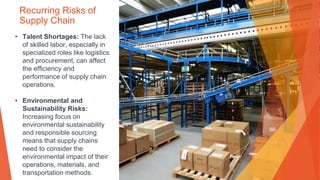
  • 91.
    High Demand, Little DomesticSupply: The European Union ▶ The European Commission released the Critical Raw Materials for the EU report in 2010. ▶ The EU plans to update its list of critical raw materials every three years. ▶ On February 2, 2011, the Commission published the EU's new resource strategy, focusing on three pillars. ▶ The strategy emphasizes fair and sustainable supply, fostering resource production within the EU, and enhancing research and development. ▶ Innovation is the central theme of the strategy, and stockpiling of crucial materials like rare earths is being considered.
  • 92.
    High Demand, Little DomesticSupply: The European Union ▶ Stability of commodity derivatives, market regulation, integrity, and transparency are critical points in the European raw materials strategy. ▶ The global economic and financial crisis prompted a focus on these aspects. ▶ Commission President José Manuel Barroso emphasized the need to understand the synergy between resources and financial markets. ▶ France, as G8 and G20 president in 2011, pushed for curtailing financial market speculation. ▶ Environmental protection remains a core issue, with guidelines for regulating extraction in nature conservation areas introduced in 2010.
  • 93.
    High Demand, Little DomesticSupply: The European Union ▶ Resource diplomacy is a key element of the European resource strategy. ▶ The EU plans to form strategic partnerships with resource-rich countries, especially in Africa. ▶ These partnerships aim to promote fair access to raw materials and create win- win situations. ▶ Initiatives include cooperation with the African Union, support for governance projects, and funding geological surveys. ▶ Transparency initiatives like the Extractive Industries Transparency Initiative (EITI) are also part of the strategy.
  • 94.
    High Demand, Little DomesticSupply: Japan ▶ Japan, despite having some domestic mineral reserves, heavily relies on imports of metals and minerals. ▶ The country's manufacturing industry, including steel and automobiles, is particularly vulnerable to supply disruptions. ▶ Japan's steel industry, for example, relies almost entirely on imported iron ore. ▶ Supply shocks were highlighted when China temporarily halted rare earth exports to Japan in 2010 due to a territorial dispute. ▶ Geopolitical tensions can exacerbate Japan's resource supply vulnerabilities.
  • 95.
    High Demand, Little DomesticSupply: Japan ▶ Japan's Ministry of Economy, Trade and Industry (METI) introduced a strategy in 2009 to ensure a stable supply of rare metals. ▶ This strategy identified 31 metals, including rare earth elements, as rare and aimed to secure the industry's supply. ▶ The strategy involves three components: a focused, strategic approach to prioritize rare metals, four pillars for securing them (overseas resources, recycling, alternative materials, and stockpiling), and the development of common infrastructure. ▶ In 2010, METI and the foreign ministry introduced a "one-stop system" to secure industrial resources, emphasizing support for foreign mining companies and exploring new resource extraction opportunities. ▶ The strategy reflects Japan's efforts to address its vulnerability to rare metal supply disruptions.
  • 96.
    High Demand, Little DomesticSupply: Japan ▶ Unlike Germany and the EU, Japan's government is actively involved in the resource sector. ▶ The state-owned corporation JOGMEG manages national stockpiles of seven rare metal commodities and can release reserves if needed for economic stability. ▶ JOGMEG has additional responsibilities such as providing information, mineral exploration, mine development financing, and R&D for recycling and substitutes. ▶ Japanese companies are actively seeking alternatives to expensive rare earths, developing technologies like samarium-cobalt magnets and palladium substitutes. ▶ The Japanese government provides extensive support for these research projects to reduce dependence on rare earth elements.
  • 97.
    High Demand, Little DomesticSupply: Japan ▶ The Japanese government assists domestic companies in investing in mining projects and companies abroad. ▶ Examples include partnerships like Sojitz's stake in the Endako molybdenum mine in Canada and Sumitomo's joint venture in Kazakhstan. ▶ Support programs are facilitated through agencies like NEXI, the Japan Bank for International Cooperation, and JOGMEG. ▶ Japan also strengthens bilateral relationships with resource-producing countries through technical support, training, and infrastructure projects. ▶ Japan is exploring cooperation with other resource-dependent countries, including the U.S. and the EU, to address shared challenges related to critical elements.
  • 98.
    High Demand, Little DomesticSupply: Japan ▶ Japan plans to explore about 340,000 square kilometers of its Exclusive Economic Zone (EEZ) in the East China Sea and the Pacific Ocean for metals. ▶ The exploration targets huge deposits of high-tech metals and materials near Okinawa and the Izu Peninsula. ▶ JOGMEC is developing a remote-controlled robot to explore depths of up to 2,000 meters. ▶ It may take over 10 years for the technology to be market-ready. ▶ Ongoing disputes with China over resource ownership in the East China Sea and the Senkaku/Diaoyu Islands pose potential challenges.
  • 99.
    Resource-Rich Countries: The UnitedStates ▶ The U.S. has significant domestic metal and mineral production, but it is still highly dependent on imports for many critical metals. ▶ Indium, gallium, and germanium are among the metals where the U.S. relies heavily on imports. ▶ Rare earth elements, which are vital for various technologies, are primarily imported from China, making the U.S. vulnerable to supply disruptions. ▶ Low world market prices and strict environmental regulations in the 1990s led to reduced mining of certain metals in the U.S. ▶ The U.S. has a history of legislative efforts to address resource security, including the Strategic Materials Act and the Defense Production Act.
  • 100.
    Resource-Rich Countries: The UnitedStates ▶ Increased demand for metals like lithium and rare earths is expected due to President Obama's renewable energy plans. ▶ Rare earths are crucial for both renewable energy technologies and the defense industry in the U.S. ▶ The Government Accountability Office (GAO) highlighted the importance of rare earths in various defense systems. ▶ The Department of Energy (DOE) published the Critical Materials Strategy with three pillars: diversified supply chains, development of substitutes, and recycling. ▶ The strategy aims to facilitate domestic extraction, encourage research on substitutes, and promote efficient use and recycling of critical minerals.
  • 101.
    Resource-Rich Countries: The United States ▶Research and development are central to the U.S. strategy, with $15 million allocated for rare earth research and magnet substitutes. ▶ An additional $35 million was invested in developing batteries that don't rely on rare earth metals. ▶ The DOE seeks to diversify supply sources, with a focus on increasing domestic reserve exploitation. ▶ Efforts are underway to reduce permitting delays and barriers to domestic mineral projects. ▶ The U.S. aims to collaborate with other import-dependent countries to collectively address market distortions caused by China.
  • 102.
    Resource-Rich Countries: The UnitedStates ▶ U.S. Congress has considered numerous legislative proposals addressing supply security of metals and minerals. ▶ The Rare Earths and Critical Materials Revitalization Act of 2010 aimed to facilitate exploration and exploitation but wasn't voted on before the midterm elections. ▶ In early 2011, multiple new proposals were introduced in both the House and Senate. ▶ These proposals included acts like the RARE Act of 2011, focusing on global rare earth element assessment. ▶ The Critical Minerals Policy Act of 2011 aimed to revitalize the critical minerals supply chain and ensure the U.S. can meet its mineral needs.
  • 103.
    Resource-Rich Countries: The United States ▶The U.S. has an interest in seabed resources, similar to its offshore oil and gas production. ▶ Mineral exploration around Pacific islands is ongoing, but the potential within the U.S.'s Exclusive Economic Zone (EEZ) lacks reliable estimates. ▶ The U.S. has not ratified UNCLOS (United Nations Convention on the Law of the Sea). ▶ This non-ratification limits the U.S. from claiming an expanded continental shelf or licenses for exploration/mining in the High Seas seabed area. ▶ Legal aspects and jurisdiction related to seabed resource exploration are complex.
  • 104.
    Resource-Rich Countries: Canada ▶ Miningis a significant sector of Canada's economy, contributing 2.7% to the GDP, employing over 300,000 people, and making up 18.5% of exports in 2009. ▶ Canada ranks highly in global mineral production, including aluminum, cobalt, gem diamonds, refined indium, nickel, platinum-group metals, sodium sulfate, and zinc. ▶ The country is heavily export-oriented, with metals and minerals being sent to nearly 200 countries, with the U.S., EU, China, and Japan as key destinations. ▶ Canada's mineral industry benefits from rising global demand and increasing mineral and metal prices. ▶ Canada leads in global exploration expenditure, accounting for 16% of total spending in 2009. The Fraser Institute assesses countries' mining policies for attractiveness.
  • 105.
    Resource-Rich Countries: Canada ▶ Canadapublished a strategic document in 1998 emphasizing the need for a value- added mineral and metal strategy. ▶ The government focuses on improving market transparency and harmonizing federal and provincial mining rules. ▶ Canada stockpiles several metals to secure supplies, including copper, gold, lead, molybdenum, nickel, silver, and zinc. ▶ Environmental protection and sustainability are important aspects of Canada's mining strategy. ▶ Canada invests in geo-mapping programs, including the Geo-mapping for Energy and Minerals (GEM) program, and explores seabed resources through companies like Nautilus Minerals.
  • 106.
    Resource-Rich Countries: China ▶ Chinais a major global producer of various metals and minerals, including rare earths, accounting for 95% of global production. ▶ It's also a significant exporter of these elements and minerals. ▶ China's minerals sector represented about 22.6% of its total trade in 2009. ▶ Despite its production capacity, China faces shortages in some metals due to its high domestic demand. ▶ China's strong economic growth in recent years has been driven by infrastructure investments and stimulus packages, increasing its demand for metals and raising prices.
  • 107.
    Resource-Rich Countries: China ▶ Chinalacks an official resource strategy document, but resource-related topics are addressed in its Five-Year Plans. ▶ The twelfth Five-Year Plan (2011-2015) focuses on energy, climate, and heavy metal pollution prevention. ▶ Environmental reforms in this plan could impact the mining industry and promote environmental friendliness in China's industries. ▶ The Ministry of Land and Resources (MLR) and the Ministry of Industry and Information Technology (MIIT) are involved in developing production plans and setting production quotas for strategic commodities. ▶ Overall, while not explicitly outlined in a central strategy, resource issues are considered within China's economic development plans and ministries' activities.
  • 108.
    Resource-Rich Countries: China ▶ Chinadeclared rare earths a strategic mineral in 1990, imposing restrictions on foreign investment in this sector. ▶ The government gradually reduced rare- earth export quotas over the years, limiting the number of domestic and Sino-foreign producers allowed to export. ▶ Export quotas were further reduced in 2008 and 2009, and export rebates were eliminated in 2005 to discourage exports. ▶ China's competitive advantage in low labor costs and environmental standards has made it challenging for other parts of the world to compete in rare earth production. ▶ China also dominates secondary production and processing of rare earths, maintaining a strong position in the industry.
  • 109.
    Resource-Rich Countries: China ▶ Chinais imposing stricter limits on emissions associated with rare earth mineral production to address environmental issues. ▶ The Chinese Ministry for Environmental Protection plans to regulate emissions further. ▶ China announced a plan to promote the healthy development of its rare earth industry, including stricter mining policies and waste emission standards. ▶ Measures include curbing illegal mining and smuggling, implementing production controls, and phasing out inefficient, polluting companies. ▶ China has authorized the creation of a "strategic reserve" of rare earths to protect domestic resources, allowing state-owned enterprises to stockpile significant amounts.
  • 110.
    Resource-Rich Countries: China ▶ Chinaviews metals and minerals as strategic resources, not just economic commodities. ▶ China uses its control over these resources to exert influence, as exemplified by Deng Xiaoping's statement, "the Middle East has oil, China has rare earth." ▶ China's price discrimination and threats to halt deliveries impact global raw materials prices and create a divided market. ▶ China aims to shift production and economic returns in its favor through trade and industry policies. ▶ Countries dependent on China's rare earth exports, like the U.S., Japan, and South Korea, are considering mineral stockpiling to counter the shrinking share of Chinese minerals in world markets, and some are pursuing legal action at the WTO for more reliable Chinese exports.
  • 111.
    Resource-Rich Countries: China ▶ Chinaencourages its enterprises to invest abroad, particularly in countries like Australia, Brazil, Burma, Chile, Indonesia, and Mongolia. ▶ Chinese investments in Africa, especially in the mining industry, have significantly increased since 2000, totaling $9.3 billion in 2009. ▶ Chinese companies are more willing to invest in politically unstable countries, backed by state support and less concerned about risks like non-payment. ▶ Chinese investments overseas are less scrutinized at home, allowing them to be less strict about standards, worker safety, and environmental protections compared to Western competitors. ▶ China is also exploring marine resources and holds a license from the International Seabed Authority (ISA) for deep-sea exploration through the China Ocean Mineral Resources R&D Association (COMRA).
  • 112.
    Conclusion ▶ Rare earths,platinum group metals, indium, niobium, lithium, germanium, and terbium are identified as critical metals in various studies. ▶ Increased demand for critical metals is driven by developments in green and information technologies, creating a new market for formerly considered by- products. ▶ The two predominant risks in resource markets are price risks (fluctuations and uncertainties) and supply risks (geological and market concentration, political conflicts, environmental, and social concerns). ▶ Industrialized countries generally view supply security as an industry task, while governments focus on creating stable governing frameworks for resource markets. ▶ Resource strategies typically involve reducing dependence on critical metals, enhancing supply through various means, and improving market discipline through international organizations like the WTO and G20, with each country emphasizing different aspects based on its unique circumstances.