Developing a contingency plan and
avoiding shutdowns from a security
breach
Danie Schoeman
1 July 2015
A changing landscape
The road to globalisation – and greater
risk
World Economic Forum Study 2012, Insurance News; Deloitte 2012 Risk Management Report; BCI Supply Chain Resilience Survey 2011; Ruud Bosman (2006)
- The New Supply Chain Challenge: Risk Management in a Global Economy, Factor Mutual Insurance
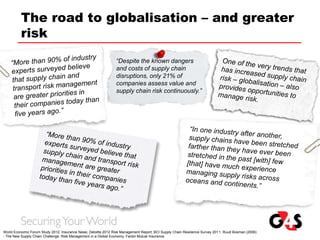
“Despite the known dangers
and costs of supply chain
disruptions, only 21% of
companies assess value and
supply chain risk continuously.”
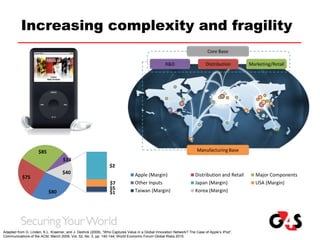
Increasing complexity and fragility
Adapted from G. Linden, K.L. Kraemer, and J. Dedrick (2009), “Who Captures Value in a Global Innovation Network? The Case of Apple’s iPod”,
Communications of the ACM, March 2009, Vol. 52, No. 3, pp. 140-144; World Economic Forum Global Risks 2015.
$80
$75
$85
$19
$27
$7
$5
$1
$40
$80
$75
$85
$19
$27
$7
$5
$1
$40
Apple (Margin) Distribution and Retail Major Components
Other Inputs Japan (Margin) USA (Margin)
Taiwan (Margin) Korea (Margin)
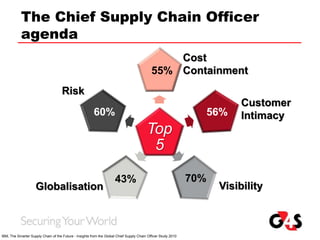
The Chief Supply Chain Officer
agenda
Top
5
Cost
Containment
Customer
Intimacy
VisibilityGlobalisation
Risk
55%
56%
70%43%
60%
IBM, The Smarter Supply Chain of the Future - Insights from the Global Chief Supply Chain Officer Study 2010
Full of risk
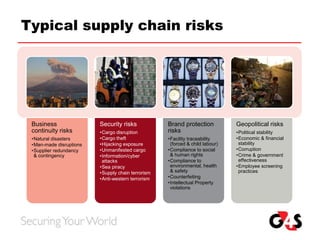
Typical supply chain risks
Business
continuity risks
•Natural disasters
•Man-made disruptions
•Supplier redundancy
& contingency
Security risks
•Cargo disruption
•Cargo theft
•Hijacking exposure
•Unmanifested cargo
•Information/cyber
attacks
•Sea piracy
•Supply chain terrorism
•Anti-western terrorism
Brand protection
risks
•Facility traceability
(forced & child labour)
•Compliance to social
& human rights
•Compliance to
environmental, health
& safety
•Counterfeiting
•Intellectual Property
violations
Geopolitical risks
•Political stability
•Economic & financial
stability
•Corruption
•Crime & government
effectiveness
•Employee screening
practices
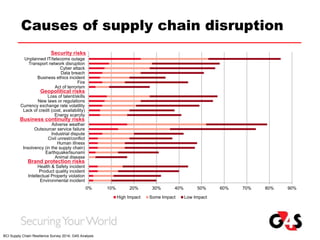
Causes of supply chain disruption
0% 10% 20% 30% 40% 50% 60% 70% 80% 90%
Environmental incident
Intellectual Property violation
Product quality incident
Health & Safety incident
Animal disease
Earthquake/tsunami
Insolvency (in the supply chain)
Human illness
Civil unrest/conflict
Industrial dispute
Outsourcer service failure
Adverse weather
Energy scarcity
Lack of credit (cost, availability)
Currency exchange rate volatility
New laws or regulations
Loss of talent/skills
Act of terrorism
Fire
Business ethics incident
Data breach
Cyber attack
Transport network disruption
Unplanned IT/telecoms outage
High Impact Some Impact Low Impact
Security risks
Business continuity risks
Brand protection risks
Geopolitical risks
BCI Supply Chain Resilience Survey 2014; G4S Analysis
Identifying security breaches
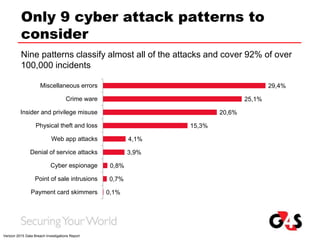
Only 9 cyber attack patterns to
consider
Nine patterns classify almost all of the attacks and cover 92% of over
100,000 incidents
0,1%
0,7%
0,8%
3,9%
4,1%
15,3%
20,6%
25,1%
29,4%
Payment card skimmers
Point of sale intrusions
Cyber espionage
Denial of service attacks
Web app attacks
Physical theft and loss
Insider and privilege misuse
Crime ware
Miscellaneous errors
Verizon 2015 Data Breach Investigations Report
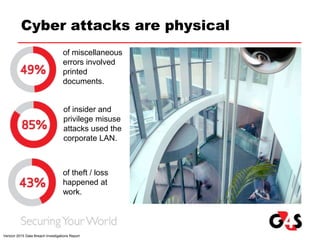
Cyber attacks are physical
of insider and
privilege misuse
attacks used the
corporate LAN.
of theft / loss
happened at
work.
of miscellaneous
errors involved
printed
documents.
Verizon 2015 Data Breach Investigations Report
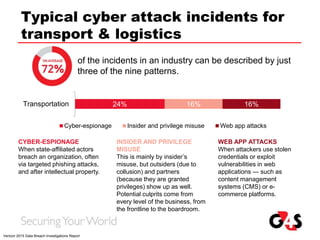
Typical cyber attack incidents for
transport & logistics
24% 16% 16%Transportation
Cyber-espionage Insider and privilege misuse Web app attacks
of the incidents in an industry can be described by just
three of the nine patterns.
WEB APP ATTACKS
When attackers use stolen
credentials or exploit
vulnerabilities in web
applications — such as
content management
systems (CMS) or e-
commerce platforms.
INSIDER AND PRIVILEGE
MISUSE
This is mainly by insider’s
misuse, but outsiders (due to
collusion) and partners
(because they are granted
privileges) show up as well.
Potential culprits come from
every level of the business, from
the frontline to the boardroom.
CYBER-ESPIONAGE
When state-affiliated actors
breach an organization, often
via targeted phishing attacks,
and after intellectual property.
Verizon 2015 Data Breach Investigations Report
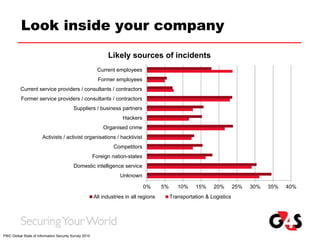
Look inside your company
0% 5% 10% 15% 20% 25% 30% 35% 40%
Unknown
Domestic intelligence service
Foreign nation-states
Competitors
Activists / activist organisations / hacktivist
Organised crime
Hackers
Suppliers / business partners
Former service providers / consultants / contractors
Current service providers / consultants / contractors
Former employees
Current employees
Likely sources of incidents
All industries in all regions Transportation & Logistics
PWC Global State of Information Security Survey 2015
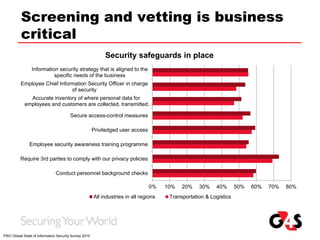
Screening and vetting is business
critical
0% 10% 20% 30% 40% 50% 60% 70% 80%
Conduct personnel background checks
Require 3rd parties to comply with our privacy policies
Employee security awareness training programme
Priviledged user access
Secure access-control measures
Accurate inventory of where personal data for
employees and customers are collected, transmitted…
Employee Chief Information Security Officer in charge
of security
Information security strategy that is aligned to the
specific needs of the business
Security safeguards in place
All industries in all regions Transportation & Logistics
PWC Global State of Information Security Survey 2015
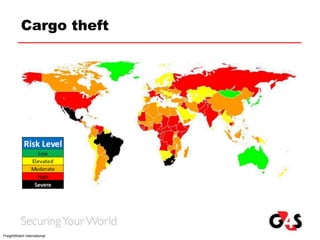
Cargo theft
FreightWatch International
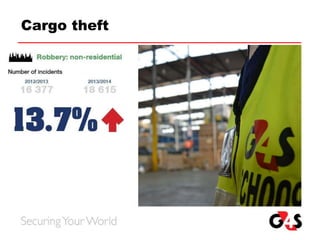
Cargo theft
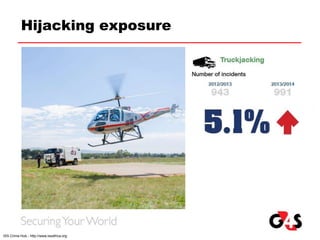
Hijacking exposure
ISS Crime Hub - http://www.issafrica.org
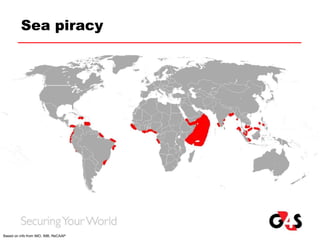
Sea piracy
Based on info from IMO, IMB, ReCAAP
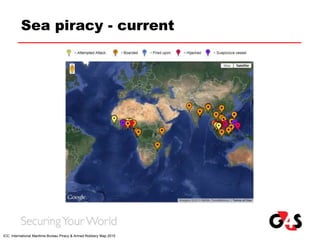
Sea piracy - current
ICC: International Maritime Bureau Piracy & Armed Robbery Map 2015
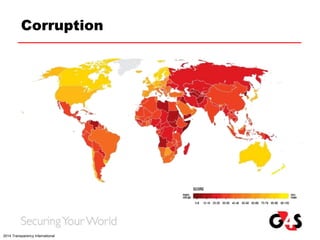
Corruption
2014 Transparency International
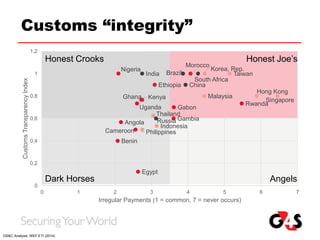
Customs “integrity”
Brazil
Russia
India
China
South Africa
Morocco
Rwanda
Nigeria
Gabon
Ghana
Ethiopia
Benin
Angola
Uganda
Cameroon
Gambia
Kenya
Egypt
Hong Kong
Indonesia
Korea, Rep.
Malaysia
Philippines
Singapore
Taiwan
Thailand
0
0,2
0,4
0,6
0,8
1
1,2
0 1 2 3 4 5 6 7
CustomsTransparencyIndex
Irregular Payments (1 = common, 7 = never occurs)
Honest Joe’sHonest Crooks
AngelsDark Horses
DS&C Analysis, WEF ETI (2014)
Consequences of security breach
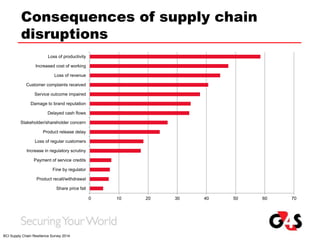
Consequences of supply chain
disruptions
0 10 20 30 40 50 60 70
Share price fall
Product recall/withdrawal
Fine by regulator
Payment of service credits
Increase in regulatory scrutiny
Loss of regular customers
Product release delay
Stakeholder/shareholder concern
Delayed cash flows
Damage to brand reputation
Service outcome impaired
Customer complaints received
Loss of revenue
Increased cost of working
Loss of productivity
BCI Supply Chain Resilience Survey 2014
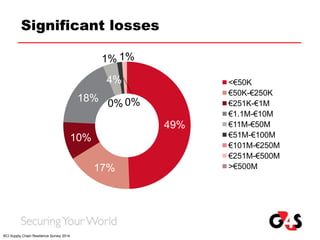
Significant losses
49%
17%
10%
18%
4%
1%
0%
1%
0%
<€50K
€50K-€250K
€251K-€1M
€1.1M-€10M
€11M-€50M
€51M-€100M
€101M-€250M
€251M-€500M
>€500M
BCI Supply Chain Resilience Survey 2014
Making a plan
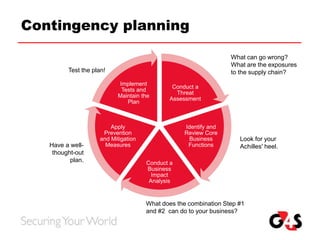
Contingency planning
Conduct a
Threat
Assessment
Identify and
Review Core
Business
Functions
Conduct a
Business
Impact
Analysis
Apply
Prevention
and Mitigation
Measures
Implement
Tests and
Maintain the
Plan
What can go wrong?
What are the exposures
to the supply chain?
Look for your
Achilles' heel.Have a well-
thought-out
plan.
Test the plan!
What does the combination Step #1
and #2 can do to your business?
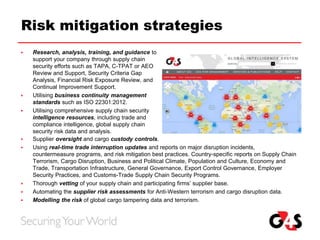
Risk mitigation strategies
 Research, analysis, training, and guidance to
support your company through supply chain
security efforts such as TAPA, C-TPAT or AEO
Review and Support, Security Criteria Gap
Analysis, Financial Risk Exposure Review, and
Continual Improvement Support.
 Utilising business continuity management
standards such as ISO 22301:2012.
 Utilising comprehensive supply chain security
intelligence resources, including trade and
compliance intelligence, global supply chain
security risk data and analysis.
 Supplier oversight and cargo custody controls.
 Using real-time trade interruption updates and reports on major disruption incidents,
countermeasure programs, and risk mitigation best practices. Country-specific reports on Supply Chain
Terrorism, Cargo Disruption, Business and Political Climate, Population and Culture, Economy and
Trade, Transportation Infrastructure, General Governance, Export Control Governance, Employer
Security Practices, and Customs-Trade Supply Chain Security Programs.
 Thorough vetting of your supply chain and participating firms’ supplier base.
 Automating the supplier risk assessments for Anti-Western terrorism and cargo disruption data.
 Modelling the risk of global cargo tampering data and terrorism.
The payoff
Benefits to you
 Effectively protect and manage your supply chains
with the ability to productively respond to stresses
 Decreased losses and lower associated production
costs
 Improved business continuity via a more robust,
resilient, and responsive supply chain
 Greater end-to-end transparency for improved
process management and efficiency
 Competitive advantages over industry rivals when
supply chain risks arise
 Brand Protection
Thank you

Transport Security 201507 lin

  • 1.
    Developing a contingencyplan and avoiding shutdowns from a security breach Danie Schoeman 1 July 2015
  • 2.
  • 3.
    The road toglobalisation – and greater risk World Economic Forum Study 2012, Insurance News; Deloitte 2012 Risk Management Report; BCI Supply Chain Resilience Survey 2011; Ruud Bosman (2006) - The New Supply Chain Challenge: Risk Management in a Global Economy, Factor Mutual Insurance “Despite the known dangers and costs of supply chain disruptions, only 21% of companies assess value and supply chain risk continuously.”
  • 4.
    Increasing complexity andfragility Adapted from G. Linden, K.L. Kraemer, and J. Dedrick (2009), “Who Captures Value in a Global Innovation Network? The Case of Apple’s iPod”, Communications of the ACM, March 2009, Vol. 52, No. 3, pp. 140-144; World Economic Forum Global Risks 2015. $80 $75 $85 $19 $27 $7 $5 $1 $40 $80 $75 $85 $19 $27 $7 $5 $1 $40 Apple (Margin) Distribution and Retail Major Components Other Inputs Japan (Margin) USA (Margin) Taiwan (Margin) Korea (Margin)
  • 5.
    The Chief SupplyChain Officer agenda Top 5 Cost Containment Customer Intimacy VisibilityGlobalisation Risk 55% 56% 70%43% 60% IBM, The Smarter Supply Chain of the Future - Insights from the Global Chief Supply Chain Officer Study 2010
  • 6.
  • 7.
    Typical supply chainrisks Business continuity risks •Natural disasters •Man-made disruptions •Supplier redundancy & contingency Security risks •Cargo disruption •Cargo theft •Hijacking exposure •Unmanifested cargo •Information/cyber attacks •Sea piracy •Supply chain terrorism •Anti-western terrorism Brand protection risks •Facility traceability (forced & child labour) •Compliance to social & human rights •Compliance to environmental, health & safety •Counterfeiting •Intellectual Property violations Geopolitical risks •Political stability •Economic & financial stability •Corruption •Crime & government effectiveness •Employee screening practices
  • 8.
    Causes of supplychain disruption 0% 10% 20% 30% 40% 50% 60% 70% 80% 90% Environmental incident Intellectual Property violation Product quality incident Health & Safety incident Animal disease Earthquake/tsunami Insolvency (in the supply chain) Human illness Civil unrest/conflict Industrial dispute Outsourcer service failure Adverse weather Energy scarcity Lack of credit (cost, availability) Currency exchange rate volatility New laws or regulations Loss of talent/skills Act of terrorism Fire Business ethics incident Data breach Cyber attack Transport network disruption Unplanned IT/telecoms outage High Impact Some Impact Low Impact Security risks Business continuity risks Brand protection risks Geopolitical risks BCI Supply Chain Resilience Survey 2014; G4S Analysis
  • 9.
  • 10.
    Only 9 cyberattack patterns to consider Nine patterns classify almost all of the attacks and cover 92% of over 100,000 incidents 0,1% 0,7% 0,8% 3,9% 4,1% 15,3% 20,6% 25,1% 29,4% Payment card skimmers Point of sale intrusions Cyber espionage Denial of service attacks Web app attacks Physical theft and loss Insider and privilege misuse Crime ware Miscellaneous errors Verizon 2015 Data Breach Investigations Report
  • 11.
    Cyber attacks arephysical of insider and privilege misuse attacks used the corporate LAN. of theft / loss happened at work. of miscellaneous errors involved printed documents. Verizon 2015 Data Breach Investigations Report
  • 12.
    Typical cyber attackincidents for transport & logistics 24% 16% 16%Transportation Cyber-espionage Insider and privilege misuse Web app attacks of the incidents in an industry can be described by just three of the nine patterns. WEB APP ATTACKS When attackers use stolen credentials or exploit vulnerabilities in web applications — such as content management systems (CMS) or e- commerce platforms. INSIDER AND PRIVILEGE MISUSE This is mainly by insider’s misuse, but outsiders (due to collusion) and partners (because they are granted privileges) show up as well. Potential culprits come from every level of the business, from the frontline to the boardroom. CYBER-ESPIONAGE When state-affiliated actors breach an organization, often via targeted phishing attacks, and after intellectual property. Verizon 2015 Data Breach Investigations Report
  • 13.
    Look inside yourcompany 0% 5% 10% 15% 20% 25% 30% 35% 40% Unknown Domestic intelligence service Foreign nation-states Competitors Activists / activist organisations / hacktivist Organised crime Hackers Suppliers / business partners Former service providers / consultants / contractors Current service providers / consultants / contractors Former employees Current employees Likely sources of incidents All industries in all regions Transportation & Logistics PWC Global State of Information Security Survey 2015
  • 14.
    Screening and vettingis business critical 0% 10% 20% 30% 40% 50% 60% 70% 80% Conduct personnel background checks Require 3rd parties to comply with our privacy policies Employee security awareness training programme Priviledged user access Secure access-control measures Accurate inventory of where personal data for employees and customers are collected, transmitted… Employee Chief Information Security Officer in charge of security Information security strategy that is aligned to the specific needs of the business Security safeguards in place All industries in all regions Transportation & Logistics PWC Global State of Information Security Survey 2015
  • 15.
  • 16.
  • 17.
    Hijacking exposure ISS CrimeHub - http://www.issafrica.org
  • 18.
    Sea piracy Based oninfo from IMO, IMB, ReCAAP
  • 19.
    Sea piracy -current ICC: International Maritime Bureau Piracy & Armed Robbery Map 2015
  • 20.
  • 21.
    Customs “integrity” Brazil Russia India China South Africa Morocco Rwanda Nigeria Gabon Ghana Ethiopia Benin Angola Uganda Cameroon Gambia Kenya Egypt HongKong Indonesia Korea, Rep. Malaysia Philippines Singapore Taiwan Thailand 0 0,2 0,4 0,6 0,8 1 1,2 0 1 2 3 4 5 6 7 CustomsTransparencyIndex Irregular Payments (1 = common, 7 = never occurs) Honest Joe’sHonest Crooks AngelsDark Horses DS&C Analysis, WEF ETI (2014)
  • 22.
  • 23.
    Consequences of supplychain disruptions 0 10 20 30 40 50 60 70 Share price fall Product recall/withdrawal Fine by regulator Payment of service credits Increase in regulatory scrutiny Loss of regular customers Product release delay Stakeholder/shareholder concern Delayed cash flows Damage to brand reputation Service outcome impaired Customer complaints received Loss of revenue Increased cost of working Loss of productivity BCI Supply Chain Resilience Survey 2014
  • 24.
  • 25.
  • 26.
    Contingency planning Conduct a Threat Assessment Identifyand Review Core Business Functions Conduct a Business Impact Analysis Apply Prevention and Mitigation Measures Implement Tests and Maintain the Plan What can go wrong? What are the exposures to the supply chain? Look for your Achilles' heel.Have a well- thought-out plan. Test the plan! What does the combination Step #1 and #2 can do to your business?
  • 27.
    Risk mitigation strategies Research, analysis, training, and guidance to support your company through supply chain security efforts such as TAPA, C-TPAT or AEO Review and Support, Security Criteria Gap Analysis, Financial Risk Exposure Review, and Continual Improvement Support.  Utilising business continuity management standards such as ISO 22301:2012.  Utilising comprehensive supply chain security intelligence resources, including trade and compliance intelligence, global supply chain security risk data and analysis.  Supplier oversight and cargo custody controls.  Using real-time trade interruption updates and reports on major disruption incidents, countermeasure programs, and risk mitigation best practices. Country-specific reports on Supply Chain Terrorism, Cargo Disruption, Business and Political Climate, Population and Culture, Economy and Trade, Transportation Infrastructure, General Governance, Export Control Governance, Employer Security Practices, and Customs-Trade Supply Chain Security Programs.  Thorough vetting of your supply chain and participating firms’ supplier base.  Automating the supplier risk assessments for Anti-Western terrorism and cargo disruption data.  Modelling the risk of global cargo tampering data and terrorism.
  • 28.
  • 29.
    Benefits to you Effectively protect and manage your supply chains with the ability to productively respond to stresses  Decreased losses and lower associated production costs  Improved business continuity via a more robust, resilient, and responsive supply chain  Greater end-to-end transparency for improved process management and efficiency  Competitive advantages over industry rivals when supply chain risks arise  Brand Protection
  • 30.