
www.oradba.ch@stefanoehrli
Security Best Practice
Oracle passwords, but secure!
Stefan Oehrli
Stefan Oehrli
Platform Architect, Trainer and Partner at Trivadis
• Since 1997 active in various IT areas
• Since 2008 with Trivadis AG
• More than 20 years of experience in Oracle databases
Focus: Protecting data and operating databases securely
• Security assessments and reviews
• Database security concepts and their implementation
• Oracle Backup & Recovery concepts and troubleshooting
• Oracle Enterprise User Security, Advanced Security, Database Vault, …
• Oracle Directory Services
Co-author of the book The Oracle DBA (Hanser, 2016/07)
@stefanoehrli www.oradba.ch
01.12.20 UKOUG - Oracle passwords, but secure!3
Agenda
• Introduction
• Oracle Password Hashes
• Oracle Logon Process
• Challenges
• Password Complexity
• Good Practice
• Conclusion
01.12.20 UKOUG - Oracle passwords, but secure!6
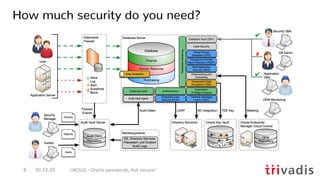
How much security do you need?
01.12.20 UKOUG - Oracle passwords, but secure!8
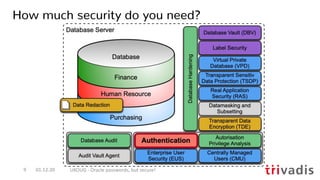
How much security do you need?
01.12.20 UKOUG - Oracle passwords, but secure!9
01.12.20 UKOUG - Oracle passwords, but secure!10
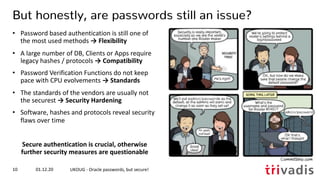
But honestly, are passwords still an issue?
• Password based authentication is still one of
the most used methods → Flexibility
• A large number of DB, Clients or Apps require
legacy hashes / protocols → Compatibility
• Password Verification Functions do not keep
pace with CPU evolvements → Standards
• The standards of the vendors are usually not
the securest → Security Hardening
• Software, hashes and protocols reveal security
flaws over time
Secure authentication is crucial, otherwise
further security measures are questionable
Agenda
• Introduction
• Oracle Password Hashes
• Oracle Logon Process
• Challenges
• Password Complexity
• Good Practice
• Conclusion
01.12.20 UKOUG - Oracle passwords, but secure!11
01.12.20 UKOUG - Oracle passwords, but secure!12
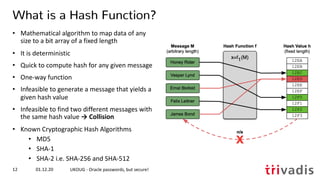
What is a Hash Function?
• Mathematical algorithm to map data of any
size to a bit array of a fixed length
• It is deterministic
• Quick to compute hash for any given message
• One-way function
• Infeasible to generate a message that yields a
given hash value
• Infeasible to find two different messages with
the same hash value → Collision
• Known Cryptographic Hash Algorithms
• MD5
• SHA-1
• SHA-2 i.e. SHA-256 and SHA-512
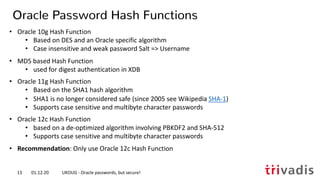
• Oracle 10g Hash Function
• Based on DES and an Oracle specific algorithm
• Case insensitive and weak password Salt => Username
• MD5 based Hash Function
• used for digest authentication in XDB
• Oracle 11g Hash Function
• Based on the SHA1 hash algorithm
• SHA1 is no longer considered safe (since 2005 see Wikipedia SHA-1)
• Supports case sensitive and multibyte character passwords
• Oracle 12c Hash Function
• based on a de-optimized algorithm involving PBKDF2 and SHA-512
• Supports case sensitive and multibyte character passwords
• Recommendation: Only use Oracle 12c Hash Function
Oracle Password Hash Functions
01.12.20 UKOUG - Oracle passwords, but secure!13
CREATE USER syste IDENTIFIED BY mmanager;
User created.
ALTER USER system IDENTIFIED BY manager;
User altered.
SELECT name, password FROM sys.user$ WHERE name LIKE 'SYSTE%';
USERNAME PASSWORD
------------------------------ ------------------------------
SYSTEM D4DF7931AB130E37
SYSTE D4DF7931AB130E37
01.12.20 UKOUG - Oracle passwords, but secure!14
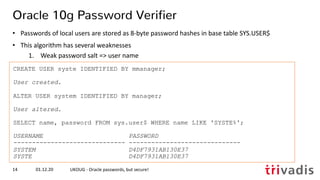
Oracle 10g Password Verifier
• Passwords of local users are stored as 8-byte password hashes in base table SYS.USER$
• This algorithm has several weaknesses
1. Weak password salt => user name
ALTER USER system IDENTIFIED BY ManAger;
User altered.
SELECT name, password FROM sys.user$ WHERE name LIKE 'SYSTEM';
USERNAME PASSWORD
------------------------------ ------------------------------
SYSTEM D4DF7931AB130E37
01.12.20 UKOUG - Oracle passwords, but secure!15
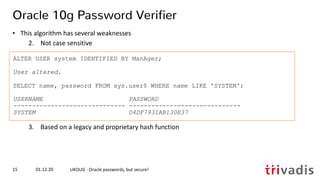
Oracle 10g Password Verifier
• This algorithm has several weaknesses
2. Not case sensitive
3. Based on a legacy and proprietary hash function
01.12.20 UKOUG - Oracle passwords, but secure!16
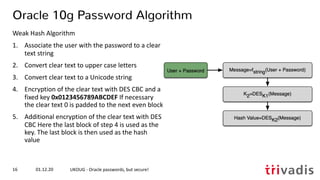
Oracle 10g Password Algorithm
Weak Hash Algorithm
1. Associate the user with the password to a clear
text string
2. Convert clear text to upper case letters
3. Convert clear text to a Unicode string
4. Encryption of the clear text with DES CBC and a
fixed key 0x0123456789ABCDEF If necessary
the clear text 0 is padded to the next even block
5. Additional encryption of the clear text with DES
CBC Here the last block of step 4 is used as the
key. The last block is then used as the hash
value
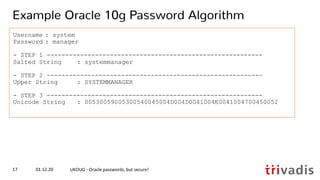
Username : system
Password : manager
- STEP 1 ----------------------------------------------------------
Salted String : systemmanager
- STEP 2 ----------------------------------------------------------
Upper String : SYSTEMMANAGER
- STEP 3 ----------------------------------------------------------
Unicode String : 00530059005300540045004D004D0041004E0041004700450052
01.12.20 UKOUG - Oracle passwords, but secure!17
Example Oracle 10g Password Algorithm
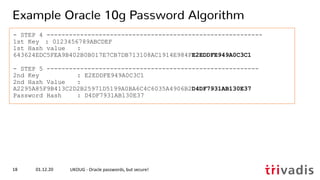
- STEP 4 ----------------------------------------------------------
1st Key : 0123456789ABCDEF
1st Hash value :
643624EDC5FEA9B402B0B017E7CB7DB713108AC1914E984FE2EDDFE949A0C3C1
- STEP 5 ---------------------------------------------------------
2nd Key : E2EDDFE949A0C3C1
2nd Hash Value :
A2295A85F9B413C2D2B25971D5199A0BA6C4C6035A4906B2D4DF7931AB130E37
Password Hash : D4DF7931AB130E37
01.12.20 UKOUG - Oracle passwords, but secure!18
Example Oracle 10g Password Algorithm
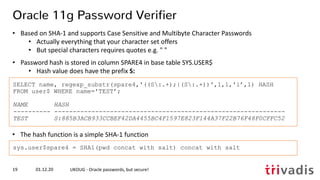
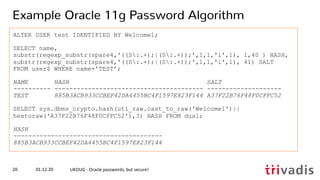
SELECT name, regexp_substr(spare4,'((S:.+);|(S:.+))',1,1,'i’,1) HASH
FROM user$ WHERE name='TEST’;
NAME HASH
---------- --------------------------------------------------------------
TEST S:885B3ACB933CCBEF42DA4455BC4F1597E823F144A37F22B76F48F0CFFC52
Oracle 11g Password Verifier
• Based on SHA-1 and supports Case Sensitive and Multibyte Character Passwords
• Actually everything that your character set offers
• But special characters requires quotes e.g. " "
• Password hash is stored in column SPARE4 in base table SYS.USER$
• Hash value does have the prefix S:
sys.user$spare4 = SHA1(pwd concat with salt) concat with salt
• The hash function is a simple SHA-1 function
01.12.20 UKOUG - Oracle passwords, but secure!19
ALTER USER test IDENTIFIED BY Welcome1;
SELECT name,
substr(regexp_substr(spare4,'((S:.+);|(S:.+));',1,1,'i',1), 1,40 ) HASH,
substr(regexp_substr(spare4,'((S:.+);|(S:.+));',1,1,'i',1), 41) SALT
FROM user$ WHERE name='TEST’;
NAME HASH SALT
---------- ---------------------------------------- --------------------
TEST 885B3ACB933CCBEF42DA4455BC4F1597E823F144 A37F22B76F48F0CFFC52
SELECT sys.dbms_crypto.hash(utl_raw.cast_to_raw('Welcome1')||
hextoraw('A37F22B76F48F0CFFC52'),3) HASH FROM dual;
HASH
----------------------------------------
885B3ACB933CCBEF42DA4455BC4F1597E823F144
01.12.20 UKOUG - Oracle passwords, but secure!20
Example Oracle 11g Password Algorithm
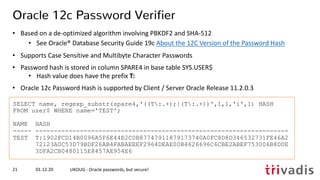
SELECT name, regexp_substr(spare4,'((T:.+);|(T:.+))',1,1,'i',1) HASH
FROM user$ WHERE name='TEST';
NAME HASH
----- --------------------------------------------------------------------
TEST T:1902FCD14B0096A5F6E44E2C0B87747911879173740A0FC8D8D346532731FE46A2
72123A0C53D79BDF26AB4FABAEEEF2964DEAE00B4626696C6CBE2ABEF753006B8D0E
3DFA2CB0480115E8457AE954E6
Oracle 12c Password Verifier
• Based on a de-optimized algorithm involving PBKDF2 and SHA-512
• See Oracle® Database Security Guide 19c About the 12C Version of the Password Hash
• Supports Case Sensitive and Multibyte Character Passwords
• Password hash is stored in column SPARE4 in base table SYS.USER$
• Hash value does have the prefix T:
• Oracle 12c Password Hash is supported by Client / Server Oracle Release 11.2.0.3
01.12.20 UKOUG - Oracle passwords, but secure!21
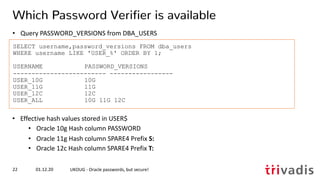
SELECT username,password_versions FROM dba_users
WHERE username LIKE 'USER_%' ORDER BY 1;
USERNAME PASSWORD_VERSIONS
------------------------- -----------------
USER_10G 10G
USER_11G 11G
USER_12C 12C
USER_ALL 10G 11G 12C
01.12.20 UKOUG - Oracle passwords, but secure!22
Which Password Verifier is available
• Query PASSWORD_VERSIONS from DBA_USERS
• Effective hash values stored in USER$
• Oracle 10g Hash column PASSWORD
• Oracle 11g Hash column SPARE4 Prefix S:
• Oracle 12c Hash column SPARE4 Prefix T:
Agenda
• Introduction
• Oracle Password Hashes
• Oracle Logon Process
• Challenges
• Password Complexity
• Good Practice
• Conclusion
01.12.20 UKOUG - Oracle passwords, but secure!23
01.12.20 UKOUG - Oracle passwords, but secure!24
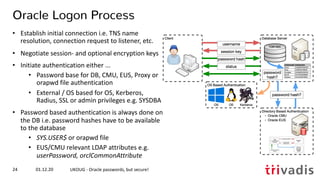
Oracle Logon Process
• Establish initial connection i.e. TNS name
resolution, connection request to listener, etc.
• Negotiate session- and optional encryption keys
• Initiate authentication either ...
• Password base for DB, CMU, EUS, Proxy or
orapwd file authentication
• External / OS based for OS, Kerberos,
Radius, SSL or admin privileges e.g. SYSDBA
• Password based authentication is always done on
the DB i.e. password hashes have to be available
to the database
• SYS.USER$ or orapwd file
• EUS/CMU relevant LDAP attributes e.g.
userPassword, orclCommonAttribute
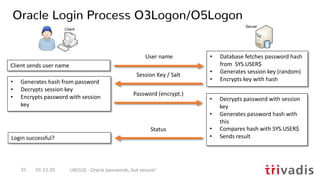
Oracle Login Process O3Logon/O5Logon
01.12.20 UKOUG - Oracle passwords, but secure!25
Client sends user name
• Database fetches password hash
from SYS.USER$
• Generates session key (random)
• Encrypts key with hash• Generates hash from password
• Decrypts session key
• Encrypts password with session
key
• Decrypts password with session
key
• Generates password hash with
this
• Compares hash with SYS.USER$
• Sends resultLogin successful?
User name
Status
Password (encrypt.)
Session Key / Salt
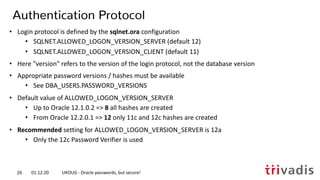
• Login protocol is defined by the sqlnet.ora configuration
• SQLNET.ALLOWED_LOGON_VERSION_SERVER (default 12)
• SQLNET.ALLOWED_LOGON_VERSION_CLIENT (default 11)
• Here "version" refers to the version of the login protocol, not the database version
• Appropriate password versions / hashes must be available
• See DBA_USERS.PASSWORD_VERSIONS
• Default value of ALLOWED_LOGON_VERSION_SERVER
• Up to Oracle 12.1.0.2 => 8 all hashes are created
• From Oracle 12.2.0.1 => 12 only 11c and 12c hashes are created
• Recommended setting for ALLOWED_LOGON_VERSION_SERVER is 12a
• Only the 12c Password Verifier is used
Authentication Protocol
01.12.20 UKOUG - Oracle passwords, but secure!26
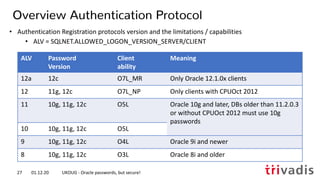
• Authentication Registration protocols version and the limitations / capabilities
• ALV = SQLNET.ALLOWED_LOGON_VERSION_SERVER/CLIENT
Overview Authentication Protocol
ALV Password
Version
Client
ability
Meaning
12a 12c O7L_MR Only Oracle 12.1.0x clients
12 11g, 12c O7L_NP Only clients with CPUOct 2012
11 10g, 11g, 12c O5L Oracle 10g and later, DBs older than 11.2.0.3
or without CPUOct 2012 must use 10g
passwords
10 10g, 11g, 12c O5L
9 10g, 11g, 12c O4L Oracle 9i and newer
8 10g, 11g, 12c O3L Oracle 8i and older
01.12.20 UKOUG - Oracle passwords, but secure!27
Agenda
• Introduction
• Oracle Password Hashes
• Oracle Logon Process
• Challenges
• Password Complexity
• Good Practice
• Conclusion
01.12.20 UKOUG - Oracle passwords, but secure!28
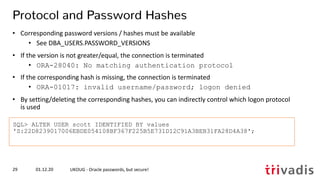
SQL> ALTER USER scott IDENTIFIED BY values
'S:22D8239017006EBDE054108BF367F225B5E731D12C91A3BEB31FA28D4A38';
01.12.20 UKOUG - Oracle passwords, but secure!29
Protocol and Password Hashes
• Corresponding password versions / hashes must be available
• See DBA_USERS.PASSWORD_VERSIONS
• If the version is not greater/equal, the connection is terminated
• ORA-28040: No matching authentication protocol
• If the corresponding hash is missing, the connection is terminated
• ORA-01017: invalid username/password; logon denied
• By setting/deleting the corresponding hashes, you can indirectly control which logon protocol
is used
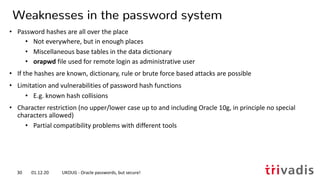
• Password hashes are all over the place
• Not everywhere, but in enough places
• Miscellaneous base tables in the data dictionary
• orapwd file used for remote login as administrative user
• If the hashes are known, dictionary, rule or brute force based attacks are possible
• Limitation and vulnerabilities of password hash functions
• E.g. known hash collisions
• Character restriction (no upper/lower case up to and including Oracle 10g, in principle no special
characters allowed)
• Partial compatibility problems with different tools
Weaknesses in the password system
01.12.20 UKOUG - Oracle passwords, but secure!30
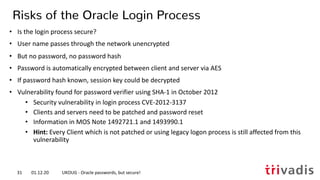
• Is the login process secure?
• User name passes through the network unencrypted
• But no password, no password hash
• Password is automatically encrypted between client and server via AES
• If password hash known, session key could be decrypted
• Vulnerability found for password verifier using SHA-1 in October 2012
• Security vulnerability in login process CVE-2012-3137
• Clients and servers need to be patched and password reset
• Information in MOS Note 1492721.1 and 1493990.1
• Hint: Every Client which is not patched or using legacy logon process is still affected from this
vulnerability
Risks of the Oracle Login Process
01.12.20 UKOUG - Oracle passwords, but secure!31
Configuration – ORA-01017 or ORA-28040
01.12.20 UKOUG - Oracle passwords, but secure!32
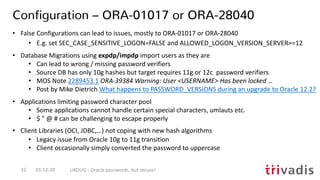
• False Configurations can lead to issues, mostly to ORA-01017 or ORA-28040
• E.g. set SEC_CASE_SENSITIVE_LOGON=FALSE and ALLOWED_LOGON_VERSION_SERVER>=12
• Database Migrations using expdp/impdp import users as they are
• Can lead to wrong / missing password verifiers
• Source DB has only 10g hashes but target requires 11g or 12c password verifiers
• MOS Note 2289453.1 ORA-39384 Warning: User <USERNAME> Has been locked …
• Post by Mike Dietrich What happens to PASSWORD_VERSIONS during an upgrade to Oracle 12.2?
• Applications limiting password character pool
• Some applications cannot handle certain special characters, umlauts etc.
• $ " @ # can be challenging to escape properly
• Client Libraries (OCI, JDBC,…) not coping with new hash algorithms
• Legacy issue from Oracle 10g to 11g transition
• Client occasionally simply converted the password to uppercase
Agenda
• Introduction
• Oracle Password Hashes
• Oracle Logon Process
• Challenges
• Password Complexity
• Good Practice
• Conclusion
01.12.20 UKOUG - Oracle passwords, but secure!33
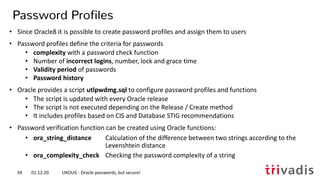
• Since Oracle8 it is possible to create password profiles and assign them to users
• Password profiles define the criteria for passwords
• complexity with a password check function
• Number of incorrect logins, number, lock and grace time
• Validity period of passwords
• Password history
• Oracle provides a script utlpwdmg.sql to configure password profiles and functions
• The script is updated with every Oracle release
• The script is not executed depending on the Release / Create method
• It includes profiles based on CIS and Database STIG recommendations
• Password verification function can be created using Oracle functions:
• ora_string_distance Calculation of the difference between two strings according to the
Levenshtein distance
• ora_complexity_check Checking the password complexity of a string
Password Profiles
01.12.20 UKOUG - Oracle passwords, but secure!34
01.12.20 UKOUG - Oracle passwords, but secure!35
Good idea to specify complexity rules?
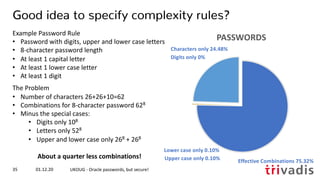
Example Password Rule
• Password with digits, upper and lower case letters
• 8-character password length
• At least 1 capital letter
• At least 1 lower case letter
• At least 1 digit
The Problem
• Number of characters 26+26+10=62
• Combinations for 8-character password 628
• Minus the special cases:
• Digits only 108
• Letters only 528
• Upper and lower case only 268 + 268
About a quarter less combinations!
Effective Combinations 75.32%
Digits only 0%
Upper case only 0.10%
Lower case only 0.10%
Characters only 24.48%
PASSWORDS
01.12.20 UKOUG - Oracle passwords, but secure!36
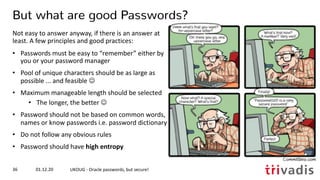
But what are good Passwords?
Not easy to answer anyway, if there is an answer at
least. A few principles and good practices:
• Passwords must be easy to “remember” either by
you or your password manager
• Pool of unique characters should be as large as
possible ... and feasible J
• Maximum manageable length should be selected
• The longer, the better J
• Password should not be based on common words,
names or know passwords i.e. password dictionary
• Do not follow any obvious rules
• Password should have high entropy
Password Entropy
01.12.20 UKOUG - Oracle passwords, but secure!37
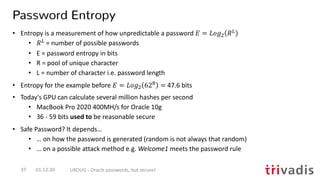
• Entropy is a measurement of how unpredictable a password ! = #$%! &"
• &"
= number of possible passwords
• E = password entropy in bits
• R = pool of unique character
• L = number of character i.e. password length
• Entropy for the example before ! = #$%! 62# = 47.6 bits
• Today's GPU can calculate several million hashes per second
• MacBook Pro 2020 400MH/s for Oracle 10g
• 36 - 59 bits used to be reasonable secure
• Safe Password? It depends…
• … on how the password is generated (random is not always that random)
• … on a possible attack method e.g. Welcome1 meets the password rule
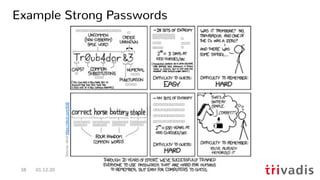
Example Strong Passwords
01.12.20 UKOUG - Oracle passwords, but secure!38
Source:xkcdhttps://xkcd.com/936
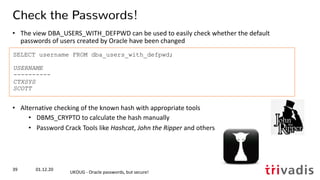
SELECT username FROM dba_users_with_defpwd;
USERNAME
----------
CTXSYS
SCOTT
Check the Passwords!
• The view DBA_USERS_WITH_DEFPWD can be used to easily check whether the default
passwords of users created by Oracle have been changed
• Alternative checking of the known hash with appropriate tools
• DBMS_CRYPTO to calculate the hash manually
• Password Crack Tools like Hashcat, John the Ripper and others
01.12.20
UKOUG - Oracle passwords, but secure!
39
Password Verification Using Tools
01.12.20 UKOUG - Oracle passwords, but secure!40
• Tools Hashcat and John the Ripper do support a wide range of known password hashes
• Including all hash functions used by Oracle e.g. 10g, 11g, 12c
• GPU power is a crucial factor when calculating hash values
• Tools do use CPU and GPU to calculate hashes where GPU
• Whereby GPU are faster by factors
• Different attack methods are possible:
• Dictionary based – testing passwords from wordlist e.g. 5-10 Mio
• Rule based – Extend wordlist by rules e.g. flip chars, add numbers etc.
• Brute force – Calculate every combination out of a character pool
• The tools are basically free and publicly available
• Relatively well documented and No darknet experience required J
• The use might be illegal depending on country and region
• Depends on the purpose of use
hashcat --benchmark --hash-type 3100 -D 1,2,3
hashcat (v6.1.1) starting in benchmark mode...
OpenCL API (OpenCL 1.2 (Oct 29 2020 19:50:08)) - Platform #1 [Apple]
====================================================================
* Device #1: Intel(R) Core(TM) i9-8950HK CPU @ 2.90GHz, 32704/32768 MB
* Device #2: Intel(R) UHD Graphics 630, 1472/1536 MB (384 MB allocatable), 24MCU
* Device #3: AMD Radeon Pro 560X Compute Engine, 4032/4096 MB (1024 MB allocatable), 16MCU
Hashmode: 3100 - Oracle H: Type (Oracle 7+)
Speed.#1.........: 11719.5 kH/s (66.85ms) @ Accel:128 Loops:512 Thr:1 Vec:4
Speed.#2.........: 4423.3 kH/s (85.02ms) @ Accel:128 Loops:16 Thr:8 Vec:1
Speed.#3.........: 117.8 MH/s (67.33ms) @ Accel:128 Loops:64 Thr:64 Vec:1
Speed.#*.........: 133.9 MH/s
01.12.20 UKOUG - Oracle passwords, but secure!41
What is possible – MacBook Pro 2018
• Simple Hashcat benchmark for the Oracle 7+ hashes i.e. 10g password verifier
hashcat --benchmark --hash-type 3100 -D 1,2,3
hashcat (v6.1.1) starting in benchmark mode...
OpenCL API (OpenCL 1.2 (Jun 8 2020 17:36:15)) - Platform #1 [Apple]
====================================================================
* Device #1: Intel(R) Core(TM) i9-9980HK CPU @ 2.40GHz, 65472/65536 MB
* Device #2: Intel(R) UHD Graphics 630, 1472/1536 MB (384 MB allocatable), 24MCU
* Device #3: AMD Radeon Pro 5500M Compute Engine, 8112/8176 MB (2044 MB allocatable), 24MCU
Hashmode: 3100 - Oracle H: Type (Oracle 7+)
Speed.#1.........: 8891.4 kH/s (58.73ms) @ Accel:32 Loops:1024 Thr:1 Vec:4
Speed.#2.........: 4653.3 kH/s (78.22ms) @ Accel:4 Loops:512 Thr:8 Vec:1
Speed.#3.........: 400.4 MH/s (61.61ms) @ Accel:256 Loops:64 Thr:64 Vec:1
Speed.#*.........: 414.0 MH/s
01.12.20 UKOUG - Oracle passwords, but secure!42
What is possible – MacBook Pro 2020
• Simple Hashcat benchmark for the Oracle 7+ hashes i.e. 10g password verifier
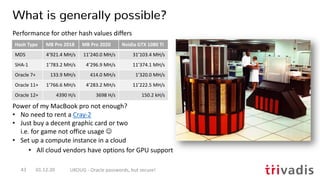
What is generally possible?
01.12.20 UKOUG - Oracle passwords, but secure!43
Performance for other hash values differs
Power of my MacBook pro not enough?
• No need to rent a Cray-2
• Just buy a decent graphic card or two
i.e. for game not office usage J
• Set up a compute instance in a cloud
• All cloud vendors have options for GPU support
Hash Type MB Pro 2018 MB Pro 2020 Nvidia GTX 1080 TI
MD5 4’921.4 MH/s 11’240.0 MH/s 31’103.4 MH/s
SHA-1 1’783.2 MH/s 4’296.9 MH/s 11’374.1 MH/s
Oracle 7+ 133.9 MH/s 414.0 MH/s 1’320.0 MH/s
Oracle 11+ 1’766.6 MH/s 4’283.2 MH/s 11’222.5 MH/s
Oracle 12+ 4390 H/s 3698 H/s 150.2 kH/s
Agenda
• Introduction
• Oracle Password Hashes
• Oracle Logon Process
• Challenges
• Password Complexity
• Good Practice
• Conclusion
01.12.20 UKOUG - Oracle passwords, but secure!44
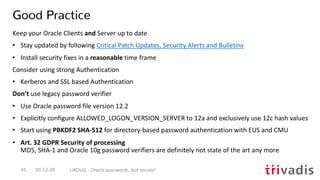
Good Practice
01.12.20 UKOUG - Oracle passwords, but secure!45
Keep your Oracle Clients and Server up to date
• Stay updated by following Critical Patch Updates, Security Alerts and Bulletins
• Install security fixes in a reasonable time frame
Consider using strong Authentication
• Kerberos and SSL based Authentication
Don’t use legacy password verifier
• Use Oracle password file version 12.2
• Explicitly configure ALLOWED_LOGON_VERSION_SERVER to 12a and exclusively use 12c hash values
• Start using PBKDF2 SHA-512 for directory-based password authentication with EUS and CMU
• Art. 32 GDPR Security of processing
MD5, SHA-1 and Oracle 10g password verifiers are definitely not state of the art any more
01.12.20 UKOUG - Oracle passwords, but secure!46
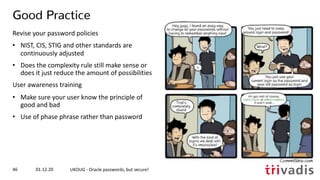
Good Practice
Revise your password policies
• NIST, CIS, STIG and other standards are
continuously adjusted
• Does the complexity rule still make sense or
does it just reduce the amount of possibilities
User awareness training
• Make sure your user know the principle of
good and bad
• Use of phase phrase rather than password
01.12.20 UKOUG - Oracle passwords, but secure!47
Good Practice
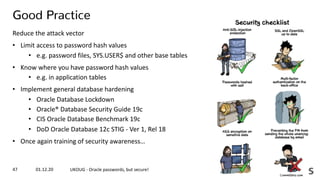
Reduce the attack vector
• Limit access to password hash values
• e.g. password files, SYS.USER$ and other base tables
• Know where you have password hash values
• e.g. in application tables
• Implement general database hardening
• Oracle Database Lockdown
• Oracle® Database Security Guide 19c
• CIS Oracle Database Benchmark 19c
• DoD Oracle Database 12c STIG - Ver 1, Rel 18
• Once again training of security awareness…
Agenda
• Introduction
• Oracle Password Hashes
• Oracle Logon Process
• Challanges
• Password Complexity
• Good Practice
• Conclusion
01.12.20 UKOUG - Oracle passwords, but secure!48
01.12.20 UKOUG - Oracle passwords, but secure!49
Conclusion
• There is no absolute security nor secure passwords
• Computing power evolves
• Revise your password rule
• Keep software up to date
• That means server and clients
• Don’t use legacy configuration
• 10g/11g hashes
• SEC_CASE_SENSITIVE_LOGON
• Consider using strong authentication
• Kerberos or SSL
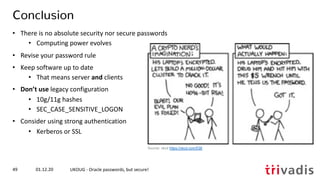
Source: xkcd https://xkcd.com/538
Security Best Practice: Oracle passwords, but secure!

Security Best Practice: Oracle passwords, but secure!

  • 1.
  • 2.
    Stefan Oehrli Platform Architect,Trainer and Partner at Trivadis • Since 1997 active in various IT areas • Since 2008 with Trivadis AG • More than 20 years of experience in Oracle databases Focus: Protecting data and operating databases securely • Security assessments and reviews • Database security concepts and their implementation • Oracle Backup & Recovery concepts and troubleshooting • Oracle Enterprise User Security, Advanced Security, Database Vault, … • Oracle Directory Services Co-author of the book The Oracle DBA (Hanser, 2016/07) @stefanoehrli www.oradba.ch
  • 3.
    01.12.20 UKOUG -Oracle passwords, but secure!3
  • 5.
    Agenda • Introduction • OraclePassword Hashes • Oracle Logon Process • Challenges • Password Complexity • Good Practice • Conclusion 01.12.20 UKOUG - Oracle passwords, but secure!6
  • 6.
    How much securitydo you need? 01.12.20 UKOUG - Oracle passwords, but secure!8
  • 7.
    How much securitydo you need? 01.12.20 UKOUG - Oracle passwords, but secure!9
  • 8.
    01.12.20 UKOUG -Oracle passwords, but secure!10 But honestly, are passwords still an issue? • Password based authentication is still one of the most used methods → Flexibility • A large number of DB, Clients or Apps require legacy hashes / protocols → Compatibility • Password Verification Functions do not keep pace with CPU evolvements → Standards • The standards of the vendors are usually not the securest → Security Hardening • Software, hashes and protocols reveal security flaws over time Secure authentication is crucial, otherwise further security measures are questionable
  • 9.
    Agenda • Introduction • OraclePassword Hashes • Oracle Logon Process • Challenges • Password Complexity • Good Practice • Conclusion 01.12.20 UKOUG - Oracle passwords, but secure!11
  • 10.
    01.12.20 UKOUG -Oracle passwords, but secure!12 What is a Hash Function? • Mathematical algorithm to map data of any size to a bit array of a fixed length • It is deterministic • Quick to compute hash for any given message • One-way function • Infeasible to generate a message that yields a given hash value • Infeasible to find two different messages with the same hash value → Collision • Known Cryptographic Hash Algorithms • MD5 • SHA-1 • SHA-2 i.e. SHA-256 and SHA-512
  • 11.
    • Oracle 10gHash Function • Based on DES and an Oracle specific algorithm • Case insensitive and weak password Salt => Username • MD5 based Hash Function • used for digest authentication in XDB • Oracle 11g Hash Function • Based on the SHA1 hash algorithm • SHA1 is no longer considered safe (since 2005 see Wikipedia SHA-1) • Supports case sensitive and multibyte character passwords • Oracle 12c Hash Function • based on a de-optimized algorithm involving PBKDF2 and SHA-512 • Supports case sensitive and multibyte character passwords • Recommendation: Only use Oracle 12c Hash Function Oracle Password Hash Functions 01.12.20 UKOUG - Oracle passwords, but secure!13
  • 12.
    CREATE USER systeIDENTIFIED BY mmanager; User created. ALTER USER system IDENTIFIED BY manager; User altered. SELECT name, password FROM sys.user$ WHERE name LIKE 'SYSTE%'; USERNAME PASSWORD ------------------------------ ------------------------------ SYSTEM D4DF7931AB130E37 SYSTE D4DF7931AB130E37 01.12.20 UKOUG - Oracle passwords, but secure!14 Oracle 10g Password Verifier • Passwords of local users are stored as 8-byte password hashes in base table SYS.USER$ • This algorithm has several weaknesses 1. Weak password salt => user name
  • 13.
    ALTER USER systemIDENTIFIED BY ManAger; User altered. SELECT name, password FROM sys.user$ WHERE name LIKE 'SYSTEM'; USERNAME PASSWORD ------------------------------ ------------------------------ SYSTEM D4DF7931AB130E37 01.12.20 UKOUG - Oracle passwords, but secure!15 Oracle 10g Password Verifier • This algorithm has several weaknesses 2. Not case sensitive 3. Based on a legacy and proprietary hash function
  • 14.
    01.12.20 UKOUG -Oracle passwords, but secure!16 Oracle 10g Password Algorithm Weak Hash Algorithm 1. Associate the user with the password to a clear text string 2. Convert clear text to upper case letters 3. Convert clear text to a Unicode string 4. Encryption of the clear text with DES CBC and a fixed key 0x0123456789ABCDEF If necessary the clear text 0 is padded to the next even block 5. Additional encryption of the clear text with DES CBC Here the last block of step 4 is used as the key. The last block is then used as the hash value
  • 15.
    Username : system Password: manager - STEP 1 ---------------------------------------------------------- Salted String : systemmanager - STEP 2 ---------------------------------------------------------- Upper String : SYSTEMMANAGER - STEP 3 ---------------------------------------------------------- Unicode String : 00530059005300540045004D004D0041004E0041004700450052 01.12.20 UKOUG - Oracle passwords, but secure!17 Example Oracle 10g Password Algorithm
  • 16.
    - STEP 4---------------------------------------------------------- 1st Key : 0123456789ABCDEF 1st Hash value : 643624EDC5FEA9B402B0B017E7CB7DB713108AC1914E984FE2EDDFE949A0C3C1 - STEP 5 --------------------------------------------------------- 2nd Key : E2EDDFE949A0C3C1 2nd Hash Value : A2295A85F9B413C2D2B25971D5199A0BA6C4C6035A4906B2D4DF7931AB130E37 Password Hash : D4DF7931AB130E37 01.12.20 UKOUG - Oracle passwords, but secure!18 Example Oracle 10g Password Algorithm
  • 17.
    SELECT name, regexp_substr(spare4,'((S:.+);|(S:.+))',1,1,'i’,1)HASH FROM user$ WHERE name='TEST’; NAME HASH ---------- -------------------------------------------------------------- TEST S:885B3ACB933CCBEF42DA4455BC4F1597E823F144A37F22B76F48F0CFFC52 Oracle 11g Password Verifier • Based on SHA-1 and supports Case Sensitive and Multibyte Character Passwords • Actually everything that your character set offers • But special characters requires quotes e.g. " " • Password hash is stored in column SPARE4 in base table SYS.USER$ • Hash value does have the prefix S: sys.user$spare4 = SHA1(pwd concat with salt) concat with salt • The hash function is a simple SHA-1 function 01.12.20 UKOUG - Oracle passwords, but secure!19
  • 18.
    ALTER USER testIDENTIFIED BY Welcome1; SELECT name, substr(regexp_substr(spare4,'((S:.+);|(S:.+));',1,1,'i',1), 1,40 ) HASH, substr(regexp_substr(spare4,'((S:.+);|(S:.+));',1,1,'i',1), 41) SALT FROM user$ WHERE name='TEST’; NAME HASH SALT ---------- ---------------------------------------- -------------------- TEST 885B3ACB933CCBEF42DA4455BC4F1597E823F144 A37F22B76F48F0CFFC52 SELECT sys.dbms_crypto.hash(utl_raw.cast_to_raw('Welcome1')|| hextoraw('A37F22B76F48F0CFFC52'),3) HASH FROM dual; HASH ---------------------------------------- 885B3ACB933CCBEF42DA4455BC4F1597E823F144 01.12.20 UKOUG - Oracle passwords, but secure!20 Example Oracle 11g Password Algorithm
  • 19.
    SELECT name, regexp_substr(spare4,'((T:.+);|(T:.+))',1,1,'i',1)HASH FROM user$ WHERE name='TEST'; NAME HASH ----- -------------------------------------------------------------------- TEST T:1902FCD14B0096A5F6E44E2C0B87747911879173740A0FC8D8D346532731FE46A2 72123A0C53D79BDF26AB4FABAEEEF2964DEAE00B4626696C6CBE2ABEF753006B8D0E 3DFA2CB0480115E8457AE954E6 Oracle 12c Password Verifier • Based on a de-optimized algorithm involving PBKDF2 and SHA-512 • See Oracle® Database Security Guide 19c About the 12C Version of the Password Hash • Supports Case Sensitive and Multibyte Character Passwords • Password hash is stored in column SPARE4 in base table SYS.USER$ • Hash value does have the prefix T: • Oracle 12c Password Hash is supported by Client / Server Oracle Release 11.2.0.3 01.12.20 UKOUG - Oracle passwords, but secure!21
  • 20.
    SELECT username,password_versions FROMdba_users WHERE username LIKE 'USER_%' ORDER BY 1; USERNAME PASSWORD_VERSIONS ------------------------- ----------------- USER_10G 10G USER_11G 11G USER_12C 12C USER_ALL 10G 11G 12C 01.12.20 UKOUG - Oracle passwords, but secure!22 Which Password Verifier is available • Query PASSWORD_VERSIONS from DBA_USERS • Effective hash values stored in USER$ • Oracle 10g Hash column PASSWORD • Oracle 11g Hash column SPARE4 Prefix S: • Oracle 12c Hash column SPARE4 Prefix T:
  • 21.
    Agenda • Introduction • OraclePassword Hashes • Oracle Logon Process • Challenges • Password Complexity • Good Practice • Conclusion 01.12.20 UKOUG - Oracle passwords, but secure!23
  • 22.
    01.12.20 UKOUG -Oracle passwords, but secure!24 Oracle Logon Process • Establish initial connection i.e. TNS name resolution, connection request to listener, etc. • Negotiate session- and optional encryption keys • Initiate authentication either ... • Password base for DB, CMU, EUS, Proxy or orapwd file authentication • External / OS based for OS, Kerberos, Radius, SSL or admin privileges e.g. SYSDBA • Password based authentication is always done on the DB i.e. password hashes have to be available to the database • SYS.USER$ or orapwd file • EUS/CMU relevant LDAP attributes e.g. userPassword, orclCommonAttribute
  • 23.
    Oracle Login ProcessO3Logon/O5Logon 01.12.20 UKOUG - Oracle passwords, but secure!25 Client sends user name • Database fetches password hash from SYS.USER$ • Generates session key (random) • Encrypts key with hash• Generates hash from password • Decrypts session key • Encrypts password with session key • Decrypts password with session key • Generates password hash with this • Compares hash with SYS.USER$ • Sends resultLogin successful? User name Status Password (encrypt.) Session Key / Salt
  • 24.
    • Login protocolis defined by the sqlnet.ora configuration • SQLNET.ALLOWED_LOGON_VERSION_SERVER (default 12) • SQLNET.ALLOWED_LOGON_VERSION_CLIENT (default 11) • Here "version" refers to the version of the login protocol, not the database version • Appropriate password versions / hashes must be available • See DBA_USERS.PASSWORD_VERSIONS • Default value of ALLOWED_LOGON_VERSION_SERVER • Up to Oracle 12.1.0.2 => 8 all hashes are created • From Oracle 12.2.0.1 => 12 only 11c and 12c hashes are created • Recommended setting for ALLOWED_LOGON_VERSION_SERVER is 12a • Only the 12c Password Verifier is used Authentication Protocol 01.12.20 UKOUG - Oracle passwords, but secure!26
  • 25.
    • Authentication Registrationprotocols version and the limitations / capabilities • ALV = SQLNET.ALLOWED_LOGON_VERSION_SERVER/CLIENT Overview Authentication Protocol ALV Password Version Client ability Meaning 12a 12c O7L_MR Only Oracle 12.1.0x clients 12 11g, 12c O7L_NP Only clients with CPUOct 2012 11 10g, 11g, 12c O5L Oracle 10g and later, DBs older than 11.2.0.3 or without CPUOct 2012 must use 10g passwords 10 10g, 11g, 12c O5L 9 10g, 11g, 12c O4L Oracle 9i and newer 8 10g, 11g, 12c O3L Oracle 8i and older 01.12.20 UKOUG - Oracle passwords, but secure!27
  • 26.
    Agenda • Introduction • OraclePassword Hashes • Oracle Logon Process • Challenges • Password Complexity • Good Practice • Conclusion 01.12.20 UKOUG - Oracle passwords, but secure!28
  • 27.
    SQL> ALTER USERscott IDENTIFIED BY values 'S:22D8239017006EBDE054108BF367F225B5E731D12C91A3BEB31FA28D4A38'; 01.12.20 UKOUG - Oracle passwords, but secure!29 Protocol and Password Hashes • Corresponding password versions / hashes must be available • See DBA_USERS.PASSWORD_VERSIONS • If the version is not greater/equal, the connection is terminated • ORA-28040: No matching authentication protocol • If the corresponding hash is missing, the connection is terminated • ORA-01017: invalid username/password; logon denied • By setting/deleting the corresponding hashes, you can indirectly control which logon protocol is used
  • 28.
    • Password hashesare all over the place • Not everywhere, but in enough places • Miscellaneous base tables in the data dictionary • orapwd file used for remote login as administrative user • If the hashes are known, dictionary, rule or brute force based attacks are possible • Limitation and vulnerabilities of password hash functions • E.g. known hash collisions • Character restriction (no upper/lower case up to and including Oracle 10g, in principle no special characters allowed) • Partial compatibility problems with different tools Weaknesses in the password system 01.12.20 UKOUG - Oracle passwords, but secure!30
  • 29.
    • Is thelogin process secure? • User name passes through the network unencrypted • But no password, no password hash • Password is automatically encrypted between client and server via AES • If password hash known, session key could be decrypted • Vulnerability found for password verifier using SHA-1 in October 2012 • Security vulnerability in login process CVE-2012-3137 • Clients and servers need to be patched and password reset • Information in MOS Note 1492721.1 and 1493990.1 • Hint: Every Client which is not patched or using legacy logon process is still affected from this vulnerability Risks of the Oracle Login Process 01.12.20 UKOUG - Oracle passwords, but secure!31
  • 30.
    Configuration – ORA-01017or ORA-28040 01.12.20 UKOUG - Oracle passwords, but secure!32 • False Configurations can lead to issues, mostly to ORA-01017 or ORA-28040 • E.g. set SEC_CASE_SENSITIVE_LOGON=FALSE and ALLOWED_LOGON_VERSION_SERVER>=12 • Database Migrations using expdp/impdp import users as they are • Can lead to wrong / missing password verifiers • Source DB has only 10g hashes but target requires 11g or 12c password verifiers • MOS Note 2289453.1 ORA-39384 Warning: User <USERNAME> Has been locked … • Post by Mike Dietrich What happens to PASSWORD_VERSIONS during an upgrade to Oracle 12.2? • Applications limiting password character pool • Some applications cannot handle certain special characters, umlauts etc. • $ " @ # can be challenging to escape properly • Client Libraries (OCI, JDBC,…) not coping with new hash algorithms • Legacy issue from Oracle 10g to 11g transition • Client occasionally simply converted the password to uppercase
  • 31.
    Agenda • Introduction • OraclePassword Hashes • Oracle Logon Process • Challenges • Password Complexity • Good Practice • Conclusion 01.12.20 UKOUG - Oracle passwords, but secure!33
  • 32.
    • Since Oracle8it is possible to create password profiles and assign them to users • Password profiles define the criteria for passwords • complexity with a password check function • Number of incorrect logins, number, lock and grace time • Validity period of passwords • Password history • Oracle provides a script utlpwdmg.sql to configure password profiles and functions • The script is updated with every Oracle release • The script is not executed depending on the Release / Create method • It includes profiles based on CIS and Database STIG recommendations • Password verification function can be created using Oracle functions: • ora_string_distance Calculation of the difference between two strings according to the Levenshtein distance • ora_complexity_check Checking the password complexity of a string Password Profiles 01.12.20 UKOUG - Oracle passwords, but secure!34
  • 33.
    01.12.20 UKOUG -Oracle passwords, but secure!35 Good idea to specify complexity rules? Example Password Rule • Password with digits, upper and lower case letters • 8-character password length • At least 1 capital letter • At least 1 lower case letter • At least 1 digit The Problem • Number of characters 26+26+10=62 • Combinations for 8-character password 628 • Minus the special cases: • Digits only 108 • Letters only 528 • Upper and lower case only 268 + 268 About a quarter less combinations! Effective Combinations 75.32% Digits only 0% Upper case only 0.10% Lower case only 0.10% Characters only 24.48% PASSWORDS
  • 34.
    01.12.20 UKOUG -Oracle passwords, but secure!36 But what are good Passwords? Not easy to answer anyway, if there is an answer at least. A few principles and good practices: • Passwords must be easy to “remember” either by you or your password manager • Pool of unique characters should be as large as possible ... and feasible J • Maximum manageable length should be selected • The longer, the better J • Password should not be based on common words, names or know passwords i.e. password dictionary • Do not follow any obvious rules • Password should have high entropy
  • 35.
    Password Entropy 01.12.20 UKOUG- Oracle passwords, but secure!37 • Entropy is a measurement of how unpredictable a password ! = #$%! &" • &" = number of possible passwords • E = password entropy in bits • R = pool of unique character • L = number of character i.e. password length • Entropy for the example before ! = #$%! 62# = 47.6 bits • Today's GPU can calculate several million hashes per second • MacBook Pro 2020 400MH/s for Oracle 10g • 36 - 59 bits used to be reasonable secure • Safe Password? It depends… • … on how the password is generated (random is not always that random) • … on a possible attack method e.g. Welcome1 meets the password rule
  • 36.
    Example Strong Passwords 01.12.20UKOUG - Oracle passwords, but secure!38 Source:xkcdhttps://xkcd.com/936
  • 37.
    SELECT username FROMdba_users_with_defpwd; USERNAME ---------- CTXSYS SCOTT Check the Passwords! • The view DBA_USERS_WITH_DEFPWD can be used to easily check whether the default passwords of users created by Oracle have been changed • Alternative checking of the known hash with appropriate tools • DBMS_CRYPTO to calculate the hash manually • Password Crack Tools like Hashcat, John the Ripper and others 01.12.20 UKOUG - Oracle passwords, but secure! 39
  • 38.
    Password Verification UsingTools 01.12.20 UKOUG - Oracle passwords, but secure!40 • Tools Hashcat and John the Ripper do support a wide range of known password hashes • Including all hash functions used by Oracle e.g. 10g, 11g, 12c • GPU power is a crucial factor when calculating hash values • Tools do use CPU and GPU to calculate hashes where GPU • Whereby GPU are faster by factors • Different attack methods are possible: • Dictionary based – testing passwords from wordlist e.g. 5-10 Mio • Rule based – Extend wordlist by rules e.g. flip chars, add numbers etc. • Brute force – Calculate every combination out of a character pool • The tools are basically free and publicly available • Relatively well documented and No darknet experience required J • The use might be illegal depending on country and region • Depends on the purpose of use
  • 39.
    hashcat --benchmark --hash-type3100 -D 1,2,3 hashcat (v6.1.1) starting in benchmark mode... OpenCL API (OpenCL 1.2 (Oct 29 2020 19:50:08)) - Platform #1 [Apple] ==================================================================== * Device #1: Intel(R) Core(TM) i9-8950HK CPU @ 2.90GHz, 32704/32768 MB * Device #2: Intel(R) UHD Graphics 630, 1472/1536 MB (384 MB allocatable), 24MCU * Device #3: AMD Radeon Pro 560X Compute Engine, 4032/4096 MB (1024 MB allocatable), 16MCU Hashmode: 3100 - Oracle H: Type (Oracle 7+) Speed.#1.........: 11719.5 kH/s (66.85ms) @ Accel:128 Loops:512 Thr:1 Vec:4 Speed.#2.........: 4423.3 kH/s (85.02ms) @ Accel:128 Loops:16 Thr:8 Vec:1 Speed.#3.........: 117.8 MH/s (67.33ms) @ Accel:128 Loops:64 Thr:64 Vec:1 Speed.#*.........: 133.9 MH/s 01.12.20 UKOUG - Oracle passwords, but secure!41 What is possible – MacBook Pro 2018 • Simple Hashcat benchmark for the Oracle 7+ hashes i.e. 10g password verifier
  • 40.
    hashcat --benchmark --hash-type3100 -D 1,2,3 hashcat (v6.1.1) starting in benchmark mode... OpenCL API (OpenCL 1.2 (Jun 8 2020 17:36:15)) - Platform #1 [Apple] ==================================================================== * Device #1: Intel(R) Core(TM) i9-9980HK CPU @ 2.40GHz, 65472/65536 MB * Device #2: Intel(R) UHD Graphics 630, 1472/1536 MB (384 MB allocatable), 24MCU * Device #3: AMD Radeon Pro 5500M Compute Engine, 8112/8176 MB (2044 MB allocatable), 24MCU Hashmode: 3100 - Oracle H: Type (Oracle 7+) Speed.#1.........: 8891.4 kH/s (58.73ms) @ Accel:32 Loops:1024 Thr:1 Vec:4 Speed.#2.........: 4653.3 kH/s (78.22ms) @ Accel:4 Loops:512 Thr:8 Vec:1 Speed.#3.........: 400.4 MH/s (61.61ms) @ Accel:256 Loops:64 Thr:64 Vec:1 Speed.#*.........: 414.0 MH/s 01.12.20 UKOUG - Oracle passwords, but secure!42 What is possible – MacBook Pro 2020 • Simple Hashcat benchmark for the Oracle 7+ hashes i.e. 10g password verifier
  • 41.
    What is generallypossible? 01.12.20 UKOUG - Oracle passwords, but secure!43 Performance for other hash values differs Power of my MacBook pro not enough? • No need to rent a Cray-2 • Just buy a decent graphic card or two i.e. for game not office usage J • Set up a compute instance in a cloud • All cloud vendors have options for GPU support Hash Type MB Pro 2018 MB Pro 2020 Nvidia GTX 1080 TI MD5 4’921.4 MH/s 11’240.0 MH/s 31’103.4 MH/s SHA-1 1’783.2 MH/s 4’296.9 MH/s 11’374.1 MH/s Oracle 7+ 133.9 MH/s 414.0 MH/s 1’320.0 MH/s Oracle 11+ 1’766.6 MH/s 4’283.2 MH/s 11’222.5 MH/s Oracle 12+ 4390 H/s 3698 H/s 150.2 kH/s
  • 42.
    Agenda • Introduction • OraclePassword Hashes • Oracle Logon Process • Challenges • Password Complexity • Good Practice • Conclusion 01.12.20 UKOUG - Oracle passwords, but secure!44
  • 43.
    Good Practice 01.12.20 UKOUG- Oracle passwords, but secure!45 Keep your Oracle Clients and Server up to date • Stay updated by following Critical Patch Updates, Security Alerts and Bulletins • Install security fixes in a reasonable time frame Consider using strong Authentication • Kerberos and SSL based Authentication Don’t use legacy password verifier • Use Oracle password file version 12.2 • Explicitly configure ALLOWED_LOGON_VERSION_SERVER to 12a and exclusively use 12c hash values • Start using PBKDF2 SHA-512 for directory-based password authentication with EUS and CMU • Art. 32 GDPR Security of processing MD5, SHA-1 and Oracle 10g password verifiers are definitely not state of the art any more
  • 44.
    01.12.20 UKOUG -Oracle passwords, but secure!46 Good Practice Revise your password policies • NIST, CIS, STIG and other standards are continuously adjusted • Does the complexity rule still make sense or does it just reduce the amount of possibilities User awareness training • Make sure your user know the principle of good and bad • Use of phase phrase rather than password
  • 45.
    01.12.20 UKOUG -Oracle passwords, but secure!47 Good Practice Reduce the attack vector • Limit access to password hash values • e.g. password files, SYS.USER$ and other base tables • Know where you have password hash values • e.g. in application tables • Implement general database hardening • Oracle Database Lockdown • Oracle® Database Security Guide 19c • CIS Oracle Database Benchmark 19c • DoD Oracle Database 12c STIG - Ver 1, Rel 18 • Once again training of security awareness…
  • 46.
    Agenda • Introduction • OraclePassword Hashes • Oracle Logon Process • Challanges • Password Complexity • Good Practice • Conclusion 01.12.20 UKOUG - Oracle passwords, but secure!48
  • 47.
    01.12.20 UKOUG -Oracle passwords, but secure!49 Conclusion • There is no absolute security nor secure passwords • Computing power evolves • Revise your password rule • Keep software up to date • That means server and clients • Don’t use legacy configuration • 10g/11g hashes • SEC_CASE_SENSITIVE_LOGON • Consider using strong authentication • Kerberos or SSL Source: xkcd https://xkcd.com/538