ECONOMIC ACTIVITIES
• Humanactivities that are connected with the
production, distribution and consumption of goods
and services are called economic activities.
Economic activities are monetarily rewarded.
3.
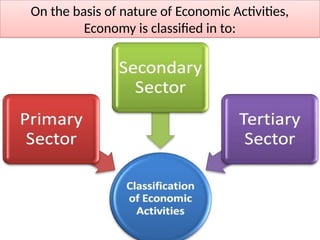
On the basisof nature of Economic Activities,
Economy is classified in to:
4.
PRIMARY SECTOR
All theeconomic activities which use natural
resources and produce natural goods through natural
processes together form the Primary sector. Examples:
Agriculture, Animal Rearing, Fishing, Lumbering, Mining etc.
It supplies raw materials for other sectors. So, it is called Primary
Sector. It is also called Agriculture and related Sector
5.
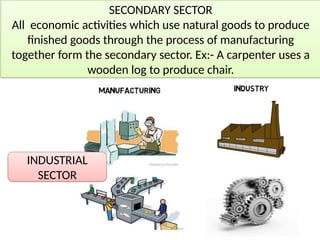
SECONDARY SECTOR
All economicactivities which use natural goods to produce
finished goods through the process of manufacturing
together form the secondary sector. Ex:- A carpenter uses a
wooden log to produce chair.
INDUSTRIAL
SECTOR
6.
All economic activitieswhich
provide services needed for primary and
secondary sectors form the tertiary sector. This
sector provides a number of personal services
also. It is also called Service Sector.
7.
INTERDEPENDENCE BETWEEN PRIMARY,SECONDARY
AND TERTIARY SECTORS
(i) Primary Sector provides raw materials needed for agro
based industries.
(ii) Primary Sector supplies food needed for the people
working in the Secondary and Tertiary Sectors.
(iii) Secondary Sector supplies fertilizers, pesticides and
agricultural machines, needed for the Primary Sector. It
also supplies various equipment needed for the service
sector.
8.
(iv) Tertiary Sectorprovides transport, insurance and
communication facilities needed for the other two
sectors.
(v) Each sector creates demand for the products of
the other two sectors.
10.
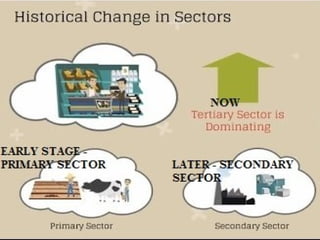
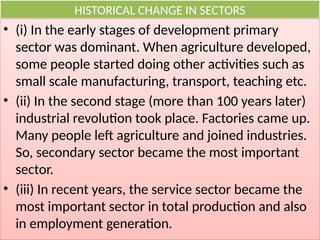
HISTORICAL CHANGE INSECTORS
• (i) In the early stages of development primary
sector was dominant. When agriculture developed,
some people started doing other activities such as
small scale manufacturing, transport, teaching etc.
• (ii) In the second stage (more than 100 years later)
industrial revolution took place. Factories came up.
Many people left agriculture and joined industries.
So, secondary sector became the most important
sector.
• (iii) In recent years, the service sector became the
most important sector in total production and also
in employment generation.
11.
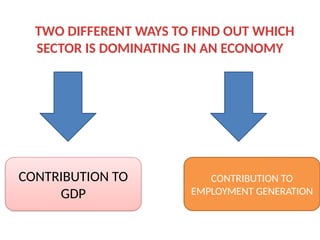
TWO DIFFERENT WAYSTO FIND OUT WHICH
SECTOR IS DOMINATING IN AN ECONOMY
CONTRIBUTION TO
GDP
CONTRIBUTION TO
EMPLOYMENT GENERATION
12.
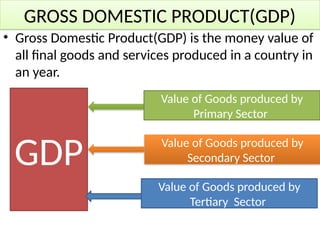
GROSS DOMESTIC PRODUCT(GDP)
•Gross Domestic Product(GDP) is the money value of
all final goods and services produced in a country in
an year.
GDP
Value of Goods produced by
Primary Sector
Value of Goods produced by
Secondary Sector
Value of Goods produced by
Tertiary Sector
13.
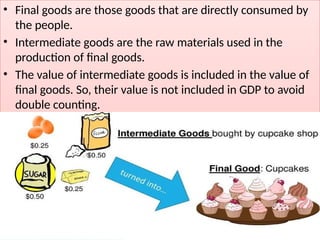
• Final goodsare those goods that are directly consumed by
the people.
• Intermediate goods are the raw materials used in the
production of final goods.
• The value of intermediate goods is included in the value of
final goods. So, their value is not included in GDP to avoid
double counting.
14.
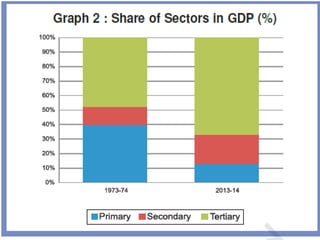
DOMINANT SECTOR ININDIAN ECONOMY ON THE BASIS OF
CONTRIBUTION TO GDP
IN 1973-74, PRIMARY SECTOR
MADE THE HIGHEST
CONTRIBUTION TO GDP. SO IT
WAS DOMINANT.
IN 2013 – 14, TERTIARY SECTOR
MADE THE HIGHEST
CONTRIBUTION TO GDP. SO
TODAY, TERTIARY SECTOR IS
DOMINANT IN INDIAN
ECONOMY. UNLIKE, DEVELOPED
COUNTRIES , SECONDARY SECTOR
NEVER BECAME DOMINANT IN
INDIA.
16.
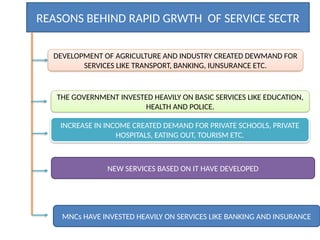
REASONS BEHIND RAPIDGRWTH OF SERVICE SECTR
DEVELOPMENT OF AGRICULTURE AND INDUSTRY CREATED DEWMAND FOR
SERVICES LIKE TRANSPORT, BANKING, IUNSURANCE ETC.
THE GOVERNMENT INVESTED HEAVILY ON BASIC SERVICES LIKE EDUCATION,
HEALTH AND POLICE.
INCREASE IN INCOME CREATED DEMAND FOR PRIVATE SCHOOLS, PRIVATE
HOSPITALS, EATING OUT, TOURISM ETC.
NEW SERVICES BASED ON IT HAVE DEVELOPED
MNCs HAVE INVESTED HEAVILY ON SERVICES LIKE BANKING AND INSURANCE
17.
SERVICE SECTOR EMPLOYSDIFFERENT KINDS OF PEOPLE
• Some service sector organizations employ educated
and skilled workers like teachers, doctors, lawyers,
etc….They are paid well.
• They also enjoy many other benefits.
• Some other service sector workers are uneducated
and unskilled. Ex: Washer men, Barbers, Rickshaw
pullers, Auto rickshaw drivers, domestic servants
etc…
• They are poorly paid and they do not enjoy any
benefits.
18.
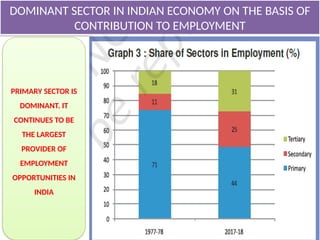
DOMINANT SECTOR ININDIAN ECONOMY ON THE BASIS OF
CONTRIBUTION TO EMPLOYMENT
PRIMARY SECTOR IS
DOMINANT. IT
CONTINUES TO BE
THE LARGEST
PROVIDER OF
EMPLOYMENT
OPPORTUNITIES IN
INDIA
19.
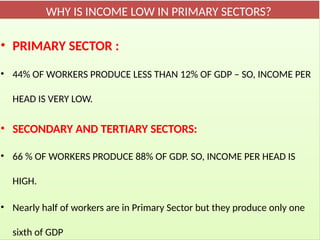
WHY IS INCOMELOW IN PRIMARY SECTORS?
• PRIMARY SECTOR :
• 44% OF WORKERS PRODUCE LESS THAN 12% OF GDP – SO, INCOME PER
HEAD IS VERY LOW.
• SECONDARY AND TERTIARY SECTORS:
• 66 % OF WORKERS PRODUCE 88% OF GDP. SO, INCOME PER HEAD IS
HIGH.
• Nearly half of workers are in Primary Sector but they produce only one
sixth of GDP
20.
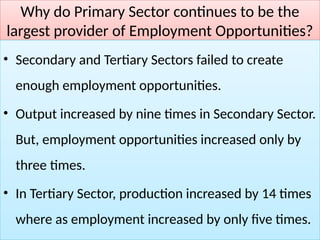
Why do PrimarySector continues to be the
largest provider of Employment Opportunities?
• Secondary and Tertiary Sectors failed to create
enough employment opportunities.
• Output increased by nine times in Secondary Sector.
But, employment opportunities increased only by
three times.
• In Tertiary Sector, production increased by 14 times
where as employment increased by only five times.
21.
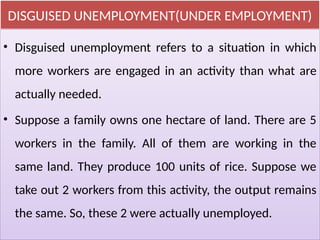
DISGUISED UNEMPLOYMENT(UNDER EMPLOYMENT)
•Disguised unemployment refers to a situation in which
more workers are engaged in an activity than what are
actually needed.
• Suppose a family owns one hectare of land. There are 5
workers in the family. All of them are working in the
same land. They produce 100 units of rice. Suppose we
take out 2 workers from this activity, the output remains
the same. So, these 2 were actually unemployed.
22.
Steps to createmore employment opportunities in rural India
• Banks and other financial institutions should provide loans for
modernizing agriculture. This will help the farmer to raise more
than one crop in an year.
• Small Agro-based industrial units should be set up in rural
areas.
• Collection centers of agricultural products should be set up in
rural area.
• All the children should be brought to the school. So,
educational sector can provide jobs to many.
• Hospitals and Health care centers should be set up in every
village.
• Tourism, development of regional craft industries or new
services like IT should be developed.
• MNREGA 2005 should be strictly implemented.
24.
• National RuralEmployment Guarantee Act 2005 (NREGA
2005) was passed by the government in order to provide at
least 100 days of employment to all those who are able
and willing to work.
• If the government fails in providing employment, the
unemployed should be given allowance.
• So, this act is referred to as “Right to Work”.
• The aim of NREGA 2005 is to reduce poverty and
unemployment in the rural areas.
• It aims at developing community assets also.
25.
STEPS TO CREATEEMPLOYMENT IN URBAN AREAS
• Educated people should be given financial and
technical help to find self employment.
• Efforts should be made to promote small scale
industries. Industrial estates can be set up.
• Private capitalists should be given encouragement
and support to start new industrial units. Foreign
capital can be invited.
• Step should be taken to provide education and
technical training to develop skill of workers.
26.
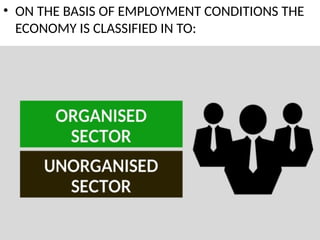
• ON THEBASIS OF EMPLOYMENT CONDITIONS THE
ECONOMY IS CLASSIFIED IN TO:
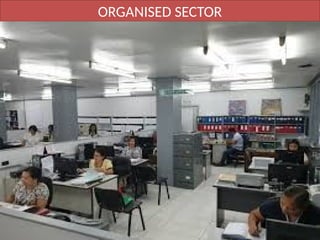
• Organised sectorconsists of those organizations and
enterprises which provide regular employment to
their workers and follow many rules and
regulations.
• They work as per the laws such as Factories Act,
Minimum Wages Act, Payment of Gratuity Act etc.
They provide good salaries to their workers.
• Workers also enjoy other benefits such as paid
leave, paid holidays, provident fund, pension after
retirement, medical facilities, housing facilities etc.
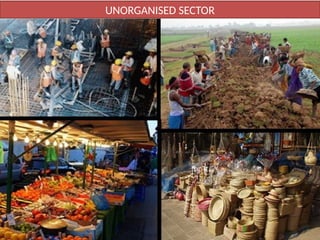
• Unorganised sectorconsists of small and scattered
units which do not follow any rules and regulations.
• They do not provide regular job to their workers.
• Workers are poorly aid.
• There is no job security.
• They do not enjoy benefits such as paid leave, Paid
holidays, provident fund, medical facilities etc.
• Condition of work is miserable.
31.
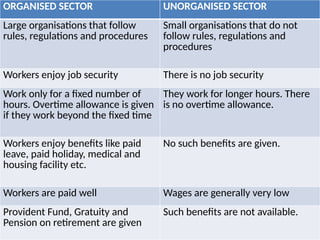
ORGANISED SECTOR UNORGANISEDSECTOR
Large organisations that follow
rules, regulations and procedures
Small organisations that do not
follow rules, regulations and
procedures
Workers enjoy job security There is no job security
Work only for a fixed number of
hours. Overtime allowance is given
if they work beyond the fixed time
They work for longer hours. There
is no overtime allowance.
Workers enjoy benefits like paid
leave, paid holiday, medical and
housing facility etc.
No such benefits are given.
Workers are paid well Wages are generally very low
Provident Fund, Gratuity and
Pension on retirement are given
Such benefits are not available.
32.
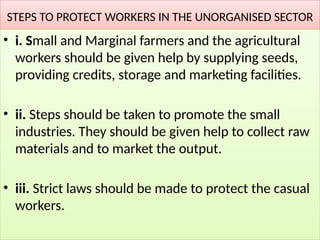
STEPS TO PROTECTWORKERS IN THE UNORGANISED SECTOR
• i. Small and Marginal farmers and the agricultural
workers should be given help by supplying seeds,
providing credits, storage and marketing facilities.
• ii. Steps should be taken to promote the small
industries. They should be given help to collect raw
materials and to market the output.
• iii. Strict laws should be made to protect the casual
workers.
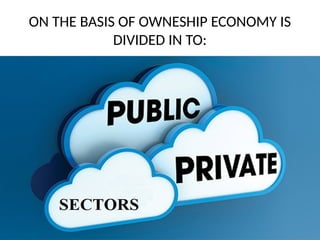
• The enterpriseswhich are owned and managed by
the government constitute the Public Sector. The
enterprises which are owned and managed by
private individuals constitute the Private Sector.
• Public Sector aims at the welfare of the people. The
private sector aims at profit.
• Basic services and basic and key industries are
mostly in public sector. The other services and other
goods are produced by the private sector.
• Railways, BHEL and HMT are in public sector.
Reliance, Tata Motors and Bajaj are in private sector.
35.
IMPORTANCE OF PUBLICSECTOR
• Public sector provides infrastructure like roads,
bridges, railways etc.
• Public sector provides education and health
services.
• Basic and Key industries in public sector promote
industrial growth in the country.
• Public sector is not profit motive. It aims at the
welfare of the people.
• Profit earned by the public sector units is a source of
income for the government.
• Large number of people are employed in Public
Sector.
36.
Examples of Publicsector Activities
• Defense production: Arms and ammunition needed
for our armed forces are produced by public sector
units. Defense production is highly important for
providing security to the people. So, the
government has brought it under public sector.
• Railways: Railways are important for transporting
goods and people over long distance. A huge
investment was needed to set up a railway network.
Private people were not capable of making such
huge investments. So the government brought it
under public sector.
37.
• iii. Education:Education is important for developing
knowledge and skill among the people. So, the
government took steps to provide education to the
poor people.
• iv. Health care: Health care facilities are essential
for the people. Health Care should be given at
cheap rate to the poorer section of the society. So,
the government invested in it.
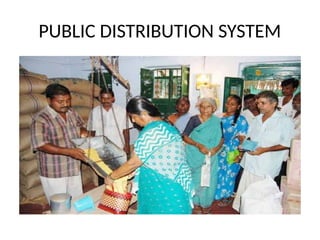
• The Governmentcollects food materials from the
farmers at the Minimum Support Price. These food
materials are distributed to the people at reduced
rate. This system is called PDS.
• This system ensures food security to the people.
Starvation deaths can be avoided.
• Farmers are benefited. They can sell food materials
to the Government at the MSP.
• Food materials can be distributed to the people
who are affected by natural calamities.

 Most read