Section 1:  Encoding
Girl with simon video
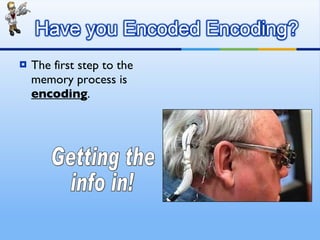
The first step to the memory process is  encoding . Getting the  info in!
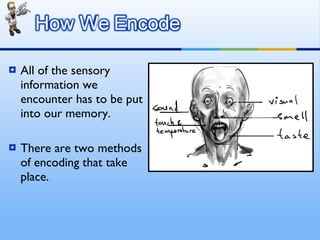
All of the sensory information we encounter has to be put into our memory. There are two methods of encoding that take place.
1.  Without looking….What time is it? 2.  How many bolded/underlined vocab have you seen today so far? 3.  What type of animal was on the first slide? 4.  What color shirt did Giff wear yesterday?
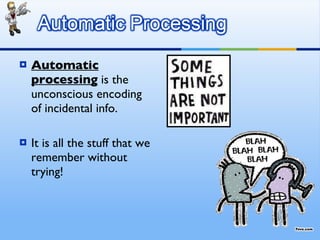
Automatic processing  is the unconscious encoding of incidental info.  It is all the stuff that we remember without trying!
Effortful Processing  is encoding that requires attention and conscious effort. You have to study to understand a difficult concept, that is Effortful Processing.
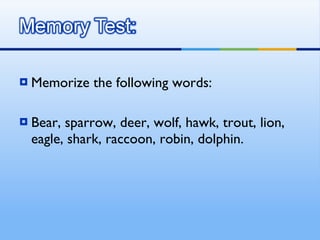
Memorize the following words: Bear, sparrow, deer, wolf, hawk, trout, lion, eagle, shark, raccoon, robin, dolphin.
Memorize the following words:
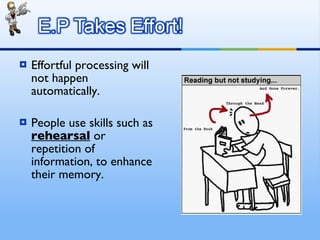
Effortful processing will not happen automatically. People use skills such as  rehearsal  or repetition of information, to enhance their memory.


Am I going to Learn Anything?
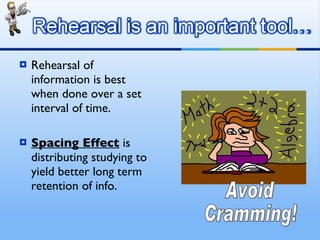
Rehearsal of information is best when done over a set interval of time. Spacing Effect  is distributing studying to yield better long term retention of info. Avoid  Cramming!
Memoriad video
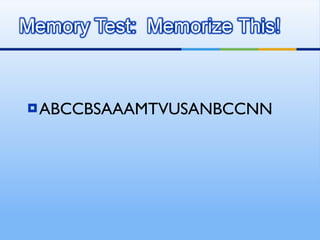
ABCCBSAAAMTVUSANBCCNN
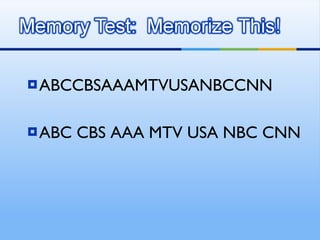
ABCCBSAAAMTVUSANBCCNN ABC CBS AAA MTV USA NBC CNN
To increase the effectiveness of encoding, try these tricks: 1. Chunking 2. Mnemonics A. Method of Loci B.  Visualization Avoid the  Duh Affect.
Chunking  is a memory aid in which you organize items into smaller, more manageable parts. Examples:  Telephone numbers and SS numbers.
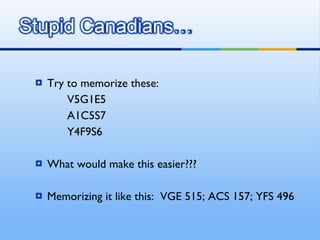
Try to memorize these:  V5G1E5 A1C5S7 Y4F9S6 What would make this easier??? Memorizing it like this:  VGE 515; ACS 157; YFS 496
Mnemonics   techniques that use vivid imagery and organizational devices to assist in encoding.  Mnemonics date back to ancient Greece when philosophers would use them to memorize lengthy speeches.  ( method of loci )
 
 
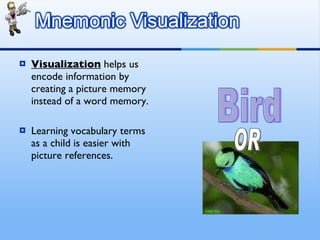
Visualization  helps us encode information by creating a picture memory instead of a word memory. Learning vocabulary terms as a child is easier with picture references. OR Bird
http://www.youtube.com/watch?v=OXJi7Vd0FPw
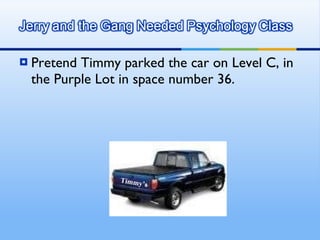
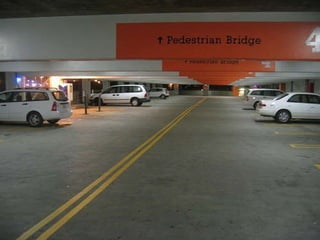
Pretend Timmy parked the car on Level C, in the Purple Lot in space number 36. Timmy’s
Hi Class!
 
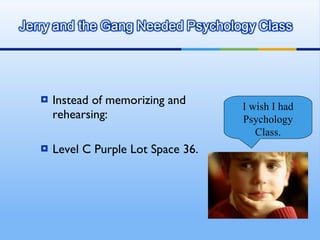
Instead of memorizing and rehearsing: Level C Purple Lot Space 36. I wish I had Psychology Class.
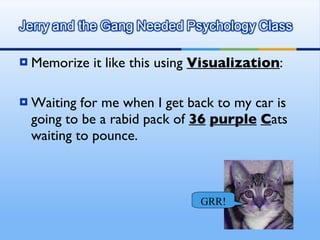
Memorize it like this using  Visualization : Waiting for me when I get back to my car is going to be a rabid pack of  36   purple   C ats waiting to pounce.  GRR!
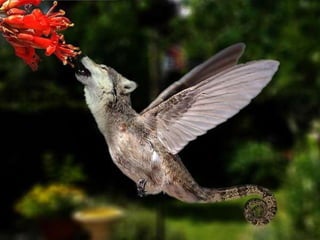
Wolf Hummingbird Lizard Red flower
 
Let’s try to memorize a list of our favorite junk foods.  We’ll go around the room and name our foods trying to use rehearsal as the method of remembering.
Let’s try to memorize a list of our favorite junk foods, only this time using a mnemonic device. This will sound crazy, but it works.
1.  Giving item to memorize some meaning helps the process. 2.  Rehearsal if used with spacing effect, is best practice. 3.  Chunking, Mnemonic Devices like Visualization help to increase retention.

1.  Define Memory 2.  What is the unconscious encoding process called? 3.  What is the encoding process that takes EFFORT called…?

Section 1 Encoding

  • 1.
    Section 1: Encoding
  • 2.
  • 3.
    The first stepto the memory process is encoding . Getting the info in!
  • 4.
    All of thesensory information we encounter has to be put into our memory. There are two methods of encoding that take place.
  • 5.
    1. Withoutlooking….What time is it? 2. How many bolded/underlined vocab have you seen today so far? 3. What type of animal was on the first slide? 4. What color shirt did Giff wear yesterday?
  • 6.
    Automatic processing is the unconscious encoding of incidental info. It is all the stuff that we remember without trying!
  • 7.
    Effortful Processing is encoding that requires attention and conscious effort. You have to study to understand a difficult concept, that is Effortful Processing.
  • 8.
    Memorize the followingwords: Bear, sparrow, deer, wolf, hawk, trout, lion, eagle, shark, raccoon, robin, dolphin.
  • 9.
  • 10.
    Effortful processing willnot happen automatically. People use skills such as rehearsal or repetition of information, to enhance their memory.
  • 11.
  • 12.
  • 13.
  • 14.
    Am I goingto Learn Anything?
  • 15.
    Rehearsal of informationis best when done over a set interval of time. Spacing Effect is distributing studying to yield better long term retention of info. Avoid Cramming!
  • 16.
  • 17.
  • 18.
    ABCCBSAAAMTVUSANBCCNN ABC CBSAAA MTV USA NBC CNN
  • 19.
    To increase theeffectiveness of encoding, try these tricks: 1. Chunking 2. Mnemonics A. Method of Loci B. Visualization Avoid the Duh Affect.
  • 20.
    Chunking isa memory aid in which you organize items into smaller, more manageable parts. Examples: Telephone numbers and SS numbers.
  • 21.
    Try to memorizethese: V5G1E5 A1C5S7 Y4F9S6 What would make this easier??? Memorizing it like this: VGE 515; ACS 157; YFS 496
  • 22.
    Mnemonics techniques that use vivid imagery and organizational devices to assist in encoding. Mnemonics date back to ancient Greece when philosophers would use them to memorize lengthy speeches. ( method of loci )
  • 23.
  • 24.
  • 25.
    Visualization helpsus encode information by creating a picture memory instead of a word memory. Learning vocabulary terms as a child is easier with picture references. OR Bird
  • 26.
  • 27.
    Pretend Timmy parkedthe car on Level C, in the Purple Lot in space number 36. Timmy’s
  • 28.
  • 29.
  • 30.
    Instead of memorizingand rehearsing: Level C Purple Lot Space 36. I wish I had Psychology Class.
  • 31.
    Memorize it likethis using Visualization : Waiting for me when I get back to my car is going to be a rabid pack of 36 purple C ats waiting to pounce. GRR!
  • 32.
  • 33.
  • 34.
    Let’s try tomemorize a list of our favorite junk foods. We’ll go around the room and name our foods trying to use rehearsal as the method of remembering.
  • 35.
    Let’s try tomemorize a list of our favorite junk foods, only this time using a mnemonic device. This will sound crazy, but it works.
  • 36.
    1. Givingitem to memorize some meaning helps the process. 2. Rehearsal if used with spacing effect, is best practice. 3. Chunking, Mnemonic Devices like Visualization help to increase retention.
  • 37.
    1. DefineMemory 2. What is the unconscious encoding process called? 3. What is the encoding process that takes EFFORT called…?