
SS - 1
SECRETARIAL STANDARD
ON
MEETINGS OF THE
BOARD OF DIRECTORS
ICSI House, 22, Institutional Area, Lodi Road, New Delhi 110 003
tel 011-4534 1000, 4150 4444 fax +91-11-2462 6727
email info@icsi.edu website www.icsi.edu
April 2015
Published by :
THE INSTITUTE OF COMPANY SECRETARIES OF INDIA
ICSI House, 22, Institutional Area, Lodi Road, New Delhi - 110 003
Phones : 41504444, 45341000, Fax : 24626727
Website : www.icsi.edu, E-mail : info@icsi.edu
© THE INSTITUTE OF COMPANY SECRETARIES OF INDIA
All rightsreserved. No part ofthis publication may betranslated orcopied
in any form or by any means without the prior written permission of The
Institute of Company Secretaries of India.
PRICE : Rs. 50/- (Excluding Postage)
Laser typesetting at AArushi Graphics
Printed at : Chandu Press/500/April 2015
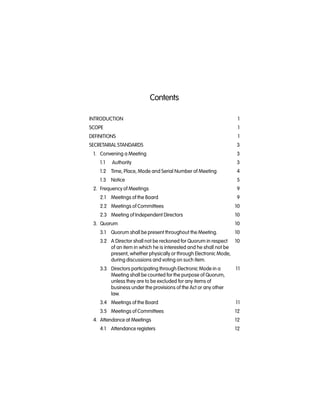
Contents
INTRODUCTION 1
SCOPE 1
DEFINITIONS 1
SECRETARIAL STANDARDS 3
1. Convening a Meeting 3
1.1 Authority 3
1.2 Time, Place, Mode and Serial Number of Meeting 4
1.3 Notice 5
2. Frequency of Meetings 9
2.1 Meetings of the Board 9
2.2 Meetings of Committees 10
2.3 Meeting of Independent Directors 10
3. Quorum 10
3.1 Quorum shall be present throughout the Meeting. 10
3.2 A Director shall not be reckoned for Quorum in respect 10
of an item in which he is interested and he shall not be
present, whether physically or through Electronic Mode,
during discussions and voting on such item.
3.3 Directors participating through Electronic Mode in a 11
Meeting shall be counted for the purpose of Quorum,
unless they are to be excluded for any items of
business under the provisions of the Act or any other
law.
3.4 Meetings of the Board 11
3.5 Meetings of Committees 12
4. Attendance at Meetings 12
4.1 Attendance registers 12
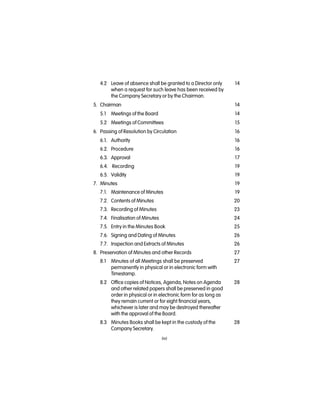
(iv)
4.2 Leave of absence shall be granted to a Director only 14
when a request for such leave has been received by
the Company Secretary or by the Chairman.
5. Chairman 14
5.1 Meetings of the Board 14
5.2 Meetings of Committees 15
6. Passing of Resolution by Circulation 16
6.1. Authority   16
6.2. Procedure 16
6.3. Approval 17
6.4. Recording 19
6.5. Validity 19
7. Minutes 19
7.1. Maintenance of Minutes 19
7.2. Contents of Minutes 20
7.3. Recording of Minutes 23
7.4. Finalisation of Minutes 24
7.5. Entry in the Minutes Book 25
7.6. Signing and Dating of Minutes 26
7.7. Inspection and Extracts of Minutes 26
8. Preservation of Minutes and other Records 27
8.1 Minutes of all Meetings shall be preserved 27
permanently in physical or in electronic form with
Timestamp.
8.2 Office copies of Notices, Agenda, Notes on Agenda 28
and other related papers shall be preserved in good
order in physical or in electronic form for as long as
they remain current or for eight financial years,
whichever is later and may be destroyed thereafter
with the approval of the Board.
8.3 Minutes Books shall be kept in the custody of the 28
Company Secretary.
(v)
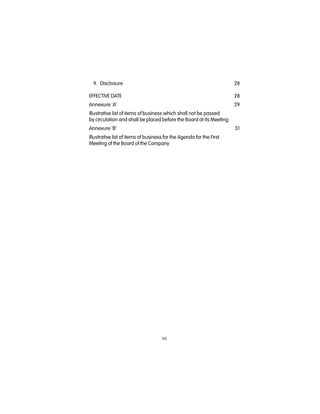
9. Disclosure 28
EFFECTIVE DATE 28
Annexure ‘A’ 29
Illustrative list of items of business which shall not be passed
by circulation and shall be placed before the Board at its Meeting
Annexure ‘B’ 31
Illustrative list of items of business for the Agenda for the First
Meeting of the Board of the Company
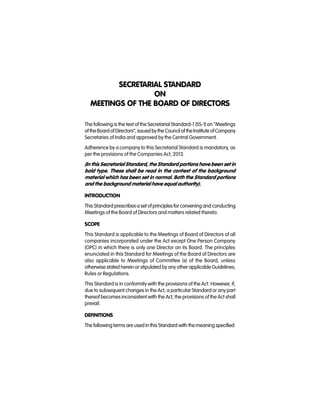
SECRETARIAL STANDARD
ON
MEETINGS OF THE BOARD OF DIRECTORS
The following is the text of the Secretarial Standard-1 (SS-1) on “Meetings
of the BoardofDirectors”, issued bythe Council of theInstitute ofCompany
Secretaries of India and approved by the Central Government.
Adherence by a company to this Secretarial Standard is mandatory, as
per the provisions of the Companies Act, 2013.
(In this Secretarial Standard, the Standard portions have been set in
bold type. These shall be read in the context of the background
material which has been set in normal. Both the Standard portions
and the background material have equal authority).
INTRODUCTION
This Standard prescribesa set of principles forconvening and conducting
Meetings of the Board of Directors and matters related thereto.
SCOPE
This Standard is applicable to the Meetings of Board of Directors of all
companies incorporated under the Act except One Person Company
(OPC) in which there is only one Director on its Board. The principles
enunciated in this Standard for Meetings of the Board of Directors are
also applicable to Meetings of Committee (s) of the Board, unless
otherwise stated herein or stipulated by any other applicable Guidelines,
Rules or Regulations.
This Standard is in conformity with the provisions of the Act. However, if,
due to subsequent changes in the Act, a particular Standard or any part
thereof becomes inconsistent with the Act, the provisions of the Act shall
prevail.
DEFINITIONS
The followingterms are used in this Standard with themeaning specified:
SS - 1 – SECRETARIAL STANDARD ON MEETINGS OF THE BODs2
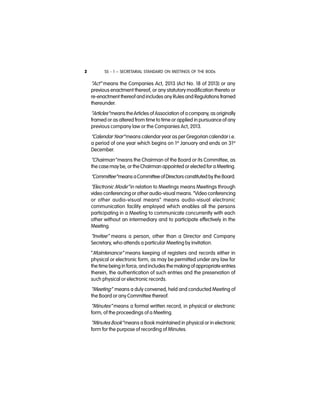
“Act” means the Companies Act, 2013 (Act No. 18 of 2013) or any
previous enactment thereof, or any statutory modification thereto or
re-enactment thereof and includes any Rules and Regulations framed
thereunder.
“Articles” means the Articles of Association of a company, as originally
framed or as altered from time to time or applied in pursuance of any
previous company law or the Companies Act, 2013.
“Calendar Year” means calendar year as per Gregorian calendar i.e.
a period of one year which begins on 1st
January and ends on 31st
December.
“Chairman” means the Chairman of the Board or its Committee, as
the case may be, or the Chairman appointed or elected for a Meeting.
“Committee”means aCommittee ofDirectors constitutedby the Board.
“Electronic Mode” in relation to Meetings means Meetings through
video conferencing or other audio-visual means. “Video conferencing
or other audio-visual means” means audio-visual electronic
communication facility employed which enables all the persons
participating in a Meeting to communicate concurrently with each
other without an intermediary and to participate effectively in the
Meeting.
“Invitee” means a person, other than a Director and Company
Secretary, who attends a particular Meeting by invitation.
”Maintenance” means keeping of registers and records either in
physical or electronic form, as may be permitted under any law for
the time being in force, andincludes the making of appropriate entries
therein, the authentication of such entries and the preservation of
such physical or electronic records.
“Meeting” means a duly convened, held and conducted Meeting of
the Board or any Committee thereof.
“Minutes” means a formal written record, in physical or electronic
form, of the proceedings of a Meeting.
“Minutes Book” means a Book maintained in physical or in electronic
form for the purpose of recording of Minutes.
SS - 1 – SECRETARIAL STANDARD ON MEETINGS OF THE BODs 3
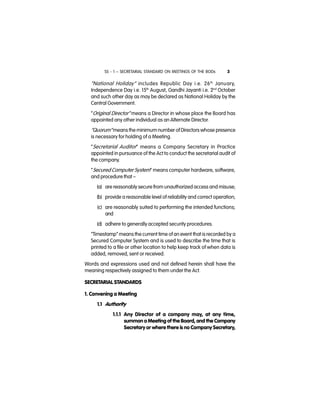
“National Holiday” includes Republic Day i.e. 26th
January,
Independence Day i.e. 15th
August, Gandhi Jayanti i.e. 2nd
October
and such other day as may be declared as National Holiday by the
Central Government.
”Original Director” means a Director in whose place the Board has
appointed any other individual as an Alternate Director.
“Quorum” means the minimum number of Directors whose presence
is necessary for holding of a Meeting.
“Secretarial Auditor” means a Company Secretary in Practice
appointed in pursuance of the Act to conduct the secretarial audit of
the company.
‘‘Secured Computer System” means computer hardware, software,
and procedure that –
(a) are reasonably secure from unauthorized access and misuse;
(b) provide a reasonable level of reliability and correct operation;
(c) are reasonably suited to performing the intended functions;
and
(d) adhere to generally accepted security procedures.
“Timestamp” means the current time of an event that is recorded by a
Secured Computer System and is used to describe the time that is
printed to a file or other location to help keep track of when data is
added, removed, sent or received.
Words and expressions used and not defined herein shall have the
meaning respectively assigned to them under the Act.
SECRETARIAL STANDARDS
1. Convening a Meeting
1.1 Authority
1.1.1 Any Director of a company may, at any time,
summon a Meeting of the Board, and the Company
Secretary or where there is no Company Secretary,
SS - 1 – SECRETARIAL STANDARD ON MEETINGS OF THE BODs4
any person authorised by the Board in this behalf,
on the requisition of a Director, shall convene a
Meeting of the Board, in consultation with the
Chairman or in his absence, the Managing Director
or in his absence, the Whole-time Director, where
there is any, unless otherwise provided in the
Articles.
1.1.2 The Chairman may, unless dissented to or objected
by the majority of Directors present at a Meeting
at which a Quorum is present, adjourn the Meeting
for any reason, at any stage of the Meeting.
1.2 Time, Place, Mode and Serial Number of Meeting
1.2.1 Every Meeting shall have a serial number.
1.2.2 A Meeting may be convened at any time and place,
on any day, excluding a National Holiday.
Notice of the Meeting, wherein the facility of participation through
Electronic Mode is provided, shall clearly mention a venue, whether
registered office or otherwise, to be the venue of the Meeting and it shall
be the place where all the recordings of the proceedings at the Meeting
would be made.
A Meeting adjourned for want of Quorum shall also not be held on a
National Holiday.
1.2.3 Any Director may participate through Electronic
Mode in a Meeting, if the company provides such
facility, unless the Act or any other law specifically
does not allow such participation through Electronic
Mode in respect of any item of business.
Directors shall not participate through Electronic Mode in the discussion
on certain restricted items, unless expressly permitted by the Chairman.
Such restricted items of business include approval of the annual financial
statement, Board’s report, prospectus and matters relating to
amalgamation, merger, demerger, acquisition and takeover. Similarly,
participation in the discussion through Electronic Mode shall not be
allowed in Meetings of the Audit Committee for consideration of annual
SS - 1 – SECRETARIAL STANDARD ON MEETINGS OF THE BODs 5
financial statement including consolidated financial statement, if any, to
be approved by the Board , unless expressly permitted by the Chairman.
1.3 Notice
1.3.1 Notice in writing of every Meeting shall be given
to every Director by hand or by speed post or by
registered post or by courier or by facsimile or by
e-mail or by any other electronic means.
The Notice shall be sent to the postal address or e-mail address,
registered by the Director with the company or in the absence of such
details or any change thereto, any of such addresses appearing in the
Director Identification Number (DIN) registration of the Director.
Where a Director specifies a particular means of delivery of Notice, the
Notice shall be given to him by such means.
Proof of sending Notice and its delivery shall be maintained by the
company.
1.3.2 Notice shall be issued by the Company Secretary
or where there is no Company Secretary, any
Director or any other person authorised by the
Board for the purpose.
1.3.3 The Notice shall specify the serial number, day,
date, time and full address of the venue of the
Meeting.
1.3.4 In case the facility of participation through
Electronic Mode is being made available , the Notice
shall inform the Directors about the availability of
such facility, and provide them necessary
information to avail such facility.
Where such facility is provided, the Notice shall seek advance
confirmation from theDirectors as to whether theywill participate through
Electronic Mode in the Meeting.
The Notice shall also contain the contact number or e-mail address (es)
of theChairman ortheCompanySecretaryoranyotherperson authorised
by the Board, to whom the Director shall confirm in this regard. In the
SS - 1 – SECRETARIAL STANDARD ON MEETINGS OF THE BODs6
absence of an advance communication or confirmation from the Director
as above, it shall be assumed that he will attend the Meeting physically.
1.3.5 The Notice of a Meeting shall be given even if
Meetings are held on pre-determined dates or at
pre-determined intervals.
1.3.6 Notice convening a Meeting shall be given at least
seven days before the date of the Meeting, unless
the Articles prescribe a longer period.
In case the company sends the Notice by speed post or by registered
post or by courier, an additional two days shall be added for the service
of Notice.
Notice of an adjourned Meeting shall be given to all Directors including
those who did not attend the Meeting on the originally convened date
and unless the date of adjourned Meeting is decided at the Meeting,
Notice thereof shall also be given not less than seven days before the
Meeting.
1.3.7 The Agenda, setting out the business to be
transacted at the Meeting, and Notes on Agenda
shall be given to the Directors at least seven days
before the date of the Meeting, unless the Articles
prescribe a longer period.
Agenda and Notes on Agenda shall be sent to all Directors by hand or
by speed post or by registered post or by courier or by e-mail or by any
other electronic means. These shall be sent to the postal address or e-
mail address or any other electronic address registered by the Director
with the company or in the absence of such details or any change
thereto, to any of such addresses appearing in the Director Identification
Number (DIN) registration of the Directors.
In case the company sends the Agenda and Notes on Agenda by speed
post or by registered post or by courier, an additional two days shall be
added for the service of Agenda and Notes on Agenda.
Where a Director specifies a particular means of delivery of Agenda and
Notes on Agenda, these papers shall be sent to him by such means.
SS - 1 – SECRETARIAL STANDARD ON MEETINGS OF THE BODs 7
Proof of sending Agenda and Notes on Agenda and their delivery shall
be maintained by the company.
The Notice, Agenda and Notes on Agenda shall be sent to the Original
Director also at the address registered with the company, even if these
have been sent to the Alternate Director.
Notes on items of business which are in the nature of Unpublished Price
Sensitive Information may be given at a shorter period of time than
stated above, with the consent of a majority of the Directors, which shall
include at least one Independent Director, if any.
For this purpose,
“unpublished pricesensitive information” means anyinformation, relating
to a company or its securities, directly or indirectly, that is not generally
available which upon becoming generally available, is likely to
materially affect the price of the securities and shall, ordinarily including
but not restricted to, information relating to the following: –
(i) financial results;
(ii) dividends;
(iii) change in capital structure;
(iv) mergers, de-mergers, acquisitions, delistings, disposals and
expansion of business and such other transactions;
(v) changes in key managerial personnel; and
(vi) material events in accordance with the listing agreement*.
General consent for giving Notes on items of Agenda which are in the
nature of Unpublished Price Sensitive Information at a shorter Notice
may be taken in the first Meeting of the Board held in each financial year
and also whenever there is any change in Directors.
Where general consent as above has not been taken, the requisite
consent shall be taken before the concerned items are taken up for
consideration at the Meeting. The fact of consent having been taken
shall be recorded in the Minutes.
* Definition under SEBI (Prohibition Insider Trading) Regulations, 2015
SS - 1 – SECRETARIAL STANDARD ON MEETINGS OF THE BODs8
Supplementary Notes on any of theAgenda Items may be circulated at or
prior to the Meeting but shall be taken up with the permission of the
Chairman and with the consent of amajority of the Directorspresent in the
Meeting, which shall include at least one Independent Director, if any.
1.3.8 Each item of business requiring approval at the
Meeting shall be supported by a note setting out
the details of the proposal, relevant material facts
that enable the Directors to understand the
meaning, scope and implications of the proposal
and the nature of concern or interest, if any, of
any Director in the proposal, which the Director
had earlier disclosed.
Where approval by means of a Resolution is required, the draft of such
Resolution shall be either set out in the note or placed at the Meeting.
The items of business that are required by the Act or any other applicable
law to be considered at a Meeting of the Board shall be placed before
the Board at its Meeting. An illustrative list of such items is given at
Annexure ‘A’.
There are certain items which shall be placed before the Board at its first
Meeting. An illustrative list thereof is given at Annexure ‘B’.
1.3.9 Each item of business to be taken up at the Meeting
shall be serially numbered.
Numbering shall be in a manner which would enable ease of reference
or cross-reference.
1.3.10 Any item not included in the Agenda may be taken
up for consideration with the permission of the
Chairman and with the consent of a majority of
the Directors present in the Meeting, which shall
include at least one Independent Director, if any.
In case of absence of Independent Directors, if any, at such Meeting, the
Minutes shall be final only after at least one Independent Director, if any,
ratifies the decision taken in respect of such item. In case the company
does not have an Independent Director, the Minutes shall be final only
on ratification of the decision taken in respect of such item by a majority
SS - 1 – SECRETARIAL STANDARD ON MEETINGS OF THE BODs 9
of the Directors of the company, unless such item was approved at the
Meeting itself by a majority of Directors of the company.
1.3.11 To transact urgent business, the Notice, Agenda
and Notes on Agenda may be given at shorter
period of time than stated above, if at least one
Independent Director, if any, shall be present at
such Meeting. If no Independent Director is present,
decisionstaken at sucha Meeting shall becirculated
to all the Directors and shall be final only on
ratification thereof by at least one Independent
Director, if any. In case the company does not have
an Independent Director, the decisions shall be final
only on ratification thereof by a majority of the
Directors of the company, unless such decisions
were approved at the Meeting itself by a majority
of Directors of the company.
The fact that the Meeting is being held at a shorter Notice shall be stated
in the Notice.
2. Frequency of Meetings
2.1 Meetings of the Board
The Board shallmeet at least once in every calendar quarter,
with a maximum interval of one hundred and twenty days
between any two consecutive Meetings of the Board, such
that at least four Meetings are held in each Calendar Year.
The Board shall hold its first Meeting within thirty days of the date of
incorporation of the company. It shall be sufficient if one Meeting is held
in each of theremaining calendarquarters,subject to amaximum interval
of one hundred and twenty days between anytwo consecutive Meetings
of the Board, after the first Meeting.
Further, it shall be sufficient if a One Person Company, Small Company
or Dormant Company holds one Meeting of the Board in each half of a
calendar year and the gap between the two Meetings of the Board is not
less than ninety days.
An adjourned Meeting being a continuation of the original Meeting, the
SS - 1 – SECRETARIAL STANDARD ON MEETINGS OF THE BODs10
interval period in such a case, shall be counted from the date of the
original Meeting.
2.2 Meetings of Committees
Committees shall meet as often as necessary subject to
the minimum number and frequency stipulated by the Board
or as prescribed by any law or authority.
2.3 Meeting of Independent Directors
Where a company is required to appoint Independent
Directors under the Act, such Independent Directors shall
meet at least once in a Calendar Year.
The meeting shallbe held to review theperformance of Non-Independent
Directors and the Board as a whole; to review the performance of the
Chairman and to assess the quality, quantity and timeliness of flow of
information between the company management and the Board and its
members that is necessary for the Board to effectively and reasonably
perform their duties.
The Company Secretary shall facilitate convening and holding of such
meeting, if so desired by the Independent Directors.
3. Quorum
3.1 Quorum shall be present throughout the Meeting.
Quorum shall be present not only at the time of
commencement of the Meeting but also while transacting
business.
3.2 A Director shall not be reckoned for Quorum in respect of
an item in which he is interested and he shall not be present,
whether physically or through Electronic Mode, during
discussions and voting on such item.
For this purpose, a Director shall be treated as interested in a contract or
arrangement enteredinto orproposedtobe entered into bythecompany:
(a) with the Director himself or his relative; or
(b) with any body corporate, if such Director, along with other
SS - 1 – SECRETARIAL STANDARD ON MEETINGS OF THE BODs 11
Directors holds more than two percent of the paid-up share
capital ofthat body corporate, or he is a promoter, or manager
or chief executive officer of that body corporate; or
(c) withafirmorotherentity,ifsuchDirectororhisrelativeisapartner,
ownerorMember,asthecasemaybe,ofthat firmorotherentity.
3.3 Directors participating through Electronic Mode in a Meeting
shall be counted for the purpose of Quorum, unless they
are to be excluded for any items of business under the
provisions of the Act or any other law.
Any Director participating through Electronic Mode in respect of restricted
items with the express permission of Chairman shall however, neither
be entitled to vote nor be counted for the purpose of Quorum in respect
of such restricted items.
The restricted items of business include approval of the annual financial
statement, Board’s Report, prospectus and matters relating to
amalgamation, merger, demerger, acquisition and takeover and in
meetings of Audit Committee for the consideration of annual financial
statement including consolidated financial statement, if any, to be
approved by the Board.
3.4 Meetings of the Board
3.4.1 The Quorum for a Meeting of the Board shall be
one-third of the total strength of the Board, or two
Directors, whichever is higher.
Any fraction contained in the above one-third shall be rounded off to the
next one.
Where the Quorum requirement provided in the Articles is higher than
one-third of the total strength, the company shall conform to such higher
requirement.
Total strength for this purpose, shall not include Directors whose places
are vacant.
If the number of Interested Directors exceeds or is equal to two-thirds of
the total strength, the remaining Directors present at the Meeting, being
not less than two, shall be the Quorum during such item.
SS - 1 – SECRETARIAL STANDARD ON MEETINGS OF THE BODs12
If a Meeting of the Board could not be held for want of Quorum, then,
unless otherwise provided in the Articles, the Meeting shall automatically
stand adjourned to the same day in the next week, at the same time and
place or, if that day is a National Holiday, to the next succeeding day
which is not a National Holiday, at the same time and place.
If there is no Quorum at the adjourned Meeting also, the Meeting shall
stand cancelled.
3.4.2 Where the number of Directors is reduced below the
minimum fixed by the Articles, no business shall be
transacted unless the number is first made up by the
remaining Director(s) or through a general meeting.
If the number of Directors is reduced below the Quorum fixed by the Act
for a Meeting of the Board, the continuing Directors may act for the
purpose ofincreasing thenumberofDirectors to that fixedfor the Quorum
or of summoning a general meeting of the company, and for no other
purpose.
3.5 Meetings of Committees
The presence of all the members of any Committee
constituted by the Board is necessary to form the Quorum
for Meetings of such Committee unless otherwise stipulated
in the Act or any other law or the Articles or by the Board.
Regulations framed under any other law may contain provisions for the
Quorum of a Committee and such stipulations shall be followed.
4. Attendance at Meetings
4.1 Attendance registers
4.1.1 Every company shall maintain separate attendance
registers for the Meetings of the Board and
Meetings of the Committee.
The pages of the respective attendance registers shall be serially
numbered.
If an attendance register is maintained in loose-leaf form, it shall be
bound periodically depending on the size and volume.
SS - 1 – SECRETARIAL STANDARD ON MEETINGS OF THE BODs 13
4.1.2 The attendance register shall contain the following
particulars: serial number and date of the
Meeting; in case of a Committee Meeting name
of the Committee; place of the Meeting; time of
the Meeting; names of the Directors and signature
of each Director present; name and signature of
the Company Secretary who is in attendance and
also of persons attending the Meeting by
invitation.
4.1.3 Every Director, Company Secretary who is in
attendance and every Invitee who attends a
Meeting of the Board or Committee thereof shall
sign the attendance register at that Meeting.
In case of Directors participating through Electronic Mode, the Chairman
shall confirm the attendance of such Directors. For this purpose, at the
commencement of the Meeting, the Chairman shall take a roll call. The
Chairman or Company Secretary shall request the Director participating
through Electronic Mode to state his full name and location from where
he is participating and shall record the same in the Minutes. The
proceedings of such Meetings shall be recorded through any electronic
recording mechanism and the details of the venue, date and time shall
be mentioned.
The attendance register shall be deemed to have been signed by the
Directors participating through Electronic Mode, if their attendance is
recorded by the Chairman or the Company Secretary in the Attendance
Register and the Minutes of the Meeting.
4.1.4 The attendance register shall be maintained at the
Registered Office of the company or such other
place as may be approved by the Board.
The attendance register may be taken to any place where a Meeting of
the Board or Committee is held.
4.1.5 The attendance register is open for inspection by
the Directors.
The Company Secretary in Practice appointed by the company or the
Secretarial Auditor or the Statutory Auditor of the company can also
SS - 1 – SECRETARIAL STANDARD ON MEETINGS OF THE BODs14
inspect the attendance register as he may consider necessary for the
performance of his duties.
A Member of the company is not entitled to inspect the attendance
register.
4.1.6 Entries in the attendance register shall be
authenticated by the Company Secretary or where
there is no Company Secretary, by the Chairman
by appending his signature to each page.
4.1.7 The attendance register shall be preserved for a
period of at least eight financial years and may be
destroyed thereafter with the approval of the
Board.
The recording of attendance of Meetings through Electronic Mode shall
be preserved for a period of at least eight financial years and may be
destroyed thereafter with the approval of the Board.
4.1.8 The attendance register shall be kept in the custody
of the Company Secretary.
Where there is no Company Secretary, the attendance register shall be
kept in the custody of any Director authorised by the Board for this
purpose.
4.2 Leave of absence shall be granted to a Director only when
a request for such leave has been received by the Company
Secretary or by the Chairman.
The office of a Director shall become vacant in case the Director absents
himself from all the Meetings of the Board held during a period of twelve
months with or without seeking leave of absence of the Board.
5. Chairman
5.1 Meetings of the Board
5.1.1 The Chairman of the company shall be the
Chairman of the Board. If the company does not
have a Chairman, the Directors may elect one of
themselves to be the Chairman of the Board.
SS - 1 – SECRETARIAL STANDARD ON MEETINGS OF THE BODs 15
5.1.2 The Chairman of the Board shall conduct the
Meetings of the Board. If no Chairman is elected
or if the Chairman is unable to attend the Meeting,
the Directors present at the Meeting shall elect
one of themselves to chair and conduct the
Meeting, unless otherwise provided in the Articles.
It would be the duty of the Chairman to check, with the assistance of
Company Secretary, that the Meeting is duly convened and constituted
in accordance with the Act or any other applicable guidelines, Rules
and Regulations before proceeding to transact business. The Chairman
shall then conduct the Meeting. The Chairman shall encourage
deliberations and debate and assess the sense of the Meeting.
If the Chairman is interested in any item of business, he shall, with the
consent of the members present, entrust the conduct of the proceedings
in respect of such item to any Dis-interested Director and resume the
Chair after that item of business has been transacted. The Chairman
shall also not be present at the Meeting during discussions on such
items.
In case some of the Directors participate through Electronic Mode, the
Chairman and the Company Secretary shall safeguard the integrity of
the Meeting by ensuring sufficient security and identification procedures.
No person other than the Director concerned shall be allowed access to
the proceedings of the Meeting where Director (s) participate through
Electronic Mode, except a Director who is differently abled, provided
such Director requests the Board to allow a person to accompany him
and ensures that such person maintains confidentiality of the matters
discussed at the Meeting.
Unless otherwise provided in the Articles, in case of an equality of votes,
the Chairman shall have a second or casting vote.
5.2 Meetings of Committees
A member of the Committee appointed by the Board or
elected by the Committee as Chairman of the Committee,
in accordance with the Act or any other law or the Articles,
shall conduct the Meetings of the Committee. If no Chairman
has been so elected or if the elected Chairman is unable to
SS - 1 – SECRETARIAL STANDARD ON MEETINGS OF THE BODs16
attend the Meeting, the Committee shall elect one of its
members present to chair and conduct the Meeting of the
Committee, unless otherwise provided in the Articles.
6. Passing of Resolution by Circulation
The Act requires certain business to be approved only at Meetings of the
Board. However, other business that requires urgent decisions can be
approved by means of Resolutions passed by circulation. Resolutions
passed by circulation are deemed to be passed at a duly convened
Meeting of the Board and have equal authority.
6.1.   Authority  
6.1.1 The Chairman of the Board or in his absence, the
Managing Director or in his absence, the Whole-
time Director and where there is none, any Director
other than an Interested Director, shall decide,
before the draft Resolution is circulated to all the
Directors, whether the approval of the Board for a
particular business shall be obtained by means of
a Resolution by circulation.
An illustrative list of items which shall be placed before the Board at its
Meeting and shall not be passed by circulation is given at Annexure ‘A’.
6.1.2 Where not less than one-third of the total number
of Directors for the time being require the
Resolution under circulation to be decided at a
Meeting, the Chairman shall put the Resolution for
consideration at a Meeting of the Board.
Interested Directors shall not be excluded for the purpose of determining
the above one-third of the total number of Directors.
6.2. Procedure
6.2.1 A Resolution proposed to be passed by circulation
shall be sent in draft, together with the necessary
papers, individually to all the Directors including
Interested Directors on the same day.
6.2.2 The draft of the Resolution to be passed and the
SS - 1 – SECRETARIAL STANDARD ON MEETINGS OF THE BODs 17
necessary papers shall be circulated amongst the
Directors by hand, or by speed post or by
registered post or by courier, or by e-mail or by
any other recognised electronic means.
The draft of the Resolution and the necessary papers shall be sent to the
postal address or e-mail address registered by the Director with the
company or in the absence of such details or any change thereto, any of
the addresses appearing in the Director Identification Number (DIN)
registration of the Director.
Proof of sending and delivery of the draft of the Resolution and the
necessary papers shall be maintained by the company.
6.2.3 Each business proposed to be passed by way of
Resolution by circulation shall be explained by a
note setting out the details of the proposal, relevant
material facts that enable the Directors to
understand the meaning, scope and implications
of the proposal, the nature of concern or interest,
if any, of any Director in the proposal, which the
Director had earlier disclosed and the draft of the
Resolution proposed. The note shall also indicate
how a Director shall signify assent or dissent to
the Resolution proposed and the date by which
the Director shall respond.
Each Resolution shall be separately explained.
The decision of the Directors shall be sought for each Resolution
separately.
Not more than seven days from the date of circulation of the draft of the
Resolution shall be given to the Directors to respond and the last date
shall be computed accordingly.
6.3. Approval
6.3.1 The Resolution is passed when it is approved by a
majority of the Directors entitled to vote on the
Resolution, unless not less than one-third of the
total number of Directors for the time being require
SS - 1 – SECRETARIAL STANDARD ON MEETINGS OF THE BODs18
the Resolution under circulation to be decided at a
Meeting.
Every such Resolution shall carry a serial number.
If any special majority or the affirmative vote of any particular Director or
Directors is specified in the Articles, the Resolution shall be passed only
with the assent of such special majority or such affirmative vote.
An Interested Director shall not be entitled to vote. For this purpose, a
Director shall be treated as interested in a contract or arrangement
entered or proposed to be entered into by the company:
(a) with the Director himself or his relative; or
(b) with any body corporate, if such Director, along with other
Directors holds more than two percent of the paid-up share
capital ofthat body corporate, or he is a promoter, or manager
or chief executive officer of that body corporate; or
(c) with a firm or other entity, if such Director or his relative is a
partner, owner or Member, as the case may be, of that firm or
other entity.
6.3.2 The Resolution, if passed, shall be deemed to have
been passed on the last date specified for signifying
assent or dissent by the Directors or the date on
which assent from more than two-third of the
Directors has been received, whichever is earlier,
and shall be effective from that date, if no other
effective date is specified in such Resolution.
Directors shall signify their assent or dissent by signing the Resolution to
be passed by circulation or by e-mail or any other electronic means.
Directors shall append the date on which they have signed the
Resolution.  In casea Director does not append a date, thedate of receipt
by the company of the signed Resolution shall be taken as the date of
signing.
In cases where the interest of a Director is yet to be communicated to the
company, the concerned Director shall disclose his interest before the
last date specified for the response and abstain from voting.
SS - 1 – SECRETARIAL STANDARD ON MEETINGS OF THE BODs 19
In case not less than one-third of the Directors wish the matter to be
discussed and decided at a Meeting, each of the concerned Directors
shall communicate the same before the last date specified for the
response.
In case the Director does not respond on or before the last date specified
for signifying assent or dissent, it shall be presumed that the Director
has abstained from voting.
If the approval of the majority of Directors entitled to vote is not received
by the last date specified for receipt of such approval, the Resolution
shall be considered as not passed.
6.4. Recording
Resolutions passed by circulation shall be noted at the next
Meeting of the Board and the text thereof with dissent or
abstention, if any, shall be recorded in the Minutes of such
Meeting.
Minutes shall also record the fact that the Interested Director did not vote
on the Resolution.
6.5. Validity
Passing of Resolution by circulation shall be considered
valid as if it had been passed at a duly convened Meeting
of the Board.
This shall not dispense with the requirement for the Board to meet at the
specified frequency.
7. Minutes
Every company shall keep Minutes of all Board and Committee Meetings
in a Minutes Book. Minutes kept in accordance with the provisions of the
Act evidence the proceedings recorded therein. Minutes help in
understanding the deliberations and decisions taken at the Meeting.
7.1. Maintenance of Minutes
7.1.1 Minutes shall be recorded in books maintained for
that purpose.
SS - 1 – SECRETARIAL STANDARD ON MEETINGS OF THE BODs20
7.1.2 A distinct Minutes Book shall be maintained for
Meetings of the Board and each of its Committees.
7.1.3 Minutes may be maintained in electronic form in
such manner as prescribed under the Act and as
may be decided by the Board. Minutes in electronic
form shall be maintained with Timestamp.
A company may maintain its Minutes in physical or in electronic form
with Timestamp.
Every company shall however follow a uniform and consistent form of
maintaining the Minutes. Any deviation in such form of maintenance
shall be authorised by the Board.
7.1.4 The pages of the Minutes Books shall be
consecutively numbered.
This shall be followed irrespective of a break in the Book arising out of
periodical binding in case the Minutes are maintained in physical form.
This shall be equally applicable for maintenance of Minutes Book in
electronic form with Timestamp.
In the event any page or part thereof in the Minutes Book is left blank, it
shall be scored out and initialled by the Chairman who signs the Minutes.
7.1.5 Minutes shall not be pasted or attached to the
Minutes Book, or tampered with in any manner.
7.1.6 Minutes of the Board Meetings, if maintained in
loose-leaf form, shall be bound periodically
depending on the size and volume and coinciding
with one or more financial years of the company.
There shall be a proper locking device to ensure security and proper
control to prevent removal or manipulation of the loose leaves.
7.1.7 Minutes of the Board Meeting shall be kept at the
Registered Office of the company or at such other
place as may be approved by the Board.
7.2. Contents of Minutes
7.2.1 General Contents
SS - 1 – SECRETARIAL STANDARD ON MEETINGS OF THE BODs 21
7.2.1.1 Minutes shall state, at the beginning the serial
number and type of the Meeting, name of the
company, day, date, venue and time of
commencement and conclusion of the Meeting.
In case a Meeting is adjourned, the Minutes shall be
entered in respect of the original Meeting as well as
the adjourned Meeting. In respect of a Meeting
convened but adjourned for want of quorum, a
statement to that effect shall be recorded by the
Chairman or any Director present at the Meeting in
the Minutes.
7.2.1.2 Minutes shall record the names of the Directors
present physically or through Electronic Mode, the
Company Secretary who is in attendance at the
Meeting and Invitees, if any, including Invitees for
specific items.
The names of the Directors shall be listed in alphabetical order or in any
other logical manner, but in either case starting with the name of the
person in the Chair.
The capacity in which an Invitee attends the Meeting and where
applicable, thename of the entitysuch Invitee represents andthe relation,
if any, of that entity to the company shall also be recorded.
7.2.1.3 Minutes shall contain a record of all appointments
made at the Meeting.
Where the Minutes have been kept in accordance with the Act and all
appointments have been recorded, then until the contrary is proved, all
appointments of Directors, First Auditors, Key Managerial Personnel,
Secretarial Auditors, InternalAuditors and Cost Auditors,shall be deemed
to have been duly approved by the Board. All appointments made one
level below Key Managerial Personnel shall be noted by the Board.
7.2.2 Specific Contents
7.2.2.1 Minutes shall inter-alia contain:
(a) Record of election, if any, of the Chairman of
the Meeting.
SS - 1 – SECRETARIAL STANDARD ON MEETINGS OF THE BODs22
(b) Record of presence of Quorum.
(c) The names of Directors who sought and were
granted leave of absence.
(d) The mode of attendance of every Director
whether physically or through Electronic
Mode.
(e) In case of a Director participating through
Electronic Mode, his particulars, the location
from where and the Agenda items in which
he participated.
(f) The name of Company Secretary who is in
attendance and Invitees, if any, for specific
items and mode of their attendance if through
Electronic Mode.
(g) Noting of the Minutes of the preceding
Meeting.
(h) Noting the Minutes of the Meetings of the
Committees.
(i) The text of the Resolution(s) passed by
circulation since the last Meeting, including
dissent or abstention, if any.
(j) The fact that an Interested Director was not
present during the discussion and did not vote.
(k) The views of the Directors particularly the
Independent Director, if specifically insisted
upon by such Directors, provided these, in
the opinion of the Chairman, are not
defamatory of any person, not irrelevant or
immaterial to the proceedings or not
detrimental to the interests of the company.
(l) If any Director has participated only for a part
of the Meeting, the Agenda items in which he
did not participate.
SS - 1 – SECRETARIAL STANDARD ON MEETINGS OF THE BODs 23
(m) The fact of the dissent and the name of the
Director who dissented from the Resolution
or abstained from voting thereon.
(n) Ratification by Independent Director or
majority of Directors, as the case may be, in
case of Meetings held at a shorter Notice and
the transacting of any item other than those
included in the Agenda.
(o) The time of commencement and conclusion
of the Meeting.
7.2.2.2. Apart from the Resolution or the decision, Minutes
shall mention the brief background of all proposals
and summarise the deliberations thereof. In case
of major decisions, the rationale thereof shall also
be mentioned.
The decisions shall be recorded in the form of Resolutions, where it is
statutorily or otherwise required. In other cases, the decisions can be
recorded in a narrative form.
Where a Resolution was passed pursuant to the Chairman ofthe Meeting
exercising his second or casting vote, the Minutes shall record such fact.
7.3. Recording of Minutes
7.3.1 Minutes shall contain a fair and correct summary
of the proceedings of the Meeting.
The Company Secretary shall record the proceedings of the Meetings.
Where there is no Company Secretary, any other person duly authorised
by the Board or by the Chairman in this behalf shall record the
proceedings.
The Chairman shall ensure that the proceedings of the Meeting are
correctly recorded.
The Chairman has absolute discretion to exclude from the Minutes,
matters which in his opinion are or could reasonably be regarded as
defamatory of any person, irrelevant or immaterial to the proceedings
or which are detrimental to the interests of the company.
SS - 1 – SECRETARIAL STANDARD ON MEETINGS OF THE BODs24
7.3.2 Minutes shall be written in clear, concise and plain
language.
Minutes shall be written in third person and past tense. Resolutions
shall however be written in present tense.
Minutesneednot bean exacttranscript of theproceedingsat theMeeting.
In case any Director requires his views or opinion on a particular item to
be recorded verbatim in the Minutes, the decision of the Chairman
whether or not to do so shall be final.
7.3.3 Any document, report or notes placed before the
Board and referred to in the Minutes shall be
identified by initialling of such document, report or
notes by the Company Secretary or the Chairman.
Wherever any approval of the Board is taken on the basis of certain
papers laid before the Board, proper identification shall be made by
initialling of such papers by the Company Secretary or the Chairman
and a reference thereto shall be made in the Minutes.
7.3.4 Where any earlier Resolution (s) or decision is
superseded or modified, Minutes shall contain a
reference to such earlier Resolution (s) or decision.
7.3.5 Minutes of the preceding Meeting shall be noted
at a Meeting of the Board held immediately
following the date of entry of such Minutes in the
Minutes Book.
Minutes of the Meetings of any Committee shall be noted at a Meeting
of theBoard held immediately following the date of entryof such Minutes
in the Minutes Book.
7.4. Finalisation of Minutes
Within fifteen days from the date of the conclusion of the
Meeting of the Board or the Committee, the draft Minutes
thereof shall be circulated by hand or by speed post or by
registered post or by courier or by e-mail or by any other
recognised electronic means to all the members of the
Board or the Committee for their comments.
SS - 1 – SECRETARIAL STANDARD ON MEETINGS OF THE BODs 25
Where a Director specifies a particular means of delivery of draft Minutes,
these shall be sent to him by such means.
If the draft Minutes are sent by speed post or by registered post or by
courier, an additional two days may be added for delivery of the draft
Minutes.
Proof of sending draft Minutes and its delivery shall be maintained by
the company.
The Directors, whether present at the Meeting or not, shall communicate
their comments, if any, in writing on the draft Minutes within seven days
from the date of circulation thereof, so that the Minutes are finalised and
entered in the Minutes Book within the specified time limit of thirty days.
If any Director communicates his comments after the expiry of the said
period of seven days, the Chairman shall have the discretion to consider
such comments.
In the event a Director does not comment on the draft Minutes, the draft
Minutes shall be deemed to have been approved by such Director.
A Director, who ceases to be a Director after a Meeting of the Board is
entitled to receive the draft Minutes of that particular Meeting and to
offer comments thereon, irrespective of whether he attended such
Meeting or not.
7.5. Entry in the Minutes Book
7.5.1 Minutes shall be entered in the Minutes Book within
thirty days from the date of conclusion of the
Meeting.
In case a Meeting is adjourned, the Minutes in respect of the original
Meeting aswell as the adjourned Meeting shall be enteredin the Minutes
Book within thirty days from the date of the respective Meetings.
7.5.2 The date of entry of the Minutes in the Minutes
Book shall be recorded by the Company Secretary.
Where there is no Company Secretary, it shall be entered by any other
person duly authorised by the Board or by the Chairman.
7.5.3 Minutes, once entered in the Minutes Book, shall
SS - 1 – SECRETARIAL STANDARD ON MEETINGS OF THE BODs26
not be altered. Any alteration in the Minutes as
entered shall be made only by way of express
approval of the Board at its subsequent Meeting in
which such Minutes are sought to be altered.
7.6. Signing and Dating of Minutes
7.6.1 Minutes of the Meeting of the Board shall be signed
and dated by the Chairman of the Meeting or by
the Chairman of the next Meeting.
Minutes of the previous Meeting may be signed either by the Chairman
of such Meeting at any time before the next Meeting is held or by the
Chairman of the next Meeting at the next Meeting.
7.6.2 The Chairman shall initial each page of the Minutes,
sign the last page and append to such signature
the date on which and the place where he has
signed the Minutes.
Any blank space in a page between the conclusion of the Minutes and
signature of the Chairman shall be scored out.
If the Minutes are maintained in electronic form, the Chairman shall
sign the Minutes digitally.
7.6.3 Minutes, once signed by the Chairman, shall not
be altered, save as mentioned in this Standard.
7.6.4 A copy of the signed Minutes certified by the
Company Secretary or where there is no Company
Secretary, by any Director authorised by the Board
shall be circulated to all Directors within fifteen
days after these are signed.
7.7. Inspection and Extracts of Minutes
7.7.1 The Minutes of Meetings of the Board and any
Committee thereof can be inspected by the
Directors.
A Director is entitled to inspect the Minutes of a Meeting held before the
period of his Directorship.
SS - 1 – SECRETARIAL STANDARD ON MEETINGS OF THE BODs 27
A Director is entitled to inspect the Minutes of the Meetings held during
the period of his Directorship, even after he ceases to be a Director.
The Company Secretary in Practice appointed by the company, the
Secretarial Auditor, the Statutory Auditor, the Cost Auditor or the Internal
Auditor of the company can inspect the Minutes as he may consider
necessary for the performance of his duties.
Inspection of Minutes Book may be provided in physical or in electronic
form.
While providing inspection of Minutes Book, the Company Secretary or
the official of the company authorised by the Company Secretary to
facilitate inspection shall take all precautions to ensure that the Minutes
Book is not mutilated or in any way tampered with by the person
inspecting.
A Member of the company is not entitled to inspect the Minutes of
Meetings of the Board.
7.7.2 Extracts of the Minutes shall be given only after
the Minutes have been duly entered in the Minutes
Book. However, certified copies of any Resolution
passed at a Meeting may be issued even earlier, if
the text of that Resolution had been placed at the
Meeting.
A Director is entitled to receive, a copy of the Minutes of a Meeting held
before the period of his Directorship.
A Director is entitled to receive a copy of the signed Minutes of a Meeting
held during the period of his Directorship, even if he ceases to be a
Director.
Extracts of the duly signed Minutes may be provided in physical or
electronic form.
8. Preservation of Minutes and other Records
8.1 Minutes of all Meetings shall be preserved permanently in
physical or in electronic form with Timestamp.
Where, under a scheme of arrangement, a company has been merged
SS - 1 – SECRETARIAL STANDARD ON MEETINGS OF THE BODs28
or amalgamated with another company, Minutes of all Meetings of the
transferor company, as handed over to the transferee company, shall be
preserved permanently by the transferee company, notwithstanding that
the transferor company might have been dissolved.
8.2 Office copies of Notices, Agenda, Notes on Agenda and
other related papers shall be preserved in good order in
physical or in electronic form for as long as they remain
current or for eight financial years, whichever is later and
may be destroyed thereafter with the approval of the Board.
Office copies of Notices, Agenda, Notes on Agenda and other related
papers of the transferor company, as handed over to the transferee
company, shall be preserved in good order in physical or electronic
form for as long as they remain current or for eight financial years,
whichever is later and may be destroyed thereafter with the approval of
the Board and permission of the Central Government, where applicable.
8.3 Minutes Books shall be kept in the custody of the Company
Secretary.
Where there is no Company Secretary, Minutes shall be kept in the
custody of any Director duly authorised for the purpose by the Board.
9. Disclosure
The Annual Report and Annual Return of a company shall disclose
the number and dates of Meetings of the Board and Committees
held during the financial year indicating the number of Meetings
attended by each Director.
EFFECTIVE DATE
This Standard shall come into effect from 1st July, 2015
SS - 1 – SECRETARIAL STANDARD ON MEETINGS OF THE BODs 29
Annexure ‘A’
(Para 1.3.8)
Illustrative list of items of business which shall not be passed by
circulation and shall be placed before the Board at its Meeting
General Business Items
• Noting Minutes of Meetings of Audit Committee and other
Committees.
• Approving financial statements and the Board’s Report.
• Considering the Compliance Certificate to ensure compliance
with the provisions of all the laws applicable to the company.
• Specifying list of laws applicable specifically to the company.
• Appointment of Secretarial Auditors and Internal Auditors.
Specific Items
• Borrowing money otherwise than by issue of debentures.
• Investing the funds of the company.
• Granting loans or giving guarantee or providing security in
respect of loans.
• Making political contributions.
• Making calls on shareholders in respect of money unpaid on
their shares.
• Approving Remuneration of Managing Director, Whole-time
Director and Manager .
• Appointment or Removal of Key Managerial Personnel.
• Appointment of a person as a Managing Director / Manager in
more than one company.
• According sanction for related party transactions which are
not in the ordinary course of business or which are not on
arm’s length basis.
SS - 1 – SECRETARIAL STANDARD ON MEETINGS OF THE BODs30
• Purchase and Sale of subsidiaries/assets which are not in the
normal course of business.
• Approve Payment to Director for loss of office.
• Items arising out of separate meeting of the Independent
Directors if so decided by the Independent Directors.
Corporate Actions
• Authorise Buy Back of securities
• Issue of securities, including debentures, whether in or outside
India.
• Approving amalgamation, merger or reconstruction.
• Diversify the business.
• Takeover another company or acquiring controlling or
substantial stake in another company.
Additional list of items in case of listed companies
• Approving Annual operating plans and budgets.
• Capital budgets and any updates.
• Information on remuneration of KMP.
• Show cause, demand, prosecution notices and penalty notices
which are materially important.
• Fatal or serious accidents, dangerous occurrences, any
material effluent or pollution problems.
• Any material default in financial obligations to and by the
company, or substantial non-payment for goods sold by the
company.
• Any issue, which involves possible public or product liability
claims of substantial nature, including any judgement or order
which, may have passed strictures on the conduct of the
company or taken an adverse view regarding another
enterprise that can have negative implicationson the company.
SS - 1 – SECRETARIAL STANDARD ON MEETINGS OF THE BODs 31
• Details of any joint venture or collaboration agreement.
• Transactions that involve substantial payment towards
goodwill, brand equity, or intellectual property.
• Significant labour problems and their proposed solutions. Any
significant development in Human Resources/ Industrial
Relations front like signing of wage agreement,
implementation of Voluntary Retirement Scheme etc.
• Quarterly details of foreign exchange exposures and the steps
taken by management to limit the risks of adverse exchange
rate movement, if material.
• Non-compliance of any regulatory, statutory or listing
requirements and shareholder services such as non-payment
of dividend, delay in share transfer etc.
Annexure ‘B’
(Para 1.3.8)
Illustrative list of items of business for the Agenda for the First
Meeting of the Board of the Company
1. To appoint the Chairman of the Meeting.
2. To note the Certificate of Incorporation of the company, issued
by the Registrar of Companies.
3. To take note of the Memorandum and Articles of Association
of the company, as registered.
4. To note the situation of the Registered Office of the company
and ratify the registered document of the title of the premises
of the registered office in the name of the company or a
Notarised copy of lease / rent agreement in the name of the
company.
5. To note the first Directors of the company.
6. To read and record the Notices of disclosure of interest given
by the Directors.
SS - 1 – SECRETARIAL STANDARD ON MEETINGS OF THE BODs32
7. To consider appointment of Additional Directors.
8. To consider appointment of the Chairman of the Board.
9. To consider appointment of the first Auditors.
10. To adopt the Common Seal of the company.
11. To appoint Bankersand to open bank accountsof the company.
12. To authorise printing of share certificates and correspondence
with the depositories, if any.
13. To authorise the issue of share certificates to the subscribers
to the Memorandum and Articles of Association of the
company.
14. To approve and ratify preliminary expenses and preliminary
agreements.
15. To approve the appointment of the Key Managerial Personnel,
if applicable and other senior officers.
16. To authorise Director(s) of the company to file a declaration
with the ROC for commencement of business.

Secretarial standard 1

  • 1.
    SS - 1 SECRETARIALSTANDARD ON MEETINGS OF THE BOARD OF DIRECTORS ICSI House, 22, Institutional Area, Lodi Road, New Delhi 110 003 tel 011-4534 1000, 4150 4444 fax +91-11-2462 6727 email info@icsi.edu website www.icsi.edu
  • 2.
    April 2015 Published by: THE INSTITUTE OF COMPANY SECRETARIES OF INDIA ICSI House, 22, Institutional Area, Lodi Road, New Delhi - 110 003 Phones : 41504444, 45341000, Fax : 24626727 Website : www.icsi.edu, E-mail : info@icsi.edu © THE INSTITUTE OF COMPANY SECRETARIES OF INDIA All rightsreserved. No part ofthis publication may betranslated orcopied in any form or by any means without the prior written permission of The Institute of Company Secretaries of India. PRICE : Rs. 50/- (Excluding Postage) Laser typesetting at AArushi Graphics Printed at : Chandu Press/500/April 2015
  • 3.
    Contents INTRODUCTION 1 SCOPE 1 DEFINITIONS1 SECRETARIAL STANDARDS 3 1. Convening a Meeting 3 1.1 Authority 3 1.2 Time, Place, Mode and Serial Number of Meeting 4 1.3 Notice 5 2. Frequency of Meetings 9 2.1 Meetings of the Board 9 2.2 Meetings of Committees 10 2.3 Meeting of Independent Directors 10 3. Quorum 10 3.1 Quorum shall be present throughout the Meeting. 10 3.2 A Director shall not be reckoned for Quorum in respect 10 of an item in which he is interested and he shall not be present, whether physically or through Electronic Mode, during discussions and voting on such item. 3.3 Directors participating through Electronic Mode in a 11 Meeting shall be counted for the purpose of Quorum, unless they are to be excluded for any items of business under the provisions of the Act or any other law. 3.4 Meetings of the Board 11 3.5 Meetings of Committees 12 4. Attendance at Meetings 12 4.1 Attendance registers 12
  • 4.
    (iv) 4.2 Leave ofabsence shall be granted to a Director only 14 when a request for such leave has been received by the Company Secretary or by the Chairman. 5. Chairman 14 5.1 Meetings of the Board 14 5.2 Meetings of Committees 15 6. Passing of Resolution by Circulation 16 6.1. Authority   16 6.2. Procedure 16 6.3. Approval 17 6.4. Recording 19 6.5. Validity 19 7. Minutes 19 7.1. Maintenance of Minutes 19 7.2. Contents of Minutes 20 7.3. Recording of Minutes 23 7.4. Finalisation of Minutes 24 7.5. Entry in the Minutes Book 25 7.6. Signing and Dating of Minutes 26 7.7. Inspection and Extracts of Minutes 26 8. Preservation of Minutes and other Records 27 8.1 Minutes of all Meetings shall be preserved 27 permanently in physical or in electronic form with Timestamp. 8.2 Office copies of Notices, Agenda, Notes on Agenda 28 and other related papers shall be preserved in good order in physical or in electronic form for as long as they remain current or for eight financial years, whichever is later and may be destroyed thereafter with the approval of the Board. 8.3 Minutes Books shall be kept in the custody of the 28 Company Secretary.
  • 5.
    (v) 9. Disclosure 28 EFFECTIVEDATE 28 Annexure ‘A’ 29 Illustrative list of items of business which shall not be passed by circulation and shall be placed before the Board at its Meeting Annexure ‘B’ 31 Illustrative list of items of business for the Agenda for the First Meeting of the Board of the Company
  • 7.
    SECRETARIAL STANDARD ON MEETINGS OFTHE BOARD OF DIRECTORS The following is the text of the Secretarial Standard-1 (SS-1) on “Meetings of the BoardofDirectors”, issued bythe Council of theInstitute ofCompany Secretaries of India and approved by the Central Government. Adherence by a company to this Secretarial Standard is mandatory, as per the provisions of the Companies Act, 2013. (In this Secretarial Standard, the Standard portions have been set in bold type. These shall be read in the context of the background material which has been set in normal. Both the Standard portions and the background material have equal authority). INTRODUCTION This Standard prescribesa set of principles forconvening and conducting Meetings of the Board of Directors and matters related thereto. SCOPE This Standard is applicable to the Meetings of Board of Directors of all companies incorporated under the Act except One Person Company (OPC) in which there is only one Director on its Board. The principles enunciated in this Standard for Meetings of the Board of Directors are also applicable to Meetings of Committee (s) of the Board, unless otherwise stated herein or stipulated by any other applicable Guidelines, Rules or Regulations. This Standard is in conformity with the provisions of the Act. However, if, due to subsequent changes in the Act, a particular Standard or any part thereof becomes inconsistent with the Act, the provisions of the Act shall prevail. DEFINITIONS The followingterms are used in this Standard with themeaning specified:
  • 8.
    SS - 1– SECRETARIAL STANDARD ON MEETINGS OF THE BODs2 “Act” means the Companies Act, 2013 (Act No. 18 of 2013) or any previous enactment thereof, or any statutory modification thereto or re-enactment thereof and includes any Rules and Regulations framed thereunder. “Articles” means the Articles of Association of a company, as originally framed or as altered from time to time or applied in pursuance of any previous company law or the Companies Act, 2013. “Calendar Year” means calendar year as per Gregorian calendar i.e. a period of one year which begins on 1st January and ends on 31st December. “Chairman” means the Chairman of the Board or its Committee, as the case may be, or the Chairman appointed or elected for a Meeting. “Committee”means aCommittee ofDirectors constitutedby the Board. “Electronic Mode” in relation to Meetings means Meetings through video conferencing or other audio-visual means. “Video conferencing or other audio-visual means” means audio-visual electronic communication facility employed which enables all the persons participating in a Meeting to communicate concurrently with each other without an intermediary and to participate effectively in the Meeting. “Invitee” means a person, other than a Director and Company Secretary, who attends a particular Meeting by invitation. ”Maintenance” means keeping of registers and records either in physical or electronic form, as may be permitted under any law for the time being in force, andincludes the making of appropriate entries therein, the authentication of such entries and the preservation of such physical or electronic records. “Meeting” means a duly convened, held and conducted Meeting of the Board or any Committee thereof. “Minutes” means a formal written record, in physical or electronic form, of the proceedings of a Meeting. “Minutes Book” means a Book maintained in physical or in electronic form for the purpose of recording of Minutes.
  • 9.
    SS - 1– SECRETARIAL STANDARD ON MEETINGS OF THE BODs 3 “National Holiday” includes Republic Day i.e. 26th January, Independence Day i.e. 15th August, Gandhi Jayanti i.e. 2nd October and such other day as may be declared as National Holiday by the Central Government. ”Original Director” means a Director in whose place the Board has appointed any other individual as an Alternate Director. “Quorum” means the minimum number of Directors whose presence is necessary for holding of a Meeting. “Secretarial Auditor” means a Company Secretary in Practice appointed in pursuance of the Act to conduct the secretarial audit of the company. ‘‘Secured Computer System” means computer hardware, software, and procedure that – (a) are reasonably secure from unauthorized access and misuse; (b) provide a reasonable level of reliability and correct operation; (c) are reasonably suited to performing the intended functions; and (d) adhere to generally accepted security procedures. “Timestamp” means the current time of an event that is recorded by a Secured Computer System and is used to describe the time that is printed to a file or other location to help keep track of when data is added, removed, sent or received. Words and expressions used and not defined herein shall have the meaning respectively assigned to them under the Act. SECRETARIAL STANDARDS 1. Convening a Meeting 1.1 Authority 1.1.1 Any Director of a company may, at any time, summon a Meeting of the Board, and the Company Secretary or where there is no Company Secretary,
  • 10.
    SS - 1– SECRETARIAL STANDARD ON MEETINGS OF THE BODs4 any person authorised by the Board in this behalf, on the requisition of a Director, shall convene a Meeting of the Board, in consultation with the Chairman or in his absence, the Managing Director or in his absence, the Whole-time Director, where there is any, unless otherwise provided in the Articles. 1.1.2 The Chairman may, unless dissented to or objected by the majority of Directors present at a Meeting at which a Quorum is present, adjourn the Meeting for any reason, at any stage of the Meeting. 1.2 Time, Place, Mode and Serial Number of Meeting 1.2.1 Every Meeting shall have a serial number. 1.2.2 A Meeting may be convened at any time and place, on any day, excluding a National Holiday. Notice of the Meeting, wherein the facility of participation through Electronic Mode is provided, shall clearly mention a venue, whether registered office or otherwise, to be the venue of the Meeting and it shall be the place where all the recordings of the proceedings at the Meeting would be made. A Meeting adjourned for want of Quorum shall also not be held on a National Holiday. 1.2.3 Any Director may participate through Electronic Mode in a Meeting, if the company provides such facility, unless the Act or any other law specifically does not allow such participation through Electronic Mode in respect of any item of business. Directors shall not participate through Electronic Mode in the discussion on certain restricted items, unless expressly permitted by the Chairman. Such restricted items of business include approval of the annual financial statement, Board’s report, prospectus and matters relating to amalgamation, merger, demerger, acquisition and takeover. Similarly, participation in the discussion through Electronic Mode shall not be allowed in Meetings of the Audit Committee for consideration of annual
  • 11.
    SS - 1– SECRETARIAL STANDARD ON MEETINGS OF THE BODs 5 financial statement including consolidated financial statement, if any, to be approved by the Board , unless expressly permitted by the Chairman. 1.3 Notice 1.3.1 Notice in writing of every Meeting shall be given to every Director by hand or by speed post or by registered post or by courier or by facsimile or by e-mail or by any other electronic means. The Notice shall be sent to the postal address or e-mail address, registered by the Director with the company or in the absence of such details or any change thereto, any of such addresses appearing in the Director Identification Number (DIN) registration of the Director. Where a Director specifies a particular means of delivery of Notice, the Notice shall be given to him by such means. Proof of sending Notice and its delivery shall be maintained by the company. 1.3.2 Notice shall be issued by the Company Secretary or where there is no Company Secretary, any Director or any other person authorised by the Board for the purpose. 1.3.3 The Notice shall specify the serial number, day, date, time and full address of the venue of the Meeting. 1.3.4 In case the facility of participation through Electronic Mode is being made available , the Notice shall inform the Directors about the availability of such facility, and provide them necessary information to avail such facility. Where such facility is provided, the Notice shall seek advance confirmation from theDirectors as to whether theywill participate through Electronic Mode in the Meeting. The Notice shall also contain the contact number or e-mail address (es) of theChairman ortheCompanySecretaryoranyotherperson authorised by the Board, to whom the Director shall confirm in this regard. In the
  • 12.
    SS - 1– SECRETARIAL STANDARD ON MEETINGS OF THE BODs6 absence of an advance communication or confirmation from the Director as above, it shall be assumed that he will attend the Meeting physically. 1.3.5 The Notice of a Meeting shall be given even if Meetings are held on pre-determined dates or at pre-determined intervals. 1.3.6 Notice convening a Meeting shall be given at least seven days before the date of the Meeting, unless the Articles prescribe a longer period. In case the company sends the Notice by speed post or by registered post or by courier, an additional two days shall be added for the service of Notice. Notice of an adjourned Meeting shall be given to all Directors including those who did not attend the Meeting on the originally convened date and unless the date of adjourned Meeting is decided at the Meeting, Notice thereof shall also be given not less than seven days before the Meeting. 1.3.7 The Agenda, setting out the business to be transacted at the Meeting, and Notes on Agenda shall be given to the Directors at least seven days before the date of the Meeting, unless the Articles prescribe a longer period. Agenda and Notes on Agenda shall be sent to all Directors by hand or by speed post or by registered post or by courier or by e-mail or by any other electronic means. These shall be sent to the postal address or e- mail address or any other electronic address registered by the Director with the company or in the absence of such details or any change thereto, to any of such addresses appearing in the Director Identification Number (DIN) registration of the Directors. In case the company sends the Agenda and Notes on Agenda by speed post or by registered post or by courier, an additional two days shall be added for the service of Agenda and Notes on Agenda. Where a Director specifies a particular means of delivery of Agenda and Notes on Agenda, these papers shall be sent to him by such means.
  • 13.
    SS - 1– SECRETARIAL STANDARD ON MEETINGS OF THE BODs 7 Proof of sending Agenda and Notes on Agenda and their delivery shall be maintained by the company. The Notice, Agenda and Notes on Agenda shall be sent to the Original Director also at the address registered with the company, even if these have been sent to the Alternate Director. Notes on items of business which are in the nature of Unpublished Price Sensitive Information may be given at a shorter period of time than stated above, with the consent of a majority of the Directors, which shall include at least one Independent Director, if any. For this purpose, “unpublished pricesensitive information” means anyinformation, relating to a company or its securities, directly or indirectly, that is not generally available which upon becoming generally available, is likely to materially affect the price of the securities and shall, ordinarily including but not restricted to, information relating to the following: – (i) financial results; (ii) dividends; (iii) change in capital structure; (iv) mergers, de-mergers, acquisitions, delistings, disposals and expansion of business and such other transactions; (v) changes in key managerial personnel; and (vi) material events in accordance with the listing agreement*. General consent for giving Notes on items of Agenda which are in the nature of Unpublished Price Sensitive Information at a shorter Notice may be taken in the first Meeting of the Board held in each financial year and also whenever there is any change in Directors. Where general consent as above has not been taken, the requisite consent shall be taken before the concerned items are taken up for consideration at the Meeting. The fact of consent having been taken shall be recorded in the Minutes. * Definition under SEBI (Prohibition Insider Trading) Regulations, 2015
  • 14.
    SS - 1– SECRETARIAL STANDARD ON MEETINGS OF THE BODs8 Supplementary Notes on any of theAgenda Items may be circulated at or prior to the Meeting but shall be taken up with the permission of the Chairman and with the consent of amajority of the Directorspresent in the Meeting, which shall include at least one Independent Director, if any. 1.3.8 Each item of business requiring approval at the Meeting shall be supported by a note setting out the details of the proposal, relevant material facts that enable the Directors to understand the meaning, scope and implications of the proposal and the nature of concern or interest, if any, of any Director in the proposal, which the Director had earlier disclosed. Where approval by means of a Resolution is required, the draft of such Resolution shall be either set out in the note or placed at the Meeting. The items of business that are required by the Act or any other applicable law to be considered at a Meeting of the Board shall be placed before the Board at its Meeting. An illustrative list of such items is given at Annexure ‘A’. There are certain items which shall be placed before the Board at its first Meeting. An illustrative list thereof is given at Annexure ‘B’. 1.3.9 Each item of business to be taken up at the Meeting shall be serially numbered. Numbering shall be in a manner which would enable ease of reference or cross-reference. 1.3.10 Any item not included in the Agenda may be taken up for consideration with the permission of the Chairman and with the consent of a majority of the Directors present in the Meeting, which shall include at least one Independent Director, if any. In case of absence of Independent Directors, if any, at such Meeting, the Minutes shall be final only after at least one Independent Director, if any, ratifies the decision taken in respect of such item. In case the company does not have an Independent Director, the Minutes shall be final only on ratification of the decision taken in respect of such item by a majority
  • 15.
    SS - 1– SECRETARIAL STANDARD ON MEETINGS OF THE BODs 9 of the Directors of the company, unless such item was approved at the Meeting itself by a majority of Directors of the company. 1.3.11 To transact urgent business, the Notice, Agenda and Notes on Agenda may be given at shorter period of time than stated above, if at least one Independent Director, if any, shall be present at such Meeting. If no Independent Director is present, decisionstaken at sucha Meeting shall becirculated to all the Directors and shall be final only on ratification thereof by at least one Independent Director, if any. In case the company does not have an Independent Director, the decisions shall be final only on ratification thereof by a majority of the Directors of the company, unless such decisions were approved at the Meeting itself by a majority of Directors of the company. The fact that the Meeting is being held at a shorter Notice shall be stated in the Notice. 2. Frequency of Meetings 2.1 Meetings of the Board The Board shallmeet at least once in every calendar quarter, with a maximum interval of one hundred and twenty days between any two consecutive Meetings of the Board, such that at least four Meetings are held in each Calendar Year. The Board shall hold its first Meeting within thirty days of the date of incorporation of the company. It shall be sufficient if one Meeting is held in each of theremaining calendarquarters,subject to amaximum interval of one hundred and twenty days between anytwo consecutive Meetings of the Board, after the first Meeting. Further, it shall be sufficient if a One Person Company, Small Company or Dormant Company holds one Meeting of the Board in each half of a calendar year and the gap between the two Meetings of the Board is not less than ninety days. An adjourned Meeting being a continuation of the original Meeting, the
  • 16.
    SS - 1– SECRETARIAL STANDARD ON MEETINGS OF THE BODs10 interval period in such a case, shall be counted from the date of the original Meeting. 2.2 Meetings of Committees Committees shall meet as often as necessary subject to the minimum number and frequency stipulated by the Board or as prescribed by any law or authority. 2.3 Meeting of Independent Directors Where a company is required to appoint Independent Directors under the Act, such Independent Directors shall meet at least once in a Calendar Year. The meeting shallbe held to review theperformance of Non-Independent Directors and the Board as a whole; to review the performance of the Chairman and to assess the quality, quantity and timeliness of flow of information between the company management and the Board and its members that is necessary for the Board to effectively and reasonably perform their duties. The Company Secretary shall facilitate convening and holding of such meeting, if so desired by the Independent Directors. 3. Quorum 3.1 Quorum shall be present throughout the Meeting. Quorum shall be present not only at the time of commencement of the Meeting but also while transacting business. 3.2 A Director shall not be reckoned for Quorum in respect of an item in which he is interested and he shall not be present, whether physically or through Electronic Mode, during discussions and voting on such item. For this purpose, a Director shall be treated as interested in a contract or arrangement enteredinto orproposedtobe entered into bythecompany: (a) with the Director himself or his relative; or (b) with any body corporate, if such Director, along with other
  • 17.
    SS - 1– SECRETARIAL STANDARD ON MEETINGS OF THE BODs 11 Directors holds more than two percent of the paid-up share capital ofthat body corporate, or he is a promoter, or manager or chief executive officer of that body corporate; or (c) withafirmorotherentity,ifsuchDirectororhisrelativeisapartner, ownerorMember,asthecasemaybe,ofthat firmorotherentity. 3.3 Directors participating through Electronic Mode in a Meeting shall be counted for the purpose of Quorum, unless they are to be excluded for any items of business under the provisions of the Act or any other law. Any Director participating through Electronic Mode in respect of restricted items with the express permission of Chairman shall however, neither be entitled to vote nor be counted for the purpose of Quorum in respect of such restricted items. The restricted items of business include approval of the annual financial statement, Board’s Report, prospectus and matters relating to amalgamation, merger, demerger, acquisition and takeover and in meetings of Audit Committee for the consideration of annual financial statement including consolidated financial statement, if any, to be approved by the Board. 3.4 Meetings of the Board 3.4.1 The Quorum for a Meeting of the Board shall be one-third of the total strength of the Board, or two Directors, whichever is higher. Any fraction contained in the above one-third shall be rounded off to the next one. Where the Quorum requirement provided in the Articles is higher than one-third of the total strength, the company shall conform to such higher requirement. Total strength for this purpose, shall not include Directors whose places are vacant. If the number of Interested Directors exceeds or is equal to two-thirds of the total strength, the remaining Directors present at the Meeting, being not less than two, shall be the Quorum during such item.
  • 18.
    SS - 1– SECRETARIAL STANDARD ON MEETINGS OF THE BODs12 If a Meeting of the Board could not be held for want of Quorum, then, unless otherwise provided in the Articles, the Meeting shall automatically stand adjourned to the same day in the next week, at the same time and place or, if that day is a National Holiday, to the next succeeding day which is not a National Holiday, at the same time and place. If there is no Quorum at the adjourned Meeting also, the Meeting shall stand cancelled. 3.4.2 Where the number of Directors is reduced below the minimum fixed by the Articles, no business shall be transacted unless the number is first made up by the remaining Director(s) or through a general meeting. If the number of Directors is reduced below the Quorum fixed by the Act for a Meeting of the Board, the continuing Directors may act for the purpose ofincreasing thenumberofDirectors to that fixedfor the Quorum or of summoning a general meeting of the company, and for no other purpose. 3.5 Meetings of Committees The presence of all the members of any Committee constituted by the Board is necessary to form the Quorum for Meetings of such Committee unless otherwise stipulated in the Act or any other law or the Articles or by the Board. Regulations framed under any other law may contain provisions for the Quorum of a Committee and such stipulations shall be followed. 4. Attendance at Meetings 4.1 Attendance registers 4.1.1 Every company shall maintain separate attendance registers for the Meetings of the Board and Meetings of the Committee. The pages of the respective attendance registers shall be serially numbered. If an attendance register is maintained in loose-leaf form, it shall be bound periodically depending on the size and volume.
  • 19.
    SS - 1– SECRETARIAL STANDARD ON MEETINGS OF THE BODs 13 4.1.2 The attendance register shall contain the following particulars: serial number and date of the Meeting; in case of a Committee Meeting name of the Committee; place of the Meeting; time of the Meeting; names of the Directors and signature of each Director present; name and signature of the Company Secretary who is in attendance and also of persons attending the Meeting by invitation. 4.1.3 Every Director, Company Secretary who is in attendance and every Invitee who attends a Meeting of the Board or Committee thereof shall sign the attendance register at that Meeting. In case of Directors participating through Electronic Mode, the Chairman shall confirm the attendance of such Directors. For this purpose, at the commencement of the Meeting, the Chairman shall take a roll call. The Chairman or Company Secretary shall request the Director participating through Electronic Mode to state his full name and location from where he is participating and shall record the same in the Minutes. The proceedings of such Meetings shall be recorded through any electronic recording mechanism and the details of the venue, date and time shall be mentioned. The attendance register shall be deemed to have been signed by the Directors participating through Electronic Mode, if their attendance is recorded by the Chairman or the Company Secretary in the Attendance Register and the Minutes of the Meeting. 4.1.4 The attendance register shall be maintained at the Registered Office of the company or such other place as may be approved by the Board. The attendance register may be taken to any place where a Meeting of the Board or Committee is held. 4.1.5 The attendance register is open for inspection by the Directors. The Company Secretary in Practice appointed by the company or the Secretarial Auditor or the Statutory Auditor of the company can also
  • 20.
    SS - 1– SECRETARIAL STANDARD ON MEETINGS OF THE BODs14 inspect the attendance register as he may consider necessary for the performance of his duties. A Member of the company is not entitled to inspect the attendance register. 4.1.6 Entries in the attendance register shall be authenticated by the Company Secretary or where there is no Company Secretary, by the Chairman by appending his signature to each page. 4.1.7 The attendance register shall be preserved for a period of at least eight financial years and may be destroyed thereafter with the approval of the Board. The recording of attendance of Meetings through Electronic Mode shall be preserved for a period of at least eight financial years and may be destroyed thereafter with the approval of the Board. 4.1.8 The attendance register shall be kept in the custody of the Company Secretary. Where there is no Company Secretary, the attendance register shall be kept in the custody of any Director authorised by the Board for this purpose. 4.2 Leave of absence shall be granted to a Director only when a request for such leave has been received by the Company Secretary or by the Chairman. The office of a Director shall become vacant in case the Director absents himself from all the Meetings of the Board held during a period of twelve months with or without seeking leave of absence of the Board. 5. Chairman 5.1 Meetings of the Board 5.1.1 The Chairman of the company shall be the Chairman of the Board. If the company does not have a Chairman, the Directors may elect one of themselves to be the Chairman of the Board.
  • 21.
    SS - 1– SECRETARIAL STANDARD ON MEETINGS OF THE BODs 15 5.1.2 The Chairman of the Board shall conduct the Meetings of the Board. If no Chairman is elected or if the Chairman is unable to attend the Meeting, the Directors present at the Meeting shall elect one of themselves to chair and conduct the Meeting, unless otherwise provided in the Articles. It would be the duty of the Chairman to check, with the assistance of Company Secretary, that the Meeting is duly convened and constituted in accordance with the Act or any other applicable guidelines, Rules and Regulations before proceeding to transact business. The Chairman shall then conduct the Meeting. The Chairman shall encourage deliberations and debate and assess the sense of the Meeting. If the Chairman is interested in any item of business, he shall, with the consent of the members present, entrust the conduct of the proceedings in respect of such item to any Dis-interested Director and resume the Chair after that item of business has been transacted. The Chairman shall also not be present at the Meeting during discussions on such items. In case some of the Directors participate through Electronic Mode, the Chairman and the Company Secretary shall safeguard the integrity of the Meeting by ensuring sufficient security and identification procedures. No person other than the Director concerned shall be allowed access to the proceedings of the Meeting where Director (s) participate through Electronic Mode, except a Director who is differently abled, provided such Director requests the Board to allow a person to accompany him and ensures that such person maintains confidentiality of the matters discussed at the Meeting. Unless otherwise provided in the Articles, in case of an equality of votes, the Chairman shall have a second or casting vote. 5.2 Meetings of Committees A member of the Committee appointed by the Board or elected by the Committee as Chairman of the Committee, in accordance with the Act or any other law or the Articles, shall conduct the Meetings of the Committee. If no Chairman has been so elected or if the elected Chairman is unable to
  • 22.
    SS - 1– SECRETARIAL STANDARD ON MEETINGS OF THE BODs16 attend the Meeting, the Committee shall elect one of its members present to chair and conduct the Meeting of the Committee, unless otherwise provided in the Articles. 6. Passing of Resolution by Circulation The Act requires certain business to be approved only at Meetings of the Board. However, other business that requires urgent decisions can be approved by means of Resolutions passed by circulation. Resolutions passed by circulation are deemed to be passed at a duly convened Meeting of the Board and have equal authority. 6.1.   Authority   6.1.1 The Chairman of the Board or in his absence, the Managing Director or in his absence, the Whole- time Director and where there is none, any Director other than an Interested Director, shall decide, before the draft Resolution is circulated to all the Directors, whether the approval of the Board for a particular business shall be obtained by means of a Resolution by circulation. An illustrative list of items which shall be placed before the Board at its Meeting and shall not be passed by circulation is given at Annexure ‘A’. 6.1.2 Where not less than one-third of the total number of Directors for the time being require the Resolution under circulation to be decided at a Meeting, the Chairman shall put the Resolution for consideration at a Meeting of the Board. Interested Directors shall not be excluded for the purpose of determining the above one-third of the total number of Directors. 6.2. Procedure 6.2.1 A Resolution proposed to be passed by circulation shall be sent in draft, together with the necessary papers, individually to all the Directors including Interested Directors on the same day. 6.2.2 The draft of the Resolution to be passed and the
  • 23.
    SS - 1– SECRETARIAL STANDARD ON MEETINGS OF THE BODs 17 necessary papers shall be circulated amongst the Directors by hand, or by speed post or by registered post or by courier, or by e-mail or by any other recognised electronic means. The draft of the Resolution and the necessary papers shall be sent to the postal address or e-mail address registered by the Director with the company or in the absence of such details or any change thereto, any of the addresses appearing in the Director Identification Number (DIN) registration of the Director. Proof of sending and delivery of the draft of the Resolution and the necessary papers shall be maintained by the company. 6.2.3 Each business proposed to be passed by way of Resolution by circulation shall be explained by a note setting out the details of the proposal, relevant material facts that enable the Directors to understand the meaning, scope and implications of the proposal, the nature of concern or interest, if any, of any Director in the proposal, which the Director had earlier disclosed and the draft of the Resolution proposed. The note shall also indicate how a Director shall signify assent or dissent to the Resolution proposed and the date by which the Director shall respond. Each Resolution shall be separately explained. The decision of the Directors shall be sought for each Resolution separately. Not more than seven days from the date of circulation of the draft of the Resolution shall be given to the Directors to respond and the last date shall be computed accordingly. 6.3. Approval 6.3.1 The Resolution is passed when it is approved by a majority of the Directors entitled to vote on the Resolution, unless not less than one-third of the total number of Directors for the time being require
  • 24.
    SS - 1– SECRETARIAL STANDARD ON MEETINGS OF THE BODs18 the Resolution under circulation to be decided at a Meeting. Every such Resolution shall carry a serial number. If any special majority or the affirmative vote of any particular Director or Directors is specified in the Articles, the Resolution shall be passed only with the assent of such special majority or such affirmative vote. An Interested Director shall not be entitled to vote. For this purpose, a Director shall be treated as interested in a contract or arrangement entered or proposed to be entered into by the company: (a) with the Director himself or his relative; or (b) with any body corporate, if such Director, along with other Directors holds more than two percent of the paid-up share capital ofthat body corporate, or he is a promoter, or manager or chief executive officer of that body corporate; or (c) with a firm or other entity, if such Director or his relative is a partner, owner or Member, as the case may be, of that firm or other entity. 6.3.2 The Resolution, if passed, shall be deemed to have been passed on the last date specified for signifying assent or dissent by the Directors or the date on which assent from more than two-third of the Directors has been received, whichever is earlier, and shall be effective from that date, if no other effective date is specified in such Resolution. Directors shall signify their assent or dissent by signing the Resolution to be passed by circulation or by e-mail or any other electronic means. Directors shall append the date on which they have signed the Resolution.  In casea Director does not append a date, thedate of receipt by the company of the signed Resolution shall be taken as the date of signing. In cases where the interest of a Director is yet to be communicated to the company, the concerned Director shall disclose his interest before the last date specified for the response and abstain from voting.
  • 25.
    SS - 1– SECRETARIAL STANDARD ON MEETINGS OF THE BODs 19 In case not less than one-third of the Directors wish the matter to be discussed and decided at a Meeting, each of the concerned Directors shall communicate the same before the last date specified for the response. In case the Director does not respond on or before the last date specified for signifying assent or dissent, it shall be presumed that the Director has abstained from voting. If the approval of the majority of Directors entitled to vote is not received by the last date specified for receipt of such approval, the Resolution shall be considered as not passed. 6.4. Recording Resolutions passed by circulation shall be noted at the next Meeting of the Board and the text thereof with dissent or abstention, if any, shall be recorded in the Minutes of such Meeting. Minutes shall also record the fact that the Interested Director did not vote on the Resolution. 6.5. Validity Passing of Resolution by circulation shall be considered valid as if it had been passed at a duly convened Meeting of the Board. This shall not dispense with the requirement for the Board to meet at the specified frequency. 7. Minutes Every company shall keep Minutes of all Board and Committee Meetings in a Minutes Book. Minutes kept in accordance with the provisions of the Act evidence the proceedings recorded therein. Minutes help in understanding the deliberations and decisions taken at the Meeting. 7.1. Maintenance of Minutes 7.1.1 Minutes shall be recorded in books maintained for that purpose.
  • 26.
    SS - 1– SECRETARIAL STANDARD ON MEETINGS OF THE BODs20 7.1.2 A distinct Minutes Book shall be maintained for Meetings of the Board and each of its Committees. 7.1.3 Minutes may be maintained in electronic form in such manner as prescribed under the Act and as may be decided by the Board. Minutes in electronic form shall be maintained with Timestamp. A company may maintain its Minutes in physical or in electronic form with Timestamp. Every company shall however follow a uniform and consistent form of maintaining the Minutes. Any deviation in such form of maintenance shall be authorised by the Board. 7.1.4 The pages of the Minutes Books shall be consecutively numbered. This shall be followed irrespective of a break in the Book arising out of periodical binding in case the Minutes are maintained in physical form. This shall be equally applicable for maintenance of Minutes Book in electronic form with Timestamp. In the event any page or part thereof in the Minutes Book is left blank, it shall be scored out and initialled by the Chairman who signs the Minutes. 7.1.5 Minutes shall not be pasted or attached to the Minutes Book, or tampered with in any manner. 7.1.6 Minutes of the Board Meetings, if maintained in loose-leaf form, shall be bound periodically depending on the size and volume and coinciding with one or more financial years of the company. There shall be a proper locking device to ensure security and proper control to prevent removal or manipulation of the loose leaves. 7.1.7 Minutes of the Board Meeting shall be kept at the Registered Office of the company or at such other place as may be approved by the Board. 7.2. Contents of Minutes 7.2.1 General Contents
  • 27.
    SS - 1– SECRETARIAL STANDARD ON MEETINGS OF THE BODs 21 7.2.1.1 Minutes shall state, at the beginning the serial number and type of the Meeting, name of the company, day, date, venue and time of commencement and conclusion of the Meeting. In case a Meeting is adjourned, the Minutes shall be entered in respect of the original Meeting as well as the adjourned Meeting. In respect of a Meeting convened but adjourned for want of quorum, a statement to that effect shall be recorded by the Chairman or any Director present at the Meeting in the Minutes. 7.2.1.2 Minutes shall record the names of the Directors present physically or through Electronic Mode, the Company Secretary who is in attendance at the Meeting and Invitees, if any, including Invitees for specific items. The names of the Directors shall be listed in alphabetical order or in any other logical manner, but in either case starting with the name of the person in the Chair. The capacity in which an Invitee attends the Meeting and where applicable, thename of the entitysuch Invitee represents andthe relation, if any, of that entity to the company shall also be recorded. 7.2.1.3 Minutes shall contain a record of all appointments made at the Meeting. Where the Minutes have been kept in accordance with the Act and all appointments have been recorded, then until the contrary is proved, all appointments of Directors, First Auditors, Key Managerial Personnel, Secretarial Auditors, InternalAuditors and Cost Auditors,shall be deemed to have been duly approved by the Board. All appointments made one level below Key Managerial Personnel shall be noted by the Board. 7.2.2 Specific Contents 7.2.2.1 Minutes shall inter-alia contain: (a) Record of election, if any, of the Chairman of the Meeting.
  • 28.
    SS - 1– SECRETARIAL STANDARD ON MEETINGS OF THE BODs22 (b) Record of presence of Quorum. (c) The names of Directors who sought and were granted leave of absence. (d) The mode of attendance of every Director whether physically or through Electronic Mode. (e) In case of a Director participating through Electronic Mode, his particulars, the location from where and the Agenda items in which he participated. (f) The name of Company Secretary who is in attendance and Invitees, if any, for specific items and mode of their attendance if through Electronic Mode. (g) Noting of the Minutes of the preceding Meeting. (h) Noting the Minutes of the Meetings of the Committees. (i) The text of the Resolution(s) passed by circulation since the last Meeting, including dissent or abstention, if any. (j) The fact that an Interested Director was not present during the discussion and did not vote. (k) The views of the Directors particularly the Independent Director, if specifically insisted upon by such Directors, provided these, in the opinion of the Chairman, are not defamatory of any person, not irrelevant or immaterial to the proceedings or not detrimental to the interests of the company. (l) If any Director has participated only for a part of the Meeting, the Agenda items in which he did not participate.
  • 29.
    SS - 1– SECRETARIAL STANDARD ON MEETINGS OF THE BODs 23 (m) The fact of the dissent and the name of the Director who dissented from the Resolution or abstained from voting thereon. (n) Ratification by Independent Director or majority of Directors, as the case may be, in case of Meetings held at a shorter Notice and the transacting of any item other than those included in the Agenda. (o) The time of commencement and conclusion of the Meeting. 7.2.2.2. Apart from the Resolution or the decision, Minutes shall mention the brief background of all proposals and summarise the deliberations thereof. In case of major decisions, the rationale thereof shall also be mentioned. The decisions shall be recorded in the form of Resolutions, where it is statutorily or otherwise required. In other cases, the decisions can be recorded in a narrative form. Where a Resolution was passed pursuant to the Chairman ofthe Meeting exercising his second or casting vote, the Minutes shall record such fact. 7.3. Recording of Minutes 7.3.1 Minutes shall contain a fair and correct summary of the proceedings of the Meeting. The Company Secretary shall record the proceedings of the Meetings. Where there is no Company Secretary, any other person duly authorised by the Board or by the Chairman in this behalf shall record the proceedings. The Chairman shall ensure that the proceedings of the Meeting are correctly recorded. The Chairman has absolute discretion to exclude from the Minutes, matters which in his opinion are or could reasonably be regarded as defamatory of any person, irrelevant or immaterial to the proceedings or which are detrimental to the interests of the company.
  • 30.
    SS - 1– SECRETARIAL STANDARD ON MEETINGS OF THE BODs24 7.3.2 Minutes shall be written in clear, concise and plain language. Minutes shall be written in third person and past tense. Resolutions shall however be written in present tense. Minutesneednot bean exacttranscript of theproceedingsat theMeeting. In case any Director requires his views or opinion on a particular item to be recorded verbatim in the Minutes, the decision of the Chairman whether or not to do so shall be final. 7.3.3 Any document, report or notes placed before the Board and referred to in the Minutes shall be identified by initialling of such document, report or notes by the Company Secretary or the Chairman. Wherever any approval of the Board is taken on the basis of certain papers laid before the Board, proper identification shall be made by initialling of such papers by the Company Secretary or the Chairman and a reference thereto shall be made in the Minutes. 7.3.4 Where any earlier Resolution (s) or decision is superseded or modified, Minutes shall contain a reference to such earlier Resolution (s) or decision. 7.3.5 Minutes of the preceding Meeting shall be noted at a Meeting of the Board held immediately following the date of entry of such Minutes in the Minutes Book. Minutes of the Meetings of any Committee shall be noted at a Meeting of theBoard held immediately following the date of entryof such Minutes in the Minutes Book. 7.4. Finalisation of Minutes Within fifteen days from the date of the conclusion of the Meeting of the Board or the Committee, the draft Minutes thereof shall be circulated by hand or by speed post or by registered post or by courier or by e-mail or by any other recognised electronic means to all the members of the Board or the Committee for their comments.
  • 31.
    SS - 1– SECRETARIAL STANDARD ON MEETINGS OF THE BODs 25 Where a Director specifies a particular means of delivery of draft Minutes, these shall be sent to him by such means. If the draft Minutes are sent by speed post or by registered post or by courier, an additional two days may be added for delivery of the draft Minutes. Proof of sending draft Minutes and its delivery shall be maintained by the company. The Directors, whether present at the Meeting or not, shall communicate their comments, if any, in writing on the draft Minutes within seven days from the date of circulation thereof, so that the Minutes are finalised and entered in the Minutes Book within the specified time limit of thirty days. If any Director communicates his comments after the expiry of the said period of seven days, the Chairman shall have the discretion to consider such comments. In the event a Director does not comment on the draft Minutes, the draft Minutes shall be deemed to have been approved by such Director. A Director, who ceases to be a Director after a Meeting of the Board is entitled to receive the draft Minutes of that particular Meeting and to offer comments thereon, irrespective of whether he attended such Meeting or not. 7.5. Entry in the Minutes Book 7.5.1 Minutes shall be entered in the Minutes Book within thirty days from the date of conclusion of the Meeting. In case a Meeting is adjourned, the Minutes in respect of the original Meeting aswell as the adjourned Meeting shall be enteredin the Minutes Book within thirty days from the date of the respective Meetings. 7.5.2 The date of entry of the Minutes in the Minutes Book shall be recorded by the Company Secretary. Where there is no Company Secretary, it shall be entered by any other person duly authorised by the Board or by the Chairman. 7.5.3 Minutes, once entered in the Minutes Book, shall
  • 32.
    SS - 1– SECRETARIAL STANDARD ON MEETINGS OF THE BODs26 not be altered. Any alteration in the Minutes as entered shall be made only by way of express approval of the Board at its subsequent Meeting in which such Minutes are sought to be altered. 7.6. Signing and Dating of Minutes 7.6.1 Minutes of the Meeting of the Board shall be signed and dated by the Chairman of the Meeting or by the Chairman of the next Meeting. Minutes of the previous Meeting may be signed either by the Chairman of such Meeting at any time before the next Meeting is held or by the Chairman of the next Meeting at the next Meeting. 7.6.2 The Chairman shall initial each page of the Minutes, sign the last page and append to such signature the date on which and the place where he has signed the Minutes. Any blank space in a page between the conclusion of the Minutes and signature of the Chairman shall be scored out. If the Minutes are maintained in electronic form, the Chairman shall sign the Minutes digitally. 7.6.3 Minutes, once signed by the Chairman, shall not be altered, save as mentioned in this Standard. 7.6.4 A copy of the signed Minutes certified by the Company Secretary or where there is no Company Secretary, by any Director authorised by the Board shall be circulated to all Directors within fifteen days after these are signed. 7.7. Inspection and Extracts of Minutes 7.7.1 The Minutes of Meetings of the Board and any Committee thereof can be inspected by the Directors. A Director is entitled to inspect the Minutes of a Meeting held before the period of his Directorship.
  • 33.
    SS - 1– SECRETARIAL STANDARD ON MEETINGS OF THE BODs 27 A Director is entitled to inspect the Minutes of the Meetings held during the period of his Directorship, even after he ceases to be a Director. The Company Secretary in Practice appointed by the company, the Secretarial Auditor, the Statutory Auditor, the Cost Auditor or the Internal Auditor of the company can inspect the Minutes as he may consider necessary for the performance of his duties. Inspection of Minutes Book may be provided in physical or in electronic form. While providing inspection of Minutes Book, the Company Secretary or the official of the company authorised by the Company Secretary to facilitate inspection shall take all precautions to ensure that the Minutes Book is not mutilated or in any way tampered with by the person inspecting. A Member of the company is not entitled to inspect the Minutes of Meetings of the Board. 7.7.2 Extracts of the Minutes shall be given only after the Minutes have been duly entered in the Minutes Book. However, certified copies of any Resolution passed at a Meeting may be issued even earlier, if the text of that Resolution had been placed at the Meeting. A Director is entitled to receive, a copy of the Minutes of a Meeting held before the period of his Directorship. A Director is entitled to receive a copy of the signed Minutes of a Meeting held during the period of his Directorship, even if he ceases to be a Director. Extracts of the duly signed Minutes may be provided in physical or electronic form. 8. Preservation of Minutes and other Records 8.1 Minutes of all Meetings shall be preserved permanently in physical or in electronic form with Timestamp. Where, under a scheme of arrangement, a company has been merged
  • 34.
    SS - 1– SECRETARIAL STANDARD ON MEETINGS OF THE BODs28 or amalgamated with another company, Minutes of all Meetings of the transferor company, as handed over to the transferee company, shall be preserved permanently by the transferee company, notwithstanding that the transferor company might have been dissolved. 8.2 Office copies of Notices, Agenda, Notes on Agenda and other related papers shall be preserved in good order in physical or in electronic form for as long as they remain current or for eight financial years, whichever is later and may be destroyed thereafter with the approval of the Board. Office copies of Notices, Agenda, Notes on Agenda and other related papers of the transferor company, as handed over to the transferee company, shall be preserved in good order in physical or electronic form for as long as they remain current or for eight financial years, whichever is later and may be destroyed thereafter with the approval of the Board and permission of the Central Government, where applicable. 8.3 Minutes Books shall be kept in the custody of the Company Secretary. Where there is no Company Secretary, Minutes shall be kept in the custody of any Director duly authorised for the purpose by the Board. 9. Disclosure The Annual Report and Annual Return of a company shall disclose the number and dates of Meetings of the Board and Committees held during the financial year indicating the number of Meetings attended by each Director. EFFECTIVE DATE This Standard shall come into effect from 1st July, 2015
  • 35.
    SS - 1– SECRETARIAL STANDARD ON MEETINGS OF THE BODs 29 Annexure ‘A’ (Para 1.3.8) Illustrative list of items of business which shall not be passed by circulation and shall be placed before the Board at its Meeting General Business Items • Noting Minutes of Meetings of Audit Committee and other Committees. • Approving financial statements and the Board’s Report. • Considering the Compliance Certificate to ensure compliance with the provisions of all the laws applicable to the company. • Specifying list of laws applicable specifically to the company. • Appointment of Secretarial Auditors and Internal Auditors. Specific Items • Borrowing money otherwise than by issue of debentures. • Investing the funds of the company. • Granting loans or giving guarantee or providing security in respect of loans. • Making political contributions. • Making calls on shareholders in respect of money unpaid on their shares. • Approving Remuneration of Managing Director, Whole-time Director and Manager . • Appointment or Removal of Key Managerial Personnel. • Appointment of a person as a Managing Director / Manager in more than one company. • According sanction for related party transactions which are not in the ordinary course of business or which are not on arm’s length basis.
  • 36.
    SS - 1– SECRETARIAL STANDARD ON MEETINGS OF THE BODs30 • Purchase and Sale of subsidiaries/assets which are not in the normal course of business. • Approve Payment to Director for loss of office. • Items arising out of separate meeting of the Independent Directors if so decided by the Independent Directors. Corporate Actions • Authorise Buy Back of securities • Issue of securities, including debentures, whether in or outside India. • Approving amalgamation, merger or reconstruction. • Diversify the business. • Takeover another company or acquiring controlling or substantial stake in another company. Additional list of items in case of listed companies • Approving Annual operating plans and budgets. • Capital budgets and any updates. • Information on remuneration of KMP. • Show cause, demand, prosecution notices and penalty notices which are materially important. • Fatal or serious accidents, dangerous occurrences, any material effluent or pollution problems. • Any material default in financial obligations to and by the company, or substantial non-payment for goods sold by the company. • Any issue, which involves possible public or product liability claims of substantial nature, including any judgement or order which, may have passed strictures on the conduct of the company or taken an adverse view regarding another enterprise that can have negative implicationson the company.
  • 37.
    SS - 1– SECRETARIAL STANDARD ON MEETINGS OF THE BODs 31 • Details of any joint venture or collaboration agreement. • Transactions that involve substantial payment towards goodwill, brand equity, or intellectual property. • Significant labour problems and their proposed solutions. Any significant development in Human Resources/ Industrial Relations front like signing of wage agreement, implementation of Voluntary Retirement Scheme etc. • Quarterly details of foreign exchange exposures and the steps taken by management to limit the risks of adverse exchange rate movement, if material. • Non-compliance of any regulatory, statutory or listing requirements and shareholder services such as non-payment of dividend, delay in share transfer etc. Annexure ‘B’ (Para 1.3.8) Illustrative list of items of business for the Agenda for the First Meeting of the Board of the Company 1. To appoint the Chairman of the Meeting. 2. To note the Certificate of Incorporation of the company, issued by the Registrar of Companies. 3. To take note of the Memorandum and Articles of Association of the company, as registered. 4. To note the situation of the Registered Office of the company and ratify the registered document of the title of the premises of the registered office in the name of the company or a Notarised copy of lease / rent agreement in the name of the company. 5. To note the first Directors of the company. 6. To read and record the Notices of disclosure of interest given by the Directors.
  • 38.
    SS - 1– SECRETARIAL STANDARD ON MEETINGS OF THE BODs32 7. To consider appointment of Additional Directors. 8. To consider appointment of the Chairman of the Board. 9. To consider appointment of the first Auditors. 10. To adopt the Common Seal of the company. 11. To appoint Bankersand to open bank accountsof the company. 12. To authorise printing of share certificates and correspondence with the depositories, if any. 13. To authorise the issue of share certificates to the subscribers to the Memorandum and Articles of Association of the company. 14. To approve and ratify preliminary expenses and preliminary agreements. 15. To approve the appointment of the Key Managerial Personnel, if applicable and other senior officers. 16. To authorise Director(s) of the company to file a declaration with the ROC for commencement of business.