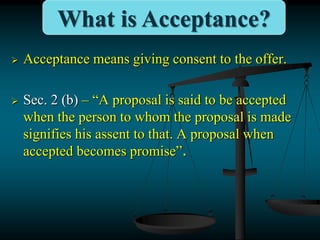
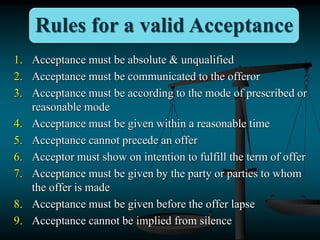
This document discusses the key rules regarding a valid acceptance in contract law. It defines acceptance under Indian law and outlines 9 rules for a valid acceptance, including that acceptance must be absolute and unqualified, communicated to the offeror according to the prescribed mode, given within a reasonable time period, and cannot be implied from silence unless previously indicated. It also provides further details on 3 specific rules - that acceptance must confirm with all terms of the offer, be given within a reasonable time if no time limit is specified, and generally cannot be implied from silence.
![1. Acceptance must be Absolute & unqualified
: [section – 7(1)] Acceptance must confirm
with the offer. In order to be binding,
acceptance must be absolute and unqualified
in respect of all terms of offer, whether
material or immaterial, major or minor. If
parties are not ad idem on all matters
concerning the offer and acceptance. There is
no contract.](https://image.slidesharecdn.com/legalrulesastovalidacceptance-201028085238/85/Legal-rules-as-to-valid-acceptance-4-320.jpg)



![[NALL OCR] HALL, Basil (1824). Extracts from a journal written on the coasts ...](https://cdn.slidesharecdn.com/ss_thumbnails/nallocrhallbasil1824-260202221936-b93ec330-thumbnail.jpg?width=640&height=640&fit=bounds)


