Royal Christian 1
JOINING & ASSEMBLING
Royal Christian 2
Methods of Joining &
Assembling
Gluing
Welding
Mechanical Connections
Royal Christian 3
Functions of Joining
For Permanent Joining
• Gluing
• Welding
For Disassembly
• Mechanical Connections
Royal Christian 4
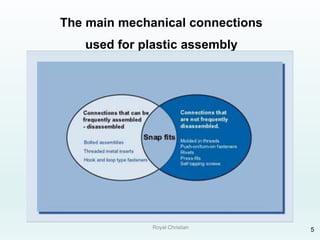
Types of Mechanical
Connections
• Bolted Assemblies
• Self Tapping Screws
• Snap Fits
• Threaded Metal
Inserts
• Hook and Loop Type
Fasteners
• Moulded-in-Threads
• Boss Cap
• Push-on / Turn-on
Fasteners
• Rivets
• Press Fits
Royal Christian 5
The main mechanical connections
used for plastic assembly
Royal Christian 6
Types of Gluing
Solvent Bonding
Adhesive Bonding
Royal Christian 7
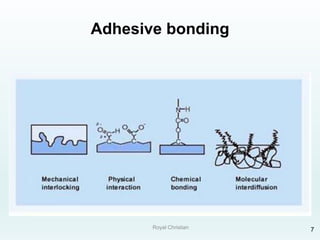
Adhesive bonding
Royal Christian 8
Solvent Bonding Advantages
• Homogeneous distribution of mechanical loads
• Good aesthetics
• Economic assembly
• Low weight, no heavy screws, bolts and nuts
• Heat sensitive constructions or materials, which
welding would distort or destroy, can be joined
• Good sealing and insulating properties.
Royal Christian 9
Solvent Bonding Limitations
• Entrapment of solvent in the joint
• Stress cracking or crazing
• Dissimilar materials can only be joined if both are soluble
in a common solvent or in a mixture of solvents
• Differences in thermal expansion of components are not
compensated if dissimilar materials are bonded
• Reproducibility/process control
• High solvent evaporation time due to its entrapment in
the polymer matrix
• No disassembly possible
• Assembly hazards such as fire or toxicity.
Royal Christian 10
Adhesive Bonding Advantages
• Application on various substrates like thermoplastics,
thermosets, elastomers and metals
• Homogenous distribution of mechanical loads
• Differences in thermal expansion of components can be
compensated for by using a thick adhesive layer
• Good aesthetics / no special requirements to hide the
bond.
• Economic assembly
• Low weight, no heavy screws, bolts and nuts
• Heat sensitive constructions or materials, which welding
would distort, can be joined
• No thermal stresses introduced
• Good sealing and insulating properties.
Royal Christian 11
Adhesive Bonding Limitations
• Long term behavior may not be very good
• Stress cracking or crazing of the plastic may
take place
• Dissimilar materials can only be joined if both
are compatible with the adhesive
• Reproducibility/process control
• Curing time can be high depending on the
adhesive
• No disassembly possible
• Assembly hazards such as fire or toxicity
Royal Christian 12
Welding
An effective method of permanently joining
plastics components together.
Royal Christian 13
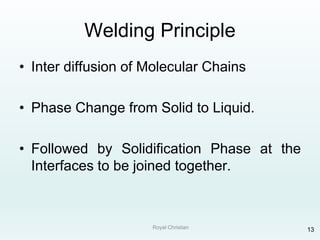
Welding Principle
• Inter diffusion of Molecular Chains
• Phase Change from Solid to Liquid.
• Followed by Solidification Phase at the
Interfaces to be joined together.
Royal Christian 14
Uniqueness of Welding
• Good Aesthetics
• Clean
• Strong Bond
Royal Christian 15
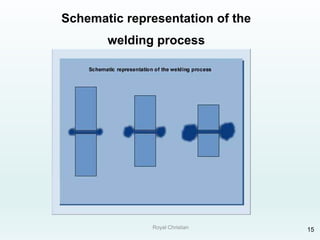
Schematic representation of the
welding process
Royal Christian 16
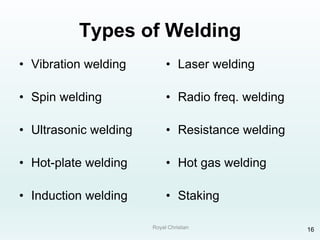
Types of Welding
• Vibration welding
• Spin welding
• Ultrasonic welding
• Hot-plate welding
• Induction welding
• Laser welding
• Radio freq. welding
• Resistance welding
• Hot gas welding
• Staking
Royal Christian 17
Vibration Welding
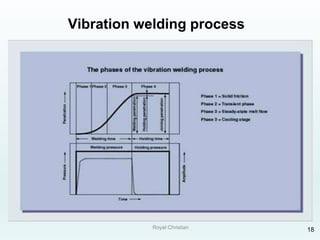
• the two plastic parts to be joined are vibrated
(rubbed) against each other at a certain
frequency, amplitude and pressure which results
in frictional heating of the surfaces, causing the
polymer to melt at the interface.
• The molten polymer flows out of the weld-zone
giving rise to flash. When vibration stops, the
weld cools down and solidifies.
Royal Christian 18
Vibration welding process
Royal Christian 19
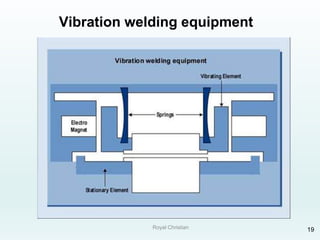
Vibration welding equipment
Royal Christian 20
Advantages of Vibration Welding
• Cost Effective
• Short Cycle Times
• Large Batch Sizes Possible
• Melted Polymer Not Exposed to Open Air
• Strong Bond
Royal Christian 21
Disadvantages of
Vibration Welding
• Welding Thermoplastic Elastomers is
problematic.
• Product is exposed to vibrations during
welding.
• Much flash is formed.
• 3D Contours can’t be welded.
Royal Christian 22
Spin Welding
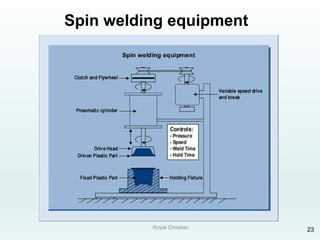
• The two parts to be welded are pressed against
each other.
• One part is held fixed and the other rotates at
high speed.
• The friction between the two parts generates
heat which causes the polymer to melt at the
interface.
• The molten polymer flows out of the weld-zone
giving rise to flash. When rotation stops, the
weld cools down and solidifies.
Royal Christian 23
Spin welding equipment
Royal Christian 24
Advantages of Spin Welding
• Efficient, Simple Process
• Simple Equipment
• Short Cycle Times
• Large Batch Sizes Possible
• Melted Polymer not Exposed to Open Air
• Strong Bond
Royal Christian 25
Disadvantages of Spin Welding
• Welding Thermoplastic Elastomers is
problematic.
• Only Circular Contours can be Welded.
• 3D Contours can not be Welded.
• Relative Position of the Parts can not be
Adjusted.
Royal Christian 26
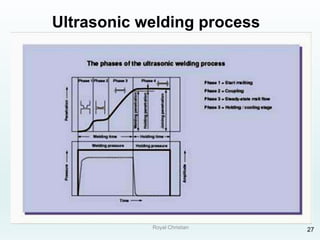
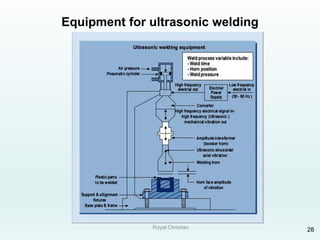
Ultrasonic Welding
• The process uses low amplitude and high
frequency vibrational energy.
• Parts to be joined are fixed firmly.
• Mating part is subjected to sinusoidal
Ultrasonic Vibrations of the order of 20,000
cycles per second.
Royal Christian 27
Ultrasonic welding process
Royal Christian 28
Equipment for ultrasonic welding
Royal Christian 29
Advantages of Ultrasonic Welding
• Cost Effective
• Short Cycle Times
• Large Batch Sizes Possible
• Melted Polymer Not Exposed to Open Air
Royal Christian 30
Disadvantages of Ultrasonic Welding
• Welding Thermoplastic Elastomers is
problematic.
• Product is exposed to vibrations during welding.
• Restricted to Small and Medium Size parts.
Royal Christian 31
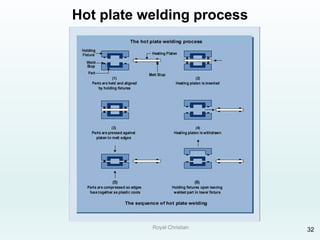
Hot Plate Welding
Uses thermal energy to melt the welding
zone through conduction.
Royal Christian 32
Hot plate welding process
Royal Christian 33
Advantages of
Hot Plate Welding
• Cost Effective
• Large Batch Size is Possible
• Suited for Soft Materials
• No Electrical Fields, No Mechanical Vibrations.
• Strong Bond
Royal Christian 34
Disadvantages of
Hot Plate Welding
• Long Cycle Times
• Molten Polymer Expose to Open Air
• Weld Strength is Poor for Certain Heat
Sensitive Materials.
Royal Christian 35
Induction Welding
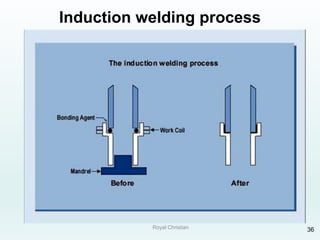
• Uses Inductive Energy to heat the Plastic.
• The bonding material melts and the parts
are joined under low pressure.
Royal Christian 36
Induction welding process
Royal Christian 37
Advantages of
Induction Welding
• Short Cycle Times.
• 3D Weld Surfaces are Possible
• Thermoplastic Elastomers can be welded.
• Can be used for highly filled materials
• Welding process is reversible (Repair,
Recycling).
• Tolerances on Part Dimensions not tight.
Royal Christian 38
Disadvantages of
Induction Welding
• Electro-magnetic Welding gasket Material is
required.
• Not well suited for parts containing
electromagnetic sensitive items (Metal Inserts).
Royal Christian 39
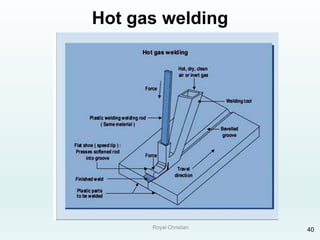
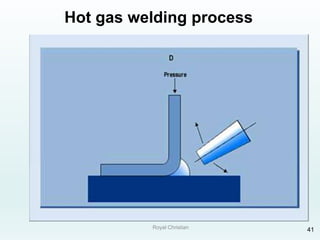
Hot Gas Welding
• Uses Hot Air or Nitrogen to Melt the Surfaces to
be joined.
• Process is extensively used for assembling large
parts.
• Suitable for field assembly and repair.
Royal Christian 40
Hot gas welding
Royal Christian 41
Hot gas welding process
Royal Christian 42
MACHINING OF PLASTICS
Royal Christian 43
Different Types of Cutting
• Sawing
• Laser Cutting
• Milling
• Turning & Boring
• Punching, Blanking and Die Cutting
Royal Christian 44
Different Types of Finishing
• Filing
• Sanding
• Grinding
• Polishing and Buffing
Royal Christian 45
SURFACE TREATMENT
Royal Christian 46
Uniqueness of
Surface Treatment
 Transforms the materials into more workable
substrates.
 Surface Treatment is a must before printing
for non-polar materials.
Royal Christian 47
Types of Surface Treatment
• Mechanical Abrasion
• Flame Treatment
• Chemical Etching
• Corona Treatment
• Plasma Treatment
Royal Christian 48
Different Types of Finishing
• Filing
• Sanding
• Grinding
• Polishing and Buffing
Royal Christian 49
METALLIZATION
Royal Christian 50
Uses of Metallization
 Enhances Reflectivity
 Improves Abrasion Resistance
 Has High Electrical Conductivity
 Provides Electromagnetic Shielding
Royal Christian 51
Types of Metallization
• Vacuum Metallization
• Plating
• Flame and Arc Spraying
Royal Christian 52
Types of
Vacuum Metallization
• Vacuum Evaporation
• Sputtering
Royal Christian 53
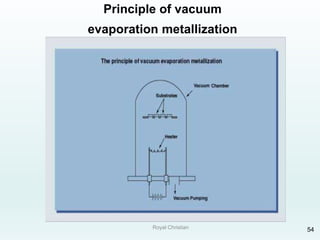
Vacuum Evaporation
• Metal usually Aluminum is heated to the point at
which it evaporates.
• The vapour is made to condense on the cold
plastic part.
• The process takes place in a vacuum in order to
allow, the metal to reach the plastic surface
without being oxidized.
Royal Christian 54
Principle of vacuum
evaporation metallization
Royal Christian 55
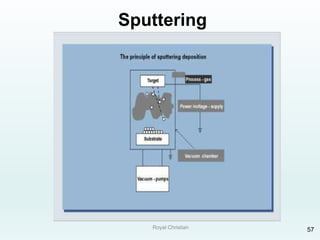
Sputtering
• Vacuum coating process in which the
coating material displaced by impact with
inert gas plasma.
Royal Christian 56
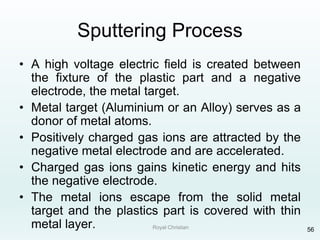
Sputtering Process
• A high voltage electric field is created between
the fixture of the plastic part and a negative
electrode, the metal target.
• Metal target (Aluminium or an Alloy) serves as a
donor of metal atoms.
• Positively charged gas ions are attracted by the
negative metal electrode and are accelerated.
• Charged gas ions gains kinetic energy and hits
the negative electrode.
• The metal ions escape from the solid metal
target and the plastics part is covered with thin
metal layer.
Royal Christian 57
Sputtering
Royal Christian 58
COATING PROCESS
Royal Christian 59
Types of Coating
• Extrusion Coating
• Calender Coating
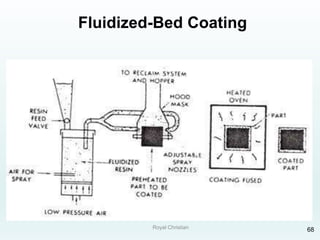
• Fluidized Bed Coating
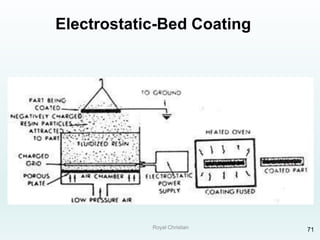
• Electrostatic Bed Coating
• Electrostatic Powder Gun Coating
• Transfer Coating
Royal Christian 60
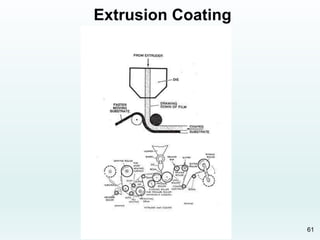
Extrusion Coating
Extrusion film coating is a technique in
which a hot film of plastics is placed on a
substrate and allowed to cool.
Royal Christian 61
Extrusion Coating
Royal Christian 62
Advantages of
Extrusion Coating
• Multilayer plastics may be placed on substrate.
• No solvents are needed.
• Thickness applied to substrate may be varied.
• Uniform coating thickness on wire and cable.
• Cellular coatings may be placed on substrate.
Royal Christian 63
Disadvantages of
Extrusion Coating
• Extrudates are hot melts.
• Equipment is expensive.
Royal Christian 64
Calender Coating
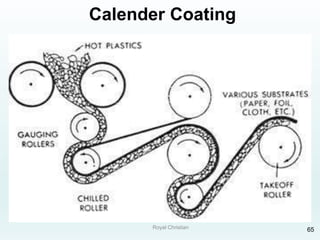
• Calendered films may be used as a coating on
many substrates, in a method similar to
extrusion coating.
• The hot film is squeezed on to the sub-strate by
the pressure of the heated gauging rollers
Royal Christian 65
Calender Coating
Royal Christian 66
Advantages of
Calender Coating
• High-speed continuous process.
• Precise thickness control.
• Pressure-sensitive and heat-reactive hot
melts may be used.
• Coatings are stress-free.
• Short runs are relatively economical.
Royal Christian 67
Disadvantages of
Calender Coating
• Equipment cost is high.
• Additional equipment needed for flat
stock.
Royal Christian 68
Fluidized-Bed Coating
Royal Christian 69
Advantages of
Fluidized Bed Coating
• Uniformity of Thickness.
• Thermoplastics and some thermosets may
be used.
• No solvents needed.
Royal Christian 70
Disadvantages of
Fluidized Bed Coating
• Substrate must be heated above plastics
melt or fusion temperature.
• Primer may be needed.
• Thin coatings are hard to control.
• Continuous automation of line is difficult.
• Post cure is needed.
• Surface finish may be uneven(Orange-peel).
Royal Christian 71
Electrostatic-Bed Coating
Royal Christian 72
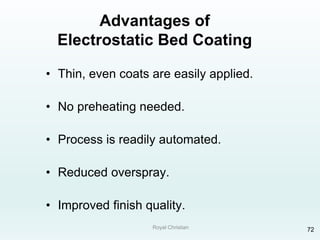
Advantages of
Electrostatic Bed Coating
• Thin, even coats are easily applied.
• No preheating needed.
• Process is readily automated.
• Reduced overspray.
• Improved finish quality.
Royal Christian 73
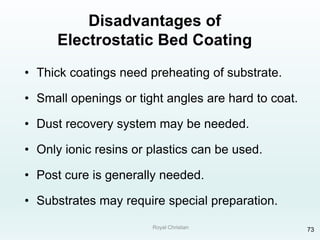
Disadvantages of
Electrostatic Bed Coating
• Thick coatings need preheating of substrate.
• Small openings or tight angles are hard to coat.
• Dust recovery system may be needed.
• Only ionic resins or plastics can be used.
• Post cure is generally needed.
• Substrates may require special preparation.
Royal Christian 74
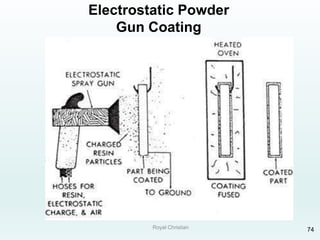
Electrostatic Powder
Gun Coating
Royal Christian 75
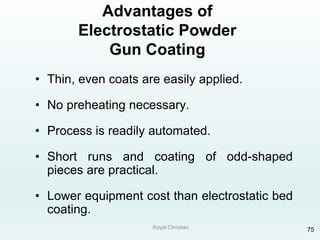
Advantages of
Electrostatic Powder
Gun Coating
• Thin, even coats are easily applied.
• No preheating necessary.
• Process is readily automated.
• Short runs and coating of odd-shaped
pieces are practical.
• Lower equipment cost than electrostatic bed
coating.
Royal Christian 76
Disadvantages of
Electrostatic Powder
Gun Coating
• Thick coatings need preheating of substrate.
• Small openings or tight angles are hard to coat
• Dust recovery system may be needed.
• Only ionic resins or plastics can be used.
• Post cure is needed.
• High labor cost.
• Thickness harder to control.
Royal Christian 77
PRINTING ON PLASTICS
Royal Christian 78
Types of Printing
 Pad Printing
 Screen Printing
 Flexographic Printing
 Rotogravure Printing
 In Mould Decoration
Royal Christian 79
Advantages of
Pad Printing
• Simple Process
• Cheap Process
• Multi-Colour Printing Possible
• Recommended for Flat Surfaces
Royal Christian 80
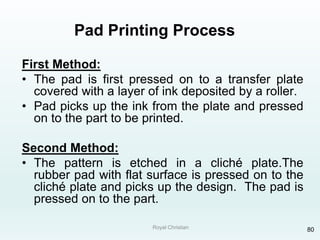
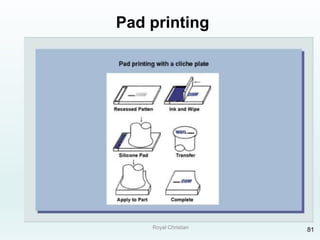
Pad Printing Process
First Method:
• The pad is first pressed on to a transfer plate
covered with a layer of ink deposited by a roller.
• Pad picks up the ink from the plate and pressed
on to the part to be printed.
Second Method:
• The pattern is etched in a cliché plate.The
rubber pad with flat surface is pressed on to the
cliché plate and picks up the design. The pad is
pressed on to the part.
Royal Christian 81
Pad printing
Royal Christian 82
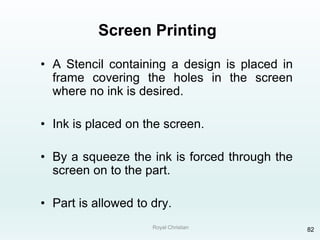
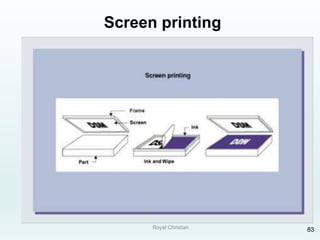
Screen Printing
• A Stencil containing a design is placed in
frame covering the holes in the screen
where no ink is desired.
• Ink is placed on the screen.
• By a squeeze the ink is forced through the
screen on to the part.
• Part is allowed to dry.
Royal Christian 83
Screen printing
Royal Christian 84
Flexographic Printing
• High Speed Printing
• Used for Printing on Films
• Recommended for Frequent Changes
• Multi-Colour designs can be produced
simultaneously.
Royal Christian 85
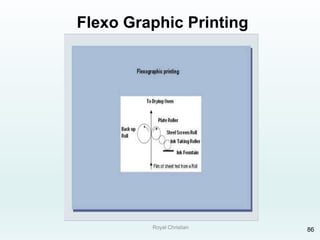
Flexographic Printing Process
• A rubber plate is attached to the plate roller.
• The plate roller picks-up the ink and
transfers it onto the film.
• Film after printing is passed through hot air
for drying.
Royal Christian 86
Flexo Graphic Printing
Royal Christian 87
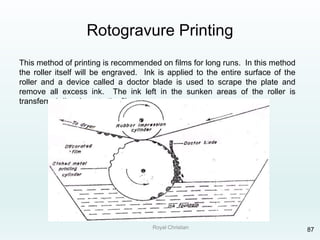
Rotogravure Printing
This method of printing is recommended on films for long runs. In this method
the roller itself will be engraved. Ink is applied to the entire surface of the
roller and a device called a doctor blade is used to scrape the plate and
remove all excess ink. The ink left in the sunken areas of the roller is
transferred directly on to the film.
Royal Christian 88
DIP MOULDING
Royal Christian 89
Dip Moulding Process
 Process in which heated moulds are
immersed in plastisol.
 Plastisol sticks to the hot mould and the
part is formed.
 Parts are stripped from the mould
Royal Christian 90
Types of
Dip Moulding Machines
• In line Machines
• Rotary Machines
• Advanced Machines
• Dual Path Machines
Royal Christian 91
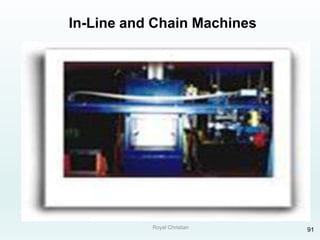
In-Line and Chain Machines
Royal Christian 92
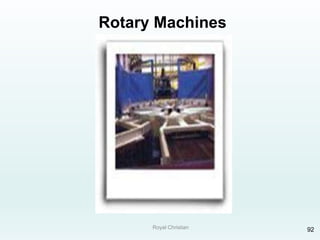
Rotary Machines
Royal Christian 93
Advantages of Dip Moulding
• Low tooling costs typically a fraction of injection
molding
• Quick and inexpensive prototypes
• Short lead-times on custom tooling weeks
versus months
• No internal stress molded into parts
• Large parts can be made without significant
tooling investment.
• Multi-Dipping capabilities allow us to design
products with two colors or materials on one part
- typically used for making products with durable
inside liners and more consumer friendly
exteriors.
Royal Christian 94
Limitations of Dip Moulding
• Internal dimensions, tolerances are
often much higher than on injection
molded parts.
Royal Christian 95
Applications of
Dip Moulding
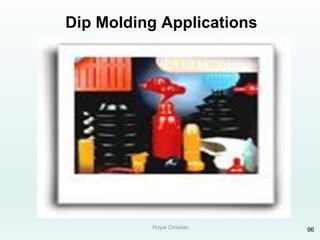
• Handle Grips
• Caps
• Plugs
• Handles
• Bellows
• Boots
• Closures
Royal Christian 96
Dip Molding Applications
Royal Christian 97
CASTING PROCESS
Royal Christian 98
Casting
• Liquid Resins or Molten Plastics mixed
with Catalyst is poured in to moulds.
• Allowed to Polymerize or Cool.
• Parts are removed.
• Finishing Operations are done as
desired.
Royal Christian 99
Product Range
• Sheets
• Rods
• Tubes
• Table Tops
• Sinks
• Fancy Buttons
• Watch Crystals
• Furniture Parts etc.
Royal Christian 100
Types of Casting
 Simple Casting
 Solvent Casting
 Hot Melt Casting
 Rotational Casting
 Slush Casting
Royal Christian 101
Solvent Casting
• Solvent Solution of Plastic Poured on to a
Stainless Steel Belt.
• Solvent is evaporated by addition of heat.
• Film deposit on the belt is stripped and
wound on roller.
Royal Christian 102
Advantages of
Solvent Casting
• Additives for heat stabilization and for
lubrication are not needed.
• Films are uniform in thickness and optically
clear.
• No orientation are stress is possible with
this method.
Royal Christian 103
Hot Melt Casting
• Used for potting and encapsulation.
• Electrical parts to be protected from
hostile environments are placed in
moulds and hot resin is poured over
the components.
• When cooled, the plastic provides
protection for the part.
Royal Christian 104
Slush Casting
• Pouring dispersions of PVC or Plastisols
in to heated hollow open mould.
• Material solidifies as it strikes the walls of
the mould.
Royal Christian 105
Applications of
Slush Casting
• Hollow parts of dolls
• Rain Boots
Royal Christian 106
Rotational Casting
• Plastics Powders or Monomers are placed
in one half of the mould.
• Keep the other half and the mould is
placed in an oven.
• Mould is rotated bi-axially.
• The plastics fuses as it touches hot mould
surface.
Royal Christian 107
Applications of
Rotational Casting
• Ice Chests
• Boxes
• Large Commercial Containers

Secondary plastic processing Techniques i

  • 1.
  • 2.
    Royal Christian 2 Methodsof Joining & Assembling Gluing Welding Mechanical Connections
  • 3.
    Royal Christian 3 Functionsof Joining For Permanent Joining • Gluing • Welding For Disassembly • Mechanical Connections
  • 4.
    Royal Christian 4 Typesof Mechanical Connections • Bolted Assemblies • Self Tapping Screws • Snap Fits • Threaded Metal Inserts • Hook and Loop Type Fasteners • Moulded-in-Threads • Boss Cap • Push-on / Turn-on Fasteners • Rivets • Press Fits
  • 5.
    Royal Christian 5 Themain mechanical connections used for plastic assembly
  • 6.
    Royal Christian 6 Typesof Gluing Solvent Bonding Adhesive Bonding
  • 7.
  • 8.
    Royal Christian 8 SolventBonding Advantages • Homogeneous distribution of mechanical loads • Good aesthetics • Economic assembly • Low weight, no heavy screws, bolts and nuts • Heat sensitive constructions or materials, which welding would distort or destroy, can be joined • Good sealing and insulating properties.
  • 9.
    Royal Christian 9 SolventBonding Limitations • Entrapment of solvent in the joint • Stress cracking or crazing • Dissimilar materials can only be joined if both are soluble in a common solvent or in a mixture of solvents • Differences in thermal expansion of components are not compensated if dissimilar materials are bonded • Reproducibility/process control • High solvent evaporation time due to its entrapment in the polymer matrix • No disassembly possible • Assembly hazards such as fire or toxicity.
  • 10.
    Royal Christian 10 AdhesiveBonding Advantages • Application on various substrates like thermoplastics, thermosets, elastomers and metals • Homogenous distribution of mechanical loads • Differences in thermal expansion of components can be compensated for by using a thick adhesive layer • Good aesthetics / no special requirements to hide the bond. • Economic assembly • Low weight, no heavy screws, bolts and nuts • Heat sensitive constructions or materials, which welding would distort, can be joined • No thermal stresses introduced • Good sealing and insulating properties.
  • 11.
    Royal Christian 11 AdhesiveBonding Limitations • Long term behavior may not be very good • Stress cracking or crazing of the plastic may take place • Dissimilar materials can only be joined if both are compatible with the adhesive • Reproducibility/process control • Curing time can be high depending on the adhesive • No disassembly possible • Assembly hazards such as fire or toxicity
  • 12.
    Royal Christian 12 Welding Aneffective method of permanently joining plastics components together.
  • 13.
    Royal Christian 13 WeldingPrinciple • Inter diffusion of Molecular Chains • Phase Change from Solid to Liquid. • Followed by Solidification Phase at the Interfaces to be joined together.
  • 14.
    Royal Christian 14 Uniquenessof Welding • Good Aesthetics • Clean • Strong Bond
  • 15.
    Royal Christian 15 Schematicrepresentation of the welding process
  • 16.
    Royal Christian 16 Typesof Welding • Vibration welding • Spin welding • Ultrasonic welding • Hot-plate welding • Induction welding • Laser welding • Radio freq. welding • Resistance welding • Hot gas welding • Staking
  • 17.
    Royal Christian 17 VibrationWelding • the two plastic parts to be joined are vibrated (rubbed) against each other at a certain frequency, amplitude and pressure which results in frictional heating of the surfaces, causing the polymer to melt at the interface. • The molten polymer flows out of the weld-zone giving rise to flash. When vibration stops, the weld cools down and solidifies.
  • 18.
  • 19.
  • 20.
    Royal Christian 20 Advantagesof Vibration Welding • Cost Effective • Short Cycle Times • Large Batch Sizes Possible • Melted Polymer Not Exposed to Open Air • Strong Bond
  • 21.
    Royal Christian 21 Disadvantagesof Vibration Welding • Welding Thermoplastic Elastomers is problematic. • Product is exposed to vibrations during welding. • Much flash is formed. • 3D Contours can’t be welded.
  • 22.
    Royal Christian 22 SpinWelding • The two parts to be welded are pressed against each other. • One part is held fixed and the other rotates at high speed. • The friction between the two parts generates heat which causes the polymer to melt at the interface. • The molten polymer flows out of the weld-zone giving rise to flash. When rotation stops, the weld cools down and solidifies.
  • 23.
    Royal Christian 23 Spinwelding equipment
  • 24.
    Royal Christian 24 Advantagesof Spin Welding • Efficient, Simple Process • Simple Equipment • Short Cycle Times • Large Batch Sizes Possible • Melted Polymer not Exposed to Open Air • Strong Bond
  • 25.
    Royal Christian 25 Disadvantagesof Spin Welding • Welding Thermoplastic Elastomers is problematic. • Only Circular Contours can be Welded. • 3D Contours can not be Welded. • Relative Position of the Parts can not be Adjusted.
  • 26.
    Royal Christian 26 UltrasonicWelding • The process uses low amplitude and high frequency vibrational energy. • Parts to be joined are fixed firmly. • Mating part is subjected to sinusoidal Ultrasonic Vibrations of the order of 20,000 cycles per second.
  • 27.
  • 28.
    Royal Christian 28 Equipmentfor ultrasonic welding
  • 29.
    Royal Christian 29 Advantagesof Ultrasonic Welding • Cost Effective • Short Cycle Times • Large Batch Sizes Possible • Melted Polymer Not Exposed to Open Air
  • 30.
    Royal Christian 30 Disadvantagesof Ultrasonic Welding • Welding Thermoplastic Elastomers is problematic. • Product is exposed to vibrations during welding. • Restricted to Small and Medium Size parts.
  • 31.
    Royal Christian 31 HotPlate Welding Uses thermal energy to melt the welding zone through conduction.
  • 32.
    Royal Christian 32 Hotplate welding process
  • 33.
    Royal Christian 33 Advantagesof Hot Plate Welding • Cost Effective • Large Batch Size is Possible • Suited for Soft Materials • No Electrical Fields, No Mechanical Vibrations. • Strong Bond
  • 34.
    Royal Christian 34 Disadvantagesof Hot Plate Welding • Long Cycle Times • Molten Polymer Expose to Open Air • Weld Strength is Poor for Certain Heat Sensitive Materials.
  • 35.
    Royal Christian 35 InductionWelding • Uses Inductive Energy to heat the Plastic. • The bonding material melts and the parts are joined under low pressure.
  • 36.
  • 37.
    Royal Christian 37 Advantagesof Induction Welding • Short Cycle Times. • 3D Weld Surfaces are Possible • Thermoplastic Elastomers can be welded. • Can be used for highly filled materials • Welding process is reversible (Repair, Recycling). • Tolerances on Part Dimensions not tight.
  • 38.
    Royal Christian 38 Disadvantagesof Induction Welding • Electro-magnetic Welding gasket Material is required. • Not well suited for parts containing electromagnetic sensitive items (Metal Inserts).
  • 39.
    Royal Christian 39 HotGas Welding • Uses Hot Air or Nitrogen to Melt the Surfaces to be joined. • Process is extensively used for assembling large parts. • Suitable for field assembly and repair.
  • 40.
  • 41.
    Royal Christian 41 Hotgas welding process
  • 42.
  • 43.
    Royal Christian 43 DifferentTypes of Cutting • Sawing • Laser Cutting • Milling • Turning & Boring • Punching, Blanking and Die Cutting
  • 44.
    Royal Christian 44 DifferentTypes of Finishing • Filing • Sanding • Grinding • Polishing and Buffing
  • 45.
  • 46.
    Royal Christian 46 Uniquenessof Surface Treatment  Transforms the materials into more workable substrates.  Surface Treatment is a must before printing for non-polar materials.
  • 47.
    Royal Christian 47 Typesof Surface Treatment • Mechanical Abrasion • Flame Treatment • Chemical Etching • Corona Treatment • Plasma Treatment
  • 48.
    Royal Christian 48 DifferentTypes of Finishing • Filing • Sanding • Grinding • Polishing and Buffing
  • 49.
  • 50.
    Royal Christian 50 Usesof Metallization  Enhances Reflectivity  Improves Abrasion Resistance  Has High Electrical Conductivity  Provides Electromagnetic Shielding
  • 51.
    Royal Christian 51 Typesof Metallization • Vacuum Metallization • Plating • Flame and Arc Spraying
  • 52.
    Royal Christian 52 Typesof Vacuum Metallization • Vacuum Evaporation • Sputtering
  • 53.
    Royal Christian 53 VacuumEvaporation • Metal usually Aluminum is heated to the point at which it evaporates. • The vapour is made to condense on the cold plastic part. • The process takes place in a vacuum in order to allow, the metal to reach the plastic surface without being oxidized.
  • 54.
    Royal Christian 54 Principleof vacuum evaporation metallization
  • 55.
    Royal Christian 55 Sputtering •Vacuum coating process in which the coating material displaced by impact with inert gas plasma.
  • 56.
    Royal Christian 56 SputteringProcess • A high voltage electric field is created between the fixture of the plastic part and a negative electrode, the metal target. • Metal target (Aluminium or an Alloy) serves as a donor of metal atoms. • Positively charged gas ions are attracted by the negative metal electrode and are accelerated. • Charged gas ions gains kinetic energy and hits the negative electrode. • The metal ions escape from the solid metal target and the plastics part is covered with thin metal layer.
  • 57.
  • 58.
  • 59.
    Royal Christian 59 Typesof Coating • Extrusion Coating • Calender Coating • Fluidized Bed Coating • Electrostatic Bed Coating • Electrostatic Powder Gun Coating • Transfer Coating
  • 60.
    Royal Christian 60 ExtrusionCoating Extrusion film coating is a technique in which a hot film of plastics is placed on a substrate and allowed to cool.
  • 61.
  • 62.
    Royal Christian 62 Advantagesof Extrusion Coating • Multilayer plastics may be placed on substrate. • No solvents are needed. • Thickness applied to substrate may be varied. • Uniform coating thickness on wire and cable. • Cellular coatings may be placed on substrate.
  • 63.
    Royal Christian 63 Disadvantagesof Extrusion Coating • Extrudates are hot melts. • Equipment is expensive.
  • 64.
    Royal Christian 64 CalenderCoating • Calendered films may be used as a coating on many substrates, in a method similar to extrusion coating. • The hot film is squeezed on to the sub-strate by the pressure of the heated gauging rollers
  • 65.
  • 66.
    Royal Christian 66 Advantagesof Calender Coating • High-speed continuous process. • Precise thickness control. • Pressure-sensitive and heat-reactive hot melts may be used. • Coatings are stress-free. • Short runs are relatively economical.
  • 67.
    Royal Christian 67 Disadvantagesof Calender Coating • Equipment cost is high. • Additional equipment needed for flat stock.
  • 68.
  • 69.
    Royal Christian 69 Advantagesof Fluidized Bed Coating • Uniformity of Thickness. • Thermoplastics and some thermosets may be used. • No solvents needed.
  • 70.
    Royal Christian 70 Disadvantagesof Fluidized Bed Coating • Substrate must be heated above plastics melt or fusion temperature. • Primer may be needed. • Thin coatings are hard to control. • Continuous automation of line is difficult. • Post cure is needed. • Surface finish may be uneven(Orange-peel).
  • 71.
  • 72.
    Royal Christian 72 Advantagesof Electrostatic Bed Coating • Thin, even coats are easily applied. • No preheating needed. • Process is readily automated. • Reduced overspray. • Improved finish quality.
  • 73.
    Royal Christian 73 Disadvantagesof Electrostatic Bed Coating • Thick coatings need preheating of substrate. • Small openings or tight angles are hard to coat. • Dust recovery system may be needed. • Only ionic resins or plastics can be used. • Post cure is generally needed. • Substrates may require special preparation.
  • 74.
  • 75.
    Royal Christian 75 Advantagesof Electrostatic Powder Gun Coating • Thin, even coats are easily applied. • No preheating necessary. • Process is readily automated. • Short runs and coating of odd-shaped pieces are practical. • Lower equipment cost than electrostatic bed coating.
  • 76.
    Royal Christian 76 Disadvantagesof Electrostatic Powder Gun Coating • Thick coatings need preheating of substrate. • Small openings or tight angles are hard to coat • Dust recovery system may be needed. • Only ionic resins or plastics can be used. • Post cure is needed. • High labor cost. • Thickness harder to control.
  • 77.
  • 78.
    Royal Christian 78 Typesof Printing  Pad Printing  Screen Printing  Flexographic Printing  Rotogravure Printing  In Mould Decoration
  • 79.
    Royal Christian 79 Advantagesof Pad Printing • Simple Process • Cheap Process • Multi-Colour Printing Possible • Recommended for Flat Surfaces
  • 80.
    Royal Christian 80 PadPrinting Process First Method: • The pad is first pressed on to a transfer plate covered with a layer of ink deposited by a roller. • Pad picks up the ink from the plate and pressed on to the part to be printed. Second Method: • The pattern is etched in a cliché plate.The rubber pad with flat surface is pressed on to the cliché plate and picks up the design. The pad is pressed on to the part.
  • 81.
  • 82.
    Royal Christian 82 ScreenPrinting • A Stencil containing a design is placed in frame covering the holes in the screen where no ink is desired. • Ink is placed on the screen. • By a squeeze the ink is forced through the screen on to the part. • Part is allowed to dry.
  • 83.
  • 84.
    Royal Christian 84 FlexographicPrinting • High Speed Printing • Used for Printing on Films • Recommended for Frequent Changes • Multi-Colour designs can be produced simultaneously.
  • 85.
    Royal Christian 85 FlexographicPrinting Process • A rubber plate is attached to the plate roller. • The plate roller picks-up the ink and transfers it onto the film. • Film after printing is passed through hot air for drying.
  • 86.
    Royal Christian 86 FlexoGraphic Printing
  • 87.
    Royal Christian 87 RotogravurePrinting This method of printing is recommended on films for long runs. In this method the roller itself will be engraved. Ink is applied to the entire surface of the roller and a device called a doctor blade is used to scrape the plate and remove all excess ink. The ink left in the sunken areas of the roller is transferred directly on to the film.
  • 88.
  • 89.
    Royal Christian 89 DipMoulding Process  Process in which heated moulds are immersed in plastisol.  Plastisol sticks to the hot mould and the part is formed.  Parts are stripped from the mould
  • 90.
    Royal Christian 90 Typesof Dip Moulding Machines • In line Machines • Rotary Machines • Advanced Machines • Dual Path Machines
  • 91.
    Royal Christian 91 In-Lineand Chain Machines
  • 92.
  • 93.
    Royal Christian 93 Advantagesof Dip Moulding • Low tooling costs typically a fraction of injection molding • Quick and inexpensive prototypes • Short lead-times on custom tooling weeks versus months • No internal stress molded into parts • Large parts can be made without significant tooling investment. • Multi-Dipping capabilities allow us to design products with two colors or materials on one part - typically used for making products with durable inside liners and more consumer friendly exteriors.
  • 94.
    Royal Christian 94 Limitationsof Dip Moulding • Internal dimensions, tolerances are often much higher than on injection molded parts.
  • 95.
    Royal Christian 95 Applicationsof Dip Moulding • Handle Grips • Caps • Plugs • Handles • Bellows • Boots • Closures
  • 96.
    Royal Christian 96 DipMolding Applications
  • 97.
  • 98.
    Royal Christian 98 Casting •Liquid Resins or Molten Plastics mixed with Catalyst is poured in to moulds. • Allowed to Polymerize or Cool. • Parts are removed. • Finishing Operations are done as desired.
  • 99.
    Royal Christian 99 ProductRange • Sheets • Rods • Tubes • Table Tops • Sinks • Fancy Buttons • Watch Crystals • Furniture Parts etc.
  • 100.
    Royal Christian 100 Typesof Casting  Simple Casting  Solvent Casting  Hot Melt Casting  Rotational Casting  Slush Casting
  • 101.
    Royal Christian 101 SolventCasting • Solvent Solution of Plastic Poured on to a Stainless Steel Belt. • Solvent is evaporated by addition of heat. • Film deposit on the belt is stripped and wound on roller.
  • 102.
    Royal Christian 102 Advantagesof Solvent Casting • Additives for heat stabilization and for lubrication are not needed. • Films are uniform in thickness and optically clear. • No orientation are stress is possible with this method.
  • 103.
    Royal Christian 103 HotMelt Casting • Used for potting and encapsulation. • Electrical parts to be protected from hostile environments are placed in moulds and hot resin is poured over the components. • When cooled, the plastic provides protection for the part.
  • 104.
    Royal Christian 104 SlushCasting • Pouring dispersions of PVC or Plastisols in to heated hollow open mould. • Material solidifies as it strikes the walls of the mould.
  • 105.
    Royal Christian 105 Applicationsof Slush Casting • Hollow parts of dolls • Rain Boots
  • 106.
    Royal Christian 106 RotationalCasting • Plastics Powders or Monomers are placed in one half of the mould. • Keep the other half and the mould is placed in an oven. • Mould is rotated bi-axially. • The plastics fuses as it touches hot mould surface.
  • 107.
    Royal Christian 107 Applicationsof Rotational Casting • Ice Chests • Boxes • Large Commercial Containers