
End-of-life BEV
AHMED SAMIR ELBERMBALI
AKSHAY CHANDEKAR
MANINDERPAL SINGH
11.02.2020
Agenda
o Introduction
o Challenges
o Current end-of-life processes
o Future end-of-life needs
o Future reuse and recycling
o Case studies
o Environmental impacts of end-of-life stage
Introduction
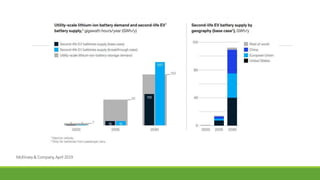
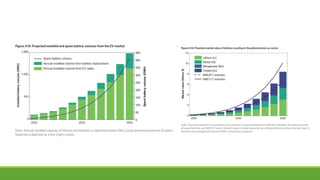
• By 2025, there will be between 40 and 70 million BEVs globally (IEA, 2017b).
• Stationary storage powered by used EV batteries, which could exceed 200
gigawatt-hours by 2030 (McKinsey & Company, April 2019).
• Which by 2030 will constitute a market with global value worth of $30 billion.
• In 2025, second-life batteries are 30-70% less expensive and by 2040 would
drop by 25% (McKinsey & Co., April 2019)
McKinsey& Company,April2019
Challenges
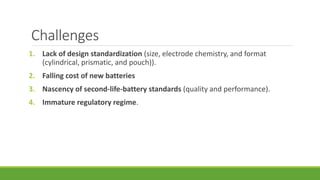
1. Lack of design standardization (size, electrode chemistry, and format
(cylindrical, prismatic, and pouch)).
2. Falling cost of new batteries
3. Nascency of second-life-battery standards (quality and performance).
4. Immature regulatory regime.
Current end-of-life processes
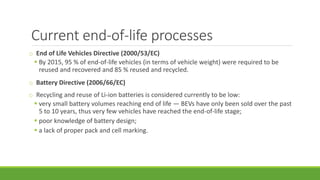
o End of Life Vehicles Directive (2000/53/EC)
▪ By 2015, 95 % of end-of-life vehicles (in terms of vehicle weight) were required to be
reused and recovered and 85 % reused and recycled.
o Battery Directive (2006/66/EC)
o Recycling and reuse of Li-ion batteries is considered currently to be low:
▪ very small battery volumes reaching end of life — BEVs have only been sold over the past
5 to 10 years, thus very few vehicles have reached the end-of-life stage;
▪ poor knowledge of battery design;
▪ a lack of proper pack and cell marking.
Future end-of-life needs
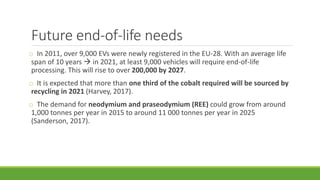
o In 2011, over 9,000 EVs were newly registered in the EU-28. With an average life
span of 10 years → in 2021, at least 9,000 vehicles will require end-of-life
processing. This will rise to over 200,000 by 2027.
o It is expected that more than one third of the cobalt required will be sourced by
recycling in 2021 (Harvey, 2017).
o The demand for neodymium and praseodymium (REE) could grow from around
1,000 tonnes per year in 2015 to around 11 000 tonnes per year in 2025
(Sanderson, 2017).
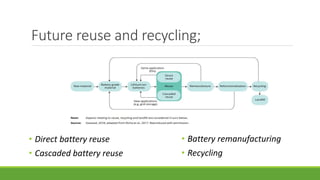
Future reuse and recycling;
• Direct battery reuse
• Cascaded battery reuse
• Battery remanufacturing
• Recycling
Case studies
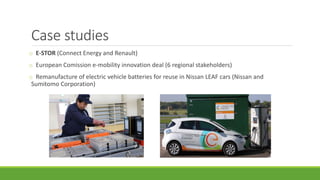
o E-STOR (Connect Energy and Renault)
o European Comission e-mobility innovation deal (6 regional stakeholders)
o Remanufacture of electric vehicle batteries for reuse in Nissan LEAF cars (Nissan and
Sumitomo Corporation)
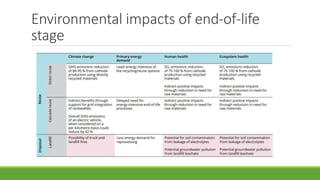
Environmental impacts of end-of-life
stage
Thank You

Second Life Electric Vehicle Battery

  • 1.
    End-of-life BEV AHMED SAMIRELBERMBALI AKSHAY CHANDEKAR MANINDERPAL SINGH 11.02.2020
  • 2.
    Agenda o Introduction o Challenges oCurrent end-of-life processes o Future end-of-life needs o Future reuse and recycling o Case studies o Environmental impacts of end-of-life stage
  • 3.
    Introduction • By 2025,there will be between 40 and 70 million BEVs globally (IEA, 2017b). • Stationary storage powered by used EV batteries, which could exceed 200 gigawatt-hours by 2030 (McKinsey & Company, April 2019). • Which by 2030 will constitute a market with global value worth of $30 billion. • In 2025, second-life batteries are 30-70% less expensive and by 2040 would drop by 25% (McKinsey & Co., April 2019)
  • 4.
  • 6.
    Challenges 1. Lack ofdesign standardization (size, electrode chemistry, and format (cylindrical, prismatic, and pouch)). 2. Falling cost of new batteries 3. Nascency of second-life-battery standards (quality and performance). 4. Immature regulatory regime.
  • 7.
    Current end-of-life processes oEnd of Life Vehicles Directive (2000/53/EC) ▪ By 2015, 95 % of end-of-life vehicles (in terms of vehicle weight) were required to be reused and recovered and 85 % reused and recycled. o Battery Directive (2006/66/EC) o Recycling and reuse of Li-ion batteries is considered currently to be low: ▪ very small battery volumes reaching end of life — BEVs have only been sold over the past 5 to 10 years, thus very few vehicles have reached the end-of-life stage; ▪ poor knowledge of battery design; ▪ a lack of proper pack and cell marking.
  • 8.
    Future end-of-life needs oIn 2011, over 9,000 EVs were newly registered in the EU-28. With an average life span of 10 years → in 2021, at least 9,000 vehicles will require end-of-life processing. This will rise to over 200,000 by 2027. o It is expected that more than one third of the cobalt required will be sourced by recycling in 2021 (Harvey, 2017). o The demand for neodymium and praseodymium (REE) could grow from around 1,000 tonnes per year in 2015 to around 11 000 tonnes per year in 2025 (Sanderson, 2017).
  • 9.
    Future reuse andrecycling; • Direct battery reuse • Cascaded battery reuse • Battery remanufacturing • Recycling
  • 10.
    Case studies o E-STOR(Connect Energy and Renault) o European Comission e-mobility innovation deal (6 regional stakeholders) o Remanufacture of electric vehicle batteries for reuse in Nissan LEAF cars (Nissan and Sumitomo Corporation)
  • 11.
    Environmental impacts ofend-of-life stage
  • 12.