Will  Googl  i f i c a t i o n    of our lives continue?   or will new  search&find  paradigms   emerge on the web? Eric Sieverts Media, Informatie & Communicatie  (Hogeschool van Amsterdam) ZV26 maart 2011
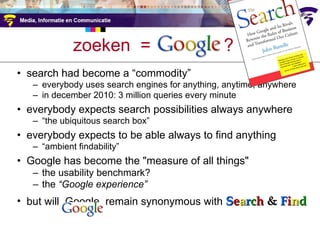
zoeken  =  google  ? search had become a  “commodity”  everybody uses search engines for anything, anytime, anywhere in december 2010: 3 million queries every minute everybody expects search possibilities always anywhere “ the ubiquitous search box” everybody expects to be able always to find anything “ ambient findability” Google has become the "measure of all things" the usability benchmark?  the  “Google experience” but will  Google  remain synonymous with  S e a r c h  &  F i n d
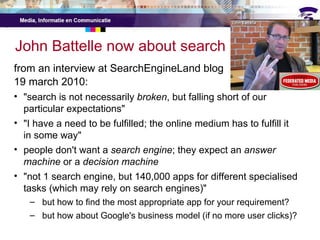
John Battelle now about search from an interview at SearchEngineLand blog 19 march 2010: "search is not necessarily  broken , but falling short of our particular expectations" "I have a need to be fulfilled; the online medium has to fulfill it in some way" people don't want a  search engine ; they expect an  answer machine  or a  decision machine "not 1 search engine, but 140,000 apps for different specialised tasks (which may rely on search engines)" but how to find the most appropriate app for your requirement? but how about Google's business model (if no more user clicks)?
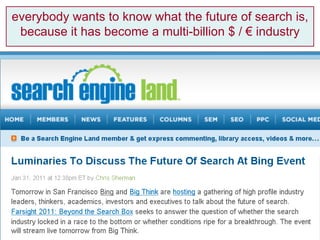
everybody wants to know what the future of search is, because it has become a multi-billion $ /  € industry
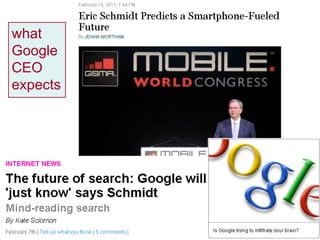
what Google CEO expects
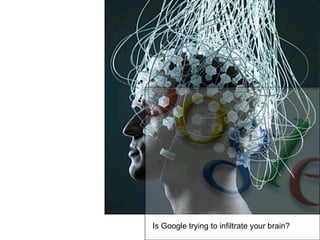
Is Google trying to infiltrate your brain?
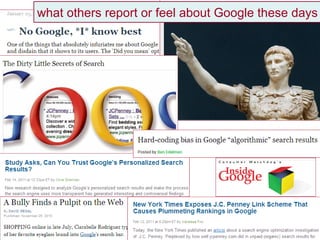
what others report or feel about Google these days
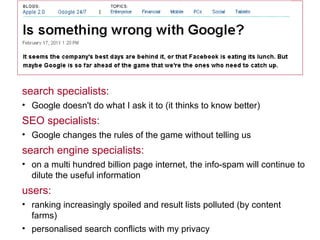
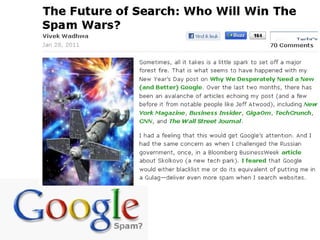
search specialists:  Google doesn't do what I ask it to (it thinks to know better) SEO specialists: Google changes the rules of the game without telling us search engine specialists: on a multi hundred billion page internet, the info-spam will continue to dilute the useful information users: ranking increasingly spoiled and result lists polluted (by content farms) personalised search conflicts with my privacy
 
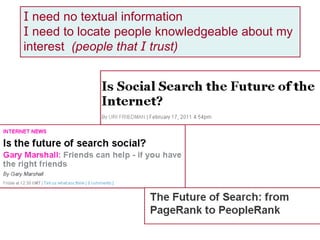
I  need no textual information I  need to locate people knowledgeable about my interest  (people that  I  trust)
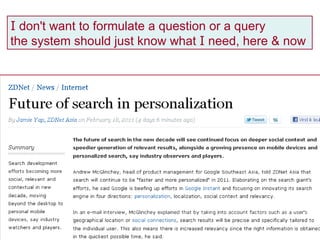
I  don't want to formulate a question or a query the system should just know what  I  need, here & now
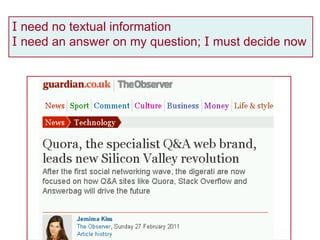
I  need no textual information I  need an answer on my question;  I  must decide now
 
 
http://is.gd/9E3brw
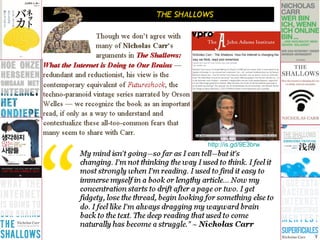
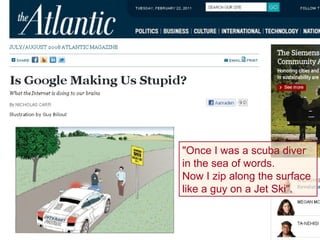
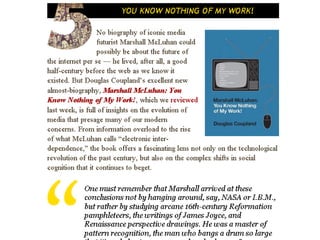
"Once I was a scuba diver  in the sea of words.  Now I zip along the surface  like a guy on a Jet Ski".


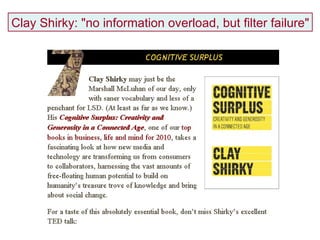
Clay Shirky: "no information overload, but filter failure"
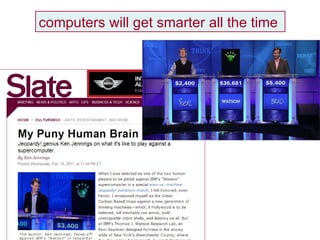
computers will get smarter all the time
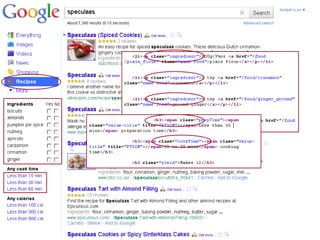
the internet will get smarter as well or rather: the information on the internet will get smarter on the  "semantic web"  the meaning of information will increasingly be known (for computers)
 
 
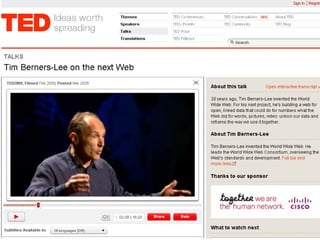
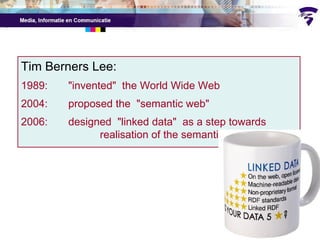
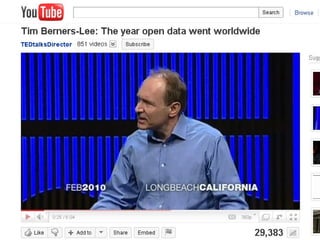
Tim Berners Lee: 1989:  "invented"  the World Wide Web 2004:  proposed  the  "semantic web" 2006: designed  "linked data"  as a step towards  realisation of the semantic web
 
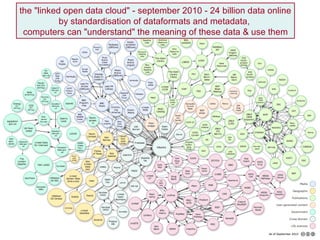
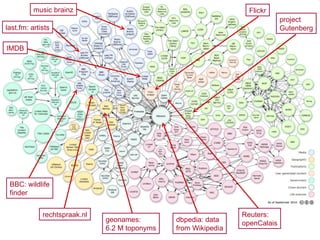
the "linked open data cloud" - september 2010 - 24 billion data online by standardisation of dataformats and metadata,  computers can "understand" the meaning of these data & use them
dbpedia: data  from Wikipedia last.fm: artists geonames: 6.2 M toponyms BBC: wildlife finder Flickr project  Gutenberg IMDB music brainz rechtspraak.nl Reuters: openCalais
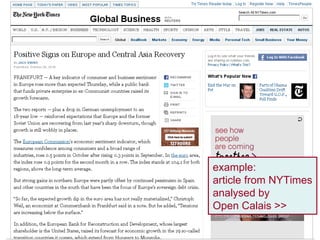
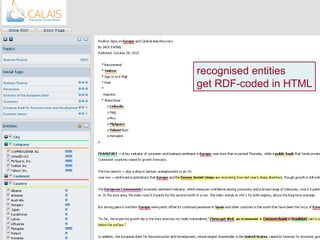
example: article from NYTimes analysed by Open Calais >>
recognised entities get RDF-coded in HTML
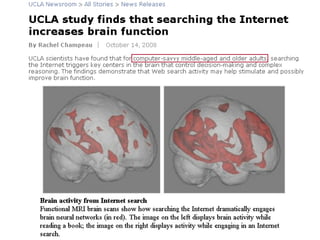
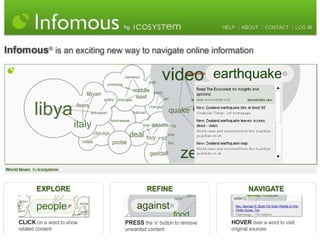
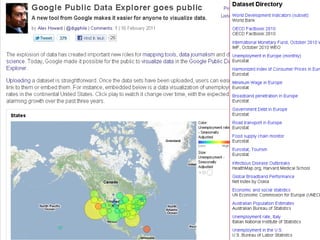
I  don't want to read all this textual information I  just want it quickly visualised, what it all means (is Nicholas Carr still right after all ?) oscar-tweets
 
 
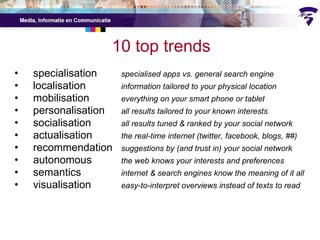
10 top trends specialisation specialised apps vs. general search engine localisation information tailored to your physical location mobilisation everything on your smart phone or tablet personalisation all results tailored to your known interests socialisation all results tuned & ranked by your social network actualisation the real-time internet (twitter, facebook, blogs, ##) recommendation suggestions by (and trust in) your social network autonomous the web knows your interests and preferences semantics internet & search engines know the meaning of it all visualisation easy-to-interpret overviews instead of texts to read

Searchtrends

  • 1.
    Will Googl i f i c a t i o n of our lives continue? or will new search&find paradigms emerge on the web? Eric Sieverts Media, Informatie & Communicatie (Hogeschool van Amsterdam) ZV26 maart 2011
  • 2.
    zoeken = google ? search had become a “commodity” everybody uses search engines for anything, anytime, anywhere in december 2010: 3 million queries every minute everybody expects search possibilities always anywhere “ the ubiquitous search box” everybody expects to be able always to find anything “ ambient findability” Google has become the "measure of all things" the usability benchmark? the “Google experience” but will Google remain synonymous with S e a r c h & F i n d
  • 3.
    John Battelle nowabout search from an interview at SearchEngineLand blog 19 march 2010: "search is not necessarily broken , but falling short of our particular expectations" "I have a need to be fulfilled; the online medium has to fulfill it in some way" people don't want a search engine ; they expect an answer machine or a decision machine "not 1 search engine, but 140,000 apps for different specialised tasks (which may rely on search engines)" but how to find the most appropriate app for your requirement? but how about Google's business model (if no more user clicks)?
  • 4.
    everybody wants toknow what the future of search is, because it has become a multi-billion $ / € industry
  • 5.
  • 6.
    Is Google tryingto infiltrate your brain?
  • 7.
    what others reportor feel about Google these days
  • 8.
    search specialists: Google doesn't do what I ask it to (it thinks to know better) SEO specialists: Google changes the rules of the game without telling us search engine specialists: on a multi hundred billion page internet, the info-spam will continue to dilute the useful information users: ranking increasingly spoiled and result lists polluted (by content farms) personalised search conflicts with my privacy
  • 9.
  • 10.
    I needno textual information I need to locate people knowledgeable about my interest (people that I trust)
  • 11.
    I don'twant to formulate a question or a query the system should just know what I need, here & now
  • 12.
    I needno textual information I need an answer on my question; I must decide now
  • 13.
  • 14.
  • 15.
  • 16.
    "Once I wasa scuba diver in the sea of words. Now I zip along the surface like a guy on a Jet Ski".
  • 17.
  • 18.
  • 19.
  • 20.
  • 21.
  • 22.
    Clay Shirky: "noinformation overload, but filter failure"
  • 23.
    computers will getsmarter all the time
  • 24.
    the internet willget smarter as well or rather: the information on the internet will get smarter on the "semantic web" the meaning of information will increasingly be known (for computers)
  • 25.
  • 26.
  • 27.
    Tim Berners Lee:1989: "invented" the World Wide Web 2004: proposed the "semantic web" 2006: designed "linked data" as a step towards realisation of the semantic web
  • 28.
  • 29.
    the "linked opendata cloud" - september 2010 - 24 billion data online by standardisation of dataformats and metadata, computers can "understand" the meaning of these data & use them
  • 30.
    dbpedia: data from Wikipedia last.fm: artists geonames: 6.2 M toponyms BBC: wildlife finder Flickr project Gutenberg IMDB music brainz rechtspraak.nl Reuters: openCalais
  • 31.
    example: article fromNYTimes analysed by Open Calais >>
  • 32.
    recognised entities getRDF-coded in HTML
  • 33.
    I don'twant to read all this textual information I just want it quickly visualised, what it all means (is Nicholas Carr still right after all ?) oscar-tweets
  • 34.
  • 35.
  • 36.
    10 top trendsspecialisation specialised apps vs. general search engine localisation information tailored to your physical location mobilisation everything on your smart phone or tablet personalisation all results tailored to your known interests socialisation all results tuned & ranked by your social network actualisation the real-time internet (twitter, facebook, blogs, ##) recommendation suggestions by (and trust in) your social network autonomous the web knows your interests and preferences semantics internet & search engines know the meaning of it all visualisation easy-to-interpret overviews instead of texts to read