“ To  exist  is to be indexed by search engines”.  (Introna & Nissenbaum, 2000)   Searching social media Presentation 2009 Sergey Malakhovets
Why search engines matter Search engines (SE) became gatekeepers of our information.  Complexity and invisibility of SE technology. Social consequences of SE technology adoption.
Who opens boxes of search technology? Mostly marketers deal with “black boxes” of SE technology Researchers put primary attention to technological and business aspects Social sciences pay little attention to social consequences of broad usage of SE
Directories: applying library technologies to Web Early Web was hand-made. People manually structured best sites intro directories.  Yahoo was the most successful project of this kind.  With the time it became impossible to find and classify all existing sites.
Magic of robots The time of software robots came.  In 1993 first real search engine appeared   Three equally important parts of search engine technology.  Crawlers (robots, bots) collect information  Database of WebPages (index) Query processor with ranking algorithm and interface
Sinking in spam First SE dealt primarily with pages metadata Soon search was polluted by spammers (“optimizers”) Users browsed pages and pages of search results looking for necessary information Liberation mission of Google: its link algorithm solved many of spam problems
Drawbacks of SE technology Increasing scale of SE economy In 2005 Google had more than 175.000 servers, in 2009 - more than 1.000.000 Prospering SEO industry (link farms, googlebombing, etc) advancing your sites for money Growth of invisible web
How to search invisible Web? Quickly growing number of dark, deep, hidden or invisible web pages and sites They cannot be indexed and found by main search engines Invisible Web is heterogeneous: Corporate Intranet Proprietary sites Pages closed by owners for crawlers  Dynamic content in the databases (typical for social media)
Social search: bots and people reunion The more “networking” becomes the world - the more difficult to find relevant information using traditional SE technology Ways out Develop more and more sophisticated search Use different social search engines, directories and direct “crowdsourcing” More and more social media built their search on peoples’ recommendations and preferences
Three case studies: Twitter, Facebook and Ning In 2008 Twitter, Facebook and Ning were among the fastest growing social sites Twitter was the champion, Facebook won competition with MySpace, Ning reached the number of 1 million networks Common and different in social media search Do all social media suggest social search opportunities for finding information?
Twitter: real-time search Twitter search tools Searching for existing accounts (“Find people” page) Twitter search engine  ( search.twitter.com ) Purchasing of Summise search engine (July 2008) Integrating search into personal accounts (April 2009)
Is it new generation of search? One hour delay for search results vs. instant search: does it matter? Google searches past Twitter gives possibility of real-time search.  In many cases they supplement each other
Business foundation for instant search Twitter is talking about different businesses in real time. As a result: People immediately receive information about different brands Businesses lost control over news about their brands Today businesses are seeking for people’s feedback
Twitter search races Several twitter search engines were launched recently Twazzup was launched in April 2009 Twellow – directory about users Cloud.li – cloud-based Twitter search engine Tweetmatic – video search for Twitter Twitterfall – real time observation of search results
Third party search tools Hashtags Hashtags are people’s tool for tagging information on Twitter Hashtags.org  and  Twemes.com   provides real-time tracking of Twitter hashtags.  Twitterfall Gives an opportunity to follow theme in Twitter in real time
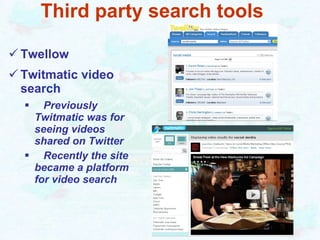
Third party search tools Twellow Twitmatic video search Previously Twitmatic was for seeing videos shared on Twitter Recently the site became a platform for video search
Third party search tools Twazzup http://www.twazzup.com Great for seeing links about a given topic.  Mix of real time search and top tweets. In conclusion: Twitter search is developing and it’s impossible to predict its future architecture
Facebook vs. Google More and more Google treats Facebook as its major rival in the search engine market. Facebook search is social  It is based more on recommendations of the friends than random links Google acknowledged plans of offering personalized, social-networking style to its search results
Facebook search system Facebook search is numerous and sophisticated First level search box is on right upper side of the home page  It is just for starting search on Facebook Most of advanced opportunities are connected with friends search and groups search
Searching friends “ You’re not real friends unless you’re Facebook friends??” Finding friends system is the most valuable part of Facebook search Search is built on the basis of chosen networks and information added by current users
Searching friends   Email Friend Finder searching tool helps to find friends by email addresses AIM Friend Finder These tolls allow users effectively use Facebook database stuff
Facebook browsing   Browsing networks feature give also great opportunities for search Your network affiliation allows effectively browse your chosen networks
Interest groups search   Searching groups Interest groups is an important Facebook feature Facebook search engine allows users effectively search different groups In conclusion:  Facebook search system is built on peoples preferences and really challenges “more objective” Google search
Ning networks   More than one million networks Small functionality of Ning search engine for networks Absence of ranking mechanism and other tools for searching (search between results, etc) Necessity of separate search inside networks Separate networks are hardly searchable with Ning search tools
Ning search drawbacks The problem of finding necessary network  Browsing? Using Ning search engine?
Ning directory   Hand-made directory can help! Directory for networks search People’s cooperation can help finding necessary networks Only combination of Ning search, Ning directory and Google or other SE search engines can give relevant result
How do social media change?   Social media sites are based on Web 2.0 technology  It allows them combining search engine technologies with individual users’ search behaviors Facebook search reached the best (is case of scale) results in combining these features
In what way do people influence searching technology?   People like to follow their friends’ recommendations This feature influencing many new “Google killers” start-up projects In fact, very few of them became successful On March 2009 Wikia search engine was closed by Jimmy Wales, founder of Wikipedia It reached only 10,000 unique users a month in comparison with Wikipedia having 30,000,000.
Social search and privacy issues   Everybody knows that you’re a dog More and more private data are included in search Privacy issues in integrating social search into search results
Underestimated social consequences   Search engine technologies generate new type of digital divide.  The border of second-level digital divide is between skilled users using search engines  and unskilled (Halavais, A. 2009) Majority of users choose “the first reasonable option, a strategy known as satisficing” (Krug, S, 2006).  Satisficing = satisfying +sufficing
In conclusion   Search engine technology is huge and demands increasing number of servers, energy and money Traditional search engines will preserve their significance Page ranking will be more and more socially influenced Instant search is challenging traditional search. Nevertheless, it cannot replace it and probably will coexist with traditional
Literature   Brin, S, and Page, L, 1998 “The Anatomy of a Large-Scale Hypertextual Web Search Engine”, delivered from  http://infolab.stanford.edi/~backrub/google.html Gori, M, Numerico, T. & Witter, I.H, 2007, “Web dragons: inside the myths of search engine technology”  Halavais, A. 2009, “Search engine society” Introna, L.D. & Nissenbaum, H. 2000, “Shaping the web: why the politics of search engines matters,” The Information Society, 16, 3, pp. 169-85 Vossen, Gottfried, Hagemann Stephan (2007) “Unleashing Web 2.0. From concepts to creativity”, Morgan Kaufmann Publishers Kolbitsch, Josef, Maurer Hermann (2006), The Transformation of the Web: How  Emerging Communities Shape the Information We Consume.  Krug, S, (2006), “Don’t Make Me Think. A Common Sense Approach to Web Usability”, New Riders.

Searching Social Media

  • 1.
    “ To exist is to be indexed by search engines”. (Introna & Nissenbaum, 2000) Searching social media Presentation 2009 Sergey Malakhovets
  • 2.
    Why search enginesmatter Search engines (SE) became gatekeepers of our information. Complexity and invisibility of SE technology. Social consequences of SE technology adoption.
  • 3.
    Who opens boxesof search technology? Mostly marketers deal with “black boxes” of SE technology Researchers put primary attention to technological and business aspects Social sciences pay little attention to social consequences of broad usage of SE
  • 4.
    Directories: applying librarytechnologies to Web Early Web was hand-made. People manually structured best sites intro directories. Yahoo was the most successful project of this kind. With the time it became impossible to find and classify all existing sites.
  • 5.
    Magic of robotsThe time of software robots came. In 1993 first real search engine appeared Three equally important parts of search engine technology. Crawlers (robots, bots) collect information Database of WebPages (index) Query processor with ranking algorithm and interface
  • 6.
    Sinking in spamFirst SE dealt primarily with pages metadata Soon search was polluted by spammers (“optimizers”) Users browsed pages and pages of search results looking for necessary information Liberation mission of Google: its link algorithm solved many of spam problems
  • 7.
    Drawbacks of SEtechnology Increasing scale of SE economy In 2005 Google had more than 175.000 servers, in 2009 - more than 1.000.000 Prospering SEO industry (link farms, googlebombing, etc) advancing your sites for money Growth of invisible web
  • 8.
    How to searchinvisible Web? Quickly growing number of dark, deep, hidden or invisible web pages and sites They cannot be indexed and found by main search engines Invisible Web is heterogeneous: Corporate Intranet Proprietary sites Pages closed by owners for crawlers Dynamic content in the databases (typical for social media)
  • 9.
    Social search: botsand people reunion The more “networking” becomes the world - the more difficult to find relevant information using traditional SE technology Ways out Develop more and more sophisticated search Use different social search engines, directories and direct “crowdsourcing” More and more social media built their search on peoples’ recommendations and preferences
  • 10.
    Three case studies:Twitter, Facebook and Ning In 2008 Twitter, Facebook and Ning were among the fastest growing social sites Twitter was the champion, Facebook won competition with MySpace, Ning reached the number of 1 million networks Common and different in social media search Do all social media suggest social search opportunities for finding information?
  • 11.
    Twitter: real-time searchTwitter search tools Searching for existing accounts (“Find people” page) Twitter search engine ( search.twitter.com ) Purchasing of Summise search engine (July 2008) Integrating search into personal accounts (April 2009)
  • 12.
    Is it newgeneration of search? One hour delay for search results vs. instant search: does it matter? Google searches past Twitter gives possibility of real-time search. In many cases they supplement each other
  • 13.
    Business foundation forinstant search Twitter is talking about different businesses in real time. As a result: People immediately receive information about different brands Businesses lost control over news about their brands Today businesses are seeking for people’s feedback
  • 14.
    Twitter search racesSeveral twitter search engines were launched recently Twazzup was launched in April 2009 Twellow – directory about users Cloud.li – cloud-based Twitter search engine Tweetmatic – video search for Twitter Twitterfall – real time observation of search results
  • 15.
    Third party searchtools Hashtags Hashtags are people’s tool for tagging information on Twitter Hashtags.org and Twemes.com provides real-time tracking of Twitter hashtags. Twitterfall Gives an opportunity to follow theme in Twitter in real time
  • 16.
    Third party searchtools Twellow Twitmatic video search Previously Twitmatic was for seeing videos shared on Twitter Recently the site became a platform for video search
  • 17.
    Third party searchtools Twazzup http://www.twazzup.com Great for seeing links about a given topic. Mix of real time search and top tweets. In conclusion: Twitter search is developing and it’s impossible to predict its future architecture
  • 18.
    Facebook vs. GoogleMore and more Google treats Facebook as its major rival in the search engine market. Facebook search is social It is based more on recommendations of the friends than random links Google acknowledged plans of offering personalized, social-networking style to its search results
  • 19.
    Facebook search systemFacebook search is numerous and sophisticated First level search box is on right upper side of the home page It is just for starting search on Facebook Most of advanced opportunities are connected with friends search and groups search
  • 20.
    Searching friends “You’re not real friends unless you’re Facebook friends??” Finding friends system is the most valuable part of Facebook search Search is built on the basis of chosen networks and information added by current users
  • 21.
    Searching friends Email Friend Finder searching tool helps to find friends by email addresses AIM Friend Finder These tolls allow users effectively use Facebook database stuff
  • 22.
    Facebook browsing Browsing networks feature give also great opportunities for search Your network affiliation allows effectively browse your chosen networks
  • 23.
    Interest groups search Searching groups Interest groups is an important Facebook feature Facebook search engine allows users effectively search different groups In conclusion: Facebook search system is built on peoples preferences and really challenges “more objective” Google search
  • 24.
    Ning networks More than one million networks Small functionality of Ning search engine for networks Absence of ranking mechanism and other tools for searching (search between results, etc) Necessity of separate search inside networks Separate networks are hardly searchable with Ning search tools
  • 25.
    Ning search drawbacksThe problem of finding necessary network Browsing? Using Ning search engine?
  • 26.
    Ning directory Hand-made directory can help! Directory for networks search People’s cooperation can help finding necessary networks Only combination of Ning search, Ning directory and Google or other SE search engines can give relevant result
  • 27.
    How do socialmedia change? Social media sites are based on Web 2.0 technology It allows them combining search engine technologies with individual users’ search behaviors Facebook search reached the best (is case of scale) results in combining these features
  • 28.
    In what waydo people influence searching technology? People like to follow their friends’ recommendations This feature influencing many new “Google killers” start-up projects In fact, very few of them became successful On March 2009 Wikia search engine was closed by Jimmy Wales, founder of Wikipedia It reached only 10,000 unique users a month in comparison with Wikipedia having 30,000,000.
  • 29.
    Social search andprivacy issues Everybody knows that you’re a dog More and more private data are included in search Privacy issues in integrating social search into search results
  • 30.
    Underestimated social consequences Search engine technologies generate new type of digital divide. The border of second-level digital divide is between skilled users using search engines and unskilled (Halavais, A. 2009) Majority of users choose “the first reasonable option, a strategy known as satisficing” (Krug, S, 2006). Satisficing = satisfying +sufficing
  • 31.
    In conclusion Search engine technology is huge and demands increasing number of servers, energy and money Traditional search engines will preserve their significance Page ranking will be more and more socially influenced Instant search is challenging traditional search. Nevertheless, it cannot replace it and probably will coexist with traditional
  • 32.
    Literature Brin, S, and Page, L, 1998 “The Anatomy of a Large-Scale Hypertextual Web Search Engine”, delivered from http://infolab.stanford.edi/~backrub/google.html Gori, M, Numerico, T. & Witter, I.H, 2007, “Web dragons: inside the myths of search engine technology” Halavais, A. 2009, “Search engine society” Introna, L.D. & Nissenbaum, H. 2000, “Shaping the web: why the politics of search engines matters,” The Information Society, 16, 3, pp. 169-85 Vossen, Gottfried, Hagemann Stephan (2007) “Unleashing Web 2.0. From concepts to creativity”, Morgan Kaufmann Publishers Kolbitsch, Josef, Maurer Hermann (2006), The Transformation of the Web: How Emerging Communities Shape the Information We Consume. Krug, S, (2006), “Don’t Make Me Think. A Common Sense Approach to Web Usability”, New Riders.