Search Optimization & Compliance
Search Engine Optimization & Compliance 
The Traditional Keyword Model
Search engine optimization has long been a key focus of digital marketing and
especially content marketing. Staying up to date with the latest trends and search
algorithms is essential to a successful content marketing strategy.
 
First lets look at the traditional model and how Expressible fits in to a keyword strategy.
Expressible micro sites let you create landing pages and content hubs for specific topics
based on keyword research. Each micro site can be optimized with keywords through
the SEO tab. These topic specific sites let you focus on a topic with greater depth and
detail than would be possible on a single company website.
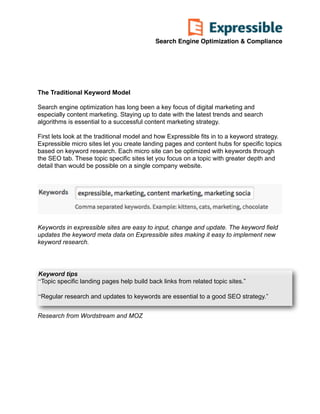
Keywords in expressible sites are easy to input, change and update. The keyword field
updates the keyword meta data on Expressible sites making it easy to implement new
keyword research.
 
Research from Wordstream and MOZ
Keyword tips
“Topic specific landing pages help build back links from related topic sites.”
“Regular research and updates to keywords are essential to a good SEO strategy.”
H1 through H3 tags and meta description
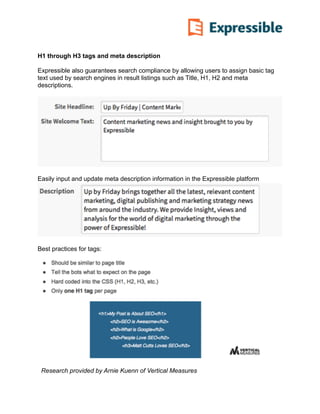
Expressible also guarantees search compliance by allowing users to assign basic tag
text used by search engines in result listings such as Title, H1, H2 and meta
descriptions.
Easily input and update meta description information in the Expressible platform
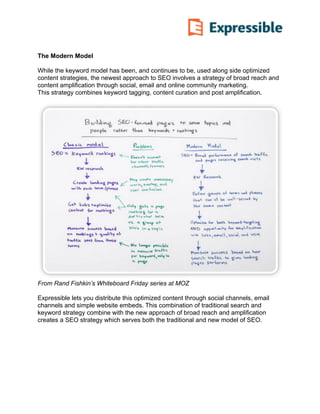
Best practices for tags:
Research provided by Arnie Kuenn of Vertical Measures
 
The Modern Model
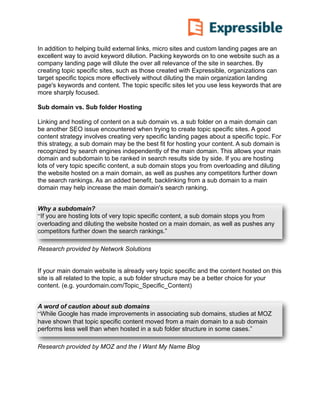
While the keyword model has been, and continues to be, used along side optimized
content strategies, the newest approach to SEO involves a strategy of broad reach and
content amplification through social, email and online community marketing.
This strategy combines keyword tagging, content curation and post amplification.
From Rand Fishkin’s Whiteboard Friday series at MOZ
 
Expressible lets you distribute this optimized content through social channels, email
channels and simple website embeds. This combination of traditional search and
keyword strategy combine with the new approach of broad reach and amplification
creates a SEO strategy which serves both the traditional and new model of SEO.
 
In addition to helping build external links, micro sites and custom landing pages are an
excellent way to avoid keyword dilution. Packing keywords on to one website such as a
company landing page will dilute the over all relevance of the site in searches. By
creating topic specific sites, such as those created with Expressible, organizations can
target specific topics more effectively without diluting the main organization landing
page's keywords and content. The topic specific sites let you use less keywords that are
more sharply focused.
 
Sub domain vs. Sub folder Hosting
Linking and hosting of content on a sub domain vs. a sub folder on a main domain can
be another SEO issue encountered when trying to create topic specific sites. A good
content strategy involves creating very specific landing pages about a specific topic. For
this strategy, a sub domain may be the best fit for hosting your content. A sub domain is
recognized by search engines independently of the main domain. This allows your main
domain and subdomain to be ranked in search results side by side. If you are hosting
lots of very topic specific content, a sub domain stops you from overloading and diluting
the website hosted on a main domain, as well as pushes any competitors further down
the search rankings. As an added benefit, backlinking from a sub domain to a main
domain may help increase the main domain's search ranking.
 
Research provided by Network Solutions
 
 
If your main domain website is already very topic specific and the content hosted on this
site is all related to the topic, a sub folder structure may be a better choice for your
content. (e.g. yourdomain.com/Topic_Specific_Content)
 
Research provided by MOZ and the I Want My Name Blog
Why a subdomain?
“If you are hosting lots of very topic specific content, a sub domain stops you from
overloading and diluting the website hosted on a main domain, as well as pushes any
competitors further down the search rankings.”
A word of caution about sub domains
“While Google has made improvements in associating sub domains, studies at MOZ
have shown that topic specific content moved from a main domain to a sub domain
performs less well than when hosted in a sub folder structure in some cases.”
The decision to host content on a sub domain vs. a sub folder structure depends on the
objective of the content strategy and the focus of the content initiative. If your strategy
involves maximum boost in ranking for an existing company site, a sub folder structure
might be the best option. If however you are looking to create a topic specific site or
content hub which focuses on one key initiative, product or community, a subdomain
would be a better choice to host and curate your topic specific content.

Search Optimization & Compliance

  • 1.
  • 2.
    Search Engine Optimization& Compliance  The Traditional Keyword Model Search engine optimization has long been a key focus of digital marketing and especially content marketing. Staying up to date with the latest trends and search algorithms is essential to a successful content marketing strategy.   First lets look at the traditional model and how Expressible fits in to a keyword strategy. Expressible micro sites let you create landing pages and content hubs for specific topics based on keyword research. Each micro site can be optimized with keywords through the SEO tab. These topic specific sites let you focus on a topic with greater depth and detail than would be possible on a single company website. Keywords in expressible sites are easy to input, change and update. The keyword field updates the keyword meta data on Expressible sites making it easy to implement new keyword research.   Research from Wordstream and MOZ Keyword tips “Topic specific landing pages help build back links from related topic sites.” “Regular research and updates to keywords are essential to a good SEO strategy.”
  • 3.
    H1 through H3tags and meta description Expressible also guarantees search compliance by allowing users to assign basic tag text used by search engines in result listings such as Title, H1, H2 and meta descriptions. Easily input and update meta description information in the Expressible platform Best practices for tags: Research provided by Arnie Kuenn of Vertical Measures
  • 4.
      The Modern Model Whilethe keyword model has been, and continues to be, used along side optimized content strategies, the newest approach to SEO involves a strategy of broad reach and content amplification through social, email and online community marketing. This strategy combines keyword tagging, content curation and post amplification. From Rand Fishkin’s Whiteboard Friday series at MOZ   Expressible lets you distribute this optimized content through social channels, email channels and simple website embeds. This combination of traditional search and keyword strategy combine with the new approach of broad reach and amplification creates a SEO strategy which serves both the traditional and new model of SEO.  
  • 5.
    In addition tohelping build external links, micro sites and custom landing pages are an excellent way to avoid keyword dilution. Packing keywords on to one website such as a company landing page will dilute the over all relevance of the site in searches. By creating topic specific sites, such as those created with Expressible, organizations can target specific topics more effectively without diluting the main organization landing page's keywords and content. The topic specific sites let you use less keywords that are more sharply focused.   Sub domain vs. Sub folder Hosting Linking and hosting of content on a sub domain vs. a sub folder on a main domain can be another SEO issue encountered when trying to create topic specific sites. A good content strategy involves creating very specific landing pages about a specific topic. For this strategy, a sub domain may be the best fit for hosting your content. A sub domain is recognized by search engines independently of the main domain. This allows your main domain and subdomain to be ranked in search results side by side. If you are hosting lots of very topic specific content, a sub domain stops you from overloading and diluting the website hosted on a main domain, as well as pushes any competitors further down the search rankings. As an added benefit, backlinking from a sub domain to a main domain may help increase the main domain's search ranking.   Research provided by Network Solutions     If your main domain website is already very topic specific and the content hosted on this site is all related to the topic, a sub folder structure may be a better choice for your content. (e.g. yourdomain.com/Topic_Specific_Content)   Research provided by MOZ and the I Want My Name Blog Why a subdomain? “If you are hosting lots of very topic specific content, a sub domain stops you from overloading and diluting the website hosted on a main domain, as well as pushes any competitors further down the search rankings.” A word of caution about sub domains “While Google has made improvements in associating sub domains, studies at MOZ have shown that topic specific content moved from a main domain to a sub domain performs less well than when hosted in a sub folder structure in some cases.”
  • 6.
    The decision tohost content on a sub domain vs. a sub folder structure depends on the objective of the content strategy and the focus of the content initiative. If your strategy involves maximum boost in ranking for an existing company site, a sub folder structure might be the best option. If however you are looking to create a topic specific site or content hub which focuses on one key initiative, product or community, a subdomain would be a better choice to host and curate your topic specific content.