Sea Breeze
Lesson 1-Thermally forced circulations
Mesoscale Meteorology
In this lesson:
• Overview of Sea Breezes
• Basic Circulation
• Modifying Effects
Overview
• Horizontal differences in the
diabatic heating of the earth’s
surface can give rise to
significant horizontal air
temperature gradients.
• The horizontal air temperature
gradients generate vertical
circulations and therefore are
often of interest to forecasters.
• Sea- and land-breeze fronts are
probably the best-known
mesoscale boundaries that can
be attributed to differential
surface heating.
• Large temperature contrasts can
develop in the proximity of
coastlines along large bodies of
water owing to heat capacity
differences between soil and
water.
Understanding and forecasting the sea breeze requires
knowledge of the following:
• Local environment
• Coastline shape
• Mountain and valley locations
• Land cover, and
• Prevailing synoptic-scale weather patterns.
Basic Circulation
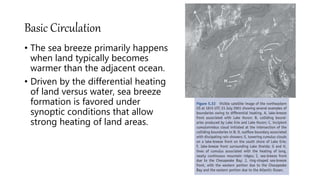
• The sea breeze primarily happens
when land typically becomes
warmer than the adjacent ocean.
• Driven by the differential heating
of land versus water, sea breeze
formation is favored under
synoptic conditions that allow
strong heating of land areas.
• Depending upon the location, the sea breeze can greatly affect
the development and location of convection, the coastal
winds, and the occurrence of coastal fog and stratus.
• Sea breezes and land breezes are most likely to be observed
during periods of relatively light winds. When the large-scale,
ambient winds are very strong, sea- and land-breeze
circulations are less prominent.
Basic Circulation
• The sea breeze front penetrates inland as the day progresses.
• Land breezes develop not as a result of the diurnal cycle but
instead as a result of the modification of a cold air mass
moving over a warm water surface.
• We will dissect its circulation on different times of the day.
Basic Circulation
• Wind Direction:
• Inland
• Along surface pressure gradient
• Perpendicular to coastline
• Direction depends on the local coastline orientation
• Wind Strength
• Proportional to land/Sea Temp difference
• Dependent on the Synoptic Flow
• Onshore flow favors sea breeze
• Offshore flow impedes it
Basic Circulation
Formation
•Mid-to-late-morning hours
•Land temp exceeds water temp by 3-6°C.
Basic Circulation
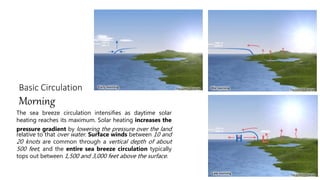
Morning
The sea breeze circulation intensifies as daytime solar
heating reaches its maximum. Solar heating increases the
pressure gradient by lowering the pressure over the land
relative to that over water. Surface winds between 10 and
20 knots are common through a vertical depth of about
500 feet, and the entire sea breeze circulation typically
tops out between 1,500 and 3,000 feet above the surface.
Basic Circulation
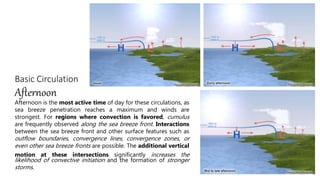
Afternoon
Afternoon is the most active time of day for these circulations, as
sea breeze penetration reaches a maximum and winds are
strongest. For regions where convection is favored, cumulus
are frequently observed along the sea breeze front. Interactions
between the sea breeze front and other surface features such as
outflow boundaries, convergence lines, convergence zones, or
even other sea breeze fronts are possible. The additional vertical
motion at these intersections significantly increases the
likelihood of convective initiation and the formation of stronger
storms.
Basic Circulation
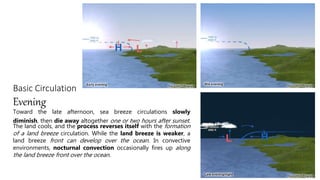
Evening
Toward the late afternoon, sea breeze circulations slowly
diminish, then die away altogether one or two hours after sunset.
The land cools, and the process reverses itself with the formation
of a land breeze circulation. While the land breeze is weaker, a
land breeze front can develop over the ocean. In convective
environments, nocturnal convection occasionally fires up along
the land breeze front over the ocean.
Modifying Effects
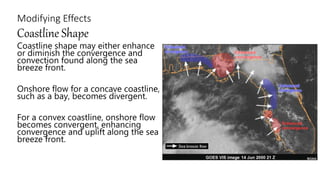
Coastline Shape
Coastline shape may either enhance
or diminish the convergence and
convection found along the sea
breeze front.
Onshore flow for a concave coastline,
such as a bay, becomes divergent.
For a convex coastline, onshore flow
becomes convergent, enhancing
convergence and uplift along the sea
breeze front.
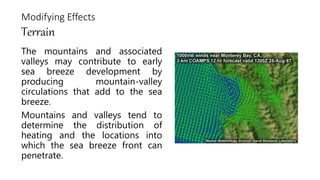
The mountains and associated
valleys may contribute to early
sea breeze development by
producing mountain-valley
circulations that add to the sea
breeze.
Mountains and valleys tend to
determine the distribution of
heating and the locations into
which the sea breeze front can
penetrate.
Modifying Effects
Terrain
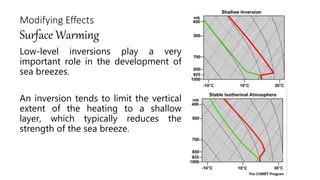
Low-level inversions play a very
important role in the development of
sea breezes.
An inversion tends to limit the vertical
extent of the heating to a shallow
layer, which typically reduces the
strength of the sea breeze.
Modifying Effects
Surface Warming
• Inversions also play an important role in other aspects of the sea
breeze. In unstable environments, an inversion may provide
significant convective inhibition by providing a cap or lid that
restricts the ascent of buoyant air parcels.
• The lift induced by a sea breeze may not suffice to break
through the inversion and initiate convection.
Modifying Effects
Inversion
Forecasting Sea Breezes
• Critical Aspects to Forecast
• Thunderstorm development
• Visibility, clouds, and inversion characteristics
• Wind speeds, gusts, and shifts
• Sea breeze front penetration
• Important Ingredients
• Amount of heating
• Distribution of heating
• Synoptic-scale flow
Forecast Tools
• Surface Data
• Sounding/Skew-T
• Model output
• Satellite data
Assignment:
• What is the importance of Synoptic Scale situation on Sea Breeze
Formation and Forecasting?

Sea-Breeze.pptx

  • 1.
    Sea Breeze Lesson 1-Thermallyforced circulations Mesoscale Meteorology
  • 2.
    In this lesson: •Overview of Sea Breezes • Basic Circulation • Modifying Effects
  • 3.
    Overview • Horizontal differencesin the diabatic heating of the earth’s surface can give rise to significant horizontal air temperature gradients. • The horizontal air temperature gradients generate vertical circulations and therefore are often of interest to forecasters. • Sea- and land-breeze fronts are probably the best-known mesoscale boundaries that can be attributed to differential surface heating. • Large temperature contrasts can develop in the proximity of coastlines along large bodies of water owing to heat capacity differences between soil and water.
  • 4.
    Understanding and forecastingthe sea breeze requires knowledge of the following: • Local environment • Coastline shape • Mountain and valley locations • Land cover, and • Prevailing synoptic-scale weather patterns.
  • 5.
    Basic Circulation • Thesea breeze primarily happens when land typically becomes warmer than the adjacent ocean. • Driven by the differential heating of land versus water, sea breeze formation is favored under synoptic conditions that allow strong heating of land areas.
  • 6.
    • Depending uponthe location, the sea breeze can greatly affect the development and location of convection, the coastal winds, and the occurrence of coastal fog and stratus. • Sea breezes and land breezes are most likely to be observed during periods of relatively light winds. When the large-scale, ambient winds are very strong, sea- and land-breeze circulations are less prominent.
  • 7.
    Basic Circulation • Thesea breeze front penetrates inland as the day progresses. • Land breezes develop not as a result of the diurnal cycle but instead as a result of the modification of a cold air mass moving over a warm water surface. • We will dissect its circulation on different times of the day.
  • 8.
    Basic Circulation • WindDirection: • Inland • Along surface pressure gradient • Perpendicular to coastline • Direction depends on the local coastline orientation • Wind Strength • Proportional to land/Sea Temp difference • Dependent on the Synoptic Flow • Onshore flow favors sea breeze • Offshore flow impedes it
  • 9.
  • 10.
    Basic Circulation Morning The seabreeze circulation intensifies as daytime solar heating reaches its maximum. Solar heating increases the pressure gradient by lowering the pressure over the land relative to that over water. Surface winds between 10 and 20 knots are common through a vertical depth of about 500 feet, and the entire sea breeze circulation typically tops out between 1,500 and 3,000 feet above the surface.
  • 11.
    Basic Circulation Afternoon Afternoon isthe most active time of day for these circulations, as sea breeze penetration reaches a maximum and winds are strongest. For regions where convection is favored, cumulus are frequently observed along the sea breeze front. Interactions between the sea breeze front and other surface features such as outflow boundaries, convergence lines, convergence zones, or even other sea breeze fronts are possible. The additional vertical motion at these intersections significantly increases the likelihood of convective initiation and the formation of stronger storms.
  • 12.
    Basic Circulation Evening Toward thelate afternoon, sea breeze circulations slowly diminish, then die away altogether one or two hours after sunset. The land cools, and the process reverses itself with the formation of a land breeze circulation. While the land breeze is weaker, a land breeze front can develop over the ocean. In convective environments, nocturnal convection occasionally fires up along the land breeze front over the ocean.
  • 13.
    Modifying Effects Coastline Shape Coastlineshape may either enhance or diminish the convergence and convection found along the sea breeze front. Onshore flow for a concave coastline, such as a bay, becomes divergent. For a convex coastline, onshore flow becomes convergent, enhancing convergence and uplift along the sea breeze front.
  • 14.
    The mountains andassociated valleys may contribute to early sea breeze development by producing mountain-valley circulations that add to the sea breeze. Mountains and valleys tend to determine the distribution of heating and the locations into which the sea breeze front can penetrate. Modifying Effects Terrain
  • 15.
    Low-level inversions playa very important role in the development of sea breezes. An inversion tends to limit the vertical extent of the heating to a shallow layer, which typically reduces the strength of the sea breeze. Modifying Effects Surface Warming
  • 16.
    • Inversions alsoplay an important role in other aspects of the sea breeze. In unstable environments, an inversion may provide significant convective inhibition by providing a cap or lid that restricts the ascent of buoyant air parcels. • The lift induced by a sea breeze may not suffice to break through the inversion and initiate convection. Modifying Effects Inversion
  • 17.
    Forecasting Sea Breezes •Critical Aspects to Forecast • Thunderstorm development • Visibility, clouds, and inversion characteristics • Wind speeds, gusts, and shifts • Sea breeze front penetration • Important Ingredients • Amount of heating • Distribution of heating • Synoptic-scale flow
  • 18.
    Forecast Tools • SurfaceData • Sounding/Skew-T • Model output • Satellite data
  • 19.
    Assignment: • What isthe importance of Synoptic Scale situation on Sea Breeze Formation and Forecasting?