Software Engineering Software Requirements Slide 1
Software Requirements
Descriptions and specifications of a system
Software Engineering Software Requirements Slide 2
Requirements engineering
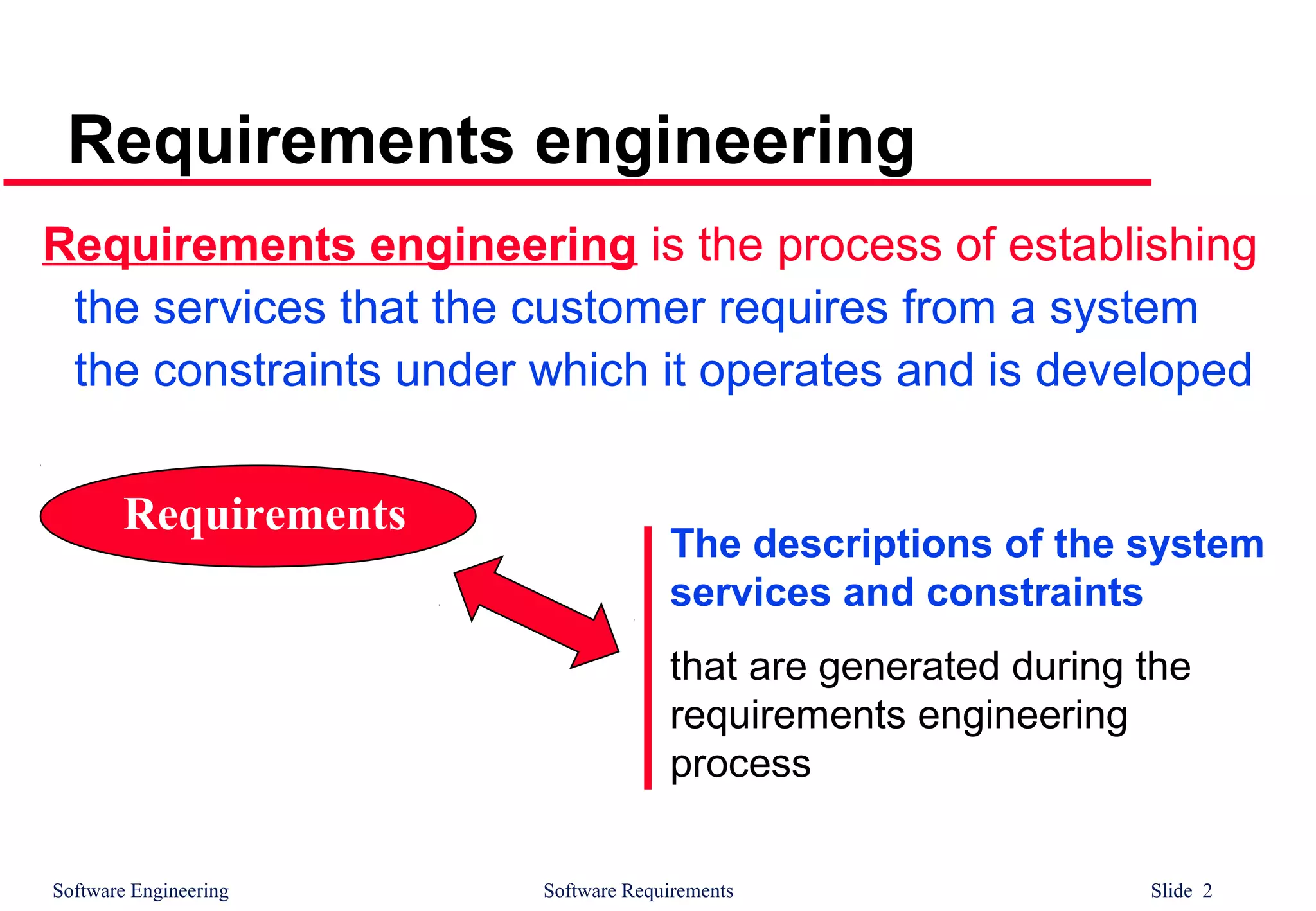
Requirements engineering is the process of establishing
the services that the customer requires from a system
the constraints under which it operates and is developed
Requirements
The descriptions of the system
services and constraints
that are generated during the
requirements engineering
process
Software Engineering Software Requirements Slide 3
What is a requirement?
It may range from a high-level abstract statement of
a service or of a system constraint to a detailed
mathematical functional specification
This is inevitable as requirements may serve a
dual function
• May be the basis for a bid for a contract - therefore must
be open to interpretation
• May be the basis for the contract itself - therefore must be
defined in detail
• Both these statements may be called requirements
Software Engineering Software Requirements Slide 4
Types of requirement
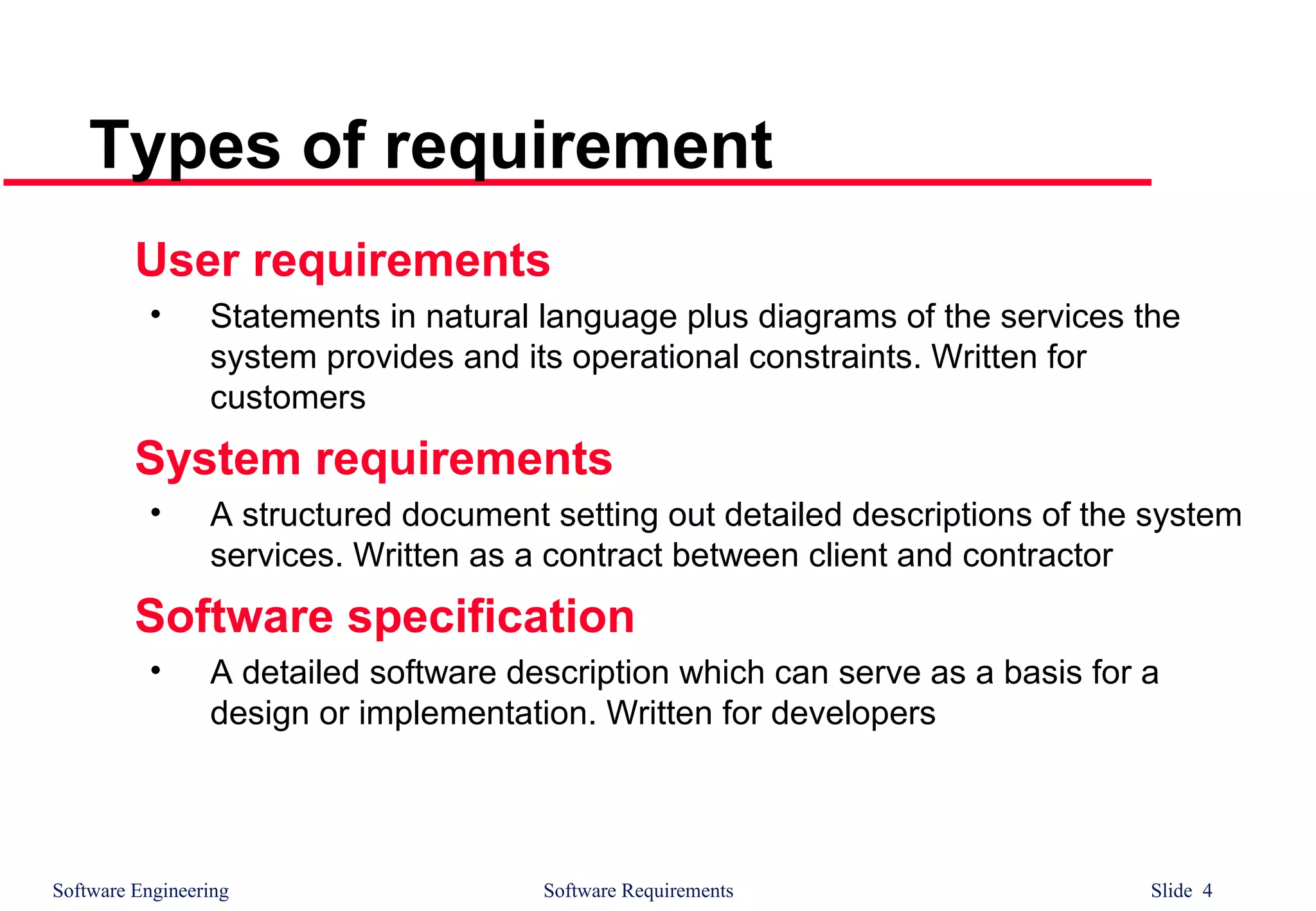
User requirements
• Statements in natural language plus diagrams of the services the
system provides and its operational constraints. Written for
customers
System requirements
• A structured document setting out detailed descriptions of the system
services. Written as a contract between client and contractor
Software specification
• A detailed software description which can serve as a basis for a
design or implementation. Written for developers
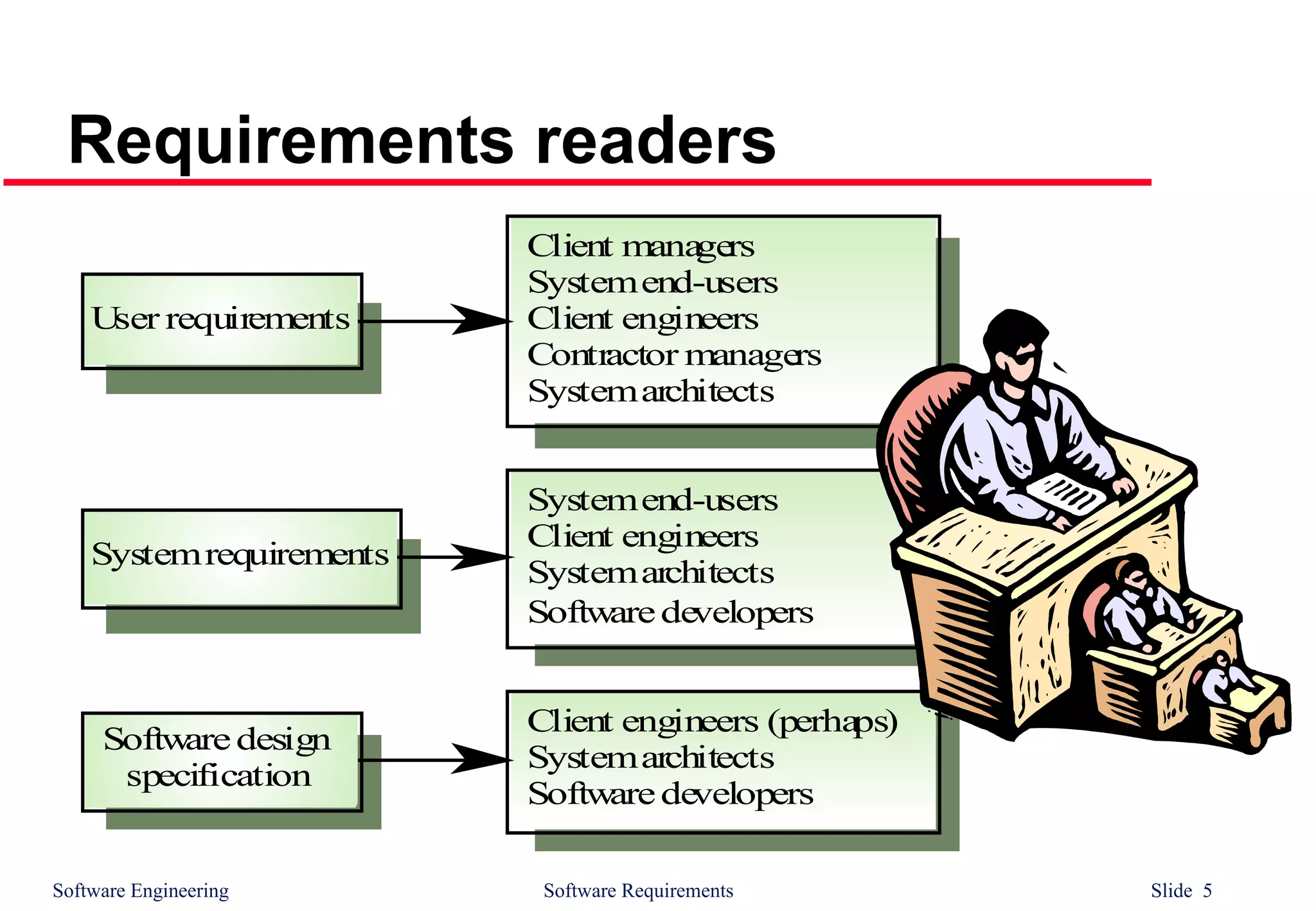
Software Engineering Software Requirements Slide 5
Requirements readers
Client managers
Systemend-users
Client engineers
Contractor managers
Systemarchitects
Systemend-users
Client engineers
Systemarchitects
Softwaredevelopers
Client engineers (perhaps)
Systemarchitects
Softwaredevelopers
User requirements
Systemrequirements
Softwaredesign
specification
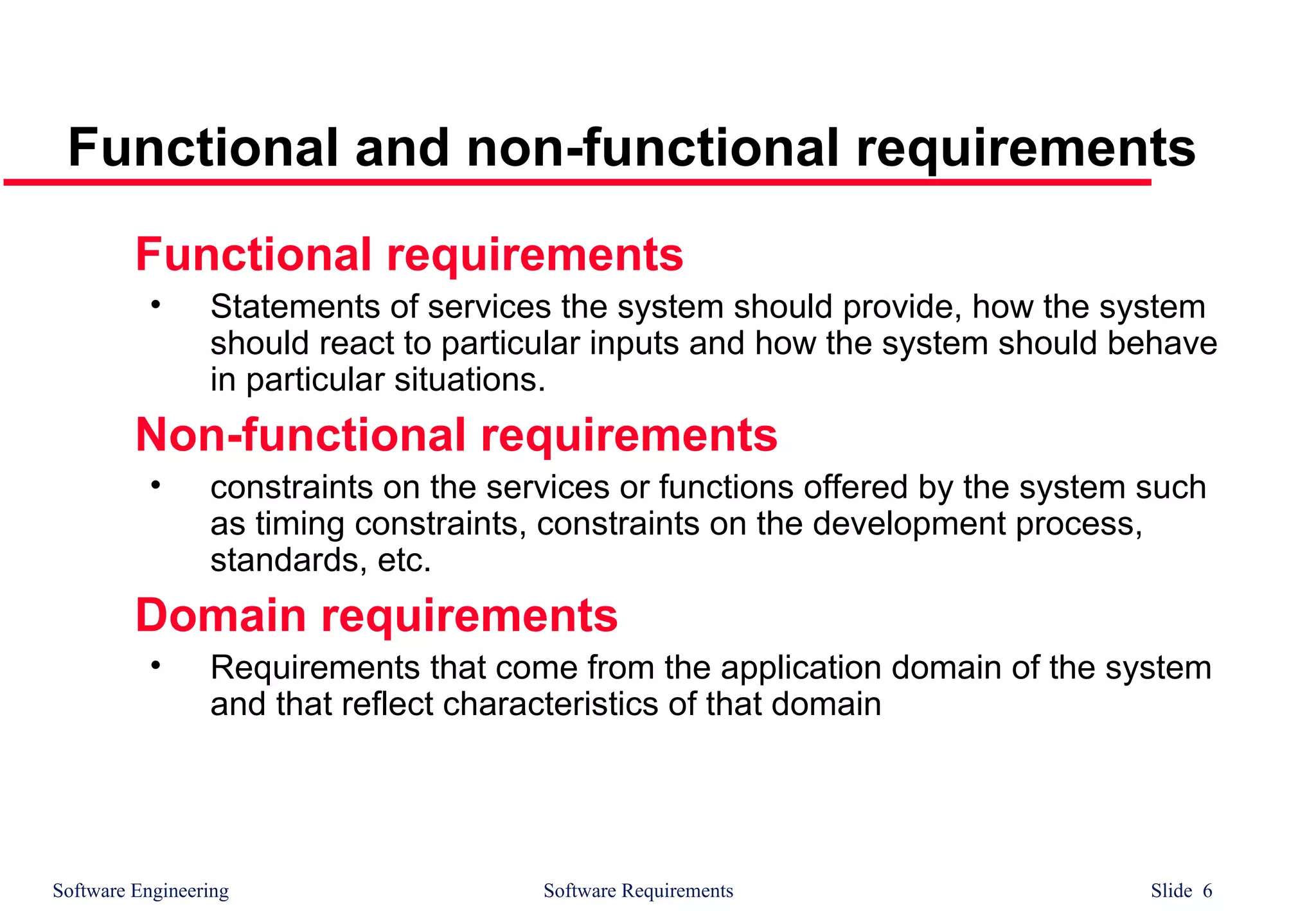
Software Engineering Software Requirements Slide 6
Functional and non-functional requirements
Functional requirements
• Statements of services the system should provide, how the system
should react to particular inputs and how the system should behave
in particular situations.
Non-functional requirements
• constraints on the services or functions offered by the system such
as timing constraints, constraints on the development process,
standards, etc.
Domain requirements
• Requirements that come from the application domain of the system
and that reflect characteristics of that domain
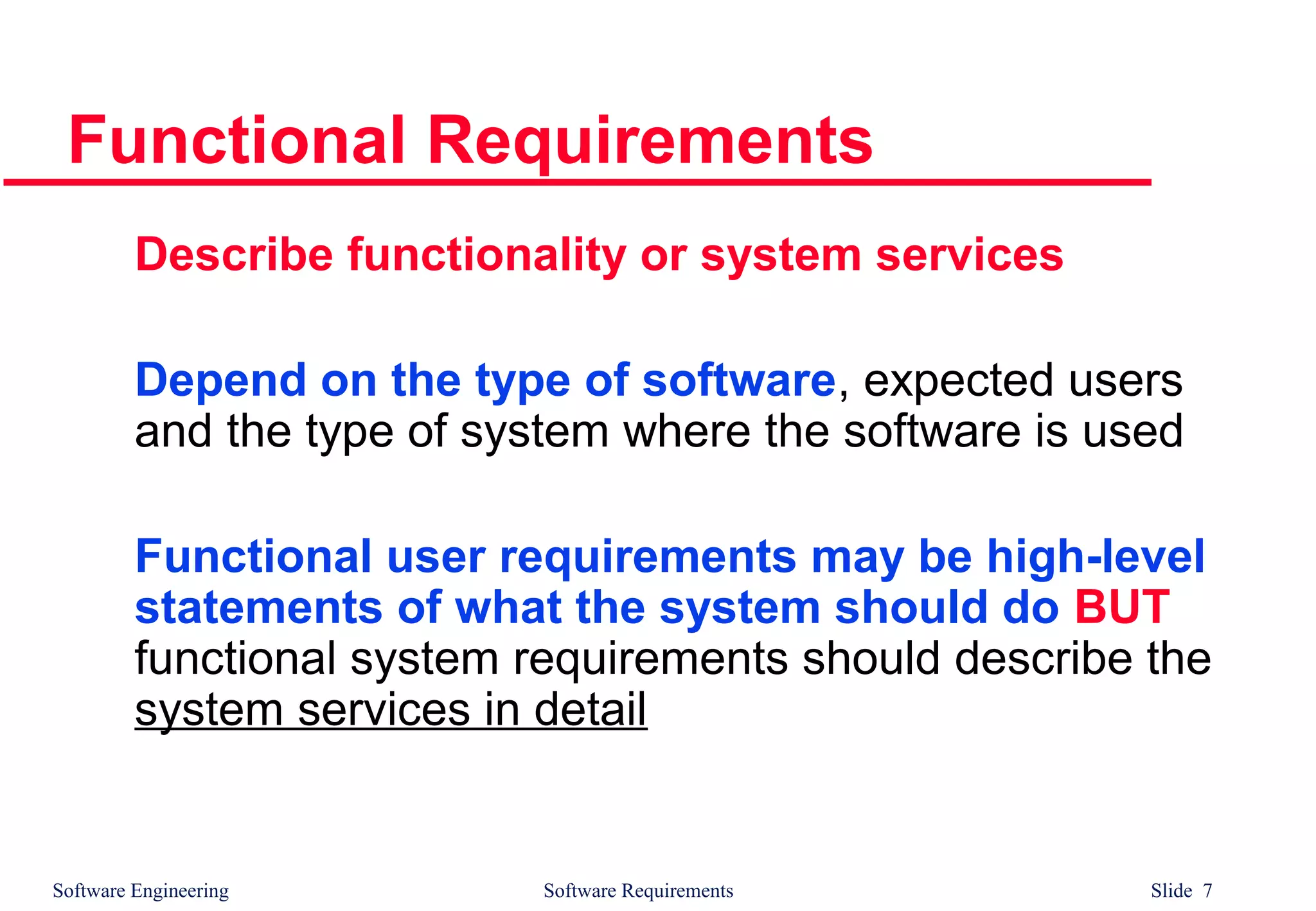
Software Engineering Software Requirements Slide 7
Functional Requirements
Describe functionality or system services
Depend on the type of software, expected users
and the type of system where the software is used
Functional user requirements may be high-level
statements of what the system should do BUT
functional system requirements should describe the
system services in detail
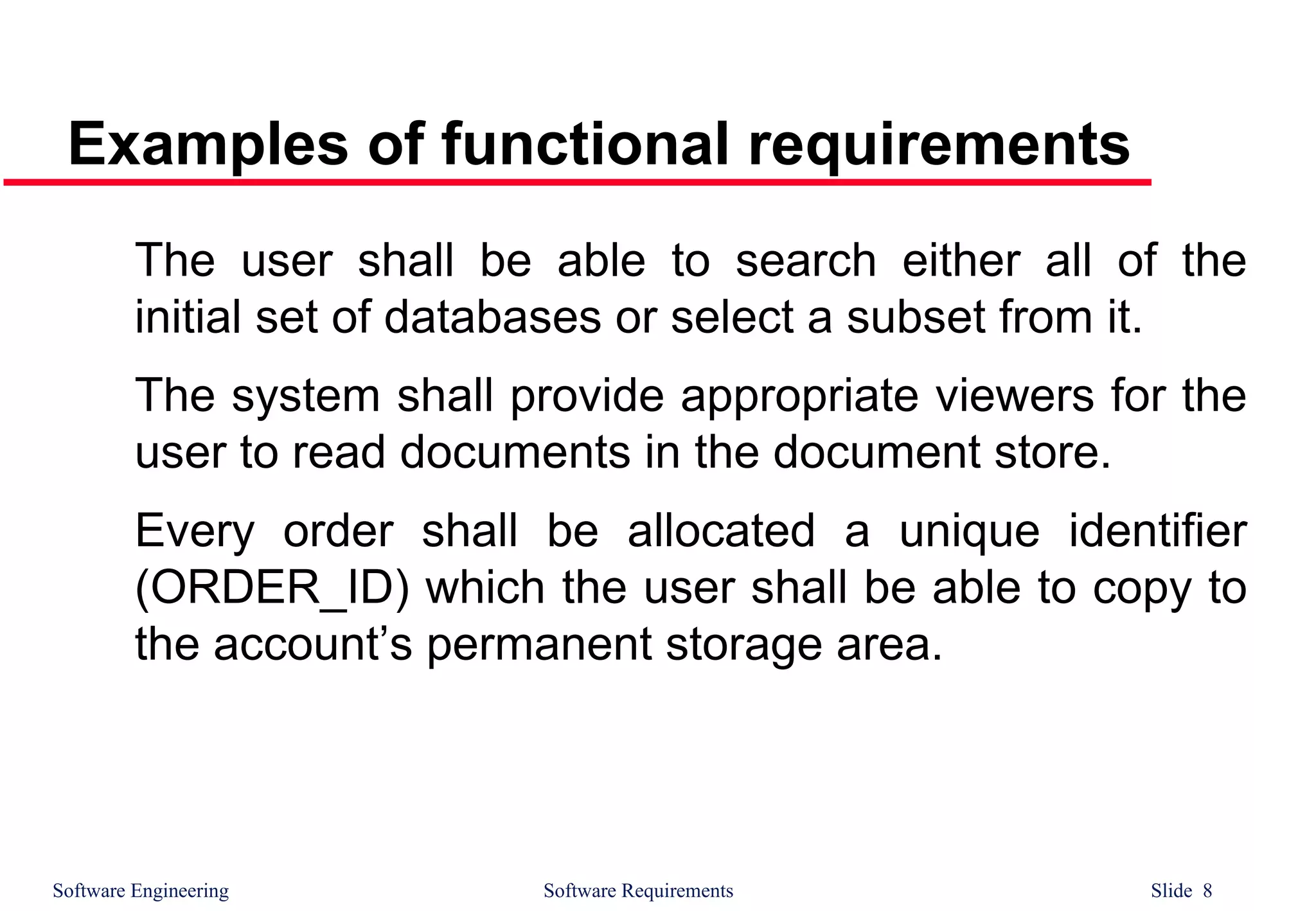
Software Engineering Software Requirements Slide 8
Examples of functional requirements
The user shall be able to search either all of the
initial set of databases or select a subset from it.
The system shall provide appropriate viewers for the
user to read documents in the document store.
Every order shall be allocated a unique identifier
(ORDER_ID) which the user shall be able to copy to
the account’s permanent storage area.
Software Engineering Software Requirements Slide 9
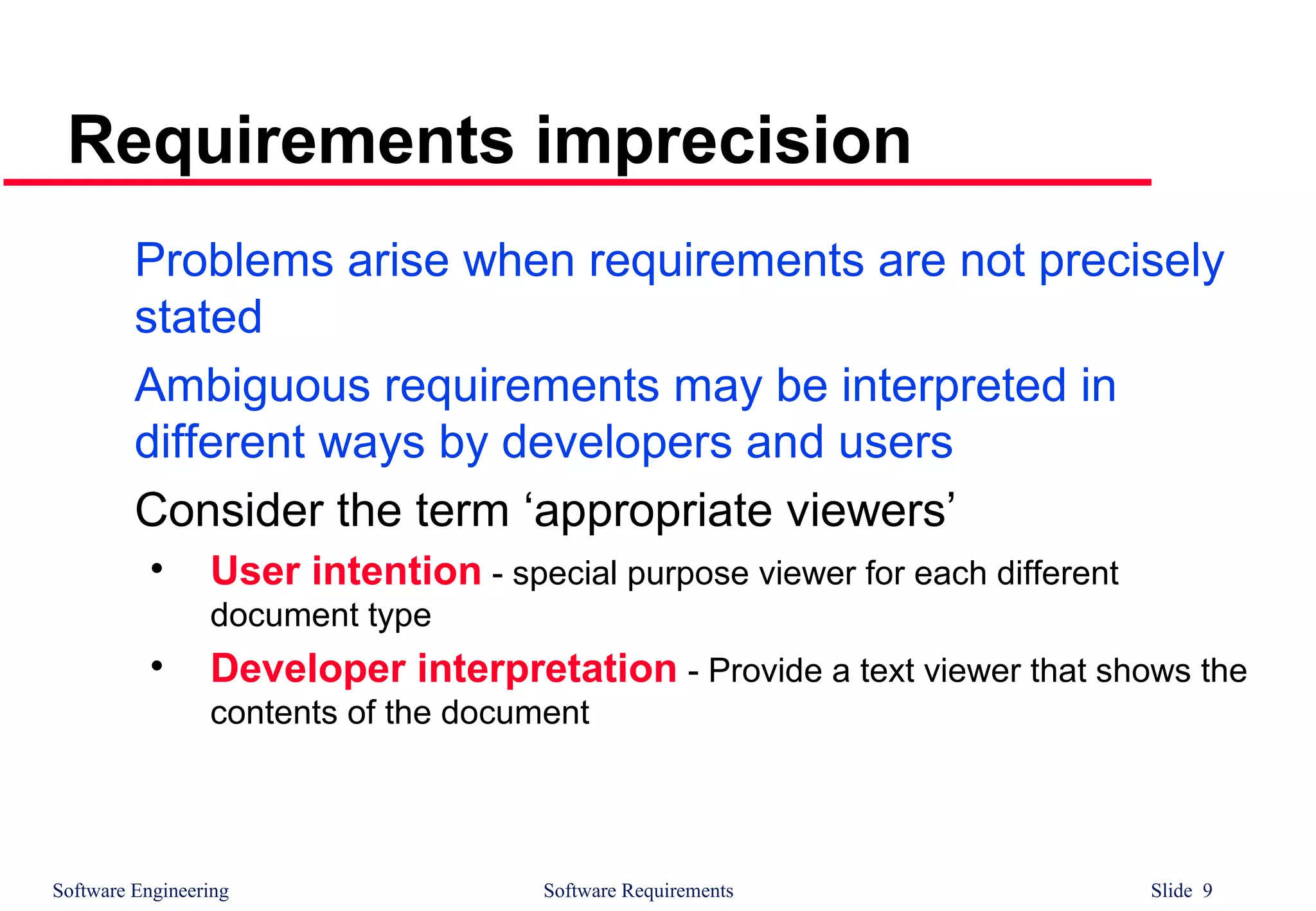
Requirements imprecision
Problems arise when requirements are not precisely
stated
Ambiguous requirements may be interpreted in
different ways by developers and users
Consider the term ‘appropriate viewers’
• User intention - special purpose viewer for each different
document type
• Developer interpretation - Provide a text viewer that shows the
contents of the document
Software Engineering Software Requirements Slide 10
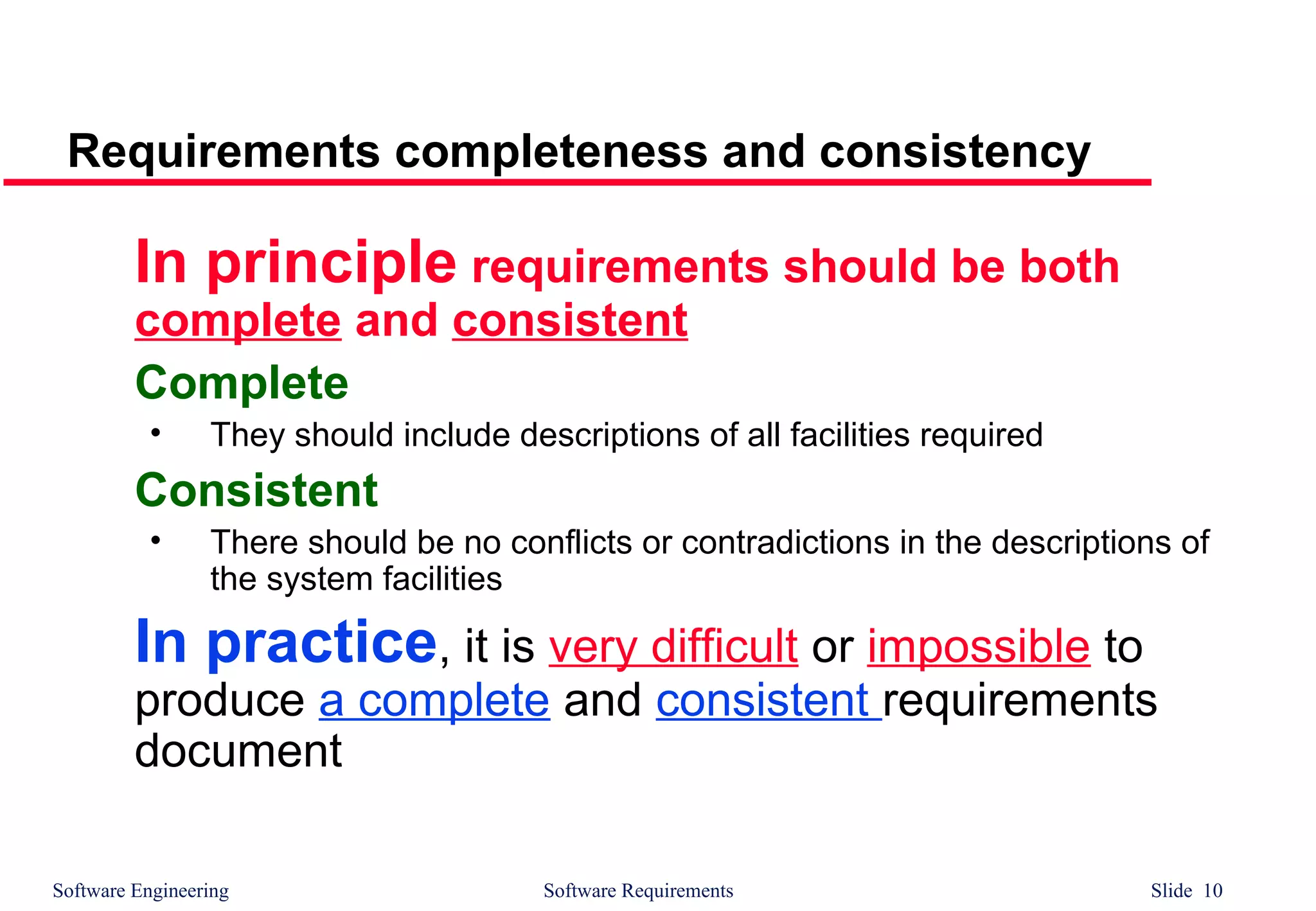
Requirements completeness and consistency
In principle requirements should be both
complete and consistent
Complete
• They should include descriptions of all facilities required
Consistent
• There should be no conflicts or contradictions in the descriptions of
the system facilities
In practice, it is very difficult or impossible to
produce a complete and consistent requirements
document
Software Engineering Software Requirements Slide 11
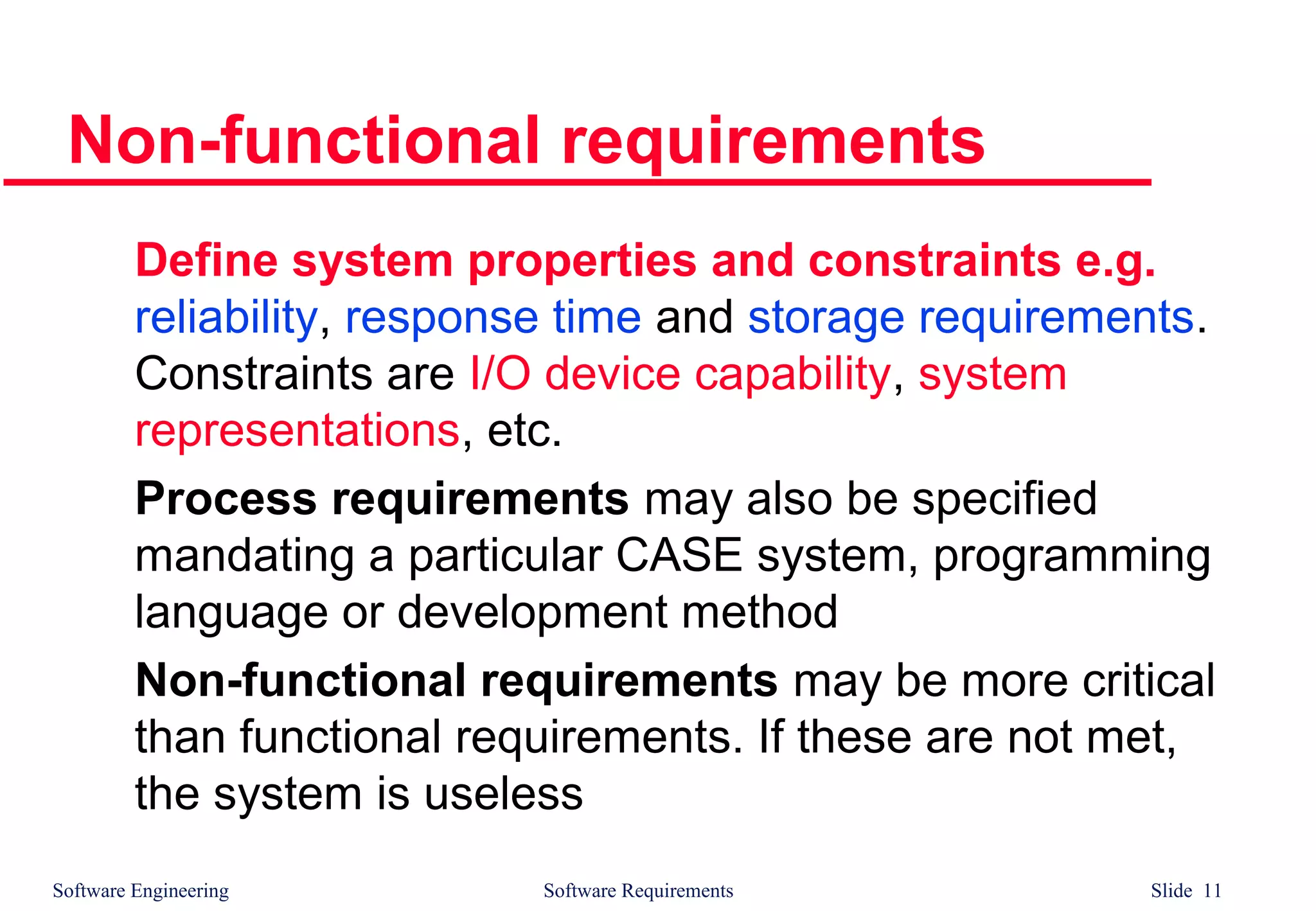
Non-functional requirements
Define system properties and constraints e.g.
reliability, response time and storage requirements.
Constraints are I/O device capability, system
representations, etc.
Process requirements may also be specified
mandating a particular CASE system, programming
language or development method
Non-functional requirements may be more critical
than functional requirements. If these are not met,
the system is useless
Software Engineering Software Requirements Slide 12
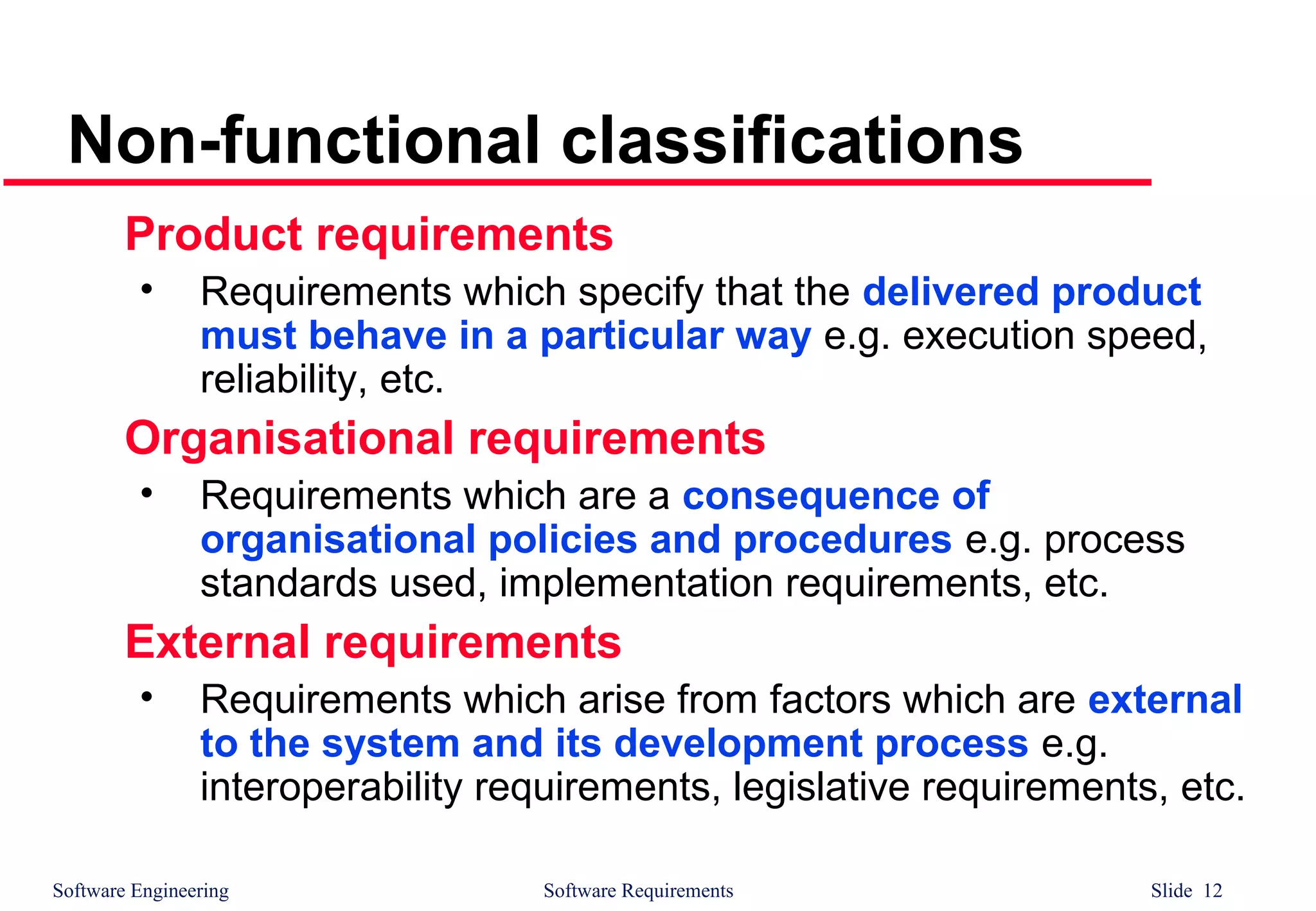
Non-functional classifications
Product requirements
• Requirements which specify that the delivered product
must behave in a particular way e.g. execution speed,
reliability, etc.
Organisational requirements
• Requirements which are a consequence of
organisational policies and procedures e.g. process
standards used, implementation requirements, etc.
External requirements
• Requirements which arise from factors which are external
to the system and its development process e.g.
interoperability requirements, legislative requirements, etc.
Software Engineering Software Requirements Slide 13
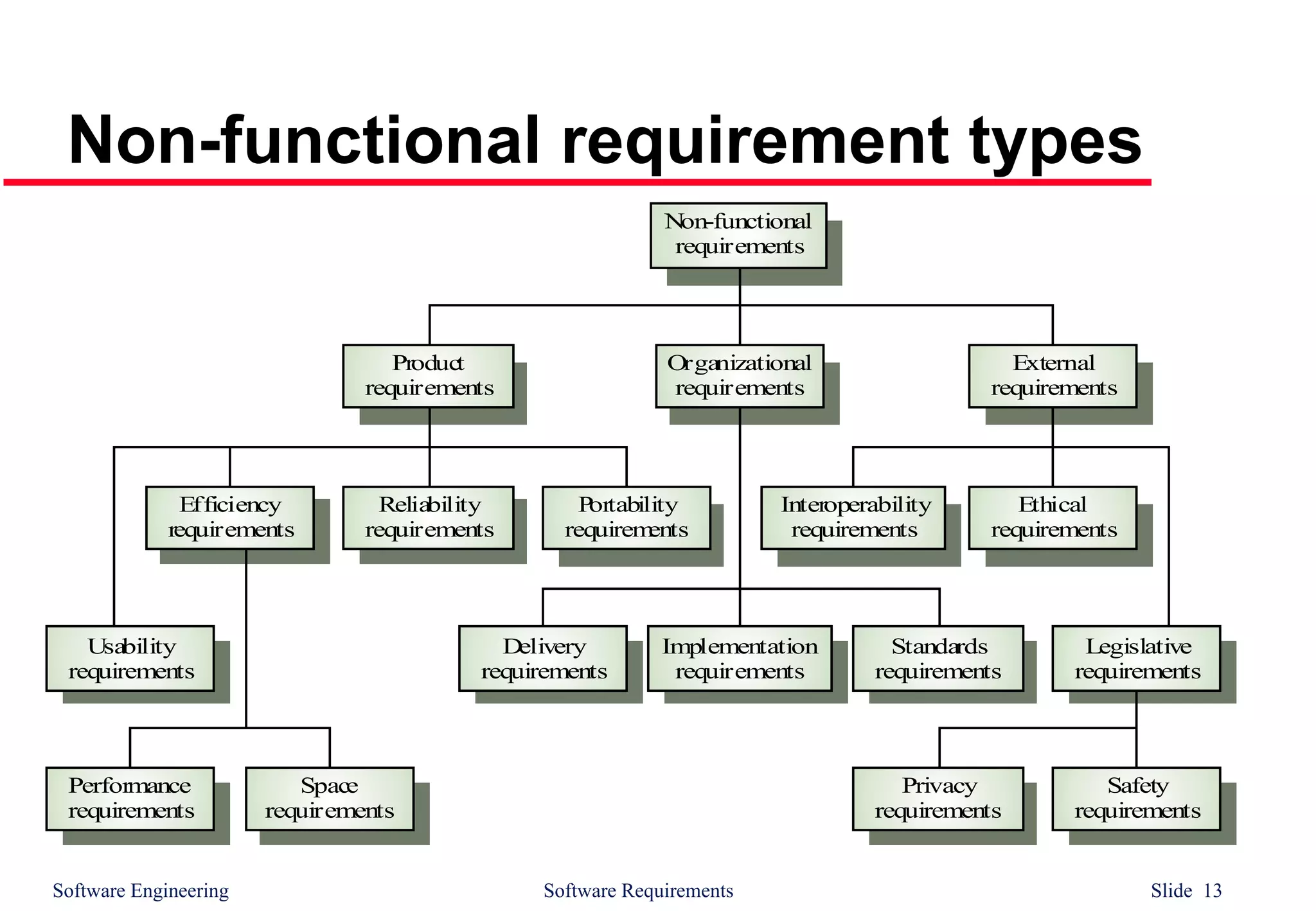
Non-functional requirement types
Performance
requirements
Space
requirements
Usability
requirements
Efficiency
requirements
Reliability
requirements
Portability
requirements
Interoperability
requirements
Ethical
requirements
Legislative
requirements
Implementation
requirements
Standards
requirements
Delivery
requirements
Safety
requirements
Privacy
requirements
Product
requirements
Organizational
requirements
External
requirements
Non-functional
requirements
Software Engineering Software Requirements Slide 14
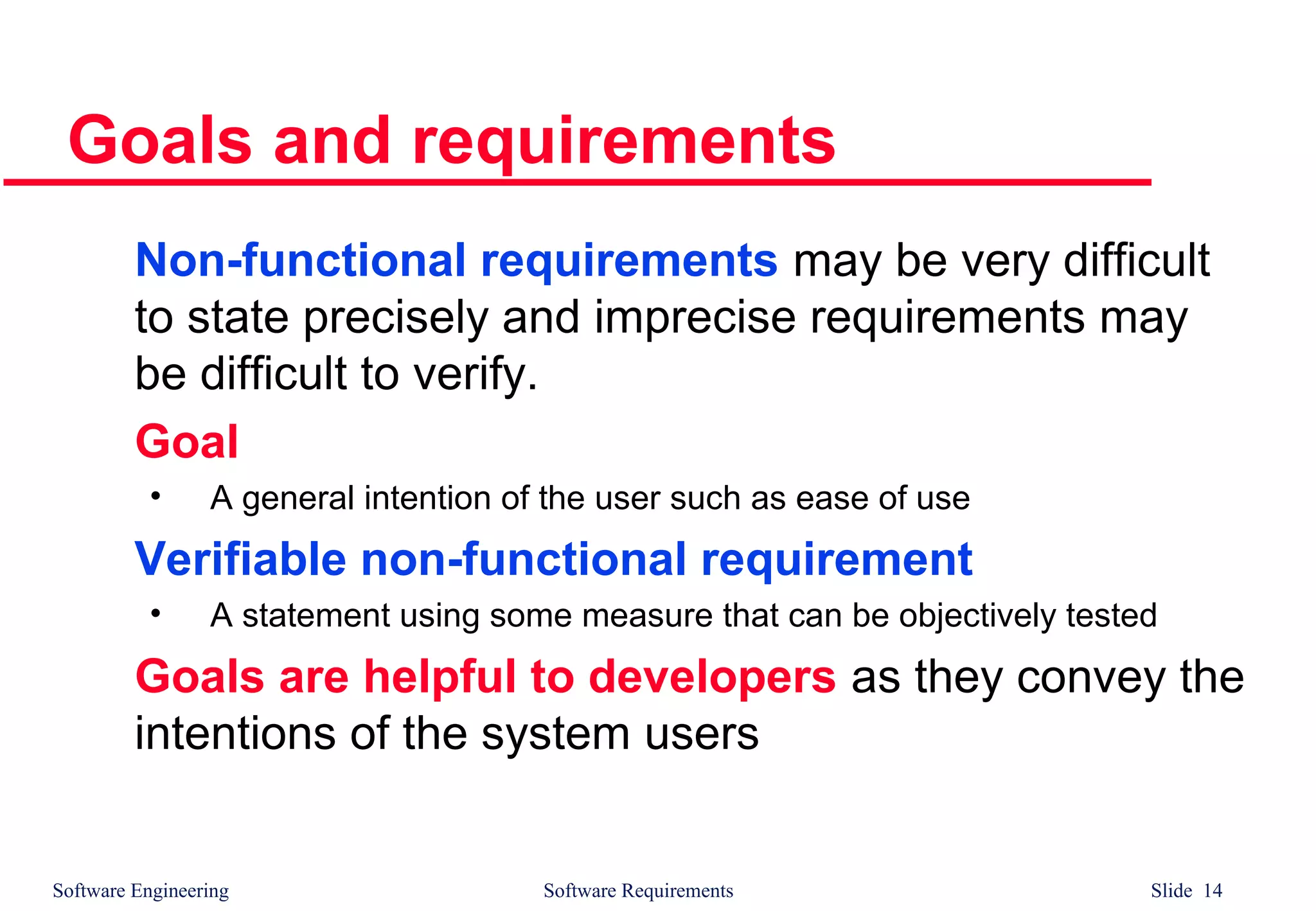
Goals and requirements
Non-functional requirements may be very difficult
to state precisely and imprecise requirements may
be difficult to verify.
Goal
• A general intention of the user such as ease of use
Verifiable non-functional requirement
• A statement using some measure that can be objectively tested
Goals are helpful to developers as they convey the
intentions of the system users
Software Engineering Software Requirements Slide 15
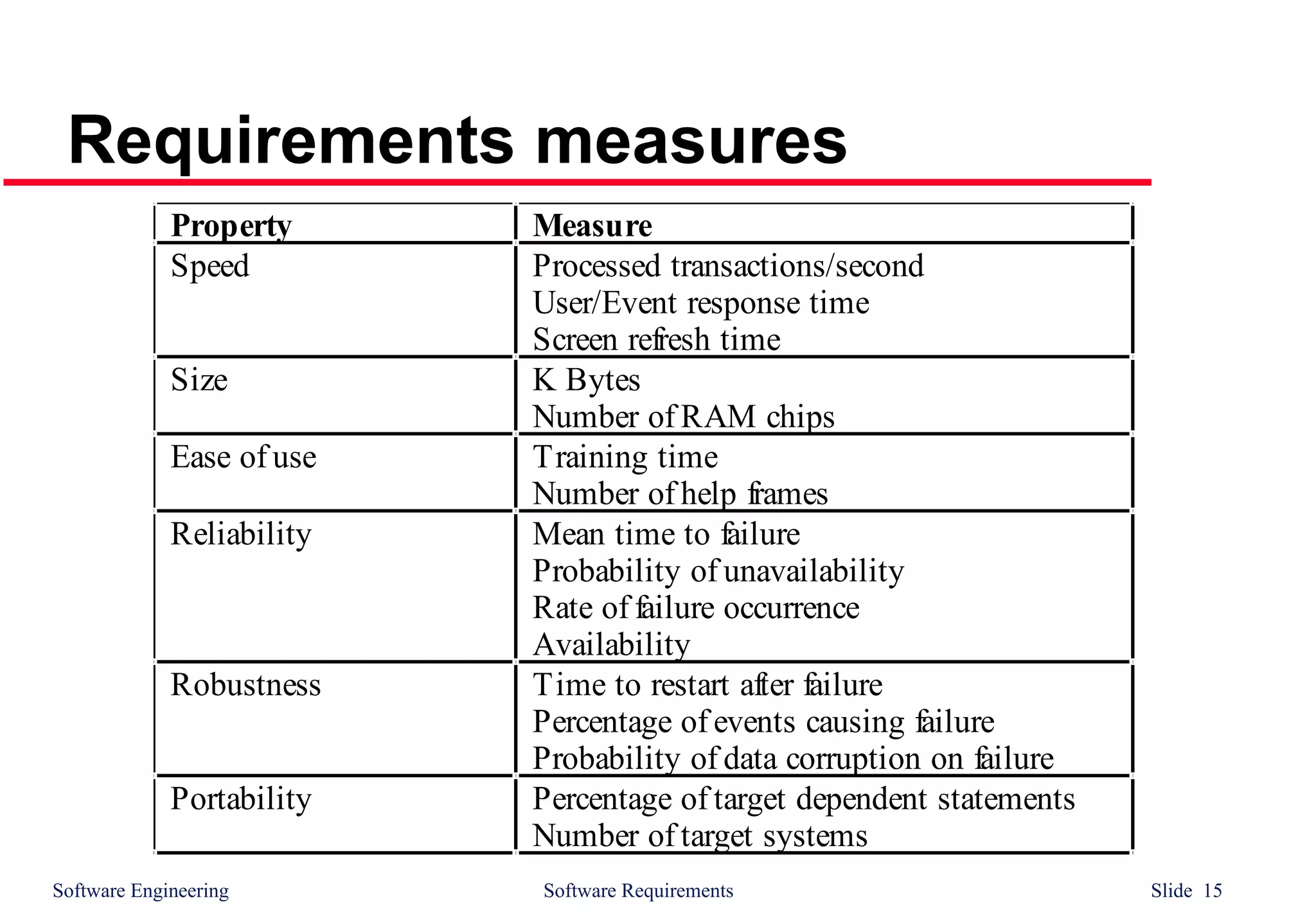
Requirements measures
Property Measure
Speed Processed transactions/second
User/Event response time
Screen refresh time
Size K Bytes
Number of RAM chips
Ease of use Training time
Number of help frames
Reliability Mean time to failure
Probability of unavailability
Rate of failure occurrence
Availability
Robustness Time to restart after failure
Percentage of events causing failure
Probability of data corruption on failure
Portability Percentage of target dependent statements
Number of target systems
Software Engineering Software Requirements Slide 16
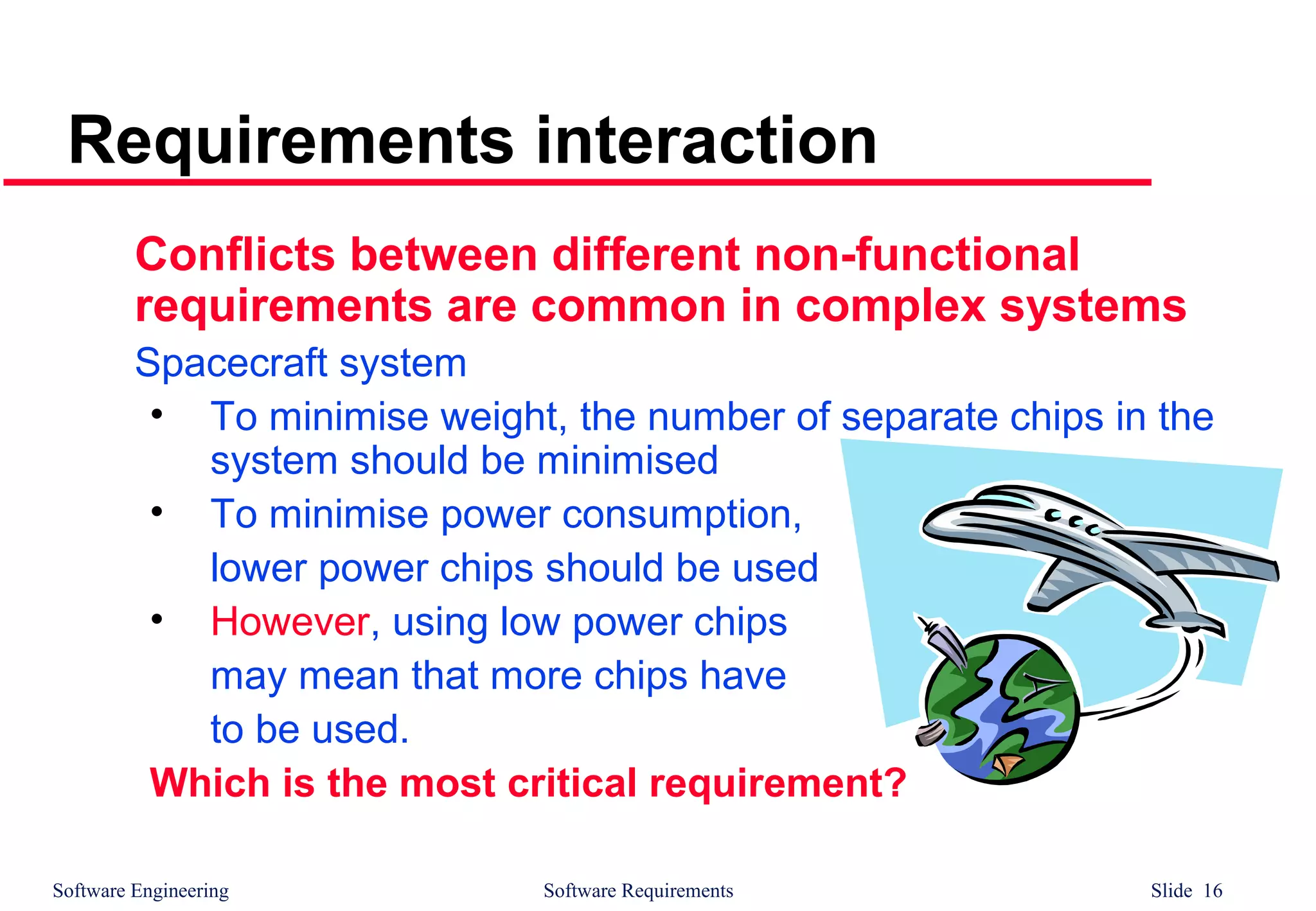
Requirements interaction
Conflicts between different non-functional
requirements are common in complex systems
Spacecraft system
• To minimise weight, the number of separate chips in the
system should be minimised
• To minimise power consumption,
lower power chips should be used
• However, using low power chips
may mean that more chips have
to be used.
Which is the most critical requirement?
Software Engineering Software Requirements Slide 17
Domain requirements
Derived from the application domain and
describe system characteristics and features that
reflect the domain
May be new functional requirements, constraints on
existing requirements or define specific computations
If domain requirements are not satisfied, the system
may be unworkable
Software Engineering Software Requirements Slide 18
Domain requirements problems
Understandability
• Requirements are expressed in the language of the
application domain
• This is often not understood by software engineers
developing the system
Implicitness
• Domain specialists understand the area so well that they
do not think of making the domain requirements explicit
Software Engineering Software Requirements Slide 19
User requirements
Should describe functional and non-functional
requirements so that they are understandable by
system users who don’t have detailed technical
knowledge
User requirements are defined using natural
language, tables and diagrams
Software Engineering Software Requirements Slide 20
Problems with natural language
Lack of clarity
• Precision is difficult without making the document difficult
to read
Requirements confusion
• Functional and non-functional requirements tend to be
mixed-up
Requirements amalgamation
• Several different requirements may be expressed
together
Software Engineering Software Requirements Slide 21
Guidelines for writing requirements
Invent a standard format and use it for all requirements
Use language in a consistent way. Use
shall for mandatory requirements,
should for desirable requirements
Use text highlighting to identify key parts of the
requirement
Avoid the use of computer jargon !!!
Software Engineering Software Requirements Slide 22
System requirements
– More detailed specifications of user requirements
Serve as a basis for designing the system
May be used as part of the system contract
System requirements may be expressed using
system models
Software Engineering Software Requirements Slide 23
Requirements and design
In principle, requirements should state what the
system should do and the design should describe
how it does this
In practice, requirements and design are
inseparable
• A system architecture may be designed to structure the requirements
• The system may inter-operate with other systems that generate
design requirements
• The use of a specific design may be a domain requirement
Software Engineering Software Requirements Slide 24
Problems with NL specification
Ambiguity
• The readers and writers of the requirement must interpret the same
words in the same way. NL is naturally ambiguous so this is very
difficult
Over-flexibility
• The same thing may be said in a number of different ways in the
specification
Lack of modularisation
• NL structures are inadequate to structure system requirements
Software Engineering Software Requirements Slide 25
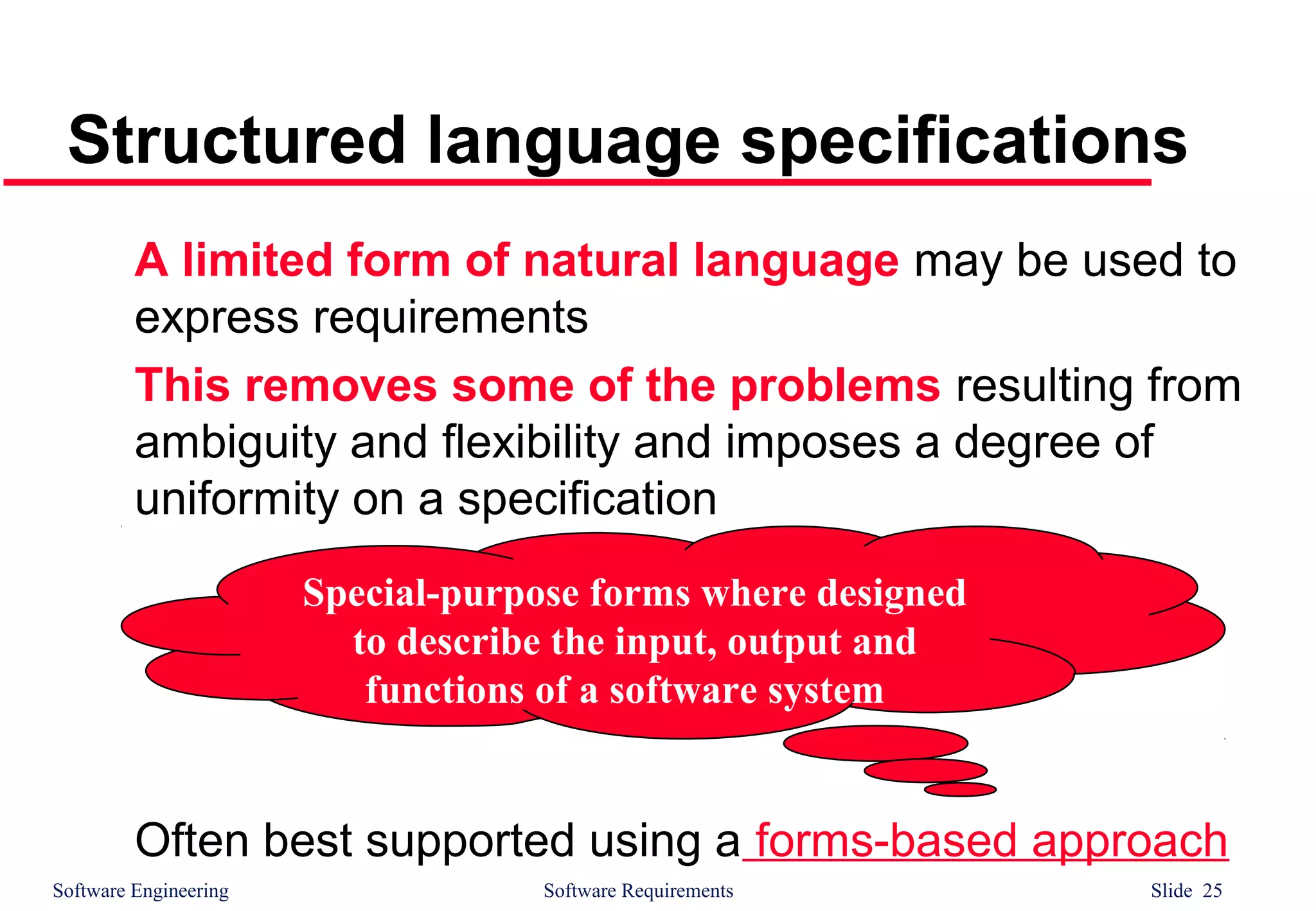
Structured language specifications
A limited form of natural language may be used to
express requirements
This removes some of the problems resulting from
ambiguity and flexibility and imposes a degree of
uniformity on a specification
Often best supported using a forms-based approach
Special-purpose forms where designed
to describe the input, output and
functions of a software system
Software Engineering Software Requirements Slide 26
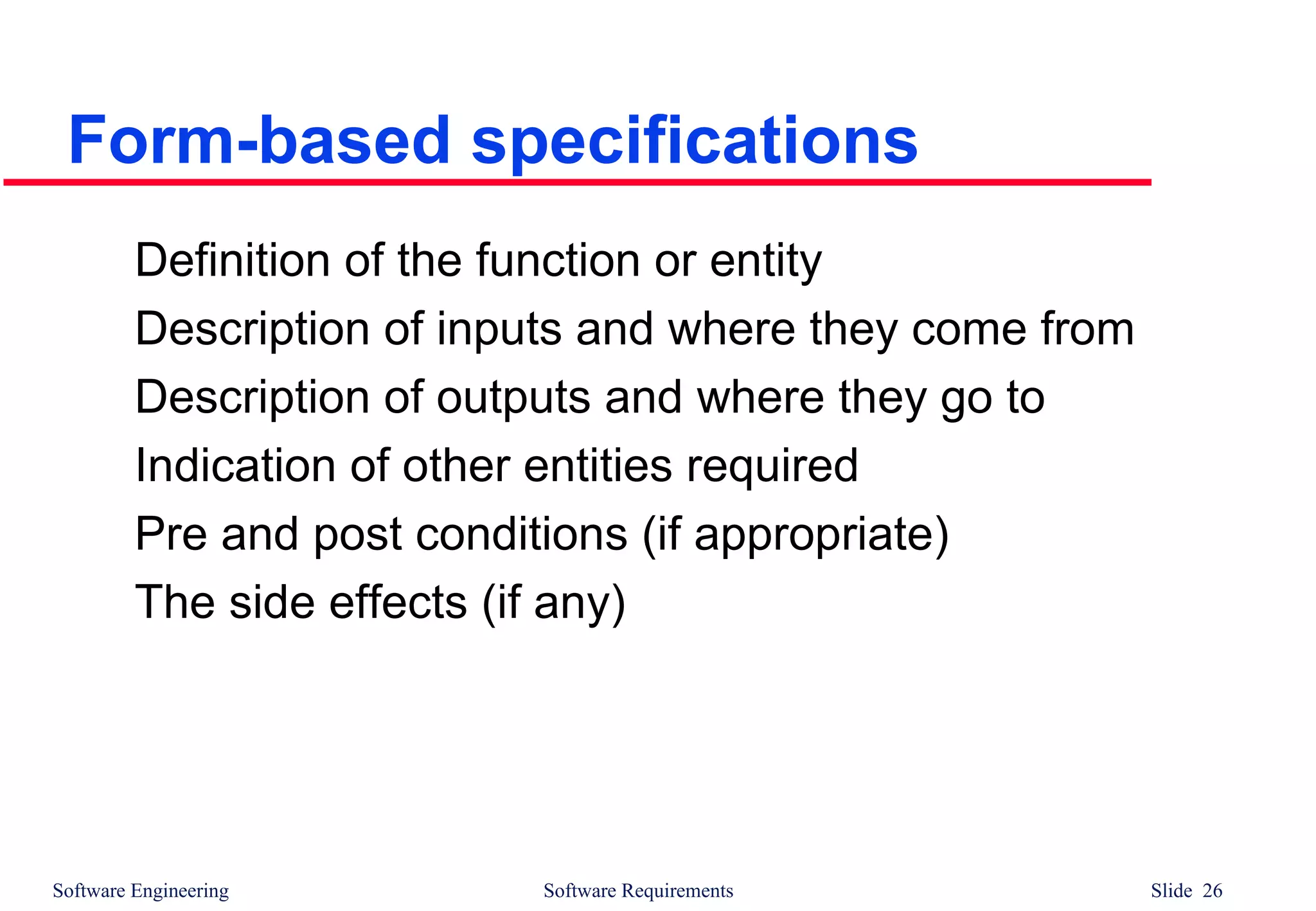
Form-based specifications
Definition of the function or entity
Description of inputs and where they come from
Description of outputs and where they go to
Indication of other entities required
Pre and post conditions (if appropriate)
The side effects (if any)
Software Engineering Software Requirements Slide 27
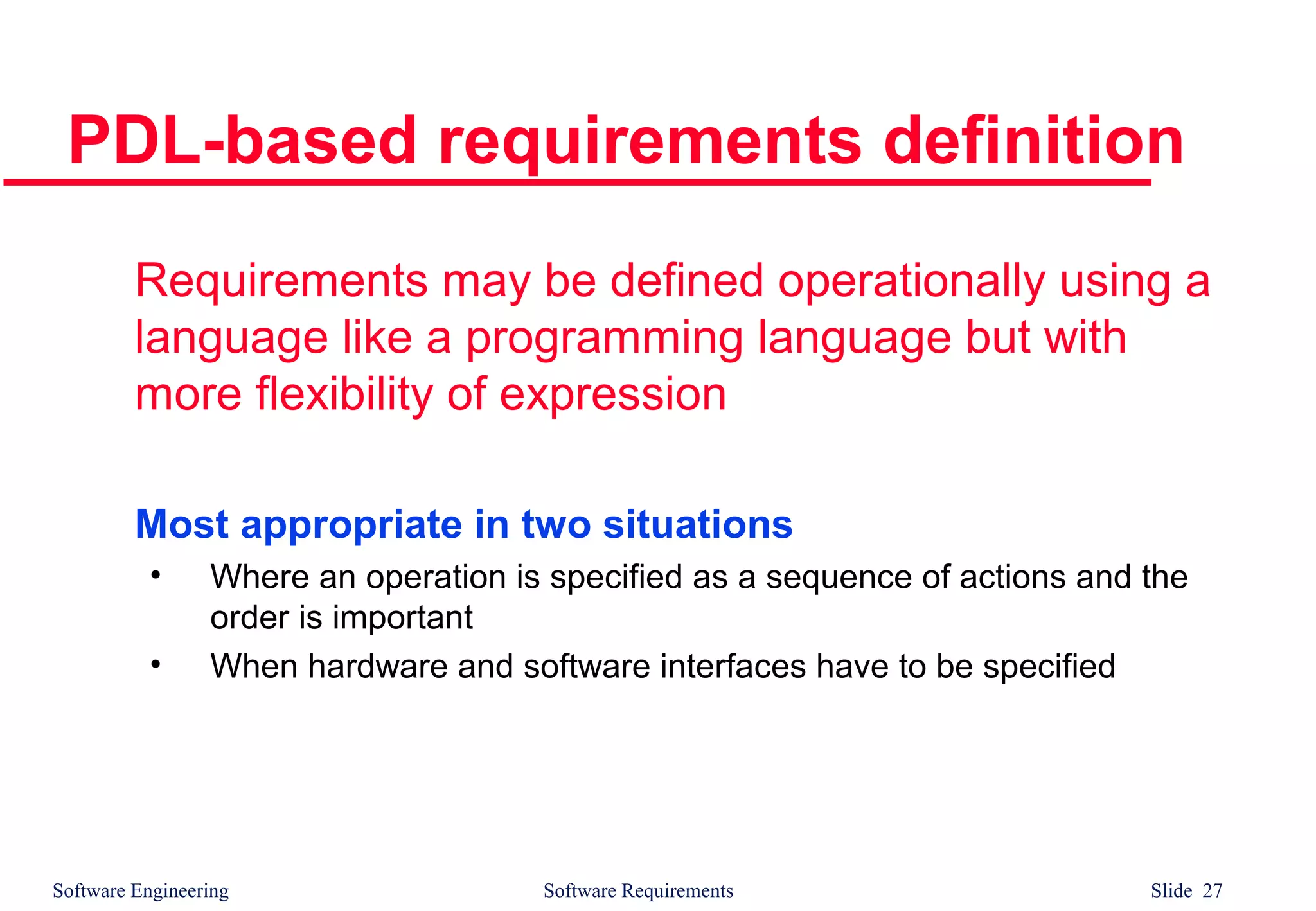
PDL-based requirements definition
Requirements may be defined operationally using a
language like a programming language but with
more flexibility of expression
Most appropriate in two situations
• Where an operation is specified as a sequence of actions and the
order is important
• When hardware and software interfaces have to be specified
Software Engineering Software Requirements Slide 28
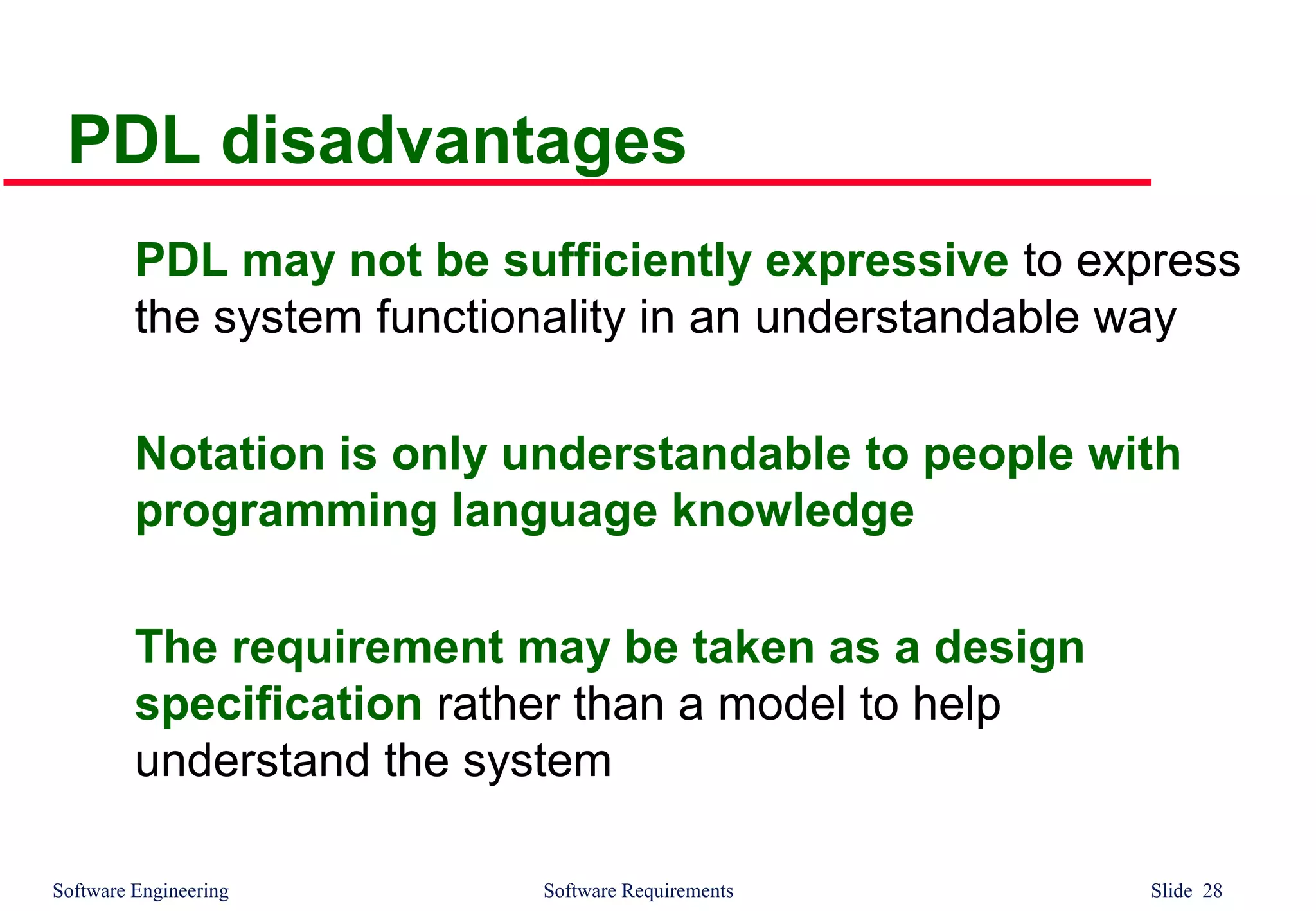
PDL disadvantages
PDL may not be sufficiently expressive to express
the system functionality in an understandable way
Notation is only understandable to people with
programming language knowledge
The requirement may be taken as a design
specification rather than a model to help
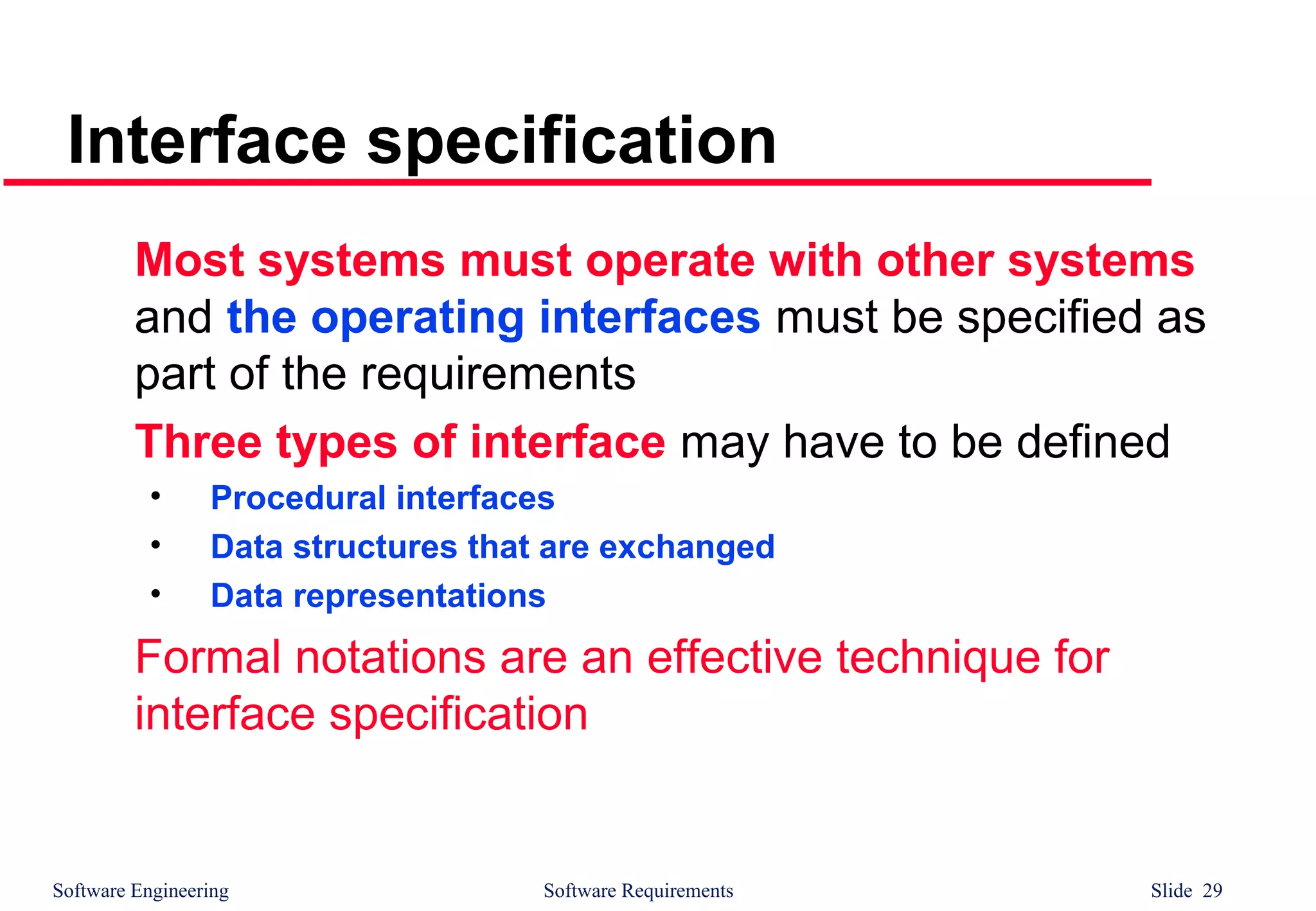
understand the system
Software Engineering Software Requirements Slide 29
Interface specification
Most systems must operate with other systems
and the operating interfaces must be specified as
part of the requirements
Three types of interface may have to be defined
• Procedural interfaces
• Data structures that are exchanged
• Data representations
Formal notations are an effective technique for
interface specification
Software Engineering Software Requirements Slide 30
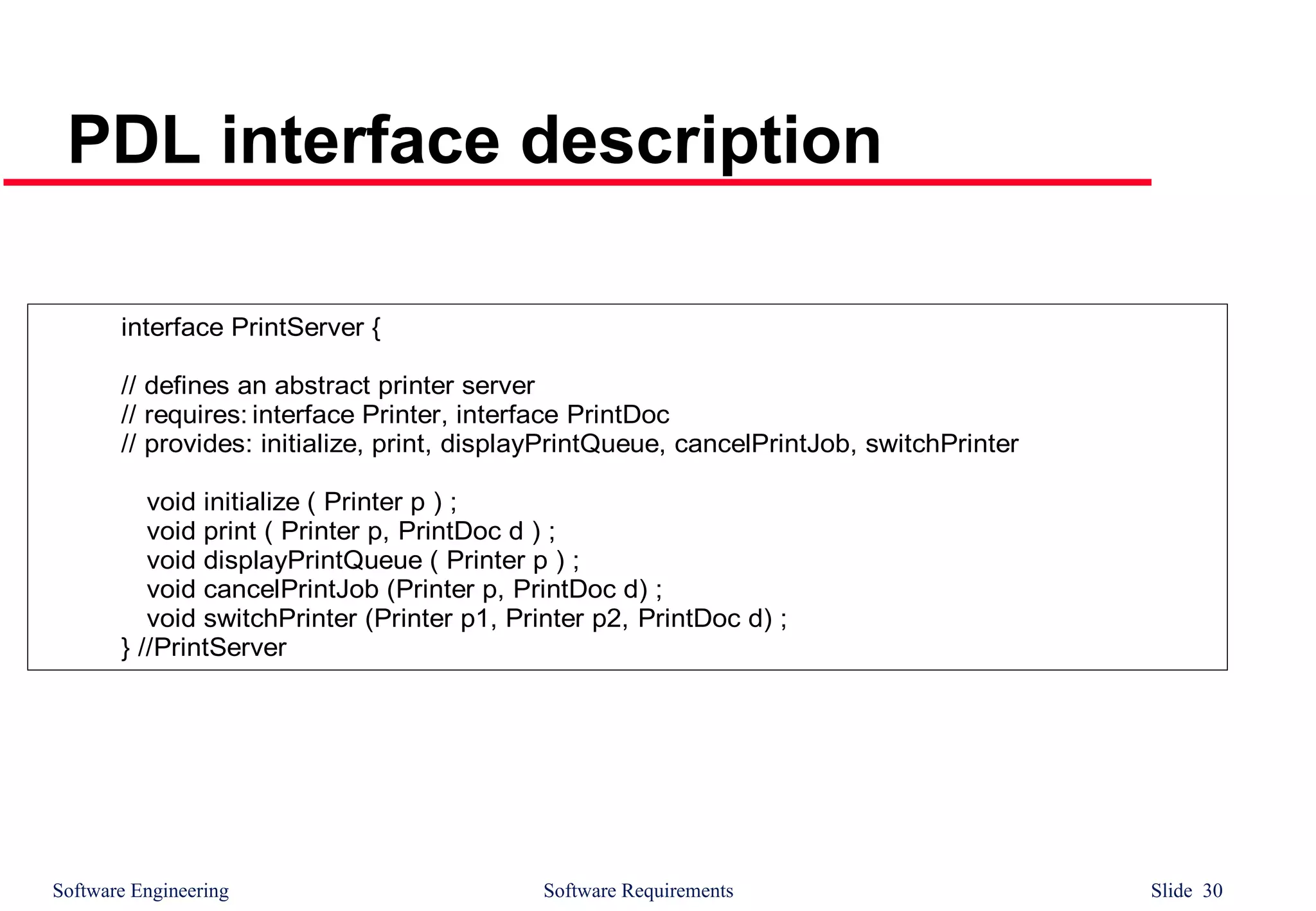
PDL interface description
interface PrintServer {
// defines an abstract printer server
// requires: interface Printer, interface PrintDoc
// provides: initialize, print, displayPrintQueue, cancelPrintJob, switchPrinter
void initialize ( Printer p ) ;
void print ( Printer p, PrintDoc d ) ;
void displayPrintQueue ( Printer p ) ;
void cancelPrintJob (Printer p, PrintDoc d) ;
void switchPrinter (Printer p1, Printer p2, PrintDoc d) ;
} //PrintServer
Software Engineering Software Requirements Slide 31
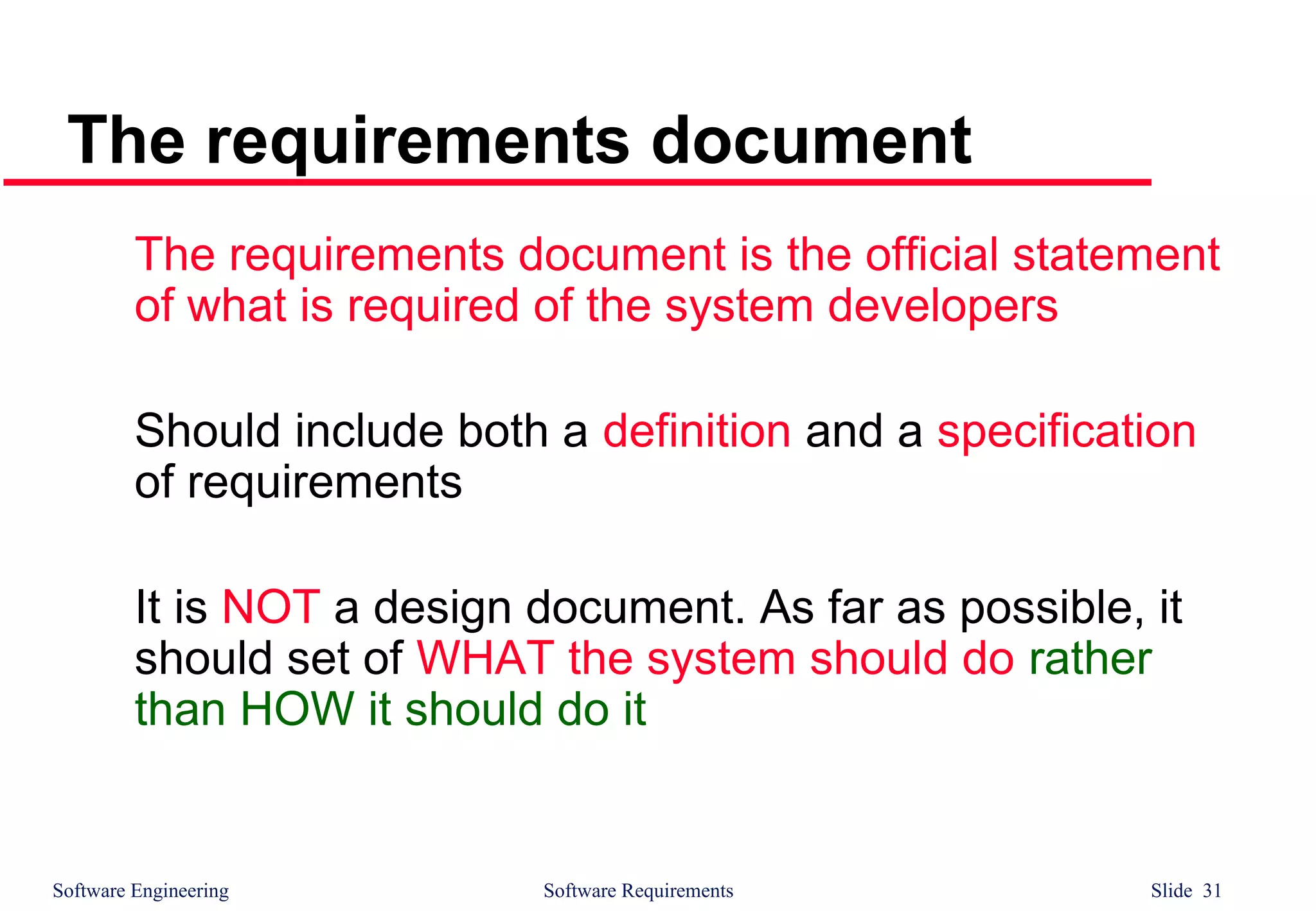
The requirements document
The requirements document is the official statement
of what is required of the system developers
Should include both a definition and a specification
of requirements
It is NOT a design document. As far as possible, it
should set of WHAT the system should do rather
than HOW it should do it
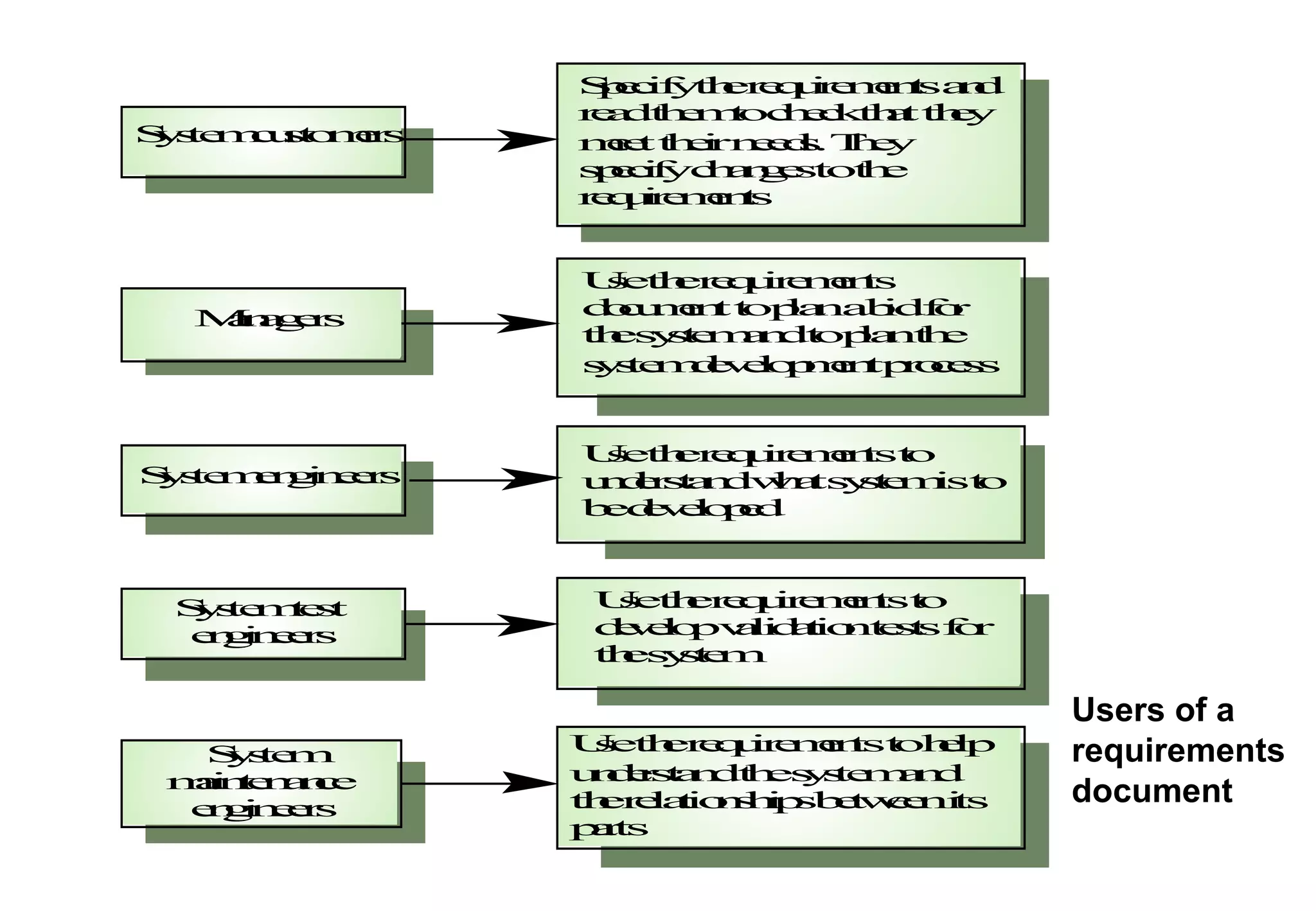
Users of a
requirements
document
Usetherequirementsto
developvalidationtestsfor
thesystem
Usetherequirements
documenttoplanabidfor
thesystemandtoplanthe
systemdevelopmentprocess
Usetherequirementsto
understandwhatsystemisto
bedeveloped
Systemtest
engineers
Managers
Systemengineers
Specifytherequirementsand
readthemtocheckthatthey
meettheirneeds.They
specifychangestothe
requirements
Systemcustomers
Usetherequirementstohelp
understandthesystemand
therelationshipsbetweenits
parts
System
maintenance
engineers
Software Engineering Software Requirements Slide 33
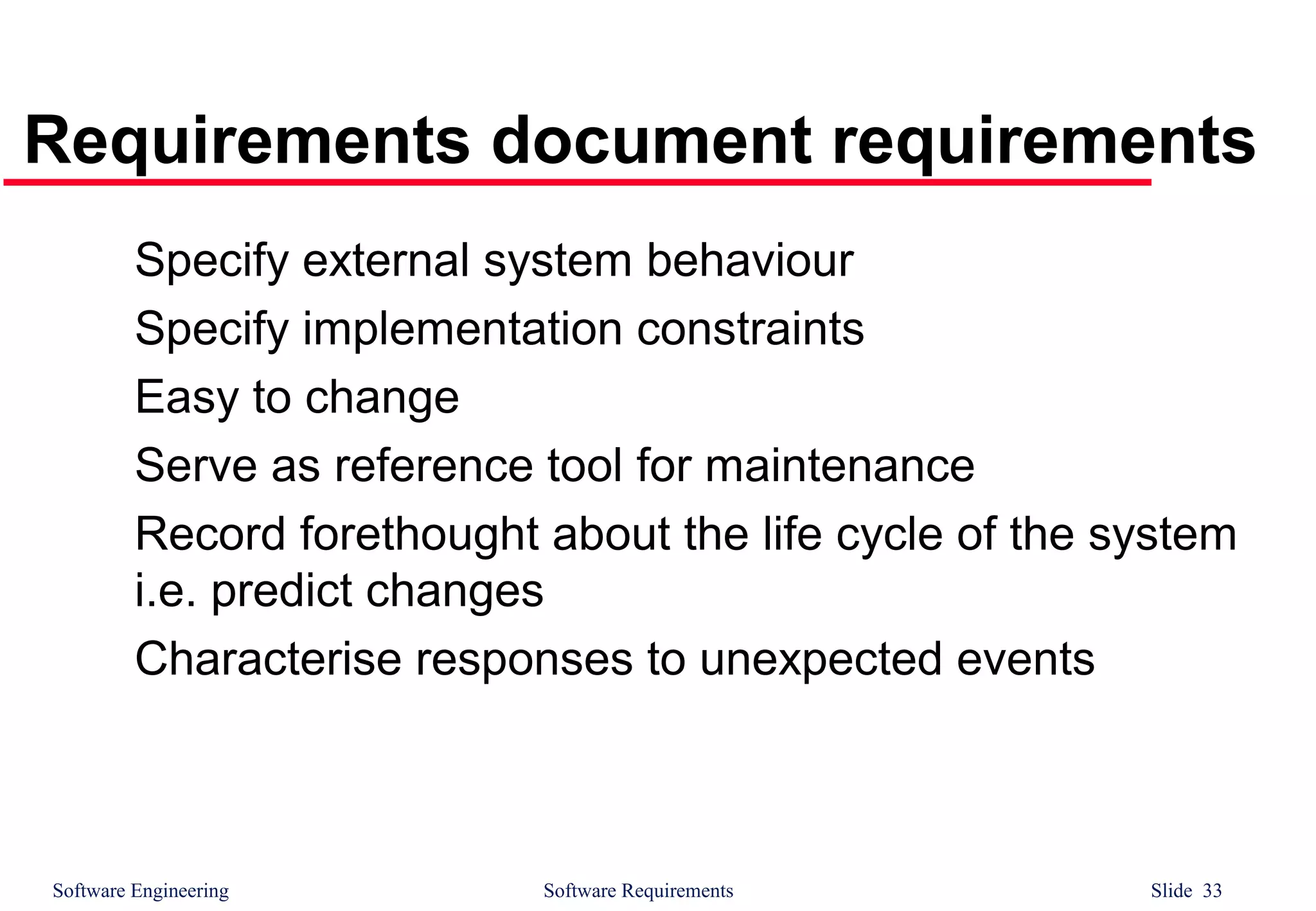
Requirements document requirements
Specify external system behaviour
Specify implementation constraints
Easy to change
Serve as reference tool for maintenance
Record forethought about the life cycle of the system
i.e. predict changes
Characterise responses to unexpected events
Software Engineering Software Requirements Slide 34
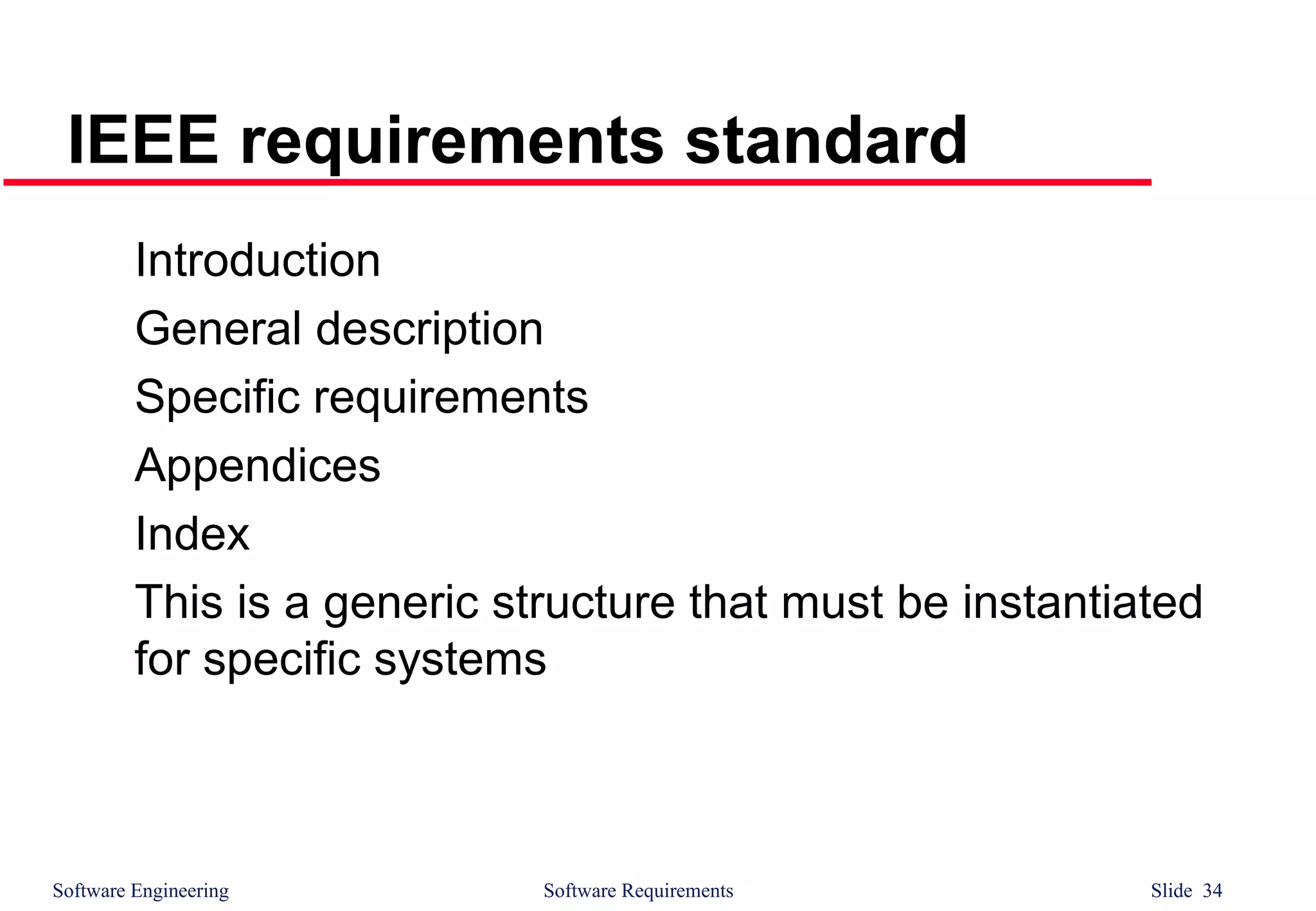
IEEE requirements standard
Introduction
General description
Specific requirements
Appendices
Index
This is a generic structure that must be instantiated
for specific systems
Software Engineering Software Requirements Slide 35
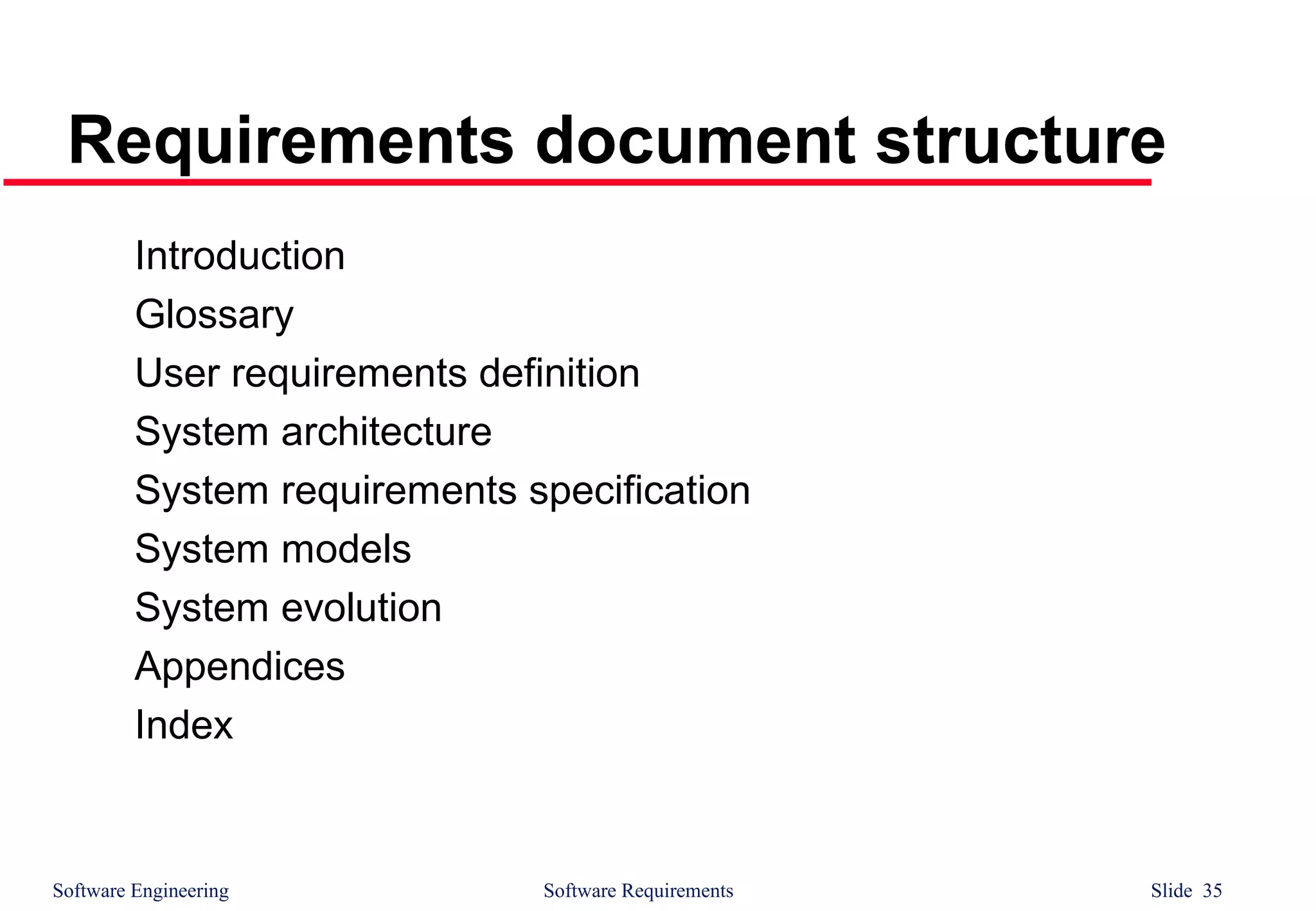
Requirements document structure
Introduction
Glossary
User requirements definition
System architecture
System requirements specification
System models
System evolution
Appendices
Index

Se week 4

  • 1.
    Software Engineering SoftwareRequirements Slide 1 Software Requirements Descriptions and specifications of a system
  • 2.
    Software Engineering SoftwareRequirements Slide 2 Requirements engineering Requirements engineering is the process of establishing the services that the customer requires from a system the constraints under which it operates and is developed Requirements The descriptions of the system services and constraints that are generated during the requirements engineering process
  • 3.
    Software Engineering SoftwareRequirements Slide 3 What is a requirement? It may range from a high-level abstract statement of a service or of a system constraint to a detailed mathematical functional specification This is inevitable as requirements may serve a dual function • May be the basis for a bid for a contract - therefore must be open to interpretation • May be the basis for the contract itself - therefore must be defined in detail • Both these statements may be called requirements
  • 4.
    Software Engineering SoftwareRequirements Slide 4 Types of requirement User requirements • Statements in natural language plus diagrams of the services the system provides and its operational constraints. Written for customers System requirements • A structured document setting out detailed descriptions of the system services. Written as a contract between client and contractor Software specification • A detailed software description which can serve as a basis for a design or implementation. Written for developers
  • 5.
    Software Engineering SoftwareRequirements Slide 5 Requirements readers Client managers Systemend-users Client engineers Contractor managers Systemarchitects Systemend-users Client engineers Systemarchitects Softwaredevelopers Client engineers (perhaps) Systemarchitects Softwaredevelopers User requirements Systemrequirements Softwaredesign specification
  • 6.
    Software Engineering SoftwareRequirements Slide 6 Functional and non-functional requirements Functional requirements • Statements of services the system should provide, how the system should react to particular inputs and how the system should behave in particular situations. Non-functional requirements • constraints on the services or functions offered by the system such as timing constraints, constraints on the development process, standards, etc. Domain requirements • Requirements that come from the application domain of the system and that reflect characteristics of that domain
  • 7.
    Software Engineering SoftwareRequirements Slide 7 Functional Requirements Describe functionality or system services Depend on the type of software, expected users and the type of system where the software is used Functional user requirements may be high-level statements of what the system should do BUT functional system requirements should describe the system services in detail
  • 8.
    Software Engineering SoftwareRequirements Slide 8 Examples of functional requirements The user shall be able to search either all of the initial set of databases or select a subset from it. The system shall provide appropriate viewers for the user to read documents in the document store. Every order shall be allocated a unique identifier (ORDER_ID) which the user shall be able to copy to the account’s permanent storage area.
  • 9.
    Software Engineering SoftwareRequirements Slide 9 Requirements imprecision Problems arise when requirements are not precisely stated Ambiguous requirements may be interpreted in different ways by developers and users Consider the term ‘appropriate viewers’ • User intention - special purpose viewer for each different document type • Developer interpretation - Provide a text viewer that shows the contents of the document
  • 10.
    Software Engineering SoftwareRequirements Slide 10 Requirements completeness and consistency In principle requirements should be both complete and consistent Complete • They should include descriptions of all facilities required Consistent • There should be no conflicts or contradictions in the descriptions of the system facilities In practice, it is very difficult or impossible to produce a complete and consistent requirements document
  • 11.
    Software Engineering SoftwareRequirements Slide 11 Non-functional requirements Define system properties and constraints e.g. reliability, response time and storage requirements. Constraints are I/O device capability, system representations, etc. Process requirements may also be specified mandating a particular CASE system, programming language or development method Non-functional requirements may be more critical than functional requirements. If these are not met, the system is useless
  • 12.
    Software Engineering SoftwareRequirements Slide 12 Non-functional classifications Product requirements • Requirements which specify that the delivered product must behave in a particular way e.g. execution speed, reliability, etc. Organisational requirements • Requirements which are a consequence of organisational policies and procedures e.g. process standards used, implementation requirements, etc. External requirements • Requirements which arise from factors which are external to the system and its development process e.g. interoperability requirements, legislative requirements, etc.
  • 13.
    Software Engineering SoftwareRequirements Slide 13 Non-functional requirement types Performance requirements Space requirements Usability requirements Efficiency requirements Reliability requirements Portability requirements Interoperability requirements Ethical requirements Legislative requirements Implementation requirements Standards requirements Delivery requirements Safety requirements Privacy requirements Product requirements Organizational requirements External requirements Non-functional requirements
  • 14.
    Software Engineering SoftwareRequirements Slide 14 Goals and requirements Non-functional requirements may be very difficult to state precisely and imprecise requirements may be difficult to verify. Goal • A general intention of the user such as ease of use Verifiable non-functional requirement • A statement using some measure that can be objectively tested Goals are helpful to developers as they convey the intentions of the system users
  • 15.
    Software Engineering SoftwareRequirements Slide 15 Requirements measures Property Measure Speed Processed transactions/second User/Event response time Screen refresh time Size K Bytes Number of RAM chips Ease of use Training time Number of help frames Reliability Mean time to failure Probability of unavailability Rate of failure occurrence Availability Robustness Time to restart after failure Percentage of events causing failure Probability of data corruption on failure Portability Percentage of target dependent statements Number of target systems
  • 16.
    Software Engineering SoftwareRequirements Slide 16 Requirements interaction Conflicts between different non-functional requirements are common in complex systems Spacecraft system • To minimise weight, the number of separate chips in the system should be minimised • To minimise power consumption, lower power chips should be used • However, using low power chips may mean that more chips have to be used. Which is the most critical requirement?
  • 17.
    Software Engineering SoftwareRequirements Slide 17 Domain requirements Derived from the application domain and describe system characteristics and features that reflect the domain May be new functional requirements, constraints on existing requirements or define specific computations If domain requirements are not satisfied, the system may be unworkable
  • 18.
    Software Engineering SoftwareRequirements Slide 18 Domain requirements problems Understandability • Requirements are expressed in the language of the application domain • This is often not understood by software engineers developing the system Implicitness • Domain specialists understand the area so well that they do not think of making the domain requirements explicit
  • 19.
    Software Engineering SoftwareRequirements Slide 19 User requirements Should describe functional and non-functional requirements so that they are understandable by system users who don’t have detailed technical knowledge User requirements are defined using natural language, tables and diagrams
  • 20.
    Software Engineering SoftwareRequirements Slide 20 Problems with natural language Lack of clarity • Precision is difficult without making the document difficult to read Requirements confusion • Functional and non-functional requirements tend to be mixed-up Requirements amalgamation • Several different requirements may be expressed together
  • 21.
    Software Engineering SoftwareRequirements Slide 21 Guidelines for writing requirements Invent a standard format and use it for all requirements Use language in a consistent way. Use shall for mandatory requirements, should for desirable requirements Use text highlighting to identify key parts of the requirement Avoid the use of computer jargon !!!
  • 22.
    Software Engineering SoftwareRequirements Slide 22 System requirements – More detailed specifications of user requirements Serve as a basis for designing the system May be used as part of the system contract System requirements may be expressed using system models
  • 23.
    Software Engineering SoftwareRequirements Slide 23 Requirements and design In principle, requirements should state what the system should do and the design should describe how it does this In practice, requirements and design are inseparable • A system architecture may be designed to structure the requirements • The system may inter-operate with other systems that generate design requirements • The use of a specific design may be a domain requirement
  • 24.
    Software Engineering SoftwareRequirements Slide 24 Problems with NL specification Ambiguity • The readers and writers of the requirement must interpret the same words in the same way. NL is naturally ambiguous so this is very difficult Over-flexibility • The same thing may be said in a number of different ways in the specification Lack of modularisation • NL structures are inadequate to structure system requirements
  • 25.
    Software Engineering SoftwareRequirements Slide 25 Structured language specifications A limited form of natural language may be used to express requirements This removes some of the problems resulting from ambiguity and flexibility and imposes a degree of uniformity on a specification Often best supported using a forms-based approach Special-purpose forms where designed to describe the input, output and functions of a software system
  • 26.
    Software Engineering SoftwareRequirements Slide 26 Form-based specifications Definition of the function or entity Description of inputs and where they come from Description of outputs and where they go to Indication of other entities required Pre and post conditions (if appropriate) The side effects (if any)
  • 27.
    Software Engineering SoftwareRequirements Slide 27 PDL-based requirements definition Requirements may be defined operationally using a language like a programming language but with more flexibility of expression Most appropriate in two situations • Where an operation is specified as a sequence of actions and the order is important • When hardware and software interfaces have to be specified
  • 28.
    Software Engineering SoftwareRequirements Slide 28 PDL disadvantages PDL may not be sufficiently expressive to express the system functionality in an understandable way Notation is only understandable to people with programming language knowledge The requirement may be taken as a design specification rather than a model to help understand the system
  • 29.
    Software Engineering SoftwareRequirements Slide 29 Interface specification Most systems must operate with other systems and the operating interfaces must be specified as part of the requirements Three types of interface may have to be defined • Procedural interfaces • Data structures that are exchanged • Data representations Formal notations are an effective technique for interface specification
  • 30.
    Software Engineering SoftwareRequirements Slide 30 PDL interface description interface PrintServer { // defines an abstract printer server // requires: interface Printer, interface PrintDoc // provides: initialize, print, displayPrintQueue, cancelPrintJob, switchPrinter void initialize ( Printer p ) ; void print ( Printer p, PrintDoc d ) ; void displayPrintQueue ( Printer p ) ; void cancelPrintJob (Printer p, PrintDoc d) ; void switchPrinter (Printer p1, Printer p2, PrintDoc d) ; } //PrintServer
  • 31.
    Software Engineering SoftwareRequirements Slide 31 The requirements document The requirements document is the official statement of what is required of the system developers Should include both a definition and a specification of requirements It is NOT a design document. As far as possible, it should set of WHAT the system should do rather than HOW it should do it
  • 32.
  • 33.
    Software Engineering SoftwareRequirements Slide 33 Requirements document requirements Specify external system behaviour Specify implementation constraints Easy to change Serve as reference tool for maintenance Record forethought about the life cycle of the system i.e. predict changes Characterise responses to unexpected events
  • 34.
    Software Engineering SoftwareRequirements Slide 34 IEEE requirements standard Introduction General description Specific requirements Appendices Index This is a generic structure that must be instantiated for specific systems
  • 35.
    Software Engineering SoftwareRequirements Slide 35 Requirements document structure Introduction Glossary User requirements definition System architecture System requirements specification System models System evolution Appendices Index