The presentation discusses software requirements and specifications. It defines user requirements as more abstract statements of what services the system should provide, while system requirements provide more detailed descriptions of the system's functions and constraints. Functional requirements describe what the system will do, including inputs, outputs, and business rules. Non-functional requirements describe emergent system properties like performance, availability, and security. Finally, a software requirements document formally specifies both the user and system requirements and serves as an agreement between developers and customers.
ACKNOWLEDGEMENT
During the designof this presentation our group are
very encouraging souls who are supporting each other in the
group. We cannot stay without giving sincere thanks to
each other.
We are greatful to our subject teacher Mr.
Ramesh Singh Saud for playing the role of guidance and
giving us such a presentation which was impossible
without him.
-Presenters
3.
OBJECTIVE
Understand theconcepts of user requirements and
system requirement .
Understand the differences between functional and
non-functional requirements.
Understand how requirements may be organized in
a software requirements documents.
4.
CONTENTS
Software Requirements
User Requirements
System Requirements
Functional and Non-Functional Requirements
Software Requirements Documents
5.
SOFTWARE REQUIREMENTS
Introduction:
Requirements are descriptions of the services that a software
system must provide and the constraints under which it must
operate.
Requirements can range from high-level abstract statements of
services or system constraints to detailed mathematical functional
specifications.
Requirements Engineering is the process of establishing the
services that the customer requires from the system and the
constraints under which it is to be developed and operated.
These requirement reflects the need of customer for a system
that helps solve problem such as controlling, placing an order
or finding information.
There are two types of software requirements:
User Requirements
System Requirements
6.
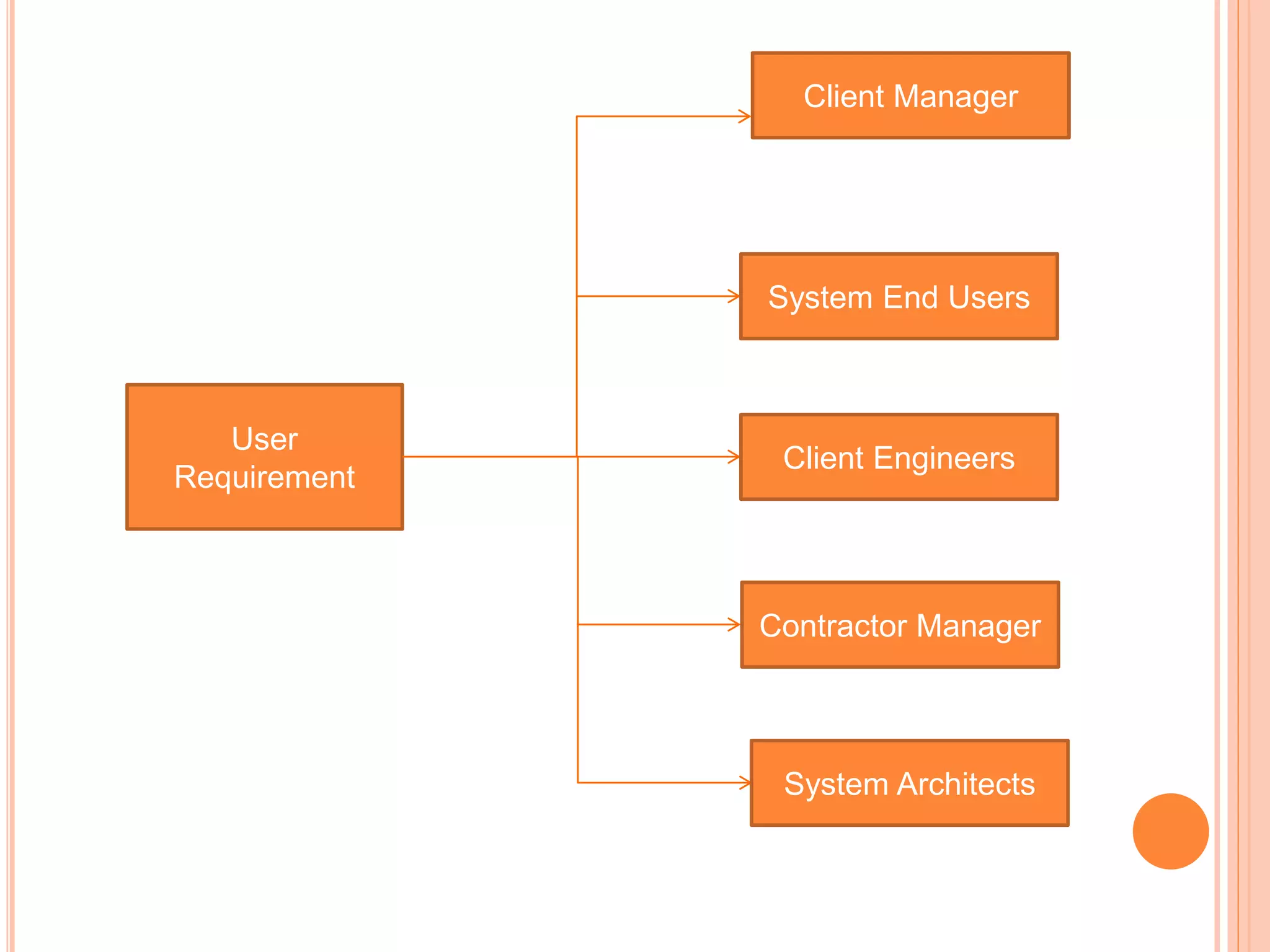
USER REQUIREMENTS
Itis the statement in natural language plus
diagrams, of what services the system the system
is expected to provide and constraints under which
it must operate.
It is more abstract.
Each and every requirement of user should be
clearly defined so the it will be easy for developer to
include the user demanded feature in the software.
It may be expanded into several system
requirements.
7.
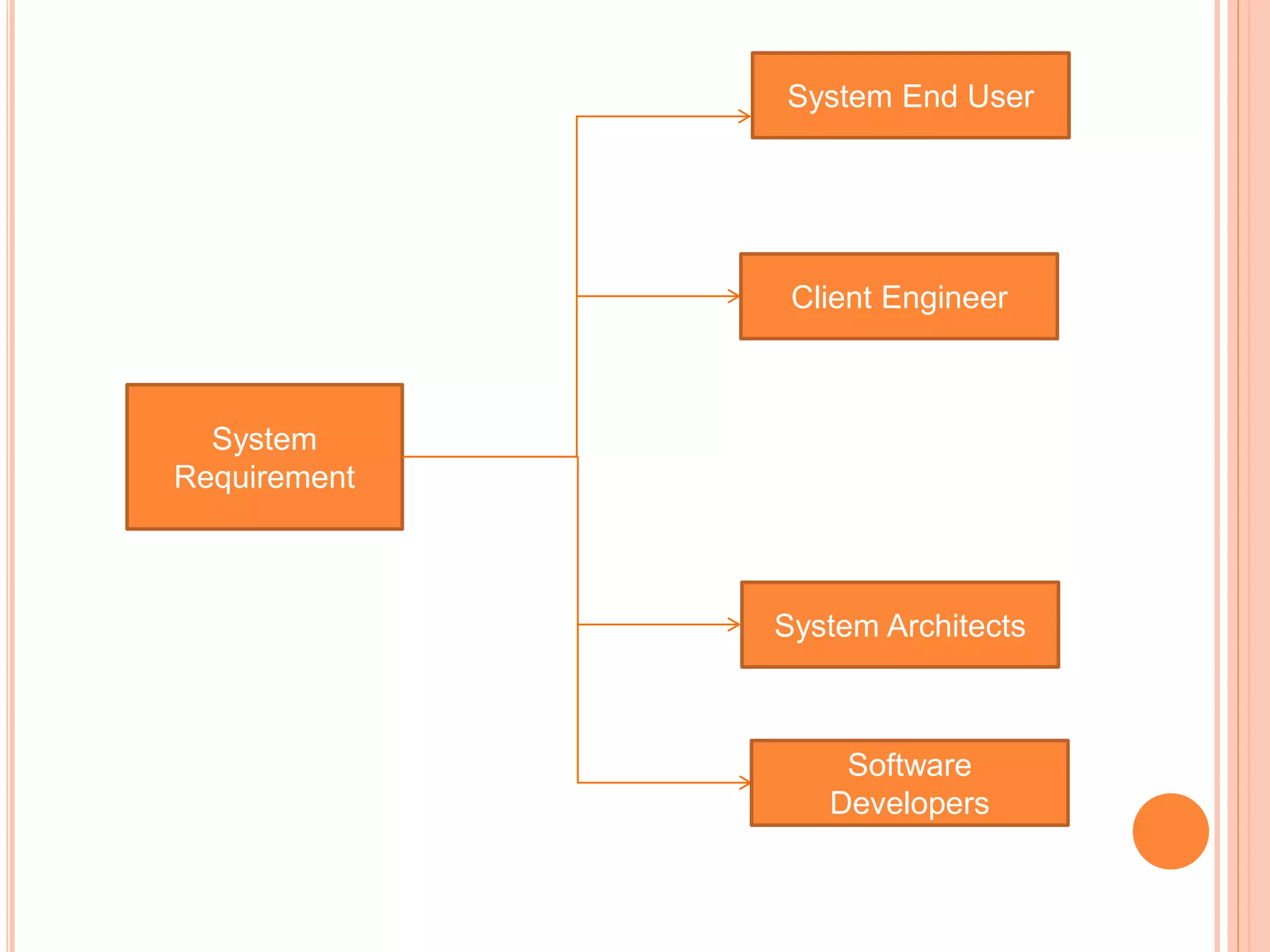
SYSTEM REQUIREMENT
Itis the set out the system’s functions, services
and operational constraints in detail.
Every requirement for the system must be in detail
or in precise view so the it will be easy to
understand the system n develop the software
accordingly.
It should also define exactly what is to be
implemented during the development.
In this, the contract between the system buyer and
software developer is made.
FUNCTIONAL REQUIREMENT
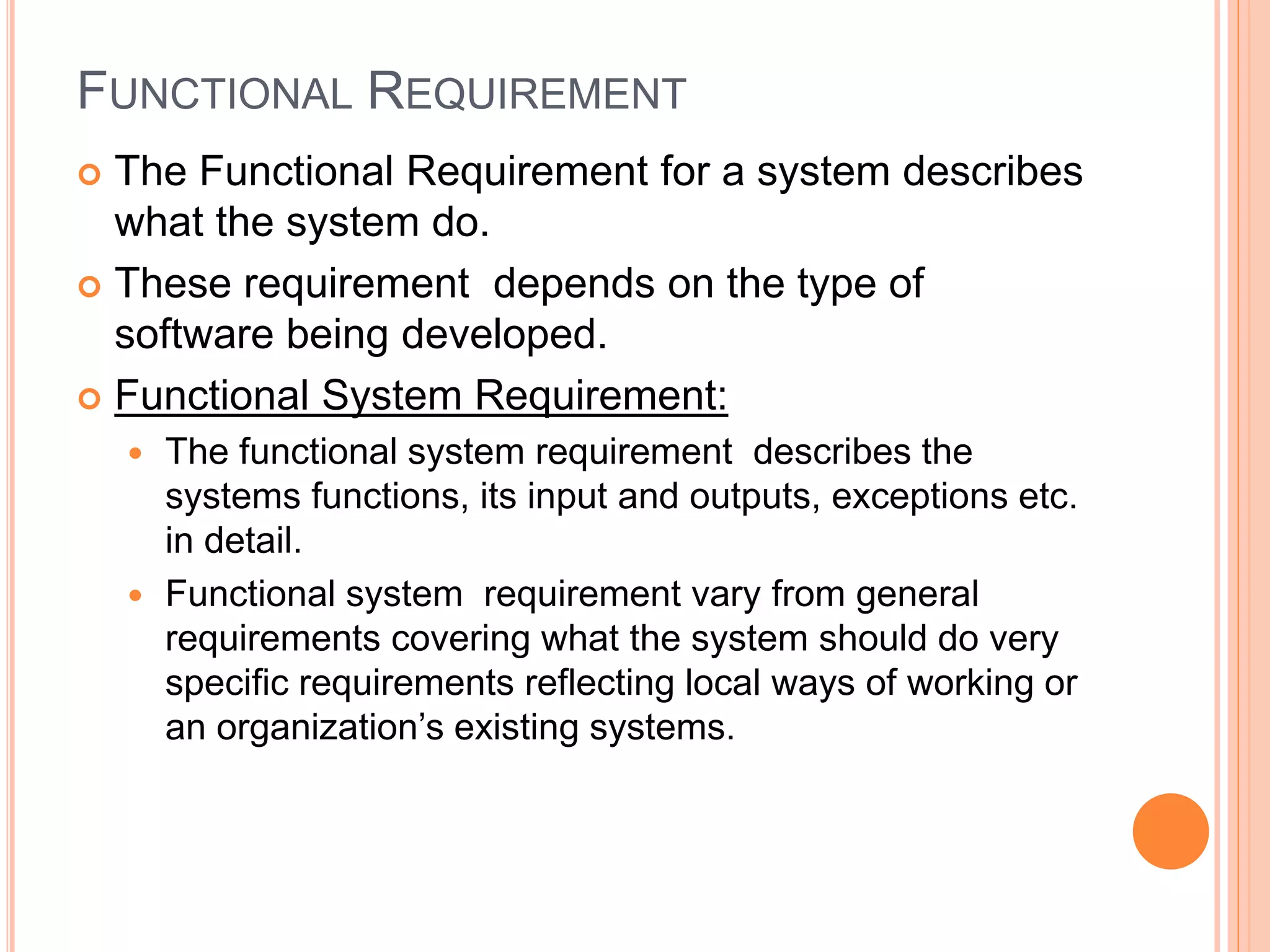
TheFunctional Requirement for a system describes
what the system do.
These requirement depends on the type of
software being developed.
Functional System Requirement:
The functional system requirement describes the
systems functions, its input and outputs, exceptions etc.
in detail.
Functional system requirement vary from general
requirements covering what the system should do very
specific requirements reflecting local ways of working or
an organization’s existing systems.
11.
FUNCTIONAL REQUIREMENT
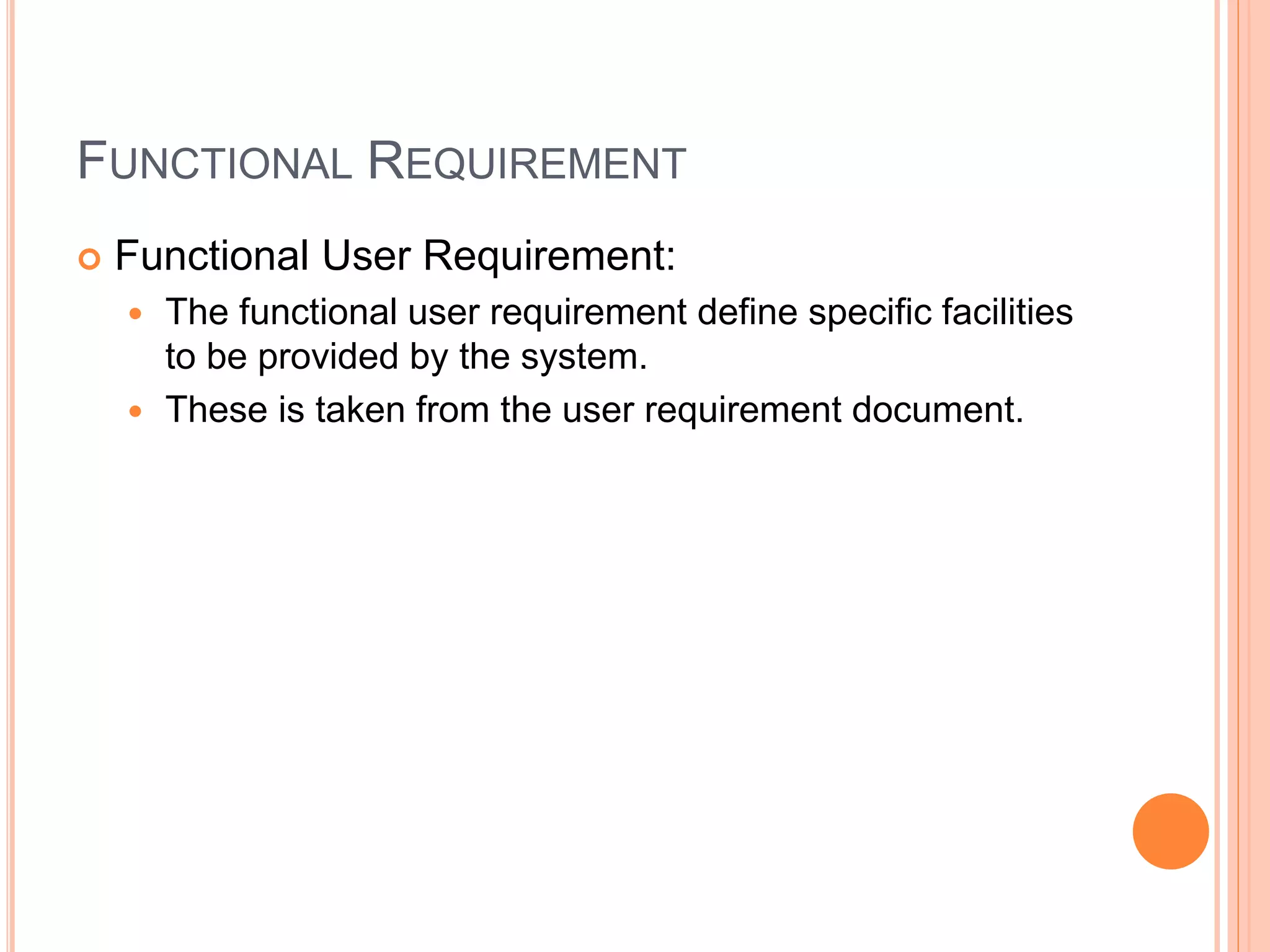
FunctionalUser Requirement:
The functional user requirement define specific facilities
to be provided by the system.
These is taken from the user requirement document.
12.
FUNCTIONAL REQUIREMENTS
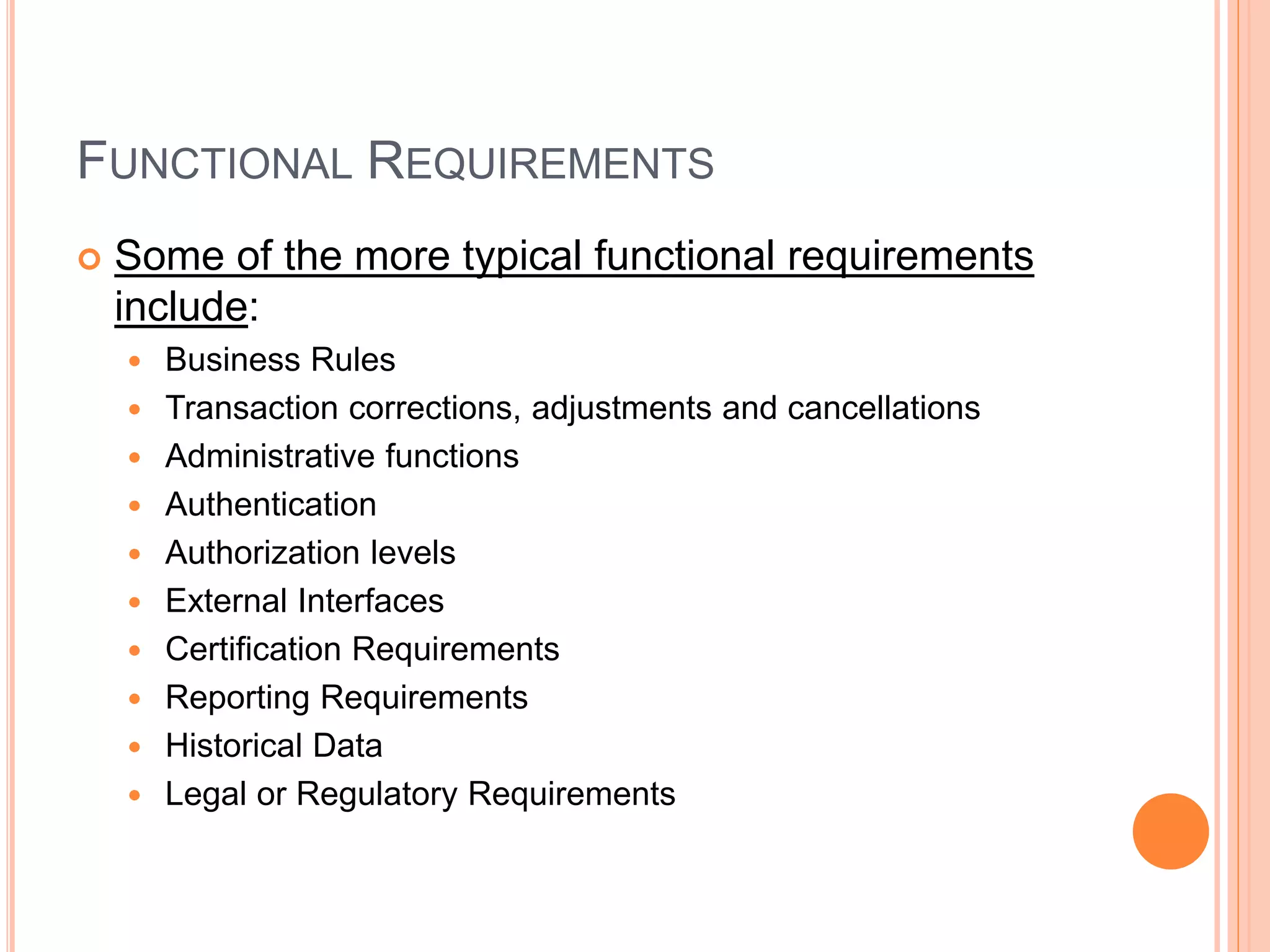
Someof the more typical functional requirements
include:
Business Rules
Transaction corrections, adjustments and cancellations
Administrative functions
Authentication
Authorization levels
External Interfaces
Certification Requirements
Reporting Requirements
Historical Data
Legal or Regulatory Requirements
13.
NON-FUNCTIONAL REQUIREMENTS
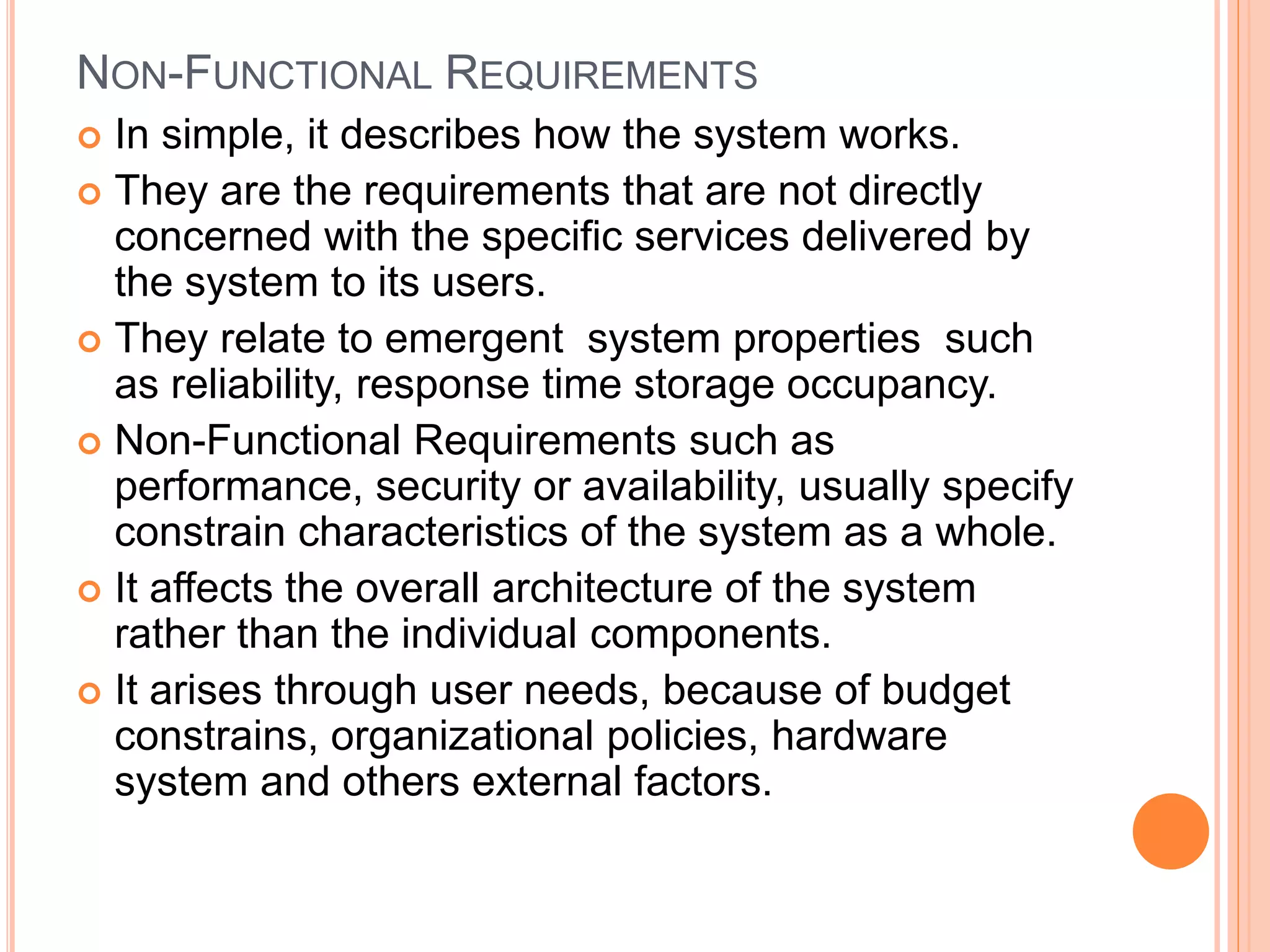
Insimple, it describes how the system works.
They are the requirements that are not directly
concerned with the specific services delivered by
the system to its users.
They relate to emergent system properties such
as reliability, response time storage occupancy.
Non-Functional Requirements such as
performance, security or availability, usually specify
constrain characteristics of the system as a whole.
It affects the overall architecture of the system
rather than the individual components.
It arises through user needs, because of budget
constrains, organizational policies, hardware
system and others external factors.
14.
NON FUNCTIONAL REQUIREMENTS
Some typical non-functional requirements are:
Performance – for example Response Time, Throughput.
Capacity
Availability
Reliability
Maintainability
Serviceability
Security
Regulatory
Manageability
Environmental
Usability
15.
SOFTWARE REQUIREMENT DOCUMENTS
The software requirement document is also called the
software requirement specification.
It is an official statement of what the system
developers should implement.
It should include both the user requirements for a
system and a detailed specification of a system
requirements. Sometimes the user and system
requirements are integrated in single description.
Requirement Documents are essential when an
outside contractor is developing the software system.
16.
CONCLUSION
From thispresentation we came to know about the
System requirements, User requirements. We also
discussed about the Functional and Non-Functional
Requirements similarly we also came to know about
Software Requirement Document., which all we
discussed in presentation.
Thank You..!



![Vibe Coding vs. Spec-Driven Development [Free Meetup]](https://cdn.slidesharecdn.com/ss_thumbnails/vibecodingvsspecdrivendevelopment-251209105622-43f455e7-thumbnail.jpg?width=640&height=640&fit=bounds)


