SDVIS AND IN-SITU VISUALIZATION
ON TACC’S STAMPEDE-KNL
Paul A. Navrátil, Ph.D.
Manager – Scalable Visualization Technologies
pnav@tacc.utexas.edu
1
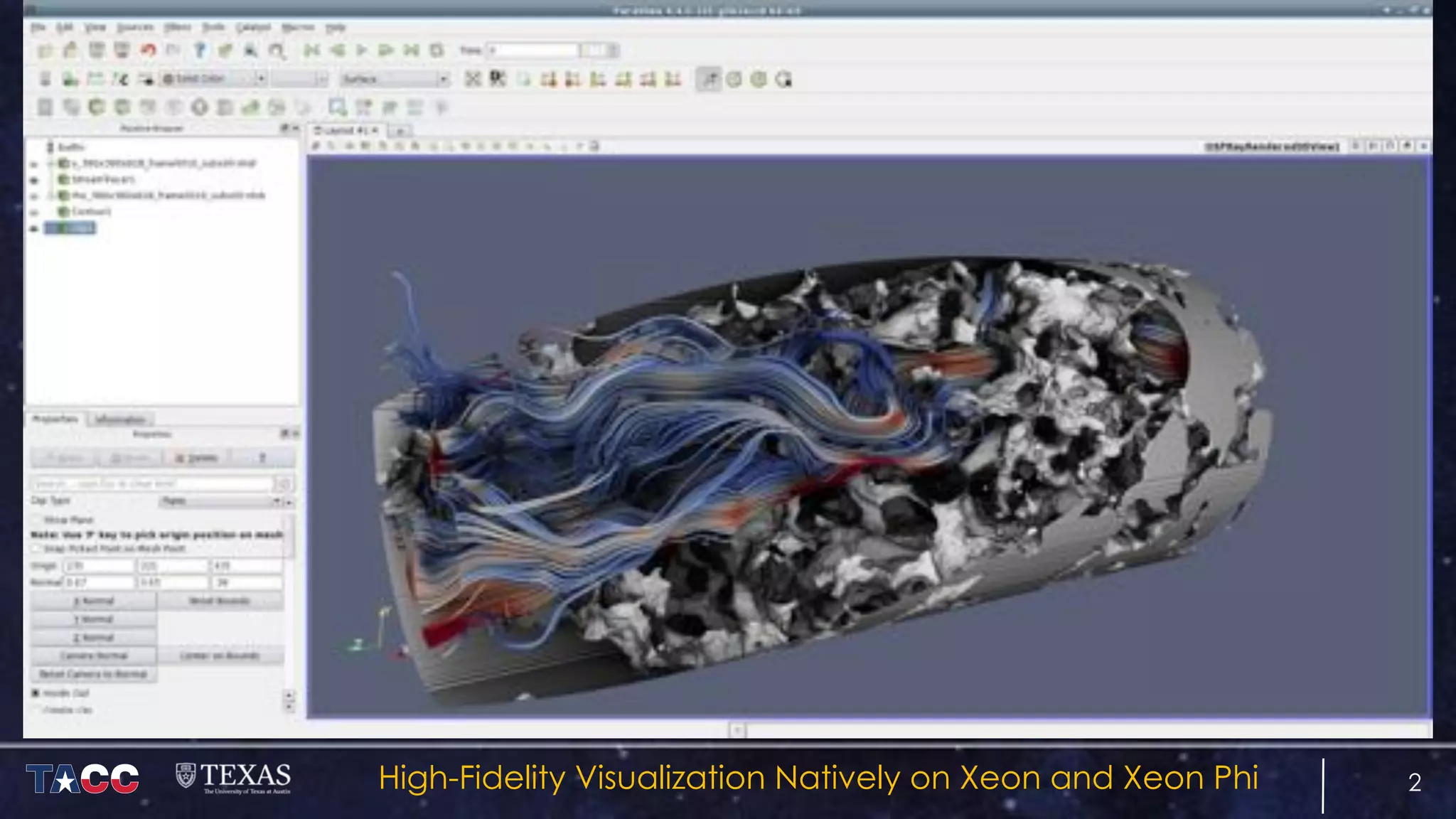
2High-Fidelity Visualization Natively on Xeon and Xeon Phi
OUTLINE
„ Stampede Architecture
„ Stampede – Sandy Bridge
„ Stampede - KNL
„ Stampede 2 – KNL + Skylake
„ Software-Defined Visualization Stack
„ VNC
„ OpenSWR
„ OSPRay
„ Path to In-Situ
„ ParaView Catalyst
„ VisIt Libsim
„ Direct renderer integration
3
4
STAMPEDE ARCHITECTURE
STAMPEDE SANDY BRIDGE
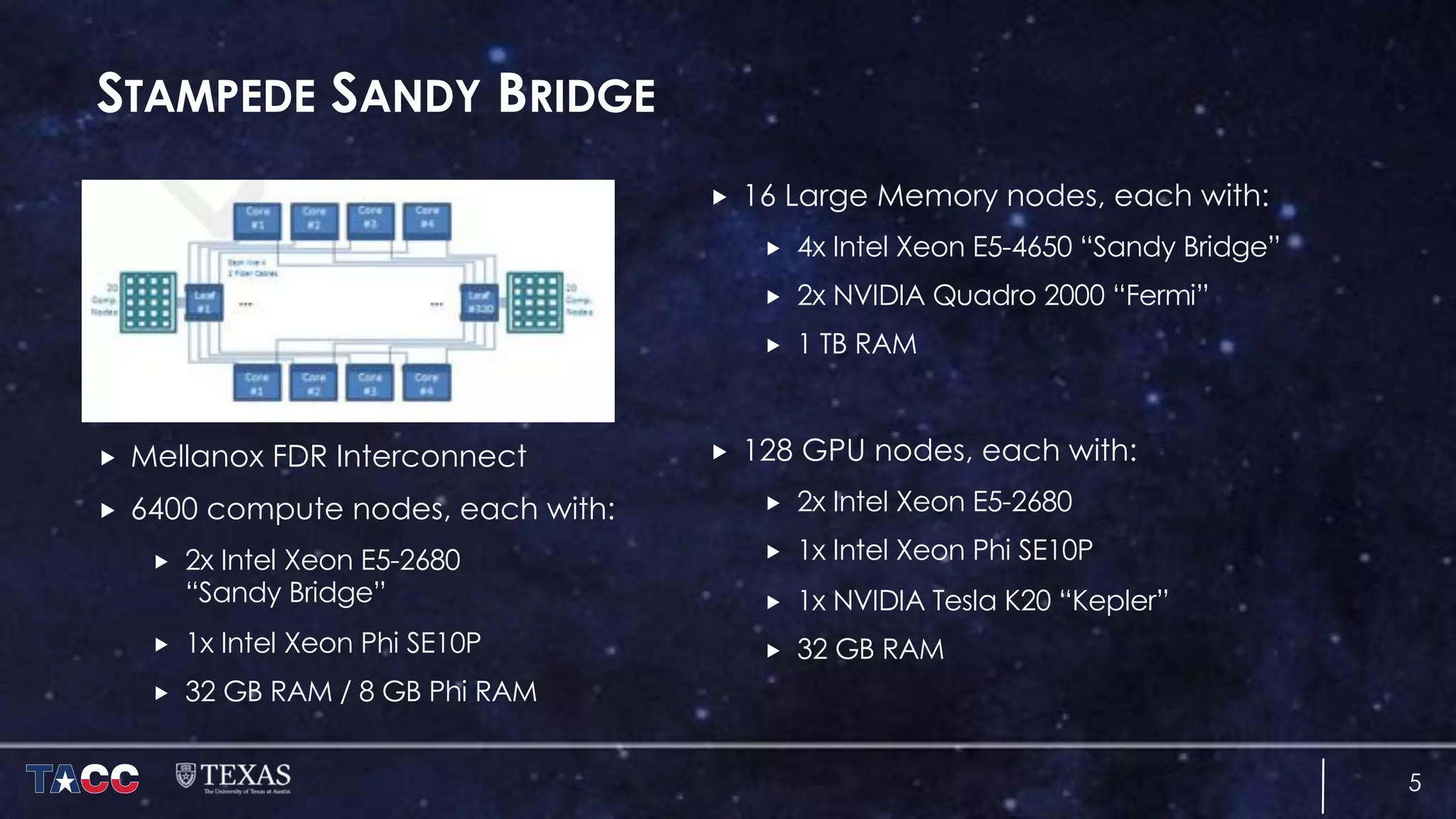
„ Mellanox FDR Interconnect
„ 6400 compute nodes, each with:
„ 2x Intel Xeon E5-2680
“Sandy Bridge”
„ 1x Intel Xeon Phi SE10P
„ 32 GB RAM / 8 GB Phi RAM
„ 16 Large Memory nodes, each with:
„ 4x Intel Xeon E5-4650 “Sandy Bridge”
„ 2x NVIDIA Quadro 2000 “Fermi”
„ 1 TB RAM
„ 128 GPU nodes, each with:
„ 2x Intel Xeon E5-2680
„ 1x Intel Xeon Phi SE10P
„ 1x NVIDIA Tesla K20 “Kepler”
„ 32 GB RAM
5
STAMPEDE KNL
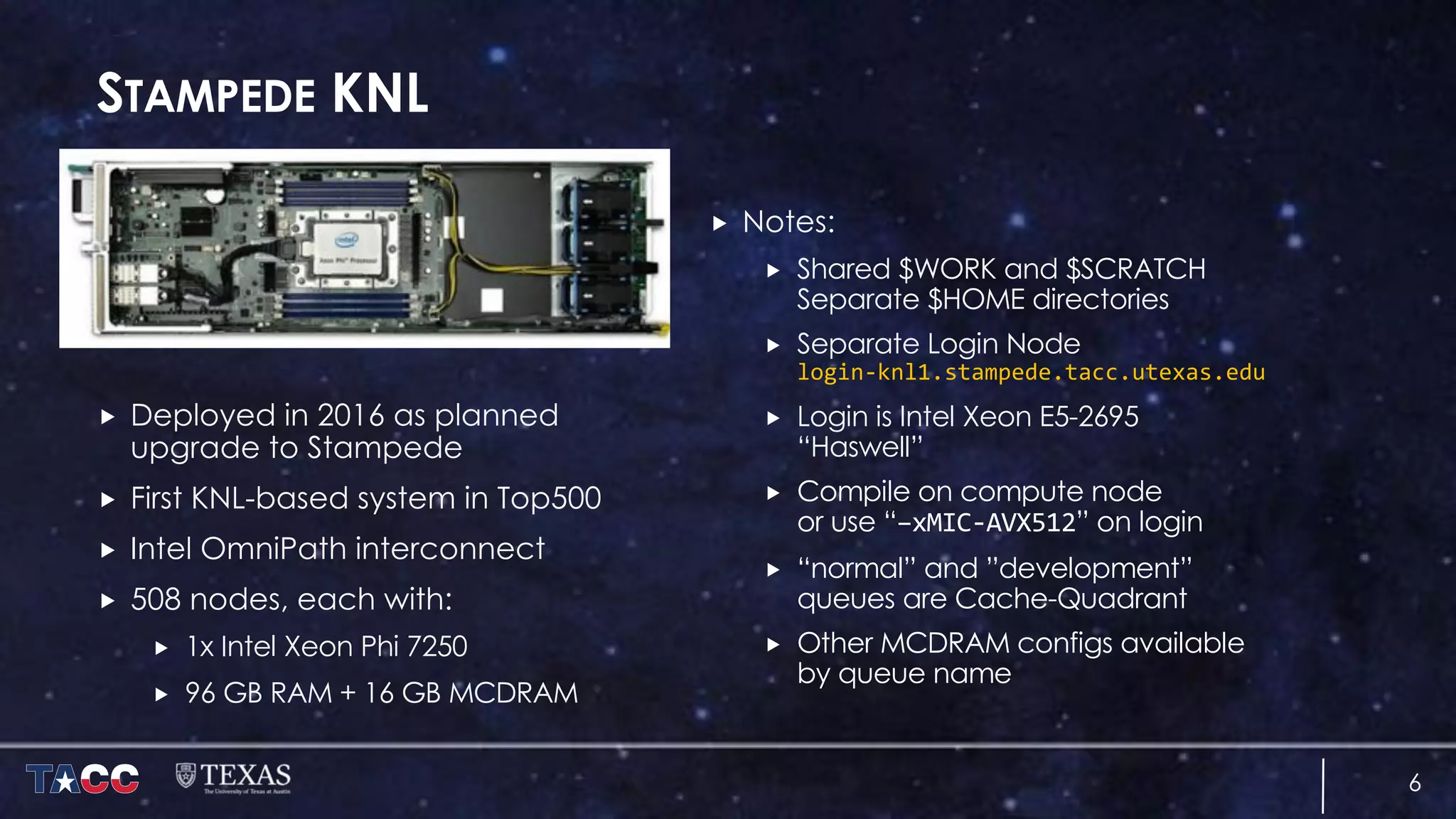
„ Deployed in 2016 as planned
upgrade to Stampede
„ First KNL-based system in Top500
„ Intel OmniPath interconnect
„ 508 nodes, each with:
„ 1x Intel Xeon Phi 7250
„ 96 GB RAM + 16 GB MCDRAM
„ Notes:
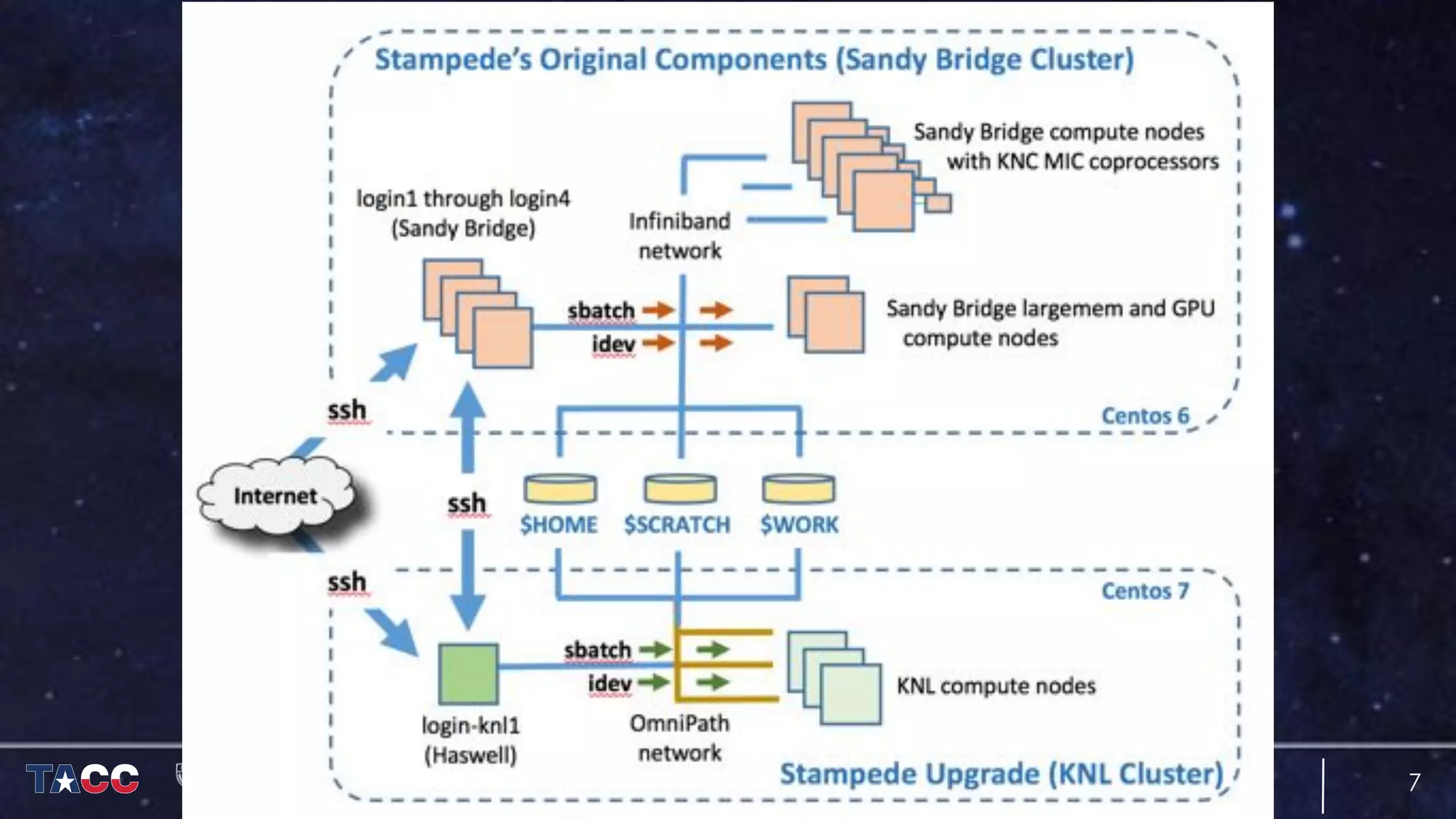
„ Shared $WORK and $SCRATCH
Separate $HOME directories
„ Separate Login Node
login-knl1.stampede.tacc.utexas.edu
„ Login is Intel Xeon E5-2695
“Haswell”
„ Compile on compute node
or use “–xMIC-AVX512” on login
„ “normal” and ”development”
queues are Cache-Quadrant
„ Other MCDRAM configs available
by queue name
6
7
STAMPEDE 2 (COMING 2017)
„ ~18 PF Dell Intel Xeon + Intel Xeon Phi system
„ Combine KNL + Skylake + OmniPath + 3D XPoint
„ Phase 1: Spring 2017
„ Stampede KNL + 4200 new KNL nodes + new filesystem
„ 60% of Stampede Sandy Bridge to remain operational during this phase
„ Phase 2: Fall 2017
„ 1736 Intel Skylake nodes
„ Phase 3: Spring 2018
„ Add 3D XPoint memory to subset of nodes
8
KEY ARCHITECTURAL TAKE-AWAY
„ Current and near-future cyberinfrastructure will use processors with many cores
„ Each core contains wide vector units: use them for max utilization (e.g., AVX512)
„ Fortunately the Software-Defined Visualization stack is optimized for such processors!
„ Use your preferred rendering method independent of the underlying hardware
„ Performant rasterization
„ Performant ray tracing
„ Visualization and analysis on the simulation machine
9
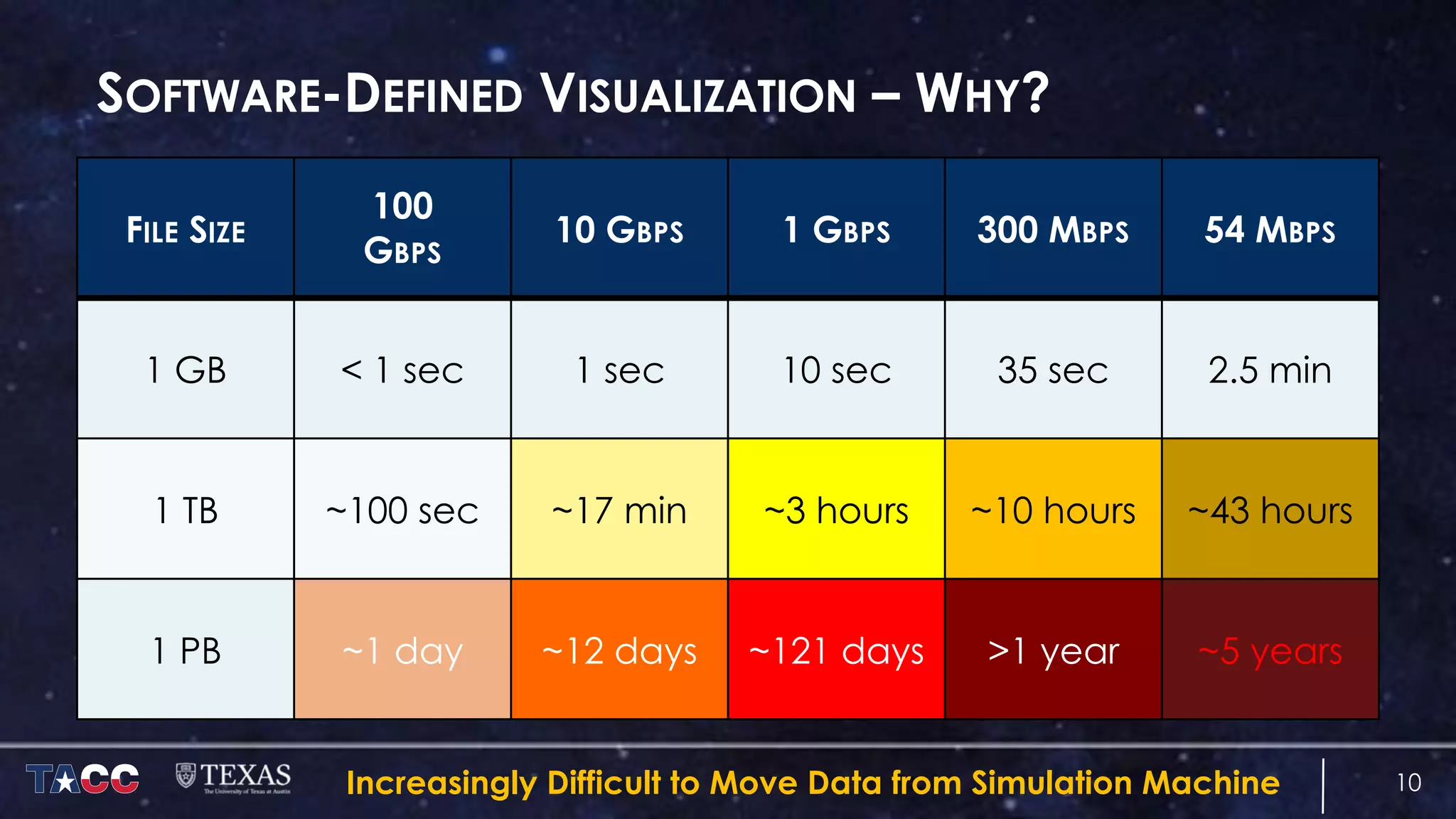
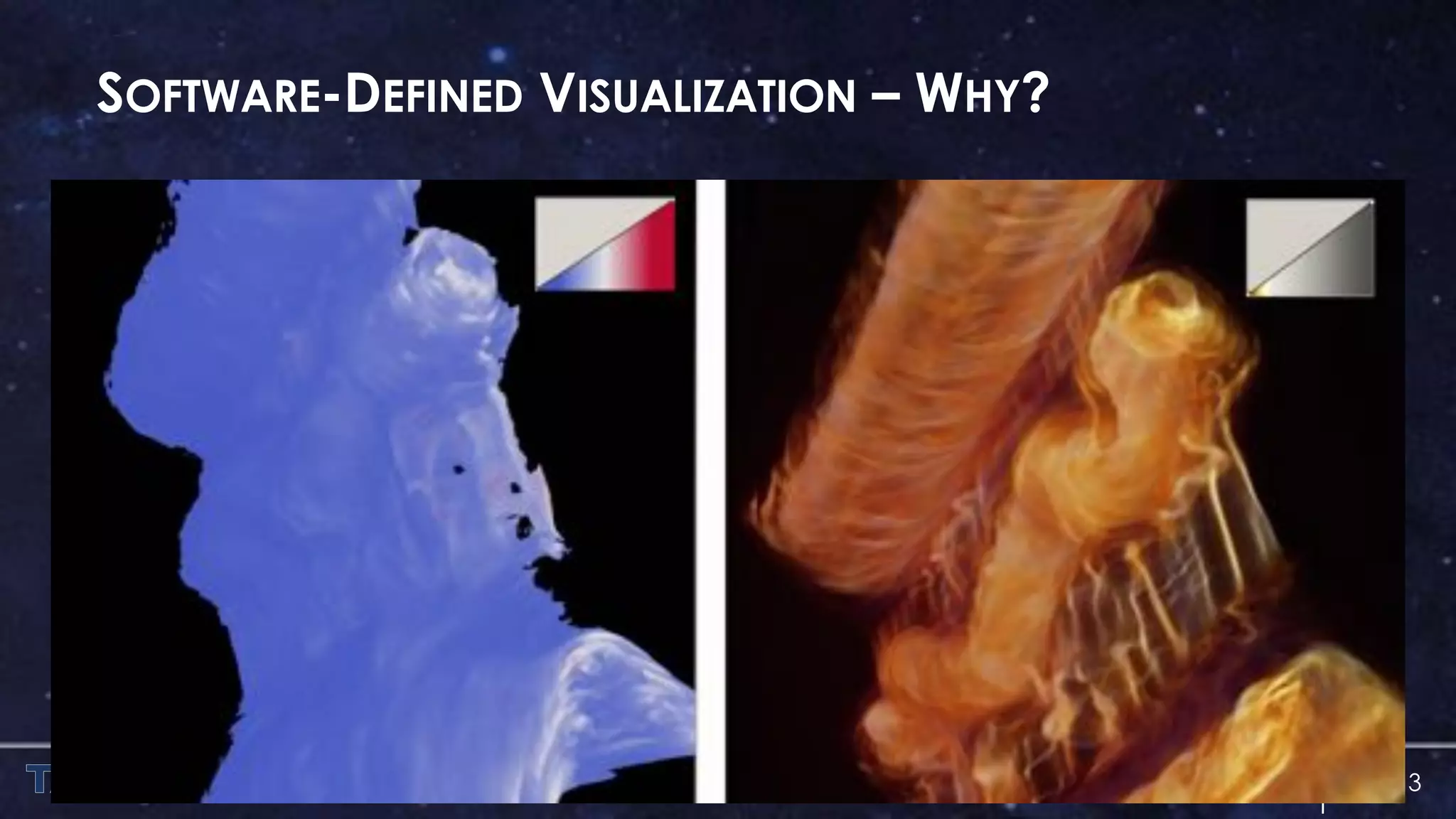
SOFTWARE-DEFINED VISUALIZATION – WHY?
10
FILE SIZE
100
GBPS
10 GBPS 1 GBPS 300 MBPS 54 MBPS
1 GB < 1 sec 1 sec 10 sec 35 sec 2.5 min
1 TB ~100 sec ~17 min ~3 hours ~10 hours ~43 hours
1 PB ~1 day ~12 days ~121 days >1 year ~5 years
Increasingly Difficult to Move Data from Simulation Machine
11
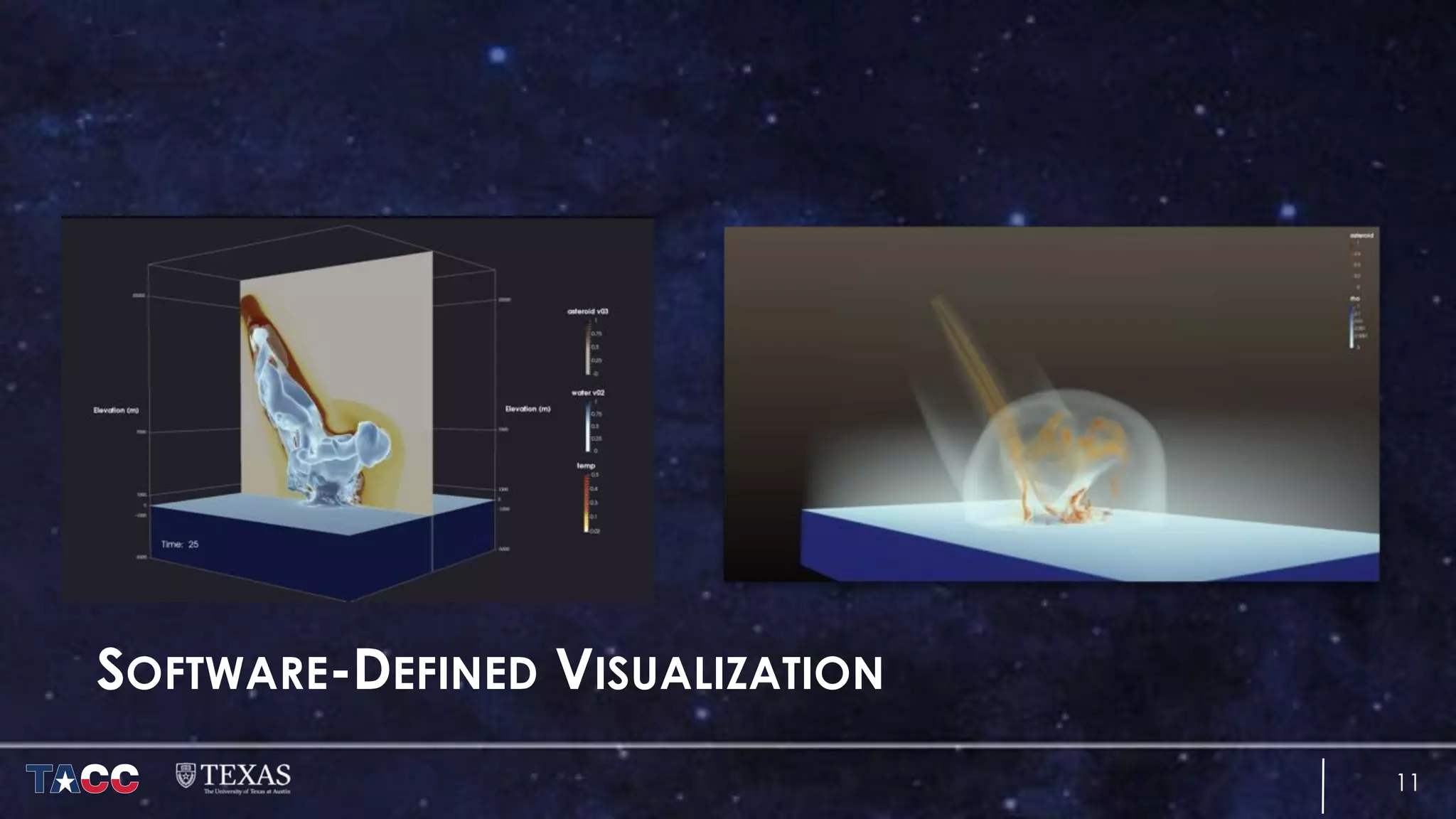
SOFTWARE-DEFINED VISUALIZATION
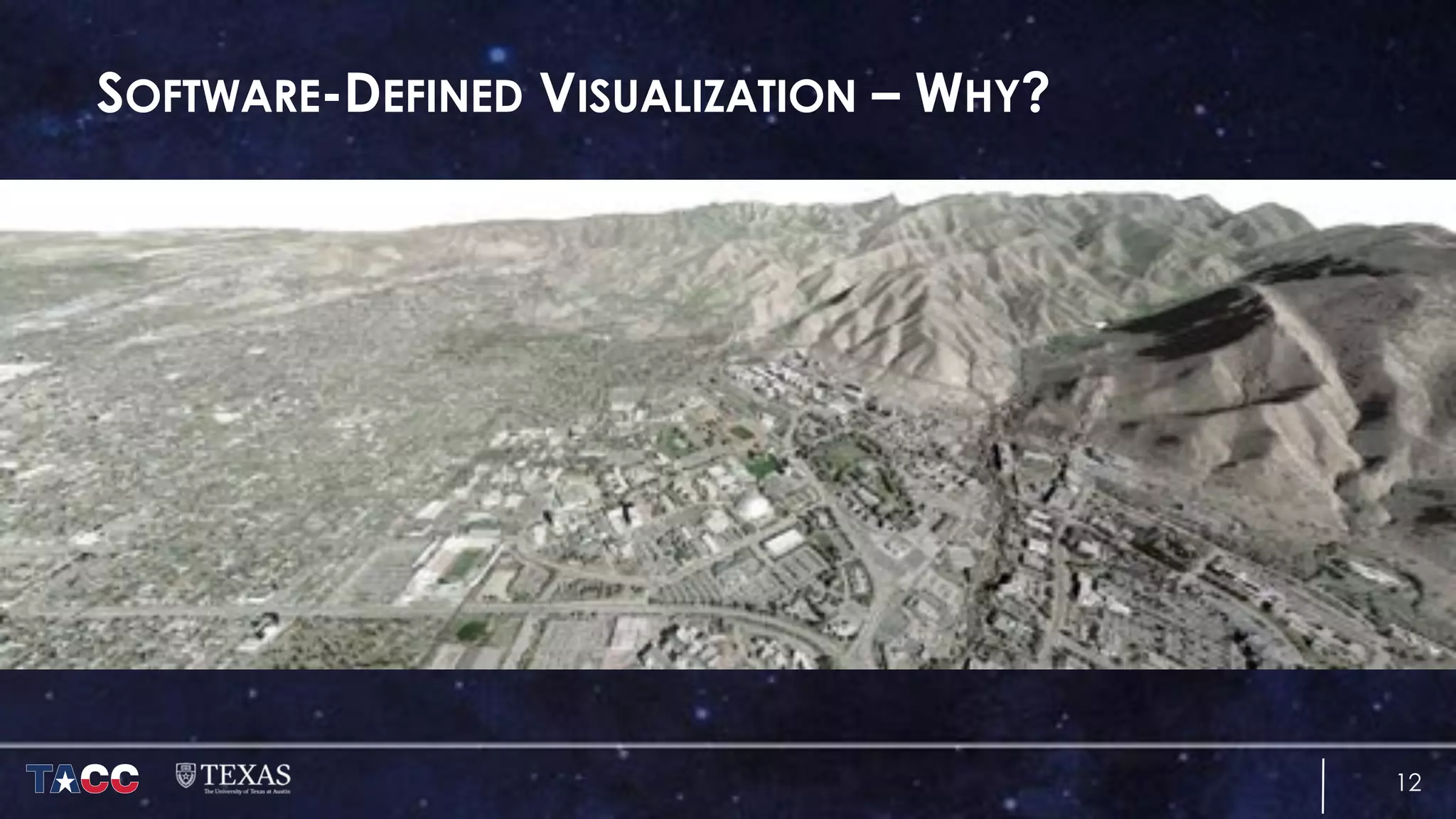
SOFTWARE-DEFINED VISUALIZATION – WHY?
12
SOFTWARE-DEFINED VISUALIZATION – WHY?
13
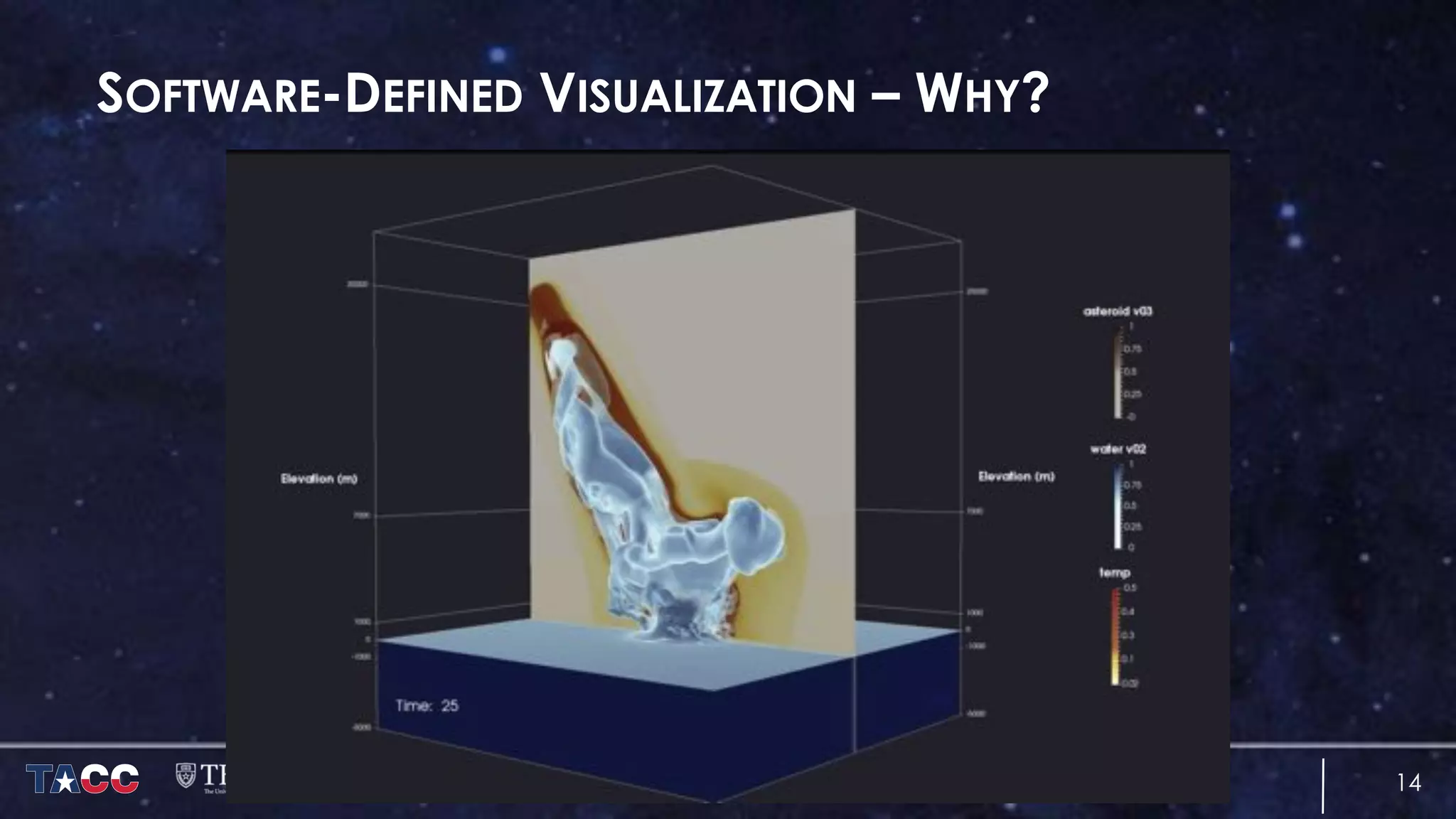
SOFTWARE-DEFINED VISUALIZATION – WHY?
14
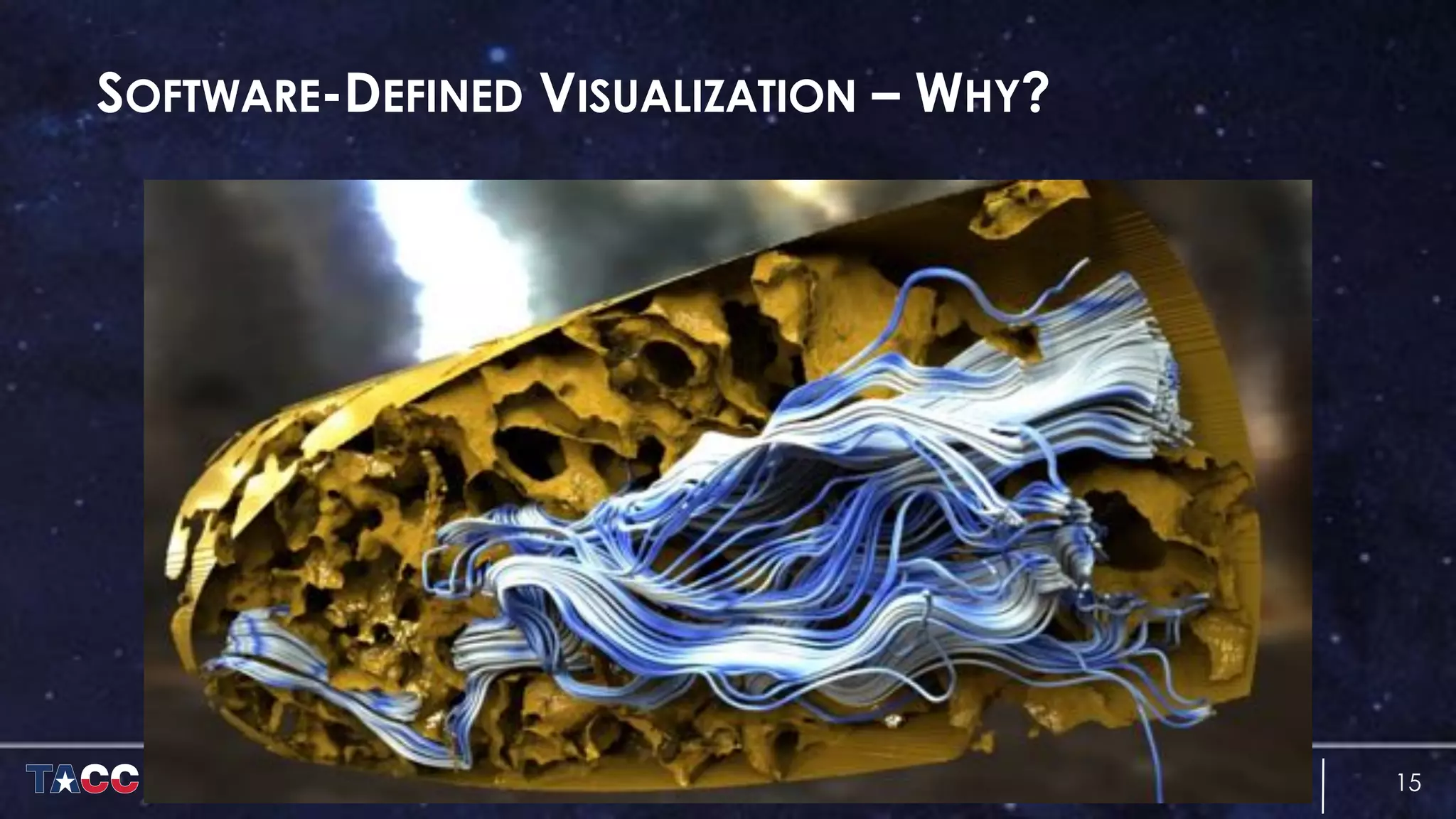
SOFTWARE-DEFINED VISUALIZATION – WHY?
15
SOFTWARE-DEFINED VISUALIZATION STACK
„ OpenSWR Software Rasterizer
„ openswr.org
„ Performant rasterization for Xeon and Xeon Phi
„ Thread-parallel vector processing (previous parallel Mesa3D only has threaded fragments)
„ Support for wide vector instruction sets, particularly AVX2 (and soon AVX512)
„ Integrated into Mesa3D 12.0 as optional driver (mesa3d.org)
„ Best Uses
„ Lines
„ Graphs
„ User Interfaces
16
SOFTWARE-DEFINED VISUALIZATION STACK
„ OSPRay Ray Tracer
„ ospray.org
„ Performant ray tracing for Xeon and Xeon Phi incorporating Embree kernels
„ Thread- and wide-vector parallel using Intel ISPC (including AVX512 support)
„ Parallel rendering support via distributed framebuffer
„ Best Uses
„ Photorealistic rendering
„ Realistic lighting
„ Realistic material effects
„ Large geometry
„ Implicit geometry (e.g., molecular ”ball and stick” models)
17
SOFTWARE-DEFINED VISUALIZATION STACK
„ GraviT Scheduling Framework
„ tacc.github.io/GraviT/
„ Large-scale, data-distributed ray tracing (uses OSPRay for rendering engine target)
„ Parallel rendering support via distributed ray scheduling
„ Best Uses
„ Large distrubted data
„ Data outside of renderer control
„ Incoherent ray-intensive sampling (e.g., global illumination approximations)
18
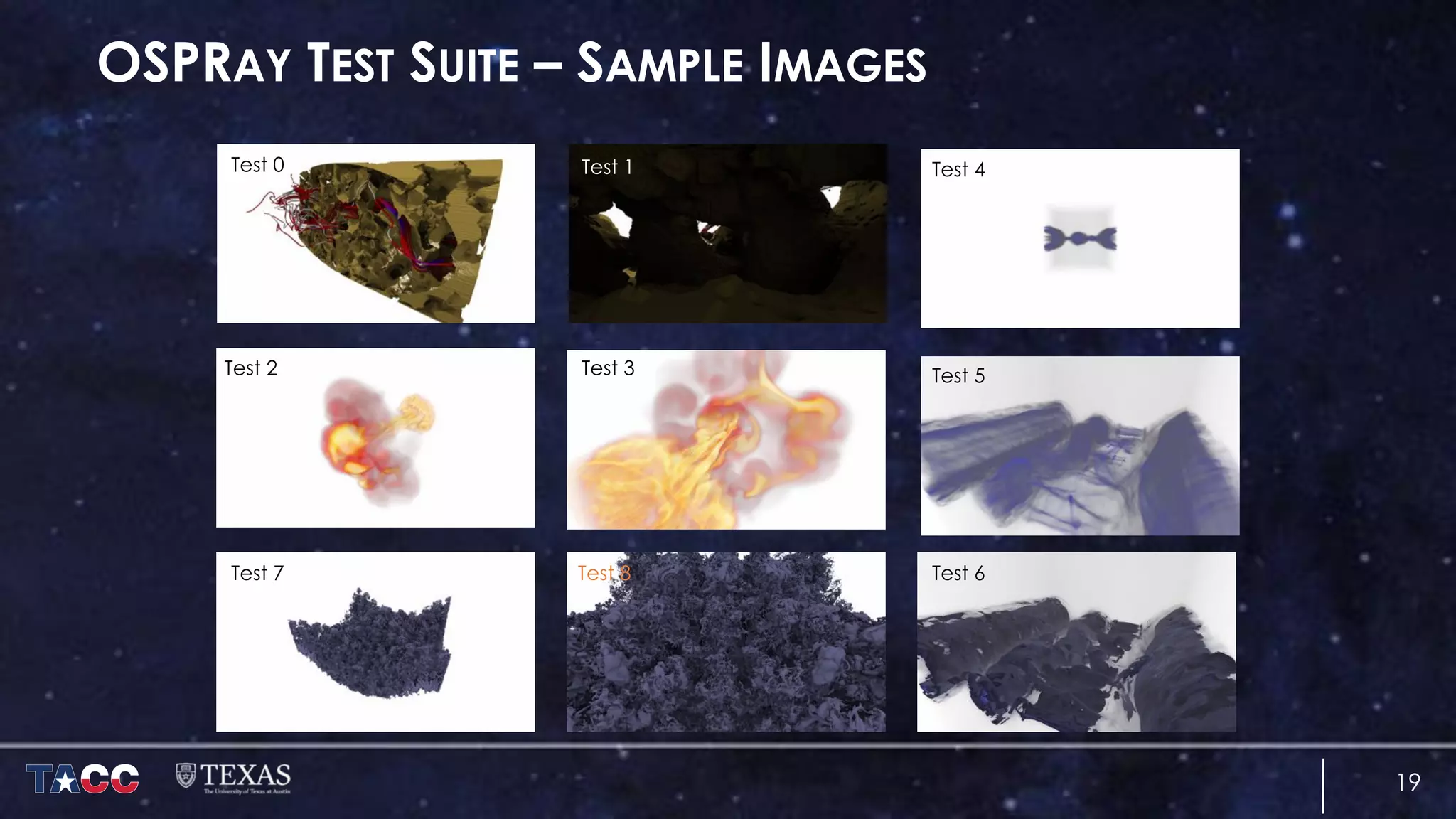
OSPRAY TEST SUITE – SAMPLE IMAGES
19
Test 0 Test 1 Test 4
Test 2 Test 3 Test 5
Test 6Test 7 Test 8
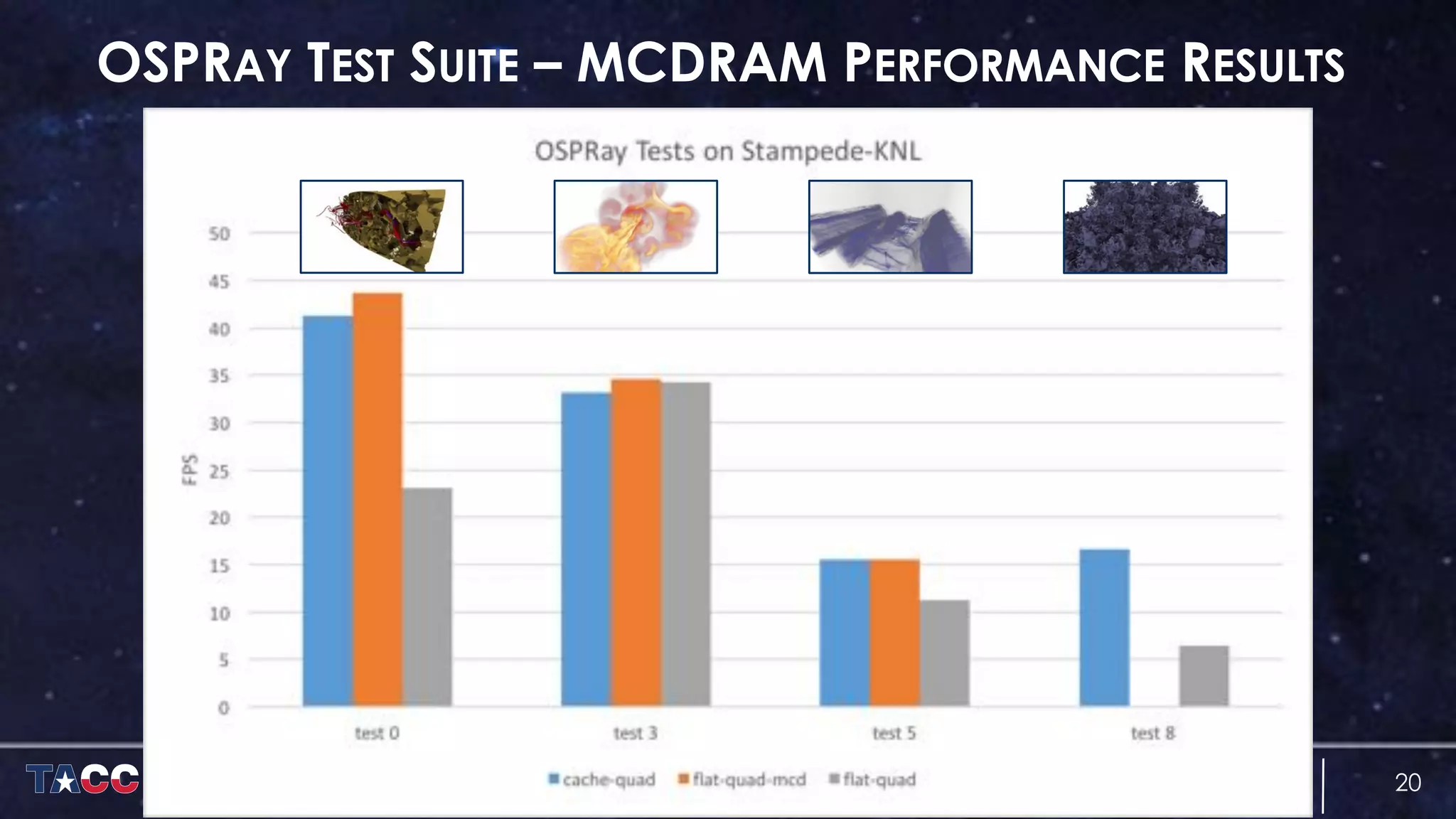
OSPRAY TEST SUITE – MCDRAM PERFORMANCE RESULTS
20
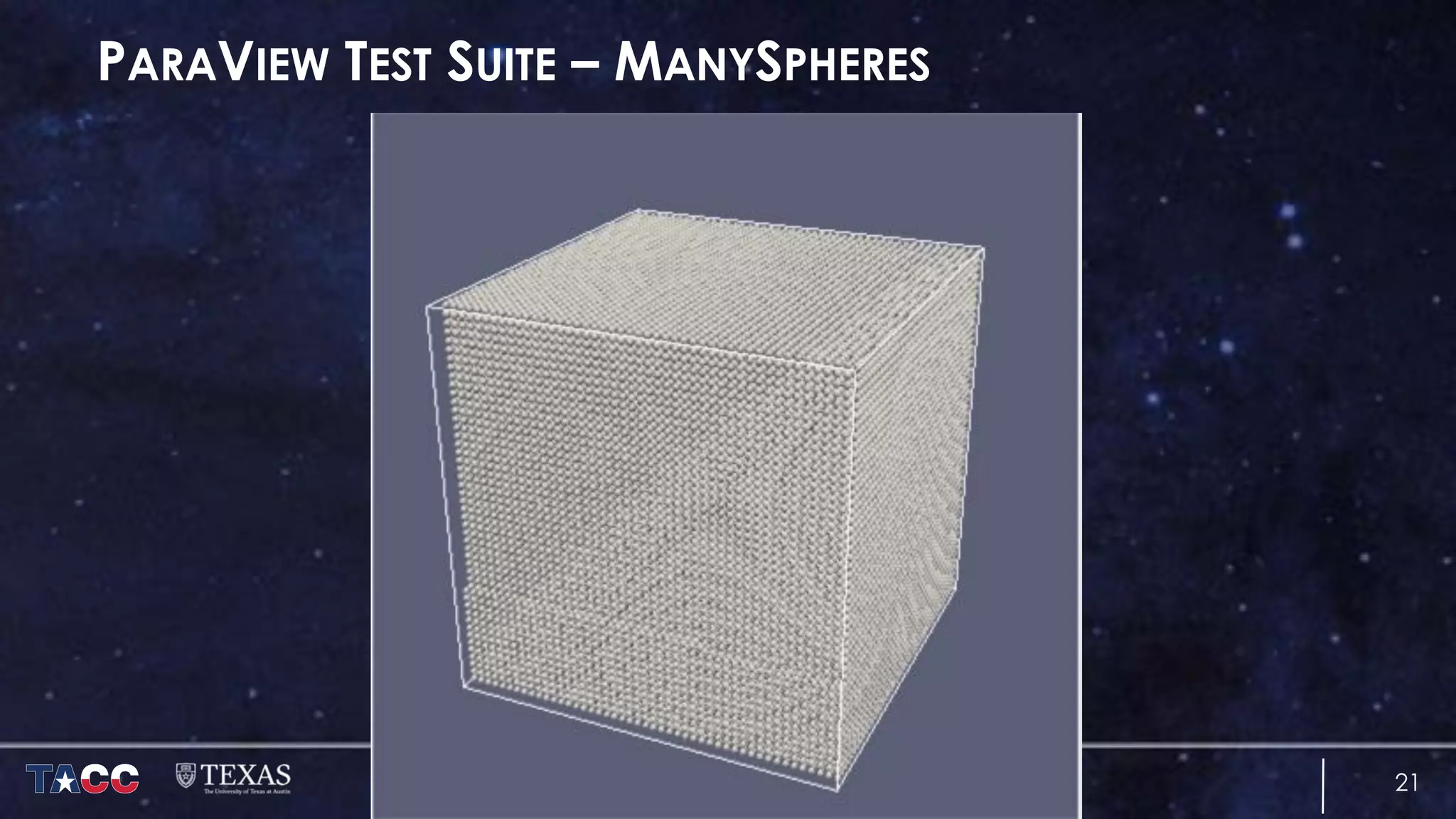
PARAVIEW TEST SUITE – MANYSPHERES
21
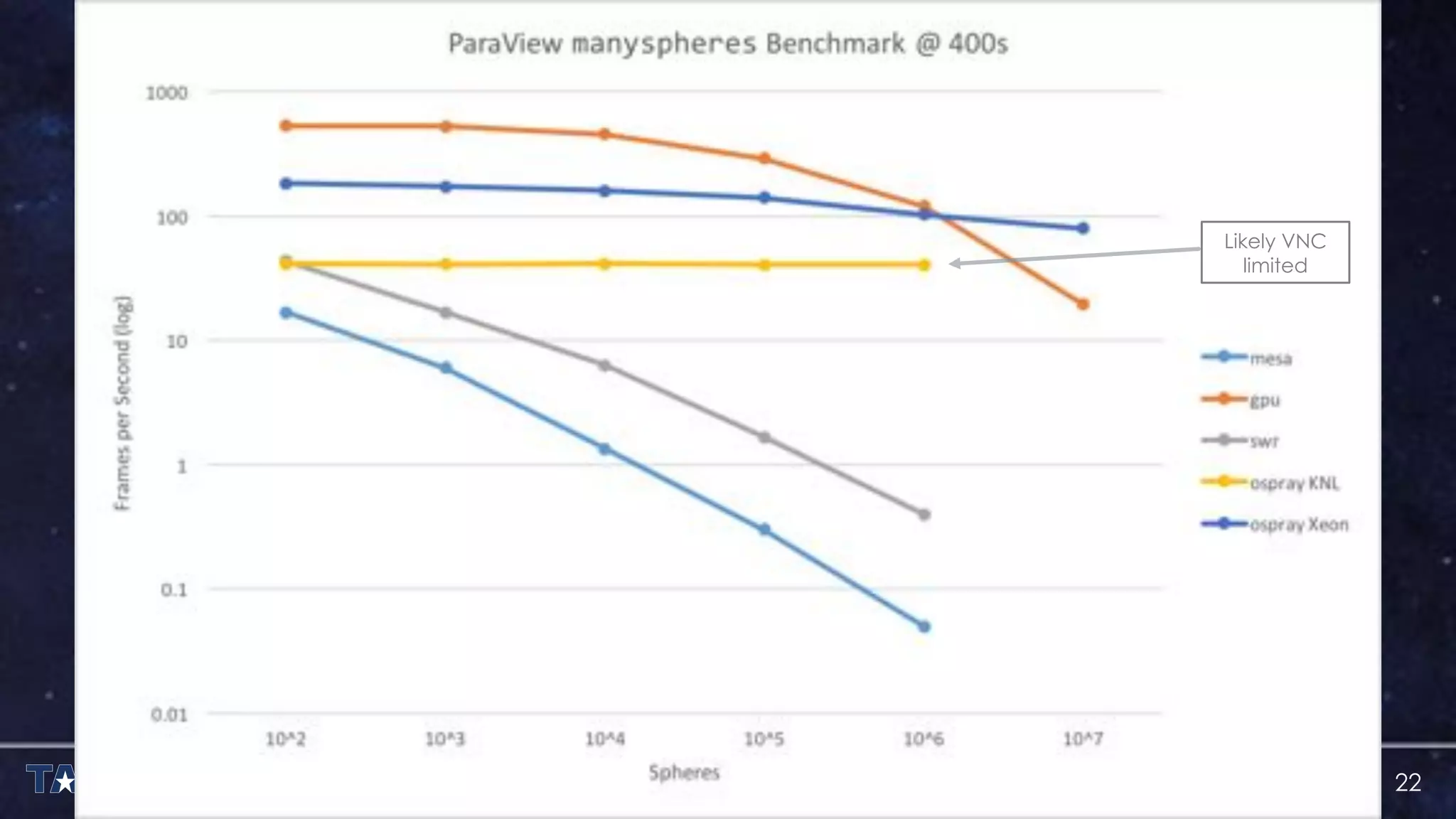
22
Likely VNC
limited
23
Likely VNC
limited
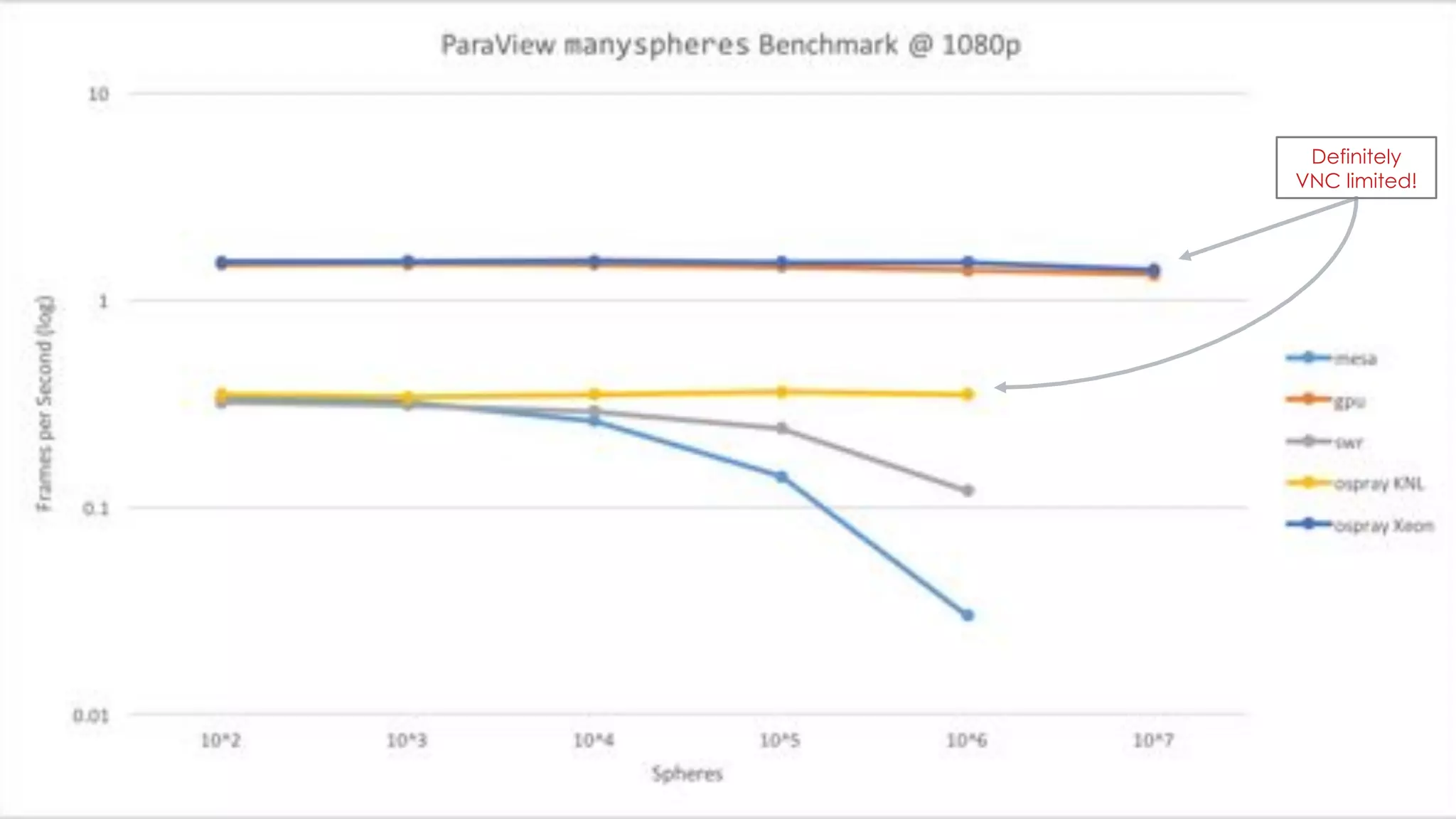
24
Definitely
VNC limited!
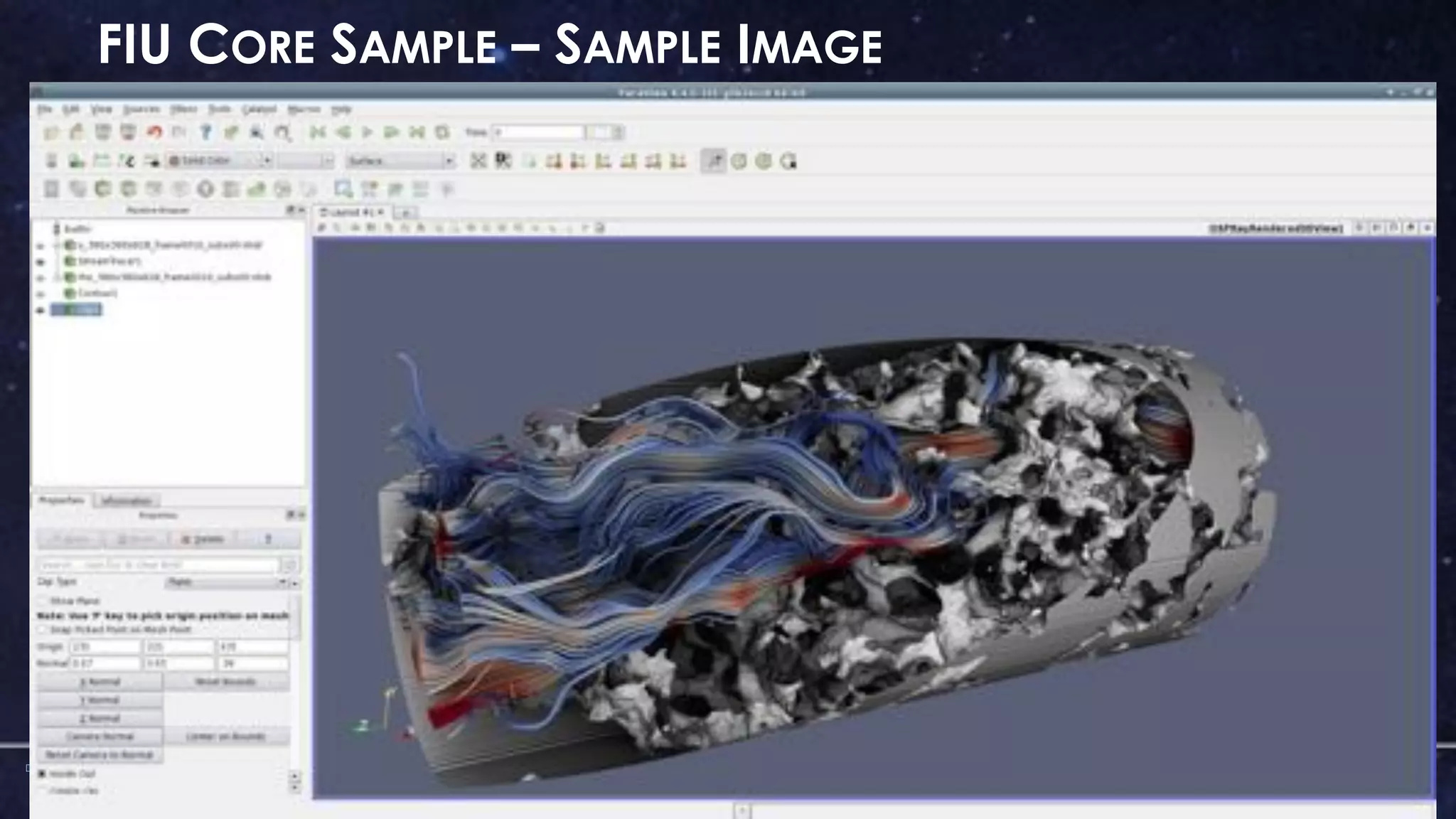
FIU CORE SAMPLE – SAMPLE IMAGE
25
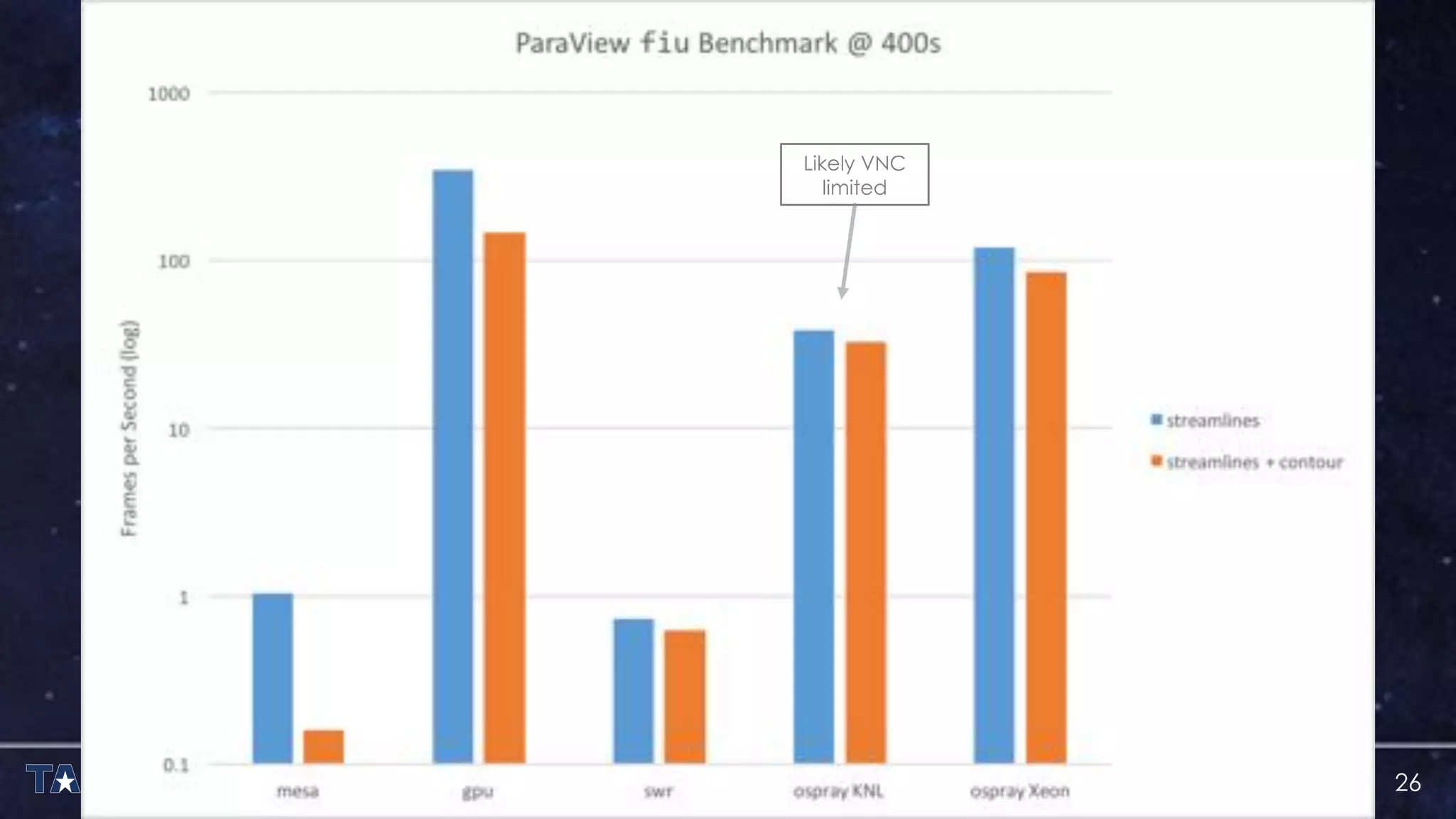
26
Likely VNC
limited
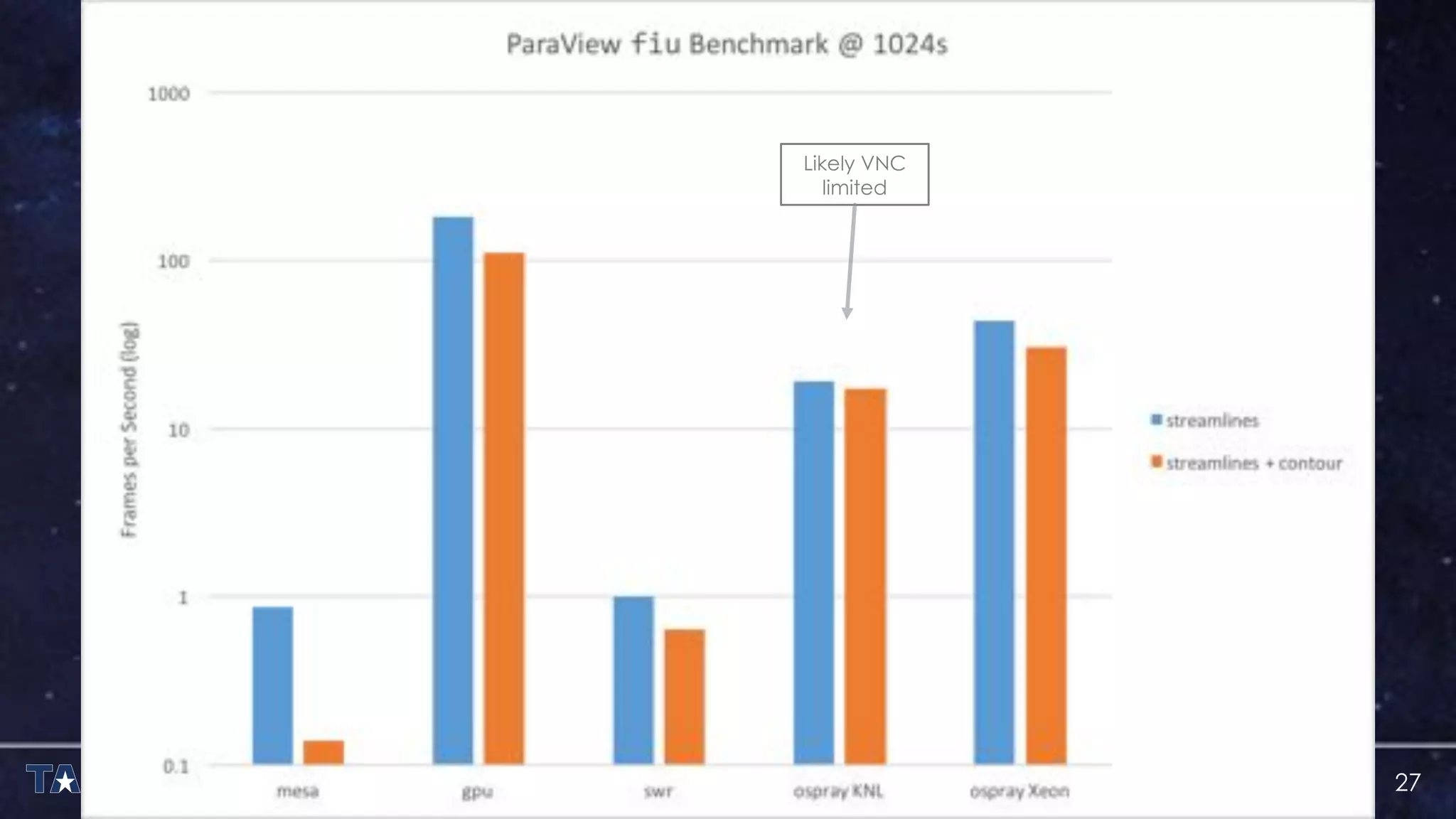
27
Likely VNC
limited
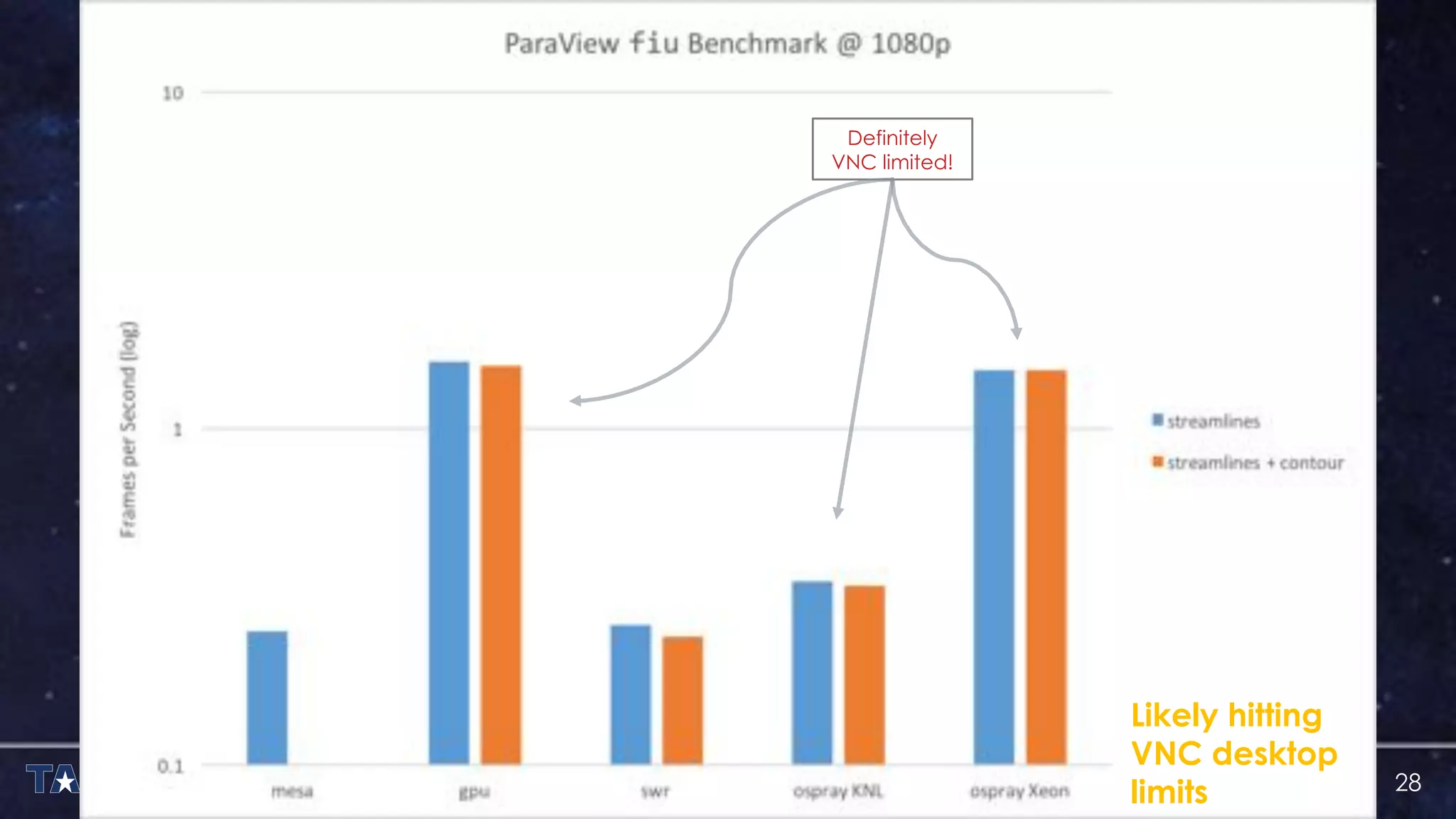
28
Likely hitting
VNC desktop
limits
Definitely
VNC limited!
29
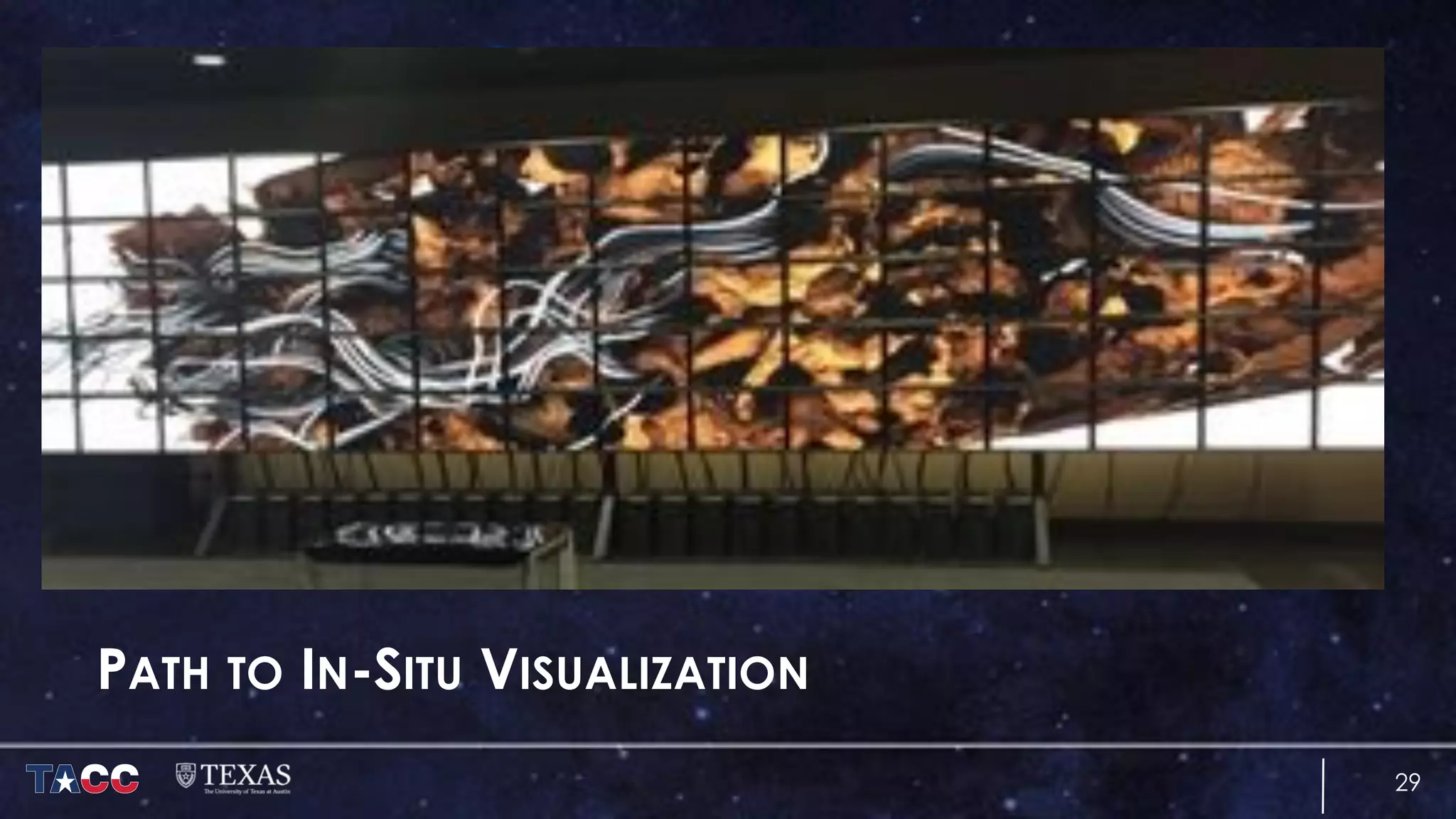
PATH TO IN-SITU VISUALIZATION
WHY IN-SITU VISUALIZATION?
„ Processors (like KNL) enabling larger, more detailed simulations
„ File system technologies not scaling at same rate (if at all….)
„ Touching disk is expensive:
„ During simulation: time checkpointing is (often) not time computing
„ During analysis: loading the data is (often) the overwhelming majority of runtime
„ In-situ capabilities overcome this data bottleneck
„ Render directly from resident simulation data
„ Tightly coupled vis opens doors for online analysis, computational steering, etc
30
CURRENT IN-SITU OPTIONS
„ Simulation developer
„ Implement visualization API (ParaView Catalyst, VisIt libsim, VTK)
„ Implement data framework (ADIOS, etc)
„ Implement direct rendering calls (OSPRay API, etc)
„ Simulation user
„ Hope the developers do one of the above J
„ Do one of the above yourself L
„ Hope technology keeps post-hoc analysis viable (3D XPoint NVRAM might help)
31
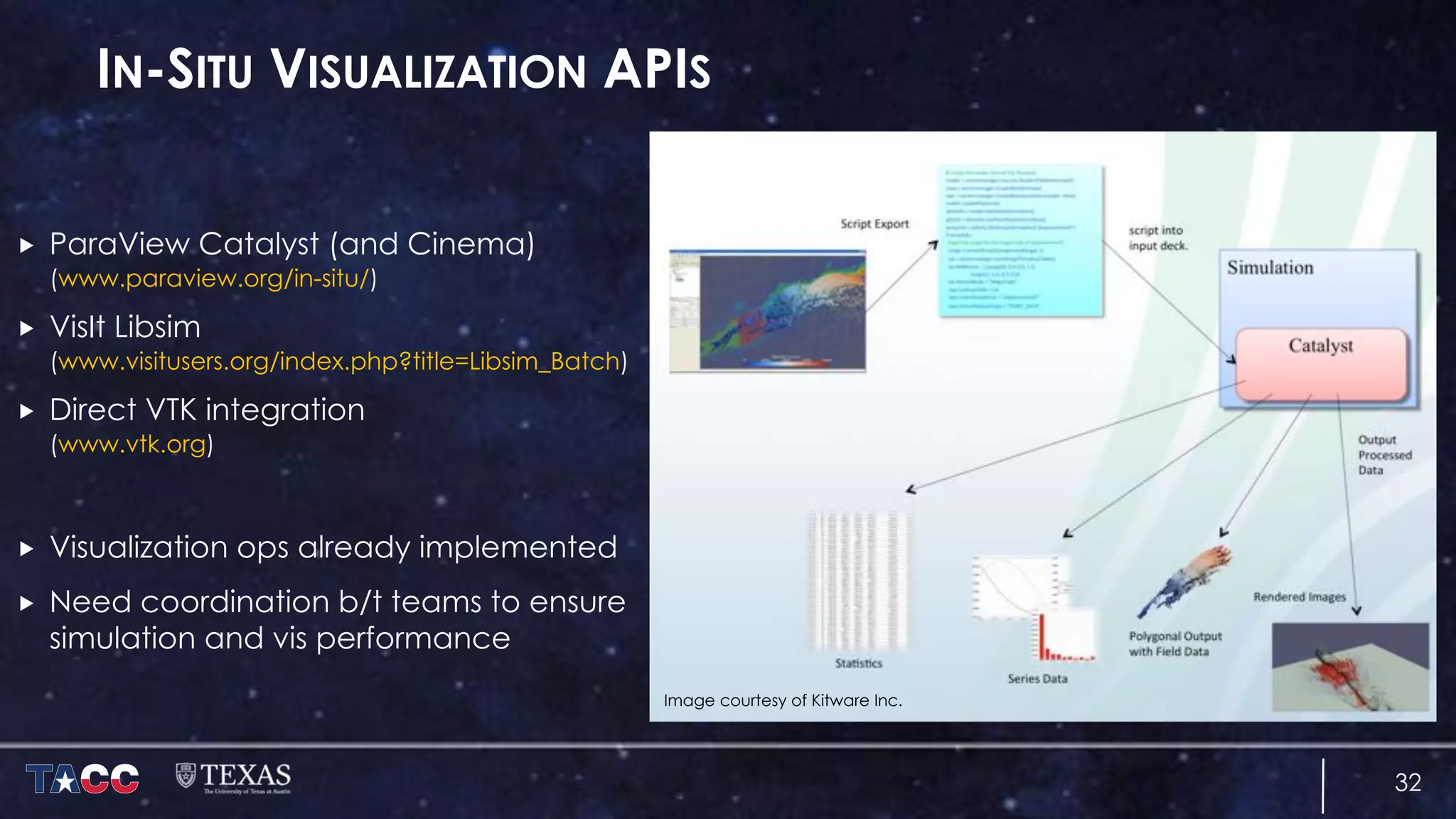
IN-SITU VISUALIZATION APIS
„ ParaView Catalyst (and Cinema)
(www.paraview.org/in-situ/)
„ VisIt Libsim
(www.visitusers.org/index.php?title=Libsim_Batch)
„ Direct VTK integration
(www.vtk.org)
„ Visualization ops already implemented
„ Need coordination b/t teams to ensure
simulation and vis performance
32
Image courtesy of Kitware Inc.
IN-SITU-COMPATIBLE DATA FRAMEWORKS
„ ADIOS – https://www.olcf.ornl.gov/center-projects/adios/
„ Damaris – https://hal.inria.fr/hal-00859603/en
„ DIY – http://www.mcs.anl.gov/~tpeterka/software.html
„ GLEAN – http://www.mcs.anl.gov/project/glean-situ-visualization-and-analysis
„ SCIRun – http://www.sci.utah.edu/cibc-software/scirun.html
„ (Possibly) more invasive implementation effort
„ (Possibly) broader benefits beyond visualization (framework now controls data)
„ Requires engagement from simulation team to ensure performance and accuracy
33
IN-SITU DIRECT RENDERING
„ Render directly within simulation using API (e.g., OSPRay, OpenGL, etc)
„ Must implement visualization operations within simulation code
„ Lightest weight, lowest overhead
„ Requires visualization algorithm knowledge for efficient implementation
„ Locks in particular rendering and visualization modes
34
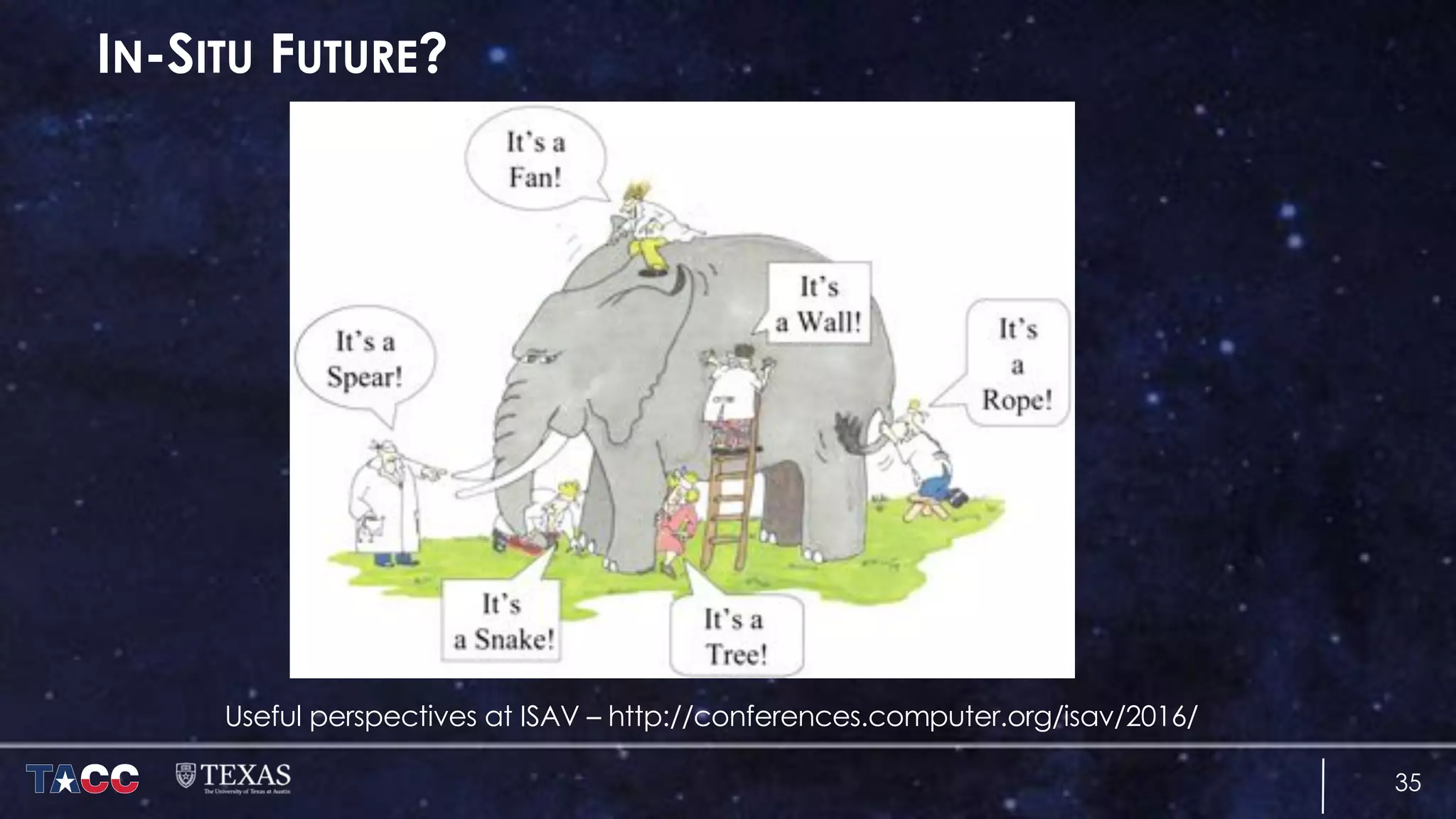
IN-SITU FUTURE?
35
Useful perspectives at ISAV – http://conferences.computer.org/isav/2016/
TACC/KITWARE IPCC – UNIMPEDED IN SITU
VISUALIZATION ON INTEL XEON AND INTEL XEON PHI
„ Optimize ParaView Catalyst for current and near-future Intel architectures
„ KNL, Skylake, Omnipath, 3D XPoint NVRAM
„ Use Stampede-KNL as testbed to target TACC Stampede 2, NERSC Cori, LANL Trinity
„ Focus on data and rendering paths for OpenSWR and OSPRay
„ Parallelize VTK data processing filters
„ Catalyst integration with simulation
„ Targeted algorithm improvements
„ Increase processor and memory utilization
36
THANK YOU!
pnav@tacc.utexas.edu
37

SDVIs and In-Situ Visualization on TACC's Stampede

  • 1.
    SDVIS AND IN-SITUVISUALIZATION ON TACC’S STAMPEDE-KNL Paul A. Navrátil, Ph.D. Manager – Scalable Visualization Technologies pnav@tacc.utexas.edu 1
  • 2.
  • 3.
    OUTLINE „ Stampede Architecture „Stampede – Sandy Bridge „ Stampede - KNL „ Stampede 2 – KNL + Skylake „ Software-Defined Visualization Stack „ VNC „ OpenSWR „ OSPRay „ Path to In-Situ „ ParaView Catalyst „ VisIt Libsim „ Direct renderer integration 3
  • 4.
  • 5.
    STAMPEDE SANDY BRIDGE „Mellanox FDR Interconnect „ 6400 compute nodes, each with: „ 2x Intel Xeon E5-2680 “Sandy Bridge” „ 1x Intel Xeon Phi SE10P „ 32 GB RAM / 8 GB Phi RAM „ 16 Large Memory nodes, each with: „ 4x Intel Xeon E5-4650 “Sandy Bridge” „ 2x NVIDIA Quadro 2000 “Fermi” „ 1 TB RAM „ 128 GPU nodes, each with: „ 2x Intel Xeon E5-2680 „ 1x Intel Xeon Phi SE10P „ 1x NVIDIA Tesla K20 “Kepler” „ 32 GB RAM 5
  • 6.
    STAMPEDE KNL „ Deployedin 2016 as planned upgrade to Stampede „ First KNL-based system in Top500 „ Intel OmniPath interconnect „ 508 nodes, each with: „ 1x Intel Xeon Phi 7250 „ 96 GB RAM + 16 GB MCDRAM „ Notes: „ Shared $WORK and $SCRATCH Separate $HOME directories „ Separate Login Node login-knl1.stampede.tacc.utexas.edu „ Login is Intel Xeon E5-2695 “Haswell” „ Compile on compute node or use “–xMIC-AVX512” on login „ “normal” and ”development” queues are Cache-Quadrant „ Other MCDRAM configs available by queue name 6
  • 7.
  • 8.
    STAMPEDE 2 (COMING2017) „ ~18 PF Dell Intel Xeon + Intel Xeon Phi system „ Combine KNL + Skylake + OmniPath + 3D XPoint „ Phase 1: Spring 2017 „ Stampede KNL + 4200 new KNL nodes + new filesystem „ 60% of Stampede Sandy Bridge to remain operational during this phase „ Phase 2: Fall 2017 „ 1736 Intel Skylake nodes „ Phase 3: Spring 2018 „ Add 3D XPoint memory to subset of nodes 8
  • 9.
    KEY ARCHITECTURAL TAKE-AWAY „Current and near-future cyberinfrastructure will use processors with many cores „ Each core contains wide vector units: use them for max utilization (e.g., AVX512) „ Fortunately the Software-Defined Visualization stack is optimized for such processors! „ Use your preferred rendering method independent of the underlying hardware „ Performant rasterization „ Performant ray tracing „ Visualization and analysis on the simulation machine 9
  • 10.
    SOFTWARE-DEFINED VISUALIZATION –WHY? 10 FILE SIZE 100 GBPS 10 GBPS 1 GBPS 300 MBPS 54 MBPS 1 GB < 1 sec 1 sec 10 sec 35 sec 2.5 min 1 TB ~100 sec ~17 min ~3 hours ~10 hours ~43 hours 1 PB ~1 day ~12 days ~121 days >1 year ~5 years Increasingly Difficult to Move Data from Simulation Machine
  • 11.
  • 12.
  • 13.
  • 14.
  • 15.
  • 16.
    SOFTWARE-DEFINED VISUALIZATION STACK „OpenSWR Software Rasterizer „ openswr.org „ Performant rasterization for Xeon and Xeon Phi „ Thread-parallel vector processing (previous parallel Mesa3D only has threaded fragments) „ Support for wide vector instruction sets, particularly AVX2 (and soon AVX512) „ Integrated into Mesa3D 12.0 as optional driver (mesa3d.org) „ Best Uses „ Lines „ Graphs „ User Interfaces 16
  • 17.
    SOFTWARE-DEFINED VISUALIZATION STACK „OSPRay Ray Tracer „ ospray.org „ Performant ray tracing for Xeon and Xeon Phi incorporating Embree kernels „ Thread- and wide-vector parallel using Intel ISPC (including AVX512 support) „ Parallel rendering support via distributed framebuffer „ Best Uses „ Photorealistic rendering „ Realistic lighting „ Realistic material effects „ Large geometry „ Implicit geometry (e.g., molecular ”ball and stick” models) 17
  • 18.
    SOFTWARE-DEFINED VISUALIZATION STACK „GraviT Scheduling Framework „ tacc.github.io/GraviT/ „ Large-scale, data-distributed ray tracing (uses OSPRay for rendering engine target) „ Parallel rendering support via distributed ray scheduling „ Best Uses „ Large distrubted data „ Data outside of renderer control „ Incoherent ray-intensive sampling (e.g., global illumination approximations) 18
  • 19.
    OSPRAY TEST SUITE– SAMPLE IMAGES 19 Test 0 Test 1 Test 4 Test 2 Test 3 Test 5 Test 6Test 7 Test 8
  • 20.
    OSPRAY TEST SUITE– MCDRAM PERFORMANCE RESULTS 20
  • 21.
    PARAVIEW TEST SUITE– MANYSPHERES 21
  • 22.
  • 23.
  • 24.
  • 25.
    FIU CORE SAMPLE– SAMPLE IMAGE 25
  • 26.
  • 27.
  • 28.
  • 29.
    29 PATH TO IN-SITUVISUALIZATION
  • 30.
    WHY IN-SITU VISUALIZATION? „Processors (like KNL) enabling larger, more detailed simulations „ File system technologies not scaling at same rate (if at all….) „ Touching disk is expensive: „ During simulation: time checkpointing is (often) not time computing „ During analysis: loading the data is (often) the overwhelming majority of runtime „ In-situ capabilities overcome this data bottleneck „ Render directly from resident simulation data „ Tightly coupled vis opens doors for online analysis, computational steering, etc 30
  • 31.
    CURRENT IN-SITU OPTIONS „Simulation developer „ Implement visualization API (ParaView Catalyst, VisIt libsim, VTK) „ Implement data framework (ADIOS, etc) „ Implement direct rendering calls (OSPRay API, etc) „ Simulation user „ Hope the developers do one of the above J „ Do one of the above yourself L „ Hope technology keeps post-hoc analysis viable (3D XPoint NVRAM might help) 31
  • 32.
    IN-SITU VISUALIZATION APIS „ParaView Catalyst (and Cinema) (www.paraview.org/in-situ/) „ VisIt Libsim (www.visitusers.org/index.php?title=Libsim_Batch) „ Direct VTK integration (www.vtk.org) „ Visualization ops already implemented „ Need coordination b/t teams to ensure simulation and vis performance 32 Image courtesy of Kitware Inc.
  • 33.
    IN-SITU-COMPATIBLE DATA FRAMEWORKS „ADIOS – https://www.olcf.ornl.gov/center-projects/adios/ „ Damaris – https://hal.inria.fr/hal-00859603/en „ DIY – http://www.mcs.anl.gov/~tpeterka/software.html „ GLEAN – http://www.mcs.anl.gov/project/glean-situ-visualization-and-analysis „ SCIRun – http://www.sci.utah.edu/cibc-software/scirun.html „ (Possibly) more invasive implementation effort „ (Possibly) broader benefits beyond visualization (framework now controls data) „ Requires engagement from simulation team to ensure performance and accuracy 33
  • 34.
    IN-SITU DIRECT RENDERING „Render directly within simulation using API (e.g., OSPRay, OpenGL, etc) „ Must implement visualization operations within simulation code „ Lightest weight, lowest overhead „ Requires visualization algorithm knowledge for efficient implementation „ Locks in particular rendering and visualization modes 34
  • 35.
    IN-SITU FUTURE? 35 Useful perspectivesat ISAV – http://conferences.computer.org/isav/2016/
  • 36.
    TACC/KITWARE IPCC –UNIMPEDED IN SITU VISUALIZATION ON INTEL XEON AND INTEL XEON PHI „ Optimize ParaView Catalyst for current and near-future Intel architectures „ KNL, Skylake, Omnipath, 3D XPoint NVRAM „ Use Stampede-KNL as testbed to target TACC Stampede 2, NERSC Cori, LANL Trinity „ Focus on data and rendering paths for OpenSWR and OSPRay „ Parallelize VTK data processing filters „ Catalyst integration with simulation „ Targeted algorithm improvements „ Increase processor and memory utilization 36
  • 37.