eleks.com
Business Analyst Role in the
Project.
by Ruslan Tsopa, Business analyst
Agenda
• Who is Business Analyst
• What are the requirements
• User stories
• Use cases
• Examples
How does the project begin?
How does the
project begin?
Question
Who is involved in development
process?
How client sees…
How developers see…
What happens if mix All?
How project fails looks like
Projects success statistics
Who is Business Analyst?
Project fails by activities
Working in Team
BA Architect
UX
No
business
value
No
software
SOLUTION:
- business value
- strong architecture
- awesome design
No
usability
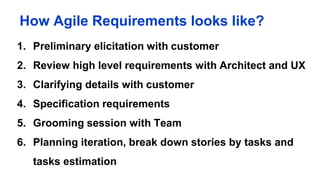
How Agile Requirements looks like?
1. Preliminary elicitation with customer
2. Review high level requirements with Architect and UX
3. Clarifying details with customer
4. Specification requirements
5. Grooming session with Team
6. Planning iteration, break down stories by tasks and
tasks estimation
What are requirements?
Functional requirements - describe the capabilities that a solution must
have in terms of the behaviour and information that the solution will
manage
Non Functional Requirements - do not relate directly to the behaviour
of functionality of the solution, but rather describe conditions under which
a solution must remain effective or qualities that a solution must have
Business rules - statements of goals, objectives, and outcomes that
describe why a change has been initiated. They can apply to the whole
of an enterprise, a business area, or a specific initiative
How to represent requirements?
Requirements representation
• User stories
• Use cases
• Documents
• Mockups
• Prototypes
• States flow / flow charts/ activity diagram
User story
A user story - simple description of a feature told from the perspective of the
person who desires the new capability. It contains enough information so that the
developers can produce a reasonable estimate of the effort to implement it.
Why all like user stories?:
• Small
• User/Customer centered
• Use end user/customer language
• Easy to read /understand bridges the gap between technical and business
• Focus on Delivering Value
• Useful for Planning
• Easily prioritizable and reprioritizable
User story
As a <User> I want to <Do something> so that <Expected outcome>
Who? What? Why?
Acceptance criteria
Defines conditions for “satisfaction”
Definition of done
Defines conditions for “readiness”
What is a User story
How good your User story is?
Use case
Use case is a list of steps, typically defining interactions between a role (known
as an "actor") and a system, to achieve a goal. The actor can be a human, an
external system, or time.
Elements of a Use Case
Depending on how in depth and complex you want or need to get, use cases describe
a combination of the following elements:
• actor
• precondition/triggers
• main scenario
• alternative paths/exceptions
• post condition
Use case
More about elements
Actor – anyone or anything that performs a behavior (who is using the system)
• Class of Users (Role)
• External Systems
Preconditions – what must be true or happen before use case to be initiated
Main scenarios [Basic Flow] – use case in which nothing goes wrong.
• Main Flow is the sequence of steps that helps the Actor achieve his or her goal.
• Main Flow is the most “typical/common” (usually also simple) success scenario.
• Main Flow always ends with success.
Alternative paths [Alternative Flow] – these paths are a variation on the main theme. These
exceptions are what happen when things go wrong at the system level.
Post condition – what is the state of system or what is expecting result after success
How Use Cases describe the system
behavior
Use case example
Description: Pay by credit card
Actor – Buyer
Preconditions
- User is authorized in the system
- Amount in cart is more than 0
Main scenarios
1. Enter credit card number
2. Enter credit card expiration date
3. Enter CVV number
4. Proceed payment
Alternative paths
A1. Continue shopping
A2. Logout
Exception
E1. There is not enough money in the credit card account
Post condition
Payment is done
User stories & Use case
For Reading
Karl Wiegers – Software
Requirements
(3rd Edition)
Mike Cohn - User Stories
Applied For Agile Software
Inspired by Technology.
Driven by Value.
Questions?
Skype: ruslan.tsopa
Facebook: tsopa.ruslan

SDLC. BA Role

  • 1.
    eleks.com Business Analyst Rolein the Project. by Ruslan Tsopa, Business analyst
  • 2.
    Agenda • Who isBusiness Analyst • What are the requirements • User stories • Use cases • Examples
  • 3.
    How does theproject begin?
  • 4.
  • 5.
    Question Who is involvedin development process?
  • 6.
  • 9.
  • 12.
  • 14.
  • 15.
  • 16.
  • 17.
    Project fails byactivities
  • 18.
    Working in Team BAArchitect UX No business value No software SOLUTION: - business value - strong architecture - awesome design No usability
  • 19.
    How Agile Requirementslooks like? 1. Preliminary elicitation with customer 2. Review high level requirements with Architect and UX 3. Clarifying details with customer 4. Specification requirements 5. Grooming session with Team 6. Planning iteration, break down stories by tasks and tasks estimation
  • 20.
    What are requirements? Functionalrequirements - describe the capabilities that a solution must have in terms of the behaviour and information that the solution will manage Non Functional Requirements - do not relate directly to the behaviour of functionality of the solution, but rather describe conditions under which a solution must remain effective or qualities that a solution must have Business rules - statements of goals, objectives, and outcomes that describe why a change has been initiated. They can apply to the whole of an enterprise, a business area, or a specific initiative
  • 21.
    How to representrequirements? Requirements representation • User stories • Use cases • Documents • Mockups • Prototypes • States flow / flow charts/ activity diagram
  • 22.
    User story A userstory - simple description of a feature told from the perspective of the person who desires the new capability. It contains enough information so that the developers can produce a reasonable estimate of the effort to implement it. Why all like user stories?: • Small • User/Customer centered • Use end user/customer language • Easy to read /understand bridges the gap between technical and business • Focus on Delivering Value • Useful for Planning • Easily prioritizable and reprioritizable
  • 23.
    User story As a<User> I want to <Do something> so that <Expected outcome> Who? What? Why? Acceptance criteria Defines conditions for “satisfaction” Definition of done Defines conditions for “readiness”
  • 24.
    What is aUser story
  • 25.
    How good yourUser story is?
  • 26.
    Use case Use caseis a list of steps, typically defining interactions between a role (known as an "actor") and a system, to achieve a goal. The actor can be a human, an external system, or time. Elements of a Use Case Depending on how in depth and complex you want or need to get, use cases describe a combination of the following elements: • actor • precondition/triggers • main scenario • alternative paths/exceptions • post condition
  • 27.
    Use case More aboutelements Actor – anyone or anything that performs a behavior (who is using the system) • Class of Users (Role) • External Systems Preconditions – what must be true or happen before use case to be initiated Main scenarios [Basic Flow] – use case in which nothing goes wrong. • Main Flow is the sequence of steps that helps the Actor achieve his or her goal. • Main Flow is the most “typical/common” (usually also simple) success scenario. • Main Flow always ends with success. Alternative paths [Alternative Flow] – these paths are a variation on the main theme. These exceptions are what happen when things go wrong at the system level. Post condition – what is the state of system or what is expecting result after success
  • 28.
    How Use Casesdescribe the system behavior
  • 29.
    Use case example Description:Pay by credit card Actor – Buyer Preconditions - User is authorized in the system - Amount in cart is more than 0 Main scenarios 1. Enter credit card number 2. Enter credit card expiration date 3. Enter CVV number 4. Proceed payment Alternative paths A1. Continue shopping A2. Logout Exception E1. There is not enough money in the credit card account Post condition Payment is done
  • 30.
  • 35.
    For Reading Karl Wiegers– Software Requirements (3rd Edition) Mike Cohn - User Stories Applied For Agile Software
  • 36.
    Inspired by Technology. Drivenby Value. Questions? Skype: ruslan.tsopa Facebook: tsopa.ruslan

Editor's Notes

  • #4 Тут я кажу, що замовник часто не знає чого хоче - і робота бізнес-аналітика to shape his do`s and wants щоби вкінці не вийшла корово-коняка.
  • #5 Як часто розпочинається проект
  • #6 Тут ставлю питання - хто ж взагалі входить у процес девелопменту, коли ви працюєте у ІТ компанії. Вони починають перераховувати - девелопер, проектний менеджер і т/д/, але головне тут почути “клієнт”.
  • #7 Тут я кажу, що клієнт є важливим учасником процесу девелопменту і важливо розуміти його і його страхи і взагалі як він ставиться до нас і як ми бачимо його. Як бачимо ми і клієнт одне одного на наступних слайдах
  • #8 Те, як бачить себе клієнт: успішний стартапер, яки зробить бізнес рівня Uber, купа ідей і все таке. Travis Kalanick
  • #9 Клієнт бачить програмістів як задротів, які неясно чим займаються і не знає як з нами спілкуватись.
  • #10 Як же ж девелопери бачать ситуацію:
  • #11 …можуть все. Буквально.
  • #12 … і дивакуватий клієнт який часто не знає чого хоче і який не розуміється на Скала, hadoop і інших зрозумілих речах.
  • #13 Що буде якщо їх зміксувати?
  • #14 Бімба. І збитки для компанії.
  • #15 Як часто виглядає фейл проекту Перевитрати Девелопер впіхнув невпіхуємоє Юзер, який розчарований поганим перфоменсом
  • #16 Статистика показує що к-т зафейлених проектів не змінюється
  • #17 A business analyst is any person who performs business analysis tasks described in. Business analysts are responsible for discovering, synthesizing, and analyzing information from a variety of sources within an enterprise, including tools, processes, documentation, and stakeholders. The business analyst is responsible for eliciting the actual needs of stakeholders—which frequently involves investigating and clarifying their expressed desires—in order to determine underlying issues and causes. Business analysts play a role in aligning the designed and delivered solutions with the needs of stakeholders
  • #19 Команда прісейлу складається зазвичай з бізнес-аналітика, дизайнера, і архітектора, і без них задумка продукту не буде повною бо (і далі розкажуєш по кружочках)
  • #23 Сторі – простий опис фічі, розказаний із точки зору персони, яка бажає нових можливостей. Вона містить достатньо інформації для того щоб розробник міг здійснити естімейт. Це визначення юзер сторі із аджайлу. Як ви знаєте, сторі асоцюються із картками, які мають front of card and back of card. Front – достатньо для естімейту, але не достатньо для імплементації
  • #24 Відсутність бенефіту типова помилка. Не можна писати такі сторі. не зрозуміло для чого вона використовується