5/8/2010


                                                                                Outline
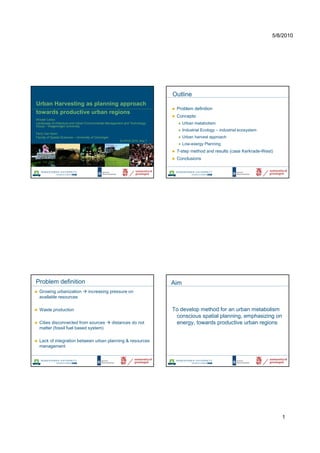
Urban Harvesting as planning approach
                                                                                 Problem definition
towards productive urban regions
                                                                                 Concepts:
Wouter Leduc
Landscape Architecture and Urban Environmental Management and Technology              Urban metabolism
Group – Wageningen University
                                                                                      Industrial Ecology – industrial ecosystem
Ferry Van Kann
Faculty of Spatial Sciences – University of Groningen                                 Urban harvest approach
                                                           SCUPAD 2010, May 7
                                                                                      Low-exergy Planning
                                                                                 7-step method and results (case Kerkrade-West)
                                                                                 Conclusions


Problem definition                                                              Aim
  Growing urbanization                increasing pressure on
  available resources

  Waste production                                                              To develop method for an urban metabolism
                                                                                 conscious spatial planning, emphasizing on
  Cities disconnected from sources                      distances do not         energy, towards productive urban regions
  matter (fossil fuel based system)

  Lack of integration between urban planning & resources
  management


                                                                                                                                     1
5/8/2010


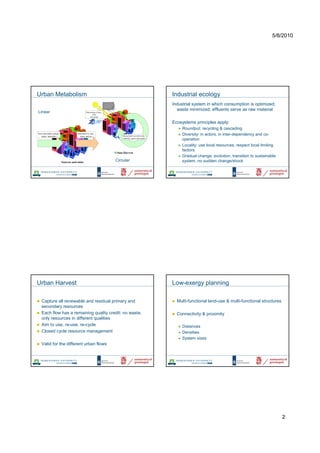
Urban Metabolism                                                                                        Industrial ecology
                                                                                                        Industrial system in which consumption is optimized;
                                                                                                          waste minimized; effluents serve as raw material
Linear                                       Harvesting of water,
                                                    wind
                                                  and energy


                                                                                                        Ecosystems principles apply:
                                                                                                             Roundput: recycling & cascading
Non-renewable energy,
   water, materials
                                    Emissions to soil,
                                      water and air                      Reused and recycled waste           Diversity: in actors, in inter-dependency and co-
                                                                         materials, gases and liquids
                                                                                                             operation
                                                                                                             Locality: use local resources, respect local limiting
                                                                                                             factors
                                                                    Urban Harvest
                                                                                                             Gradual change: evolution, transition to sustainable
                        Sources-and-sinks
                                                                    Circular                                 system, no sudden change/shock


Urban Harvest                                                                                           Low-exergy planning

   Capture all renewable and residual primary and                                                         Multi-functional land-use & multi-functional structures
   secondary resources
   Each flow has a remaining quality credit: no waste,                                                    Connectivity & proximity
   only resources in different qualities
   Aim to use, re-use, re-cycle                                                                              Distances
   Closed cycle resource management                                                                          Densities
                                                                                                             System sizes
   Valid for the different urban flows


                                                                                                                                                                     2
5/8/2010


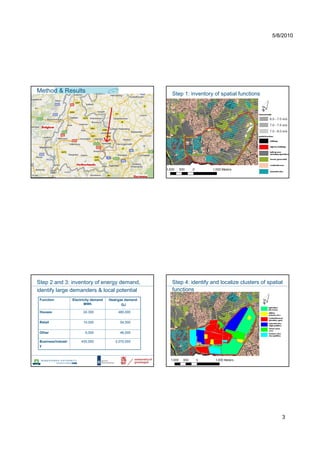
Method & Results                                           Step 1: inventory of spatial functions


Step 2 and 3: inventory of energy demand,                  Step 4: identify and localize clusters of spatial
identify large demanders & local potential                 functions
 Function           Electricity demand   Heat/gas demand
                           MWh                  GJ

 Houses                   24,300              480,000

 Retail                   15,000               54,000

 Other                     6,000               46,000

 Business/industr        435,000            2,070,000
 y


                                                                                                           3
5/8/2010


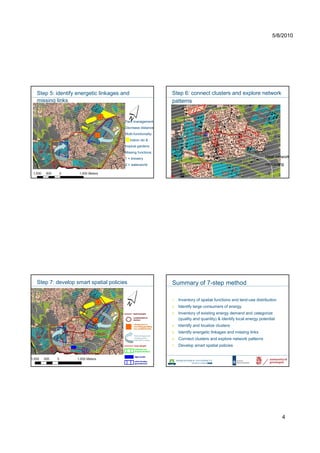
Step 5: identify energetic linkages and                    Step 6: connect clusters and explore network
missing links                                              patterns

                             2

                                     Park-management
                                     Decrease distances

                         1           Multi-functionality
                                          Indoor ski &
                                     tropical gardens
                                     Missing functions
                                     1 = brewery                                                                  Heat network
                                     2 = waterworld                                                               cascading


Step 7: develop smart spatial policies                     Summary of 7-step method

                                                           1.   Inventory of spatial functions and land-use distribution
                                                           2.   Identify large consumers of energy
                                                           3.   Inventory of existing energy demand and categorize
                                                                (quality and quantity) & identify local energy potential
                                                           4.   Identify and localize clusters
                                                           5.   Identify energetic linkages and missing links
                                                           6.   Connect clusters and explore network patterns
                                                           7.   Develop smart spatial policies


                                                                                                                           4
5/8/2010


Spatial strategy towards productive urban regions                         Conclusions
 1 Brewery
 2 Waterworld
 3 Algae ponds                          2
 4 Greenhouses
 5 Zoo extension                                                          Spatial strategy based on Urban Harvest as planning
     new productive functions                        park management        approach towards productive urban regions
 2   closing cycles and cascading                    closing cycles
                                                     industrial ecology        Urban circular metabolism
     heat flow
     cold flow                                                  1              Locality, re-using, cascading, gradual change
     closing cycle (re-using)
     cascading (re-using)                                                      Multi-functionality
                                                 c                             Connectivity & proximity
               park management              res luste
                                               ide        r
               closing cycles                       nt s of                    Waste = remaining quality
               industrial ecology               util ial are
                                                    itie
                                                         s as
                                        3

                                    4
                                                                      5


                 Thanks for your attention!


                                                                                                                                5

Scupad Congress 2010, Salzburg

  • 1.
    5/8/2010 Outline Urban Harvesting as planning approach Problem definition towards productive urban regions Concepts: Wouter Leduc Landscape Architecture and Urban Environmental Management and Technology Urban metabolism Group – Wageningen University Industrial Ecology – industrial ecosystem Ferry Van Kann Faculty of Spatial Sciences – University of Groningen Urban harvest approach SCUPAD 2010, May 7 Low-exergy Planning 7-step method and results (case Kerkrade-West) Conclusions Problem definition Aim Growing urbanization increasing pressure on available resources Waste production To develop method for an urban metabolism conscious spatial planning, emphasizing on Cities disconnected from sources distances do not energy, towards productive urban regions matter (fossil fuel based system) Lack of integration between urban planning & resources management 1
  • 2.
    5/8/2010 Urban Metabolism Industrial ecology Industrial system in which consumption is optimized; waste minimized; effluents serve as raw material Linear Harvesting of water, wind and energy Ecosystems principles apply: Roundput: recycling & cascading Non-renewable energy, water, materials Emissions to soil, water and air Reused and recycled waste Diversity: in actors, in inter-dependency and co- materials, gases and liquids operation Locality: use local resources, respect local limiting factors Urban Harvest Gradual change: evolution, transition to sustainable Sources-and-sinks Circular system, no sudden change/shock Urban Harvest Low-exergy planning Capture all renewable and residual primary and Multi-functional land-use & multi-functional structures secondary resources Each flow has a remaining quality credit: no waste, Connectivity & proximity only resources in different qualities Aim to use, re-use, re-cycle Distances Closed cycle resource management Densities System sizes Valid for the different urban flows 2
  • 3.
    5/8/2010 Method & Results Step 1: inventory of spatial functions Step 2 and 3: inventory of energy demand, Step 4: identify and localize clusters of spatial identify large demanders & local potential functions Function Electricity demand Heat/gas demand MWh GJ Houses 24,300 480,000 Retail 15,000 54,000 Other 6,000 46,000 Business/industr 435,000 2,070,000 y 3
  • 4.
    5/8/2010 Step 5: identifyenergetic linkages and Step 6: connect clusters and explore network missing links patterns 2 Park-management Decrease distances 1 Multi-functionality Indoor ski & tropical gardens Missing functions 1 = brewery Heat network 2 = waterworld cascading Step 7: develop smart spatial policies Summary of 7-step method 1. Inventory of spatial functions and land-use distribution 2. Identify large consumers of energy 3. Inventory of existing energy demand and categorize (quality and quantity) & identify local energy potential 4. Identify and localize clusters 5. Identify energetic linkages and missing links 6. Connect clusters and explore network patterns 7. Develop smart spatial policies 4
  • 5.
    5/8/2010 Spatial strategy towardsproductive urban regions Conclusions 1 Brewery 2 Waterworld 3 Algae ponds 2 4 Greenhouses 5 Zoo extension Spatial strategy based on Urban Harvest as planning new productive functions park management approach towards productive urban regions 2 closing cycles and cascading closing cycles industrial ecology Urban circular metabolism heat flow cold flow 1 Locality, re-using, cascading, gradual change closing cycle (re-using) cascading (re-using) Multi-functionality c Connectivity & proximity park management res luste ide r closing cycles nt s of Waste = remaining quality industrial ecology util ial are itie s as 3 4 5 Thanks for your attention! 5