SECTION A : True / False

TOTAL 10 MARKS

Answer TRUE or FALSE for the following and justify your answer by stating the reason
for each answer. There are 5 questions in this section. Each question carries 2 marks.
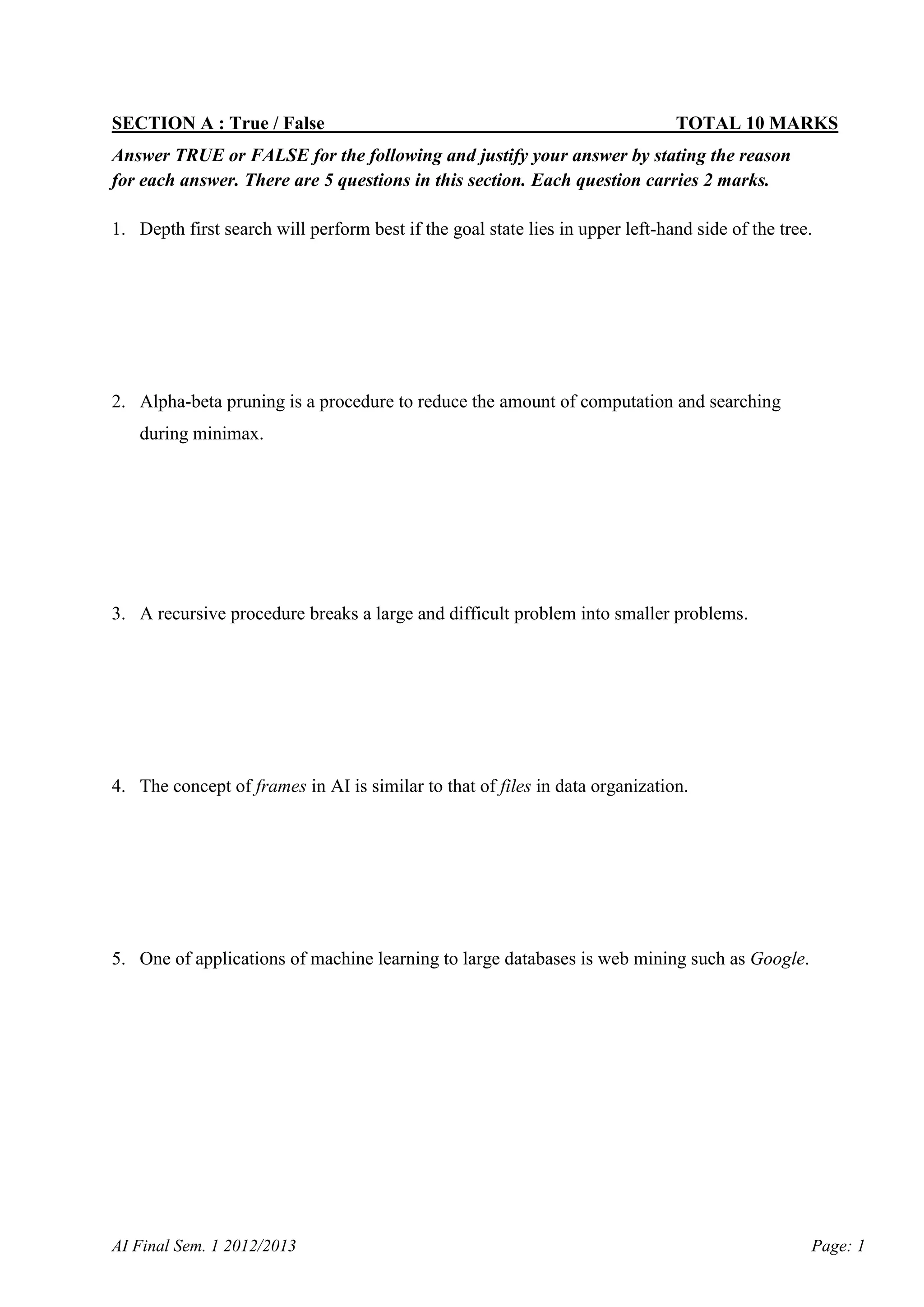
1. Depth first search will perform best if the goal state lies in upper left-hand side of the tree.

2. Alpha-beta pruning is a procedure to reduce the amount of computation and searching
during minimax.

3. A recursive procedure breaks a large and difficult problem into smaller problems.

4. The concept of frames in AI is similar to that of files in data organization.

5. One of applications of machine learning to large databases is web mining such as Google.

AI Final Sem. 1 2012/2013

Page: 1
SECTION B : Short Explanation Questions
TOTAL 10 MARKS
Answer each question in the space provided. There are 5 questions in this section. Each
question carries 2 marks.
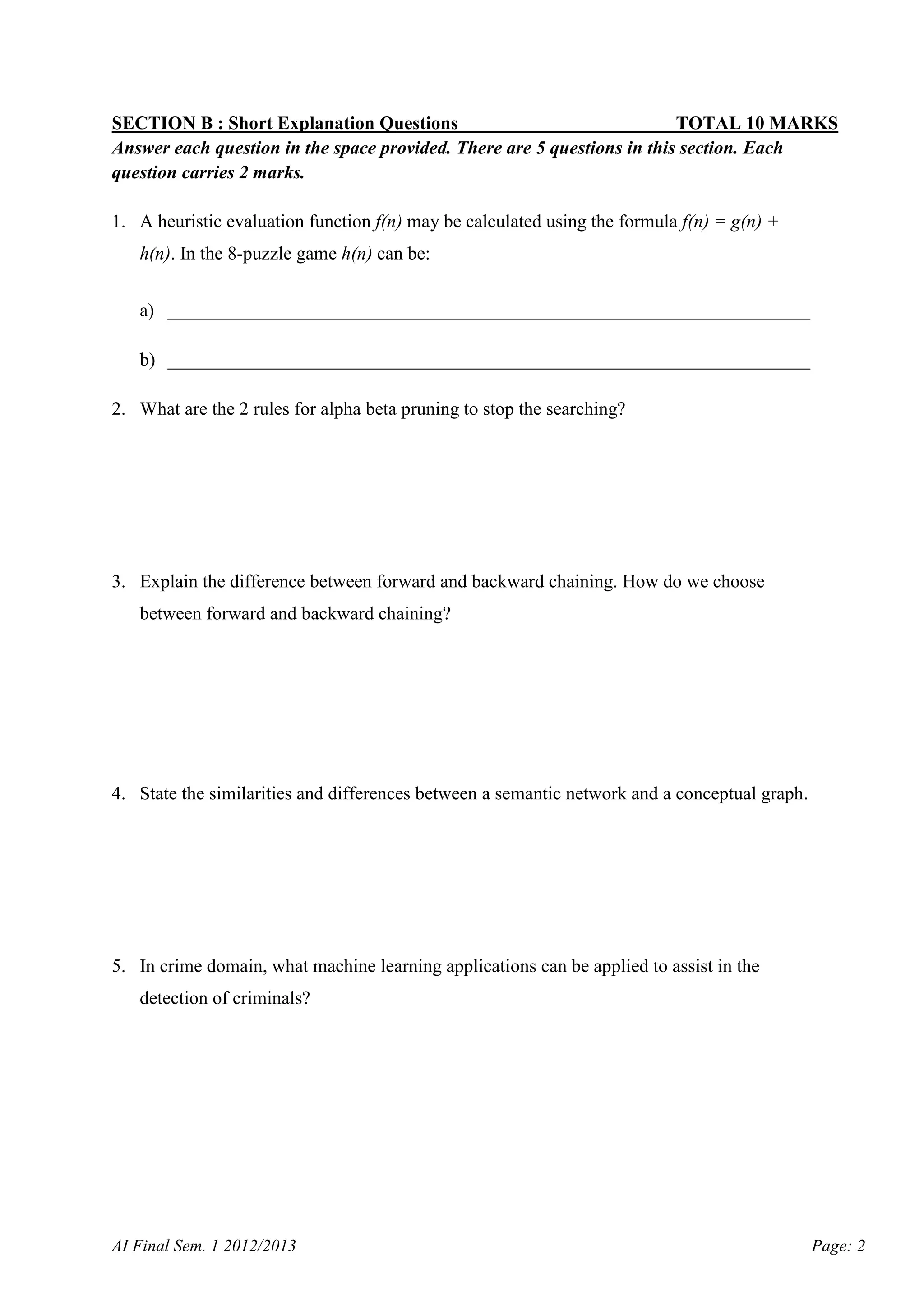
1. A heuristic evaluation function f(n) may be calculated using the formula f(n) = g(n) +
h(n). In the 8-puzzle game h(n) can be:
a) _____________________________________________________________________
b) _____________________________________________________________________
2. What are the 2 rules for alpha beta pruning to stop the searching?

3. Explain the difference between forward and backward chaining. How do we choose
between forward and backward chaining?

4. State the similarities and differences between a semantic network and a conceptual graph.

5. In crime domain, what machine learning applications can be applied to assist in the
detection of criminals?

AI Final Sem. 1 2012/2013

Page: 2
SECTION C : Structured Questions

TOTAL 80 MARKS

Answer all questions in the space provided. There are 4 questions in this section. Use extra
paper(s) if necessary. Each question carries a total of 20 marks.
Question 1 (a) – Uninformed Search

Total 10 marks

Based on Figure: 1, answer questions (i) to (iii).
S

A

H

D

B

I

F

F

F

P

Q

G

Figure: 1
i) Perform a Breadth-First search on the above tree. List the nodes on OPEN and CLOSED
for each iteration. S = Start, and F = Goal.
Iteration

ii)

OPEN

[ 3 marks ]
CLOSED

The Breadth-First search algorithm can be implemented in a
___________________________________ order or with a __________.

AI Final Sem. 1 2012/2013

[1.5 marks]

Page: 3
iii)

Perform a Depth-First search on the above tree. List the nodes on OPEN and
CLOSED for each iteration. S = Start, and F = Goal.
Iteration

iv)

OPEN

CLOSED

The Depth-First Search algorithm can be implemented in a
___________________________ order or with a ________.

v)

[ 3 marks ]

[1.5 marks]

In Sudoku game application which search technique is better to be applied (Best first
or depth first search ? ). Give a short reason why (BFS/DFS) is more suitable for
Sudoku.
[ 1 marks]

AI Final Sem. 1 2012/2013

Page: 4
Question 1(b) – Informed Search

Total 10 marks

Figure: 2 shows a tree where each node is assigned a heuristic value. Based on this tree,
answer questions (i) to (iii).

A, 3
B, 3

C, 2

D, 2

H, 1
N, 0

E, 3

I, 2
O, 0

F, 1

J, 1

K, 0

P, 2

G, 2

L, 1

M, 2

Q, 2

R, 2

S, 3

Figure: 2
i)

Apply the Best-First search from the start state A to reach to the goal state, K. Show
all the steps you will perform by filling in the table below.
Node Evaluated

ii)

OPEN

[4 marks]
CLOSED

What is the solution path for the Best-First search performed on this tree?

AI Final Sem. 1 2012/2013

[1 mark]

Page: 5
iii)

What are the evaluation function that is the f(n) values for nodes A, B, G, I and Q? Show how
you obtain each value.

AI Final Sem. 1 2012/2013

[5 marks]

Page: 6
Question 2a – Minimax Search

Total 10 marks

Refer to Figure: 3 to answer this question.
MAX

3

6

7

5

6

9
5

6

7

4

5

6

8

9

Figure: 3
Apply the minimax algorithm to the game tree in Figure: 3 above, where it is the
MAXIMIZER’s turn to play. The values estimated by the evaluation function are indicated at
the leaf nodes. Assume that the search always visits children left-to-right.

Compute the backed-up values computed by the minimax algorithm. Show your answer by
writing values at the appropriate nodes in the above tree.

[7m]

a. Indicate the proper move of the maximizer by marking the line with bold indicator
(

) to the root’s outgoing edges.

AI Final Sem. 1 2012/2013

[3m]

Page: 7
Question 2b – Alpha-Beta Pruning

Total 10 marks

Refer to Figure 3 above, answer the following questions
a. Using alpha-beta pruning (and standard left-to-right evaluation of nodes), how many of the
leaves get evaluated?
b. Indicate all parts of the tree that are cut off.

[4m]
[3m]

c. if the standard right-to-left evaluation of nodes is applied to the search tree in Figure 3
above:
i.

are the minimax value computed at the root will be changed. (just write down yes or
no)

ii.

[1.5m]

are the number of nodes pruned will be changed. (just write down yes or no) [1.5m]

AI Final Sem. 1 2012/2013

Page: 8
Question 3 (a) – 15 marks
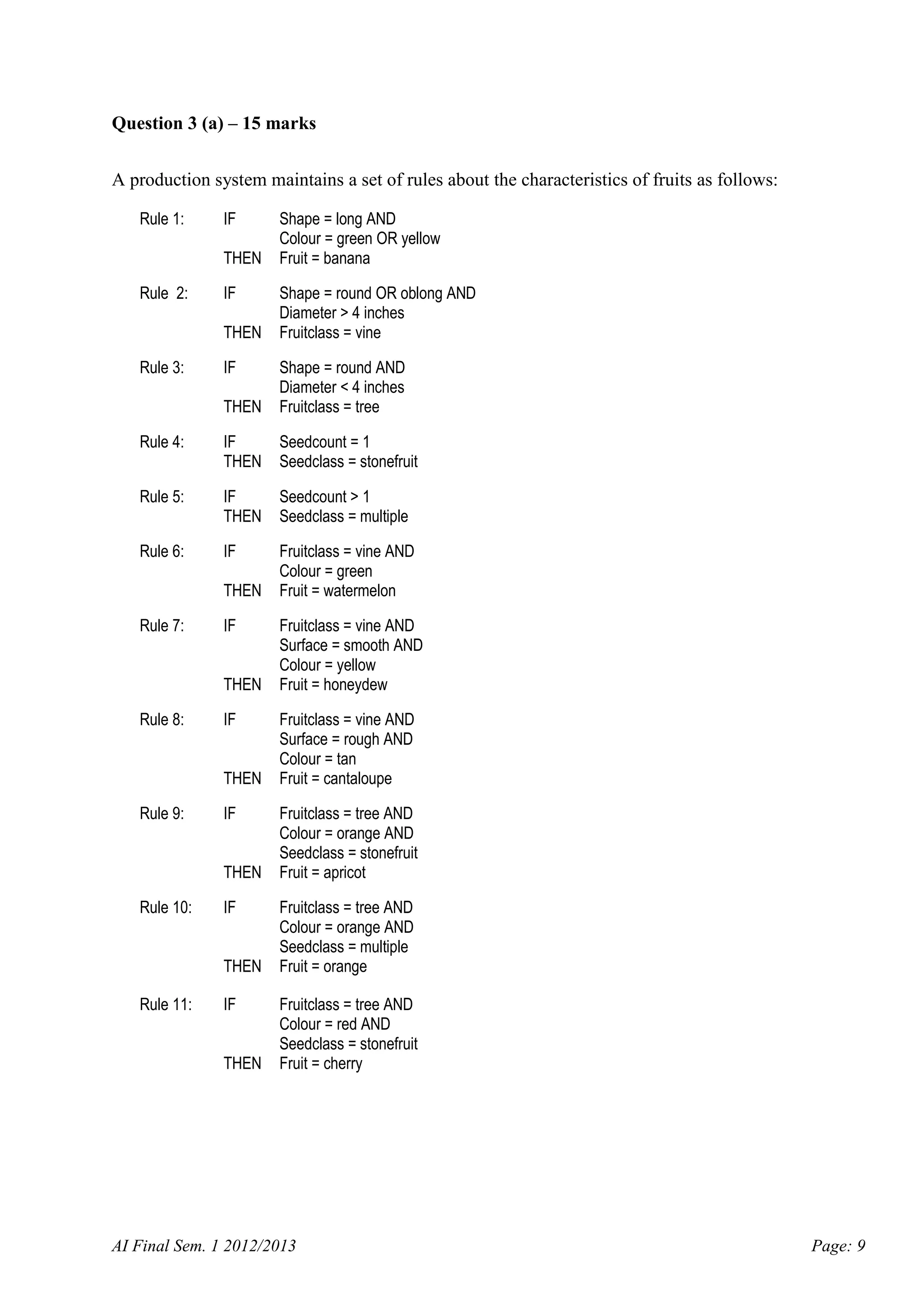
A production system maintains a set of rules about the characteristics of fruits as follows:
Rule 1:

IF
THEN

Rule 2:

IF
THEN

Rule 3:

IF

Shape = long AND
Colour = green OR yellow
Fruit = banana
Shape = round OR oblong AND
Diameter > 4 inches
Fruitclass = vine

THEN

Shape = round AND
Diameter < 4 inches
Fruitclass = tree

Rule 4:

IF
THEN

Seedcount = 1
Seedclass = stonefruit

Rule 5:

IF
THEN

Seedcount > 1
Seedclass = multiple

Rule 6:

IF

Fruitclass = vine AND
Colour = green
Fruit = watermelon

THEN
Rule 7:

IF
THEN

Rule 8:

IF
THEN

Rule 9:

IF
THEN

Rule 10:

IF
THEN

Rule 11:

IF
THEN

Fruitclass = vine AND
Surface = smooth AND
Colour = yellow
Fruit = honeydew
Fruitclass = vine AND
Surface = rough AND
Colour = tan
Fruit = cantaloupe
Fruitclass = tree AND
Colour = orange AND
Seedclass = stonefruit
Fruit = apricot
Fruitclass = tree AND
Colour = orange AND
Seedclass = multiple
Fruit = orange
Fruitclass = tree AND
Colour = red AND
Seedclass = stonefruit
Fruit = cherry

AI Final Sem. 1 2012/2013

Page: 9
Rule 12:

IF
THEN

Rule 13:

IF
THEN

Rule 14:

IF
THEN

i)

Fruitclass = tree AND
Colour = orange AND
Seedclass = stonefruit
Fruit = peach
Fruitclass = tree AND
Colour = red OR yellow OR green AND
Seedclass = multiple
Fruit = apple
Fruitclass = tree AND
Colour = purple AND
Seedclass = stonefruit
Fruit = plum

Use FORWARD CHAINING to describe the production system table including its
working memory, conflict set and rule fired to establish a fruit. Initial data given is :
Shape = round
Diameter > 4 inches
Surface = smooth
Colour = yellow
Terminate when the final value for Fruit in the working memory.

Iteration
#

AI Final Sem. 1 2012/2013

Working memory

[6 marks]

Conflict
set

Rule
fired

Page: 10
ii)

Given the fruit to search is apple, use BACKWARD CHAINING to describe the
production system table including its working memory, conflict set and rule fired to
establish the initial data for this fruit.
State the initial facts required to establish that the fruit searched is an apple. [9 marks]
Iteration
#

Working memory

Conflict
set

Rule
fired

The initial facts required to establish fruit to search is apple are:

AI Final Sem. 1 2012/2013

Page: 11
Question 3 (b) – 5 marks

i) How is blackboard systems related to production systems? Give a diagrammatic
example of such an application.

[2.5 marks]

ii) How can the concept of agents be applied in the blackboard architecture? [2.5 marks]

AI Final Sem. 1 2012/2013

Page: 12
Question 4 (a) – 10 marks
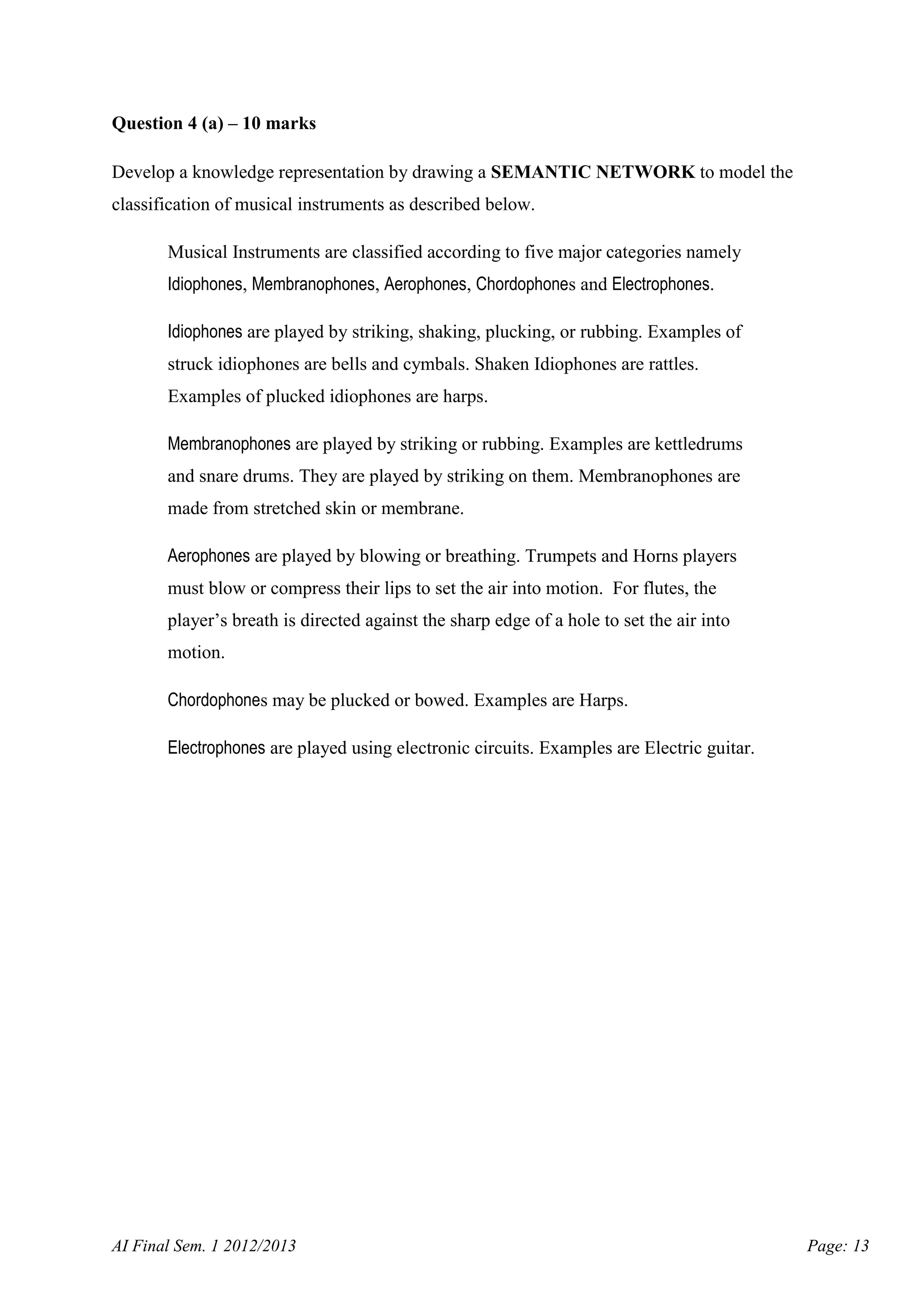
Develop a knowledge representation by drawing a SEMANTIC NETWORK to model the
classification of musical instruments as described below.
Musical Instruments are classified according to five major categories namely
Idiophones, Membranophones, Aerophones, Chordophones and Electrophones.
Idiophones are played by striking, shaking, plucking, or rubbing. Examples of
struck idiophones are bells and cymbals. Shaken Idiophones are rattles.
Examples of plucked idiophones are harps.
Membranophones are played by striking or rubbing. Examples are kettledrums
and snare drums. They are played by striking on them. Membranophones are
made from stretched skin or membrane.
Aerophones are played by blowing or breathing. Trumpets and Horns players
must blow or compress their lips to set the air into motion. For flutes, the
player’s breath is directed against the sharp edge of a hole to set the air into
motion.
Chordophones may be plucked or bowed. Examples are Harps.
Electrophones are played using electronic circuits. Examples are Electric guitar.

AI Final Sem. 1 2012/2013

Page: 13
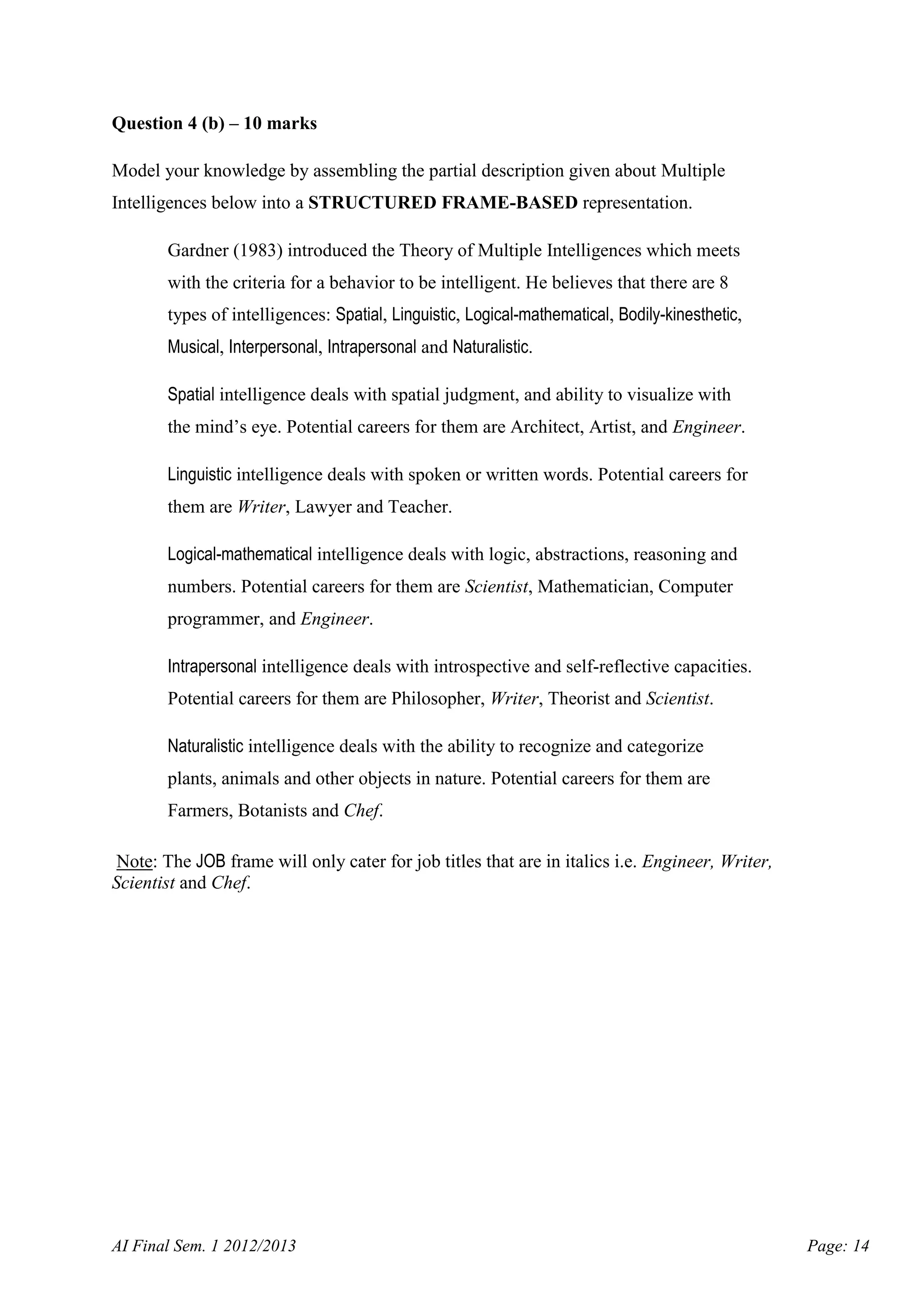
Question 4 (b) – 10 marks
Model your knowledge by assembling the partial description given about Multiple
Intelligences below into a STRUCTURED FRAME-BASED representation.
Gardner (1983) introduced the Theory of Multiple Intelligences which meets
with the criteria for a behavior to be intelligent. He believes that there are 8
types of intelligences: Spatial, Linguistic, Logical-mathematical, Bodily-kinesthetic,
Musical, Interpersonal, Intrapersonal and Naturalistic.
Spatial intelligence deals with spatial judgment, and ability to visualize with
the mind’s eye. Potential careers for them are Architect, Artist, and Engineer.
Linguistic intelligence deals with spoken or written words. Potential careers for
them are Writer, Lawyer and Teacher.
Logical-mathematical intelligence deals with logic, abstractions, reasoning and
numbers. Potential careers for them are Scientist, Mathematician, Computer
programmer, and Engineer.
Intrapersonal intelligence deals with introspective and self-reflective capacities.
Potential careers for them are Philosopher, Writer, Theorist and Scientist.
Naturalistic intelligence deals with the ability to recognize and categorize
plants, animals and other objects in nature. Potential careers for them are
Farmers, Botanists and Chef.
Note: The JOB frame will only cater for job titles that are in italics i.e. Engineer, Writer,
Scientist and Chef.

AI Final Sem. 1 2012/2013

Page: 14

SCSJ3553 - Artificial Intelligence Final Exam paper - UTM

  • 1.
    SECTION A :True / False TOTAL 10 MARKS Answer TRUE or FALSE for the following and justify your answer by stating the reason for each answer. There are 5 questions in this section. Each question carries 2 marks. 1. Depth first search will perform best if the goal state lies in upper left-hand side of the tree. 2. Alpha-beta pruning is a procedure to reduce the amount of computation and searching during minimax. 3. A recursive procedure breaks a large and difficult problem into smaller problems. 4. The concept of frames in AI is similar to that of files in data organization. 5. One of applications of machine learning to large databases is web mining such as Google. AI Final Sem. 1 2012/2013 Page: 1
  • 2.
    SECTION B :Short Explanation Questions TOTAL 10 MARKS Answer each question in the space provided. There are 5 questions in this section. Each question carries 2 marks. 1. A heuristic evaluation function f(n) may be calculated using the formula f(n) = g(n) + h(n). In the 8-puzzle game h(n) can be: a) _____________________________________________________________________ b) _____________________________________________________________________ 2. What are the 2 rules for alpha beta pruning to stop the searching? 3. Explain the difference between forward and backward chaining. How do we choose between forward and backward chaining? 4. State the similarities and differences between a semantic network and a conceptual graph. 5. In crime domain, what machine learning applications can be applied to assist in the detection of criminals? AI Final Sem. 1 2012/2013 Page: 2
  • 3.
    SECTION C :Structured Questions TOTAL 80 MARKS Answer all questions in the space provided. There are 4 questions in this section. Use extra paper(s) if necessary. Each question carries a total of 20 marks. Question 1 (a) – Uninformed Search Total 10 marks Based on Figure: 1, answer questions (i) to (iii). S A H D B I F F F P Q G Figure: 1 i) Perform a Breadth-First search on the above tree. List the nodes on OPEN and CLOSED for each iteration. S = Start, and F = Goal. Iteration ii) OPEN [ 3 marks ] CLOSED The Breadth-First search algorithm can be implemented in a ___________________________________ order or with a __________. AI Final Sem. 1 2012/2013 [1.5 marks] Page: 3
  • 4.
    iii) Perform a Depth-Firstsearch on the above tree. List the nodes on OPEN and CLOSED for each iteration. S = Start, and F = Goal. Iteration iv) OPEN CLOSED The Depth-First Search algorithm can be implemented in a ___________________________ order or with a ________. v) [ 3 marks ] [1.5 marks] In Sudoku game application which search technique is better to be applied (Best first or depth first search ? ). Give a short reason why (BFS/DFS) is more suitable for Sudoku. [ 1 marks] AI Final Sem. 1 2012/2013 Page: 4
  • 5.
    Question 1(b) –Informed Search Total 10 marks Figure: 2 shows a tree where each node is assigned a heuristic value. Based on this tree, answer questions (i) to (iii). A, 3 B, 3 C, 2 D, 2 H, 1 N, 0 E, 3 I, 2 O, 0 F, 1 J, 1 K, 0 P, 2 G, 2 L, 1 M, 2 Q, 2 R, 2 S, 3 Figure: 2 i) Apply the Best-First search from the start state A to reach to the goal state, K. Show all the steps you will perform by filling in the table below. Node Evaluated ii) OPEN [4 marks] CLOSED What is the solution path for the Best-First search performed on this tree? AI Final Sem. 1 2012/2013 [1 mark] Page: 5
  • 6.
    iii) What are theevaluation function that is the f(n) values for nodes A, B, G, I and Q? Show how you obtain each value. AI Final Sem. 1 2012/2013 [5 marks] Page: 6
  • 7.
    Question 2a –Minimax Search Total 10 marks Refer to Figure: 3 to answer this question. MAX 3 6 7 5 6 9 5 6 7 4 5 6 8 9 Figure: 3 Apply the minimax algorithm to the game tree in Figure: 3 above, where it is the MAXIMIZER’s turn to play. The values estimated by the evaluation function are indicated at the leaf nodes. Assume that the search always visits children left-to-right. Compute the backed-up values computed by the minimax algorithm. Show your answer by writing values at the appropriate nodes in the above tree. [7m] a. Indicate the proper move of the maximizer by marking the line with bold indicator ( ) to the root’s outgoing edges. AI Final Sem. 1 2012/2013 [3m] Page: 7
  • 8.
    Question 2b –Alpha-Beta Pruning Total 10 marks Refer to Figure 3 above, answer the following questions a. Using alpha-beta pruning (and standard left-to-right evaluation of nodes), how many of the leaves get evaluated? b. Indicate all parts of the tree that are cut off. [4m] [3m] c. if the standard right-to-left evaluation of nodes is applied to the search tree in Figure 3 above: i. are the minimax value computed at the root will be changed. (just write down yes or no) ii. [1.5m] are the number of nodes pruned will be changed. (just write down yes or no) [1.5m] AI Final Sem. 1 2012/2013 Page: 8
  • 9.
    Question 3 (a)– 15 marks A production system maintains a set of rules about the characteristics of fruits as follows: Rule 1: IF THEN Rule 2: IF THEN Rule 3: IF Shape = long AND Colour = green OR yellow Fruit = banana Shape = round OR oblong AND Diameter > 4 inches Fruitclass = vine THEN Shape = round AND Diameter < 4 inches Fruitclass = tree Rule 4: IF THEN Seedcount = 1 Seedclass = stonefruit Rule 5: IF THEN Seedcount > 1 Seedclass = multiple Rule 6: IF Fruitclass = vine AND Colour = green Fruit = watermelon THEN Rule 7: IF THEN Rule 8: IF THEN Rule 9: IF THEN Rule 10: IF THEN Rule 11: IF THEN Fruitclass = vine AND Surface = smooth AND Colour = yellow Fruit = honeydew Fruitclass = vine AND Surface = rough AND Colour = tan Fruit = cantaloupe Fruitclass = tree AND Colour = orange AND Seedclass = stonefruit Fruit = apricot Fruitclass = tree AND Colour = orange AND Seedclass = multiple Fruit = orange Fruitclass = tree AND Colour = red AND Seedclass = stonefruit Fruit = cherry AI Final Sem. 1 2012/2013 Page: 9
  • 10.
    Rule 12: IF THEN Rule 13: IF THEN Rule14: IF THEN i) Fruitclass = tree AND Colour = orange AND Seedclass = stonefruit Fruit = peach Fruitclass = tree AND Colour = red OR yellow OR green AND Seedclass = multiple Fruit = apple Fruitclass = tree AND Colour = purple AND Seedclass = stonefruit Fruit = plum Use FORWARD CHAINING to describe the production system table including its working memory, conflict set and rule fired to establish a fruit. Initial data given is : Shape = round Diameter > 4 inches Surface = smooth Colour = yellow Terminate when the final value for Fruit in the working memory. Iteration # AI Final Sem. 1 2012/2013 Working memory [6 marks] Conflict set Rule fired Page: 10
  • 11.
    ii) Given the fruitto search is apple, use BACKWARD CHAINING to describe the production system table including its working memory, conflict set and rule fired to establish the initial data for this fruit. State the initial facts required to establish that the fruit searched is an apple. [9 marks] Iteration # Working memory Conflict set Rule fired The initial facts required to establish fruit to search is apple are: AI Final Sem. 1 2012/2013 Page: 11
  • 12.
    Question 3 (b)– 5 marks i) How is blackboard systems related to production systems? Give a diagrammatic example of such an application. [2.5 marks] ii) How can the concept of agents be applied in the blackboard architecture? [2.5 marks] AI Final Sem. 1 2012/2013 Page: 12
  • 13.
    Question 4 (a)– 10 marks Develop a knowledge representation by drawing a SEMANTIC NETWORK to model the classification of musical instruments as described below. Musical Instruments are classified according to five major categories namely Idiophones, Membranophones, Aerophones, Chordophones and Electrophones. Idiophones are played by striking, shaking, plucking, or rubbing. Examples of struck idiophones are bells and cymbals. Shaken Idiophones are rattles. Examples of plucked idiophones are harps. Membranophones are played by striking or rubbing. Examples are kettledrums and snare drums. They are played by striking on them. Membranophones are made from stretched skin or membrane. Aerophones are played by blowing or breathing. Trumpets and Horns players must blow or compress their lips to set the air into motion. For flutes, the player’s breath is directed against the sharp edge of a hole to set the air into motion. Chordophones may be plucked or bowed. Examples are Harps. Electrophones are played using electronic circuits. Examples are Electric guitar. AI Final Sem. 1 2012/2013 Page: 13
  • 14.
    Question 4 (b)– 10 marks Model your knowledge by assembling the partial description given about Multiple Intelligences below into a STRUCTURED FRAME-BASED representation. Gardner (1983) introduced the Theory of Multiple Intelligences which meets with the criteria for a behavior to be intelligent. He believes that there are 8 types of intelligences: Spatial, Linguistic, Logical-mathematical, Bodily-kinesthetic, Musical, Interpersonal, Intrapersonal and Naturalistic. Spatial intelligence deals with spatial judgment, and ability to visualize with the mind’s eye. Potential careers for them are Architect, Artist, and Engineer. Linguistic intelligence deals with spoken or written words. Potential careers for them are Writer, Lawyer and Teacher. Logical-mathematical intelligence deals with logic, abstractions, reasoning and numbers. Potential careers for them are Scientist, Mathematician, Computer programmer, and Engineer. Intrapersonal intelligence deals with introspective and self-reflective capacities. Potential careers for them are Philosopher, Writer, Theorist and Scientist. Naturalistic intelligence deals with the ability to recognize and categorize plants, animals and other objects in nature. Potential careers for them are Farmers, Botanists and Chef. Note: The JOB frame will only cater for job titles that are in italics i.e. Engineer, Writer, Scientist and Chef. AI Final Sem. 1 2012/2013 Page: 14