Advanced Software Engineering
Kanban
Kanban
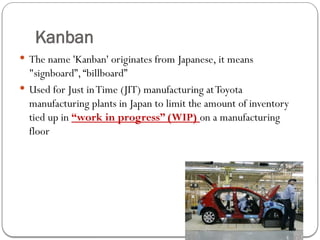
 The name 'Kanban' originates from Japanese, it means
"signboard”,“billboard”
 Used for Just inTime (JIT) manufacturing atToyota
manufacturing plants in Japan to limit the amount of inventory
tied up in “work in progress” (WIP) on a manufacturing
floor
Kanban
 Kanban is a lean agile system that can be used to enhance any
software development lifecycle including Scrum, XP, or
Waterfall.
Principles
 Start with what you do now
 No specific set of roles or process steps
 Agree to pursue incremental, evolutionary change
 encourages continuous small incremental and evolutionary
changes to your current system
 Respect the current process, roles, responsibilities & titles
 eliminate initial fears
Core Properties
 Kanban promotes the lean concept of flow
 to continuously and predictably deliver value.
 The work and the workflow is made visible
 to make activities and issues like backups obvious.
 Kanban limits work in progress
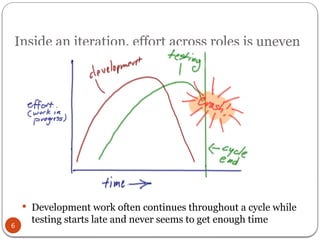
Inside an iteration, effort across roles is uneven
6
 Development work often continues throughout a cycle while
testing starts late and never seems to get enough time
Using a Kanban approach in software drops time-boxed
iterations in favor of focusing on continuous flow.
7
SCRUM vs. Kanban
 Kanban has less rules than scrum
 Kanban is great methodology for Maintenance
 teams that need to adapt to customer input on a daily basis.
 Scrum is good for development that is heavily dependant on
stakeholders' feedback
 The sprint lock and the end of sprint demos to stakeholders
SCRUM vs. Kanban
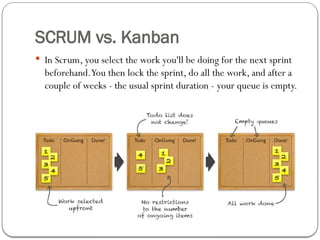
 In Scrum, you select the work you'll be doing for the next sprint
beforehand.You then lock the sprint, do all the work, and after a
couple of weeks - the usual sprint duration - your queue is empty.
SCRUM vs. Kanban
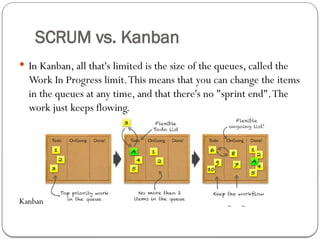
 In Kanban, all that's limited is the size of the queues, called the
Work In Progress limit.This means that you can change the items
in the queues at any time, and that there's no "sprint end".The
work just keeps flowing.
Kanban flow, with aWIP limit of 3 for theTodo, and 2 for the Ongoing
Why limit the WIP?
Limiting WIP may have the following effects:
 Reduces cycle time per task
 Insures WIP is highest priority task
 Reduces or eliminates queues between groups
 Reduces multi-tasking by team members
 Reduces lead times and increases quality
Work Process Flow
• Analysis
– Create specification and acceptance criteria
– Product Owners
• Development
– Code features, fix bugs
– EngineeringTeam
• Test
– Test features and bug fixes
– QATeam
• Merge and Deploy
– Release features and bug fixes to customers
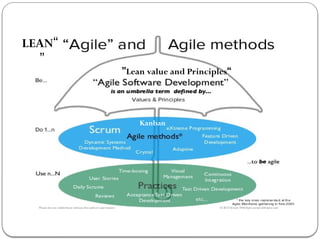
Kanban
“
Lean value and Principles
”
“
LEAN
”
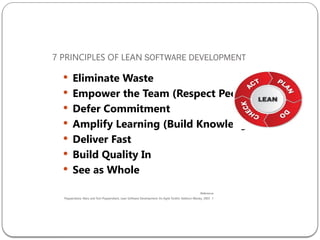
7 PRINCIPLES OF LEAN SOFTWARE DEVELOPMENT
 Eliminate Waste
 Empower the Team (Respect People)
 Defer Commitment
 Amplify Learning (Build Knowledge)
 Deliver Fast
 Build Quality In
 See as Whole
Reference
:
1
.
Poppendieck, Mary and Tom Poppendieck, Lean Software Development: An Agile Toolkit, Addison Wesley, 2003
Software Waste
 Poppendieck’s 7 types of software waste
 Partially done work
 Extra processes
 Extra features
 Task switching
 Waiting
 Motion
 Hand-offs; lack of co-located teams
 Defects
Reference:
 Anywhere from where you can get better knowledge
Q&A?

Lecture 6- Kanban Lean and applications.pptx

  • 1.
  • 2.
    Kanban  The name'Kanban' originates from Japanese, it means "signboard”,“billboard”  Used for Just inTime (JIT) manufacturing atToyota manufacturing plants in Japan to limit the amount of inventory tied up in “work in progress” (WIP) on a manufacturing floor
  • 3.
    Kanban  Kanban isa lean agile system that can be used to enhance any software development lifecycle including Scrum, XP, or Waterfall.
  • 4.
    Principles  Start withwhat you do now  No specific set of roles or process steps  Agree to pursue incremental, evolutionary change  encourages continuous small incremental and evolutionary changes to your current system  Respect the current process, roles, responsibilities & titles  eliminate initial fears
  • 5.
    Core Properties  Kanbanpromotes the lean concept of flow  to continuously and predictably deliver value.  The work and the workflow is made visible  to make activities and issues like backups obvious.  Kanban limits work in progress
  • 6.
    Inside an iteration,effort across roles is uneven 6  Development work often continues throughout a cycle while testing starts late and never seems to get enough time
  • 7.
    Using a Kanbanapproach in software drops time-boxed iterations in favor of focusing on continuous flow. 7
  • 8.
    SCRUM vs. Kanban Kanban has less rules than scrum  Kanban is great methodology for Maintenance  teams that need to adapt to customer input on a daily basis.  Scrum is good for development that is heavily dependant on stakeholders' feedback  The sprint lock and the end of sprint demos to stakeholders
  • 9.
    SCRUM vs. Kanban In Scrum, you select the work you'll be doing for the next sprint beforehand.You then lock the sprint, do all the work, and after a couple of weeks - the usual sprint duration - your queue is empty.
  • 10.
    SCRUM vs. Kanban In Kanban, all that's limited is the size of the queues, called the Work In Progress limit.This means that you can change the items in the queues at any time, and that there's no "sprint end".The work just keeps flowing. Kanban flow, with aWIP limit of 3 for theTodo, and 2 for the Ongoing
  • 11.
    Why limit theWIP? Limiting WIP may have the following effects:  Reduces cycle time per task  Insures WIP is highest priority task  Reduces or eliminates queues between groups  Reduces multi-tasking by team members  Reduces lead times and increases quality
  • 12.
    Work Process Flow •Analysis – Create specification and acceptance criteria – Product Owners • Development – Code features, fix bugs – EngineeringTeam • Test – Test features and bug fixes – QATeam • Merge and Deploy – Release features and bug fixes to customers
  • 13.
    Kanban “ Lean value andPrinciples ” “ LEAN ”
  • 14.
    7 PRINCIPLES OFLEAN SOFTWARE DEVELOPMENT  Eliminate Waste  Empower the Team (Respect People)  Defer Commitment  Amplify Learning (Build Knowledge)  Deliver Fast  Build Quality In  See as Whole Reference : 1 . Poppendieck, Mary and Tom Poppendieck, Lean Software Development: An Agile Toolkit, Addison Wesley, 2003
  • 15.
    Software Waste  Poppendieck’s7 types of software waste  Partially done work  Extra processes  Extra features  Task switching  Waiting  Motion  Hand-offs; lack of co-located teams  Defects
  • 16.
    Reference:  Anywhere fromwhere you can get better knowledge
  • 17.

Editor's Notes

  • #14  Definition - Anything not needed right now Book Recommendation - Escape Velocity - Jeffrey Moore