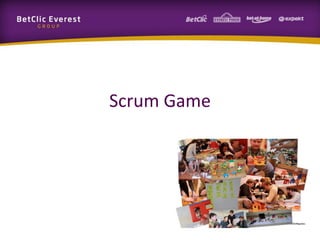
Scrum Game
Learning the principles of the Agile manifesto
1. OPEN BACKLOGS THAT TRIGGER IDEATING over DETAILED INSTRUCTIONS TO FOLLOW
 Invitation for collaboration between a customer and teams
2. MINDFUL PRODUCT DEVELOPMENT over A SERIES OF TASKS TO ACCOMPLISH
 Teach product development, not micromanagement on a task level
3. TEAMS COLLABORATING TOWARD COMMON SUCCESS over COMPETITION FOR SCORE
 A chance to practice skills of inter-team collaboration
4. USEFUL METRICS TO ASSESS BENEFITS OF AGILE over FIGURES THE TRAINERS ASKED TO COLLECT
 teach the team to own their process
2
Organization
• Teams of 4 to 8
• Timing: ~100 minutes
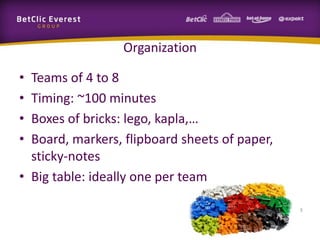
• Boxes of bricks: lego, kapla,…
• Board, markers, flipboard sheets of paper,
sticky-notes
• Big table: ideally one per team
3
Roles
• Product Owner: this is me. I represent the
client.
• Team members: all of you.
• Scrum master: optional. The game can be
played without scrum master. This is up to
you: self–organize.
4
PRE-GAME: Organizing Teams (5 min)
• Self-organize yourself in groups of 4-8 people
and allocate the working space and material
5
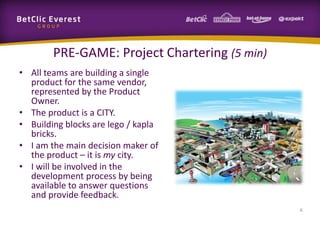
PRE-GAME: Project Chartering (5 min)
• All teams are building a single
product for the same vendor,
represented by the Product
Owner.
• The product is a CITY.
• Building blocks are lego / kapla
bricks.
• I am the main decision maker of
the product – it is my city.
• I will be involved in the
development process by being
available to answer questions
and provide feedback.
6
PRE-GAME: Building the Backlog (15 min)
• We want to build:
– Small house: one storey building (several)
– Big house: two storey building (several)
– Shop
– School
– Church
– Hospital
– Kindergarten
– Bus stop
– Intersection (can be drawn)
– Park (can be drawn)
– River (can be drawn)
– Bridge
7
PRE-GAME: Estimating (15 min)
• Choose an estimation method, but keep it
simple and keep it fast.
– Recently, agile gurus have recommended dropping
estimates.
• A possible approach is t-shirt sizing: S, M, L, XL
• Or you may use story points: 1 2 3 5 8 13
• Or planning poker
8
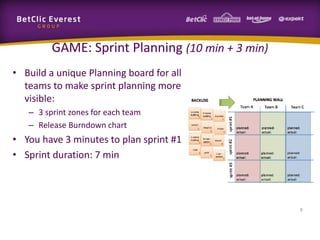
GAME: Sprint Planning (10 min + 3 min)
• Build a unique Planning board for all
teams to make sprint planning more
visible:
– 3 sprint zones for each team
– Release Burndown chart
• You have 3 minutes to plan sprint #1
• Sprint duration: 7 min
9
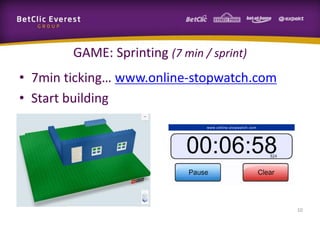
GAME: Sprinting (7 min / sprint)
• 7min ticking… www.online-stopwatch.com
• Start building
10
GAME: Reviewing (5 min)
• Stop building
• Demo: where is the demo of my city?
• Update planning wall
• Update Release Burndown chart
• Retrospective: “how can we make it better the next
sprint?”
11
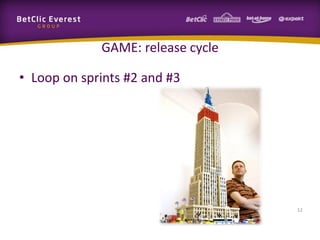
GAME: release cycle
• Loop on sprints #2 and #3
12
POST-GAME: Debriefing
• How did it feel being on a Scrum team?
• How did the short iterations go?
• How accurate were the estimations?
• What would we have done differently from the beginning, if we had another chance to play the
game?
• What was the job of the Product Owner?
• How did it feel after the first sprint when most items required re-work?
• How will your strategy change, if you know the Product Owner is unavailable during sprints?
• How did inter-team communication go? Were there any dependencies? How were they resolved?
• What did you learn?
13
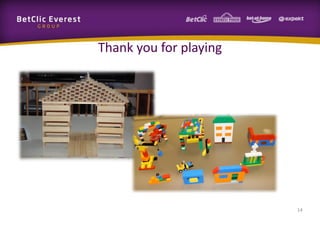
Thank you for playing
14
References:
• www.lego4scrum.com
15
Preparation for this workshop
• Gather material:
– Flipboard pages
– Markers of different colours
– Sticky notes
– Whiteboard
– For each team, 1 set of lego/kapla
• Prepare sticky notes with buildings
16

Scrum Game

  • 1.
  • 2.
    Learning the principlesof the Agile manifesto 1. OPEN BACKLOGS THAT TRIGGER IDEATING over DETAILED INSTRUCTIONS TO FOLLOW  Invitation for collaboration between a customer and teams 2. MINDFUL PRODUCT DEVELOPMENT over A SERIES OF TASKS TO ACCOMPLISH  Teach product development, not micromanagement on a task level 3. TEAMS COLLABORATING TOWARD COMMON SUCCESS over COMPETITION FOR SCORE  A chance to practice skills of inter-team collaboration 4. USEFUL METRICS TO ASSESS BENEFITS OF AGILE over FIGURES THE TRAINERS ASKED TO COLLECT  teach the team to own their process 2
  • 3.
    Organization • Teams of4 to 8 • Timing: ~100 minutes • Boxes of bricks: lego, kapla,… • Board, markers, flipboard sheets of paper, sticky-notes • Big table: ideally one per team 3
  • 4.
    Roles • Product Owner:this is me. I represent the client. • Team members: all of you. • Scrum master: optional. The game can be played without scrum master. This is up to you: self–organize. 4
  • 5.
    PRE-GAME: Organizing Teams(5 min) • Self-organize yourself in groups of 4-8 people and allocate the working space and material 5
  • 6.
    PRE-GAME: Project Chartering(5 min) • All teams are building a single product for the same vendor, represented by the Product Owner. • The product is a CITY. • Building blocks are lego / kapla bricks. • I am the main decision maker of the product – it is my city. • I will be involved in the development process by being available to answer questions and provide feedback. 6
  • 7.
    PRE-GAME: Building theBacklog (15 min) • We want to build: – Small house: one storey building (several) – Big house: two storey building (several) – Shop – School – Church – Hospital – Kindergarten – Bus stop – Intersection (can be drawn) – Park (can be drawn) – River (can be drawn) – Bridge 7
  • 8.
    PRE-GAME: Estimating (15min) • Choose an estimation method, but keep it simple and keep it fast. – Recently, agile gurus have recommended dropping estimates. • A possible approach is t-shirt sizing: S, M, L, XL • Or you may use story points: 1 2 3 5 8 13 • Or planning poker 8
  • 9.
    GAME: Sprint Planning(10 min + 3 min) • Build a unique Planning board for all teams to make sprint planning more visible: – 3 sprint zones for each team – Release Burndown chart • You have 3 minutes to plan sprint #1 • Sprint duration: 7 min 9
  • 10.
    GAME: Sprinting (7min / sprint) • 7min ticking… www.online-stopwatch.com • Start building 10
  • 11.
    GAME: Reviewing (5min) • Stop building • Demo: where is the demo of my city? • Update planning wall • Update Release Burndown chart • Retrospective: “how can we make it better the next sprint?” 11
  • 12.
    GAME: release cycle •Loop on sprints #2 and #3 12
  • 13.
    POST-GAME: Debriefing • Howdid it feel being on a Scrum team? • How did the short iterations go? • How accurate were the estimations? • What would we have done differently from the beginning, if we had another chance to play the game? • What was the job of the Product Owner? • How did it feel after the first sprint when most items required re-work? • How will your strategy change, if you know the Product Owner is unavailable during sprints? • How did inter-team communication go? Were there any dependencies? How were they resolved? • What did you learn? 13
  • 14.
    Thank you forplaying 14
  • 15.
  • 16.
    Preparation for thisworkshop • Gather material: – Flipboard pages – Markers of different colours – Sticky notes – Whiteboard – For each team, 1 set of lego/kapla • Prepare sticky notes with buildings 16