3
• Organize teams- 5 min
• Project charter - 5 min
• Building the backlog - 15 min
• Estimating - 20 min
• 3 Sprints
• Sprint planning - 3 min
• Execute sprint - 7 min
• Review sprint - 5 min
Organize teams
Scrum simulation
4.
4
• We needteams of 4 persons each
• Set up the room
• Worktable for each time and one
city table
• Backlog wall
• Scrum board for active sprint
• “Sprint report” board
Organize teams
Scrum simulation
5.
5
• PROJECT:
The productwe’ll be building is a city with certain
features (will be discussed in detail later)
• Main building elements are Lego bricks, but any
other materials may be used
• Be creative! Work with the resources available
• TIME FRAME:
Deadline is tight, we only have about an hour and a
half to build this thing.
Project charter
Scrum simulation
6.
6
• VISION:
• Forour company, this needs to be a showcase
city where everyone would want to live, and one
that shows our expertise and will make all our
competitors envious.
• The city will be modern, ecologically oriented,
clean, green, attractive, easy to get around in
• TEAMS:
• Considering the large scope, we will build in
parallel with multiple teams
• The teams are building a single product together.
We are not competing, but working towards a
single goal for the same client
Project charter
Scrum simulation
7.
7
• ROLES:
• We’regoing to use Scrum to build the city
• I am the product owner
• I am the main decision maker, it is my city
• I am available at every stage for answering
questions and providing feedback
• Scrum masters, who?
• Building the city is the “software development”
• TIMELINE:
• We start immediately
• Planned activities: story workshop (15 mins)
> estimate stories (20 mins) > build project in
3 sprints (15 mins each)
Project charter
Scrum simulation
8.
8
• I’ll talkabout what the city needs, in the
meantime you write down the stories you
identify
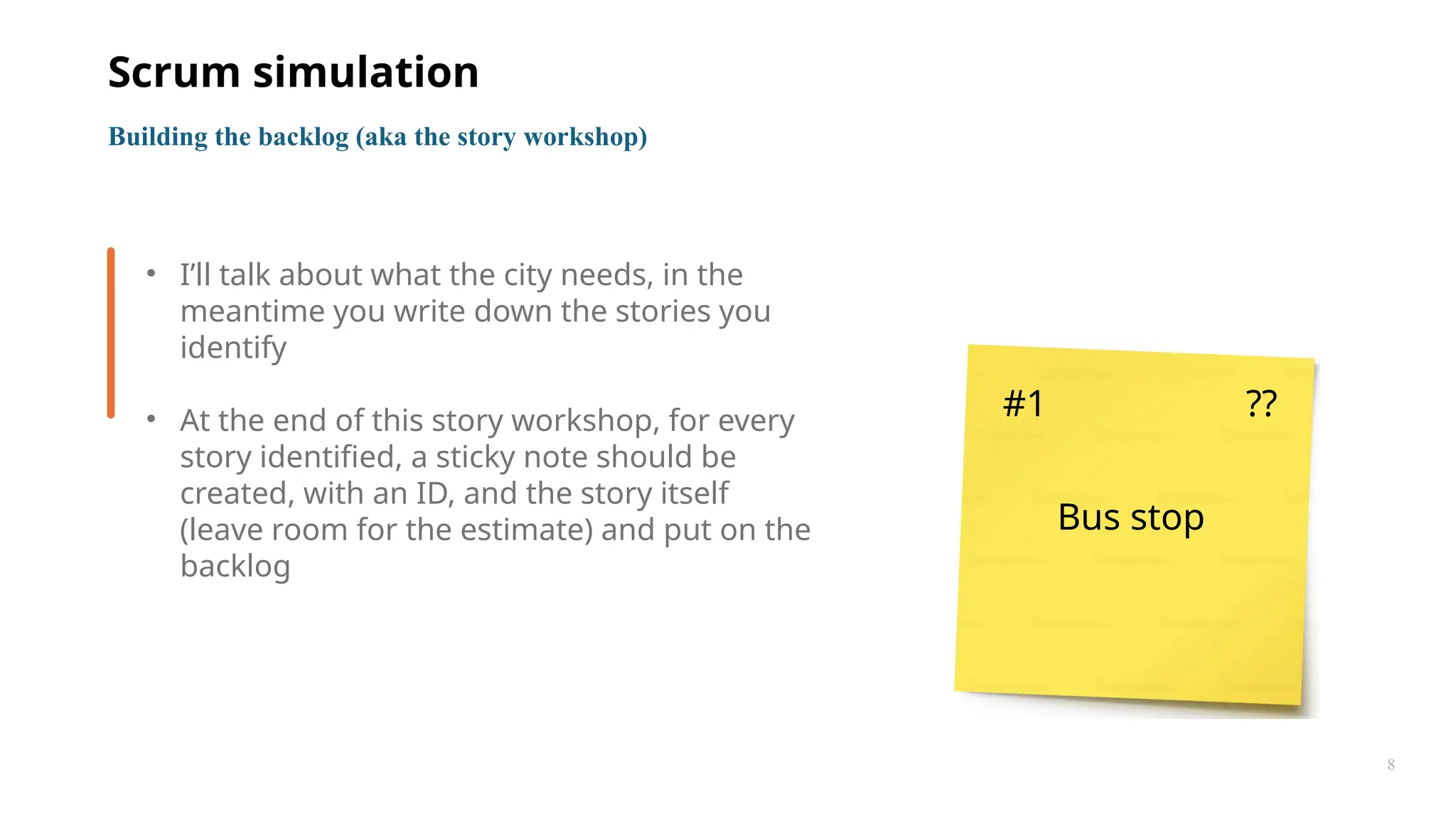
• At the end of this story workshop, for every
story identified, a sticky note should be
created, with an ID, and the story itself
(leave room for the estimate) and put on the
backlog
Building the backlog (aka the story workshop)
Scrum simulation
#1 ??
Bus stop
9.
9
• For everystory, the acceptance criteria
should be written down (on a separate
page)
• Now, or at the very latest when planning
the sprint (DoR)
• You probably still have questions for some
items, I can answer them in the next stage
(estimating)
• Take a minute to agree on a strategy for
capturing all information
Building the backlog (continued)
Scrum simulation
10.
10
• First, let’schoose a common reference story
• Agree on an item which is small and simple enough, but
not trivial and assign it “2”
• Complexity of all other stories will be estimated, relative
to this reference story of 2 story points
• Then, make estimates per team
• Choose an unestimated story from the backlog
• Discuss and play planning poker until you reach an
agreement
• I am available for answering questions and providing
clarifications
• Entire backlog should be estimated before we proceed
• In the meantime, I’ll prioritise the backlog so we’re ready to
start planning our first sprint!
Estimating
Scrum simulation
11.
11
• Planning (3mins)
• Sprint 1: make an educated guess as to which
stories you think you can deliver as a team
• Next sprints: maybe the last sprint’s velocity can
help?
• Put the stories you’re going to deliver in the next
sprint in your “to do” column
• Execute sprint (strictly 7 mins, time is measured)
• Keep it simple: no stand-ups or backlog
groomings, just execute the work
• Review (5 mins)
• Demo
• Retrospective
• What worked?
• What didn’t work?
• Actions for next sprints write down
actionable items!
Execute sprints
Scrum simulation
12.
12
• What didyou observe?
• How did it feel being on a Scrum team?
• How did the short iterations go?
• How accurate were the estimations?
• What would we have done differently from the
beginning, if we had another chance to play the
game?
• How did it feel after the first sprint? Did a lot of
items require re-work? Why?
• Did you change your strategy after the
retrospectives?
• How did inter-team communication go? Were there
any dependencies? How were they resolved?
• What problems did you encounter, and could you
not solve?
• What did you learn?
Debriefing
Scrum simulation



![Coded Agents – with UiPath SDK + LangGraph [Virtual Hands-on Workshop]](https://cdn.slidesharecdn.com/ss_thumbnails/codedagentsdeck-251215155422-5497c599-thumbnail.jpg?width=640&height=640&fit=bounds)


