Facts & Figures
   Application of the japanese „lean“ concept on
    project management
   Self organised teams, close collaboration of
    clients -developers
   Bottom-up corporate development
   Agile methods: Scrum, Kanban, Scrumban,
    Extreme Programming, etc.
   Most popular agile method: Scrum
Scrum is …

   An agile management framework
   A method of management for complex
    projects (inspect & adapt)
   A lean, agile process for project
    management especially in software
    development (ca. 75%)
   IT projects are growing up…
   „Classical“ waterfall methods in project and
    development steering are not functioning as
    desired
   End-to-end planning is effecting negatively
    on flexibility, goal orientation and the final
    product
   With standardised methods, budget and time
    frames cannot be met on a regular basis…
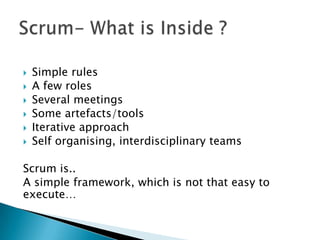
   Simple rules
   A few roles
   Several meetings
   Some artefacts/tools
   Iterative approach
   Self organising, interdisciplinary teams

Scrum is..
A simple framework, which is not that easy to
execute…
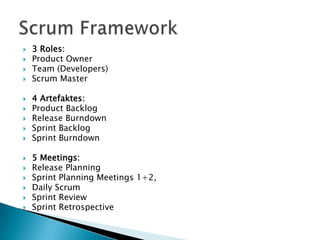
   6 Roles:
   Product Owner
   Team (Developers)
   Scrum Master
   Manager
   Customers
   User

   7 Artefaktes:
   Product Backlog
   Release Burndown
   Sprint Backlog
   Sprint Burndown
   Impediment Backlog
   Potentially Shippable Code
   Burndown Charts

   5 Meetings:
   Release Planning
   Sprint Planning Meetings 1+2,
   Daily Scrum
   Sprint Review
   Sprint Retrospective
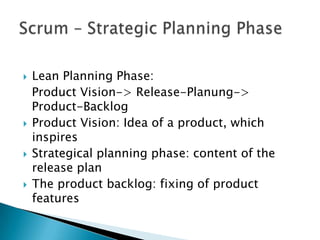
   Lean Planning Phase:
    Product Vision-> Release-Planung->
    Product-Backlog
   Product Vision: Idea of a product, which
    inspires
   Strategical planning phase: content of the
    release plan
   The product backlog: fixing of product
    features
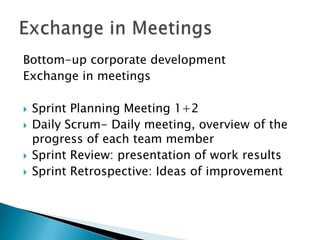
Bottom-up corporate development
Exchange in meetings

   Sprint Planning Meeting 1+2
   Daily Scrum- Daily meeting, overview of the
    progress of each team member
   Sprint Review: presentation of work results
   Sprint Retrospective: Ideas of improvement
   Shortening of the „time-to-market“
   Need for reduced time and budget in projects
   Improvement of productivity
   Alignment of IT to the organisation´s KPIs
   Improved software quality
   Increased project transparence
   Optimised team collaboration
   Improved communication, within the team and to
    the outside
   Increased customer satisfaction
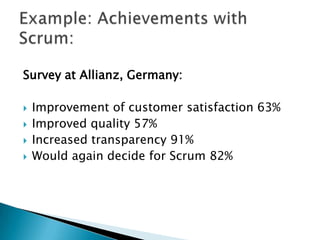
Employee Survey at Allianz, Germany:

The effect of Scrum was:
 Improvement of customer satisfaction 63%
 Improved quality 57%
 Increased transparency 91%
 Would again decide for Scrum 82%
   According to statistics, only 5% of all agile users
    do not see significant improvements of results
    and efficiency

   Users of agile methods have been more
    successful in companies within the last 3 years
    than users of standard PM methods.

   Users of agile methods rate scrum practices
    better than users of standardised PM methods
   Client Contact
Projects with direct client contact several times a week have been
significantly more succesful than others
„Business people and developers must work together daily throughout
the project“ (Agile Manifest)
   Flexibility
Reaction on change is given more emphasis than following of a pre-set
plan
   Speed
Delivery of functioning software on a regular basis within a few
weeks and months with focus on prioritising the shorter time frame
   Focus: Employee
Build up projects around motivated individuals and provide them with
the environment and support they need. Trust, that they will manage
the tasks you give them.
   Team Meetings
On a regular basis, the team reflects, how it can work more effectively
and can adapt behavior accordingly
   Sustainability
Agile processes promote sustainably development. The customer,
developer and user should maintain a steadily pace.
   How can I affect a team to deliver excellent work?
   Agile management -> focus on value creation,
    not adaptation
   Working in self organised teams, benefit from the
    brain power of all members
   The result: „Cultural Change“ within the
    organisation
   An organisationwide change process is starting -
    > the company is on the way to an agiel
    organisation
Sonja Uhl
sonja.uhl@mbo-consulting.eu

     MBO Consulting
      Altheimer Eck 11
      80331 München
Tel. +49 (0) 89 1250 9223-0

Scrum facts and figures en

  • 1.
  • 2.
    Application of the japanese „lean“ concept on project management  Self organised teams, close collaboration of clients -developers  Bottom-up corporate development  Agile methods: Scrum, Kanban, Scrumban, Extreme Programming, etc.  Most popular agile method: Scrum
  • 3.
    Scrum is …  An agile management framework  A method of management for complex projects (inspect & adapt)  A lean, agile process for project management especially in software development (ca. 75%)  IT projects are growing up…
  • 4.
    „Classical“ waterfall methods in project and development steering are not functioning as desired  End-to-end planning is effecting negatively on flexibility, goal orientation and the final product  With standardised methods, budget and time frames cannot be met on a regular basis…
  • 5.
    Simple rules  A few roles  Several meetings  Some artefacts/tools  Iterative approach  Self organising, interdisciplinary teams Scrum is.. A simple framework, which is not that easy to execute…
  • 6.
    6 Roles:  Product Owner  Team (Developers)  Scrum Master  Manager  Customers  User  7 Artefaktes:  Product Backlog  Release Burndown  Sprint Backlog  Sprint Burndown  Impediment Backlog  Potentially Shippable Code  Burndown Charts  5 Meetings:  Release Planning  Sprint Planning Meetings 1+2,  Daily Scrum  Sprint Review  Sprint Retrospective
  • 7.
    Lean Planning Phase: Product Vision-> Release-Planung-> Product-Backlog  Product Vision: Idea of a product, which inspires  Strategical planning phase: content of the release plan  The product backlog: fixing of product features
  • 8.
    Bottom-up corporate development Exchangein meetings  Sprint Planning Meeting 1+2  Daily Scrum- Daily meeting, overview of the progress of each team member  Sprint Review: presentation of work results  Sprint Retrospective: Ideas of improvement
  • 9.
    Shortening of the „time-to-market“  Need for reduced time and budget in projects  Improvement of productivity  Alignment of IT to the organisation´s KPIs  Improved software quality  Increased project transparence  Optimised team collaboration  Improved communication, within the team and to the outside  Increased customer satisfaction
  • 10.
    Employee Survey atAllianz, Germany: The effect of Scrum was:  Improvement of customer satisfaction 63%  Improved quality 57%  Increased transparency 91%  Would again decide for Scrum 82%
  • 11.
    According to statistics, only 5% of all agile users do not see significant improvements of results and efficiency  Users of agile methods have been more successful in companies within the last 3 years than users of standard PM methods.  Users of agile methods rate scrum practices better than users of standardised PM methods
  • 12.
    Client Contact Projects with direct client contact several times a week have been significantly more succesful than others „Business people and developers must work together daily throughout the project“ (Agile Manifest)  Flexibility Reaction on change is given more emphasis than following of a pre-set plan  Speed Delivery of functioning software on a regular basis within a few weeks and months with focus on prioritising the shorter time frame
  • 13.
    Focus: Employee Build up projects around motivated individuals and provide them with the environment and support they need. Trust, that they will manage the tasks you give them.  Team Meetings On a regular basis, the team reflects, how it can work more effectively and can adapt behavior accordingly  Sustainability Agile processes promote sustainably development. The customer, developer and user should maintain a steadily pace.
  • 14.
    How can I affect a team to deliver excellent work?  Agile management -> focus on value creation, not adaptation  Working in self organised teams, benefit from the brain power of all members  The result: „Cultural Change“ within the organisation  An organisationwide change process is starting - > the company is on the way to an agiel organisation
  • 15.
    Sonja Uhl sonja.uhl@mbo-consulting.eu MBO Consulting Altheimer Eck 11 80331 München Tel. +49 (0) 89 1250 9223-0