SCRIPTURE
SCRIPTURE refers to any sacred writings.
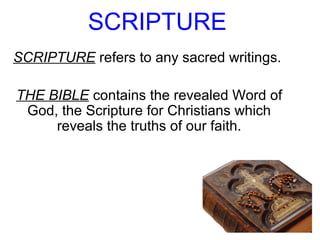
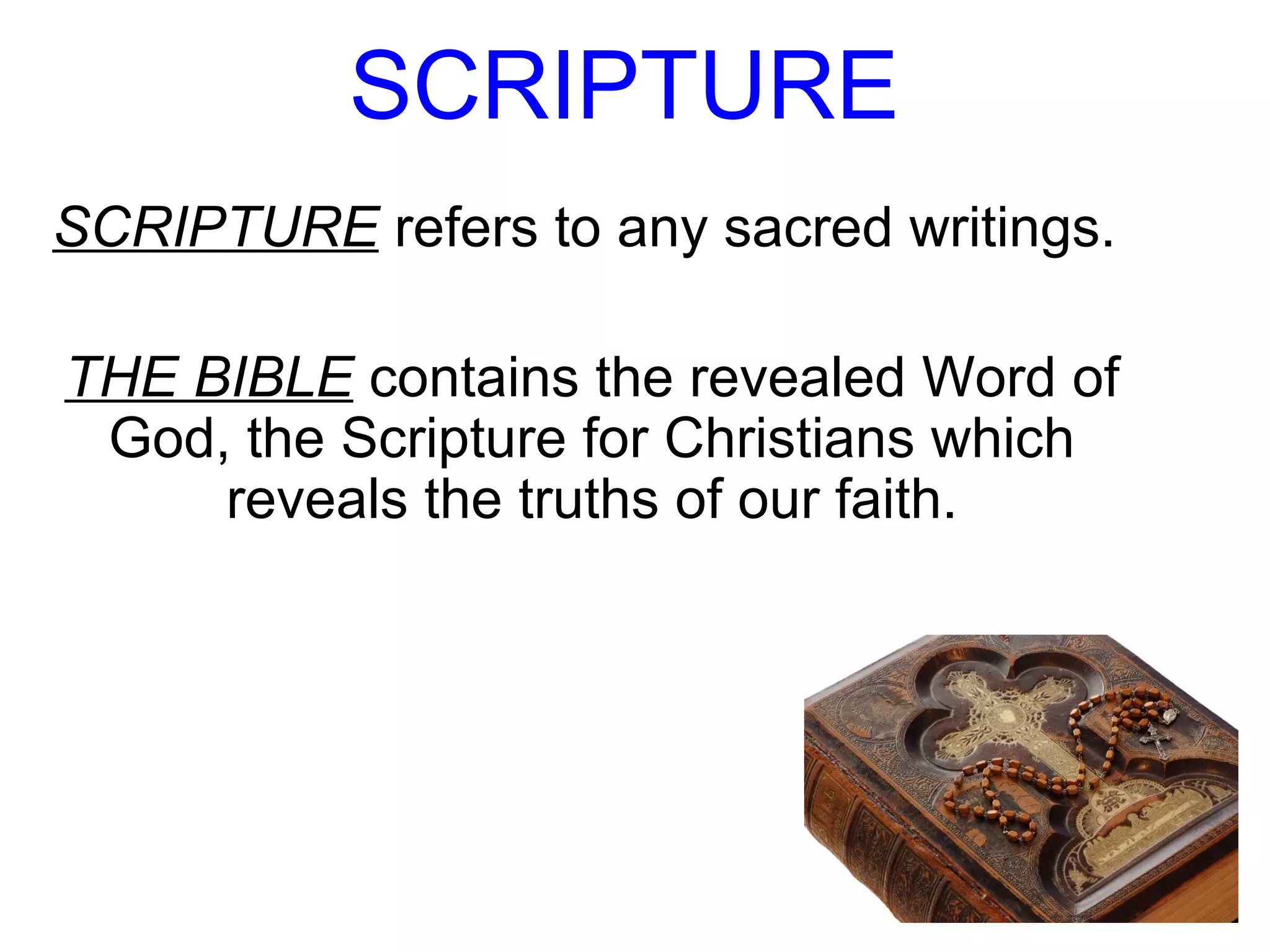
THE BIBLE contains the revealed Word of
God, the Scripture for Christians which
reveals the truths of our faith.
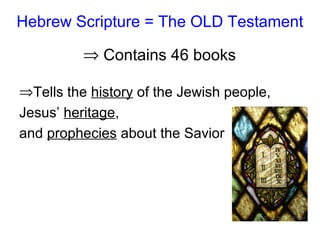
Hebrew Scripture = The OLD Testament
⇒ Contains 46 books
⇒Tells the history of the Jewish people,
Jesus’ heritage,
and prophecies about the Savior
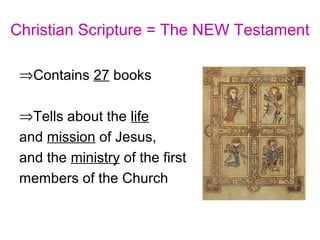
Christian Scripture = The NEW Testament
⇒Contains 27 books
⇒Tells about the life
and mission of Jesus,
and the ministry of the first
members of the Church
Kinds of books in the New Testament:
1. GOSPELS (4)
⇒ Written by Evangelists Matthew, Mark, Luke & John
⇒ Tell the life and mission of Jesus
⇒ Synoptic means “same view”. The synoptic gospels are
Matthew, Mark and Luke. These three gospels give similar
descriptions, witness, and stories from the life of Christ
⇒ John’s gospel is more symbolic and uses more poetic
language. The Gospel of John also contains discourses, long
speeches of Jesus not found in the synoptic gospels.
⇒ The earliest gospel, the Gospel of Mark, was written about 60-
100 years after the Crucifixion of Christ
2. Epistles (21)
⇒ Letters sent to different groups of people after the Resurrection,
telling them about Jesus
⇒ Most of the epistles were written by Paul (14)
⇒ Other authors of the epistles include Peter, John, James and Jude
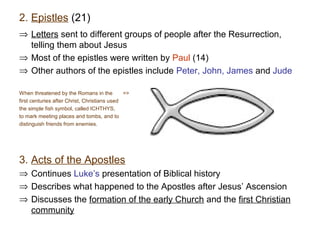
When threatened by the Romans in the =>
first centuries after Christ, Christians used
the simple fish symbol, called ICHTHYS,
to mark meeting places and tombs, and to
distinguish friends from enemies.
3. Acts of the Apostles
⇒ Continues Luke’s presentation of Biblical history
⇒ Describes what happened to the Apostles after Jesus’ Ascension
⇒ Discusses the formation of the early Church and the first Christian
community
4. Revelation – also called Apocalypse
⇒ Written by John
⇒ NOT a literal story; like John’s gospel, there is a lot of symbolism in
the Book of Revelation
⇒ The purpose of this book is to remind Christians to stand firm in
faith, and to trust in Jesus’ promise of salvation
“In the beginning, when God created the heavens and the earth, the earth was a formless
wasteland, and darkness covered the abyss, while a mighty wind swept over the
waters.” – Genesis 1:1
“In the beginning was the Word, and the Word was with God, and the Word was God.” –
John 1:1
“The grace of the Lord Jesus be with all.” – Revelation 22:21
TERMS
1. Creed – a formal statement of belief. Catholics profess the Nicene Creed
at Mass, and we begin the Rosary with the Apostle’s Creed
=> These creeds express the Church’s understanding of the two natures
of Jesus: Jesus has a divine nature as God, and a human nature as a
man
2. Doctrine – a belief that the Church holds, which may change with times
3. Dogma – a truth revealed by God, which is unchangeable
4. Evangelist – one who wrote about the life of Jesus
5. Incarnation – the belief that God became human; the “Word made Flesh”
6. Magesterium – the teaching authority of the Church
7. Ministry – a person’s response to God’s call
8. Mystery – something that cannot be fully understood
9. Theology – the study of God and His relationship to people and to all
creation
JESUS is a name which means “savior”
CHRIST is a Greek word meaning “anointed one”. This is a reverent title
for the Messiah

Scripture Grade 7

  • 1.
    SCRIPTURE SCRIPTURE refers toany sacred writings. THE BIBLE contains the revealed Word of God, the Scripture for Christians which reveals the truths of our faith.
  • 2.
    Hebrew Scripture =The OLD Testament ⇒ Contains 46 books ⇒Tells the history of the Jewish people, Jesus’ heritage, and prophecies about the Savior
  • 3.
    Christian Scripture =The NEW Testament ⇒Contains 27 books ⇒Tells about the life and mission of Jesus, and the ministry of the first members of the Church
  • 4.
    Kinds of booksin the New Testament: 1. GOSPELS (4) ⇒ Written by Evangelists Matthew, Mark, Luke & John ⇒ Tell the life and mission of Jesus ⇒ Synoptic means “same view”. The synoptic gospels are Matthew, Mark and Luke. These three gospels give similar descriptions, witness, and stories from the life of Christ ⇒ John’s gospel is more symbolic and uses more poetic language. The Gospel of John also contains discourses, long speeches of Jesus not found in the synoptic gospels. ⇒ The earliest gospel, the Gospel of Mark, was written about 60- 100 years after the Crucifixion of Christ
  • 5.
    2. Epistles (21) ⇒Letters sent to different groups of people after the Resurrection, telling them about Jesus ⇒ Most of the epistles were written by Paul (14) ⇒ Other authors of the epistles include Peter, John, James and Jude When threatened by the Romans in the => first centuries after Christ, Christians used the simple fish symbol, called ICHTHYS, to mark meeting places and tombs, and to distinguish friends from enemies. 3. Acts of the Apostles ⇒ Continues Luke’s presentation of Biblical history ⇒ Describes what happened to the Apostles after Jesus’ Ascension ⇒ Discusses the formation of the early Church and the first Christian community
  • 6.
    4. Revelation –also called Apocalypse ⇒ Written by John ⇒ NOT a literal story; like John’s gospel, there is a lot of symbolism in the Book of Revelation ⇒ The purpose of this book is to remind Christians to stand firm in faith, and to trust in Jesus’ promise of salvation “In the beginning, when God created the heavens and the earth, the earth was a formless wasteland, and darkness covered the abyss, while a mighty wind swept over the waters.” – Genesis 1:1 “In the beginning was the Word, and the Word was with God, and the Word was God.” – John 1:1 “The grace of the Lord Jesus be with all.” – Revelation 22:21
  • 7.
    TERMS 1. Creed –a formal statement of belief. Catholics profess the Nicene Creed at Mass, and we begin the Rosary with the Apostle’s Creed => These creeds express the Church’s understanding of the two natures of Jesus: Jesus has a divine nature as God, and a human nature as a man 2. Doctrine – a belief that the Church holds, which may change with times 3. Dogma – a truth revealed by God, which is unchangeable 4. Evangelist – one who wrote about the life of Jesus 5. Incarnation – the belief that God became human; the “Word made Flesh” 6. Magesterium – the teaching authority of the Church 7. Ministry – a person’s response to God’s call 8. Mystery – something that cannot be fully understood 9. Theology – the study of God and His relationship to people and to all creation JESUS is a name which means “savior” CHRIST is a Greek word meaning “anointed one”. This is a reverent title for the Messiah