“Ignorance of the Scriptures is
     ignorance of Christ.”
                          St. Jerome
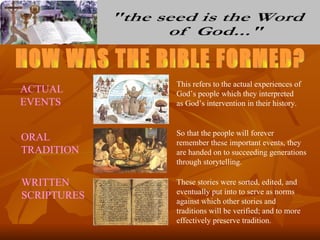
This refers to the actual experiences of
ACTUAL       God’s people which they interpreted
EVENTS       as God’s intervention in their history.


             So that the people will forever
ORAL         remember these important events, they
TRADITION    are handed on to succeeding generations
             through storytelling.

WRITTEN      These stories were sorted, edited, and
             eventually put into to serve as norms
SCRIPTURES   against which other stories and
             traditions will be verified; and to more
             effectively preserve tradition.
Gk. “τα βιβλια” – “the books”      -refers the whole sacred volume
Lt. “biblia” – “The Book” -designates the eminence of the Bible

The Bible is a collection of sacred writings which
the Church solemnly recognized as the:
“God is the author of Sacred Scripture because he
inspired its human authors; he acts in them and by
means of them. He thus gives assurance that their
writings teach without error his saving truth”
                                   Dei Verbum 11


           To say that the Bible is the Word of
            God is to acknowledge its Divine
                       Authorship.
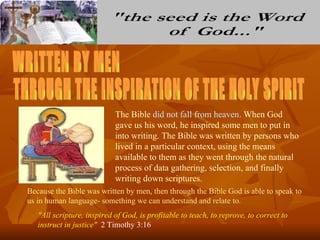
The Bible did not fall from heaven. When God
                            gave us his word, he inspired some men to put in
                            into writing. The Bible was written by persons who
                            lived in a particular context, using the means
                            available to them as they went through the natural
                            process of data gathering, selection, and finally
                            writing down scriptures.
Because the Bible was written by men, then through the Bible God is able to speak to
us in human language- something we can understand and relate to.
   "All scripture, inspired of God, is profitable to teach, to reprove, to correct to
   instruct in justice" 2 Timothy 3:16
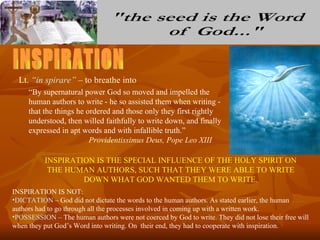
Lt. “in spirare” – to breathe into
     “By supernatural power God so moved and impelled the
     human authors to write - he so assisted them when writing -
     that the things he ordered and those only they first rightly
     understood, then willed faithfully to write down, and finally
     expressed in apt words and with infallible truth.”
                         Providentissimus Deus, Pope Leo XIII

          INSPIRATION IS THE SPECIAL INFLUENCE OF THE HOLY SPIRIT ON
           THE HUMAN AUTHORS, SUCH THAT THEY WERE ABLE TO WRITE
                   DOWN WHAT GOD WANTED THEM TO WRITE.
INSPIRATION IS NOT:
•DICTATION – God did not dictate the words to the human authors. As stated earlier, the human
authors had to go through all the processes involved in coming up with a written work.
•POSSESSION – The human authors were not coerced by God to write. They did not lose their free will
when they put God’s Word into writing. On their end, they had to cooperate with inspiration.
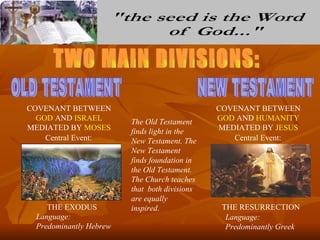
COVENANT BETWEEN                              COVENANT BETWEEN
  GOD AND ISRAEL        The Old Testament     GOD AND HUMANITY
MEDIATED BY MOSES       finds light in the    MEDIATED BY JESUS
    Central Event:      New Testament. The       Central Event:
                        New Testament
                        finds foundation in
                        the Old Testament.
                        The Church teaches
                        that both divisions
                        are equally
    THE EXODUS          inspired.              THE RESURRECTION
 Language:                                      Language:
 Predominantly Hebrew                           Predominantly Greek
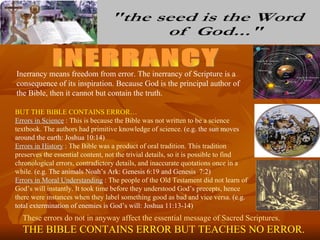
Inerrancy means freedom from error. The inerrancy of Scripture is a
consequence of its inspiration. Because God is the principal author of
the Bible, then it cannot but contain the truth.

BUT THE BIBLE CONTAINS ERROR…
Errors in Science : This is because the Bible was not written to be a science
textbook. The authors had primitive knowledge of science. (e.g. the sun moves
around the earth: Joshua 10:14)
Errors in History : The Bible was a product of oral tradition. This tradition
preserves the essential content, not the trivial details, so it is possible to find
chronological errors, contradictory details, and inaccurate quotations once in a
while. (e.g. The animals Noah’s Ark: Genesis 6:19 and Genesis 7:2)
Errors in Moral Understanding : The people of the Old Testament did not learn of
God’s will instantly. It took time before they understood God’s precepts, hence
there were instances when they label something good as bad and vice versa. (e.g.
total extermination of enemies is God’s will: Joshua 11:13-14)
  These errors do not in anyway affect the essential message of Sacred Scriptures.
  THE BIBLE CONTAINS ERROR BUT TEACHES NO ERROR.
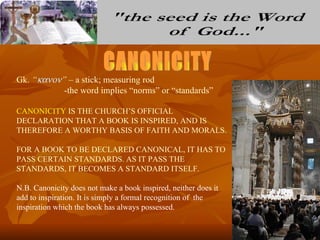
Gk. “κανον” – a stick; measuring rod
           -the word implies “norms” or “standards”

CANONICITY IS THE CHURCH’S OFFICIAL
DECLARATION THAT A BOOK IS INSPIRED, AND IS
THEREFORE A WORTHY BASIS OF FAITH AND MORALS.

FOR A BOOK TO BE DECLARED CANONICAL, IT HAS TO
PASS CERTAIN STANDARDS. AS IT PASS THE
STANDARDS, IT BECOMES A STANDARD ITSELF.

N.B. Canonicity does not make a book inspired, neither does it
add to inspiration. It is simply a formal recognition of the
inspiration which the book has always possessed.
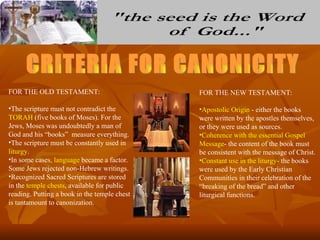
FOR THE OLD TESTAMENT:                        FOR THE NEW TESTAMENT:

•The scripture must not contradict the        •Apostolic Origin - either the books
TORAH (five books of Moses). For the          were written by the apostles themselves,
Jews, Moses was undoubtedly a man of          or they were used as sources.
God and his “books” measure everything.       •Coherence with the essential Gospel
•The scripture must be constantly used in     Message- the content of the book must
liturgy.                                      be consistent with the message of Christ.
•In some cases, language became a factor.     •Constant use in the liturgy- the books
Some Jews rejected non-Hebrew writings.       were used by the Early Christian
•Recognized Sacred Scriptures are stored      Communities in their celebration of the
in the temple chests, available for public    “breaking of the bread” and other
reading. Putting a book in the temple chest   liturgical functions.
is tantamount to canonization.
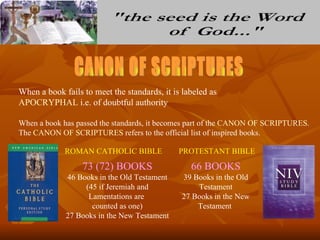
When a book fails to meet the standards, it is labeled as
APOCRYPHAL i.e. of doubtful authority

When a book has passed the standards, it becomes part of the CANON OF SCRIPTURES.
The CANON OF SCRIPTURES refers to the official list of inspired books.

             ROMAN CATHOLIC BIBLE             PROTESTANT BIBLE
                  73 (72) BOOKS                  66 BOOKS
             46 Books in the Old Testament     39 Books in the Old
                  (45 if Jeremiah and              Testament
                   Lamentations are            27 Books in the New
                    counted as one)                Testament
             27 Books in the New Testament
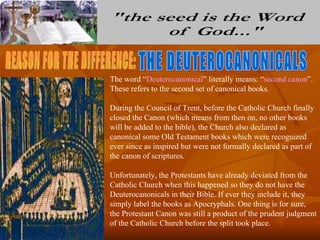
The word “Deuterocanonical” literally means: “second canon”.
These refers to the second set of canonical books.

During the Council of Trent, before the Catholic Church finally
closed the Canon (which means from then on, no other books
will be added to the bible), the Church also declared as
canonical some Old Testament books which were recognized
ever since as inspired but were not formally declared as part of
the canon of scriptures.

Unfortunately, the Protestants have already deviated from the
Catholic Church when this happened so they do not have the
Deuterocanonicals in their Bible. If ever they include it, they
simply label the books as Apocryphals. One thing is for sure,
the Protestant Canon was still a product of the prudent judgment
of the Catholic Church before the split took place.
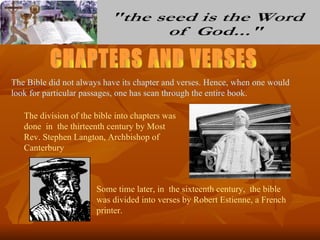
The Bible did not always have its chapter and verses. Hence, when one would
look for particular passages, one has scan through the entire book.

   The division of the bible into chapters was
   done in the thirteenth century by Most
   Rev. Stephen Langton, Archbishop of
   Canterbury


                       Some time later, in the sixteenth century, the bible
                       was divided into verses by Robert Estienne, a French
                       printer.
CATECHISM OF THE CATHOLIC CHURCH
nos.101-141
Francis E. Gigot
SACRED SCRIPTURES, THE BIBLE
www.pax-et-veritas.org
Ian Knox C.S.Sp.
THEOLOGY FOR TEACHERS
Ottawa: Novalis Press, 1994

INSPIRATION AND INERRANCY
www.cathtruth.com
Notes on class: INTRO. TO THE BIBLE
         with Fr. Steve Placente, SDB, SSL
2 sacred scriptures

2 sacred scriptures

  • 1.
    “Ignorance of theScriptures is ignorance of Christ.” St. Jerome
  • 2.
    This refers tothe actual experiences of ACTUAL God’s people which they interpreted EVENTS as God’s intervention in their history. So that the people will forever ORAL remember these important events, they TRADITION are handed on to succeeding generations through storytelling. WRITTEN These stories were sorted, edited, and eventually put into to serve as norms SCRIPTURES against which other stories and traditions will be verified; and to more effectively preserve tradition.
  • 3.
    Gk. “τα βιβλια”– “the books” -refers the whole sacred volume Lt. “biblia” – “The Book” -designates the eminence of the Bible The Bible is a collection of sacred writings which the Church solemnly recognized as the:
  • 4.
    “God is theauthor of Sacred Scripture because he inspired its human authors; he acts in them and by means of them. He thus gives assurance that their writings teach without error his saving truth” Dei Verbum 11 To say that the Bible is the Word of God is to acknowledge its Divine Authorship.
  • 5.
    The Bible didnot fall from heaven. When God gave us his word, he inspired some men to put in into writing. The Bible was written by persons who lived in a particular context, using the means available to them as they went through the natural process of data gathering, selection, and finally writing down scriptures. Because the Bible was written by men, then through the Bible God is able to speak to us in human language- something we can understand and relate to. "All scripture, inspired of God, is profitable to teach, to reprove, to correct to instruct in justice" 2 Timothy 3:16
  • 6.
    Lt. “in spirare”– to breathe into “By supernatural power God so moved and impelled the human authors to write - he so assisted them when writing - that the things he ordered and those only they first rightly understood, then willed faithfully to write down, and finally expressed in apt words and with infallible truth.” Providentissimus Deus, Pope Leo XIII INSPIRATION IS THE SPECIAL INFLUENCE OF THE HOLY SPIRIT ON THE HUMAN AUTHORS, SUCH THAT THEY WERE ABLE TO WRITE DOWN WHAT GOD WANTED THEM TO WRITE. INSPIRATION IS NOT: •DICTATION – God did not dictate the words to the human authors. As stated earlier, the human authors had to go through all the processes involved in coming up with a written work. •POSSESSION – The human authors were not coerced by God to write. They did not lose their free will when they put God’s Word into writing. On their end, they had to cooperate with inspiration.
  • 7.
    COVENANT BETWEEN COVENANT BETWEEN GOD AND ISRAEL The Old Testament GOD AND HUMANITY MEDIATED BY MOSES finds light in the MEDIATED BY JESUS Central Event: New Testament. The Central Event: New Testament finds foundation in the Old Testament. The Church teaches that both divisions are equally THE EXODUS inspired. THE RESURRECTION Language: Language: Predominantly Hebrew Predominantly Greek
  • 8.
    Inerrancy means freedomfrom error. The inerrancy of Scripture is a consequence of its inspiration. Because God is the principal author of the Bible, then it cannot but contain the truth. BUT THE BIBLE CONTAINS ERROR… Errors in Science : This is because the Bible was not written to be a science textbook. The authors had primitive knowledge of science. (e.g. the sun moves around the earth: Joshua 10:14) Errors in History : The Bible was a product of oral tradition. This tradition preserves the essential content, not the trivial details, so it is possible to find chronological errors, contradictory details, and inaccurate quotations once in a while. (e.g. The animals Noah’s Ark: Genesis 6:19 and Genesis 7:2) Errors in Moral Understanding : The people of the Old Testament did not learn of God’s will instantly. It took time before they understood God’s precepts, hence there were instances when they label something good as bad and vice versa. (e.g. total extermination of enemies is God’s will: Joshua 11:13-14) These errors do not in anyway affect the essential message of Sacred Scriptures. THE BIBLE CONTAINS ERROR BUT TEACHES NO ERROR.
  • 9.
    Gk. “κανον” –a stick; measuring rod -the word implies “norms” or “standards” CANONICITY IS THE CHURCH’S OFFICIAL DECLARATION THAT A BOOK IS INSPIRED, AND IS THEREFORE A WORTHY BASIS OF FAITH AND MORALS. FOR A BOOK TO BE DECLARED CANONICAL, IT HAS TO PASS CERTAIN STANDARDS. AS IT PASS THE STANDARDS, IT BECOMES A STANDARD ITSELF. N.B. Canonicity does not make a book inspired, neither does it add to inspiration. It is simply a formal recognition of the inspiration which the book has always possessed.
  • 10.
    FOR THE OLDTESTAMENT: FOR THE NEW TESTAMENT: •The scripture must not contradict the •Apostolic Origin - either the books TORAH (five books of Moses). For the were written by the apostles themselves, Jews, Moses was undoubtedly a man of or they were used as sources. God and his “books” measure everything. •Coherence with the essential Gospel •The scripture must be constantly used in Message- the content of the book must liturgy. be consistent with the message of Christ. •In some cases, language became a factor. •Constant use in the liturgy- the books Some Jews rejected non-Hebrew writings. were used by the Early Christian •Recognized Sacred Scriptures are stored Communities in their celebration of the in the temple chests, available for public “breaking of the bread” and other reading. Putting a book in the temple chest liturgical functions. is tantamount to canonization.
  • 11.
    When a bookfails to meet the standards, it is labeled as APOCRYPHAL i.e. of doubtful authority When a book has passed the standards, it becomes part of the CANON OF SCRIPTURES. The CANON OF SCRIPTURES refers to the official list of inspired books. ROMAN CATHOLIC BIBLE PROTESTANT BIBLE 73 (72) BOOKS 66 BOOKS 46 Books in the Old Testament 39 Books in the Old (45 if Jeremiah and Testament Lamentations are 27 Books in the New counted as one) Testament 27 Books in the New Testament
  • 12.
    The word “Deuterocanonical”literally means: “second canon”. These refers to the second set of canonical books. During the Council of Trent, before the Catholic Church finally closed the Canon (which means from then on, no other books will be added to the bible), the Church also declared as canonical some Old Testament books which were recognized ever since as inspired but were not formally declared as part of the canon of scriptures. Unfortunately, the Protestants have already deviated from the Catholic Church when this happened so they do not have the Deuterocanonicals in their Bible. If ever they include it, they simply label the books as Apocryphals. One thing is for sure, the Protestant Canon was still a product of the prudent judgment of the Catholic Church before the split took place.
  • 13.
    The Bible didnot always have its chapter and verses. Hence, when one would look for particular passages, one has scan through the entire book. The division of the bible into chapters was done in the thirteenth century by Most Rev. Stephen Langton, Archbishop of Canterbury Some time later, in the sixteenth century, the bible was divided into verses by Robert Estienne, a French printer.
  • 14.
    CATECHISM OF THECATHOLIC CHURCH nos.101-141 Francis E. Gigot SACRED SCRIPTURES, THE BIBLE www.pax-et-veritas.org Ian Knox C.S.Sp. THEOLOGY FOR TEACHERS Ottawa: Novalis Press, 1994 INSPIRATION AND INERRANCY www.cathtruth.com Notes on class: INTRO. TO THE BIBLE with Fr. Steve Placente, SDB, SSL