INVIVO SCREENING METHODS
FOR ANTI INFLAMMATORY
AGENTS
SATHYAMOOORTHY .K
SEMESTER-II
M.PHARM PHARMACOGNOSY
INTRODUCTION
Inflammation is a universal host defense process involving a
complex network of cell-cell , cell-mediator and tissue
interraction . It occurs in response to a variety of stimuli such
as physical, chemical , traumatic and infectious agents.
Apart from exogenous factors, endogenous factors also
contribute to inflammatory response.
INVIVO SCREENING METHODS FOR ANTI
INFLAMMATORY AGENTS
• In this screening methods, the potency of antiinflammatory
agents are measured, by inducing the inflammation in the
experimental animal like rats, mice, monkeys, dog or either
sex can be selected.
• Before starting any in vivo assays, it is important to study the
oral acute toxicity study, for the selection of test dose.
• In this maximum tolerated dose and minimum toxic dose are
calculated, by injecting the test dose at an interval of 2 hrs in
10, 50,100, 200, 300,... 2000mg/kg pattern.
Types of screening methods
Based on the symptoms observed during the inflammation
invivo screening methods for anti inflammatory drugs are
characterized in to three phases:
Acute(or)transient phase: In this phase vasodilation and
increased capillary permeability are observed.
Sub acute phase : Infiltration of leucocytes and phagocytes
in blood.
Chronic inflammatory phase: granuloma formation is
observed in this phase.
ACUTE PHASE
Acute phase: The methods that include acute phase are as
follows:
Carrageenan induced paw oedema in rats
Croton-oil induced ear edema
Oxazolone induced ear edema
U V erythema in guinea pigs
Pleurisy in rats
Granuloma air pouch technique
Vascular permeability
CHRONIC PHASE
• Chronic phase : The methods that include this chronic phase
are:
• Cotton wool granuloma
• Glass rod granuloma
• Sponge implantation technique
Carrageenan induced paw oedema in
rats
Methodology :
 Male or female sprague-dawley rats with a body weight
between 150 and 170g are used . the animals are starved for
overnight .
The animal should be grouped, this grouping is based on of
test compounds
Thirty minutes later, the rats are challenged by a
subcutaneous injection of 0.05ml of 1% solution of
carrageenan in to the plantar side of the left hind paw.
The paw is marked with ink at the level of lateral malleolus
and immersed in the mercury up to this mark.
Evaluation:
• The paw volume was measured using plenthysmometer at 3 and
6 hr, eventually at 24 hr immediately after the injection.
• The increase in paw volume at 3 and 6 hr is calculated.
• The percentage increase in paw volume was measured by
comparing the difference of the average values between treated
group animals and control group animals is calculated at each
interval time.
• A dose-response curve is run for the active drugs and ED50
values can be determined.
• Generally the treated group animal show much less edema than
control group animal.
Croton-oil induced ear edema in mice
Methodology:
• Both rats and mice are used, usually male rats (sprague-dawley)
of 80-60kg is selected, where as male swiss mice weighing
between 18-22g is selected.
• Grouping is done according to the body weight
• In this methodology, a total of 15mul containing an acetonic
solution of 75microg of croton oil is applied to the inner surface
of the right ear of each mouse.
• The animals are previously, anaesthetised with diethyl ether at a
rate 0.02ml in rats and 0.01ml in mice.
Methodology:
• Left ear remains untreated control group receives the irritant
solution, while indomethacin serves as a standard (reference).
• Varying dose levels of test drug are applied to inner surface of
the right ear of each mouse inducing inflammation.
• As soon as the test and standard drug are given, the animals are
sacrificed by cervical dislocation, both treated and untreated ear
are removed and a plug of 8mm diameter is removed from each
of the ear.
• The difference in weight between the two plugs is taken as the
measure of edematous response
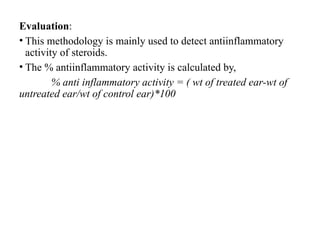
Evaluation:
• This methodology is mainly used to detect antiinflammatory
activity of steroids.
• The % antiinflammatory activity is calculated by,
% anti inflammatory activity = ( wt of treated ear-wt of
untreated ear/wt of control ear)*100
Oxazolone induced ear edema in mice
• This model permits the quantitative evaluation of the topical and
systemic antiinflammatory activity of the compound following
topical administration.
Methodology:
• The experimental animal used in this model is mice and they are
divided into 12 each group.
• They are injected with the 10ml of 0.5% of oxazolone in acetone
in to the right ear and the same was given repeatedly 3 times per
week, to the sensitized right ear.
• In non sensitized animals, acetone alone was given.
• The mice are again injected with 0.01ml of 2% oxazolone
solution inside of the right ear, in which test or standard are
resolved.
• Group of 10 to 15 animals are treated with irritant alone or with
the solution of the test compound.
• The left ear remains untreated and actual inflammation occurs
after 24 hrs.
• The animals are sacrificed under anaesthesia, at this time and a
disc of 8mm diameter is punched from both the sides.
• The discs are allowed to dry and are weighed on a balance. The
weight difference is an indicator of inflammatory edema.
Evaluation:
• Average values of the increase of weight are calculated for each
treated group and compared statistically with control group.
U V Erythema in guinea pigs
Methodology:
• Albino guinea pigs of both the sexes weighing about 350g are
used.
• Four animals are used each for treatment and the control.
• 18hrs prior to the experiment, the animals are shaved on both
the flanks and on the back, chemically by means of a depilatory
cream or using a suspension of barium chloride.
• The next day the test compound is dissolved in the vehicle and
half of it is administered to the animal by gavage, 30min before
the UV exposure.
• Control animals are treated with the vehicle alone.
• The guinea pigs are placed in a leather cuff with a hole of
1.5x2.5cm size punched in it, allowing the UV radiation to
reach only this area.
• During this time, the remaining half of the test compound is
administered.
• Generally the erythema is scored after 2 and 4 hr of exposure.
Evaluation:
• The degree of erythema is evaluated in a double blinded
manner. The following scores are given:
0 – no erythema
1 – weak erythema
2 – strong erythema
4 – very strong erythema
Animals with a score of 0 or 1 are said to be protected. The
scoring after 2 and 4hr, generally indicates some duration of the
effect and ED50
values can be calculated.
Pleurisy test
Methodology:
• The animal used in pleurisy test was mouse.
• A single dose of 0.1ml carrageenan was injected intravenously.
• After 4hr the animal was killed with an over dose of ether and
the pleural cavity was washed with 1.0ml of sterile PBS,
containing heparin (20 IU per ml)
• Samples of the pleural lavage were collected for determination
of exudation, myeloperoxidase, adenosine de-aminase activities,
and nitric oxide levels, as well as for determination of total
and differential leukocyte counts. Total leukocyte counts were
performed in a Neuberger Chamber.
• The serum level of the C-reactive protein was also analysed. In
another set of experiment animals were treated 30 min before
carrageenan with a solution of Evans blue dye (25 mg/kg, i.v.)
in order to evaluate the degree of exudation in the pleural space.
• The amount of dye was estimated by colorimetry using an Elisa
plate reader at 600nm, by interpolation from a standard curve of
Evans blue dye in the range of 0.01 to 50µg/ml.
Evaluation:
The values of each experimental group are averaged and
compared with that control. ED50 values can be calculated using
various doses.
Granuloma pouch technique
Methodology:
• Male or female Sprague-Dawley rats with a body weight
between 150 and 200g are used.
• Ten animals are taken for controls and for test groups.
• The back of the animals is shaved and disinfected. With a very
thin needle a pneumoderma is made in the middle of the dorsal
skin by injection of 20ml of air under ether anesthesia, which
results in oval air pouch.
• 0.5 ml of a 1% solution of Croton oil in sesame oil is injected,
avoiding any leakage of air.
• The air pouch is removed after 48hrs.
• The test compound is injected directly in to the air sac at the
same time as the irritant.
• On the 4th or 5th day animals are sacrificed under anesthesia.
• The pouch is opened and the exudate is collected in glass
cylinders.
• Total no. of leukocytes migrated in to the pouch are evaluated
after staining with Erythrosine B.
Evaluation:
• The average value of the exudates of the controls and the test
groups is calculated.
• Comparison is made by statistical means.
Vascular permeability
Methodology:
•Albino Wistar are used each group containing 4 rats.
• Control group will receive distilled water 1% w/v 1ml/100g by
oral route and other group will receive test compound by oral
route and standard group will receive diclofenac 10ml/kg by
intraperitoneal route.
• After 1hr of the administration, rats are injected with 0.25ml of
0.6% v/v solution of acetic acid intraperitoneally. Immediately,
10 ml/kg of 10%w/v Evans blue is injected intravenously via
tail vain.
• After 30 min, the animals are anesthetized with ether
anesthesia and sacrificed.
• The abdomen is cut open and exposed viscera. The animals are
held by a flap of abdominal wall over a Petri dish.
• The peritoneal fluid (exudates) collected, filtered and made up
the volume to 10 ml using normal saline solution and
centrifuged at 3000 rpm for 15 min. The absorbance (A) of the
supernatant is measured at590 nm using spectrophotometer.
Evaluation:
Decreased concentration of dye with respect to absorbance
indicates reduction in permeability.
Cotton wool induced granuloma
Methodology:
• Male rats weighing about 180-200g are used.
• The test drugs were administered orally once on a dosage
regimen for 7 days and the control group received the vehicle.
• Two sterilized pellets of cotton wool were implanted
subcutaneously, one on each side of abdomen of the animal,
under the light ether anaesthesia and sterile technique.
• The rats were sacrificed on the 8th
day, the implanted pellet was
dissected out and the wet weight was recorded. Thymuses were
also dissected out.
• Both of these were dried at 600
c for 18 hrs and the dry weight
was recorded.
Evaluation:
• The weight of transudate and the granuloma as well as the
percent granuloma inhibition of the test drugs were calculated.
• The body weight gain was also recorded.
Glass rod granuloma technique
Methodology:
• In this technique, glass rod with a diameter of 6mm and 40
mm length are selected.
• Male sprague-dawley rats with an initial weight of 130g are
selected.
• These rats are anaesthetized with ether and their back skins
were shaved and disinfected.
• From an incision in the caudal region a subcutaneous tunnel is
formed in the cranial direction with a closed blunted forceps.
• The glass rod is introduced in to this tunnel which lies on the
back of the animal.The incision wound is closed by sutures.
• The animals are kept in separate cages, the rods remain
insitu for 20 or 40 days.
• At the end, the animals are sacrificed under CO2
anaesthesia.
• The glass rod is prepared with surrounding connective
tissue which forms a tube around the glass rod.
• Wet weight of the granuloma tissue is recorded, finally it is
dried and the dry weight is also recorded.
Evaluation:
• Granuloma weight reduced by the test compound is
compared with that of the standard.
Sponge Implantation Technique
Methodology:
• Sponges used for implantation are prepared from poly vinyl
foam sheets (thickness) 5mm discs are punched out to standard
size and weight(10.0+_0.02mg) using a 13mm cork borer .
• The sponges are then soaked in 76%v/v ethanol for 30 min, and
then heated at 800
c for 2 hr.
• Prior to implantation in the animal, the sponges are soaked in
sterile 0.9% saline in which either drugs, antigens(or) irritants
have been suspended.
• Sponges are implanted in female wistar rats weighing about
150-200g under ether anaesthesia.
• A 20mm dorsal incision is made and the dermis is separated
from the underlying muscle layer by insertion of blunt forceps
to form separate cavities in to which the sponges are inserted.
• Up to 8 sponges may be implanted per rat .The insertion is
closed with micheal clips and the animals are maintainted at a
constant temperature of 240
c.
Evaluation:
• For estimation of fluid phase of sponge exudates eg: protein
content enzyme levels and biological mediators such as
prostaglandins as well as for leucocyte migration, sponges
removed after 9 hrs.

In vivo screening method for anti inflammatory agent

  • 1.
    INVIVO SCREENING METHODS FORANTI INFLAMMATORY AGENTS SATHYAMOOORTHY .K SEMESTER-II M.PHARM PHARMACOGNOSY
  • 2.
    INTRODUCTION Inflammation is auniversal host defense process involving a complex network of cell-cell , cell-mediator and tissue interraction . It occurs in response to a variety of stimuli such as physical, chemical , traumatic and infectious agents. Apart from exogenous factors, endogenous factors also contribute to inflammatory response.
  • 3.
    INVIVO SCREENING METHODSFOR ANTI INFLAMMATORY AGENTS • In this screening methods, the potency of antiinflammatory agents are measured, by inducing the inflammation in the experimental animal like rats, mice, monkeys, dog or either sex can be selected. • Before starting any in vivo assays, it is important to study the oral acute toxicity study, for the selection of test dose. • In this maximum tolerated dose and minimum toxic dose are calculated, by injecting the test dose at an interval of 2 hrs in 10, 50,100, 200, 300,... 2000mg/kg pattern.
  • 4.
    Types of screeningmethods Based on the symptoms observed during the inflammation invivo screening methods for anti inflammatory drugs are characterized in to three phases: Acute(or)transient phase: In this phase vasodilation and increased capillary permeability are observed. Sub acute phase : Infiltration of leucocytes and phagocytes in blood. Chronic inflammatory phase: granuloma formation is observed in this phase.
  • 5.
    ACUTE PHASE Acute phase:The methods that include acute phase are as follows: Carrageenan induced paw oedema in rats Croton-oil induced ear edema Oxazolone induced ear edema U V erythema in guinea pigs Pleurisy in rats Granuloma air pouch technique Vascular permeability
  • 6.
    CHRONIC PHASE • Chronicphase : The methods that include this chronic phase are: • Cotton wool granuloma • Glass rod granuloma • Sponge implantation technique
  • 7.
    Carrageenan induced pawoedema in rats Methodology :  Male or female sprague-dawley rats with a body weight between 150 and 170g are used . the animals are starved for overnight . The animal should be grouped, this grouping is based on of test compounds Thirty minutes later, the rats are challenged by a subcutaneous injection of 0.05ml of 1% solution of carrageenan in to the plantar side of the left hind paw. The paw is marked with ink at the level of lateral malleolus and immersed in the mercury up to this mark.
  • 8.
    Evaluation: • The pawvolume was measured using plenthysmometer at 3 and 6 hr, eventually at 24 hr immediately after the injection. • The increase in paw volume at 3 and 6 hr is calculated. • The percentage increase in paw volume was measured by comparing the difference of the average values between treated group animals and control group animals is calculated at each interval time. • A dose-response curve is run for the active drugs and ED50 values can be determined. • Generally the treated group animal show much less edema than control group animal.
  • 9.
    Croton-oil induced earedema in mice Methodology: • Both rats and mice are used, usually male rats (sprague-dawley) of 80-60kg is selected, where as male swiss mice weighing between 18-22g is selected. • Grouping is done according to the body weight • In this methodology, a total of 15mul containing an acetonic solution of 75microg of croton oil is applied to the inner surface of the right ear of each mouse. • The animals are previously, anaesthetised with diethyl ether at a rate 0.02ml in rats and 0.01ml in mice.
  • 10.
    Methodology: • Left earremains untreated control group receives the irritant solution, while indomethacin serves as a standard (reference). • Varying dose levels of test drug are applied to inner surface of the right ear of each mouse inducing inflammation. • As soon as the test and standard drug are given, the animals are sacrificed by cervical dislocation, both treated and untreated ear are removed and a plug of 8mm diameter is removed from each of the ear. • The difference in weight between the two plugs is taken as the measure of edematous response
  • 11.
    Evaluation: • This methodologyis mainly used to detect antiinflammatory activity of steroids. • The % antiinflammatory activity is calculated by, % anti inflammatory activity = ( wt of treated ear-wt of untreated ear/wt of control ear)*100
  • 12.
    Oxazolone induced earedema in mice • This model permits the quantitative evaluation of the topical and systemic antiinflammatory activity of the compound following topical administration. Methodology: • The experimental animal used in this model is mice and they are divided into 12 each group. • They are injected with the 10ml of 0.5% of oxazolone in acetone in to the right ear and the same was given repeatedly 3 times per week, to the sensitized right ear. • In non sensitized animals, acetone alone was given. • The mice are again injected with 0.01ml of 2% oxazolone solution inside of the right ear, in which test or standard are resolved.
  • 13.
    • Group of10 to 15 animals are treated with irritant alone or with the solution of the test compound. • The left ear remains untreated and actual inflammation occurs after 24 hrs. • The animals are sacrificed under anaesthesia, at this time and a disc of 8mm diameter is punched from both the sides. • The discs are allowed to dry and are weighed on a balance. The weight difference is an indicator of inflammatory edema. Evaluation: • Average values of the increase of weight are calculated for each treated group and compared statistically with control group.
  • 14.
    U V Erythemain guinea pigs Methodology: • Albino guinea pigs of both the sexes weighing about 350g are used. • Four animals are used each for treatment and the control. • 18hrs prior to the experiment, the animals are shaved on both the flanks and on the back, chemically by means of a depilatory cream or using a suspension of barium chloride. • The next day the test compound is dissolved in the vehicle and half of it is administered to the animal by gavage, 30min before the UV exposure.
  • 15.
    • Control animalsare treated with the vehicle alone. • The guinea pigs are placed in a leather cuff with a hole of 1.5x2.5cm size punched in it, allowing the UV radiation to reach only this area. • During this time, the remaining half of the test compound is administered. • Generally the erythema is scored after 2 and 4 hr of exposure. Evaluation: • The degree of erythema is evaluated in a double blinded manner. The following scores are given:
  • 16.
    0 – noerythema 1 – weak erythema 2 – strong erythema 4 – very strong erythema Animals with a score of 0 or 1 are said to be protected. The scoring after 2 and 4hr, generally indicates some duration of the effect and ED50 values can be calculated.
  • 17.
    Pleurisy test Methodology: • Theanimal used in pleurisy test was mouse. • A single dose of 0.1ml carrageenan was injected intravenously. • After 4hr the animal was killed with an over dose of ether and the pleural cavity was washed with 1.0ml of sterile PBS, containing heparin (20 IU per ml) • Samples of the pleural lavage were collected for determination of exudation, myeloperoxidase, adenosine de-aminase activities, and nitric oxide levels, as well as for determination of total and differential leukocyte counts. Total leukocyte counts were performed in a Neuberger Chamber.
  • 18.
    • The serumlevel of the C-reactive protein was also analysed. In another set of experiment animals were treated 30 min before carrageenan with a solution of Evans blue dye (25 mg/kg, i.v.) in order to evaluate the degree of exudation in the pleural space. • The amount of dye was estimated by colorimetry using an Elisa plate reader at 600nm, by interpolation from a standard curve of Evans blue dye in the range of 0.01 to 50µg/ml. Evaluation: The values of each experimental group are averaged and compared with that control. ED50 values can be calculated using various doses.
  • 19.
    Granuloma pouch technique Methodology: •Male or female Sprague-Dawley rats with a body weight between 150 and 200g are used. • Ten animals are taken for controls and for test groups. • The back of the animals is shaved and disinfected. With a very thin needle a pneumoderma is made in the middle of the dorsal skin by injection of 20ml of air under ether anesthesia, which results in oval air pouch. • 0.5 ml of a 1% solution of Croton oil in sesame oil is injected, avoiding any leakage of air. • The air pouch is removed after 48hrs.
  • 20.
    • The testcompound is injected directly in to the air sac at the same time as the irritant. • On the 4th or 5th day animals are sacrificed under anesthesia. • The pouch is opened and the exudate is collected in glass cylinders. • Total no. of leukocytes migrated in to the pouch are evaluated after staining with Erythrosine B. Evaluation: • The average value of the exudates of the controls and the test groups is calculated. • Comparison is made by statistical means.
  • 21.
    Vascular permeability Methodology: •Albino Wistarare used each group containing 4 rats. • Control group will receive distilled water 1% w/v 1ml/100g by oral route and other group will receive test compound by oral route and standard group will receive diclofenac 10ml/kg by intraperitoneal route. • After 1hr of the administration, rats are injected with 0.25ml of 0.6% v/v solution of acetic acid intraperitoneally. Immediately, 10 ml/kg of 10%w/v Evans blue is injected intravenously via tail vain.
  • 22.
    • After 30min, the animals are anesthetized with ether anesthesia and sacrificed. • The abdomen is cut open and exposed viscera. The animals are held by a flap of abdominal wall over a Petri dish. • The peritoneal fluid (exudates) collected, filtered and made up the volume to 10 ml using normal saline solution and centrifuged at 3000 rpm for 15 min. The absorbance (A) of the supernatant is measured at590 nm using spectrophotometer. Evaluation: Decreased concentration of dye with respect to absorbance indicates reduction in permeability.
  • 23.
    Cotton wool inducedgranuloma Methodology: • Male rats weighing about 180-200g are used. • The test drugs were administered orally once on a dosage regimen for 7 days and the control group received the vehicle. • Two sterilized pellets of cotton wool were implanted subcutaneously, one on each side of abdomen of the animal, under the light ether anaesthesia and sterile technique. • The rats were sacrificed on the 8th day, the implanted pellet was dissected out and the wet weight was recorded. Thymuses were also dissected out. • Both of these were dried at 600 c for 18 hrs and the dry weight was recorded.
  • 24.
    Evaluation: • The weightof transudate and the granuloma as well as the percent granuloma inhibition of the test drugs were calculated. • The body weight gain was also recorded.
  • 25.
    Glass rod granulomatechnique Methodology: • In this technique, glass rod with a diameter of 6mm and 40 mm length are selected. • Male sprague-dawley rats with an initial weight of 130g are selected. • These rats are anaesthetized with ether and their back skins were shaved and disinfected. • From an incision in the caudal region a subcutaneous tunnel is formed in the cranial direction with a closed blunted forceps. • The glass rod is introduced in to this tunnel which lies on the back of the animal.The incision wound is closed by sutures.
  • 26.
    • The animalsare kept in separate cages, the rods remain insitu for 20 or 40 days. • At the end, the animals are sacrificed under CO2 anaesthesia. • The glass rod is prepared with surrounding connective tissue which forms a tube around the glass rod. • Wet weight of the granuloma tissue is recorded, finally it is dried and the dry weight is also recorded. Evaluation: • Granuloma weight reduced by the test compound is compared with that of the standard.
  • 27.
    Sponge Implantation Technique Methodology: •Sponges used for implantation are prepared from poly vinyl foam sheets (thickness) 5mm discs are punched out to standard size and weight(10.0+_0.02mg) using a 13mm cork borer . • The sponges are then soaked in 76%v/v ethanol for 30 min, and then heated at 800 c for 2 hr. • Prior to implantation in the animal, the sponges are soaked in sterile 0.9% saline in which either drugs, antigens(or) irritants have been suspended. • Sponges are implanted in female wistar rats weighing about 150-200g under ether anaesthesia.
  • 28.
    • A 20mmdorsal incision is made and the dermis is separated from the underlying muscle layer by insertion of blunt forceps to form separate cavities in to which the sponges are inserted. • Up to 8 sponges may be implanted per rat .The insertion is closed with micheal clips and the animals are maintainted at a constant temperature of 240 c. Evaluation: • For estimation of fluid phase of sponge exudates eg: protein content enzyme levels and biological mediators such as prostaglandins as well as for leucocyte migration, sponges removed after 9 hrs.