
APHA – ANIMAL BY-
PRODUCTS UPDATE
#ADBARegDay @adbioresources
SCOTT REANEY
APHA ADVISOR – ANIMAL BY-PRODUCTS, ANIMAL AND PLANT HEALTH AGENCY
Anaerobic Digestion & Biogas Association Regulator Day
21st May 2015
APHA – Animal By-Products – Update
Scott Reaney
Overview
Last year:
• ABP Approval and routine inspection process
Updates
• Update on testing
• Definition of digestate
• Update on charging
• Guidance (Gov.UK)
Regulations
• Control Regulation (EC) 1069/2009
• Implementing Regulation (EC) 142/2011
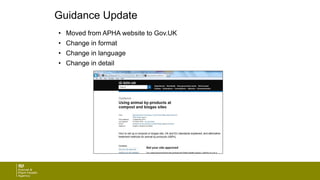
• Animal By-Products (Enforcement) Regulations 2013
Can treat:
• Category 3 material, including catering waste
• Manure and gut contents, milk
• Pressure cooked category 2 material
Regulations
Sites are approved and inspected by APHA against the
requirements of the regulation
No AHVLA approval needed if plant only treat:
• Manure, digestive tract content separated from
• digestive tract
• Milk and milk-based products
• Colostrum
Laboratory Testing Update
Testing requirements
• Salmonella
• E.coli (or Enterococcaceae)
Sampling points:
• Salmonella - during or on withdrawal from storage
• E. coli (or Enterococcaceae) - during or immediately after
transformation.
Laboratory Testing Update
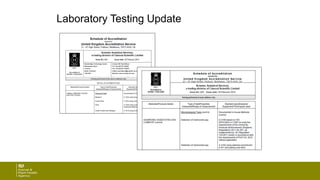
Laboratory requirements
• ISO17025
• UKAS
• Must be for digestate testing
– Digestate
– Compost
Laboratory Testing Update
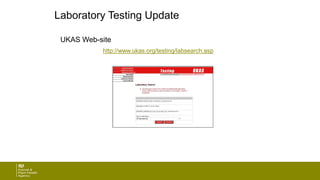
UKAS Web-site
http://www.ukas.org/testing/labsearch.asp
Laboratory Testing Update
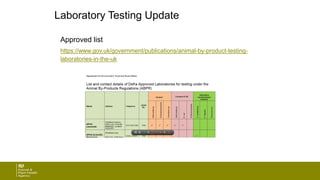
Approved list
https://www.gov.uk/government/publications/animal-by-product-testing-
laboratories-in-the-uk
Laboratory Testing Update
Results
Salmonella : nil
Escherichia coli: n = 5, c = 1, m = 1,000, M = 5,000 in 1g:
• the result is unsatisfactory if the bacterial count in one or
more sub-samples is 5,000 cfu/g or more
• the result is satisfactory if the bacterial counts in all five sub-
samples do not exceed 1,000 cfu/g, or if the bacterial counts in
one sub-sample are between 1,000 and 5,000 cfu/g and the
bacterial counts in the remaining four sub-samples are 1,000
cfu/g or less.
Laboratory Testing Update
Results
Salmonella : nil
Escherichia coli: n = 5, c = 1, m = 1,000, M = 5,000 in 1g:
• the result is unsatisfactory if the bacterial count in one or
more sub-samples is 5,000 cfu/g or more
• the result is satisfactory if the bacterial counts in all five sub-
samples do not exceed 1,000 cfu/g, or if the bacterial counts in
one sub-sample are between 1,000 and 5,000 cfu/g and the
bacterial counts in the remaining four sub-samples are 1,000
cfu/g or less.
Laboratory Testing Update
Results:
• Non-compliant results must be reported to APHA
– ABP testing
– PAS testing
• Restrictions
• HACCP
Change:
• Laboratories are also required to notify APHA of ABP
non-compliant results.
Legislation Update
Commission Regulation (EU) 294/2013:
‘The production of biogas leads to the generation of solid
or liquid fractions. It is necessary to clarify that the
requirements on the disposal of those residues apply to
both fractions.’
Definition:
‘digestion residues means residues, including the liquid
fraction, resulting from the transformation of animal by-
products in a biogas plant.
Legislation Update
• Both liquid and solid material is in scope of the
regulation.
• If liquid is discharged to sewer or tankered to a Waste
Water Treatment Works (WWTW) then the WWTW will
need to meet ABPR requirements:
• Documentation
• traceability
• grazing ban
Legislation Update
• However, the WWTW does not require approval by
APHA.
• Once treated through the WWTW the liquid phase is no
longer under ABP controls
• In practice many WWTW may already be compliant with
the ABP documentation and grazing ban requirements
through observance of the Safe Sludge Matrix.
Charging Update
• 2014: APHA held meetings to get early views on the
impact of introducing a charge for ABP inspection.
• We continue to explore options for charging for
approvals and inspections.
• There is no confirmed timescale for introduction of a
charge for ABP visits.
• Review of ABP delivery approach to ensure a high quality,
efficient process.
Charging Update
Initial improvements:
• Update to inspection forms
• Making the inspection forms available to businesses
• Review of the visit frequency risk model
• Mapping processes
• Efficiencies
• Best practice
• Internal quality auditing
Charging Update
Future communications:
• As the situation progresses we will continue to engage with ADBA
• Further details are available at:
http://webarchive.nationalarchives.gov.uk/20140707135733/http://ww
w.defra.gov.uk/ahvla-en/tests-and-services/charges-for-ahvla-services/
Guidance Update
• Moved from APHA website to Gov.UK
• Change in format
• Change in language
• Change in detail
Guidance Update
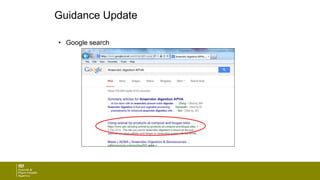
• Google search
Guidance Update
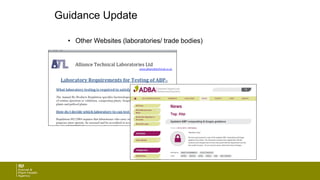
• Other Websites (laboratories/ trade bodies)
Questions
APHA – ANIMAL BY-
PRODUCTS UPDATE
#ADBARegDay @adbioresources
SCOTT REANEY
APHA ADVISOR – ANIMAL BY-PRODUCTS, ANIMAL AND PLANT HEALTH AGENCY

Scott Reaney, APHA

  • 1.
    APHA – ANIMALBY- PRODUCTS UPDATE #ADBARegDay @adbioresources SCOTT REANEY APHA ADVISOR – ANIMAL BY-PRODUCTS, ANIMAL AND PLANT HEALTH AGENCY
  • 2.
    Anaerobic Digestion &Biogas Association Regulator Day 21st May 2015 APHA – Animal By-Products – Update Scott Reaney
  • 3.
    Overview Last year: • ABPApproval and routine inspection process Updates • Update on testing • Definition of digestate • Update on charging • Guidance (Gov.UK)
  • 4.
    Regulations • Control Regulation(EC) 1069/2009 • Implementing Regulation (EC) 142/2011 • Animal By-Products (Enforcement) Regulations 2013 Can treat: • Category 3 material, including catering waste • Manure and gut contents, milk • Pressure cooked category 2 material
  • 5.
    Regulations Sites are approvedand inspected by APHA against the requirements of the regulation No AHVLA approval needed if plant only treat: • Manure, digestive tract content separated from • digestive tract • Milk and milk-based products • Colostrum
  • 6.
    Laboratory Testing Update Testingrequirements • Salmonella • E.coli (or Enterococcaceae) Sampling points: • Salmonella - during or on withdrawal from storage • E. coli (or Enterococcaceae) - during or immediately after transformation.
  • 7.
    Laboratory Testing Update Laboratoryrequirements • ISO17025 • UKAS • Must be for digestate testing – Digestate – Compost
  • 8.
    Laboratory Testing Update UKASWeb-site http://www.ukas.org/testing/labsearch.asp
  • 9.
  • 10.
    Laboratory Testing Update Approvedlist https://www.gov.uk/government/publications/animal-by-product-testing- laboratories-in-the-uk
  • 11.
    Laboratory Testing Update Results Salmonella: nil Escherichia coli: n = 5, c = 1, m = 1,000, M = 5,000 in 1g: • the result is unsatisfactory if the bacterial count in one or more sub-samples is 5,000 cfu/g or more • the result is satisfactory if the bacterial counts in all five sub- samples do not exceed 1,000 cfu/g, or if the bacterial counts in one sub-sample are between 1,000 and 5,000 cfu/g and the bacterial counts in the remaining four sub-samples are 1,000 cfu/g or less.
  • 12.
    Laboratory Testing Update Results Salmonella: nil Escherichia coli: n = 5, c = 1, m = 1,000, M = 5,000 in 1g: • the result is unsatisfactory if the bacterial count in one or more sub-samples is 5,000 cfu/g or more • the result is satisfactory if the bacterial counts in all five sub- samples do not exceed 1,000 cfu/g, or if the bacterial counts in one sub-sample are between 1,000 and 5,000 cfu/g and the bacterial counts in the remaining four sub-samples are 1,000 cfu/g or less.
  • 13.
    Laboratory Testing Update Results: •Non-compliant results must be reported to APHA – ABP testing – PAS testing • Restrictions • HACCP Change: • Laboratories are also required to notify APHA of ABP non-compliant results.
  • 14.
    Legislation Update Commission Regulation(EU) 294/2013: ‘The production of biogas leads to the generation of solid or liquid fractions. It is necessary to clarify that the requirements on the disposal of those residues apply to both fractions.’ Definition: ‘digestion residues means residues, including the liquid fraction, resulting from the transformation of animal by- products in a biogas plant.
  • 15.
    Legislation Update • Bothliquid and solid material is in scope of the regulation. • If liquid is discharged to sewer or tankered to a Waste Water Treatment Works (WWTW) then the WWTW will need to meet ABPR requirements: • Documentation • traceability • grazing ban
  • 16.
    Legislation Update • However,the WWTW does not require approval by APHA. • Once treated through the WWTW the liquid phase is no longer under ABP controls • In practice many WWTW may already be compliant with the ABP documentation and grazing ban requirements through observance of the Safe Sludge Matrix.
  • 17.
    Charging Update • 2014:APHA held meetings to get early views on the impact of introducing a charge for ABP inspection. • We continue to explore options for charging for approvals and inspections. • There is no confirmed timescale for introduction of a charge for ABP visits. • Review of ABP delivery approach to ensure a high quality, efficient process.
  • 18.
    Charging Update Initial improvements: •Update to inspection forms • Making the inspection forms available to businesses • Review of the visit frequency risk model • Mapping processes • Efficiencies • Best practice • Internal quality auditing
  • 19.
    Charging Update Future communications: •As the situation progresses we will continue to engage with ADBA • Further details are available at: http://webarchive.nationalarchives.gov.uk/20140707135733/http://ww w.defra.gov.uk/ahvla-en/tests-and-services/charges-for-ahvla-services/
  • 20.
    Guidance Update • Movedfrom APHA website to Gov.UK • Change in format • Change in language • Change in detail
  • 21.
  • 22.
    Guidance Update • OtherWebsites (laboratories/ trade bodies)
  • 23.
  • 24.
    APHA – ANIMALBY- PRODUCTS UPDATE #ADBARegDay @adbioresources SCOTT REANEY APHA ADVISOR – ANIMAL BY-PRODUCTS, ANIMAL AND PLANT HEALTH AGENCY