
How to Teach SEO Like You
Know What You’re Talking
About
#StukentDS18
SCOTT COWLEY
DIGITAL MARKETING PROFESSOR
WESTERN MICHIGAN UNIVERSITY
@scottcowley
Knowing SEO≠Knowing How
to Teach SEO
#StukentDS18
SCOTT COWLEY
@scottcowley
Itinerary
#StukentDS18
SCOTT COWLEY
@scottcowley
• What students need to know about SEO (AKA what
you need to be able to teach them)
• Where to begin?
• Exercises, tools, and projects to make it stick
Skills to Transmit
#StukentDS18
SCOTT COWLEY
@scottcowley
• How do I “SEO” something so that it actually gets seen
by people?
• Why is one website/video/business showing up higher
than another in search results (Competitive analysis)
• What can I do about it if I’m the one behind?
First Start With Why
#StukentDS18
Search engine rankings are worth $$$ when the
searchers are searching to buy something
car insurance (200K searches / month)
Source
#1: 20% CTR #3: 7% CTR #4: 5% CTR#2: 10% CTR
Assume 5% conversion rate, $2,000 customer lifetime value...
$4M $2M $1.4M $1M
Ranking:
Humans are lazy searchers
#StukentDS18
SCOTT COWLEY
@scottcowley
I Ease Into SEO
#StukentDS18
SCOTT COWLEY
@scottcowley
1. Local Search SEO (Easy)
2. YouTube SEO (More complex)
3. Regular Website SEO (Much more complex)
Local SEO
#StukentDS18
SCOTT COWLEY
@scottcowley
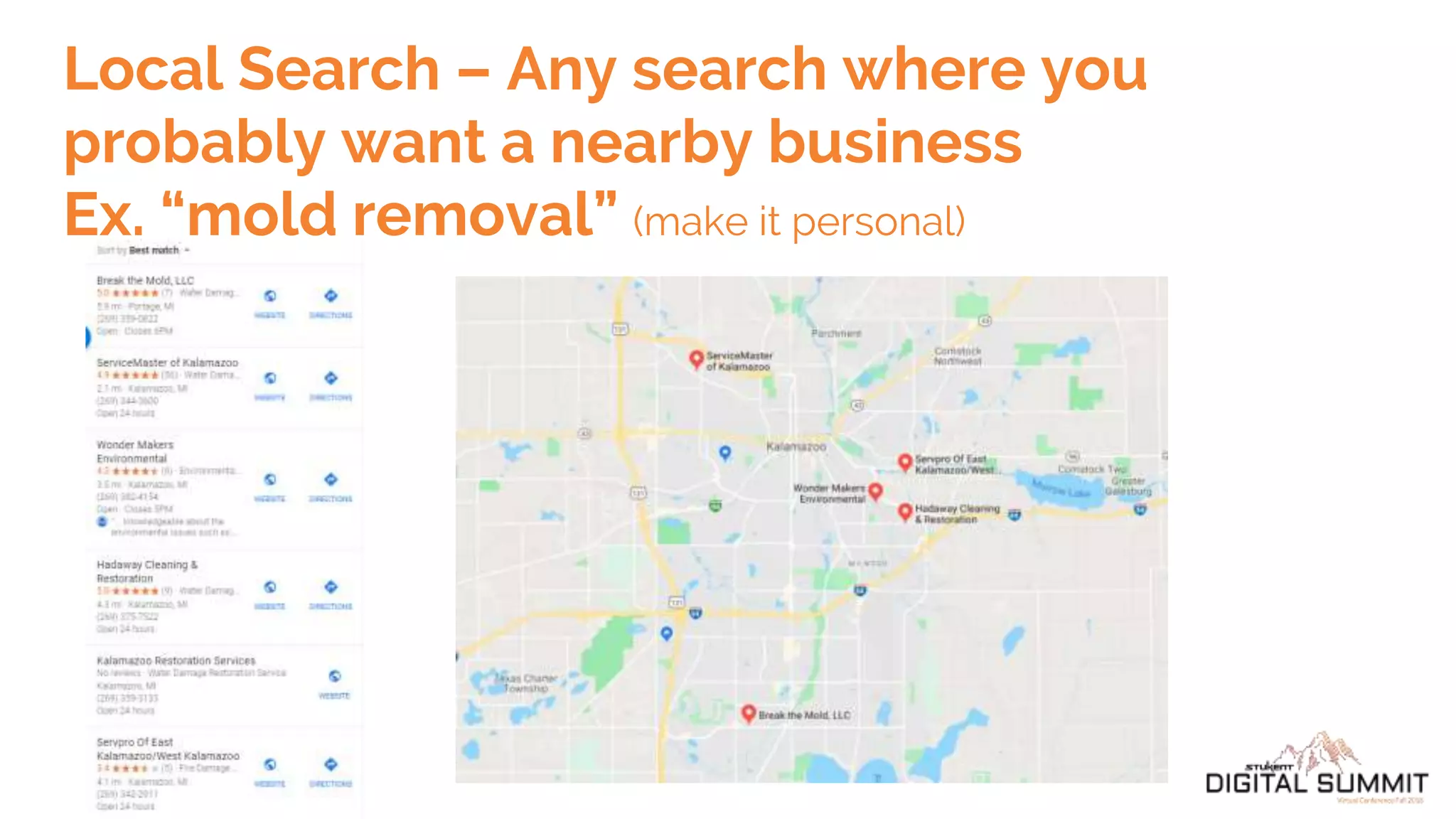
Local Search – Any search where you
probably want a nearby business
Ex. “mold removal” (make it personal)
Use a local search to teach
the concept of algorithms
- Google could easily list businesses by how
close they are to the searcher. This would be a 1-
factor algorithm.
- We can tell Google doesn’t do that (notice that
results aren’t ordered by proximity and it says
“Best Match” at the top), so what other factors
could they use to determine the “best match?”
- Students will have a lot of good intuition:
Mentions of mold
Reviews
Is the store open?
Nearly every answer will be correct – This is what real algorithms do
(algorithms are simply behind-the-scenes math formulas that take
multiple factors into account at the same time
Google’s normal search engine reportedly has 200+ factors)
Local SEO Factors
1. Proximity
Location of the business relative to the searcher (#1 local ranking factor)
2. Relevance
A. Google My Business (Google.com/business)
• Claim your business and tell Google about your business, business categories, etc.
B. Your website content matches the topic being searched on Google
3. Legitimacy
A. Review quality and quantity relative to the competition
B. NAP (Name, Address, Phone) consistent between Google’s information and your company’s web page
C. Citation consistency
• Citation = a 3rd party website that reinforces what Google knows about you (NAP matches your website, Google, etc.)
• Examples: Yellow Pages, Urban Spoon, Apple Maps
Exercise:
Do a local search and find a business that is ranking below another business, even though it’s
physically closer. Investigate factors in #2 and #3 above to see if you can diagnose why (connect it
back to what the business should do to improve its position)
Your student now knows more about SEO than 90% of small business owners.
YouTube (Video) SEO
#StukentDS18
(YouTube is technically the 2nd largest search engine)
YouTube SEO Factors (Simplified)
1. Content Optimization
• Keyword* included in the video title
• Keyword included in the video description
• Video length (longer = sometimes better)
2. Viewer Behavior
• Video retention (are viewers staying for the whole video?)
• Engagement (Likes, Comments, Shares – and how fast they come)
• Video traffic (and is the image thumbnail attracting clicks?)
3. Channel Strength (Established, popular channels carry more weight than new or low visibility channels)
Reinforce that when one video is ranking higher than another following a search, it’s
either due to 1, 2, or all 3 of these factors. (Audit exercise if you want)
*Make sure that when students hear “keyword” they know you mean “phrase someone might search”
Task: Find a Low-Competition Keyword
Low-Competition means:
1. People are searching for it, but…
2. Videos aren’t optimizing their title/description for it well
Why are we doing this?
Principle: People have many different ways of searching for the same thing
If we can tell which of those ways has less competition in search results, we can create a video and
increase our ability to get viewers just by using better keywords, even on a brand new YouTube channel
Pick a topic and start searching YouTube
• Every keyword that YouTube *suggests* in the
dropdown is a keyword that people search
regularly
• Longer phrases are usually called “long tail
keywords” --they’re very specific and usually get
fewer searches than shorter phrases (but also
have fewer videos about the topic and less
competition in search results)
• Try to identify multiple longtail keywords around
the same topic by trying different iterations.
How to make a book cover out of wrapping paper
How to make a book cover with wrapping paper
How to make a wrapping paper book cover
Wrapping paper book cover
Wrapping paper book cover instructions
6 Steps:
1. Generate a list of interchangeable keywords
2. Check competition levels
3. Check search volume levels
4. Decide on a keyword that maximizes search volume
while minimizing competition
5. Use the keyword in the video title and description in
exact order (This is “perfect optimization” vs. “partially optimized” that uses some of the same words, but in
a different order)
6. Drive video engagement through promotion/retention
best practices
#StukentDS18
SCOTT COWLEY
@scottcowley
Example: YouTube search results for “how to frost a
cake” and “how to frost a cake with a butter knife.”
I see multiple popular videos that use my “how to frost a cake” keyword = high competition No videos use the full “butter knife” keyword or even mention
“butter knife” in title or description = low competition
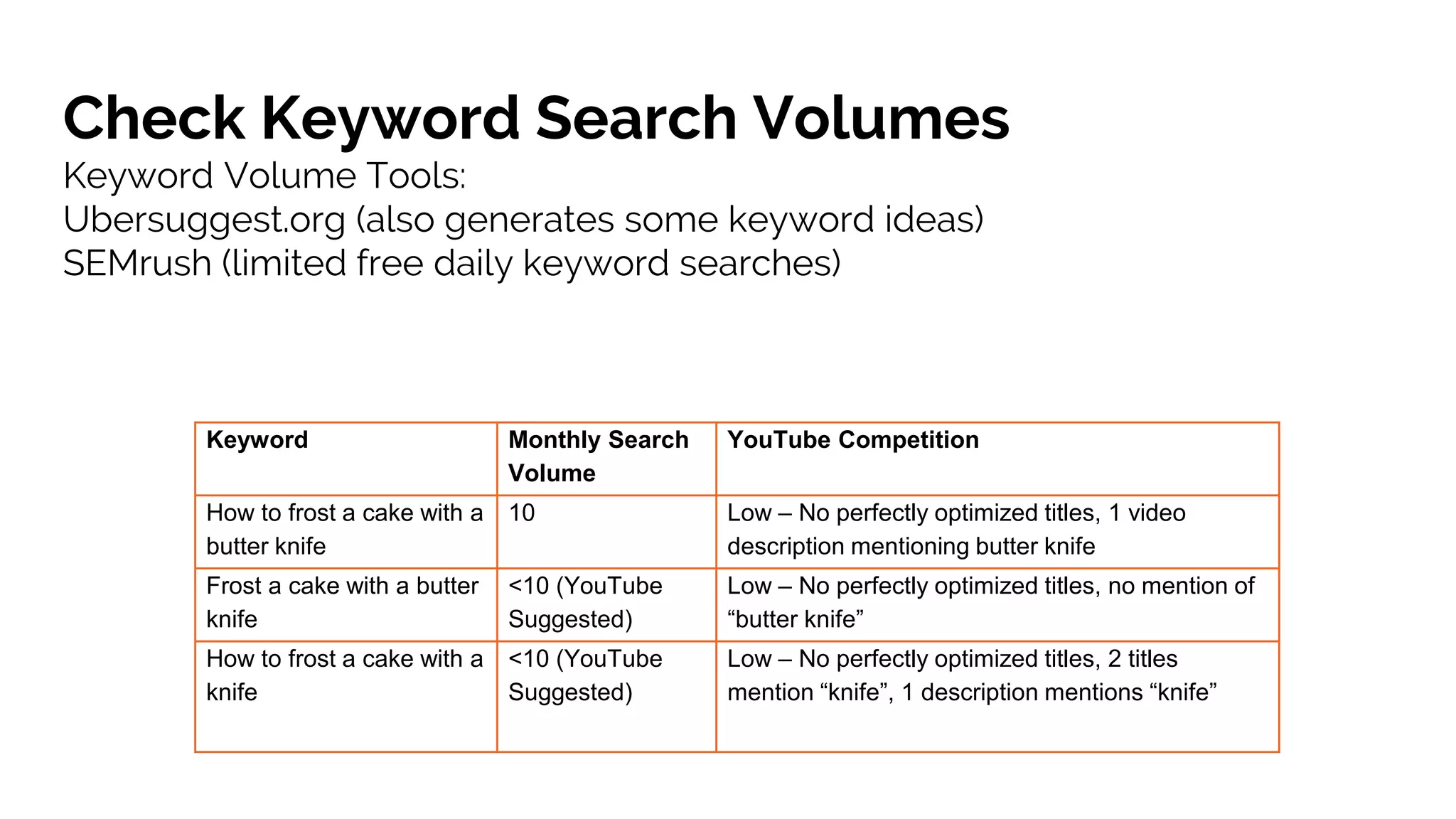
Keyword Monthly Search
Volume
YouTube Competition
How to frost a cake with a
butter knife
10 Low – No perfectly optimized titles, 1 video
description mentioning butter knife
Frost a cake with a butter
knife
<10 (YouTube
Suggested)
Low – No perfectly optimized titles, no mention of
“butter knife”
How to frost a cake with a
knife
<10 (YouTube
Suggested)
Low – No perfectly optimized titles, 2 titles
mention “knife”, 1 description mentions “knife”
Check Keyword Search Volumes
Keyword Volume Tools:
Ubersuggest.org (also generates some keyword ideas)
SEMrush (limited free daily keyword searches)
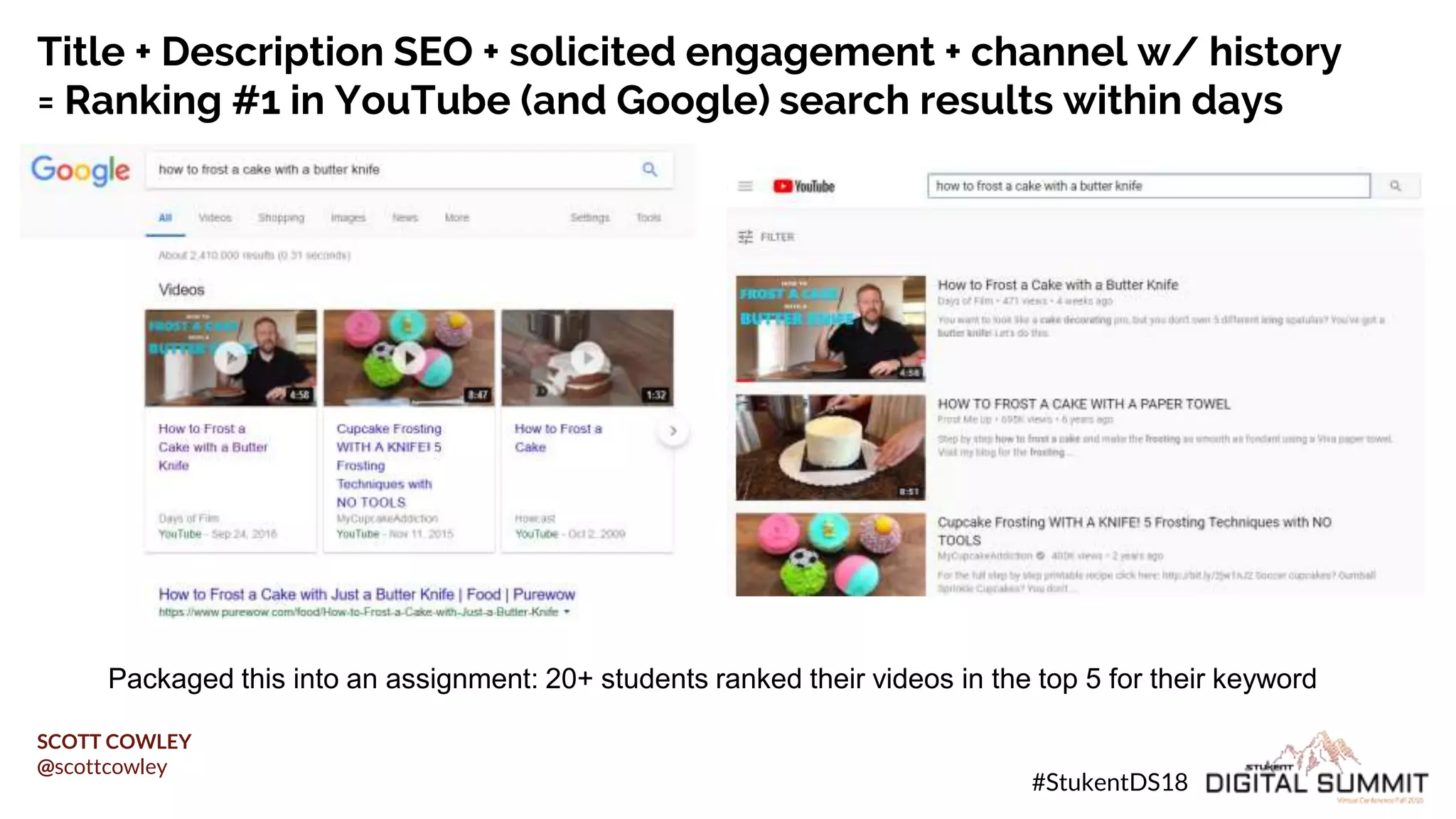
Title + Description SEO + solicited engagement + channel w/ history
= Ranking #1 in YouTube (and Google) search results within days
#StukentDS18
SCOTT COWLEY
@scottcowley
Packaged this into an assignment: 20+ students ranked their videos in the top 5 for their keyword
Website SEO
#StukentDS18
SCOTT COWLEY
@scottcowley
To Google, the quality of a webpage for a search is
a combination of 2 things: its relevance and
popularity
Relevance
(Keywords)
(On-Page SEO)
Popularity
(Backlinks)
(Off-Page SEO)
If Page A is outranking Page B for a search, either:
1. Page A is more relevant than Page B for that search (content is better optimized)
2. Page A is more popular than Page B (based on backlink metrics)
3. Both: Page A is more relevant AND more popular than Page B.
Where can you incorporate your keyword(s)?
SCOTT COWLEY
@scottcowley
#StukentDS18
Web Pages
Page title
Meta description
URL
H1 tag
Page content
Image file names & ALT tags
Anchor text of links pointing to the page
YouTube
Title
Video description
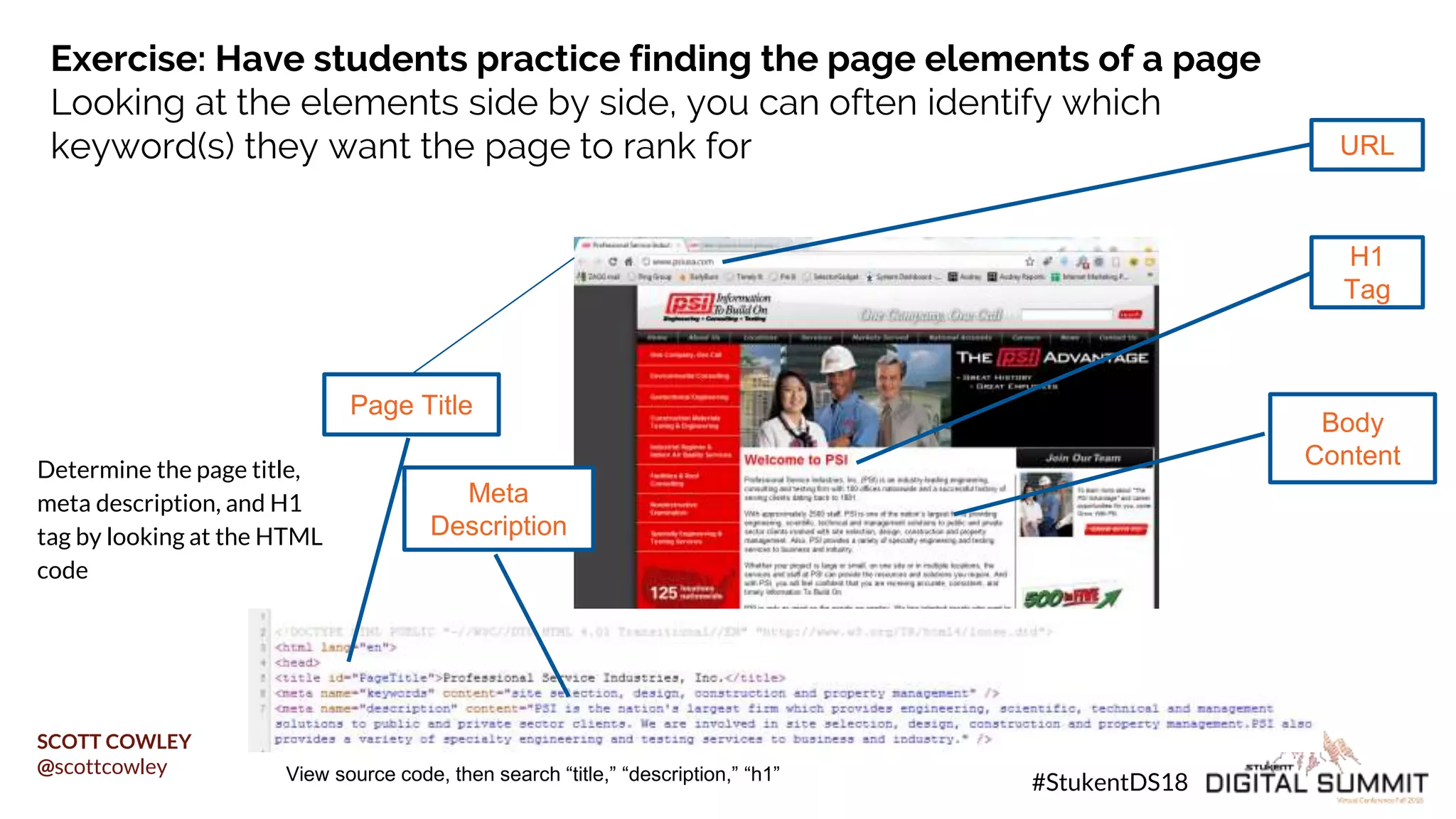
Exercise: Have students practice finding the page elements of a page
Looking at the elements side by side, you can often identify which
keyword(s) they want the page to rank for
Determine the page title,
meta description, and H1
tag by looking at the HTML
code
#StukentDS18
SCOTT COWLEY
@scottcowley
URL
H1
Tag
Body
Content
Page Title
Meta
Description
View source code, then search “title,” “description,” “h1”
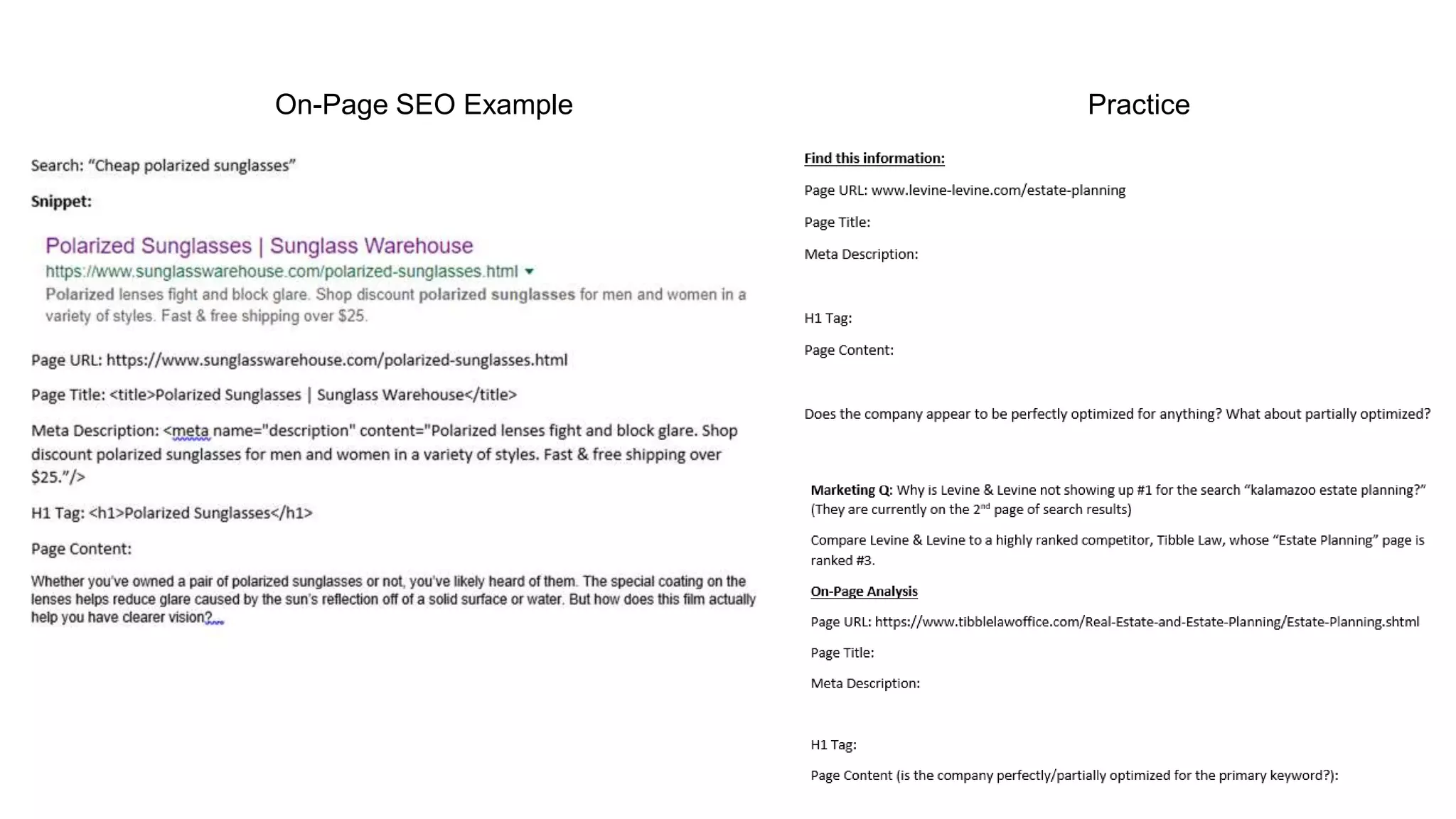
On-Page SEO Example Practice
A comparison of page elements for SEO
To understand the conventions of writing them
URL Title Tag Meta
Description
H1 Page Content
Displays in
Search Results?
Yes Yes Yes No No
Importance for
SEO?
Important Very
Important
Does nothing
for SEO
Important Very Important
Length
Considerations?
Short 50-60
characters
max*
155
characters
max*
Short 100 words
minimum
Try to include the
company name?
No Yes (at the
end)
Yes No Yes
Optimize for
multiple
keywords?
No Depends on
length
Yes No Yes
Needs to be
unique?
Yes Yes Yes Yes Yes
*Character limits seem to change annually as Google changes the layout of search results
A brief guide to off-page SEO
• Every time a website links to ours, it’s like a vote for us – it makes us seem more popular
• To compare the popularity of one web page to another, use tools to see how one webpage’s backlink
portfolio compares to another (SEMrush [below] or OpenSiteExplorer.org)
• I look at “Referring Domains” to measure popularity– how many different websites link to us? There
are many other metrics that capture quantity and quality of links, but this simple heuristic is accurate
most of the time.
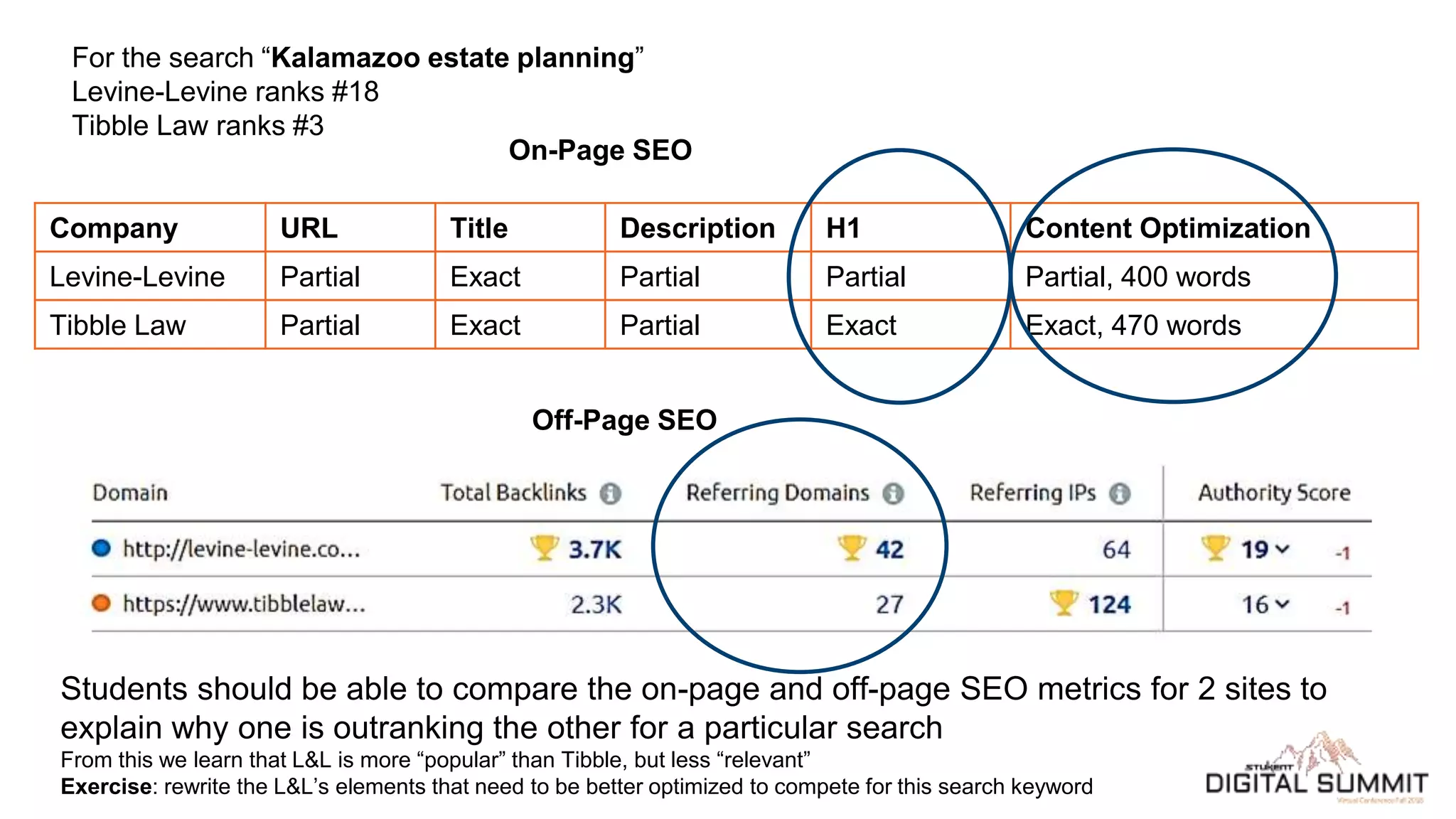
Company URL Title Description H1 Content Optimization
Levine-Levine Partial Exact Partial Partial Partial, 400 words
Tibble Law Partial Exact Partial Exact Exact, 470 words
Students should be able to compare the on-page and off-page SEO metrics for 2 sites to
explain why one is outranking the other for a particular search
From this we learn that L&L is more “popular” than Tibble, but less “relevant”
Exercise: rewrite the L&L’s elements that need to be better optimized to compete for this search keyword
For the search “Kalamazoo estate planning”
Levine-Levine ranks #18
Tibble Law ranks #3
On-Page SEO
Off-Page SEO
If more website popularity is needed
We call this process “link building” – getting more relevant websites to link to us
(This is the hard part of SEO – a 6-month SEO campaign may spend 1 month on keyword research
and updating the website content then 5 months on link building)
Exercise:
Use backlink tools (SEMrush, OpenSiteExplorer) to look at a competitor’s backlinks
Investigate the pages that are doing the linking and write (1) why each page appears to be linking to
the competitor and (2) how we could create a similar strategy and earn this type of link
Thank You
Email me with any content requests: scott.cowley@wmich.edu
#StukentDS18
SCOTT COWLEY
@scottcowley

Scott Cowley - Fall Stukent Digital Summit

  • 1.
    How to TeachSEO Like You Know What You’re Talking About #StukentDS18 SCOTT COWLEY DIGITAL MARKETING PROFESSOR WESTERN MICHIGAN UNIVERSITY @scottcowley
  • 2.
    Knowing SEO≠Knowing How toTeach SEO #StukentDS18 SCOTT COWLEY @scottcowley
  • 3.
    Itinerary #StukentDS18 SCOTT COWLEY @scottcowley • Whatstudents need to know about SEO (AKA what you need to be able to teach them) • Where to begin? • Exercises, tools, and projects to make it stick
  • 4.
    Skills to Transmit #StukentDS18 SCOTTCOWLEY @scottcowley • How do I “SEO” something so that it actually gets seen by people? • Why is one website/video/business showing up higher than another in search results (Competitive analysis) • What can I do about it if I’m the one behind?
  • 5.
    First Start WithWhy #StukentDS18
  • 6.
    Search engine rankingsare worth $$$ when the searchers are searching to buy something car insurance (200K searches / month) Source #1: 20% CTR #3: 7% CTR #4: 5% CTR#2: 10% CTR Assume 5% conversion rate, $2,000 customer lifetime value... $4M $2M $1.4M $1M Ranking:
  • 7.
    Humans are lazysearchers #StukentDS18 SCOTT COWLEY @scottcowley
  • 8.
    I Ease IntoSEO #StukentDS18 SCOTT COWLEY @scottcowley 1. Local Search SEO (Easy) 2. YouTube SEO (More complex) 3. Regular Website SEO (Much more complex)
  • 9.
  • 10.
    Local Search –Any search where you probably want a nearby business Ex. “mold removal” (make it personal)
  • 11.
    Use a localsearch to teach the concept of algorithms - Google could easily list businesses by how close they are to the searcher. This would be a 1- factor algorithm. - We can tell Google doesn’t do that (notice that results aren’t ordered by proximity and it says “Best Match” at the top), so what other factors could they use to determine the “best match?” - Students will have a lot of good intuition: Mentions of mold Reviews Is the store open? Nearly every answer will be correct – This is what real algorithms do (algorithms are simply behind-the-scenes math formulas that take multiple factors into account at the same time Google’s normal search engine reportedly has 200+ factors)
  • 12.
    Local SEO Factors 1.Proximity Location of the business relative to the searcher (#1 local ranking factor) 2. Relevance A. Google My Business (Google.com/business) • Claim your business and tell Google about your business, business categories, etc. B. Your website content matches the topic being searched on Google 3. Legitimacy A. Review quality and quantity relative to the competition B. NAP (Name, Address, Phone) consistent between Google’s information and your company’s web page C. Citation consistency • Citation = a 3rd party website that reinforces what Google knows about you (NAP matches your website, Google, etc.) • Examples: Yellow Pages, Urban Spoon, Apple Maps Exercise: Do a local search and find a business that is ranking below another business, even though it’s physically closer. Investigate factors in #2 and #3 above to see if you can diagnose why (connect it back to what the business should do to improve its position) Your student now knows more about SEO than 90% of small business owners.
  • 13.
    YouTube (Video) SEO #StukentDS18 (YouTubeis technically the 2nd largest search engine)
  • 14.
    YouTube SEO Factors(Simplified) 1. Content Optimization • Keyword* included in the video title • Keyword included in the video description • Video length (longer = sometimes better) 2. Viewer Behavior • Video retention (are viewers staying for the whole video?) • Engagement (Likes, Comments, Shares – and how fast they come) • Video traffic (and is the image thumbnail attracting clicks?) 3. Channel Strength (Established, popular channels carry more weight than new or low visibility channels) Reinforce that when one video is ranking higher than another following a search, it’s either due to 1, 2, or all 3 of these factors. (Audit exercise if you want) *Make sure that when students hear “keyword” they know you mean “phrase someone might search”
  • 15.
    Task: Find aLow-Competition Keyword Low-Competition means: 1. People are searching for it, but… 2. Videos aren’t optimizing their title/description for it well Why are we doing this? Principle: People have many different ways of searching for the same thing If we can tell which of those ways has less competition in search results, we can create a video and increase our ability to get viewers just by using better keywords, even on a brand new YouTube channel
  • 16.
    Pick a topicand start searching YouTube • Every keyword that YouTube *suggests* in the dropdown is a keyword that people search regularly • Longer phrases are usually called “long tail keywords” --they’re very specific and usually get fewer searches than shorter phrases (but also have fewer videos about the topic and less competition in search results) • Try to identify multiple longtail keywords around the same topic by trying different iterations. How to make a book cover out of wrapping paper How to make a book cover with wrapping paper How to make a wrapping paper book cover Wrapping paper book cover Wrapping paper book cover instructions
  • 17.
    6 Steps: 1. Generatea list of interchangeable keywords 2. Check competition levels 3. Check search volume levels 4. Decide on a keyword that maximizes search volume while minimizing competition 5. Use the keyword in the video title and description in exact order (This is “perfect optimization” vs. “partially optimized” that uses some of the same words, but in a different order) 6. Drive video engagement through promotion/retention best practices #StukentDS18 SCOTT COWLEY @scottcowley
  • 18.
    Example: YouTube searchresults for “how to frost a cake” and “how to frost a cake with a butter knife.” I see multiple popular videos that use my “how to frost a cake” keyword = high competition No videos use the full “butter knife” keyword or even mention “butter knife” in title or description = low competition
  • 19.
    Keyword Monthly Search Volume YouTubeCompetition How to frost a cake with a butter knife 10 Low – No perfectly optimized titles, 1 video description mentioning butter knife Frost a cake with a butter knife <10 (YouTube Suggested) Low – No perfectly optimized titles, no mention of “butter knife” How to frost a cake with a knife <10 (YouTube Suggested) Low – No perfectly optimized titles, 2 titles mention “knife”, 1 description mentions “knife” Check Keyword Search Volumes Keyword Volume Tools: Ubersuggest.org (also generates some keyword ideas) SEMrush (limited free daily keyword searches)
  • 20.
    Title + DescriptionSEO + solicited engagement + channel w/ history = Ranking #1 in YouTube (and Google) search results within days #StukentDS18 SCOTT COWLEY @scottcowley Packaged this into an assignment: 20+ students ranked their videos in the top 5 for their keyword
  • 21.
  • 22.
    To Google, thequality of a webpage for a search is a combination of 2 things: its relevance and popularity Relevance (Keywords) (On-Page SEO) Popularity (Backlinks) (Off-Page SEO) If Page A is outranking Page B for a search, either: 1. Page A is more relevant than Page B for that search (content is better optimized) 2. Page A is more popular than Page B (based on backlink metrics) 3. Both: Page A is more relevant AND more popular than Page B.
  • 23.
    Where can youincorporate your keyword(s)? SCOTT COWLEY @scottcowley #StukentDS18 Web Pages Page title Meta description URL H1 tag Page content Image file names & ALT tags Anchor text of links pointing to the page YouTube Title Video description
  • 24.
    Exercise: Have studentspractice finding the page elements of a page Looking at the elements side by side, you can often identify which keyword(s) they want the page to rank for Determine the page title, meta description, and H1 tag by looking at the HTML code #StukentDS18 SCOTT COWLEY @scottcowley URL H1 Tag Body Content Page Title Meta Description View source code, then search “title,” “description,” “h1”
  • 25.
  • 26.
    A comparison ofpage elements for SEO To understand the conventions of writing them URL Title Tag Meta Description H1 Page Content Displays in Search Results? Yes Yes Yes No No Importance for SEO? Important Very Important Does nothing for SEO Important Very Important Length Considerations? Short 50-60 characters max* 155 characters max* Short 100 words minimum Try to include the company name? No Yes (at the end) Yes No Yes Optimize for multiple keywords? No Depends on length Yes No Yes Needs to be unique? Yes Yes Yes Yes Yes *Character limits seem to change annually as Google changes the layout of search results
  • 27.
    A brief guideto off-page SEO • Every time a website links to ours, it’s like a vote for us – it makes us seem more popular • To compare the popularity of one web page to another, use tools to see how one webpage’s backlink portfolio compares to another (SEMrush [below] or OpenSiteExplorer.org) • I look at “Referring Domains” to measure popularity– how many different websites link to us? There are many other metrics that capture quantity and quality of links, but this simple heuristic is accurate most of the time.
  • 28.
    Company URL TitleDescription H1 Content Optimization Levine-Levine Partial Exact Partial Partial Partial, 400 words Tibble Law Partial Exact Partial Exact Exact, 470 words Students should be able to compare the on-page and off-page SEO metrics for 2 sites to explain why one is outranking the other for a particular search From this we learn that L&L is more “popular” than Tibble, but less “relevant” Exercise: rewrite the L&L’s elements that need to be better optimized to compete for this search keyword For the search “Kalamazoo estate planning” Levine-Levine ranks #18 Tibble Law ranks #3 On-Page SEO Off-Page SEO
  • 29.
    If more websitepopularity is needed We call this process “link building” – getting more relevant websites to link to us (This is the hard part of SEO – a 6-month SEO campaign may spend 1 month on keyword research and updating the website content then 5 months on link building) Exercise: Use backlink tools (SEMrush, OpenSiteExplorer) to look at a competitor’s backlinks Investigate the pages that are doing the linking and write (1) why each page appears to be linking to the competitor and (2) how we could create a similar strategy and earn this type of link
  • 30.
    Thank You Email mewith any content requests: scott.cowley@wmich.edu #StukentDS18 SCOTT COWLEY @scottcowley