

“Enhance your Research
with SCOPUS”
Atul Bhatt, Ph.D.
Librarian
Institute of Law
Nirma University
Outline
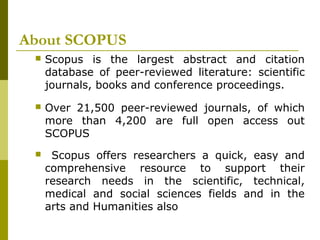
 About SCOPUS
 Why SCOPUS
 SCOPUS is your first step to
 Content Covers
 Features
 Registration
 Access
 Conclusion
About SCOPUS
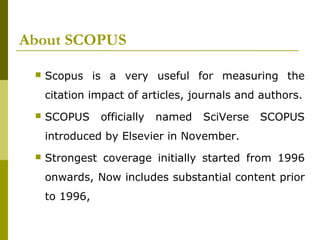
 Scopus is the largest abstract and citation
database of peer-reviewed literature: scientific
journals, books and conference proceedings.
 Over 21,500 peer-reviewed journals, of which
more than 4,200 are full open access out
SCOPUS
 Scopus offers researchers a quick, easy and
comprehensive resource to support their
research needs in the scientific, technical,
medical and social sciences fields and in the
arts and Humanities also
About SCOPUS
 Scopus is a very useful for measuring the
citation impact of articles, journals and authors.
 SCOPUS officially named SciVerse SCOPUS
introduced by Elsevier in November.
 Strongest coverage initially started from 1996
onwards, Now includes substantial content prior
to 1996,
Why SCOPUS?
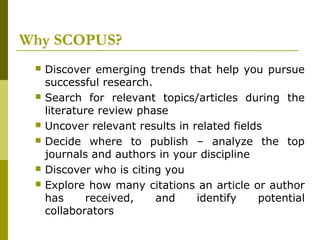
 Discover emerging trends that help you pursue
successful research.
 Search for relevant topics/articles during the
literature review phase
 Uncover relevant results in related fields
 Decide where to publish – analyze the top
journals and authors in your discipline
 Discover who is citing you
 Explore how many citations an article or author
has received, and identify potential
collaborators
SCOPUS is your first step to
 Discover what research exists globally
 Look for new ideas and research
opportunities
 Figure out who to follow and collaborate
with
 Decide which journal to submit my paper
 Evaluate my own success
Content covers
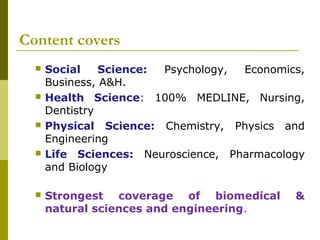
 Social Science: Psychology, Economics,
Business, A&H.
 Health Science: 100% MEDLINE, Nursing,
Dentistry
 Physical Science: Chemistry, Physics and
Engineering
 Life Sciences: Neuroscience, Pharmacology
and Biology 
 Strongest coverage of biomedical &
natural sciences and engineering.
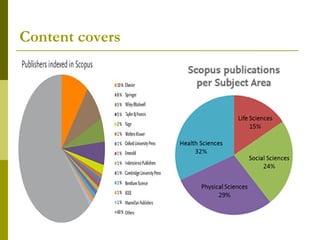
Content covers
Features – Search
Document search
Author search
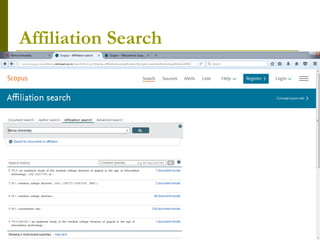
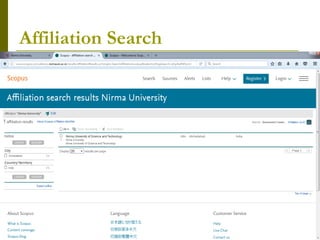
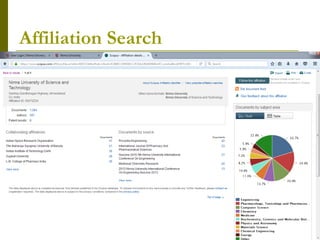
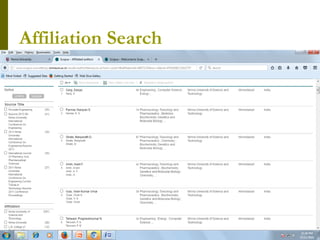
Affiliation searches
Advanced search
Refine results
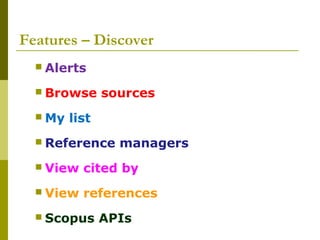
Features – Discover
 Alerts
 Browse sources
 My list
 Reference managers
 View cited by
 View references
 Scopus APIs
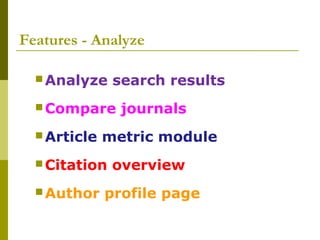
Features - Analyze
 Analyze search results
 Compare journals
 Article metric module
 Citation overview
 Author profile page
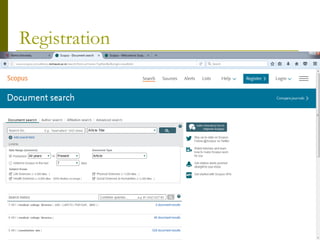
Registration
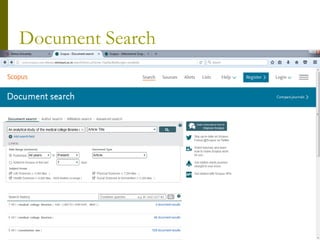
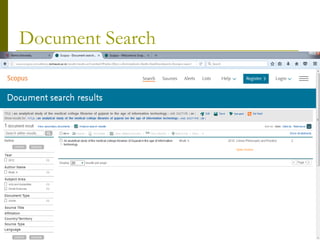
Document Search
Document Search
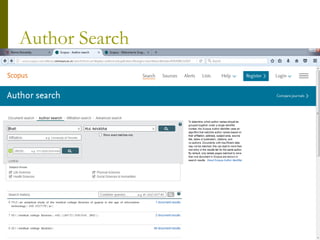
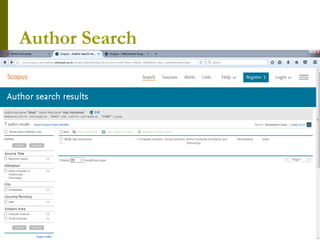
Author Search
Author Search
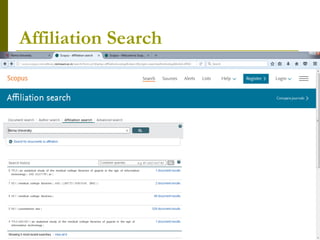
Affiliation Search
Affiliation Search
Affiliation Search
Affiliation Search
Affiliation Search
Conclusion
 Scopus has outstanding software features
 Scopus is the largest abstract and citation
database of peer-reviewed literature.
 You can access this database in campus and
outside campus using remote login facility.
 http://www.scopus.com/
 http://www.elsevier.com/online-tools/scopus
Enhance your research with scopus

Enhance your research with scopus

  • 1.
    “Enhance your Research withSCOPUS” Atul Bhatt, Ph.D. Librarian Institute of Law Nirma University
  • 2.
    Outline  About SCOPUS Why SCOPUS  SCOPUS is your first step to  Content Covers  Features  Registration  Access  Conclusion
  • 3.
    About SCOPUS  Scopusis the largest abstract and citation database of peer-reviewed literature: scientific journals, books and conference proceedings.  Over 21,500 peer-reviewed journals, of which more than 4,200 are full open access out SCOPUS  Scopus offers researchers a quick, easy and comprehensive resource to support their research needs in the scientific, technical, medical and social sciences fields and in the arts and Humanities also
  • 4.
    About SCOPUS  Scopusis a very useful for measuring the citation impact of articles, journals and authors.  SCOPUS officially named SciVerse SCOPUS introduced by Elsevier in November.  Strongest coverage initially started from 1996 onwards, Now includes substantial content prior to 1996,
  • 5.
    Why SCOPUS?  Discoveremerging trends that help you pursue successful research.  Search for relevant topics/articles during the literature review phase  Uncover relevant results in related fields  Decide where to publish – analyze the top journals and authors in your discipline  Discover who is citing you  Explore how many citations an article or author has received, and identify potential collaborators
  • 6.
    SCOPUS is yourfirst step to  Discover what research exists globally  Look for new ideas and research opportunities  Figure out who to follow and collaborate with  Decide which journal to submit my paper  Evaluate my own success
  • 7.
    Content covers  SocialScience: Psychology, Economics, Business, A&H.  Health Science: 100% MEDLINE, Nursing, Dentistry  Physical Science: Chemistry, Physics and Engineering  Life Sciences: Neuroscience, Pharmacology and Biology   Strongest coverage of biomedical & natural sciences and engineering.
  • 8.
  • 9.
    Features – Search Documentsearch Author search Affiliation searches Advanced search Refine results
  • 10.
    Features – Discover Alerts  Browse sources  My list  Reference managers  View cited by  View references  Scopus APIs
  • 11.
    Features - Analyze Analyze search results  Compare journals  Article metric module  Citation overview  Author profile page
  • 12.
  • 13.
  • 14.
  • 15.
  • 16.
  • 17.
  • 18.
  • 19.
  • 20.
  • 21.
  • 22.
    Conclusion  Scopus hasoutstanding software features  Scopus is the largest abstract and citation database of peer-reviewed literature.  You can access this database in campus and outside campus using remote login facility.  http://www.scopus.com/  http://www.elsevier.com/online-tools/scopus