SCIENCE 4
Materials and their uses
QUARTER 1 WEEK 4
D
A
Y
1
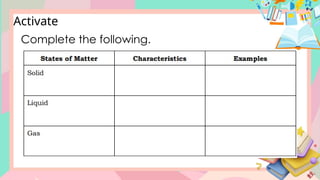
Complete the following.
Activate
Matter undergoes various changes when exposed
to changes in temperature, which can be classified
as either physical or chemical. In the next phase of
the lesson, you will be able to know and
understand how these changes in matter
happened. It could be a change in its internal
structure or physical appearance. It may also result
in the formation of new materials when they are
mixed.
Aims
Analyze
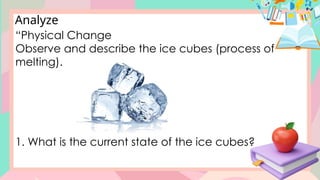
“Physical Change
Observe and describe the ice cubes (process of
melting).
1. What is the current state of the ice cubes?
Analyze
2. Can you describe the properties of the ice cubes?
(e.g., solid, cold to touch)
3. What changes do you observe as the ice cubes are
heated?
4. What is happening to the ice cubes as they start to
melt?
5. Can you describe any changes in the appearance or
texture of the ice cubes?
Analyze
What is Melting?
Melting is a process where a solid turns into a liquid
when it gets warm enough. When something melts,
it becomes soft and turns into a liquid. For example,
when ice cream melts, it becomes liquid instead of
being hard like ice.
Analyze
Examples of Melting:
Ice Melting:
One common example of melting is when ice
cubes are left outside on a warm day. As the sun
shines on them or the temperature gets warmer,
the ice cubes start to melt and turn into water.
Analyze
Chocolate Melting:
Another example is when you heat chocolate in a
microwave or over a stove. The solid chocolate
turns into a liquid, making it easier to spread or use
for making desserts like chocolate-covered
strawberries
Analyze
Candle Wax Melting:
When you light a candle, the heat from the flame
melts the wax. The melted wax then drips down the
candle, creating a pool of liquid wax that fuels the
flame.
Analyze
Real-Life Applications/Uses:
Cooking:
Melting is used in cooking to transform solid
ingredients into liquids. For example, butter is
melted before adding it to cake batter or melted
cheese is used as a topping for nachos.
Analyze
Making Popsicles:
Melting is involved in making popsicles. You pour
liquid juice or flavored water into molds and then
freeze them. When you take them out of the freezer
and let them sit, the popsicles start to melt, turning
back into liquid
Analyze
Recycling:
Melting is used to recycle metals like aluminum and
steel. Scrap metal is melted down at high
temperatures to make new products, like aluminum
cans or steel beams, instead of throwing it away.
Analyze
Art and Crafts:
Melting can be used in art and crafts projects. For
example, crayons can be melted and poured into
molds to make new crayons with different shapes
or colors
Analyze
What is evaporation?
If the melted ice cubes, which have turned into
liquid, are continually exposed to high
temperatures, the liquid will eventually turn into gas
Analyze
Evaporation is when the liquid turns into a gas. This
happens when the liquid gets warm enough, and
its molecules move so fast that they escape into
the air as vapor. You can think of it like tiny invisible
water particles flying away from a puddle, a cup of
water, or even wet clothes when they're left out to
dry.
Analyze
Examples of Evaporation:
Drying Clothes:
After washing your clothes, you hang them outside
to dry. As the sun shines on them and the air
around them gets warm, the water on the clothes
evaporates, and they become dry.
Analyze
Puddles Disappearing:
After it rains, you might notice that puddles on the
ground disappear even if it's not sunny. This
happens because the water in the puddles slowly
evaporates into the air.
Analyze
Steam from Boiling Water:
When you heat water on a stove to make tea or
cook pasta, steam rises from the pot. This steam is
water vapor, formed because the water is
evaporating.
Analyze
Real-Life Applications/Uses:
Swimming Pool Evaporation:
Have you ever noticed that a swimming pool gets
lower over time, even if nobody takes water out?
This is because water evaporates from the surface
of the pool, especially on hot days. That's why
sometimes we need to add more water to keep
the pool full.
Analyze
Drying Wet Surfaces:
If you spill water on the kitchen counter or the
bathroom floor, you can wipe it up with a towel.
But what happens if you leave it there? Eventually,
the water evaporates, and the surface becomes
dry again.
Analyze
Water Cycle:
Evaporation is a crucial part of the water cycle.
When the sun heats up bodies of water like oceans,
rivers, and lakes, water evaporates into the air. This
water vapor rises, cools down, and forms clouds.
Later, when the clouds get heavy with water, it falls
back to the ground as rain, snow, or hail.
Analyze
Making Salt:
Ever heard of sea salt? It's made by evaporating
seawater. When seawater is left out in the sun, the
water evaporates, leaving behind salt crystals.
These crystals are collected and cleaned to make
the salt we use in cooking.
Activity 1
Do the Activity:
I. Activity: “Changing State of Water” (30 Minutes)
II. Objective(s): At the end of the activity, the
learners are expected to:
● Describe changes in water that involved physical
change
Activity 1
III. Materials Needed:
● ice cubes
● saucer
● handkerchief
● small basin
● glass
● sheet of paper
● water
● small plastic bag (ice candy bag)
Activity 1
IV. Instructions:
● Work in group.
● Together with your teammates, perform the
activity.
Procedures:
PART A
1. Take three ice cubes. Place them in a saucer.
Activity 1
2. Put the saucer with ice cubes directly under the
sun.
3. Wait for 10 minutes. Observe what happens to
the ice cube.
4. Based on your observations, answer the following
questions:
a. What happened to the ice cubes when placed
directly under the sun?
b. What process was observed in this part
Activity 1
PART B
1. Put water in a small basin.
2. Soak the handkerchief in water until it is totally
wet.
3. Place the wet handkerchief directly under the
sun for one hour. Observe what happens to the
handkerchief.
Activity 1
4. Based on your observations, answer the following
questions:
a. What happened to the handkerchief when
placed directly under the sun?
b. What process was observed in this part?
● Present your findings to the class.
Activity 2
Answer the following.
1. Which of the following is not a characteristic of a
physical change?
a.) shape b.) colour
c.) size d.) new substance
2. Which property remains constant even after
physical and chemical changes?
a.) density b.) shape
c.) mass d.) arrangement of particles
Activity 2
3. What is the change called if there is a change in
physical state only?
4. What kind of change is dissolving?
5. How to identify a physical change?
Activity 1
PART B
1. Put water in a small basin.
2. Soak the handkerchief in water until it is totally
wet.
3. Place the wet handkerchief directly under the
sun for one hour. Observe what happens to the
handkerchief.
Abstraction
What is physical change?
Give examples.
Assessment
Read each question carefully.
Identify the letter of the correct answer.
1. Which of the following is an example of a
physical change?
A) Burning wood
B) Rusting iron
C) Melting ice cream
D) Baking a cake
Assessment
2. What happens when you tear a
piece of paper into small pieces?
A) A chemical change occurs.
B) The paper undergoes evaporation.
C) The paper undergoes a physical change.
D) The paper undergoes sublimation.
Assessment
3. Which of the following is an example of a
physical change involving a change of state?
A) Rust forming on an iron nail
B) Paper burning and turning into ashes
C) Ice melting into water
D) Milk spoiling and curdling
Assessment
4. Which of the following is an example of physical
change?
A Sublimation of dry ice.
B Burning firewoods.
C. Heating sugar to form caramel.
D. Corroding metal.
Assessment
5. Which of the following is an example of physical
change?
A. A plant collecting sunlight and turning it into
food.
B. Baking a birthday cake for your mother.
C. Filling up a balloon with hot air.
D. Burning a piece of paper.
SCIENCE 4
Materials and their uses
QUARTER 1 WEEK 4
D
A
Y
2
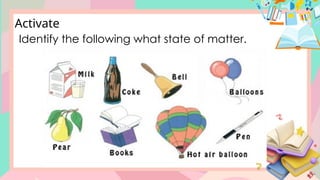
Identify the following what state of matter.
Activate
Aims
Unscramble Word Game
Re-arrange the letters to create a word
corresponding to the word.
1. It is to make or become different. EGNAHC
2. It is a measure of how hot or cold something is.
TURETEMAREP
3. It is a type of food with a limited shelf life if it's not
refrigerated.
ELBAHSIREP
Aims
4. It is a process in which one or more substances, the
reactants, are converted to one or more different
substances, the products.
IONTCAER LACIMEHC
5. It is the chemical reaction that occurs between
substances when materials burn.
NOIBUSTMOC
Analyze
What is Freezing?
Freezing occurs when a liquid turns into a solid
when it gets cold enough. Imagine water turning
into ice when it's left in the freezer or outside on a
cold winter day. The cold slows down the
molecules in the liquid, making them stick together
and form a solid.
Analyze
Examples of Freezing:
Making Ice Cubes:
One common example of freezing is making ice
cubes. You pour water into an ice cube tray and
put it in the freezer. The water freezes and turns into
solid ice cubes as the water gets cold.
Analyze
Freezing Popsicles:
When you make popsicles at home, you pour juice or
flavored water into molds and put them in the freezer.
Over time, the liquid freezes, turning into tasty frozen
treats.
Ice Cream:
Have you ever seen an ice cream machine at an ice
cream shop? It works by freezing a mixture of cream,
sugar, and flavors while stirring it. This makes creamy ice
cream that you can enjoy on a hot day.
Analyze
Real-Life Applications/Uses:
Preserving Food:
Freezing is a great way to keep food fresh for
longer. You can freeze fruits, vegetables, meat,
and leftovers to prevent them from spoiling. This
way, you can enjoy your favorite foods even if you
can't eat them right away.
Analyze
Keeping Cool:
Ice and frozen treats are perfect for keeping cool
on a hot day. Whether you're drinking a cold glass
of lemonade with ice cubes or enjoying a frozen
dessert like ice cream or popsicles, freezing helps us
stay refreshed when it's hot outside.
Analyze
Transporting Perishable Goods:
In places where it's hard to keep food fresh, like
during long journeys or in remote areas, freezing is
used to preserve perishable goods. Foods like
meat, fish, and vegetables are frozen before being
transported to keep them from spoiling.
Analyze
Making Frozen Treats:
Freezing is essential for making all kinds of delicious
frozen treats, such as ice cream, sorbet, frozen
yogurt, and gelato. These treats are enjoyed by
people all over the world, especially on hot
summer days.
Activity 1
Do the Activity:
1. Fill half of a small plastic bag with water.
2. Place in the freezer overnight.
3. After one day, remove the small plastic bag from
the freezer and observe what happens to the
water inside.
Activity 1
4. Based on your observations, answer the following
questions:
a. What happened to the handkerchief when
placed directly under the sun?
b. What process was observed in this part
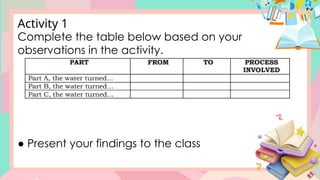
Complete the table below based on your
observations in the activity.
● Present your findings to the class
Activity 1
Activity 2
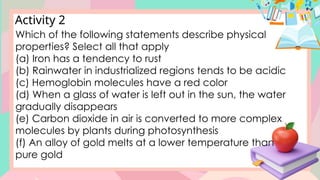
Which of the following statements describe physical
properties? Select all that apply
(a) Iron has a tendency to rust
(b) Rainwater in industrialized regions tends to be acidic
(c) Hemoglobin molecules have a red color
(d) When a glass of water is left out in the sun, the water
gradually disappears
(e) Carbon dioxide in air is converted to more complex
molecules by plants during photosynthesis
(f) An alloy of gold melts at a lower temperature than
pure gold
Abstraction
What is physical change?
Give examples.
Read each question carefully.
Identify the letter of the correct answer.
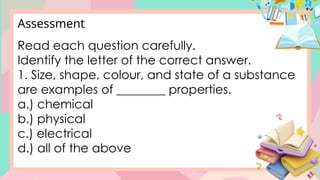
1. Size, shape, colour, and state of a substance
are examples of ________ properties.
a.) chemical
b.) physical
c.) electrical
d.) all of the above
Assessment
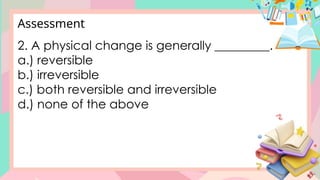
2. A physical change is generally _________.
a.) reversible
b.) irreversible
c.) both reversible and irreversible
d.) none of the above
Assessment
Assessment
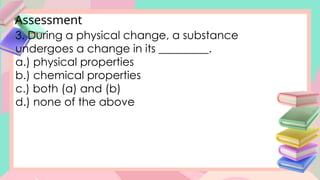
3. During a physical change, a substance
undergoes a change in its _________.
a.) physical properties
b.) chemical properties
c.) both (a) and (b)
d.) none of the above
Assessment
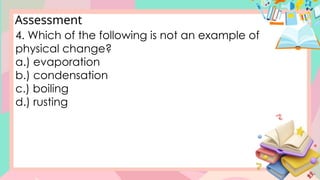
4. Which of the following is not an example of
physical change?
a.) evaporation
b.) condensation
c.) boiling
d.) rusting
Assessment
5. Which of the following is an example of physical
change?
a.) burning of paper
b.) ripening of fruit
c.) cutting of wood
d.) cooking food
Assessment
6. Define physical changes.
7. How can you say that crystallisation is not a
chemical change?
8.Can all physical changes be reversed?
9. Give an example of a physical change caused
by the action of heat.
10. What changes may happen in physical
change?
SCIENCE 4
Holiday
QUARTER 1 WEEK 4
D
A
Y
3
SCIENCE 4
Materials and their uses
QUARTER 1 WEEK 4
D
A
Y
4
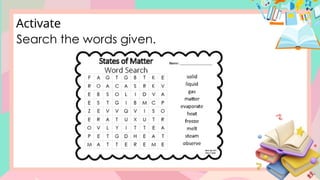
Search the words given.
Activate
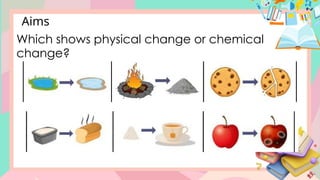
Which shows physical change or chemical
change?
Aims
Analyze
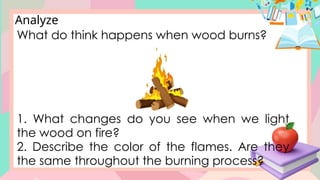
What do think happens when wood burns?
1. What changes do you see when we light
the wood on fire?
2. Describe the color of the flames. Are they
the same throughout the burning process?
Analyze
3. Do you notice any smoke? What do you think is
causing it?
4. How does the wood change as it burns? Does it
look or feel different?
5. What do you see left behind after the wood has
burned completely?
Analyze
6. Can you describe the ashes? What do you think
they are made of?
7. Based on what you observed, do you think
burning wood is a chemical change or a physical
change? Why?
Analyze
8. What do you think happens to the wood
molecules during the burning process?
9. Can you name any other examples of chemical
changes that you have seen or heard about?
Analyze
Examples of Chemical change
Toasting Bread:
When bread is toasted, it undergoes a
chemical change. The heat causes the bread
to turn golden brown and crispy. Explain that
the high temperature of the toaster or oven
changes the bread's color and texture,
creating new flavors.
Analyze
Roasting Marshmallows:
When marshmallows are roasted over a
campfire, they undergo a chemical change.
The heat makes them melt and turn brown on
the outside. Describe how the heat from the
fire transforms the marshmallow's texture and
taste, making it gooey and delicious.
Analyze
Baking Cookies:
When cookie dough is placed in the oven, it
undergoes a chemical change. The heat causes
the dough to rise and turn into cookies. Discuss how
the high temperature of the oven changes the
dough's composition, turning it into a tasty treat.
Analyze
Caramelizing Sugar:
When sugar is heated in a pan, it undergoes a
chemical change called caramelization. The sugar
melts and turns into a golden-brown liquid with a
rich flavor. Describe how the sugar changes color
and taste as it is heated, creating a sweet caramel
sauce for desserts like caramel apples or caramel
popcorn.
Analyze
Popcorn Popping:
When popcorn kernels are heated on the stove or
in a microwave, they undergo a chemical change.
The heat causes the moisture inside the kernels to
turn into steam, which builds up pressure and
eventually makes the kernels pop.
Analyze
Frying an Egg:
When an egg is cracked into a hot frying pan, it
undergoes a chemical change. The heat causes
the proteins in the egg white and yolk to denature
and coagulate, turning from a liquid to a solid.
Describe how the egg changes texture and color
as it cooks, becoming a delicious breakfast food
that can be enjoyed sunny-side up, scrambled, or
fried.
Activity 1
Do the Activity:
I. Activity: “Unveiling Chemical Transformations with
Heat” (30 Minutes)
II. Objective(s): At the end of the activity, the
learners are expected to:
● Observe chemical changes in materials when
exposed to high temperatures and identify
evidence of these changes.
Activity 1
III. Materials Needed:
● Table sugar
● Test tubes
● Strips of aluminum foil
● Alcohol lamp
● Vinegar (500-1000ml)
● Baking soda
● Matches
● Piece of wood
● Beaker
● Liquid milk
● Tongs
● Steel wool
● Medicine dropper
● Pieces of recyclable paper
Activity 1
IV. Instructions:
Safety First: Ensure all participants are wearing safety
goggles and understand the importance of safety
when handling chemicals. Adult supervision is
necessary throughout the activity.
● Work in group.
● Together with your teammates, perform the activity.
Activity 1
● Procedures:
PART A
a. Put a teaspoon of table sugar into a test tube.
b. Carefully light the alcohol lamp. Using a pair of
tongs, hold the test tube and place it over the flame
of the alcohol lamp while swirling it. Observe
Activity
PART B
a. Pour vinegar into a beaker until it is halfway full.
b. Place the steel wool or aluminum foil strips in the
vinegar.
c. Feel the temperature of the beaker by feeling it.
Then, let it sit for 15 minutes.
d. After 15 minutes, hold and feel the temperature of
the beaker again.
Activity 1
PART C
a. Pour vinegar into a beaker until it is halfway full.
b. Add a spoonful of baking soda to the vinegar.
Observe.
Activity 1
Activity 1
PART D
a. Pour vinegar into a beaker until it is one-fourth
full.
b. Add 10 drops of liquid milk to the vinegar. Let it
sit for at least five minutes.
Activity 1
PART E
a. Get a piece of wood.
b. Carefully light the alcohol lamp. Using a pair of
tongs, hold the wood over the flame of the alcohol
lamp. Observe.
Activity 1
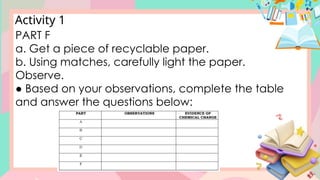
PART F
a. Get a piece of recyclable paper.
b. Using matches, carefully light the paper.
Observe.
● Based on your observations, complete the table
and answer the questions below:
Activity 1
1. What evidence of chemical change is present?
2. When does chemical change occur? Explain
your answer.
Based on this activity, what are the pieces of
evidence of chemical change in materials or
substances?
Activity 2
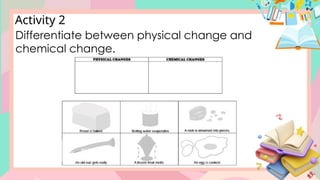
Differentiate between physical change and
chemical change.
Activity 3
Read the following sentences carefully. Write True if
the situation shows
how matter changes when applied with heat. Write
False if not.
1. Melting ice cube, boiling water, and drying
clothes are examples of physical
changes.
Activity 3
2. Physical and chemical changes are results when
heat is applied to matter.
3. A vanilla ice cream melts when taken out from a
refrigerator for a long time.
4. Charcoal burning on the grill is an example of
chemical change.
5. When heat is applied to matter or material
nothing happens.
Abstraction
What is chemical change?
Give examples.
Express your understanding of the lesson in this
module by supplying the blanks in the following
sentence with a word or a phrase.
I learned that ____ (1) ____ application in matter
results to either ______(2)_____
and ______(3)_______ .
Assessment
Read each question carefully.
Identify the letter of the correct answer.
1. Which of the following is an example of chemical
change when heat is applied?
A. Burning of wood
B. Cutting clothes
C. Freezing of water
D. Sharpening a pencil
Assessment
2. Which is TRUE about chemical change?
A. A new product is formed.
B. Chemicals change as a result of physical
change.
C. The product can be changed to its original form.
D. A chemical change is more important than any
other process.
Assessment
3. What happens when a piece of paper is burned
inside a tin can?
A. A new material is formed.
B. There are no changes.
C. Both physical changes and chemical changes
happen.
D. It became ashes and after a few minutes, it turns
to its original form.
Assessment
4. What happens to the ice cube, and butter after
heat is applied?
A. They melt, physical change happens.
B. They melt, chemical change happens.
C. Nothing happens to the materials.
D. All the materials dissolve in the removed air.
Assessment
5. What process is applied in the melting of ice
cream, drying of wet clothes, and
cooking of vegetables that result in physical and
chemical change?
A. Boiling
B. Drying
C. Freezing
D. Heating
Assessment
6. Maria was baking cookies in the oven. As the
cookies were baked, they turned golden brown
and became firm. What type of change occurred
to the cookies during baking?
A) Physical change
B) Chemical change
C) No change occurred
D) Both physical and chemical change
Assessment
7. Alex lit a candle and observed as the wax
melted and formed a pool of liquid around the
wick. What type of change occurred to the wax
during burning?
A) Physical change
B) Chemical change
C) No change occurred
D) Both physical and chemical changes
Assessment
9. Jason was cleaning his bicycle after a ride. He
noticed that the metal parts were starting to rust.
Why is it important for Jason to prevent rust from
forming on his bicycle?
A) To make his bicycle look shiny and new
B) To avoid damaging the metal parts of his bicycle
C) To impress his friends with his well-maintained
bicycle
D) To win a prize for the best-looking bicycle
Assessment
10. Anna was planning to cook dinner for her
family. She needed to know whether cooking
chicken in the oven would result in a physical or
chemical change. Why is this important for Anna to
consider?
A) So she can impress her family with her cooking
skills
B) So she can choose the best cooking method for
the chicken
C) So she can avoid making a mess in the kitchen
D) So she can win a cooking competition

SCIENCE4-Q1-W4-PPT. Grade 4_Power Points

  • 1.
    SCIENCE 4 Materials andtheir uses QUARTER 1 WEEK 4 D A Y 1
  • 2.
  • 3.
    Matter undergoes variouschanges when exposed to changes in temperature, which can be classified as either physical or chemical. In the next phase of the lesson, you will be able to know and understand how these changes in matter happened. It could be a change in its internal structure or physical appearance. It may also result in the formation of new materials when they are mixed. Aims
  • 4.
    Analyze “Physical Change Observe anddescribe the ice cubes (process of melting). 1. What is the current state of the ice cubes?
  • 5.
    Analyze 2. Can youdescribe the properties of the ice cubes? (e.g., solid, cold to touch) 3. What changes do you observe as the ice cubes are heated? 4. What is happening to the ice cubes as they start to melt? 5. Can you describe any changes in the appearance or texture of the ice cubes?
  • 6.
    Analyze What is Melting? Meltingis a process where a solid turns into a liquid when it gets warm enough. When something melts, it becomes soft and turns into a liquid. For example, when ice cream melts, it becomes liquid instead of being hard like ice.
  • 7.
    Analyze Examples of Melting: IceMelting: One common example of melting is when ice cubes are left outside on a warm day. As the sun shines on them or the temperature gets warmer, the ice cubes start to melt and turn into water.
  • 8.
    Analyze Chocolate Melting: Another exampleis when you heat chocolate in a microwave or over a stove. The solid chocolate turns into a liquid, making it easier to spread or use for making desserts like chocolate-covered strawberries
  • 9.
    Analyze Candle Wax Melting: Whenyou light a candle, the heat from the flame melts the wax. The melted wax then drips down the candle, creating a pool of liquid wax that fuels the flame.
  • 10.
    Analyze Real-Life Applications/Uses: Cooking: Melting isused in cooking to transform solid ingredients into liquids. For example, butter is melted before adding it to cake batter or melted cheese is used as a topping for nachos.
  • 11.
    Analyze Making Popsicles: Melting isinvolved in making popsicles. You pour liquid juice or flavored water into molds and then freeze them. When you take them out of the freezer and let them sit, the popsicles start to melt, turning back into liquid
  • 12.
    Analyze Recycling: Melting is usedto recycle metals like aluminum and steel. Scrap metal is melted down at high temperatures to make new products, like aluminum cans or steel beams, instead of throwing it away.
  • 13.
    Analyze Art and Crafts: Meltingcan be used in art and crafts projects. For example, crayons can be melted and poured into molds to make new crayons with different shapes or colors
  • 14.
    Analyze What is evaporation? Ifthe melted ice cubes, which have turned into liquid, are continually exposed to high temperatures, the liquid will eventually turn into gas
  • 15.
    Analyze Evaporation is whenthe liquid turns into a gas. This happens when the liquid gets warm enough, and its molecules move so fast that they escape into the air as vapor. You can think of it like tiny invisible water particles flying away from a puddle, a cup of water, or even wet clothes when they're left out to dry.
  • 16.
    Analyze Examples of Evaporation: DryingClothes: After washing your clothes, you hang them outside to dry. As the sun shines on them and the air around them gets warm, the water on the clothes evaporates, and they become dry.
  • 17.
    Analyze Puddles Disappearing: After itrains, you might notice that puddles on the ground disappear even if it's not sunny. This happens because the water in the puddles slowly evaporates into the air.
  • 18.
    Analyze Steam from BoilingWater: When you heat water on a stove to make tea or cook pasta, steam rises from the pot. This steam is water vapor, formed because the water is evaporating.
  • 19.
    Analyze Real-Life Applications/Uses: Swimming PoolEvaporation: Have you ever noticed that a swimming pool gets lower over time, even if nobody takes water out? This is because water evaporates from the surface of the pool, especially on hot days. That's why sometimes we need to add more water to keep the pool full.
  • 20.
    Analyze Drying Wet Surfaces: Ifyou spill water on the kitchen counter or the bathroom floor, you can wipe it up with a towel. But what happens if you leave it there? Eventually, the water evaporates, and the surface becomes dry again.
  • 21.
    Analyze Water Cycle: Evaporation isa crucial part of the water cycle. When the sun heats up bodies of water like oceans, rivers, and lakes, water evaporates into the air. This water vapor rises, cools down, and forms clouds. Later, when the clouds get heavy with water, it falls back to the ground as rain, snow, or hail.
  • 22.
    Analyze Making Salt: Ever heardof sea salt? It's made by evaporating seawater. When seawater is left out in the sun, the water evaporates, leaving behind salt crystals. These crystals are collected and cleaned to make the salt we use in cooking.
  • 23.
    Activity 1 Do theActivity: I. Activity: “Changing State of Water” (30 Minutes) II. Objective(s): At the end of the activity, the learners are expected to: ● Describe changes in water that involved physical change
  • 24.
    Activity 1 III. MaterialsNeeded: ● ice cubes ● saucer ● handkerchief ● small basin ● glass ● sheet of paper ● water ● small plastic bag (ice candy bag)
  • 25.
    Activity 1 IV. Instructions: ●Work in group. ● Together with your teammates, perform the activity. Procedures: PART A 1. Take three ice cubes. Place them in a saucer.
  • 26.
    Activity 1 2. Putthe saucer with ice cubes directly under the sun. 3. Wait for 10 minutes. Observe what happens to the ice cube. 4. Based on your observations, answer the following questions: a. What happened to the ice cubes when placed directly under the sun? b. What process was observed in this part
  • 27.
    Activity 1 PART B 1.Put water in a small basin. 2. Soak the handkerchief in water until it is totally wet. 3. Place the wet handkerchief directly under the sun for one hour. Observe what happens to the handkerchief.
  • 28.
    Activity 1 4. Basedon your observations, answer the following questions: a. What happened to the handkerchief when placed directly under the sun? b. What process was observed in this part? ● Present your findings to the class.
  • 29.
    Activity 2 Answer thefollowing. 1. Which of the following is not a characteristic of a physical change? a.) shape b.) colour c.) size d.) new substance 2. Which property remains constant even after physical and chemical changes? a.) density b.) shape c.) mass d.) arrangement of particles
  • 30.
    Activity 2 3. Whatis the change called if there is a change in physical state only? 4. What kind of change is dissolving? 5. How to identify a physical change?
  • 31.
    Activity 1 PART B 1.Put water in a small basin. 2. Soak the handkerchief in water until it is totally wet. 3. Place the wet handkerchief directly under the sun for one hour. Observe what happens to the handkerchief.
  • 32.
    Abstraction What is physicalchange? Give examples.
  • 33.
    Assessment Read each questioncarefully. Identify the letter of the correct answer. 1. Which of the following is an example of a physical change? A) Burning wood B) Rusting iron C) Melting ice cream D) Baking a cake
  • 34.
    Assessment 2. What happenswhen you tear a piece of paper into small pieces? A) A chemical change occurs. B) The paper undergoes evaporation. C) The paper undergoes a physical change. D) The paper undergoes sublimation.
  • 35.
    Assessment 3. Which ofthe following is an example of a physical change involving a change of state? A) Rust forming on an iron nail B) Paper burning and turning into ashes C) Ice melting into water D) Milk spoiling and curdling
  • 36.
    Assessment 4. Which ofthe following is an example of physical change? A Sublimation of dry ice. B Burning firewoods. C. Heating sugar to form caramel. D. Corroding metal.
  • 37.
    Assessment 5. Which ofthe following is an example of physical change? A. A plant collecting sunlight and turning it into food. B. Baking a birthday cake for your mother. C. Filling up a balloon with hot air. D. Burning a piece of paper.
  • 38.
    SCIENCE 4 Materials andtheir uses QUARTER 1 WEEK 4 D A Y 2
  • 39.
    Identify the followingwhat state of matter. Activate
  • 40.
    Aims Unscramble Word Game Re-arrangethe letters to create a word corresponding to the word. 1. It is to make or become different. EGNAHC 2. It is a measure of how hot or cold something is. TURETEMAREP 3. It is a type of food with a limited shelf life if it's not refrigerated. ELBAHSIREP
  • 41.
    Aims 4. It isa process in which one or more substances, the reactants, are converted to one or more different substances, the products. IONTCAER LACIMEHC 5. It is the chemical reaction that occurs between substances when materials burn. NOIBUSTMOC
  • 42.
    Analyze What is Freezing? Freezingoccurs when a liquid turns into a solid when it gets cold enough. Imagine water turning into ice when it's left in the freezer or outside on a cold winter day. The cold slows down the molecules in the liquid, making them stick together and form a solid.
  • 43.
    Analyze Examples of Freezing: MakingIce Cubes: One common example of freezing is making ice cubes. You pour water into an ice cube tray and put it in the freezer. The water freezes and turns into solid ice cubes as the water gets cold.
  • 44.
    Analyze Freezing Popsicles: When youmake popsicles at home, you pour juice or flavored water into molds and put them in the freezer. Over time, the liquid freezes, turning into tasty frozen treats. Ice Cream: Have you ever seen an ice cream machine at an ice cream shop? It works by freezing a mixture of cream, sugar, and flavors while stirring it. This makes creamy ice cream that you can enjoy on a hot day.
  • 45.
    Analyze Real-Life Applications/Uses: Preserving Food: Freezingis a great way to keep food fresh for longer. You can freeze fruits, vegetables, meat, and leftovers to prevent them from spoiling. This way, you can enjoy your favorite foods even if you can't eat them right away.
  • 46.
    Analyze Keeping Cool: Ice andfrozen treats are perfect for keeping cool on a hot day. Whether you're drinking a cold glass of lemonade with ice cubes or enjoying a frozen dessert like ice cream or popsicles, freezing helps us stay refreshed when it's hot outside.
  • 47.
    Analyze Transporting Perishable Goods: Inplaces where it's hard to keep food fresh, like during long journeys or in remote areas, freezing is used to preserve perishable goods. Foods like meat, fish, and vegetables are frozen before being transported to keep them from spoiling.
  • 48.
    Analyze Making Frozen Treats: Freezingis essential for making all kinds of delicious frozen treats, such as ice cream, sorbet, frozen yogurt, and gelato. These treats are enjoyed by people all over the world, especially on hot summer days.
  • 49.
    Activity 1 Do theActivity: 1. Fill half of a small plastic bag with water. 2. Place in the freezer overnight. 3. After one day, remove the small plastic bag from the freezer and observe what happens to the water inside.
  • 50.
    Activity 1 4. Basedon your observations, answer the following questions: a. What happened to the handkerchief when placed directly under the sun? b. What process was observed in this part
  • 51.
    Complete the tablebelow based on your observations in the activity. ● Present your findings to the class Activity 1
  • 52.
    Activity 2 Which ofthe following statements describe physical properties? Select all that apply (a) Iron has a tendency to rust (b) Rainwater in industrialized regions tends to be acidic (c) Hemoglobin molecules have a red color (d) When a glass of water is left out in the sun, the water gradually disappears (e) Carbon dioxide in air is converted to more complex molecules by plants during photosynthesis (f) An alloy of gold melts at a lower temperature than pure gold
  • 53.
    Abstraction What is physicalchange? Give examples.
  • 54.
    Read each questioncarefully. Identify the letter of the correct answer. 1. Size, shape, colour, and state of a substance are examples of ________ properties. a.) chemical b.) physical c.) electrical d.) all of the above Assessment
  • 55.
    2. A physicalchange is generally _________. a.) reversible b.) irreversible c.) both reversible and irreversible d.) none of the above Assessment
  • 56.
    Assessment 3. During aphysical change, a substance undergoes a change in its _________. a.) physical properties b.) chemical properties c.) both (a) and (b) d.) none of the above
  • 57.
    Assessment 4. Which ofthe following is not an example of physical change? a.) evaporation b.) condensation c.) boiling d.) rusting
  • 58.
    Assessment 5. Which ofthe following is an example of physical change? a.) burning of paper b.) ripening of fruit c.) cutting of wood d.) cooking food
  • 59.
    Assessment 6. Define physicalchanges. 7. How can you say that crystallisation is not a chemical change? 8.Can all physical changes be reversed? 9. Give an example of a physical change caused by the action of heat. 10. What changes may happen in physical change?
  • 60.
  • 61.
    SCIENCE 4 Materials andtheir uses QUARTER 1 WEEK 4 D A Y 4
  • 62.
    Search the wordsgiven. Activate
  • 63.
    Which shows physicalchange or chemical change? Aims
  • 64.
    Analyze What do thinkhappens when wood burns? 1. What changes do you see when we light the wood on fire? 2. Describe the color of the flames. Are they the same throughout the burning process?
  • 65.
    Analyze 3. Do younotice any smoke? What do you think is causing it? 4. How does the wood change as it burns? Does it look or feel different? 5. What do you see left behind after the wood has burned completely?
  • 66.
    Analyze 6. Can youdescribe the ashes? What do you think they are made of? 7. Based on what you observed, do you think burning wood is a chemical change or a physical change? Why?
  • 67.
    Analyze 8. What doyou think happens to the wood molecules during the burning process? 9. Can you name any other examples of chemical changes that you have seen or heard about?
  • 68.
    Analyze Examples of Chemicalchange Toasting Bread: When bread is toasted, it undergoes a chemical change. The heat causes the bread to turn golden brown and crispy. Explain that the high temperature of the toaster or oven changes the bread's color and texture, creating new flavors.
  • 69.
    Analyze Roasting Marshmallows: When marshmallowsare roasted over a campfire, they undergo a chemical change. The heat makes them melt and turn brown on the outside. Describe how the heat from the fire transforms the marshmallow's texture and taste, making it gooey and delicious.
  • 70.
    Analyze Baking Cookies: When cookiedough is placed in the oven, it undergoes a chemical change. The heat causes the dough to rise and turn into cookies. Discuss how the high temperature of the oven changes the dough's composition, turning it into a tasty treat.
  • 71.
    Analyze Caramelizing Sugar: When sugaris heated in a pan, it undergoes a chemical change called caramelization. The sugar melts and turns into a golden-brown liquid with a rich flavor. Describe how the sugar changes color and taste as it is heated, creating a sweet caramel sauce for desserts like caramel apples or caramel popcorn.
  • 72.
    Analyze Popcorn Popping: When popcornkernels are heated on the stove or in a microwave, they undergo a chemical change. The heat causes the moisture inside the kernels to turn into steam, which builds up pressure and eventually makes the kernels pop.
  • 73.
    Analyze Frying an Egg: Whenan egg is cracked into a hot frying pan, it undergoes a chemical change. The heat causes the proteins in the egg white and yolk to denature and coagulate, turning from a liquid to a solid. Describe how the egg changes texture and color as it cooks, becoming a delicious breakfast food that can be enjoyed sunny-side up, scrambled, or fried.
  • 74.
    Activity 1 Do theActivity: I. Activity: “Unveiling Chemical Transformations with Heat” (30 Minutes) II. Objective(s): At the end of the activity, the learners are expected to: ● Observe chemical changes in materials when exposed to high temperatures and identify evidence of these changes.
  • 75.
    Activity 1 III. MaterialsNeeded: ● Table sugar ● Test tubes ● Strips of aluminum foil ● Alcohol lamp ● Vinegar (500-1000ml) ● Baking soda ● Matches
  • 76.
    ● Piece ofwood ● Beaker ● Liquid milk ● Tongs ● Steel wool ● Medicine dropper ● Pieces of recyclable paper Activity 1
  • 77.
    IV. Instructions: Safety First:Ensure all participants are wearing safety goggles and understand the importance of safety when handling chemicals. Adult supervision is necessary throughout the activity. ● Work in group. ● Together with your teammates, perform the activity. Activity 1
  • 78.
    ● Procedures: PART A a.Put a teaspoon of table sugar into a test tube. b. Carefully light the alcohol lamp. Using a pair of tongs, hold the test tube and place it over the flame of the alcohol lamp while swirling it. Observe Activity
  • 79.
    PART B a. Pourvinegar into a beaker until it is halfway full. b. Place the steel wool or aluminum foil strips in the vinegar. c. Feel the temperature of the beaker by feeling it. Then, let it sit for 15 minutes. d. After 15 minutes, hold and feel the temperature of the beaker again. Activity 1
  • 80.
    PART C a. Pourvinegar into a beaker until it is halfway full. b. Add a spoonful of baking soda to the vinegar. Observe. Activity 1
  • 81.
    Activity 1 PART D a.Pour vinegar into a beaker until it is one-fourth full. b. Add 10 drops of liquid milk to the vinegar. Let it sit for at least five minutes.
  • 82.
    Activity 1 PART E a.Get a piece of wood. b. Carefully light the alcohol lamp. Using a pair of tongs, hold the wood over the flame of the alcohol lamp. Observe.
  • 83.
    Activity 1 PART F a.Get a piece of recyclable paper. b. Using matches, carefully light the paper. Observe. ● Based on your observations, complete the table and answer the questions below:
  • 84.
    Activity 1 1. Whatevidence of chemical change is present? 2. When does chemical change occur? Explain your answer. Based on this activity, what are the pieces of evidence of chemical change in materials or substances?
  • 85.
    Activity 2 Differentiate betweenphysical change and chemical change.
  • 86.
    Activity 3 Read thefollowing sentences carefully. Write True if the situation shows how matter changes when applied with heat. Write False if not. 1. Melting ice cube, boiling water, and drying clothes are examples of physical changes.
  • 87.
    Activity 3 2. Physicaland chemical changes are results when heat is applied to matter. 3. A vanilla ice cream melts when taken out from a refrigerator for a long time. 4. Charcoal burning on the grill is an example of chemical change. 5. When heat is applied to matter or material nothing happens.
  • 88.
    Abstraction What is chemicalchange? Give examples. Express your understanding of the lesson in this module by supplying the blanks in the following sentence with a word or a phrase. I learned that ____ (1) ____ application in matter results to either ______(2)_____ and ______(3)_______ .
  • 89.
    Assessment Read each questioncarefully. Identify the letter of the correct answer. 1. Which of the following is an example of chemical change when heat is applied? A. Burning of wood B. Cutting clothes C. Freezing of water D. Sharpening a pencil
  • 90.
    Assessment 2. Which isTRUE about chemical change? A. A new product is formed. B. Chemicals change as a result of physical change. C. The product can be changed to its original form. D. A chemical change is more important than any other process.
  • 91.
    Assessment 3. What happenswhen a piece of paper is burned inside a tin can? A. A new material is formed. B. There are no changes. C. Both physical changes and chemical changes happen. D. It became ashes and after a few minutes, it turns to its original form.
  • 92.
    Assessment 4. What happensto the ice cube, and butter after heat is applied? A. They melt, physical change happens. B. They melt, chemical change happens. C. Nothing happens to the materials. D. All the materials dissolve in the removed air.
  • 93.
    Assessment 5. What processis applied in the melting of ice cream, drying of wet clothes, and cooking of vegetables that result in physical and chemical change? A. Boiling B. Drying C. Freezing D. Heating
  • 94.
    Assessment 6. Maria wasbaking cookies in the oven. As the cookies were baked, they turned golden brown and became firm. What type of change occurred to the cookies during baking? A) Physical change B) Chemical change C) No change occurred D) Both physical and chemical change
  • 95.
    Assessment 7. Alex lita candle and observed as the wax melted and formed a pool of liquid around the wick. What type of change occurred to the wax during burning? A) Physical change B) Chemical change C) No change occurred D) Both physical and chemical changes
  • 96.
    Assessment 9. Jason wascleaning his bicycle after a ride. He noticed that the metal parts were starting to rust. Why is it important for Jason to prevent rust from forming on his bicycle? A) To make his bicycle look shiny and new B) To avoid damaging the metal parts of his bicycle C) To impress his friends with his well-maintained bicycle D) To win a prize for the best-looking bicycle
  • 97.
    Assessment 10. Anna wasplanning to cook dinner for her family. She needed to know whether cooking chicken in the oven would result in a physical or chemical change. Why is this important for Anna to consider? A) So she can impress her family with her cooking skills B) So she can choose the best cooking method for the chicken C) So she can avoid making a mess in the kitchen D) So she can win a cooking competition