MATH 4
QUARTER 3 WEEK 1
D
A
Y
1
Administering Third Quarter
Examination
Daily Classroom Routine
1. Prayer
2. Checking of attendance
3. Singing a song
Activate
Aims
Setting standard before taking test and
giving clear directions
Activity
Test Proper
Abstraction
Collecting answer sheets and test papers.
Assessment
Checking and recording of scores in the e-class
record.
Computation of Mean, SD, MPS, and Item
Analysis
MATH 4
QUARTER 3 WEEK 1
D
A
Y
2
Administering Third Quarter
Examination
Daily Classroom Routine
1. Prayer
2. Checking of attendance
3. Singing a song
Activate
Aims
Setting standard before taking test and
giving clear directions
Activity
Test Proper
Abstraction
Collecting answer sheets and test papers.
Assessment
Checking and recording of scores in the e-class
record.
Computation of Mean, SD, MPS, and Item
Analysis
MATH 4
Representing Dissimilar Fractions
QUARTER 3 WEEK 1
D
A
Y
3
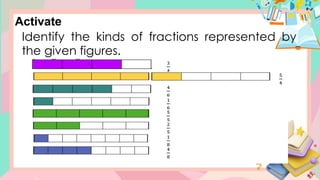
Identify the kinds of fractions represented by
the given figures.
Activate
Activate
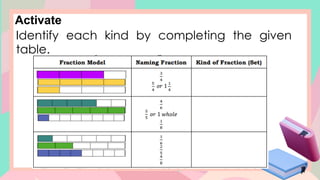
Identify each kind by completing the given
table.
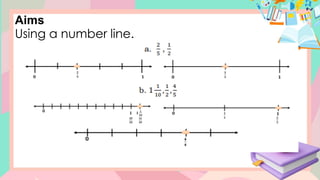
Aims
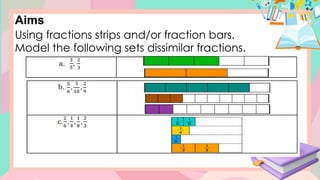
Using fractions strips and/or fraction bars.
Model the following sets dissimilar fractions.
Aims
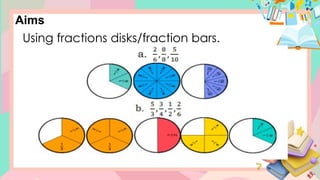
Using fractions disks/fraction bars.
Aims
Using a number line.
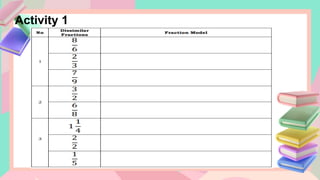
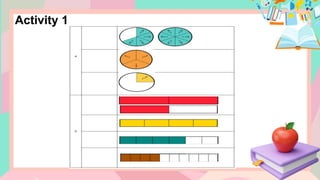
Activity 1
Complete the table below. For numbers 1 -3,
illustrate each set of fractions by drawing any
of the following: (a) fraction bars/strips, (b)
fraction discs/circles, (c) number lines. For
numbers 4 -5, given the fraction models, name
the set of dissimilar fractions.
Activity 1
Activity 1
Activity 2
Draw the shapes to represent the given
fractions.
1) ½ and 1/4
2) ¾ and 2/3
3) 1/3 and 2/6
4) 1/5 and 2/4
5) 2/6 and 3/4
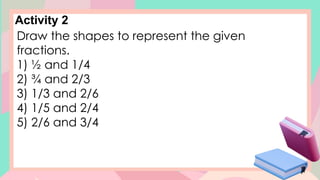
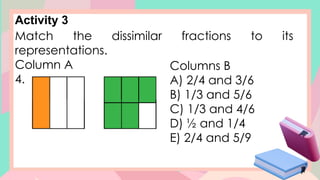
Activity 3
Match the dissimilar fractions to its
representations.
Column A
1.
Columns B
A) 2/4 and 3/6
B) 1/3 and 5/6
C) 1/3 and 4/6
D) ½ and 1/4
E) 2/4 and 5/9
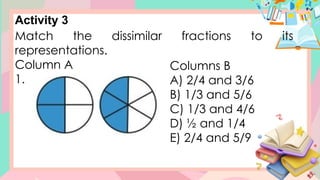
Activity 3
Match the dissimilar fractions to its
representations.
Column A
2.
Columns B
A) 2/4 and 3/6
B) 1/3 and 5/6
C) 1/3 and 4/6
D) ½ and 1/4
E) 2/4 and 5/9
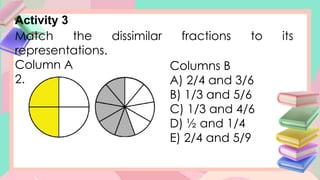
Activity 3
Match the dissimilar fractions to its
representations.
Column A
3.
Columns B
A) 2/4 and 3/6
B) 1/3 and 5/6
C) 1/3 and 4/6
D) ½ and 1/4
E) 2/4 and 5/9
Activity 3
Match the dissimilar fractions to its
representations.
Column A
4.
Columns B
A) 2/4 and 3/6
B) 1/3 and 5/6
C) 1/3 and 4/6
D) ½ and 1/4
E) 2/4 and 5/9
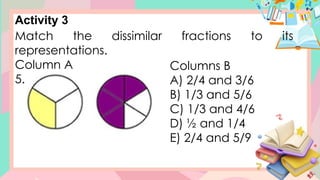
Activity 3
Match the dissimilar fractions to its
representations.
Column A
5.
Columns B
A) 2/4 and 3/6
B) 1/3 and 5/6
C) 1/3 and 4/6
D) ½ and 1/4
E) 2/4 and 5/9
Abstraction
How can the lesson on modeling dissimilar and
equivalent fractions be valuable in one’s daily
life? Give instances when these lessons can
be of help to you.
Assessment
A. Compare the following fractions using <, >,
or =. Then, encircle the dissimilar fractions.
1. 2/5 ___ 3/5
2. 3/4 ___ 2/3
3. 1/2 ___ 3/6
4. 5/8 ___ 3/4
5. 2/7 ___ 4/7
Assessment
B. Solve.
1. Alice ate 1/4 of a pizza. Ben ate 2/4 of a
pizza. Who ate more pizza?
2. A glass of juice is 3/4 full. Another glass is 1/2
full. Which glass has more juice?
MATH 4
Comparing Dissimilar Fractions
QUARTER 3 WEEK 1
D
A
Y
4
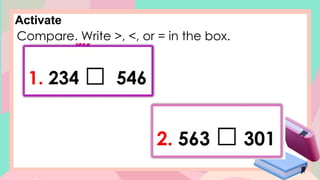
Activate
Compare. Write >, <, or = in the box.
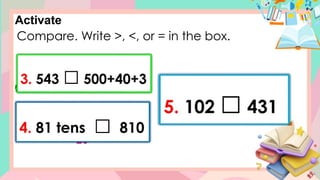
Activate
Compare. Write >, <, or = in the box.
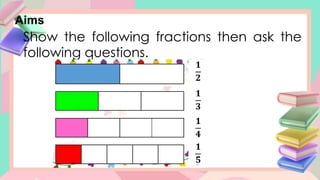
Aims
Show the following fractions then ask the
following questions.
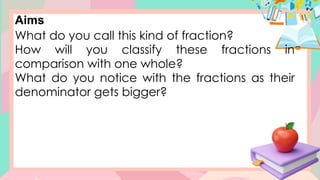
Aims
What do you call this kind of fraction?
How will you classify these fractions in
comparison with one whole?
What do you notice with the fractions as their
denominator gets bigger?
Aims
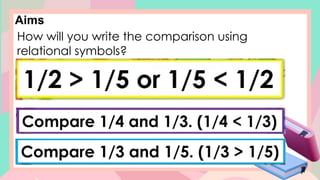
How will you write the comparison using
relational symbols?
Activity 1
Group 1
Write ">", "=" or "<" to compare the fractions.
Activity 1
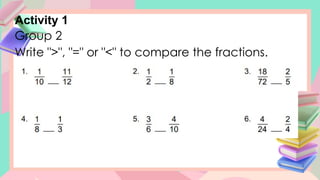
Group 2
Write ">", "=" or "<" to compare the fractions.
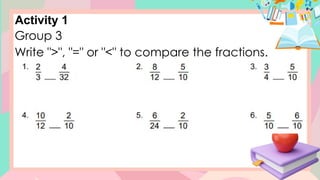
Activity 1
Group 3
Write ">", "=" or "<" to compare the fractions.
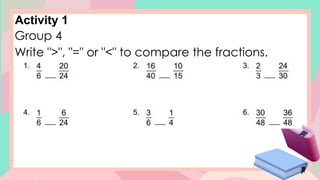
Activity 1
Group 4
Write ">", "=" or "<" to compare the fractions.
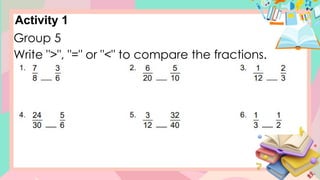
Activity 1
Group 5
Write ">", "=" or "<" to compare the fractions.
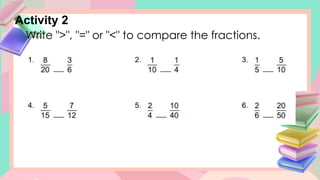
Activity 2
Write ">", "=" or "<" to compare the fractions.
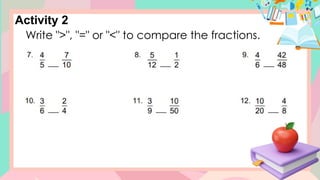
Activity 2
Write ">", "=" or "<" to compare the fractions.
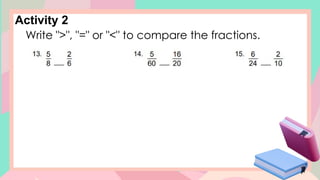
Activity 2
Write ">", "=" or "<" to compare the fractions.
Activity 3
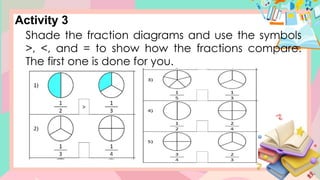
Shade the fraction diagrams and use the symbols
>, <, and = to show how the fractions compare.
The first one is done for you.
Abstraction
When you have the same numerators but
different denominators, how will you know
which one is bigger? lesser?
How will you classify fractions in comparison to
one whole?
How do you compare the sets of fractions?
Assessment
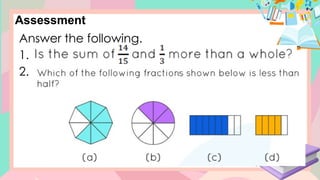
Answer the following.
1.
2.
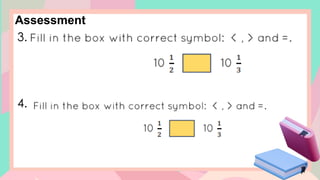
Assessment
3.
4.

MATH4-Q3-W1-PPT. power point presentation