Synopsis – Grade 9 Science Term II


Chapter 1: Atoms and Molecules
 Law of conservation of mass: Mass can neither be created nor can it be destroyed in a
  chemical reaction.
 Law of constant proportion: A chemical substance always contains the same elements in a
  fixed proportion by mass, irrespective of the source of compound.
 Atom: The smallest particle which is the building block of matter.
 The symbol of the element is made from one or two letters of the English or the Latin name
  of the element.
 Atomic mass: The sum of the protons and neutrons in an element gives its atomic mass. The
  atomic mass of an atom of an element is also known as its relative atomic mass, since it is
  determined relative to the mass of C-12 isotope.
 Molecule: It is formed when two or more atoms of the same element or different elements
  get combined chemically.
 Atomicity: The number of atoms that combine to form a molecule is called the atomicity of
  the molecule.
 Ion: A charged species in which an atom or a group of atoms possess a net electric charge
  (positive or negative).
   Cations → Positively charged ion
   Anion → Negatively charged ion
 Chemical formula: Representation of the composition of a molecule in terms of the
  symbols of elements present in that molecule.
 Molecular mass: It is the sum of the atomic masses of all the atoms present in a molecule of
  that substance.
 Formula unit mass: It is the sum of the atomic masses of all the atoms present in a formula
  unit of that substance.
 Mole: The mole is a unit of measurement for the amount of substance. One mole of a
  substance is the quantity of the substance containing 6.022  1023 numbers of particles
  (atoms, molecules, or ions).


                             Chapter 2: Structure of the Atom
 Atoms are not indivisible and are composed of three fundamental particles. These particles
  are electrons, protons, and neutrons.
 Electrons: These are the negatively charged particle and were discovered by J. J. Thomson,
  by cathode ray experiment.
 Canal rays are positively charged radiations consisting of protons.
 Protons: These are the positively-charged particles and were discovered by E. Goldstein.
 Neutron: These are electrically-neutral particle and were discovered by J. Chadwick.
 Various atomic models:
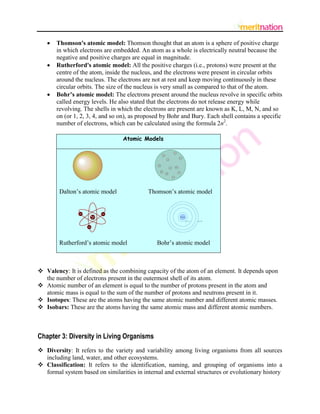
   Thomson's atomic model: Thomson thought that an atom is a sphere of positive charge
       in which electrons are embedded. An atom as a whole is electrically neutral because the
       negative and positive charges are equal in magnitude.
      Rutherford's atomic model: All the positive charges (i.e., protons) were present at the
       centre of the atom, inside the nucleus, and the electrons were present in circular orbits
       around the nucleus. The electrons are not at rest and keep moving continuously in these
       circular orbits. The size of the nucleus is very small as compared to that of the atom.
      Bohr’s atomic model: The electrons present around the nucleus revolve in specific orbits
       called energy levels. He also stated that the electrons do not release energy while
       revolving. The shells in which the electrons are present are known as K, L, M, N, and so
       on (or 1, 2, 3, 4, and so on), as proposed by Bohr and Bury. Each shell contains a specific
       number of electrons, which can be calculated using the formula 2n2.

                                 Atomic Models


        Dalton’s atomic model              Thomson’s atomic model


        Rutherford’s atomic model              Bohr’s atomic model


 Valency: It is defined as the combining capacity of the atom of an element. It depends upon
  the number of electrons present in the outermost shell of its atom.
 Atomic number of an element is equal to the number of protons present in the atom and
  atomic mass is equal to the sum of the number of protons and neutrons present in it.
 Isotopes: These are the atoms having the same atomic number and different atomic masses.
 Isobars: These are the atoms having the same atomic mass and different atomic numbers.


Chapter 3: Diversity in Living Organisms
 Diversity: It refers to the variety and variability among living organisms from all sources
  including land, water, and other ecosystems.
 Classification: It refers to the identification, naming, and grouping of organisms into a
  formal system based on similarities in internal and external structures or evolutionary history
 Characteristic: A feature that helps identify or describe a person or a thing.
 Principles of classification
   Nature of cell (Fundamental characteristic): prokaryotes and eukaryotes
   Cellularity: unicellular and multicellular
   Mode of nutrition: autotrophs and heterotrophs
 Classification and evolution
   Primitive organism or lower organism has a simple body structure and ancient body
     design
   Advanced organism or higher organism has a complex body structure and organisation
   Evolution: The process of gradual and continuous change in primitive or simple
     organisms to give rise to advanced organisms
   Biodiversity: The variety of life forms present in various ecosystems
 Hierarchy of classification: Kingdom  Phylum (for animals)/ Division (for plants) 
  Class  Order  Family  Genus  Species.
  Mnemonic to learn this hierarchy: Kids Prefer Cheese Over Fried Green Spinach
   Species is the basic unit of classification
   Carolus Linnaeus developed the hierarchy of classification. Linnaeus also developed the
     concept of binomial nomenclature
   Binomial nomenclature In this system, the name of a species is made up of two words:
     the genus name and the species name. E.g. Rosa indica
   R.H. Whittaker (in 1969) proposed a five-kingdom classification of living organisms
   The five kingdoms proposed by Whittaker along with their features are

             Kingdom                   Special feature                  Example of organisms

        Kingdom Monera        Prokaryotic and unicellular          bacteria, blue-green algae, or
                              organisms.                           cyanobacteria

        Kingdom Protista      Unicellular, eukaryotic organism     Amoeba, Paramecium, diatoms etc

        Kingdom Fungi         Multicellular eukaryotic             Yeast, mushroom, Penicillium,
                              heterotrophic (saprophytic)          Aspergillus, etc
                              organisms with citinious cell wall

        Kingdom Plantae       Multicellular eukaryotic             All plants
                              autotrophic organisms with
                              cellulosic cell wall

        Kingdom Animalia      Multicellular eukaryotic             All animals
                              heterotrophic organisms with no
                              cell wall


 Kingdom Plantae: It includes five divisions:
  Division Thallophyta: Includes Spirogyra, Cladophora, Ulva
       Plant body is not differentiated into true root, stem, and leaves
   Division Bryophyta (also called amphibians of plant kingdom):
      o Includes mosses, Riccia, Marchantia,
      o Specialised vascular tissues (such as xylem) for the conduction of water are absent
      o Body is differentiated into stem and leaf like structures
      o Naked embryo i.e. spores are present.
   Division Pteridophyta:
      o Includes ferns, Marsilea, Equisetum
      o Specialised vascular tissues for the conduction of water are absent
      o Naked embryo i.e. spores are present
 Cryptogams: Plants that do not have well differentiated reproductive organs and produce
  naked embryo (spores) are called cryptogams. Thallophyta, Bryophyta and Pteridophyta all
  possess naked embryo.
 Phanerogams: Plants that have well developed reproductive organs that finally make seeds
  are called Phanerogams. Gymnosperms and angiosperms belong to Phanerogams.
   Division Gymnospermae:
      o Includes Pinus, cedar, fir, Juniper, Cycas, etc:
      o Seed bearing, non-flowering plants.
      o Bear naked seeds, not enclosed inside fruits.
   Division Angiospermae: Includes all flowering plants:
       Flowering plants in which seeds are enclosed inside fruits.
       Seeds develop inside the ovary, which develops into a fruit
      o Monocotyledons: Seeds that have one cotyledon. E.g. maize, wheat etc
      o Dicotyledons: Seeds that have two cotyledons. E.g. Sunflower, gram etc
 Kingdom Animalia
  Kingdom Animalia can be divided into two major groups on the basis of the presence or
  absence of notochord: non-chordata and chordata
  Non-chordata can be further divided into the following phyla:
   Phylum Porifera: Includes sponges such as Spongilla, Euplectella, etc:
      o Cellular level of organisation
      o Mainly found in marine habitats
      o Posses canal system for circulating water.
   Phylum Coelenterata: Includes sponges such as Spongilla, Euplectella, etc
      o Tissue level of organisation
      o Body cavity (coelom) is absent
      o Diploblastic i.e body is made of two layers of cells.
   Phylum Platyhelminthes: Includes flatworms, liver flukes and planarians
      o Bilateral symmetry
      o Triploblastic i.e. three layers of cells are present
      o Body cavity is absent
   Phylum Nematoda (Aschelminthes): Includes roundworms - Ascaris
      o Bilaterally symmetrical
      o Triploblastic
      o Pseudocoelom (false coelom) is present
 Phylum Annelida: Includes segmented worms such as earthworms and leeches
     o Bilaterally symmetrical
     o Triploblastic
     o Body is segmented
    Phylum Arthropoda: Includes crabs, prawns, insects, spiders, scorpions, etc
     o Largest group of the animal kingdom.
     o Bilaterally symmetrical and segmented
     o Coelomic cavity is blood-filled
     o Presence of Jointed legs
   Phylum Mollusca: Includes snails, octopus, Pila, etc
     o Bilaterally symmetrical, little segmentation
     o Coelomic cavity is reduced
     o Open circulatory system and kidney like organ for excretion is present.
   Phylum Echinodermata: Includes marine animals such as starfishes, sea urchins, etc
     o Spiny skinned organisms
     o Free living marine organisms
     o Triploblastic and coelomate
     o Skeleton is made of calcium carbonate
 Chordata can be further divided into sub-phyla Protochordata and Vertebrata
   Protochordata: Includes Herdmania and Amphioxus
     o Triploblastic, and have a coelom cavity
     o Bilaterally symmetrical
     o Notochord at some stages of life is present.
     o Notochord is a flexible rod like structure that forms the supporting axis of the body in
        the chordates.
   Vertebrata: The sub-phylum Vertebrata is further divided into five classes:
   Class Pisces: Includes all fishes
     o Exclusively aquatic animals
     o Body is streamlined and covered with scales
     o They are cold blooded animals
     o Heart is two chambered
     o Skeleton is bony or cartilaginous
     o Oviparous. They lay eggs in water.
   Class Amphibia: Includes frogs, toads, and salamanders
     o Scales are absent
     o Cold blooded animals
     o Heart is three chambered
     o Oviparous. They lay eggs in water
     o Have a dual mode of life (in water and land); respire through gills, skin and lungs
   Class Reptilia: Includes reptiles such as lizard, snake, turtle, etc
     o Cold blooded animals
     o Most of them have three chambered heart (Crocodiles have four chambered heart)
     o Skin is covered with scales
     o These animals are completely terrestrial. They breath through lungs
     o Lay eggs on land (oviparous)
   Class Aves: Includes all birds
o Warm-blooded animals with four chambered heart
         o They breathe through lungs
         o Have feathers and forelimbs modified for flight
         o Exclusively egg-laying animals
        Class Mammalia: Includes kangaroo, rat, dolphin, elephant, horse, human, tiger, etc
         o Warm-blooded animals with four chambered heart
         o Most of them are viviparous except for platypus and echidna. They both are
            oviparous
         o These animals have milk-producing glands (mammary glands) to nourish their young
            ones


Chapter 4: Work and Energy
 Scientifically, work is done when:
   There is a displacement.
   Displacement is in any direction except the direction normal to the direction of force.
 No work is done when
   Net displacement is zero. [No work is done in circular path]
   Displacement occurs perpendicularly to the applied force
 Work = Force  Displacement [along force direction]
   W = F  s [Unit – Joule, 1 J = 1 N.m]
 Unit of energy: Joule
 Commercial unit of Energy: kWh
  1 kWh  3.6  106 J
 The energy possessed by a body by virtue of its motion is called kinetic energy.
                              1
 Kinetic energy of a body = mv 2 , where m is mass and v is speed of the body.
                              2
 Proof:
  v 2  u 2  2as
      v2  u 2
    s
        2a
              v2  u 2
   W  ma 
                2a
      1
      2
                   
     m v 2  u 2  mv 2  when u  0
                       1
                       2

 Energy possessed by a body by virtue of its position or its shape is called potential energy.
 Gravitational potential energy = mgh where, m is mass, g acceleration due to gravity, and h is
  the height above surface of Earth.
 Law of conservation of energy: Energy can neither be created nor destroyed, it is only
  converted from one form to other.
1 2
   Total energy is constant: mgh   mv  Constant
                                  2
                                      Work done                     1J 
 Power is the rate of work done. P =             Unit  Watt, 1 W = 
                                      Time taken                    1s 


Chapter 5: Sound
 Sound is a mechanical wave and requires a medium to propagate.
   It cannot pass through vacuum.
 Sound waves are longitudinal waves and propagate by continuous compressions and
  rarefactions of the medium.
 Longitudinal wave:
  Individual particles of the medium move in the direction parallel to the direction of wave
  propagation
 Transverse wave:
  Particle movement is perpendicular to the wave propagation
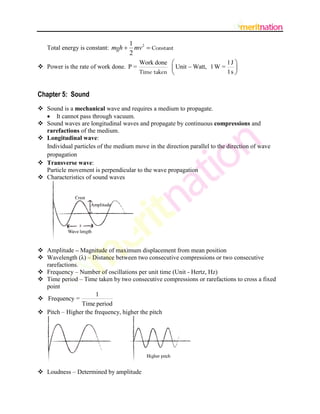
 Characteristics of sound waves


 Amplitude – Magnitude of maximum displacement from mean position
 Wavelength (λ) – Distance between two consecutive compressions or two consecutive
  rarefactions.
 Frequency – Number of oscillations per unit time (Unit - Hertz, Hz)
 Time period – Time taken by two consecutive compressions or rarefactions to cross a fixed
  point
                      1
 Frequency =
                Time period
 Pitch – Higher the frequency, higher the pitch


 Loudness – Determined by amplitude
 Tone – Sound of single frequency
 Speed of sound depends on temperature, pressure, humidity and nature of the material
  medium.
   Speed increases with increasing temp.
 Speed in solid > Speed in liquid > Speed in gas
   In air, speed 344 m s–1 at 22 C
   Supersonic – More speed than sound
   Sonic boom  loud noise produced by supersonic object is sonic boom
 Echo- Reflection of sound
                                   1
   Sensation of sound persists      = 0.1 s in the human brain
                                  10
                                         344×0.1
   Minimum distance to hear echo =                = 17.2 m
                                             2
 Reverberation – Persistence of sound by repeated reflection
   Uses – Loud speaker, stethoscope, curved ceiling of a concert hall, sound board in a big
      hall
 Range of hearing for humans: 20 – 20000 Hz
   But, rhinoceroses use infrasound
 Application of ultrasound : Cleaning, detecting defects in metals, echocardiography,
  ultrasonography, to break small kidney stone
 SONAR is Sound navigation and Ranging.
 Human ear: Pinna collects sound; eardrum vibrates in response to sound
   Vibrations are amplified by the three ear bones [hammer, anvil, stirrup (smallest human
      bone)]


Chapter 6: Why Do We Fall Ill

 Health: A state of physical, mental, and social well-being, which includes a unity and
  harmony within the mind, body, and soul of an organism
 Disease: Any condition that can lead to discomfort, distress, health problems, and even death
  of the affected person
 Symptoms: Indications of disease, such as headache, stomach pain, nausea, etc that can only
  be felt by the patient
 Signs of a disease include fever, vomiting, diarrhoea, etc that can be observed by a physician
 Incubation period: The time interval between infection and appearance of symptoms
 Causes of diseases
    On the basis of its duration - Acute and Chronic
         o Acute: Lasts for a short period of time, E.g. Cold, cough, influenza, etc.
         o Chronic: Lasts for long periods of time, E.g. Diabetes, kidney stones, etc.
     On the basis of causative agents - Infectious and Non-infectious
         o Infectious: Diseases such as influenza, cold, etc., which are caused due to infectious
              agents
         o Non-infectious; Diseases such as high blood pressure, cancer, etc., which are caused
              by some internal causes such as excessive weight, genetic defects, etc.
   Infectious agents: disease-causing microorganisms which belong to different categories
    such as:
     Viruses: These are tiny organisms that grow, multiply, or reproduce only inside the host
         cells. Diseases caused by viruses include Influenza, cold (Rhinovirus), dengue, AIDS,
         SARS etc.
     Bacteria: These are unicellular organisms; larger than viruses. Diseases caused by
         bacteria include whooping cough, typhoid, cholera, anthrax, etc.
     Fungi: These are plant-like organisms; heterotrophic. Diseases caused by Fungi include
         Athlete’s foot, candidiasis, ringworms, etc.
     Protozoa: These are simple, primitive unicellular organisms which are often found in
         water. Diseases caused by Protozoa include amoebiasis, kala azar (Leishmania), malaria,
         African sleeping sickness (Trypanosoma), etc.
     Multicellular animals like worms - These are parasites that infect the intestines of
         human beings and other animals. Diseases caused by worms include diarrhoea, liver rot,
         etc.
   Communicable diseases: An infectious disease is classified as communicable disease when
    it can be transferred from an infected person to a healthy person
   Means of disease spread
     Air-borne diseases: Transmitted when disease-causing microorganisms are expelled into
         the air by coughing, sneezing, talking, etc. E.g. common cold, chicken pox, small pox,
         pneumonia, influenza, tuberculosis, etc.
     Water-borne diseases: Spreads when the excretions (from an infected person)
         containing causal microorganisms get mixed with drinking water and this contaminated
         water is consumed. E.g. cholera, typhoid, hepatitis A, etc.
     Physical contact: Includes sexually-transmitted diseases. E.g. syphilis, gonorrhoea,
         AIDS, etc.
     Blood to blood contact: Such contact is established during blood transfusion or
         pregnancy (between the mother and her baby). E.g. AIDS can spread through blood
         contact
     Animals: Animals which transfer disease-causing microorganisms from an infected
         person to others are called vectors. E.g. female mosquitoes can transfer the malaria-
         causing Plasmodium
   Effects of diseases
     Local effects: Includes swelling, pain, joint stiffness, etc., occur only at the site of
         infection
     General effects: Includes fever chills, headaches, fatigue, loss of appetite, etc., occur all
         over the body
 Inflammation: The process by which the body’s immune system shows response to
     protect the body from infection
 Prevention of diseases
   Antigens: Foreign substances that invade our body
   Immunisation: The protection of the body from communicable diseases by
     administration of some agent that mimics the microbe.
   Vaccine: The suspension of killed microbes that mimics the disease causing microbes.
   Vaccines are available against tetanus, polio, measles, hepatitis B, etc.


Chapter 7: Natural Resources

 Role of the atmosphere → Atmosphere acts as a heat protector and it plays an important
  role in the generation of wind.
 Soil: It is a mixture of small rock particles and decayed living organisms.
 Humus: A constituent of soil which makes it fertile
 Factors that influence soil formation:
   Sun: Heats up the rock during the day
      Rocks cool during night time
      Formation of creaksbreaking of rocks
   Water – water in cracks freeze  breaks rocks
      Water carries rocks  friction breaks rocks
   Wind – Particles in air erode the rocks
 Greenhouse effect: The trapping up of reflected solar radiations by the earth’s atmosphere
  and gradual heating up is known as greenhouse effect.
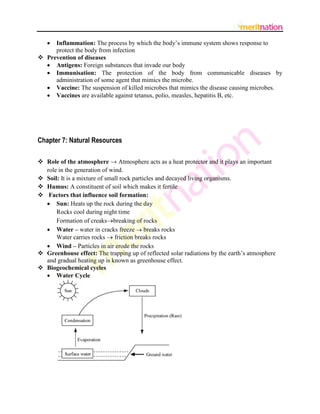
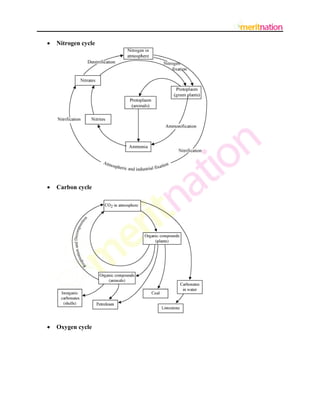
 Biogeochemical cycles
   Water Cycle
   Nitrogen cycle


   Carbon cycle


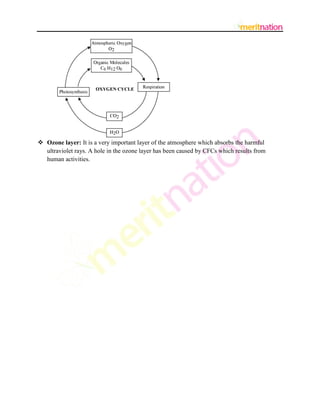
   Oxygen cycle
 Ozone layer: It is a very important layer of the atmosphere which absorbs the harmful
  ultraviolet rays. A hole in the ozone layer has been caused by CFCs which results from
  human activities.

Science sa 2 synopsis

  • 1.
    Synopsis – Grade9 Science Term II Chapter 1: Atoms and Molecules  Law of conservation of mass: Mass can neither be created nor can it be destroyed in a chemical reaction.  Law of constant proportion: A chemical substance always contains the same elements in a fixed proportion by mass, irrespective of the source of compound.  Atom: The smallest particle which is the building block of matter.  The symbol of the element is made from one or two letters of the English or the Latin name of the element.  Atomic mass: The sum of the protons and neutrons in an element gives its atomic mass. The atomic mass of an atom of an element is also known as its relative atomic mass, since it is determined relative to the mass of C-12 isotope.  Molecule: It is formed when two or more atoms of the same element or different elements get combined chemically.  Atomicity: The number of atoms that combine to form a molecule is called the atomicity of the molecule.  Ion: A charged species in which an atom or a group of atoms possess a net electric charge (positive or negative).  Cations → Positively charged ion  Anion → Negatively charged ion  Chemical formula: Representation of the composition of a molecule in terms of the symbols of elements present in that molecule.  Molecular mass: It is the sum of the atomic masses of all the atoms present in a molecule of that substance.  Formula unit mass: It is the sum of the atomic masses of all the atoms present in a formula unit of that substance.  Mole: The mole is a unit of measurement for the amount of substance. One mole of a substance is the quantity of the substance containing 6.022  1023 numbers of particles (atoms, molecules, or ions). Chapter 2: Structure of the Atom  Atoms are not indivisible and are composed of three fundamental particles. These particles are electrons, protons, and neutrons.  Electrons: These are the negatively charged particle and were discovered by J. J. Thomson, by cathode ray experiment.  Canal rays are positively charged radiations consisting of protons.  Protons: These are the positively-charged particles and were discovered by E. Goldstein.  Neutron: These are electrically-neutral particle and were discovered by J. Chadwick.  Various atomic models:
  • 2.
    Thomson's atomic model: Thomson thought that an atom is a sphere of positive charge in which electrons are embedded. An atom as a whole is electrically neutral because the negative and positive charges are equal in magnitude.  Rutherford's atomic model: All the positive charges (i.e., protons) were present at the centre of the atom, inside the nucleus, and the electrons were present in circular orbits around the nucleus. The electrons are not at rest and keep moving continuously in these circular orbits. The size of the nucleus is very small as compared to that of the atom.  Bohr’s atomic model: The electrons present around the nucleus revolve in specific orbits called energy levels. He also stated that the electrons do not release energy while revolving. The shells in which the electrons are present are known as K, L, M, N, and so on (or 1, 2, 3, 4, and so on), as proposed by Bohr and Bury. Each shell contains a specific number of electrons, which can be calculated using the formula 2n2. Atomic Models Dalton’s atomic model Thomson’s atomic model Rutherford’s atomic model Bohr’s atomic model  Valency: It is defined as the combining capacity of the atom of an element. It depends upon the number of electrons present in the outermost shell of its atom.  Atomic number of an element is equal to the number of protons present in the atom and atomic mass is equal to the sum of the number of protons and neutrons present in it.  Isotopes: These are the atoms having the same atomic number and different atomic masses.  Isobars: These are the atoms having the same atomic mass and different atomic numbers. Chapter 3: Diversity in Living Organisms  Diversity: It refers to the variety and variability among living organisms from all sources including land, water, and other ecosystems.  Classification: It refers to the identification, naming, and grouping of organisms into a formal system based on similarities in internal and external structures or evolutionary history
  • 3.
     Characteristic: Afeature that helps identify or describe a person or a thing.  Principles of classification  Nature of cell (Fundamental characteristic): prokaryotes and eukaryotes  Cellularity: unicellular and multicellular  Mode of nutrition: autotrophs and heterotrophs  Classification and evolution  Primitive organism or lower organism has a simple body structure and ancient body design  Advanced organism or higher organism has a complex body structure and organisation  Evolution: The process of gradual and continuous change in primitive or simple organisms to give rise to advanced organisms  Biodiversity: The variety of life forms present in various ecosystems  Hierarchy of classification: Kingdom  Phylum (for animals)/ Division (for plants)  Class  Order  Family  Genus  Species. Mnemonic to learn this hierarchy: Kids Prefer Cheese Over Fried Green Spinach  Species is the basic unit of classification  Carolus Linnaeus developed the hierarchy of classification. Linnaeus also developed the concept of binomial nomenclature  Binomial nomenclature In this system, the name of a species is made up of two words: the genus name and the species name. E.g. Rosa indica  R.H. Whittaker (in 1969) proposed a five-kingdom classification of living organisms  The five kingdoms proposed by Whittaker along with their features are Kingdom Special feature Example of organisms Kingdom Monera Prokaryotic and unicellular bacteria, blue-green algae, or organisms. cyanobacteria Kingdom Protista Unicellular, eukaryotic organism Amoeba, Paramecium, diatoms etc Kingdom Fungi Multicellular eukaryotic Yeast, mushroom, Penicillium, heterotrophic (saprophytic) Aspergillus, etc organisms with citinious cell wall Kingdom Plantae Multicellular eukaryotic All plants autotrophic organisms with cellulosic cell wall Kingdom Animalia Multicellular eukaryotic All animals heterotrophic organisms with no cell wall  Kingdom Plantae: It includes five divisions:
  • 4.
     DivisionThallophyta: Includes Spirogyra, Cladophora, Ulva  Plant body is not differentiated into true root, stem, and leaves  Division Bryophyta (also called amphibians of plant kingdom): o Includes mosses, Riccia, Marchantia, o Specialised vascular tissues (such as xylem) for the conduction of water are absent o Body is differentiated into stem and leaf like structures o Naked embryo i.e. spores are present.  Division Pteridophyta: o Includes ferns, Marsilea, Equisetum o Specialised vascular tissues for the conduction of water are absent o Naked embryo i.e. spores are present  Cryptogams: Plants that do not have well differentiated reproductive organs and produce naked embryo (spores) are called cryptogams. Thallophyta, Bryophyta and Pteridophyta all possess naked embryo.  Phanerogams: Plants that have well developed reproductive organs that finally make seeds are called Phanerogams. Gymnosperms and angiosperms belong to Phanerogams.  Division Gymnospermae: o Includes Pinus, cedar, fir, Juniper, Cycas, etc: o Seed bearing, non-flowering plants. o Bear naked seeds, not enclosed inside fruits.  Division Angiospermae: Includes all flowering plants:  Flowering plants in which seeds are enclosed inside fruits.  Seeds develop inside the ovary, which develops into a fruit o Monocotyledons: Seeds that have one cotyledon. E.g. maize, wheat etc o Dicotyledons: Seeds that have two cotyledons. E.g. Sunflower, gram etc  Kingdom Animalia Kingdom Animalia can be divided into two major groups on the basis of the presence or absence of notochord: non-chordata and chordata Non-chordata can be further divided into the following phyla:  Phylum Porifera: Includes sponges such as Spongilla, Euplectella, etc: o Cellular level of organisation o Mainly found in marine habitats o Posses canal system for circulating water.  Phylum Coelenterata: Includes sponges such as Spongilla, Euplectella, etc o Tissue level of organisation o Body cavity (coelom) is absent o Diploblastic i.e body is made of two layers of cells.  Phylum Platyhelminthes: Includes flatworms, liver flukes and planarians o Bilateral symmetry o Triploblastic i.e. three layers of cells are present o Body cavity is absent  Phylum Nematoda (Aschelminthes): Includes roundworms - Ascaris o Bilaterally symmetrical o Triploblastic o Pseudocoelom (false coelom) is present
  • 5.
     Phylum Annelida:Includes segmented worms such as earthworms and leeches o Bilaterally symmetrical o Triploblastic o Body is segmented  Phylum Arthropoda: Includes crabs, prawns, insects, spiders, scorpions, etc o Largest group of the animal kingdom. o Bilaterally symmetrical and segmented o Coelomic cavity is blood-filled o Presence of Jointed legs  Phylum Mollusca: Includes snails, octopus, Pila, etc o Bilaterally symmetrical, little segmentation o Coelomic cavity is reduced o Open circulatory system and kidney like organ for excretion is present.  Phylum Echinodermata: Includes marine animals such as starfishes, sea urchins, etc o Spiny skinned organisms o Free living marine organisms o Triploblastic and coelomate o Skeleton is made of calcium carbonate  Chordata can be further divided into sub-phyla Protochordata and Vertebrata  Protochordata: Includes Herdmania and Amphioxus o Triploblastic, and have a coelom cavity o Bilaterally symmetrical o Notochord at some stages of life is present. o Notochord is a flexible rod like structure that forms the supporting axis of the body in the chordates.  Vertebrata: The sub-phylum Vertebrata is further divided into five classes:  Class Pisces: Includes all fishes o Exclusively aquatic animals o Body is streamlined and covered with scales o They are cold blooded animals o Heart is two chambered o Skeleton is bony or cartilaginous o Oviparous. They lay eggs in water.  Class Amphibia: Includes frogs, toads, and salamanders o Scales are absent o Cold blooded animals o Heart is three chambered o Oviparous. They lay eggs in water o Have a dual mode of life (in water and land); respire through gills, skin and lungs  Class Reptilia: Includes reptiles such as lizard, snake, turtle, etc o Cold blooded animals o Most of them have three chambered heart (Crocodiles have four chambered heart) o Skin is covered with scales o These animals are completely terrestrial. They breath through lungs o Lay eggs on land (oviparous)  Class Aves: Includes all birds
  • 6.
    o Warm-blooded animalswith four chambered heart o They breathe through lungs o Have feathers and forelimbs modified for flight o Exclusively egg-laying animals  Class Mammalia: Includes kangaroo, rat, dolphin, elephant, horse, human, tiger, etc o Warm-blooded animals with four chambered heart o Most of them are viviparous except for platypus and echidna. They both are oviparous o These animals have milk-producing glands (mammary glands) to nourish their young ones Chapter 4: Work and Energy  Scientifically, work is done when:  There is a displacement.  Displacement is in any direction except the direction normal to the direction of force.  No work is done when  Net displacement is zero. [No work is done in circular path]  Displacement occurs perpendicularly to the applied force  Work = Force  Displacement [along force direction]  W = F  s [Unit – Joule, 1 J = 1 N.m]  Unit of energy: Joule  Commercial unit of Energy: kWh 1 kWh  3.6  106 J  The energy possessed by a body by virtue of its motion is called kinetic energy. 1  Kinetic energy of a body = mv 2 , where m is mass and v is speed of the body. 2  Proof: v 2  u 2  2as v2  u 2 s 2a v2  u 2 W  ma  2a 1 2    m v 2  u 2  mv 2  when u  0 1 2  Energy possessed by a body by virtue of its position or its shape is called potential energy.  Gravitational potential energy = mgh where, m is mass, g acceleration due to gravity, and h is the height above surface of Earth.  Law of conservation of energy: Energy can neither be created nor destroyed, it is only converted from one form to other.
  • 7.
    1 2 Total energy is constant: mgh  mv  Constant 2 Work done  1J   Power is the rate of work done. P =  Unit  Watt, 1 W =  Time taken  1s  Chapter 5: Sound  Sound is a mechanical wave and requires a medium to propagate.  It cannot pass through vacuum.  Sound waves are longitudinal waves and propagate by continuous compressions and rarefactions of the medium.  Longitudinal wave: Individual particles of the medium move in the direction parallel to the direction of wave propagation  Transverse wave: Particle movement is perpendicular to the wave propagation  Characteristics of sound waves  Amplitude – Magnitude of maximum displacement from mean position  Wavelength (λ) – Distance between two consecutive compressions or two consecutive rarefactions.  Frequency – Number of oscillations per unit time (Unit - Hertz, Hz)  Time period – Time taken by two consecutive compressions or rarefactions to cross a fixed point 1  Frequency = Time period  Pitch – Higher the frequency, higher the pitch  Loudness – Determined by amplitude
  • 8.
     Tone –Sound of single frequency  Speed of sound depends on temperature, pressure, humidity and nature of the material medium.  Speed increases with increasing temp.  Speed in solid > Speed in liquid > Speed in gas  In air, speed 344 m s–1 at 22 C  Supersonic – More speed than sound  Sonic boom  loud noise produced by supersonic object is sonic boom  Echo- Reflection of sound 1  Sensation of sound persists = 0.1 s in the human brain 10 344×0.1  Minimum distance to hear echo = = 17.2 m 2  Reverberation – Persistence of sound by repeated reflection  Uses – Loud speaker, stethoscope, curved ceiling of a concert hall, sound board in a big hall  Range of hearing for humans: 20 – 20000 Hz  But, rhinoceroses use infrasound  Application of ultrasound : Cleaning, detecting defects in metals, echocardiography, ultrasonography, to break small kidney stone  SONAR is Sound navigation and Ranging.  Human ear: Pinna collects sound; eardrum vibrates in response to sound  Vibrations are amplified by the three ear bones [hammer, anvil, stirrup (smallest human bone)] Chapter 6: Why Do We Fall Ill  Health: A state of physical, mental, and social well-being, which includes a unity and harmony within the mind, body, and soul of an organism  Disease: Any condition that can lead to discomfort, distress, health problems, and even death of the affected person  Symptoms: Indications of disease, such as headache, stomach pain, nausea, etc that can only be felt by the patient  Signs of a disease include fever, vomiting, diarrhoea, etc that can be observed by a physician  Incubation period: The time interval between infection and appearance of symptoms  Causes of diseases
  • 9.
    On the basis of its duration - Acute and Chronic o Acute: Lasts for a short period of time, E.g. Cold, cough, influenza, etc. o Chronic: Lasts for long periods of time, E.g. Diabetes, kidney stones, etc.  On the basis of causative agents - Infectious and Non-infectious o Infectious: Diseases such as influenza, cold, etc., which are caused due to infectious agents o Non-infectious; Diseases such as high blood pressure, cancer, etc., which are caused by some internal causes such as excessive weight, genetic defects, etc.  Infectious agents: disease-causing microorganisms which belong to different categories such as:  Viruses: These are tiny organisms that grow, multiply, or reproduce only inside the host cells. Diseases caused by viruses include Influenza, cold (Rhinovirus), dengue, AIDS, SARS etc.  Bacteria: These are unicellular organisms; larger than viruses. Diseases caused by bacteria include whooping cough, typhoid, cholera, anthrax, etc.  Fungi: These are plant-like organisms; heterotrophic. Diseases caused by Fungi include Athlete’s foot, candidiasis, ringworms, etc.  Protozoa: These are simple, primitive unicellular organisms which are often found in water. Diseases caused by Protozoa include amoebiasis, kala azar (Leishmania), malaria, African sleeping sickness (Trypanosoma), etc.  Multicellular animals like worms - These are parasites that infect the intestines of human beings and other animals. Diseases caused by worms include diarrhoea, liver rot, etc.  Communicable diseases: An infectious disease is classified as communicable disease when it can be transferred from an infected person to a healthy person  Means of disease spread  Air-borne diseases: Transmitted when disease-causing microorganisms are expelled into the air by coughing, sneezing, talking, etc. E.g. common cold, chicken pox, small pox, pneumonia, influenza, tuberculosis, etc.  Water-borne diseases: Spreads when the excretions (from an infected person) containing causal microorganisms get mixed with drinking water and this contaminated water is consumed. E.g. cholera, typhoid, hepatitis A, etc.  Physical contact: Includes sexually-transmitted diseases. E.g. syphilis, gonorrhoea, AIDS, etc.  Blood to blood contact: Such contact is established during blood transfusion or pregnancy (between the mother and her baby). E.g. AIDS can spread through blood contact  Animals: Animals which transfer disease-causing microorganisms from an infected person to others are called vectors. E.g. female mosquitoes can transfer the malaria- causing Plasmodium  Effects of diseases  Local effects: Includes swelling, pain, joint stiffness, etc., occur only at the site of infection  General effects: Includes fever chills, headaches, fatigue, loss of appetite, etc., occur all over the body
  • 10.
     Inflammation: Theprocess by which the body’s immune system shows response to protect the body from infection  Prevention of diseases  Antigens: Foreign substances that invade our body  Immunisation: The protection of the body from communicable diseases by administration of some agent that mimics the microbe.  Vaccine: The suspension of killed microbes that mimics the disease causing microbes.  Vaccines are available against tetanus, polio, measles, hepatitis B, etc. Chapter 7: Natural Resources  Role of the atmosphere → Atmosphere acts as a heat protector and it plays an important role in the generation of wind.  Soil: It is a mixture of small rock particles and decayed living organisms.  Humus: A constituent of soil which makes it fertile  Factors that influence soil formation:  Sun: Heats up the rock during the day Rocks cool during night time Formation of creaksbreaking of rocks  Water – water in cracks freeze  breaks rocks Water carries rocks  friction breaks rocks  Wind – Particles in air erode the rocks  Greenhouse effect: The trapping up of reflected solar radiations by the earth’s atmosphere and gradual heating up is known as greenhouse effect.  Biogeochemical cycles  Water Cycle
  • 11.
    Nitrogen cycle  Carbon cycle  Oxygen cycle
  • 12.
     Ozone layer:It is a very important layer of the atmosphere which absorbs the harmful ultraviolet rays. A hole in the ozone layer has been caused by CFCs which results from human activities.